
AICOPSE Research Report
Artificial Intelligence Data Center Trends and Future Predictions 2027–2030
How AI is transforming data center power, cooling, chips, infrastructure design, investment, sustainability, and the global digital economy.
2027 Trends
2030 Predictions
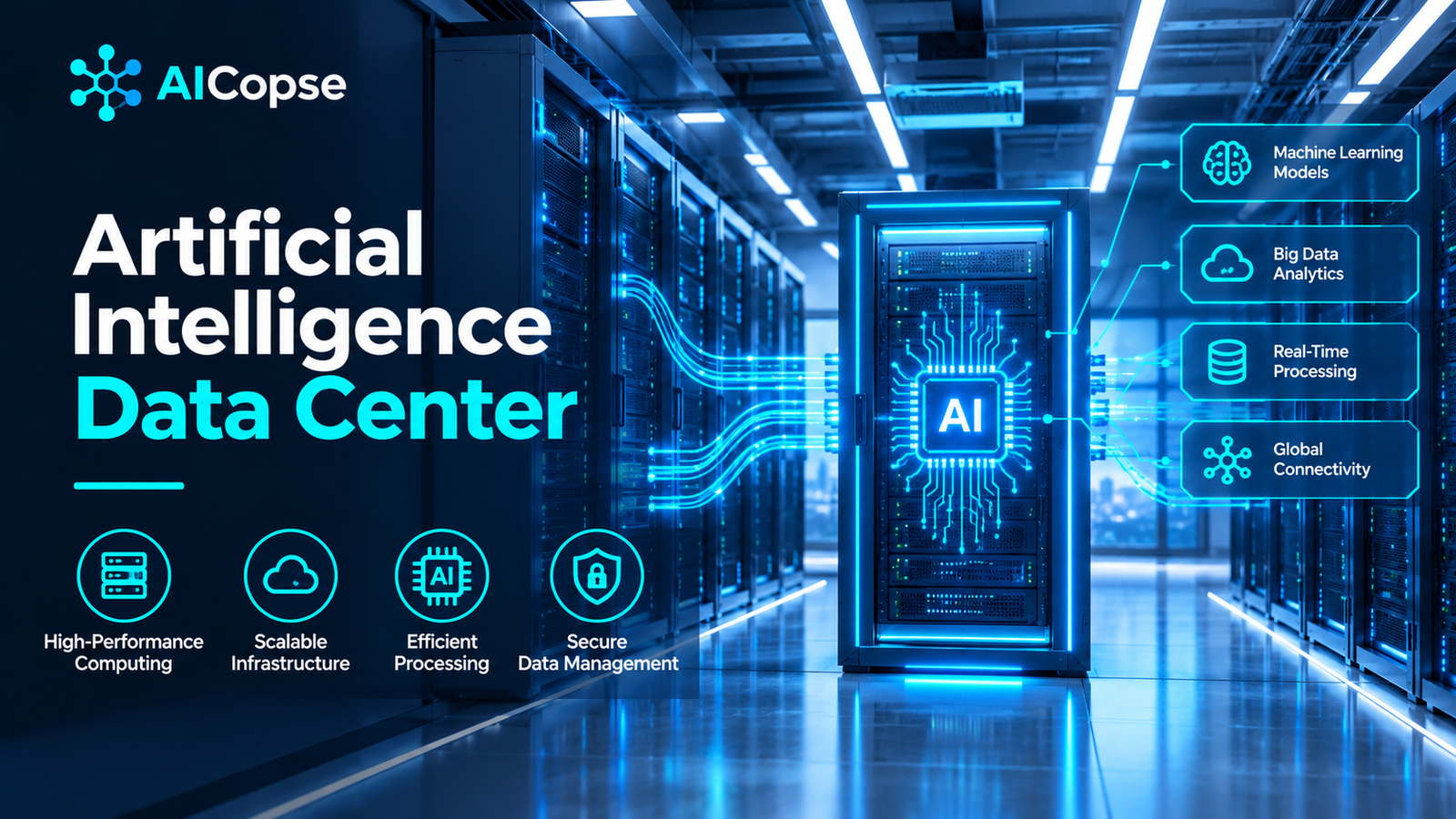
Artificial intelligence is changing data centers from general-purpose computing facilities into highly specialized infrastructure built to train AI models, serve billions of model requests, process business data, and support increasingly autonomous digital services. This shift is changing what data centers need, where companies build them, how they obtain electricity, how they remove heat, and how investors measure the value of infrastructure.
The next stage of growth will not be determined by computing chips alone. Access to reliable power, advanced cooling, high-speed networking, construction capacity, water availability, and efficient software will increasingly decide which projects become operational and which remain delayed. These constraints create opportunities for infrastructure developers, technology startups, energy companies, investors, and businesses that depend on AI.
The International Energy Agency’s 2026 analysis projects that global data center electricity consumption could rise from approximately 485 terawatt-hours in 2025 to 950 TWh in 2030. That would represent close to a doubling in five years. The same report explains that AI-focused facilities are expected to grow faster than the wider data center sector. These are projections, not guaranteed outcomes, because construction delays, power shortages, efficiency improvements, and changes in AI demand can all alter the final result.
Source: IEA, Key Questions on Energy and AI.
Executive Summary
- Electricity becomes a competitive advantage: access to power may determine project feasibility before land or computing equipment is secured.
- AI infrastructure investment remains substantial: hyperscalers, specialist cloud providers, and enterprises are competing for computing capacity.
- Inference becomes increasingly important: serving AI applications continuously can create a different demand profile from training a model once.
- Liquid cooling expands: high-density AI systems create heat loads that traditional air cooling may struggle to manage efficiently.
- Grid constraints influence location decisions: developers increasingly evaluate connection timelines, energy costs, and local infrastructure capacity.
- Efficiency becomes a financial metric: energy consumed per useful AI task matters alongside hardware performance.
- Risks become more interconnected: power, chips, networking, cooling, cybersecurity, water, and permitting can affect one another.
Key Numbers Shaping AI Data Centers
Figures above come from different reports and use different measures. TWh measures energy consumed over time, GW measures power capacity or demand, and CAGR represents a compound annual growth rate. They should not be treated as directly interchangeable.
Table of Contents
- Understanding AI data centers
- Market growth and investment outlook
- Major AI data center trends
- Six research studies and what they reveal
- Competitor and industry landscape
- Major events and industry developments
- Future predictions for 2027–2030
- Opportunities for developers, startups, and businesses
- Risks, sustainability, and security
- Expert recommendations and implementation roadmap
- Frequently asked questions
- Research sources
Understanding AI Data Centers
A data center is a facility that houses computing servers, storage systems, networking equipment, power systems, cooling equipment, and security controls. AI data centers are designed or adapted to support the unusually demanding workloads associated with artificial intelligence, including large language models, image generation, scientific computing, recommendation systems, and autonomous AI agents.
Traditional enterprise data centers often run a broad mix of business applications, databases, websites, and internal systems. AI facilities may use large groups of accelerators connected by high-speed networks. These systems can consume substantial power and produce intense heat within a relatively small physical area.
AI training
Uses computing resources to teach a model from large datasets. Training can require tightly coordinated accelerators, fast networking, and sustained high power.
AI inference
Runs a trained model to answer questions, generate content, classify information, or power an application. Demand can continue every time a user or software agent makes a request.
Hybrid workloads
Combine AI services with databases, conventional cloud applications, analytics, storage, and enterprise systems. Efficient coordination is essential for business use.
The distinction matters because a facility optimized for large training runs may not be the cheapest or most responsive location for every inference request. Inference workloads vary in urgency, model size, user location, and acceptable latency. Data center operators will increasingly design infrastructure around the actual service being delivered rather than treating every AI workload as identical.
AI Data Center Market Growth and Investment Outlook
The industry is moving into a period of rapid expansion, but investment announcements are not the same as completed capacity. Projects require permits, grid connections, substations, transformers, cooling equipment, skilled workers, servers, and reliable supply chains. A project can be financially attractive yet delayed because one essential component is unavailable.
The International Energy Agency’s 2026 report, Powering Artificial Intelligence, says major data center operators are set to spend more than $700 billion in capital expenditure in 2026. It also describes the pressure that AI infrastructure is placing on electricity networks and equipment supply chains.
JLL’s 2026 Global Data Centre Outlook forecasts nearly 100 GW of additional data center capacity between 2026 and 2030 and approximately $3 trillion of investment to provide 100 GW of new supply by 2030. These figures are market estimates, not a guarantee that every proposed project will be built.
Visual: The AI Infrastructure Growth Cycle
More AI use
More compute
More infrastructure
New services
This cycle can reinforce growth, but power shortages, weak utilization, high costs, or low customer demand can interrupt it.
Why investment may not translate into immediate supply
- Grid connection delays: a facility cannot operate at full capacity without enough dependable electricity.
- Electrical equipment shortages: transformers, switchgear, and other critical components may have long lead times.
- Advanced chip supply: accelerators and high-bandwidth memory can constrain how quickly a site becomes productive.
- Construction complexity: high-density AI facilities require careful coordination across structural, electrical, mechanical, and networking systems.
- Demand uncertainty: a proposed facility may be based on forecasts that change before construction is complete.
Major AI Data Center Trends Through 2030
AI workloads are changing facility design
AI infrastructure increasingly depends on systems that can move large amounts of data between accelerators quickly. The computing chips matter, but their value can be limited if networking, memory, storage, or software cannot keep them busy. This is why modern AI facility planning must consider the complete system rather than selecting hardware in isolation.
Operators will need to evaluate accelerator utilization, memory capacity, network congestion, job scheduling, failure recovery, and power draw together. A cluster that has expensive accelerators sitting idle because data arrives too slowly can produce poor financial returns despite impressive hardware specifications.
Electricity availability becomes a location advantage
For years, businesses often compared data center locations using connectivity, land cost, tax treatment, and access to customers. Those factors remain important, but the availability of reliable power and the time required to connect to the grid have become major constraints.
Gartner’s June 2026 forecast estimates global data center electricity consumption at 565 TWh in 2026, up from 447 TWh in 2025. It forecasts 702 TWh in 2027 and says consumption could exceed 1,200 TWh by 2030 under its outlook. This is materially higher than the IEA’s 950 TWh central projection, illustrating how assumptions and forecasting methods can produce different results.
Rather than selecting a location only because land is inexpensive, developers should compare time to energization, electricity price, grid reliability, renewable energy availability, water risk, construction cost, and the probability that planned capacity will actually be delivered.
Liquid cooling moves toward mainstream adoption
High-density computing equipment concentrates more heat into a smaller area. Air cooling remains useful for many workloads, but some AI systems require liquid-based solutions to move heat away from processors and other components more effectively.
Liquid cooling is not one single technology. Direct-to-chip systems circulate coolant through cold plates attached to heat-generating components. Immersion cooling places compatible hardware in a dielectric liquid. Rear-door heat exchangers and other hybrid arrangements can also support higher-density environments.
Air cooling
- Established operational practices
- Works well for many conventional workloads
- May struggle at very high rack densities
Liquid cooling
- Supports higher heat removal capacity
- Can improve thermal control for dense systems
- Requires careful coolant, leak, and maintenance management
TrendForce’s 2026 infrastructure outlook describes liquid cooling as becoming increasingly important for next-generation AI platforms, alongside changes in power delivery architecture. Its report also discusses a longer-term shift toward high-voltage direct-current distribution. These are industry technology directions, not proof that every data center will adopt the same design.
Source: TrendForce, 2026 AI Factory Infrastructure Outlook.
Power architecture will evolve alongside AI hardware
Power delivery inside a data center must safely convert and distribute electricity from the grid to servers. As AI clusters become more power-dense, traditional designs face new challenges around conversion losses, cabling, protection, redundancy, and space.
Companies are exploring improved power distribution, more modular power systems, battery storage, and architectures that can accommodate increasing rack loads. High-voltage direct-current systems may become more important in selected large facilities, but adoption depends on equipment availability, standards, safety requirements, and the total cost of ownership.
Inference demand changes how infrastructure is used
Training is often a large, planned computing activity. Inference can be continuous, geographically distributed, and closely tied to customer demand. An AI assistant, coding tool, search product, or enterprise agent may call a model repeatedly throughout the day.
JLL’s 2026 outlook anticipates a shift in which inference becomes the dominant AI workload driver around 2027. It also suggests AI could represent about half of data center workloads by 2030. These figures are forecasts, but they highlight a meaningful planning question: operators must prepare not only to build models, but also to serve them reliably and economically at scale.
Source: JLL, 2026 Global Data Centre Outlook.
Inference growth may encourage more model optimization, caching, quantization, specialized hardware, and regional deployment. Some requests will need low latency, while others can run in lower-cost locations or at quieter times. Intelligent scheduling can reduce expenses without compromising service quality.
Data center efficiency becomes more than a sustainability metric
Power is a major operating cost, so efficiency is both an environmental and financial concern. One familiar metric is Power Usage Effectiveness, or PUE. It compares total facility energy with energy used by IT equipment. A lower PUE generally means less overhead energy for cooling, power conversion, and other facility systems.
PUE does not measure how much useful AI work a facility produces. Two sites can have similar PUE values while delivering very different performance, utilization, or model-serving costs. Operators should also track energy per inference, accelerator utilization, water use, workload completion time, and cost per useful output.
Water use and community impact receive more scrutiny
Water requirements vary by cooling technology, climate, facility design, and energy source. A data center with efficient electricity use can still face local water concerns, particularly in water-stressed regions. Some facilities use water for evaporative cooling, while others use different designs that change the balance among water consumption, electricity use, and capital cost.
Companies should evaluate both direct facility water use and the wider water impact associated with electricity generation. They should also disclose how they calculate water metrics, because a number without a clear boundary can mislead customers and local communities.
AI will increasingly operate the infrastructure that serves AI
AI tools can assist data center teams with anomaly detection, cooling optimization, equipment maintenance, workload forecasting, and operational documentation. These uses may help identify problems before they cause downtime, but automated recommendations must be tested against real operating conditions.
In critical infrastructure, AI should initially advise operators or control bounded processes under strict limits. Unsupervised changes to power, cooling, or safety systems can create cascading failures. Human approval, rollback plans, observability, and clear responsibility remain essential.
Six Research Studies That Explain the Market
The following studies provide a stronger basis for planning than relying on technology announcements alone. Each has a different purpose: energy modelling, market forecasting, operator surveys, infrastructure analysis, and technology assessment. Their numbers should be interpreted within their own methods and assumptions.
International Energy Agency: Key Questions on Energy and AI, 2026
485 TWh
950 TWh
About 2x
What the research says: The IEA’s 2026 analysis forecasts that data center electricity consumption will roughly double between 2025 and 2030. It says AI-focused data center consumption grows faster than the overall sector. The report also explains how bottlenecks in chips, energy equipment, and grid connections can limit the speed at which projects come online.
Why it matters: This study connects AI adoption to the physical energy system. It shows that AI infrastructure is not simply a software investment. Electricity supply, transmission capacity, and the timing of grid connections can determine whether planned computing capacity becomes available.
Business implication: Data center developers should assess power availability before committing to large construction budgets. AI startups should model the cost of inference and identify where smaller models, caching, or workload scheduling can reduce energy demand.
Gartner: Data Center Electricity Demand Forecast, June 2026
| Year | Estimated electricity consumption | Annual change |
|---|---|---|
| 2025 | 447 TWh | Baseline |
| 2026 | 565 TWh | 26.4% approximately |
| 2027 | 702 TWh | 24.1% approximately |
What the research says: Gartner expects AI-optimized servers to account for 31% of data center power consumption in 2026 and forecasts their electricity use to surpass conventional servers in 2027. Its 2030 outlook puts total data center power demand at around 290 GW and electricity consumption above 1,200 TWh.
How to interpret it: Gartner’s outlook is more aggressive than the IEA’s central 2030 projection. This is not necessarily a contradiction: the forecasts may use different definitions, models, and assumptions about AI growth and infrastructure. The difference is a reminder to plan using multiple scenarios instead of betting on one number.
Business implication: Developers should stress-test power and cooling plans against a high-demand scenario. Enterprises should ask cloud providers how capacity constraints, pricing, and regional availability may affect their AI applications.
JLL: 2026 Global Data Centre Outlook
Nearly 100 GW
14% CAGR
About 50%
What the research says: JLL expects a significant expansion in global capacity and anticipates inference becoming a major driver of AI infrastructure demand. It also highlights the role of hyperscalers, colocation providers, on-site power, and battery storage.
Why it matters: Capacity growth will not be evenly distributed. Some regions offer strong connectivity and customer demand but face power shortages. Others may attract investment because they can provide suitable land, electricity, and faster project delivery.
Business implication: Location strategy should compare the total operating environment rather than relying on low property costs. For inference products, latency, data residency, network costs, and proximity to users may be as important as the headline price of compute.
CBRE: Global Data Center Trends, June 2026
What the research says: CBRE reported strong inventory growth in the first quarter of 2026 across major regions, driven largely by hyperscale and AI demand. Its report highlighted extremely tight vacancy in key North American markets, including Northern Virginia at 0.3% and Atlanta at 1%.
CBRE also described power availability and grid infrastructure constraints as factors affecting development timelines and site selection. Strong demand can coexist with low vacancy even when new capacity is being delivered, because customer requirements and project completion schedules are not perfectly aligned.
Key insight
A market can add substantial new capacity and still have limited immediately available space if demand grows faster or available facilities do not meet the required power, cooling, location, or technical specifications.
Business implication: Organizations planning large deployments should consider long-term capacity reservations, regional alternatives, and hybrid infrastructure. Startups selling to data center operators should focus on specific bottlenecks, such as power planning, thermal management, monitoring, or deployment speed.
Uptime Institute: Global Data Center Survey 2026
What the research says: Uptime Institute’s 2026 survey describes an industry dealing with rising costs, power availability concerns, supply chain risks, increasing rack densities, and workforce shortages. It reports that more operators are encountering peak rack densities of 30 kW or above and that more than half of respondents track water use.
The report also notes that expectations for AI’s operational benefits declined slightly in 2026. Operators appear most comfortable with lower-risk applications such as sensor analytics and predictive maintenance. This suggests that the industry is interested in AI, but practical value and reliability remain important conditions for adoption.
Why it matters: The facilities needed to host AI are themselves becoming more complex to operate. A company may invest in advanced hardware but still face downtime, maintenance problems, skills shortages, or inefficient cooling if its operational practices do not keep pace.
Business implication: Build operational capability alongside physical capacity. Invest in training, clear maintenance procedures, failure simulation, observability, spare-parts planning, and tested recovery procedures. AI-based monitoring should support—not replace—reliable operational engineering.
McKinsey: Colocation Data Centers, June 2026
What the research says: McKinsey’s June 2026 analysis describes the infrastructure race behind AI and says global data center demand could almost triple between 2025 and 2030 under the adoption scenarios it references, rising from about 82 GW to about 220 GW.
This is a scenario-based market outlook, not a measured outcome. It shows the scale of the potential expansion and why colocation providers, specialist AI cloud companies, and hyperscalers are competing to secure power, equipment, and development capacity.
Why it matters: Colocation can help businesses access specialized infrastructure without building and operating every part of a facility themselves. However, availability, contract terms, power allocation, location, cooling compatibility, and service commitments must be evaluated carefully.
Business implication: Companies should compare building their own facilities, leasing colocation capacity, and using public cloud services. The right answer depends on workload predictability, scale, security requirements, engineering capability, and capital availability.
What These Six Studies Collectively Reveal
| Research source | Primary focus | Strategic lesson |
|---|---|---|
| IEA | Energy demand | Plan for power constraints and several demand scenarios. |
| Gartner | Electricity growth | Test infrastructure plans against high-growth forecasts. |
| JLL | Capacity and workloads | Prepare for inference growth and regional differences. |
| CBRE | Market availability | Available capacity may remain tight despite new construction. |
| Uptime Institute | Operational performance | Reliability, staffing, cooling, and maintenance matter. |
| McKinsey | Infrastructure investment | Compare ownership, colocation, and cloud strategically. |
Across these reports, one message is consistent: the AI data center opportunity is large, but the winning strategy is not simply to build the biggest facility. Long-term competitiveness depends on delivering useful compute reliably, at a sustainable cost, with enough power and cooling, and with strong operational execution.
Competitor and Industry Landscape
The AI data center market includes several types of competitors. They do not all sell the same thing, so comparing them only by facility size or announced spending can lead to misleading conclusions. Some companies own and operate global cloud infrastructure, others lease facilities, some build specialist AI clouds, and others supply chips, cooling, power equipment, and data center software.
| Company or group | Competitive position | What customers should compare |
|---|---|---|
| Amazon Web Services | Large cloud infrastructure ecosystem | Service availability, pricing, deployment regions, security, and workload portability. |
| Microsoft Azure | Enterprise cloud and AI infrastructure | Enterprise integration, capacity, governance, latency, and total operating cost. |
| Google Cloud | Cloud, AI platforms, and custom infrastructure | Model and hardware fit, data services, networking, and performance per dollar. |
| Oracle Cloud Infrastructure | Cloud infrastructure for enterprise and AI workloads | Cluster capacity, network design, contract structure, and availability commitments. |
| CoreWeave and other specialist AI clouds | Specialized GPU and AI compute capacity | Accelerator availability, utilization, deployment speed, reliability, and exit options. |
| Equinix and Digital Realty | Colocation and data center infrastructure | Power delivery, location, interconnection, cooling support, and contract flexibility. |
| NVIDIA, AMD, and infrastructure suppliers | Accelerators, platforms, and components | Supported workloads, supply lead times, memory, networking, efficiency, and ecosystem fit. |
This is a strategic landscape overview, not a ranking of vendor performance. Product availability, pricing, regional capacity, and technical specifications change frequently. Businesses should validate current terms and benchmarks directly before committing to a supplier.
How to conduct competitor research in this market
- Compare delivered capacity, not announcements alone. Separate planned, under-construction, energized, and customer-ready capacity.
- Study the full cost structure. Include compute, networking, storage, power, cooling, data transfer, support, and reserved capacity.
- Test workload portability. Determine how difficult it would be to move models and data to another provider.
- Check reliability commitments. Review service-level agreements, incident reporting, maintenance windows, and disaster recovery.
- Evaluate power and cooling plans. A large announced cluster has limited value if it cannot be delivered on schedule.
- Measure performance on your own workloads. Public benchmarks may not reflect your model, context length, data pattern, latency target, or concurrency.
Major Events and Industry Developments in 2026
The following developments illustrate how quickly the AI data center conversation has expanded from computing capacity to energy systems, market availability, and operational readiness.
JLL publishes its 2026 Global Data Centre Outlook
The outlook highlights expected capacity expansion, growing AI workloads, power constraints, and the potential shift toward inference-driven demand. It reinforces the need to consider energy and deployment schedules when evaluating market growth.
IEA expands its focus on AI and energy infrastructure
The IEA’s analysis of AI and energy examines investment, electricity networks, supply constraints, and the relationship between data center growth and power system planning. It emphasizes that electricity infrastructure must evolve alongside computing demand.
Gartner forecasts a sharp rise in electricity demand
Gartner projected 565 TWh of data center electricity consumption in 2026 and forecast AI-optimized servers would use more electricity than conventional servers in 2027. The report placed power security at the center of AI infrastructure planning.
CBRE reports tight supply in key data center markets
CBRE’s global market report described record-low vacancy in some North American locations and continuing constraints related to power availability and grid infrastructure. The findings underline the difference between announced investment and available capacity.
McKinsey examines the colocation infrastructure race
The analysis explores the capital and operational challenges involved in scaling infrastructure for AI. It gives businesses a framework for considering colocation and other approaches to accessing computing capacity.
Uptime Institute highlights operational challenges
Its 2026 survey discusses power availability, costs, supply chains, rising rack density, and staffing challenges. It also indicates that operators remain more comfortable with lower-risk operational AI uses than with broader, less proven applications.
Important context: These developments are industry research publications and market signals, not a list of confirmed data center disasters. They document emerging pressures and strategic changes. Any claim about a specific outage, environmental incident, or construction failure should be supported by a separate, verifiable incident report before publication.
Future Predictions for AI Data Centers: 2027–2030
The following predictions combine published forecasts, the current infrastructure buildout, and analysis of the constraints discussed above. The probability ranges are editorial estimates for strategic planning, not measured statistics or official forecasts from the cited organizations.
Power-first planning
Power availability, cooling readiness, and delivery schedules become central to new project decisions.
More liquid cooling
New high-density AI deployments increasingly plan thermal management alongside server design.
Efficiency competition
Performance per watt, utilization, and cost per useful AI output become stronger buying criteria.
Integrated AI infrastructure
Successful operators coordinate compute, power, cooling, networks, and software as one system.
Prediction for 2027: Power becomes a primary competitive differentiator
By 2027, data center developers are likely to place greater emphasis on verified power delivery dates and grid connection certainty. Gartner forecasts that AI-optimized servers will surpass conventional servers in electricity consumption during 2027. At the same time, the IEA and real estate research firms identify power availability as a constraint on expansion.
Projects with a credible path to reliable electricity may gain an advantage over projects that have secured land but lack a realistic energization schedule. Operators will also seek more accurate demand forecasts, flexible workloads, and energy-aware scheduling.
Planning estimate: There is a high likelihood that power availability remains one of the most important constraints on large AI data center projects in 2027. This is a qualitative assessment, not a precise probability.
Prediction for 2028: Cooling and power architecture become core design decisions
As high-density AI systems expand, liquid cooling and redesigned power distribution are likely to become more common in new AI-focused facilities. The exact mix will depend on chip designs, rack power, local climate, maintenance requirements, and the economics of each deployment.
More developers will consider modular electrical systems, advanced heat exchangers, and facility designs that allow capacity to expand without rebuilding the entire site. Standard air-cooled infrastructure will continue to serve many workloads, so a universal switch to one cooling technology is unlikely.
Planning estimate: A substantial share of new high-density AI deployments will require purpose-built thermal planning rather than simply reusing conventional server room designs.
Prediction for 2029: Efficiency becomes a direct measure of AI competitiveness
As more AI services move from experiments into daily business operations, customers will pay closer attention to the cost of delivering useful results. Raw accelerator performance will remain important, but companies will also compare energy per request, model quality, throughput, latency, utilization, and total service cost.
Software improvements can create meaningful savings. Techniques such as quantization, caching, model routing, batching, smaller specialized models, and efficient retrieval can reduce unnecessary computation. The best solution will vary by workload: a high-stakes application may prioritize accuracy and reliability over the lowest possible inference cost.
Planning estimate: By 2029, efficiency metrics beyond PUE are likely to be a more prominent part of enterprise AI procurement and infrastructure reporting.
Prediction for 2030: AI workloads reshape the data center operating model
By 2030, AI may account for a much larger share of global data center workloads. JLL estimates that AI could represent about half of workloads, while the IEA’s central outlook projects around 950 TWh of total data center electricity consumption in 2030. Gartner’s forecast is higher, exceeding 1,200 TWh. The gap demonstrates why infrastructure strategies should consider more than one possible future.
Large operators are likely to coordinate compute allocation, power procurement, cooling, network performance, and maintenance through increasingly integrated control systems. AI-assisted operations may help forecast failures, adjust cooling settings, and improve workload placement. Critical changes will still require robust safety boundaries and operational controls.
Planning estimate: By 2030, leading data center operators will compete on their ability to deliver reliable and efficient AI services, not simply on the number of servers or accelerators they own.
Additional forecasts worth monitoring
| Trend | 2027–2030 outlook | What could change the forecast? |
|---|---|---|
| Inference growth | Likely to increase as AI becomes embedded in more products. | Slower adoption, more efficient models, or weaker monetization. |
| Liquid cooling | Likely to expand in high-density AI deployments. | Hardware design, cost, and cooling alternatives. |
| On-site power and storage | Likely to gain attention where grid access is constrained. | Permitting, economics, fuel costs, and grid upgrades. |
| Regional AI infrastructure | Likely to grow where latency, sovereignty, or customer demand justifies it. | Local power, investment, regulation, and utilization. |
| AI-driven operations | Likely to expand first in monitoring and predictive maintenance. | Reliability, data quality, security, and operator trust. |
Opportunities for Developers, Startups, and Businesses
For software developers
Developers can influence infrastructure cost before a company purchases additional hardware. Application architecture determines how often a model is called, how much context it receives, where data is stored, and how many requests can be processed together.
- Measure cost per task: track model cost, latency, token usage, energy-related cost where available, and success rate for each important workflow.
- Use the right model: route simple tasks to smaller models and reserve larger models for work that genuinely needs their capabilities.
- Cache repeated work: reuse safe, reusable results when requests are identical or sufficiently similar.
- Batch where possible: group non-urgent tasks to improve throughput and resource utilization.
- Reduce unnecessary context: use retrieval and structured inputs instead of sending large amounts of irrelevant information to every request.
- Design for portability: isolate provider-specific code so workloads can move if pricing, capacity, or service quality changes.
- Load-test realistically: test peak concurrency, large inputs, retries, and failure scenarios rather than relying on a few manual requests.
A practical starting point is to establish a baseline for cost per successful task and p95 latency. Then test one optimization at a time and compare model quality, error rates, and cost. A cheaper model is not a good optimization if it causes enough failures to require repeated processing or human intervention.
For AI startups
Startups do not need to build a data center to create value in the AI infrastructure market. Many opportunities exist in the software and operational layers that make existing facilities more productive.
Energy optimization
Forecasting, demand response, energy dashboards, and workload scheduling based on power constraints.
Cooling intelligence
Thermal monitoring, fault detection, maintenance prediction, and safe optimization recommendations.
Compute management
GPU utilization analysis, cluster scheduling, capacity planning, and cost allocation.
AI efficiency software
Model routing, inference optimization, caching, workload benchmarking, and observability.
Successful startups should identify a measurable problem before building a platform. For example, a cooling analytics product should prove that it detects faults earlier, reduces unnecessary energy use, or improves maintenance planning. A GPU scheduling product should demonstrate better utilization or lower cost without violating service-level requirements.
Infrastructure buyers often require security reviews, integration work, references, and proof of reliability. A startup should plan for long sales cycles and pilot projects rather than assuming that a promising prototype will quickly be deployed across a critical facility.
For enterprises and business owners
Businesses should select infrastructure according to workload needs, not the excitement surrounding a particular provider or chip. Some organizations benefit from public cloud because it provides flexibility and reduces the need to manage physical infrastructure. Others may find colocation or dedicated capacity useful for stable, high-volume workloads.
- Forecast demand using low, expected, and high adoption scenarios.
- Estimate total cost of ownership, including engineering, storage, network transfer, support, and idle capacity.
- Review service reliability, recovery objectives, and provider concentration risk.
- Set clear requirements for data residency, access control, encryption, and audit logging.
- Test portability before committing to a long-term infrastructure contract.
- Track business outcomes such as revenue, customer experience, productivity, or time saved—not just the amount of compute purchased.
For broader AI adoption context, businesses can explore the AI news and research resources on AICOPSE’s AI article archive and learn more about the publication through the AICOPSE About page.
Risks, Sustainability, and Security Challenges
Power shortages and project delays
A data center can face financial losses if its power connection arrives later than expected. Delays can affect customer commitments, financing costs, hardware delivery schedules, and the period during which capital remains unproductive. Developers should validate grid studies, equipment lead times, backup arrangements, and realistic construction milestones before promising capacity.
Water stress and environmental pressure
Local communities may question new data center projects when water supplies are limited or electricity costs are rising. Operators should assess local water stress, publish meaningful metrics, consider alternative cooling approaches, and explain how the facility interacts with the local energy system.
Renewable energy contracts can support cleaner electricity procurement, but their impact depends on location, timing, additional generation, and accounting methods. Annual renewable energy matching does not necessarily mean that a facility is supplied with carbon-free electricity every hour of every day.
Cybersecurity and physical resilience
AI data centers combine valuable models, training data, customer workloads, control systems, and administrative interfaces. A security incident can expose data, interrupt service, or compromise infrastructure management.
- Use strong identity management and least-privilege access.
- Separate facility control networks from general IT systems where appropriate.
- Protect model artifacts, training datasets, credentials, and operational logs.
- Test incident response and recovery procedures regularly.
- Monitor for unusual access, unexpected workload changes, and suspicious administrative actions.
- Validate third-party software, hardware updates, and remote maintenance access.
Hardware obsolescence and stranded investment
AI hardware evolves quickly. A facility designed around one generation of accelerators may face challenges when newer systems require different rack density, networking, power delivery, or cooling. Long-lived infrastructure should therefore include flexibility where it is economically justified.
Modular designs, adaptable electrical capacity, serviceable cooling systems, and clear upgrade plans can reduce the risk of expensive redesign. However, flexibility also costs money. The objective is not to make every system infinitely adaptable; it is to identify which changes are sufficiently likely and costly to justify preparation.
Financial risk and overbuilding
Strong demand forecasts can encourage aggressive construction. Yet not every announced project will be completed, and not every completed facility will achieve expected utilization. Businesses should distinguish between contracted demand, speculative demand, and internal growth assumptions.
Before approving a major project, investors and operators should test what happens if electricity costs rise, customer demand arrives later, hardware utilization is lower than expected, or financing becomes more expensive. A resilient project should have a credible downside plan, not only an optimistic growth scenario.
Expert Recommendations and a 90-Day Action Plan
The most effective strategy is to connect infrastructure investment to measurable workload requirements. A business should understand what it needs to run, how reliably it must run, what it can afford, and which constraints are likely to emerge as adoption grows.
Days 1–30: Establish the baseline
- Inventory current AI workloads, infrastructure, and provider dependencies.
- Measure utilization, cost per workload, latency, failure rates, and service availability.
- Estimate future demand using low, expected, and high growth scenarios.
- Identify power, cooling, network, data, security, and staffing constraints.
- Document the requirements that matter most to customers and internal users.
Days 31–60: Test the highest-value improvements
- Benchmark alternative models, accelerators, or cloud configurations.
- Test caching, quantization, batching, and workload scheduling where suitable.
- Evaluate power and cooling requirements for planned capacity increases.
- Review colocation, cloud, and dedicated infrastructure options.
- Test security controls, failure recovery, and workload portability.
Days 61–90: Make decisions using evidence
- Compare pilot results with the original baseline.
- Approve changes only when cost, performance, reliability, or business value improves sufficiently.
- Assign owners for capacity, energy, security, operations, and vendor management.
- Build a quarterly review of utilization, spending, power requirements, and supplier risk.
- Maintain a documented contingency plan for delayed capacity or changing demand.
KPIs every AI infrastructure team should monitor
| Metric | What it measures | Why it matters |
|---|---|---|
| Accelerator utilization | How much available compute is actively used | Highlights idle or poorly scheduled resources. |
| PUE | Total facility energy divided by IT energy | Tracks facility overhead, but not AI output efficiency alone. |
| Cost per successful task | Cost of delivering a useful result | Connects infrastructure spending to business value. |
| p95 latency | Response time below which 95% of requests fall | Shows whether most users receive timely service. |
| Availability | Time a service is available | Measures reliability against business requirements. |
| Water usage | Water consumed within a defined boundary | Supports local impact assessment and sustainability planning. |
| Time to deploy capacity | Time from approval to usable compute | Reveals bottlenecks in delivery and operations. |
A practical decision framework
Before investing in new AI infrastructure, decision-makers should answer five questions:
- Demand: Do we have real workloads or only projected demand?
- Capacity: Can the required compute, power, cooling, and networking be delivered on time?
- Economics: Does the expected utilization justify the total cost of ownership?
- Risk: What happens if a supplier, grid connection, model, or customer commitment fails?
- Flexibility: Can we change providers, models, or deployment locations without unacceptable disruption?
These questions help prevent overinvestment while keeping a business ready to scale when demand is proven. The best infrastructure strategy is the one that balances growth, reliability, efficiency, and adaptability.
Industry Expert Perspective
“Power security” is becoming a central battleground in the race to scale AI infrastructure.
This summarizes the central message of Gartner’s June 2026 data center electricity forecast, which identifies power availability as a growing constraint on AI expansion. It is a paraphrase of the report’s analysis, not a direct quotation.
The strategic lesson is straightforward: AI infrastructure should be planned as an integrated system. More computing power creates value only when the facility can deliver it reliably, the software can use it effectively, and customers are willing to pay for the resulting service.
Frequently Asked Questions
What is an AI data center?
An AI data center is a facility designed or adapted to run demanding artificial intelligence workloads. It combines computing accelerators, storage, high-speed networking, power systems, cooling, and operational controls to support model training, inference, and AI-powered applications.
How much electricity will data centers use by 2030?
The IEA’s 2026 central projection estimates approximately 950 TWh of global data center electricity consumption in 2030. Gartner’s 2026 forecast is higher, exceeding 1,200 TWh. These are different forecasts, so they should be treated as scenarios rather than one certain outcome.
Why are AI data centers using liquid cooling?
High-density AI systems can produce more heat than conventional cooling designs can efficiently remove. Liquid cooling transfers heat from components more effectively in suitable configurations, but it requires careful engineering, monitoring, maintenance, and compatibility planning.
Will inference become more important than training?
Industry forecasts anticipate that inference will become a major and potentially dominant driver of AI workload demand as more applications reach everyday users. The timing and scale will depend on adoption, model efficiency, usage patterns, and the economics of delivering AI services.
What are the biggest AI data center opportunities for startups?
Opportunities include energy optimization, cooling analytics, predictive maintenance, GPU scheduling, inference efficiency, infrastructure observability, security, and capacity planning. The strongest products solve a clearly measured problem and demonstrate value in real operating environments.
What is the biggest risk for AI data center developers?
There is no single risk for every project. Power connection delays, equipment shortages, rising costs, lower-than-expected utilization, water constraints, security incidents, and rapid hardware changes can all affect returns. Project-specific risk analysis is essential.
How can a business reduce AI infrastructure costs?
Measure cost per successful task, choose an appropriate model, reduce unnecessary context, use caching where safe, optimize batching, improve utilization, benchmark providers, and monitor latency and failure rates. Cost reduction should not come at the expense of unacceptable quality or reliability.
Research Sources and Further Reading
The report draws on the following research and industry publications. Forecasts may differ because organizations use different methods, scenarios, and definitions. Readers should consult the original sources for full methodology and updates.
- International Energy Agency — Key Questions on Energy and AI, 2026
Global electricity demand projections and AI energy infrastructure. - International Energy Agency — Powering Artificial Intelligence
Data center investment, grid integration, power procurement, and sustainability. - Gartner — Data Center Electricity Demand Forecast, June 2026
Power consumption projections and AI-optimized server demand. - JLL — 2026 Global Data Centre Outlook
Capacity, investment, regional development, and AI workload forecasts. - CBRE — Global Data Center Trends 2026
Market supply, vacancy, regional inventory, and power constraints. - Uptime Institute — Global Data Center Survey 2026
Operational resilience, rack density, costs, staffing, and sustainability metrics. - McKinsey — Colocation Data Centers: The Infrastructure Race Behind AI
Infrastructure investment, capacity scenarios, and colocation strategy. - TrendForce — 2026 AI Factory Infrastructure Outlook
Liquid cooling, power racks, and future power distribution architecture. - S&P Global — 2026 Trends in Data Center Services and Infrastructure
AI infrastructure investment and technology supply-chain trends.
Conclusion
Artificial intelligence will remain a major force shaping data center development between 2027 and 2030. The strongest industry signals point toward higher electricity demand, more specialized AI infrastructure, increased attention to liquid cooling, tighter power planning, and a greater need to measure the economics of inference.
However, forecasts should not be mistaken for guaranteed outcomes. The IEA, Gartner, JLL, CBRE, Uptime Institute, and McKinsey examine different parts of the market, and their estimates vary. The final scale of expansion will depend on real customer demand, project delivery, grid upgrades, equipment availability, energy costs, and improvements in AI efficiency.
For developers, the opportunity is to build efficient software that uses compute well. For startups, it is to solve measurable infrastructure problems. For businesses, it is to select reliable capacity and connect AI spending to business results. For data center operators, it is to coordinate power, cooling, hardware, networks, and operations as one system.
The long-term winners will not necessarily be the organizations that consume the most electricity or own the largest number of accelerators. They will be the organizations that turn infrastructure into reliable, secure, and economically useful AI services.
Research note: This report reflects publicly available research and forecasts available by October 2026. Industry projections are subject to change. Market figures use the definitions and assumptions of their respective sources. This report is for general informational purposes and should not be treated as financial, engineering, energy procurement, or investment advice.
Published by AICOPSE — AI News, Research, Technology, and Industry Insights.

Leave a Reply