
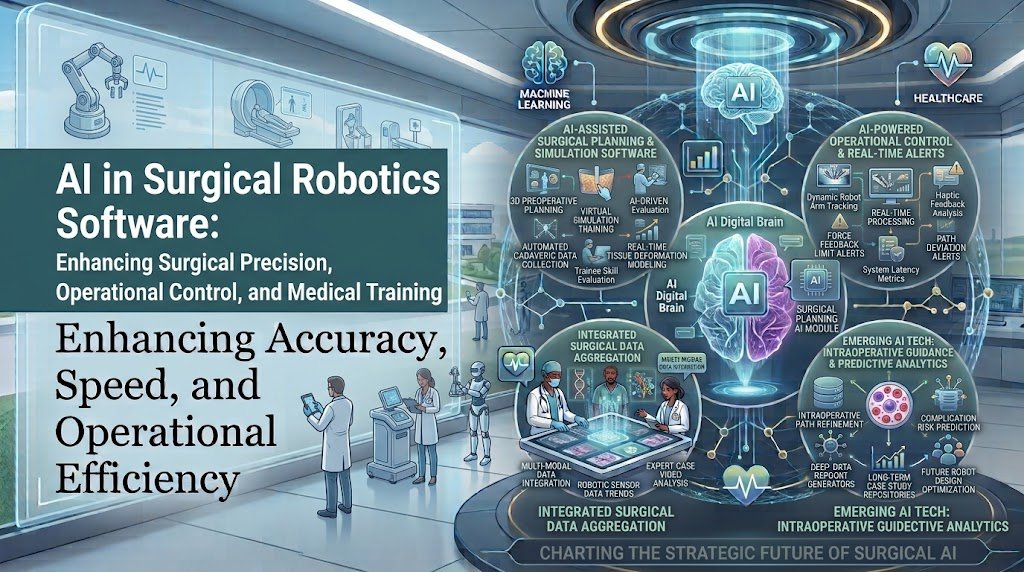
Primary topic: AI in Surgical Robotics Software
Research focus: Surgical robotics software, computer vision, surgical workflow intelligence, intraoperative guidance, robotic control, surgical navigation, autonomy, predictive analytics, simulation, surgeon assistance, safety, validation, regulation, and future autonomous surgery
Why AI Software Is Becoming the Core of Surgical Robotics
Surgical robots already provide surgeons with mechanical precision, improved visualization, instrument articulation, tremor filtering, and control over minimally invasive instruments. AI adds a different capability: it allows software to interpret what is happening during a procedure and use that information to provide context-aware assistance.
This distinction is important. Traditional robotic software mainly responds to surgeon commands. AI-enabled software can increasingly interpret surgical video, recognize anatomy, identify instruments, estimate surgical phases, detect events, predict workflow, and generate recommendations.
The result is a transition from a robotic platform that follows commands toward an intelligent surgical system that understands more of the operating environment.
Computer vision interprets surgical video, instruments, anatomy, and tissue.
AI identifies the current surgical phase, action, and clinical context.
Models can estimate upcoming steps, risks, and workflow events.
Software can provide guidance while keeping the surgeon in control.
Research source: FDA: Computer-Assisted Surgical Systems
What Surgical Robotics Software Actually Includes
“Surgical robotics software” is much broader than the control program that moves a robotic arm. Modern systems can contain multiple software layers that work together during planning, navigation, surgery, and postoperative analysis.
| Software layer | Primary function | AI opportunity |
|---|---|---|
| Robot control | Controls robotic movement | Motion prediction and adaptive control |
| Computer vision | Interprets surgical images | Anatomy and instrument recognition |
| Navigation | Guides instruments and procedures | Image fusion and intelligent guidance |
| Workflow intelligence | Understands procedure phases | Phase and action recognition |
| Decision support | Supports surgical decisions | Risk prediction and recommendations |
| Simulation | Training and rehearsal | Adaptive feedback and skill assessment |
| Analytics | Postoperative and system analysis | Outcome and performance prediction |
Current Level of Surgical Robot Autonomy
The public discussion around robotic surgery often makes it sound as though robots are already performing operations independently. The clinical reality is very different.
A systematic review of surgical robots cleared by the U.S. FDA between 2015 and 2023 examined 49 surgical robots and classified them using Levels of Autonomy in Surgical Robotics, or LASR. The study found that 86% were Level 1 robot-assistance systems. Only 6% reached Level 3 conditional autonomy, and none were classified as full autonomy.
Two of the reviewed robots were recognized by the FDA as having machine-learning-enabled capabilities, although additional systems reported AI or ML capabilities in their marketing material.
Research source: Levels of autonomy in FDA-cleared surgical robots: a systematic review
Robot assists surgeon
Robot performs task under supervision
Conditional autonomy
High autonomy within defined scope
Full autonomy
This progression is important for healthcare startups. The most realistic near-term opportunities are not necessarily systems designed to replace surgeons. They are AI systems that make surgeons more informed, precise, consistent, and efficient while maintaining human control.
Computer Vision: The Eyes of Surgical Robotics
Computer vision is one of the most important software technologies behind intelligent surgery. A robot cannot intelligently assist a surgeon unless its software can interpret the surgical environment.
Surgical video contains information about anatomy, instruments, tissue, bleeding, surgical actions, procedural phases, and changes in the operating field. Deep learning models can process these visual signals to create machine-readable representations of the procedure.
A 2025 systematic review of deep learning for surgical workflow recognition initially identified 2,937 articles and selected 59 for detailed review. The research showed widespread use of neural networks and transformers for surgical workflow analysis, particularly in minimally invasive procedures.
Research source: Deep learning in surgical process modeling: a systematic review of workflow recognition
Surgical Instrument Detection and Segmentation
One of the first requirements for an intelligent surgical robot is knowing where its instruments are and what they are doing. Instrument detection identifies surgical tools within video frames, while segmentation identifies their precise visual boundaries.
This information can support several higher-level functions.
- Instrument tracking.
- Collision avoidance.
- Surgical action recognition.
- Workflow understanding.
- Instrument handoff detection.
- Training assessment.
- Real-time surgical guidance.
- Postoperative video analysis.
A systematic review of deep learning for instrument recognition and segmentation in robotic-assisted surgery analyzed 48 studies and found substantial progress in detecting and segmenting surgical tools. The review also highlighted applications in intraoperative guidance, postoperative evaluation, and objective surgical-skill assessment.
Research source: Deep learning for surgical instrument recognition and segmentation in robotic-assisted surgeries
Surgical Scene Understanding
Instrument recognition alone is not enough. An intelligent system needs to understand the relationship between instruments, anatomy, surgical actions, and procedural context.
This is known as surgical scene understanding. The objective is to transform raw surgical video into structured information that software can use to understand what is happening during an operation.
↓
Instrument Detection + Anatomy Recognition
↓
Action and Spatial Relationship Detection
↓
Surgical Phase Recognition
↓
Context-Aware Surgical Understanding
↓
Guidance / Prediction / Safety Assistance
A 2025 systematic review and meta-analysis of AI for surgical scene understanding evaluated 188 studies. It found that 70.7% relied on small single-center datasets and 59.0% focused on laparoscopic cholecystectomy. Only 10.1% used external datasets for validation, while just 5.9% addressed clinical translation.
These findings show why surgical AI cannot be judged only by impressive laboratory accuracy. Models need to work across surgeons, hospitals, cameras, instruments, procedures, patient anatomies, and operating environments.
Research source: Artificial intelligence for surgical scene understanding: a systematic review and reporting quality meta-analysis
AI Surgical Workflow Recognition
Surgical procedures follow structured but highly variable workflows. Recognizing the current phase can allow software to provide the right information at the right time.
For example, the software should not provide the same guidance during initial dissection that it would provide during closure. Workflow-aware AI can determine where the procedure currently sits within its overall sequence.
- Procedure identification.
- Phase recognition.
- Step recognition.
- Action recognition.
- Instrument-action relationships.
- Next-step prediction.
- Unexpected event detection.
The 2025 systematic review of deep learning surgical workflow research found that temporal relationships are especially important for identifying surgical phases. Recurrent neural networks, temporal convolutional networks, and transformers are commonly used to model these long-range relationships.
Research source: Deep learning in surgical process modeling
AI for Intraoperative Surgical Guidance
Intraoperative guidance is one of the most valuable applications of surgical robotics software because it connects AI perception directly with the procedure happening in real time.
AI can potentially identify anatomical structures, estimate boundaries, highlight relevant regions, track instruments, recognize procedural phases, and provide context-sensitive information to the surgical team.
A July 2026 systematic review examined AI-based computer vision methods for intraoperative guidance in abdominal, thoracic, and pelvic robotic surgery. The search identified 2,601 records, with 95 studies included after screening. The review emphasized that reliable clinical translation requires both rigorous technical validation and clinical validation demonstrating patient benefit.
Research source: Artificial intelligence for intraoperative surgical guidance in robotic-assisted ventral cavity surgery
- Identify anatomical landmarks.
- Highlight structures that require caution.
- Track surgical instruments.
- Recognize the current procedural phase.
- Detect deviations from expected workflow.
- Estimate surgical risk signals.
- Provide visual or contextual guidance.
- Document important intraoperative events.
AI for Surgical Navigation
Surgical navigation software connects patient anatomy, preoperative imaging, intraoperative information, and instrument position. AI can improve this layer by helping software interpret imaging and identify relevant anatomical structures.
Potential applications include tumor localization, image registration, trajectory planning, orthopedic alignment, neurosurgical navigation, and image-guided interventions.
The key opportunity is multimodal fusion. A future surgical robot may combine preoperative CT or MRI, intraoperative video, instrument tracking, patient-specific anatomy, surgical history, and real-time sensor data into one computational model.
↓
AI Multimodal Surgical Model
↓
Patient-Specific Surgical Map
↓
Navigation and Decision Support
Predictive AI Before Surgery
Surgical robotics software does not have to wait until the first incision. AI can support preoperative planning by analyzing patient information and predicting factors that may affect the procedure.
- Potential operative difficulty.
- Expected operating time.
- Potential complications.
- Expected length of stay.
- Resource requirements.
- Patient-specific anatomical challenges.
- Potential conversion to another surgical approach.
AI-based preoperative planning can also help determine how a robotic procedure should be approached. This is especially useful when patient anatomy varies significantly between individuals.
However, predictions must be treated as decision support. A model trained on one hospital’s population may not perform equally well in another hospital.
AI for Surgical Skill Assessment
Robotic surgery produces detailed digital information about instrument movement. This creates an opportunity to evaluate surgical skills more objectively than traditional observation alone.
AI can analyze movement patterns, instrument trajectories, task completion, unnecessary movements, time spent on specific actions, and other behavioral features.
- Path length
- Velocity
- Acceleration
- Task duration
- Idle time
- Unnecessary movement
- Instrument handling
- Procedure sequence
- Action consistency
This can support surgical education, credentialing, simulation, and continuous professional development. The system should not, however, reduce a complex surgical skill to one simplistic score.
AI Simulation and Robotic Surgical Training
Surgical robotics creates a rich environment for simulation because software can reproduce instrument movement and procedural tasks. AI can make these simulations adaptive.
- Adjust difficulty based on performance.
- Identify repeated mistakes.
- Provide immediate feedback.
- Generate personalized training plans.
- Compare performance against validated benchmarks.
- Simulate uncommon or high-risk scenarios.
Generative AI could also create interactive training scenarios in which trainees explain their decisions while the system dynamically changes the simulated surgical environment. The strongest systems will combine AI-generated feedback with validated surgical curricula rather than relying entirely on an LLM.
AI for Surgical Risk and Complication Prediction
Another important software layer is postoperative prediction. AI can analyze patient characteristics, procedure information, intraoperative events, and historical data to estimate complication risks.
Potential applications include prediction of postoperative complications, prolonged hospitalization, readmission, conversion, blood loss, or other outcomes relevant to a specific procedure.
The advantage of integrating this intelligence into a robotic platform is that the system can combine preoperative and intraoperative information. A prediction can potentially be updated as the operation progresses.
During surgery: instrument activity + surgical phase + events + imaging
After surgery: operative findings + postoperative signals
AI output: continuously updated risk profile for clinician review
Robotic Surgery and Generative AI
Generative AI has a different role from traditional surgical machine-learning models. Instead of controlling robotic movement directly, large language and multimodal models can become an interface between surgeons and complex information systems.
For example, a surgeon could ask for a summary of relevant patient information, retrieve a specific imaging finding, review prior procedures, or query an institution’s surgical protocol.
- Clinical information retrieval.
- Procedure documentation assistance.
- Surgical video summarization.
- Postoperative report generation.
- Protocol retrieval.
- Training explanations.
- Natural-language access to surgical analytics.
The safest architecture is retrieval-grounded. The model should retrieve information from approved clinical sources and clearly identify the evidence supporting its answer.
Multimodal AI Will Be More Important Than Text-Only AI
Surgery is inherently multimodal. The operating environment contains images, video, movement data, audio, instrument telemetry, physiological measurements, imaging, and clinical documentation.
A surgical AI system that only reads text cannot fully understand the surgical environment. Future platforms will increasingly combine these data types.
Visual scene
Patient anatomy
Robot state
Patient context
Team context
Why Surgical AI Validation Is Difficult
Surgery creates an unusually difficult environment for AI validation. Patients are different, surgeons have different techniques, instruments change, cameras move, anatomy varies, procedures evolve, and unexpected events happen.
A model that performs well on a controlled dataset may fail when exposed to a different hospital, camera system, surgical technique, or patient population.
Earlier systematic research on AI in robot-assisted surgery identified small datasets, heterogeneous algorithms, limited external validation, and insufficient transparency as major limitations. The review found 35 publications involving 3,436 patients and concluded that evidence quality was limited and there was no proof that AI could reliably identify critical tasks that determine patient outcomes.
Research source: A systematic review on artificial intelligence in robot-assisted surgery
The Data Problem in Surgical Robotics
High-quality surgical AI requires high-quality surgical datasets. Yet surgical video is difficult to annotate because procedures can last for hours and contain thousands of individual actions.
Annotation may require surgeons to label instruments, anatomy, actions, phases, complications, tissue characteristics, and clinically meaningful events.
- Large annotation costs.
- Limited availability of expert annotators.
- Different annotation standards.
- Different surgical techniques.
- Institution-specific workflows.
- Limited public datasets.
- Patient privacy requirements.
- Long-tailed rare events.
Researchers are therefore exploring self-supervised learning, semi-supervised learning, transfer learning, contrastive learning, and active learning to reduce dependence on manually labeled data.
Edge AI for Real-Time Robotic Surgery
Real-time surgical assistance creates a demanding computing environment. AI predictions may need to happen within fractions of a second while the operation is underway.
Cloud-only inference may introduce latency, connectivity dependence, and privacy concerns. Edge computing can move selected AI workloads closer to the surgical system.
↓
Local Edge AI
↓
Instrument detection • Anatomy recognition • Workflow recognition
↓
Safety / Guidance Layer
↓
Surgeon Interface + Robotic System
Cloud infrastructure can still support model training, fleet analytics, retrospective research, and centralized monitoring. The safest architecture may therefore combine edge inference with controlled cloud-based analytics.
Cybersecurity in Surgical Robotics Software
As surgical robots become increasingly connected and software-driven, cybersecurity becomes a patient-safety issue rather than only an IT issue.
A security failure could potentially affect availability, data confidentiality, software integrity, or system behavior. Surgical robotics therefore requires security engineering throughout the product lifecycle.
- Secure software development.
- Strong authentication.
- Role-based access.
- Encrypted communications.
- Software integrity verification.
- Network segmentation.
- Security logging.
- Vulnerability management.
- Controlled software updates.
- Incident-response planning.
AI models themselves also introduce attack surfaces. Developers should consider data poisoning, adversarial inputs, model theft, unauthorized updates, and manipulation of AI outputs.
Human-in-the-Loop Is Essential
One of the most important principles for surgical AI is maintaining meaningful human control. The surgeon should understand when AI is providing a recommendation, when the robot is performing an automated action, and when intervention is required.
- AI observes: video, sensors, imaging, and workflow.
- AI interprets: anatomy, instruments, actions, and context.
- AI recommends: guidance, alerts, or possible next actions.
- Surgeon evaluates: clinical relevance and safety.
- Surgeon authorizes: high-impact robotic actions.
- AI monitors: system behavior and procedure context.
- Surgeon overrides: whenever required.
Regulatory Considerations
Surgical robotics software can fall within medical-device regulation depending on its intended function. AI that controls, guides, analyzes, or influences a medical device can create complex regulatory questions.
The FDA maintains an AI-enabled medical device list to provide transparency around authorized AI-enabled devices. The agency also publishes guidance concerning AI/ML-enabled device software, including lifecycle management, transparency, and predetermined change-control plans.
Research sources: FDA AI-Enabled Medical Devices and FDA Artificial Intelligence and Machine Learning Software as a Medical Device
| Development stage | Important control |
|---|---|
| Data collection | Quality, representativeness, privacy |
| Model development | Version control and reproducibility |
| Validation | External and clinically relevant testing |
| Deployment | Human oversight and safety controls |
| Post-market | Performance monitoring and change management |
AI Surgical Robotics Risk Matrix
| Use case | Potential value | Risk | Best deployment model |
|---|---|---|---|
| Video summarization | High | Low | AI-assisted |
| Instrument tracking | Very high | Medium | Validated real-time AI |
| Workflow recognition | Very high | Medium | Decision support |
| Anatomy identification | Very high | High | AI + surgeon confirmation |
| Autonomous tissue manipulation | Very high | Very high | Highly constrained autonomy |
| Fully autonomous surgery | Potentially transformative | Extremely high | Research stage |
AI Maturity Model for Surgical Robotics
| Level | Capability | Example |
|---|---|---|
| 1 | Robotic assistance | Surgeon controls instruments |
| 2 | AI observation | Instrument and phase recognition |
| 3 | AI decision support | Risk and workflow guidance |
| 4 | Constrained automation | Robot performs validated subtasks |
| 5 | Conditional autonomy | Robot performs defined surgical actions under supervision |
| 6 | High autonomy | AI manages broader validated surgical workflows |
This maturity ladder should not be confused with a regulatory classification. It is a practical product-development framework showing how AI capability can evolve from observation toward constrained autonomy.
Startup Opportunities in Surgical Robotics Software
The software layer offers significant opportunities for healthcare AI startups because companies do not necessarily need to manufacture an entire surgical robot to create value. Specialized software can be developed around video intelligence, navigation, analytics, simulation, workflow, or clinical decision support.
| Product opportunity | Core technology | Potential customer | Opportunity |
|---|---|---|---|
| Surgical Video Intelligence | Computer vision + transformers | Hospitals and robot manufacturers | Very high |
| AI Surgical Navigator | Computer vision + imaging | Surgical centers | High |
| Robotic Training Copilot | ML + simulation | Teaching hospitals | High |
| Surgical Performance Analytics | Motion analysis + ML | Hospitals and training programs | High |
| Intraoperative AI Guidance | Multimodal AI | Robot manufacturers | Very high |
| Surgical Data Platform | Data engineering + AI | Health systems | High |
Legacy Modernization for Robotic Surgery
Hospitals and surgical centers may already have robotic platforms, PACS systems, EHRs, operating-room systems, video systems, and analytics tools. Replacing these systems is usually impractical.
A more realistic modernization strategy is to create an interoperability layer that allows new AI services to consume approved data without disrupting the core surgical platform.
↓
Integration and Data Layer
APIs • Imaging Interfaces • Video Streams • Device Telemetry
↓
AI Services
Computer Vision • Workflow AI • Predictive Models • Generative AI
↓
Clinical Intelligence Layer
Guidance • Analytics • Training • Documentation
↓
Surgeon and Surgical Team
Implementation Roadmap for AI Surgical Robotics
Organizations should avoid beginning with autonomous robotic movement. The safest path is to start with AI applications that have measurable value but limited direct control over the robot.
- Phase 1: Identify a narrow surgical workflow problem.
- Phase 2: Collect representative surgical video and operational data.
- Phase 3: Establish annotation and data-quality standards.
- Phase 4: Build an offline AI prototype.
- Phase 5: Validate across multiple surgeons and cases.
- Phase 6: Test the system prospectively without changing clinical decisions.
- Phase 7: Introduce decision-support functionality.
- Phase 8: Integrate with the robotic platform under strict safety controls.
- Phase 9: Continuously monitor performance and model drift.
- Phase 10: Consider narrowly constrained automation only after sufficient evidence.
KPIs for AI Surgical Robotics Software
AI robotics projects should be evaluated using clinical, technical, operational, and safety measures together.
- Precision
- Recall
- F1 score
- Latency
- Calibration
- Procedure time
- Task efficiency
- Error rate
- Workflow variation
- False alerts
- Missed events
- Override rate
- Near misses
- Complications
- Recovery
- Length of stay
- Patient outcomes
2027–2030 Outlook
The next several years are likely to focus less on the headline idea of fully autonomous surgery and more on the software capabilities required to make higher levels of autonomy safe.
| Period | Likely direction |
|---|---|
| 2027 | More surgical video intelligence, workflow recognition, AI documentation, and decision-support systems. |
| 2028 | Greater multimodal integration of video, imaging, robot telemetry, and clinical information. |
| 2029 | More validated autonomous subtasks and constrained robotic automation. |
| 2030 | More advanced conditional autonomy, supported by stronger validation, monitoring, and regulatory frameworks. |
The direction is therefore not simply “robots replacing surgeons.” The more realistic trajectory is a layered intelligent operating environment in which AI understands the surgical scene, assists with decisions, monitors the robotic system, and eventually performs carefully defined subtasks under controlled conditions.
Final Perspective
AI is becoming one of the most important software technologies in surgical robotics. The robotic hardware provides mechanical capabilities, but intelligent software determines how much the system can understand, predict, guide, and eventually automate.
The strongest near-term opportunities are in computer vision, surgical workflow recognition, instrument tracking, anatomy recognition, surgical navigation, skill assessment, simulation, predictive analytics, and multimodal intraoperative guidance.
The research also makes the limitations clear. Surgical AI still faces small datasets, weak external validation, inconsistent annotation, limited prospective evidence, domain shift, explainability challenges, cybersecurity concerns, and complex regulatory requirements.
For healthcare startups, the best strategy is therefore not to promise fully autonomous surgery before the evidence exists. A stronger product strategy is to solve one high-value surgical problem exceptionally well, validate it across real clinical environments, create transparent evidence, and then gradually move toward more advanced levels of automation.
- Today: AI observes and analyzes surgery.
- Near term: AI provides context-aware guidance.
- Next stage: AI performs tightly constrained robotic subtasks.
- Long term: Conditional autonomy may expand as evidence and regulation mature.
The future of surgical robotics will ultimately depend less on how powerful a robotic arm is and more on how reliably its software can understand the patient, the anatomy, the instruments, the procedure, and the consequences of every action.
Original Research & Reference Sources
- Levels of autonomy in FDA-cleared surgical robots: a systematic review
- Artificial intelligence for intraoperative surgical guidance in robotic-assisted ventral cavity surgery — 2026 systematic review
- Artificial intelligence for surgical scene understanding — systematic review and reporting quality meta-analysis
- Deep learning in surgical process modeling: systematic review of workflow recognition
- Deep learning for surgical instrument recognition and segmentation in robotic-assisted surgeries
- A systematic review on artificial intelligence in robot-assisted surgery
- FDA Computer-Assisted Surgical Systems
- FDA Artificial Intelligence-Enabled Medical Devices
- FDA Artificial Intelligence and Machine Learning Software as a Medical Device
- Advances in Computer Vision Enabling More Autonomous Actions in Surgery
- Deep learning for surgical workflow analysis: survey of progress, limitations, and trends
- FDA-approved AI and ML-enabled medical devices in general surgery — 2026 review

Leave a Reply