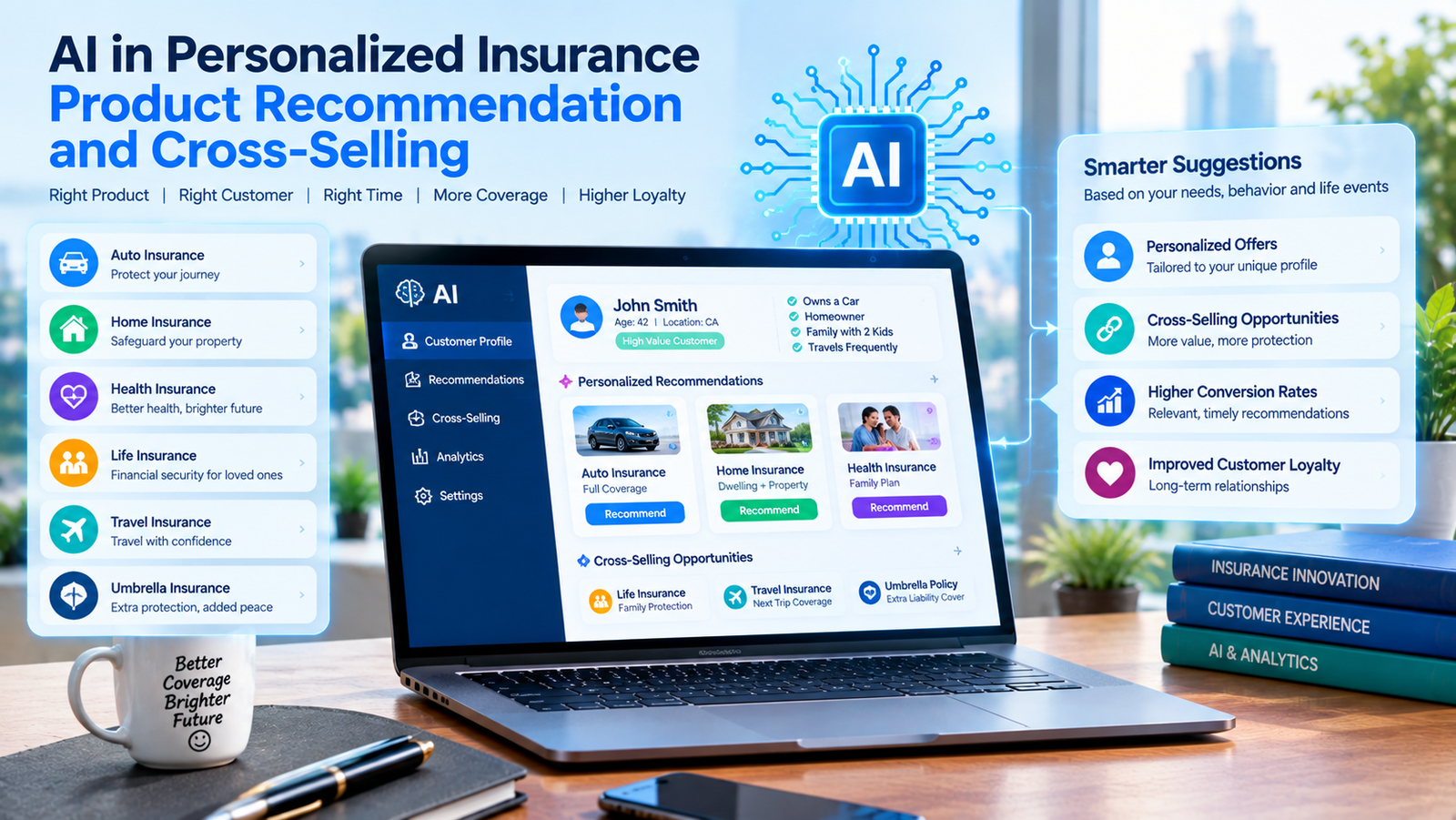
Primary topic: AI in Personalized Insurance Product Recommendation and Cross-Selling
Research focus: AI-powered insurance recommendations, customer coverage-gap analysis, next-best-action models, cross-selling, policyholder lifetime value, insurance product matching, explainable AI, customer consent, responsible personalization and digital insurance distribution
What Is AI in Personalized Insurance Recommendation?
AI-powered insurance recommendation uses data and machine learning to identify insurance products, coverage options, add-ons or policy changes that may fit a customer’s needs. Cross-selling is the process of offering an additional product to an existing customer, such as recommending renters insurance to a customer who already has auto insurance. Upselling encourages a customer to move to a different tier or increase coverage within an existing product.
These activities are related, but they are not the same. A useful recommendation system should distinguish between a product that addresses a real customer need and one that merely increases the insurer’s premium income.
Traditional insurance cross-selling often relies on broad customer segments, agent judgment, campaign lists or fixed business rules. AI can evaluate a wider range of signals and update recommendations as a customer’s circumstances change. For example, a customer who recently purchased a home may need homeowners insurance, while a customer whose existing policy already provides adequate protection may not need another product.
The core question is not simply, “Which customer is most likely to buy?” It is also, “Which product is relevant, suitable, understandable and useful for this customer?”
Why Traditional Insurance Cross-Selling Falls Short
Insurance products are difficult to compare because their value depends on coverage limits, exclusions, deductibles, waiting periods, eligibility rules and the customer’s personal circumstances. A product that appears inexpensive may offer limited protection, while an additional policy may overlap with coverage the customer already has.
Traditional campaign-based approaches can miss these details. They may also contact customers at the wrong time, repeat offers that have already been rejected or promote products based on broad demographic assumptions.
AI can improve this process by connecting customer information with product rules and context. A recommendation engine can identify possible needs, check existing coverage, estimate customer interest and select an appropriate communication channel. However, the system should not treat a high probability of purchase as proof that the product is suitable.
Understand
Build a current view of the customer’s policies, needs and preferences
Identify
Find potential coverage gaps, relevant products and suitable moments
Validate
Check eligibility, exclusions, overlap and suitability constraints
Recommend
Explain the offer and let the customer decide without pressure
Research Study: How AI Recommendations Influence Insurance Customer Acceptance
A 2026 study published in the Korean Journal of Risk Management examined how the design of AI-based insurance recommendations affects customer acceptance. The researchers conducted a scenario-based survey with 400 participants and compared a lower-involvement approach, in which AI mainly provides information, with a higher-involvement approach, in which users actively contribute to the recommendation process.
The study found that the higher-involvement approach improved participants’ reported autonomy, competence and relatedness. Competence and relatedness were important mechanisms connecting the interaction design with acceptance intentions. The findings also suggested that digital self-efficacy influenced how people experienced the more interactive recommendation process.
This is directly relevant to insurance cross-selling. A system that simply presents “Recommended for you” may offer convenience, but it does not necessarily help a customer understand the recommendation. A guided experience can ask what the customer wants to protect, show existing cover, explain possible gaps and let the customer adjust priorities before viewing products.
For insurers, the implication is that recommendation interfaces should support customer participation rather than treat personalization as an invisible algorithmic decision. The study measures acceptance intentions in a survey setting, so it should not be interpreted as proof that the same interface will increase actual purchases or improve policy outcomes in every market.
Source: How Can AI Recommend Insurance Products That Customers Will Accept? Journal of Risk Management, 2026
Research Study: Consumer Risks from AI Personalization in Insurance
A 2025 systematic review in the Journal of Consumer Affairs examined how AI design features can create consumer harm in insurance. The review synthesized 33 empirical studies and organized the findings around mechanisms linking AI features to consumer responses and outcomes.
Three issues are especially relevant to personalized product recommendations: algorithmic opacity, hyper-personalization and data-driven bias. These features can contribute to concerns about fairness, anxiety and loss of control, which may lead customers to resist or disengage from AI-enabled insurance services.
The findings highlight a risk that conversion-focused systems can overlook. A recommendation may be highly personalized but still feel intrusive if the customer does not understand why the insurer knows something about them. A model may also use historical data that reflects unequal access, past discrimination or differences in how customers have been served.
For example, a system that infers a customer’s financial stress from account activity and immediately promotes a high-cost insurance product could create a serious trust problem. Even if the model predicts a high purchase probability, the timing and rationale may be inappropriate.
The review supports transparent, consumer-centered design. Insurers should explain the data used for personalization, provide meaningful controls, test for unfair outcomes and make it possible to decline recommendations without losing access to ordinary service.
Research Study: Human and AI Intermediaries in Insurance Decisions
A 2025 experimental study published in the Journal of Behavioral and Experimental Finance examined consumer decision-making with human and AI intermediaries in insurance. The research addresses a central question for digital insurers: how does the role of an AI intermediary affect a customer’s ability to make an insurance decision?
This research direction matters because insurance is not a simple retail purchase. Customers may need help understanding exclusions, deductibles, limits and the relationship between several policies. An AI assistant can make product information easier to navigate, but customers may still need human support for complex decisions.
For cross-selling, the practical lesson is to design AI as a decision-support layer rather than assume that it should replace every human interaction. AI can explain the differences between policies, summarize relevant terms and collect the customer’s priorities. A licensed agent or qualified representative can handle complex questions, unusual circumstances and cases where the customer needs additional explanation.
The study’s publication and subject make it relevant to the design of insurance intermediaries. Its findings should be interpreted within the actual experimental design and not generalized automatically to every insurance product, distribution channel or customer population.
Research Study: Generative AI and the Insurance Customer Journey
The Geneva Association’s research on generative AI in the insurance customer journey examines how AI can change the way insurers communicate with customers, personalize recommendations and identify opportunities for additional products.
The report describes how insurers can use internal information, including policy records and customer interactions, to tailor recommendations and communications. It also discusses the potential for AI to identify cross-selling and upselling opportunities as customer interactions accumulate.
This is particularly important for insurers with several product lines. A customer may hold an auto policy but have no home, renters, travel or personal liability coverage with the same provider. AI can help identify relevant product relationships and present them at a suitable point in the customer journey.
However, a recommendation should be based on more than the fact that a customer does not own another product from the same insurer. The system needs to consider whether the customer already has equivalent cover elsewhere, whether the new policy is appropriate and whether the customer has consented to the use of relevant information.
The report is an industry analysis rather than a controlled trial of conversion or customer outcomes. It is useful for understanding the direction of insurance distribution, but any claimed commercial benefit should be validated through an insurer’s own controlled testing.
Source: The Geneva Association, Gen AI in the Insurance Customer Journey
Research Study: Consumer Preferences for Open Insurance and Personalized Recommendations
A 2026 study published in The Geneva Papers on Risk and Insurance – Issues and Practice investigated consumer preferences, trust and willingness to pay for open insurance services. Its choice-based conjoint analysis included 579 respondents.
The study found that price and service functionality were the most influential attributes in consumer decision-making. It also found positive consumer value for transparency-related functions, such as providing an overview of existing insurance coverage and identifying gaps or redundancies. Personalized recommendations generated positive utility as well.
An important result concerned data sharing. Among respondents who did not categorically reject data sharing, most preferred case-by-case consent rather than a single, long-term authorization.
This has direct implications for AI-driven cross-selling. A recommendation engine can create value by helping customers understand what they already have and where they may be underinsured or overinsured. The customer may value this service even when the outcome is not a new purchase.
The consent finding also suggests that insurers should avoid treating permission as permanent. Customers should be able to understand what information is being accessed, for which purpose and for how long. Where applicable, they should be able to withdraw consent or change their preferences.
The study offers evidence about stated preferences in its sample. It does not establish that every customer will respond identically or that stated preferences will always translate into real-world behavior.
Research Study: AI-Empowered Insurance Distribution and the Next Customer Interface
A February 2026 Boston Consulting Group article examined how AI assistants may change insurance discovery, comparison and purchasing. It describes a possible shift in which AI assistants become an early point of contact between customers and insurers.
The article outlines a progression from AI that augments existing interactions, to AI that actively assists customers, and potentially to more autonomous interactions. For insurers, this raises a distribution question: customers may increasingly ask an AI assistant to compare coverage or explain which policy fits their circumstances before they visit an insurer’s website.
This development could change how insurers design product data, recommendation logic and digital sales journeys. Product information must be structured well enough for AI systems to compare coverage, exclusions, eligibility and price without reducing a complex policy to a misleading summary.
Insurers will also need to make their product information clear and consistent across channels. If an external assistant presents an incomplete or inaccurate description of coverage, the customer may make a decision based on a misunderstanding.
The article is a strategic industry perspective, not a forecast with a verified probability. It is best used to identify a distribution scenario that insurers can prepare for rather than assume is inevitable.
Source: Boston Consulting Group, Competing for the AI-Empowered Insurance Customer, February 2026
How an AI Insurance Recommendation Engine Works
A practical recommendation engine combines customer understanding, product eligibility, suitability rules, ranking and communication. These functions should remain separate enough to be tested and governed independently.
Existing policies, declared needs, service history and consented signals
Current protection, preferences, possible gaps and policy overlap
Product availability, exclusions, regulatory constraints and customer needs
Relevant products, reasons, trade-offs and confidence
Review, compare, ask questions, accept or decline
The model should not be allowed to recommend a product that fails a hard eligibility or suitability rule. A high predicted conversion probability must never override product restrictions or required disclosures.
Key AI Techniques for Insurance Personalization
| AI technique | Insurance application | Important control |
|---|---|---|
| Recommendation models | Rank products based on customer needs and product relationships | Do not rank solely by commission or premium |
| Propensity models | Estimate the likelihood of a customer responding to an offer | Purchase likelihood is not suitability |
| Coverage-gap analysis | Compare declared needs and existing cover with available products | Account for policies held elsewhere where known and consented |
| Natural language processing | Extract customer needs from service conversations and inquiries | Respect privacy and verify extracted information |
| Next-best-action models | Choose whether to offer, educate, follow up or take no action | Include “no offer” as a valid outcome |
| Generative AI | Explain product differences and answer customer questions | Use approved product facts and controlled language |
Coverage-Gap Detection: A More Customer-Centered Use Case
Coverage-gap detection is one of the most useful ways to make personalization different from ordinary cross-selling. Rather than beginning with a product the insurer wants to sell, the system begins with the customer’s existing protection and stated needs.
For example, a customer may have auto insurance but recently moved into a rented apartment. The system could ask whether the customer wants to review protection for personal belongings and liability. If the customer already has renters insurance through another provider, the recommendation should reflect that information rather than automatically promote a duplicate policy.
The system can also identify possible overinsurance. A customer may hold multiple products with overlapping benefits, or a policy may no longer match their circumstances. A customer-centered recommendation engine should be able to explain overlap and recommend reviewing existing cover rather than purchasing another product.
This approach can create value even when it reduces immediate cross-selling. It can improve trust, reduce complaints and support a longer-term customer relationship.
Next-Best-Action: Knowing When Not to Sell
A next-best-action system determines the most appropriate next interaction with a customer. The possible actions should include more than selling a product.
RecommendOffer a relevant product when a verified need exists
EducateExplain exclusions, deductibles or coverage limits before an offer
ReviewInvite the customer to check existing policies for gaps or overlap
WaitDelay contact when timing, consent or customer context makes an offer inappropriate
Do nothingAvoid an offer when no meaningful customer need is identified
Including these options prevents the system from treating every customer interaction as a sales opportunity. It also creates a measurable way to test whether the AI is helping customers rather than merely increasing contact frequency.
Personalization Across the Insurance Customer Lifecycle
AI recommendations can be useful at several points in the customer journey, but the signals and controls should change according to the context.
| Customer stage | Potential AI use | Customer-centered outcome |
|---|---|---|
| Quote and onboarding | Explain relevant coverage options and identify missing information | A more informed initial policy choice |
| After purchase | Explain policy features and identify related protection needs | Better understanding of existing cover |
| Life event | Prompt a review after a move, new vehicle or declared family change | Coverage that keeps pace with changing needs |
| Renewal | Compare current cover, changes and available options | A clearer renewal decision |
| Claim or complaint | Prioritize service and explain relevant policy information | Resolution before promotional messaging |
An important operational rule is to suppress promotional recommendations when a customer is dealing with a serious claim, complaint or distressing event unless the communication is directly relevant to resolving that issue.
Data Architecture for Personalized Insurance Recommendations
An effective system needs reliable data, but it should not collect every available customer signal simply because it can. The data architecture should connect policy administration, customer relationship management, claims, billing, product catalogs, consent records and communication channels through controlled interfaces.
Core data sources
- Policy administration system
- Customer relationship management platform
- Claims and service records
- Product catalog, eligibility and policy wording
- Customer preferences and consent records
- Quote, renewal and communication history
Data quality and governance layer
- Identity resolution and duplicate handling
- Data freshness and accuracy checks
- Purpose limitation and access controls
- Consent and retention enforcement
Recommendation services
- Customer need and coverage profile
- Product eligibility engine
- Recommendation ranking
- Explanation and approved content generation
Delivery and measurement
- Website, app, agent and contact center
- Customer feedback and preference updates
- Conversion, suitability and complaint monitoring
For legacy insurers, this does not necessarily require replacing the policy administration system. An integration layer can expose approved product and customer data while the core system continues to manage policies. The priority is to establish dependable data definitions and controls before adding complex AI models.
Generative AI for Insurance Product Explanations
Generative AI can help customers understand insurance terms by translating complex policy language into simpler explanations. It can compare selected products, summarize differences and answer questions using approved product documents.
For example, a customer comparing two home insurance policies may want to understand the difference between replacement-cost coverage and actual-cash-value settlement. A grounded AI assistant can explain the concepts, point to the relevant policy wording and show where exclusions or limits apply.
The main risk is that generative AI may invent a benefit, overlook an exclusion or describe a general rule as if it applies to a specific policy. For this reason, it should retrieve information from current, approved documents and show the source of important statements.
Recommended controls include:
- Use retrieval-augmented generation with approved policy documents
- Keep product facts separate from persuasive marketing copy
- Show policy references for important coverage explanations
- Escalate ambiguous or high-impact questions to a qualified person
- Test answers against exclusions, limits and edge cases
- Keep records of the product version and information shown to the customer
Generative AI should explain the recommendation, not secretly determine the customer’s eligibility or make an unreviewed coverage decision.
Measuring Recommendation Quality Beyond Conversion
A cross-selling system can appear successful if it increases quote requests or policy purchases. Those metrics alone do not reveal whether the recommendations were appropriate or whether customers understood what they bought.
A balanced measurement framework should combine commercial, customer and risk outcomes.
| Metric | What it measures | Why it matters |
|---|---|---|
| Recommendation acceptance | Share of offers that lead to a customer action | Measures engagement, but not suitability by itself |
| Coverage-gap resolution | Share of identified needs addressed | Connects recommendations to customer protection |
| Duplicate-cover rate | Potentially overlapping recommendations | Helps identify avoidable or confusing offers |
| Complaint rate | Complaints related to offers or advice | Signals poor timing, explanation or suitability |
| Customer retention | Renewal and continued relationship | Measures longer-term relationship quality |
| Fairness measures | Differences in recommendation and outcome patterns | Helps detect unjustified disparities |
| Incremental value | Additional value compared with a control group | Separates model impact from purchases that would happen anyway |
Where possible, insurers should use controlled experiments to evaluate recommendation changes. Experiments should include guardrails for customer harm and should not withhold essential information or required protections from a control group.
Risk, Fairness and Consumer Protection
Insurance personalization can affect access, price, coverage and customer treatment. Even when a recommendation model is not directly setting premiums, it can influence which products customers see, which customers receive assistance and how frequently people are contacted.
The main risks include:
- Privacy overreach: using sensitive or unexpected data without a clear purpose
- Unfair targeting: excluding or disadvantaging customer groups through biased data or proxies
- Unsuitable recommendations: prioritizing products that do not match the customer’s needs
- Misleading explanations: simplifying policy terms in a way that hides important limitations
- Manipulative timing: using distress, urgency or financial pressure to drive a purchase
- Over-contact: repeatedly promoting products after a customer declines
- Model drift: recommendations becoming less relevant as products, customer behavior or markets change
A responsible system should maintain a clear distinction between marketing personalization, product suitability, underwriting and pricing. These functions may use related data, but they have different purposes and may be subject to different legal requirements.
Expert Recommendation
Insurers should build personalized recommendation systems around customer needs and product suitability, with commercial optimization operating inside those boundaries. The system should be able to recommend a product, provide education, request clarification, defer an offer or recommend no action.
The implementation should begin with a narrow use case where the customer need can be defined and the result can be measured. For example, an insurer could start with renewal-time coverage reviews for customers who have consented to receive personalized policy information. The pilot should compare AI-supported recommendations with the existing process and measure customer understanding, coverage-gap resolution, complaints and incremental business outcomes.
Before expanding, the insurer should establish the following controls:
- Maintain a reliable, current product catalog with eligibility and exclusions
- Use explicit consent and purpose limitation for personal data
- Separate suitability checks from purchase-propensity scoring
- Provide clear explanations for recommendations
- Offer customers control over personalization and marketing contact
- Test outcomes across relevant customer groups
- Monitor complaints, cancellations and signs of unsuitable selling
- Keep an audit trail of data, model version, recommendation and customer response
- Provide human assistance for complex or disputed recommendations
Expert Perspective
Boston Consulting Group’s 2026 analysis describes a future in which AI assistants increasingly influence how customers discover, compare and purchase insurance. Its central strategic implication is that insurers need to prepare for AI-mediated distribution, not only improve their own apps and websites.
For insurers, this means product information must be structured, accurate and easy to compare. Coverage limits, exclusions, eligibility, price and policy conditions should be available in a form that supports reliable explanations across both internal and external customer interfaces.
Source: BCG, Competing for the AI-Empowered Insurance Customer, 2026
Implementation Roadmap
Foundation: Data and Product Readiness
Start by connecting customer records, policy details, product documents and consent information. Resolve inconsistent product definitions and confirm that the recommendation engine can distinguish active cover from expired, cancelled or duplicate policies.
Pilot: One Product Relationship
Select a narrow cross-sell scenario with a clear customer need, such as offering renters insurance information to eligible auto customers who have indicated that they rent their home. Keep the recommendation optional and make the reason for the offer clear.
Validation: Test Quality and Customer Outcomes
Compare the AI-assisted process with the existing customer journey. Measure conversion alongside customer understanding, complaints, cancellations, duplicate coverage and fairness indicators. Review individual recommendations that produce unexpected or harmful outcomes.
Expansion: Add Products and Channels
After the pilot meets predefined quality and risk thresholds, extend the system to other product relationships and channels. Ensure that customers receive consistent explanations whether they interact through an app, website, agent or contact center.
Optimization: Continuous Monitoring
Monitor model performance as products, pricing, customer needs and market conditions change. Refresh product information, review feedback and investigate changes in recommendation patterns. Do not retrain or deploy a model solely because it increases conversion.
Future Predictions: 2027–2030
2027: Recommendations Become More Interactive
Insurance apps are likely to move beyond static product carousels toward guided coverage reviews. Customers will increasingly be able to explain their needs, compare options and ask follow-up questions before requesting a quote. Insurers will need to ensure that the conversational experience remains grounded in approved policy information.
2028: Coverage Reviews Become More Contextual
Recommendation systems may increasingly connect policy renewal, declared life events and customer service interactions to prompt timely reviews. The key constraint will be consent and data quality. A model should not infer a sensitive life event from uncertain signals and use it to trigger an intrusive offer.
2029: AI Assistants Influence Insurance Discovery
External AI assistants may play a larger role in comparing insurance products. Insurers will need structured product information that allows coverage, exclusions, limits and price to be compared accurately. Clear policy language and machine-readable product data may become important distribution capabilities.
2030: Customer-Centered Recommendation Systems Mature
More advanced systems may combine product matching, coverage-gap analysis, policy explanation and service routing in one experience. The defining measure of success should not be the number of offers generated. It should be whether customers can make better-informed decisions and obtain appropriate protection with less effort.
These are reasoned scenarios based on current industry direction, not guaranteed outcomes or precise market forecasts.
Frequently Asked Questions
What is AI in personalized insurance product recommendation?
AI in personalized insurance recommendation uses customer, policy and product information to identify insurance options that may fit a customer’s needs. It can support product matching, coverage-gap analysis, explanations and next-best-action decisions.
How does AI improve insurance cross-selling?
AI can identify relevant product relationships, estimate customer interest, select an appropriate communication moment and explain why a product may be useful. Responsible systems also check for eligibility, existing coverage and potential duplication before presenting an offer.
Can AI recommend the wrong insurance product?
Yes. Recommendations can be unsuitable because of inaccurate data, incomplete policy information, biased models or incorrect assumptions about customer needs. Insurers should use eligibility and suitability rules, provide explanations and monitor complaints and cancellations.
What data is needed for AI insurance recommendations?
Common inputs include existing policies, product eligibility, declared customer needs, consented preferences, service history and renewal information. Data collection should be limited to what is necessary for a defined purpose.
How can insurers measure AI cross-selling success?
Insurers should measure conversion and incremental revenue alongside coverage-gap resolution, customer understanding, retention, complaints, cancellations, duplicate-cover indicators and fairness outcomes.
Will AI replace insurance agents?
AI can automate product discovery, comparisons and routine explanations, but human support remains important for complex needs, disputed recommendations and decisions that require professional judgment.
What is the biggest risk of AI-powered insurance personalization?
A major risk is optimizing for sales while overlooking suitability, privacy, fairness or customer understanding. A recommendation system should be designed to support informed customer choice, not simply maximize the probability of purchase.
Final Perspective
AI can make insurance recommendations more relevant by connecting customer needs with product information, existing coverage and the timing of an interaction. Its value is greatest when it helps customers understand their protection rather than simply encourages them to buy another policy.
The research points to several practical conclusions. The 2026 study of AI insurance recommendation acceptance highlights the importance of user participation. The 2025 systematic review of consumer harm shows why opacity, hyper-personalization and bias need active controls. Research on open insurance suggests that customers value transparency and personalized recommendations, while consent preferences remain important. Industry analysis also indicates that AI assistants may become a more prominent part of insurance discovery and distribution.
These findings point toward a more thoughtful model of cross-selling. Insurers should begin with the customer’s coverage and needs, validate product suitability, explain the recommendation and allow the customer to decide. They should also recognize that a useful outcome may be a policy review, clearer information or no additional purchase.
The long-term opportunity is to connect three goals:
Customer valueRelevant protection, clearer choices and less confusion
Business valueRelevant offers, stronger relationships and sustainable retention
Responsible AITransparency, consent, fairness and measurable safeguards
Insurers that build around these principles can use AI to make cross-selling more useful and less intrusive. The strongest recommendation engine will not be the one that always finds another product to sell. It will be the one that can explain when a product fits, when it does not, and what the customer should understand before making a decision.
Research Sources
- How Can AI Recommend Insurance Products That Customers Will Accept? Journal of Risk Management, 2026
- The Dark Side of AI in Insurance: A Systematic Review of Mechanisms Linking AI Design Features to Consumer Harm, Journal of Consumer Affairs, 2025
- Empowering Consumers: An Experimental Study of Human and AI Intermediary in Insurance Decision-Making, Journal of Behavioral and Experimental Finance, 2025
- The Geneva Association, Gen AI in the Insurance Customer Journey
- Open Insurance: Consumer Preferences, Trust, and Willingness to Pay, The Geneva Papers on Risk and Insurance – Issues and Practice, 2026
- Boston Consulting Group, Competing for the AI-Empowered Insurance Customer, 2026

Leave a Reply