Primary topic: Artificial intelligence in insurance medical bill review and processing
Research focus: Medical claim validation, AI medical coding, bill auditing, clinical documentation analysis, payment integrity, fraud detection, denial prevention, claims adjudication, reimbursement accuracy, and automated insurance workflows
How AI Is Changing Insurance Medical Bill Review
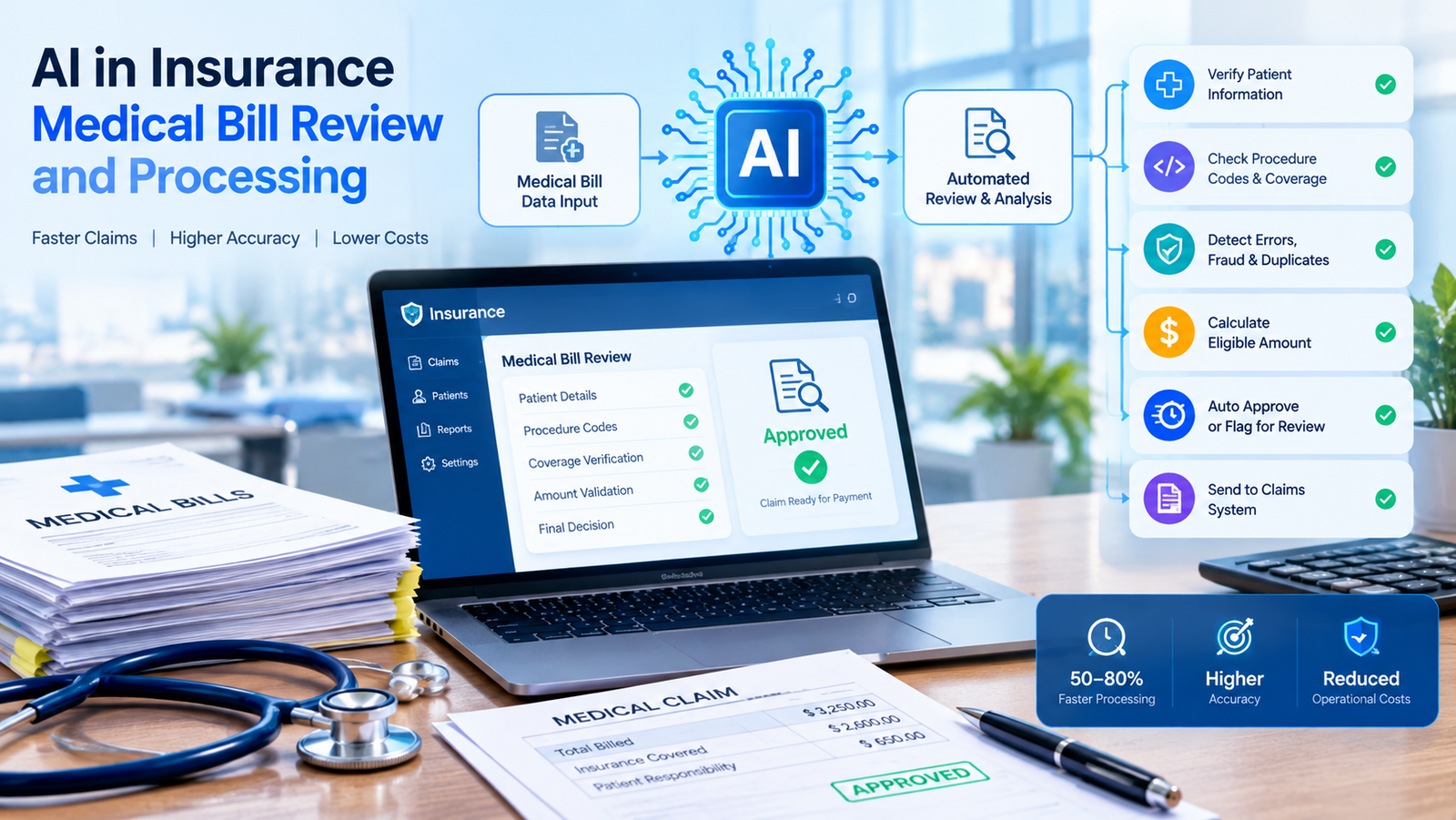
Medical bill review is the process of checking whether a healthcare provider’s charges are accurate, properly documented, correctly coded, and eligible for payment under an insurance policy or contract. It can involve medical necessity, diagnosis and procedure codes, duplicate charges, benefit limits, provider contracts, billing rules, and supporting clinical records.
For insurers, the challenge is processing large volumes of claims while identifying errors, inappropriate charges, possible fraud, and cases that need additional documentation. For hospitals and billing companies, the challenge is submitting clean claims, resolving rejections, responding to payer questions, and collecting payment without unnecessary delays.
AI can support both sides of this process. Machine learning can identify unusual billing patterns, natural language processing can interpret clinical documentation, computer vision can extract information from scanned bills, and generative AI can help explain claim issues or prepare supporting documents.
Visual: The AI-assisted medical bill lifecycle
Medical notes, tests and procedures
Codes, charges and documents
Validation and anomaly detection
Approve, correct or investigate
Reimbursement and monitoring
Key principle: AI should identify evidence and recommend the next action. The insurer remains responsible for applying the relevant policy, contract, clinical standards, and legal requirements.
Why Medical Bill Processing Needs More Than Basic Automation
Traditional claims systems are effective at applying fixed rules, but medical bills contain information that is difficult to standardize. A claim may include structured codes, free-text clinical notes, scanned documents, itemized charges, provider identifiers, and policy-specific requirements. The same procedure can also be described differently across hospitals and billing systems.
AI can help connect these data sources, but medical bill review is not just a document-processing problem. A technically correct code may still be unsupported by the clinical record, while an unusual charge may be legitimate because of the patient’s condition or the complexity of treatment.
The most useful systems combine deterministic rules with AI-based interpretation. Rules should handle requirements that are explicit and stable, such as required fields, valid code formats, and contract edits. AI should help with less structured tasks, such as identifying relevant documentation, detecting unusual combinations, and explaining why a claim needs further review.
- Validate patient, provider, policy, and claim information
- Extract diagnosis, procedure, medication, and service details from documents
- Compare billed services with clinical documentation
- Identify missing, inconsistent, duplicated, or conflicting information
- Detect unusual billing patterns across providers and claims
- Route complex or high-risk cases to qualified reviewers
- Prepare clear explanations for corrections, requests for information, and appeals
Research Study: AI and Machine Learning for Healthcare Claims Fraud Detection
A systematic review published in Artificial Intelligence in Medicine in February 2025 examined machine learning methods used to detect fraud in healthcare claims. The review highlighted a fundamental problem: confirmed fraudulent claims are relatively scarce compared with legitimate claims. This imbalance makes it difficult to train and evaluate models using conventional classification methods alone.
The review covered supervised, unsupervised, and hybrid approaches. Supervised models learn from examples labelled as fraudulent or legitimate, while unsupervised models search for unusual patterns without requiring every case to have a confirmed label. Hybrid approaches combine these methods to improve detection and investigation prioritization.
The review recommends advanced machine learning and explainable AI as important directions for healthcare fraud detection. This is directly relevant to medical bill review because fraud is rarely established by one isolated billing feature. A suspicious claim may become more meaningful when it is considered alongside provider history, service frequency, patient patterns, and relationships among claims.
For an insurer, the practical lesson is to treat an AI fraud score as an investigative signal rather than proof of wrongdoing. The system should show which billing features, relationships, or deviations contributed to the alert, allowing a trained investigator to examine the underlying evidence.
Research Study: Large Language Models for Fraud Analysis in Blockchain-Based Health Insurance Claims
A study published in Scientific Reports in August 2025 examined the use of large language models for fraud analysis and detection in blockchain-based health insurance claims. The research is relevant because insurance claim review often requires connecting structured claim fields with unstructured information, including descriptions, supporting documents, and explanations of services.
Large language models can help interpret the language surrounding a claim, summarize evidence, and identify inconsistencies that may be difficult to detect through simple field-by-field checks. When paired with structured claim data and traceable records, this capability can support more efficient review and investigation.
However, the presence of blockchain in a claims architecture does not automatically establish that a bill is medically appropriate or correctly priced. A tamper-evident record can help preserve the history of submitted information, but the accuracy of the original information still needs to be verified. Similarly, an LLM-generated explanation should be checked against the source documents rather than accepted as an independent finding.
For production use, a system of this kind should keep the original claim, extracted information, model output, and reviewer decision linked together. That makes it easier to reconstruct why a claim was flagged and what evidence supported the final decision.
Research Study: Robotic Process Automation for Identifying Missing Codes on Insurance Claims
A 2026 operational study published in BMJ Health & Care Informatics evaluated a robotic process automation system designed to identify missing codes during insurance claim post-review at a tertiary hospital. The system integrated optical character recognition with electronic medical record data and compared surgical procedure codes with related cutting-device codes.
During the reported implementation period, the system analyzed 61 claim statements and performed 199 OCR processes. Google Cloud Vision achieved 100% detection accuracy in the study’s test, with no false positives, while Tesseract produced lower accuracy. Average processing time fell from 120 minutes for manual review to 54 minutes with the automated workflow, a reported efficiency improvement of 55%.
This study is especially useful because it evaluates a defined operational task rather than making a broad claim that AI can automate all medical billing. The workflow had a clear comparison rule, a specific set of codes, and a measurable outcome. It demonstrates how OCR and automation can reduce repetitive review work when the information and validation criteria are sufficiently structured.
The findings should not be generalized to every type of medical bill. The study was conducted at one center and focused on a specific coding discrepancy. Insurers should test similar systems on their own claim types, document formats, coding rules, and exception cases before expanding them.
Research Study: AI in Prior Authorization and Coverage Decisions
A systematic review published in the Journal of Managed Care & Specialty Pharmacy in September 2026 examined AI applications across prior authorization workflows. Although prior authorization occurs before some services are delivered, its findings are relevant to medical bill processing because both workflows depend on clinical documentation, coverage criteria, and decisions about whether a service meets applicable requirements.
The review screened 3,417 records and included 16 studies. AI applications were concentrated in payer review and decision-making, which accounted for 62.5% of the included studies. Other applications covered post-denial appeals, initial submissions, and early authorization steps. The research included classical machine learning, deep learning, and hybrid approaches.
The review found that fairness and bias were rarely evaluated in the included research. This is a significant evidence gap. A model can achieve strong overall performance while producing less reliable results for particular patient groups, medical conditions, or providers. In medical bill review, such differences could affect which claims are delayed, investigated, or denied.
The practical implication is that insurers should evaluate not only processing speed and model accuracy but also the effect of AI-assisted decisions on claim outcomes, appeals, and different patient populations. The review also reinforces the need to distinguish between automating administrative tasks and making consequential coverage decisions.
Research Study: AI Adoption in Health Insurance Utilization Review
A January 2026 policy analysis in Health Affairs examined the use of AI by insurers and healthcare providers in utilization review, including prior authorization, concurrent review, and claims adjudication. The article reported findings from a 2024 National Association of Insurance Commissioners survey of 93 large health insurers across 16 states.
According to the survey, 84% of those insurers were using AI for some operational purposes. The reported use included 44% for claims adjudication, 37% for prior authorization, and 56% for utilization management activities broadly defined. These figures describe reported adoption among the surveyed large insurers, not the entire insurance market.
The article explains that AI tools can help extract information from electronic health records, compare requests with coverage criteria, identify billing anomalies, and support post-payment audits. It also raises concerns about opaque decisions, automation bias, weak governance, and whether human review is meaningful when staff are expected to follow AI recommendations.
For medical bill processing, this research suggests that adoption is moving beyond experimentation. However, adoption rates should not be mistaken for proof of effectiveness. Insurers need independently measured evidence that automation improves accuracy, reduces unnecessary delays, and does not increase inappropriate denials.
Research Study: Data-Driven Healthcare Insurance Using Machine Learning and Blockchain
A 2025 study published in PeerJ Computer Science explored a data-driven healthcare insurance system combining machine learning and blockchain technologies. This research addresses two distinct parts of insurance processing: using data analytics to support insurance-related decisions and using blockchain to strengthen the integrity and traceability of records.
For medical bill review, these ideas can be applied to a system in which claim data is analyzed for inconsistencies while important processing events are recorded in an auditable history. For example, a claim may pass through document extraction, code validation, exception review, correction, and payment. A traceable record can help establish which data and decisions were present at each stage.
The combination should be designed carefully. Machine learning can help identify patterns, but blockchain does not guarantee that a submitted medical record or bill is true. Likewise, putting sensitive patient information directly on a public or broadly accessible ledger can create privacy and governance problems. A safer architecture generally keeps sensitive clinical data in appropriately protected systems and records only the necessary references or integrity proofs in the audit layer.
Visual Research Summary: What the Evidence Actually Shows
| Research | AI application | Reported contribution | Important limitation |
|---|---|---|---|
| Healthcare claims fraud review, 2025 | Machine learning | Reviews supervised, unsupervised, and hybrid fraud detection | Fraud labels are scarce |
| LLMs and blockchain claims, 2025 | LLM-assisted fraud analysis | Explores language-model support for claim analysis | Model output needs evidence verification |
| Missing-code RPA, 2026 | OCR and workflow automation | 55% lower average processing time in the implementation | Single-center, specific coding task |
| Prior authorization review, 2026 | ML, deep learning, hybrid AI | Maps workflow applications and evidence gaps | Fairness rarely evaluated |
| Health insurance utilization review, 2026 | Claims and utilization AI | Documents insurer adoption and governance concerns | Adoption is not proof of better outcomes |
| ML and blockchain insurance, 2025 | Data analytics and record integrity | Explores an auditable data-driven architecture | Data integrity does not establish clinical truth |
Where AI Fits in the Medical Bill Review Workflow
Automated Medical Document Intake
Medical bills arrive in different formats, including electronic claims, scanned invoices, itemized statements, medical records, and supporting attachments. AI-powered document processing can classify these files, extract relevant fields, and connect them to the correct claim.
Optical character recognition converts scanned text into machine-readable content. Natural language processing can then identify details such as service dates, procedure descriptions, diagnosis references, provider names, and billed amounts. Validation rules should check extracted values against the original document and known claim data before they are used downstream.
This workflow is especially useful when organizations still receive documents through email, portals, fax conversions, or legacy systems. However, low-quality scans, handwritten notes, unusual layouts, and inconsistent terminology should trigger confidence checks rather than silent acceptance.
AI-Assisted Medical Coding Review
Medical coding review checks whether the codes on a bill accurately represent the services documented in the medical record. AI can compare code descriptions with clinical notes, identify missing supporting information, and flag combinations that may require a specialist’s review.
A useful system should distinguish between a clear coding error and a potential discrepancy. For example, a code may appear inconsistent because a required modifier is missing, because the documentation is incomplete, or because the service was genuinely different from what the code suggests. These situations require different actions.
AI coding review should use current code sets, payer policies, and contract rules. Updates to coding standards must be reflected in the validation layer, and model performance should be rechecked when coding requirements change.
Medical Necessity and Documentation Checks
Medical necessity review examines whether the submitted documentation supports the billed service under the applicable coverage policy. AI can retrieve relevant passages from clinical records and compare them with specific policy requirements.
The system should show the evidence it used, including the document, page or section, and the policy criterion being checked. If the required evidence is absent, the system should identify the missing information rather than invent a clinical explanation.
Medical necessity is a high-impact area because an incorrect decision can delay reimbursement or affect access to care. AI can help organize evidence, but clinical judgment and the applicable coverage rules must remain central to the decision.
Duplicate and Inconsistent Charge Detection
Duplicate billing can occur when the same service is submitted more than once, when corrected claims are not properly linked, or when different systems create overlapping records. AI can compare claims using patient, provider, date, procedure, amount, and claim-history features.
A simple exact match can be handled with deterministic rules. AI becomes more useful when duplicates are not identical, such as when descriptions differ, dates are shifted, or a claim has been resubmitted with altered fields. The system should consider legitimate repeat services and corrected submissions before flagging a case.
Payment Integrity and Post-Payment Audits
Payment integrity focuses on ensuring that claims are paid accurately under the relevant contract and coverage rules. AI can identify unusual billing patterns, compare charges with historical behavior, and select claims for post-payment audit.
The model should account for differences among specialties, provider sizes, geographic markets, patient complexity, and service types. A provider that bills more complex cases may naturally have higher average charges than a general practice. A model that ignores these differences may generate many false positives.
AI Techniques for Insurance Medical Bill Processing
| Technology | Best-fit task | Required safeguard |
|---|---|---|
| OCR and document AI | Extract fields from bills and attachments | Confidence thresholds and source-document checks |
| Natural language processing | Interpret notes and procedure descriptions | Clinical terminology validation |
| Supervised machine learning | Predict errors or prioritize audit cases | Reliable labels and drift monitoring |
| Anomaly detection | Find unusual billing patterns | Contextual review to avoid false accusations |
| Generative AI | Summarize records and draft explanations | Citations to source evidence and human approval |
| Rules engines | Apply explicit coding and contract edits | Version control and policy updates |
Visual: Recommended AI Claims Review Decision Flow
Validate required fields and documents
Codes, duplicates, policy rules, arithmetic and eligibility
Assess discrepancies and supporting evidence
Process under approved rules
Request clarification or correction
Route to qualified reviewer
Record evidence, rule version, model output and reviewer action
Generative AI for Medical Bill Explanations and Appeals
Generative AI can reduce the time needed to explain a claim issue, summarize a medical record, or prepare a response to a payer. For example, a billing team may need to explain why a procedure was performed, identify the documentation supporting a billed service, or respond to a denial based on missing information.
A well-designed assistant can retrieve relevant sections of the medical record, match them to the payer’s stated reason, and prepare a structured draft. It should also identify evidence gaps and distinguish facts from assumptions.
The assistant must not fabricate clinical details, policy language, or billing codes. Every material statement should be traceable to a source document or an approved policy. Drafts involving clinical interpretation, payment disputes, or appeals should be reviewed by qualified staff before submission.
Business Benefits and How to Measure Them
The value of AI in medical bill processing should be measured across the full workflow rather than through speed alone. A system that processes claims quickly but increases incorrect denials or creates more appeals may simply move costs from one department to another.
| Metric | What it measures | How to use it |
|---|---|---|
| Processing time per claim | Operational speed | Compare before and after deployment |
| First-pass clean-claim rate | Quality of claims submitted without correction | Track by provider and claim type |
| False-positive rate | Unnecessary flags | Measure investigator workload |
| Overturn rate | Decisions reversed through appeal or review | Check for poor decision quality |
| Manual touch rate | Share of claims needing staff intervention | Identify safe automation opportunities |
| Payment accuracy | Correct payment under policy and contract | Validate against audited outcomes |
Risks and Governance Requirements
AI in insurance medical bill review affects reimbursement, provider revenue, patient finances, and sometimes access to care. Organizations should therefore treat it as a governed decision-support capability rather than a generic back-office automation project.
- Incorrect extraction: OCR or document AI may misread a code, amount, date, or patient detail
- False fraud alerts: unusual billing patterns may reflect legitimate differences in case mix or specialty
- Biased outcomes: models may perform differently across providers, patient groups, or service categories
- Outdated rules: coding requirements, contracts, and coverage policies can change
- Automation bias: staff may accept model recommendations without checking the evidence
- Privacy and security: medical records contain sensitive personal information that requires strong safeguards
- Weak explainability: unexplained decisions are difficult to audit, appeal, or correct
A responsible system should preserve the original claim, extracted fields, policy version, model version, supporting evidence, reviewer actions, and final outcome. It should also support correction when a model or rule produces an error.
Expert Recommendation
The recommended strategy is to begin with high-volume, clearly defined review tasks and expand only after measurable results have been demonstrated. Medical bill review contains many repetitive processes, but not all of them are suitable for full automation.
Start with document classification, missing-field detection, duplicate checks, arithmetic validation, and code consistency. These tasks have clearer rules and can be evaluated against known outcomes. Then introduce AI-assisted documentation review, anomaly detection, and case prioritization, where contextual judgment becomes more important.
For high-impact decisions, use a human-reviewed workflow with evidence-based explanations. Do not make a claim denial, fraud accusation, or clinical necessity determination solely because a model produced a high risk score.
The implementation should include:
- Baseline measurement before automation
- Validation on representative historical claims
- Prospective testing in a limited workflow
- Separate monitoring of approvals, denials, corrections, and appeals
- Fairness checks across relevant patient and provider groups
- Clear escalation paths for uncertain or high-impact cases
- Regular review of model drift and policy changes
- Auditable records of model outputs and human decisions
Expert Perspective: Keep Human Review Meaningful
A key concern raised in the 2026 Health Affairs analysis is the risk of nominal human oversight, where a person is technically involved but does not meaningfully evaluate the AI recommendation. The article discusses the problem of “humans in the loop” and the risks of automation bias, opaque decisions, and insufficient governance.
For medical bill processing, this means that human review should involve access to the source evidence, enough time to assess the case, and genuine authority to disagree with the model. A reviewer should not be expected to approve an AI-generated recommendation without understanding its basis.
Source: Health Affairs, The AI Arms Race in Health Insurance Utilization Review, 2026
Implementation Roadmap
Phase 1: Data readinessMap claim formats, clinical records, coding systems, payer policies, and existing exception queues
Phase 2: Rules and extractionAutomate document intake, required-field checks, code validation, and duplicate detection
Phase 3: AI reviewIntroduce anomaly detection, documentation comparison, and risk-based case prioritization
Phase 4: Governed scale-upExpand only after outcome, fairness, audit, and operational checks meet agreed thresholds
Future Predictions: 2027–2030
More Claims Will Be Reviewed Before Submission
AI is likely to move further upstream, helping providers and billing teams identify missing documentation, coding inconsistencies, and incomplete claim fields before submission. This could reduce avoidable rework for both providers and insurers. The value will depend on whether systems can interpret payer-specific rules accurately and keep those rules current.
Medical Bill Review Will Become More Evidence-Centered
Future systems will increasingly connect each claim decision to the exact clinical record, billing field, policy clause, or contract rule that supports it. This will make reviews easier to explain and audit, and could help reduce disputes caused by vague denial explanations.
AI Agents Will Coordinate Administrative Workflows
AI agents may coordinate tasks such as retrieving missing records, checking claim status, drafting requests for information, and routing cases to the right team. High-impact decisions should remain subject to controlled workflows, permissions, and human review rather than being delegated to an unrestricted agent.
Payment Integrity Will Use Network-Level Analysis
Fraud and abuse detection is likely to combine individual claim anomalies with provider, patient, procedure, and billing-network patterns. This could help investigators identify connected behavior that is difficult to detect from a single claim, while requiring safeguards against treating statistical association as proof of misconduct.
Regulatory Expectations Will Emphasize Accountability
As AI use expands in insurance operations, organizations should expect continued scrutiny of how models are tested, monitored, explained, and governed. The exact requirements will differ by jurisdiction and insurance product, so implementation teams must map the applicable rules rather than rely on a single global compliance checklist.
Startup Opportunities
AI medical bill review creates opportunities for specialized healthcare technology companies. The strongest products will solve a clearly defined operational problem and integrate with existing claims, billing, and clinical systems.
- AI Medical Bill Auditor: Reviews itemized bills for inconsistent charges, missing details, and coding issues
- Clinical Documentation Matching: Connects billed services to supporting medical-record evidence
- Pre-Submission Claim Quality Platform: Helps providers identify avoidable errors before claims reach payers
- AI Payment Integrity Engine: Prioritizes claims for audit using explainable anomaly detection
- Medical Coding Review Assistant: Flags potential coding inconsistencies for qualified coders
- Claims Appeal Copilot: Organizes denial reasons, supporting records, and draft appeal documents
- Insurance Document Intelligence API: Extracts structured claim data from bills, forms, and attachments
- AI Claims Audit Trail: Records evidence, rule versions, model outputs, and reviewer decisions
A practical product strategy is to focus on one expensive, measurable problem first, such as missing-code detection or pre-submission document completeness. A narrow tool with reliable results can be easier to validate and integrate than a platform that promises to automate every stage of medical billing.
Frequently Asked Questions
What is AI in insurance medical bill review?
AI in insurance medical bill review uses machine learning, document processing, natural language processing, and automation to check medical claims for missing information, coding inconsistencies, unusual charges, potential fraud, and policy-related issues.
Can AI automatically process medical insurance claims?
AI can automate defined administrative checks and support claim decisions. Full automation is most appropriate for cases governed by clear rules and reliable data. Complex clinical, coverage, or fraud-related cases may require qualified human review.
How does AI detect medical billing fraud?
AI can identify unusual billing patterns, suspicious relationships among claims, and deviations from expected provider behavior. These signals help prioritize investigations, but they do not independently prove fraud.
Can generative AI review medical bills?
Generative AI can summarize records, extract relevant information, explain potential discrepancies, and draft responses. Its outputs should be checked against source documents because it can misinterpret records or generate unsupported statements.
What is the difference between RPA and AI in claims processing?
Robotic process automation follows defined steps to move data between systems and perform repetitive tasks. AI can interpret documents, identify patterns, and handle less structured information. Combining them can support more flexible workflows, provided that validation and exception handling are built in.
How should insurers measure AI claims-processing performance?
Insurers should track processing time, first-pass accuracy, manual review rates, false positives, appeal outcomes, payment accuracy, and differences in performance across relevant claim categories. Speed alone is not enough to establish that the system is improving claim quality.
Final Perspective
AI can improve insurance medical bill review when it is applied to specific problems with clear evidence and measurable outcomes. The most immediate opportunities include document extraction, missing-code checks, duplicate detection, claim completeness, coding consistency, and prioritization of unusual claims.
Research published in 2025 and 2026 shows that machine learning, large language models, and automation are being applied to healthcare claims and insurance workflows. The evidence also shows why careful implementation matters. A single-center automation study reported a 55% reduction in processing time for a specific missing-code review task, while systematic reviews highlight challenges such as scarce fraud labels, limited fairness evaluation, and the need for explainable models.
The practical goal should not be to maximize the number of automated denials or fraud alerts. It should be to make claim processing more accurate, faster, easier to audit, and less burdensome for providers, insurers, and patients.
The strongest operating model combines:
Organizations that build around these principles can use AI to reduce avoidable administrative work while preserving accountability for consequential decisions.
Research Sources
- Fraud Detection in Healthcare Claims Using Machine Learning: A Systematic Review, Artificial Intelligence in Medicine, 2025
- Using Large Language Models for Enhanced Fraud Analysis and Detection in Blockchain-Based Health Insurance Claims, Scientific Reports, 2025
- Robotic Process Automation for Identifying Missing Codes on Insurance Claims, BMJ Health & Care Informatics, 2026
- Artificial Intelligence in Prior Authorization and Coverage Decisions: A Systematic Review of Methods, Evidence Gaps, and Future Implications for Patient Access, 2026
- The AI Arms Race in Health Insurance Utilization Review: Promises of Efficiency and Risks of Supercharged Flaws, Health Affairs, 2026
- Data-Driven Healthcare Insurance System Using Machine Learning and Blockchain Technologies, PeerJ Computer Science, 2025
- Centers for Medicare & Medicaid Services, Eligibility and Claim Status Operating Rules
- U.S. Department of Health and Human Services, HIPAA Security Rule

Leave a Reply