
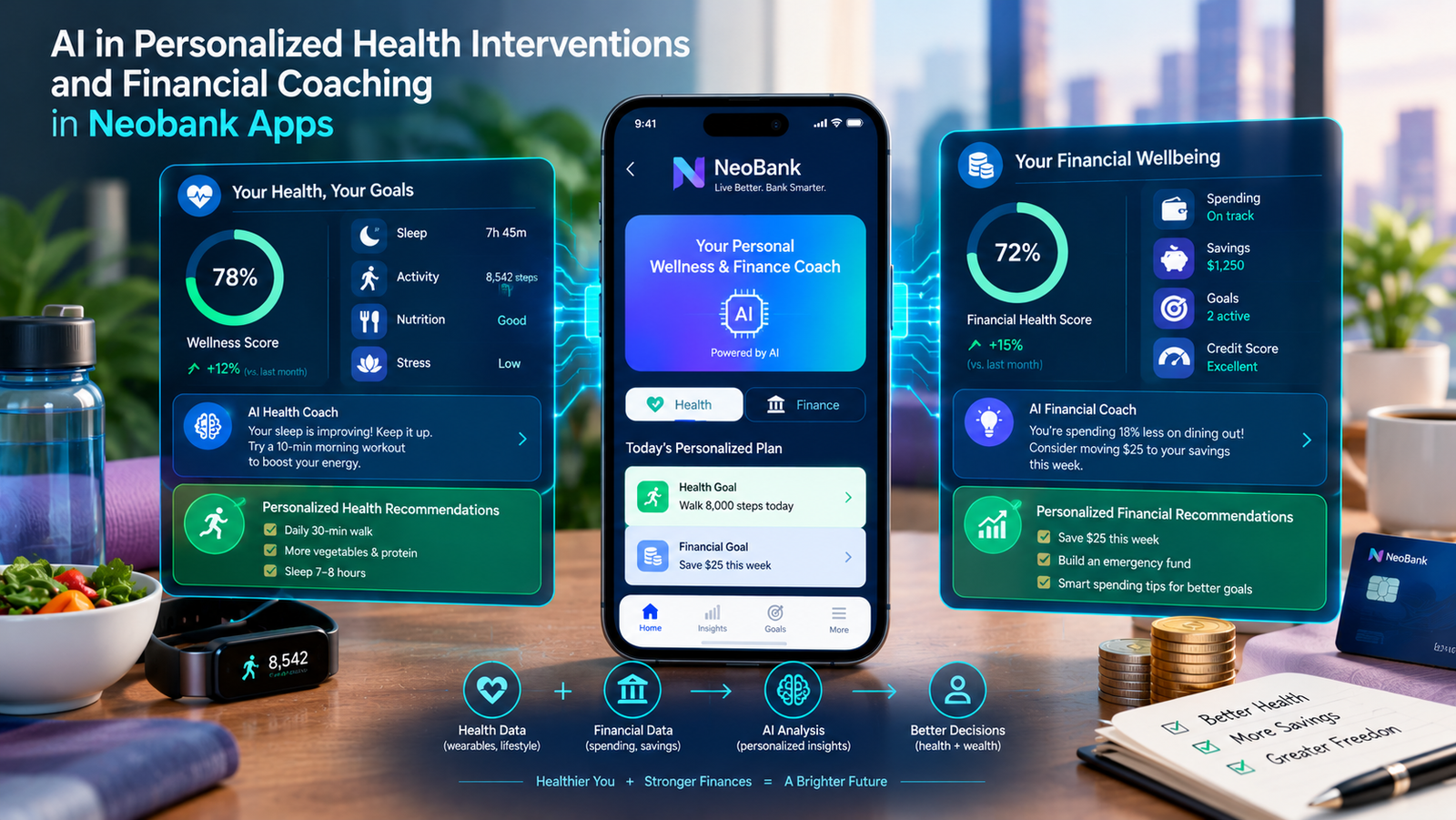
Primary topic: AI in Personalized Health Interventions and Financial Coaching in Neobank Apps
Research focus: AI-powered financial wellness, personalized coaching, behavioral nudges, predictive cash-flow alerts, savings behavior, debt management, financial stress, digital health integration, habit formation, conversational AI, privacy, and responsible personalization in mobile banking
Why Neobanks Are Moving Toward Personalized Financial Wellness
Neobanks have a close view of everyday financial activity. With customer permission, they may be able to analyze salary deposits, recurring bills, subscriptions, card spending, savings balances, and changes in cash flow. This creates an opportunity to provide help at the moment a customer needs it rather than waiting for them to open a budgeting tool or speak to an adviser.
Traditional mobile banking apps mainly show what has already happened. They display balances, transaction histories, spending categories, and monthly summaries. An AI-enabled financial wellness app can go further by estimating what may happen next and explaining which actions could help.
For example, a customer who receives a salary every two weeks may have rent, utility bills, loan payments, and grocery expenses due before the next payday. Instead of merely reporting that the account balance is low, an AI system could forecast the likely shortfall, explain which upcoming payments contribute to it, and suggest practical options such as moving a savings transfer, reviewing subscriptions, or setting a lower discretionary spending limit.
The health connection requires more care. Financial pressure can affect sleep, stress, access to healthcare, and the ability to maintain healthy routines. Yet a bank should not assume that transaction data reveals a person’s health condition. Health-related support should be optional, clearly explained, and separated from decisions about credit, pricing, or eligibility.
What Is AI-Powered Financial and Health Coaching?
AI-powered financial coaching uses machine learning, predictive analytics, and conversational systems to help customers understand their financial position and act on their goals. A health-related intervention may add optional tools that help customers plan for healthcare expenses, manage the financial side of a wellness goal, or access relevant support resources.
The two areas overlap, but they are not interchangeable. Financial coaching can use banking data to identify cash-flow problems, while health interventions may require information about goals, habits, symptoms, or care needs. A neobank should not infer sensitive medical information from spending patterns or use it to make financial decisions.
Six Research Studies That Inform This Opportunity
The evidence is strongest when each study is considered in its own context. Some research directly examines AI in personal finance, while other studies examine financial coaching or AI-powered behavior change in health. These findings can inform neobank product design, but results from one setting should not be treated as proof of effectiveness in another.
AI-based reminders to prevent overdrafts
A randomized field experiment published in Management Science examined an AI-based advising system designed to help users avoid overdrafts and nonsufficient-funds fees. The system used financial information to predict the likelihood of an overdraft and sent reminders when they were needed. The study drew on users of a large personal financial management platform operating in the United States and Canada.
The researchers found that as-needed reminders were effective, and the effect depended partly on how the message was written. Simpler messages were more effective, and the framing of the message mattered. This is directly relevant to neobanks because an alert is only useful if customers understand it and can act on it.
The finding suggests that personalization should not mean sending a long, complicated explanation. A useful intervention might say, “Your scheduled bills may leave your balance short before payday. Review your upcoming payments,” then provide a clear forecast and customer-controlled options.
The research supports the use of predictive financial alerts, but it does not mean every alert will prevent an overdraft. A bank should test outcomes such as overdraft frequency, fees, customer engagement, and whether alerts create unnecessary anxiety.
Personalized savings messages for underbanked customers
A randomized controlled trial published in the Journal of Economic Behavior & Organization investigated whether personalized messages could encourage savings among a mostly unbanked population. The study compared different information interventions, including messages tailored to individuals’ savings behavior.
The researchers found that personalized SMS messages had a positive effect on savings during the messaging period. However, the effects faded after the messages stopped. The study also found that highlighting a specific monetary goal appeared more effective than simply making the information feel more tangible.
For neobanks, this points toward goal-based coaching rather than generic reminders. A customer saving for an emergency fund, a rent payment, or a planned healthcare expense may benefit from seeing progress toward that specific goal. The app could calculate a manageable contribution based on expected income and upcoming expenses.
The limitation is important: a temporary increase in saving does not necessarily mean a lasting change in financial behavior. A neobank should measure whether customers maintain their savings after prompts become less frequent.
Financial coaching and measurable household outcomes
A randomized evaluation of client-led financial coaching examined outcomes at two sites in New York City and Miami. Researchers used credit bureau records, surveys, and individual-level outcomes to assess the effects of coaching.
The study reported improvements in several areas related to money management, debt, savings, and perceived financial well-being. Results differed by site: at one location, coaching helped participants increase savings and credit scores, while at the other, participants reduced aggregate and delinquent debt.
This research is not an evaluation of AI coaching. Its value is that it helps define the outcomes a digital financial coach should aim to support. A product should not judge success only by app opens, chatbot conversations, or the number of goals created. It should examine whether customers build savings, reduce missed payments, manage debt, and feel more capable of handling financial decisions.
AI may make certain coaching functions available more frequently and at lower marginal cost, but automated guidance may not reproduce the trust, context, and accountability provided by a human coach.
AI and machine learning in digital behavior-change interventions
A scoping review examined real-world digital behavior-change interventions that use AI or machine learning to influence health behaviors. The researchers identified 32 articles, of which 23 described digital behavior-change interventions using AI to influence real-world behavior.
The methods included classical machine learning, reinforcement learning, natural language understanding, and conversational AI. Applications covered areas such as cardiometabolic health and lifestyle interventions. The review found generally positive evidence, while also identifying limitations such as difficulty establishing causation, limited generalizability, and study durations that were too short to assess long-term outcomes.
This research is relevant to the health component of a neobank wellness service. It suggests that AI can help process multiple inputs and tailor interventions to a person’s context. For example, an optional wellness feature might adapt the timing of a reminder to a user’s chosen routine rather than sending the same message to everyone.
However, a banking app should not present a behavior-change model as a medical treatment. If the product provides health recommendations, those features require appropriate clinical evidence, safety review, and qualified oversight.
How people use generative AI for personal financial management
A 2026 study in the Journal of Behavioral and Experimental Finance examined how individuals use large language models for everyday personal financial management. It reported that 67.8% of participants had used an LLM for at least one of the financial tasks presented, while 15% had used one across all ten tasks.
Common uses included investment, savings planning, budget management, and tax filing. Participants treated the tools in different ways, including as an on-demand tutor, a search tool, a quasi-adviser, and a source of psychological support.
For neobanks, this suggests that customers may welcome conversational interfaces for explaining financial information. An in-app assistant could explain why spending has increased, compare a customer’s current progress with a savings goal, or describe the trade-offs between paying down debt and building an emergency fund.
The study concerns reported use of generative AI, not proof that AI advice improves financial outcomes. Product teams should therefore distinguish customer interest from demonstrated effectiveness and prevent the assistant from inventing account facts, making unsupported claims, or presenting uncertain projections as guarantees.
Financial habit formation and goal-setting
A 2026 randomized behavioral trial published in Scientific Reports compared goal-setting and habit-based interventions designed to change financial behavior. The study enrolled 397 students, with 224 completing the trial, across two universities in the United Kingdom and Australia. It used objective bank transaction data over a 12-week period.
The goal-setting intervention included expense tracking, explicit savings targets, and progress feedback. The habit-based intervention encouraged participants to substitute cheaper alternatives for routine purchases. The published results reported that goal-setting reduced monetary consumption and improved account balances compared with the control group.
This study provides a useful product-design lesson: financial coaching can focus on either deliberate goals or everyday habits. A neobank could let customers choose between a goal such as “save $500” and a habit such as “keep weekday takeaway spending within a chosen limit.”
The sample and setting limit how broadly the results can be generalized. The findings should inform experiments, not be treated as a guarantee that the same intervention will work for all ages, income levels, or customer groups.
What the Research Means for Neobank Product Design
Across these studies, several design principles emerge. They are not all proven by the same experiment, and the distinction matters when translating research into a commercial product.
| Research insight | Product implication | What to measure |
|---|---|---|
| Timely reminders can help prevent overdrafts | Forecast shortfalls and alert customers before bills are due | Overdrafts, fees, alert usefulness |
| Personalized savings effects may fade | Build durable goals and review progress over time | Savings persistence after prompts stop |
| Coaching outcomes vary by setting | Offer human escalation and segment-specific evaluation | Debt, savings, missed payments, well-being |
| AI can personalize behavior interventions | Adapt timing and content to user-selected goals | Behavior change, opt-outs, adverse effects |
| Customers use LLMs for financial questions | Provide grounded, account-aware explanations | Answer accuracy, resolution, complaints |
| Goal-setting can influence financial habits | Support both goal-based plans and small habit changes | Goal completion and account balance trends |
High-Value AI Use Cases in Neobank Apps
Predictive cash-flow coaching
Cash-flow coaching is a natural starting point because it can use transaction data that the bank already holds. A forecasting model can estimate upcoming income, bills, card payments, and likely end-of-period balances. When a potential shortfall appears, the app can explain the forecast and offer options without making decisions for the customer.
Useful capabilities include:
- Forecasting balances before recurring bills are charged
- Identifying irregular income patterns
- Estimating how much is safe to move into savings
- Warning about possible low-balance periods
- Explaining which assumptions drive the forecast
The forecast should show uncertainty. If income varies, the app should not display one future balance as though it were certain.
Personalized savings and emergency-fund plans
A generic savings target can be unrealistic for someone with irregular income or high fixed costs. AI can help create a plan around the customer’s actual cash-flow pattern, selected goal, and preferred contribution frequency.
For example, the app could suggest a smaller contribution after a low-income week and a larger contribution after a stronger one. Customers should be able to change the plan, pause transfers, or reject recommendations without penalty.
The system should avoid encouraging savings transfers that leave customers unable to pay essential bills. A savings recommendation is only useful when it accounts for liquidity needs.
Debt-management support
An AI coach can help customers understand payment schedules, interest costs, and the potential consequences of missed payments. It may compare repayment scenarios using verified account terms and clearly state assumptions.
The app should not automatically prioritize a debt strategy without considering fees, promotional rates, minimum payments, emergency cash needs, and the customer’s preferences. Complex hardship cases should be referred to qualified human support.
Financial stress and optional wellness support
Financial stress can be relevant to a customer’s broader well-being, but a neobank should avoid diagnosing stress or mental health conditions from transaction data. A safer approach is to let customers voluntarily choose a goal such as reducing money-related worry, planning for healthcare expenses, or building a financial buffer.
The app could then offer practical tools, such as a bill calendar, a spending plan, or links to reputable support services. If it includes clinical health content, that content should be developed and reviewed with qualified health professionals.
Conversational financial coaching
A conversational assistant can make financial information easier to understand. Customers might ask why their balance is lower than expected, how much they spent on subscriptions, or what would happen if they saved a fixed amount each month.
The assistant should retrieve figures from trusted banking systems rather than invent them. It should distinguish historical facts from estimates, cite the transactions or assumptions behind an answer, and avoid presenting itself as a licensed financial adviser unless the service is appropriately authorized.
Visual: How a Personalized Coaching Session Works
Transactions, bills, chosen goals
Cash-flow or goal risk
Simple explanation and options
Accept, adjust, or dismiss
Feedback loop: Measure the outcome, learn whether the intervention helped, and improve future recommendations without removing customer control
Technical Architecture: From Banking Data to Personalized Guidance
A production system should separate financial data processing, prediction, language generation, and action execution. This reduces the chance that a conversational model will make unsupported claims or initiate an action without authorization.
Bank transactions, recurring payments, customer-selected goals, and separately consented wellness preferences
Data processing layer
Transaction categorization, identity controls, data quality checks, and feature engineering
Prediction layer
Cash-flow forecasts, bill-risk prediction, savings projections, and personalized intervention selection
Coaching layer
Grounded explanations, goal planning, conversational support, and accessible content
Control layer
Customer confirmation, suitability checks, escalation rules, audit logs, and monitoring
Which AI models belong in the system?
Different tasks require different methods. A single large language model should not be expected to forecast balances, detect behavioral changes, calculate debt costs, and provide health guidance equally well.
| Capability | Potential method | Required safeguard |
|---|---|---|
| Cash-flow forecasting | Time-series models and supervised ML | Prediction intervals and backtesting |
| Transaction categorization | Classification and text models | Correction tools and confidence thresholds |
| Intervention timing | Rules, contextual bandits, or reinforcement learning | Frequency limits and outcome testing |
| Financial explanations | Retrieval-grounded language models | Verified data, citations, and refusal behavior |
| Wellness content | Curated content with personalization | Clinical review where health claims are made |
Privacy, Consent, and the Boundary Between Finance and Health
A neobank may have access to highly revealing financial data. Merchant names, recurring purchases, pharmacy transactions, insurance payments, and healthcare bills can expose sensitive aspects of a person’s life. The fact that data is available does not mean it should be used for every possible inference.
Health-related personalization should follow clear boundaries:
- Make wellness features optional and explain what information they use
- Collect only the data needed for the selected service
- Keep health-related preferences separate from credit underwriting and pricing
- Do not infer diagnoses, disability, pregnancy, or mental health conditions from spending
- Provide controls to review, correct, delete, or withdraw optional data where applicable
- Limit employee and vendor access to sensitive information
- Use retention limits, encryption, and auditable access controls
Consent should be understandable and specific. A general acceptance of banking terms should not be treated as meaningful permission for unrelated health profiling.
Risk Matrix: Where Personalized AI Can Go Wrong
| Risk | Example | Control |
|---|---|---|
| Incorrect prediction | The app predicts a shortfall despite an upcoming income deposit | Show assumptions and uncertainty; allow correction |
| Intrusive personalization | A purchase triggers an unwanted health-related message | Use opt-in preferences and neutral language |
| Financial harm | A savings prompt leaves too little for essential bills | Protect liquidity and require confirmation |
| Biased recommendations | Advice works poorly for irregular-income customers | Evaluate performance across customer groups |
| Hallucinated advice | A chatbot invents a fee, benefit, or account term | Ground responses in verified product and account data |
| Over-notification | Repeated alerts create stress or cause users to disengage | Frequency caps and notification controls |
Expert Recommendation
The most practical approach is to begin with financial coaching features that have measurable outcomes and relatively low risk, then expand into optional wellness support only when the product has appropriate evidence, consent, and oversight.
A recommended development sequence is:
- Start with transaction categorization, bill calendars, and cash-flow forecasts
- Add personalized overdraft warnings with clear explanations
- Introduce customer-defined savings and debt goals
- Test reminder timing, wording, and frequency through controlled experiments
- Add a conversational assistant grounded in verified account data
- Offer optional wellness planning without inferring medical conditions
- Introduce health-related content only with suitable expert review
- Provide human escalation for hardship, complex debt, or sensitive situations
- Evaluate real financial outcomes, fairness, privacy, and customer trust
The product team should treat customer autonomy as a core feature. Recommendations should explain the reason for a suggestion, show relevant trade-offs, and let customers decline without repeated pressure. The system should never optimize only for engagement, deposits, lending conversion, or product sales when those goals could conflict with a customer’s financial well-being.
Expert Quote: Why Simplicity Matters
Mintz and Sade, Management Science, research on AI-based reminders and overdraft prevention
This finding is particularly relevant to financial coaching. Personalization should make guidance more useful, not more complicated. A clear message tied to a specific upcoming event may be more actionable than a long AI-generated explanation filled with financial terminology.
Implementation Roadmap for a Neobank
Data foundation
Improve transaction categorization, recurring-payment detection, consent records, and data quality
Predictive insights
Launch balance forecasts, upcoming-bill alerts, and customer-controlled savings plans
Adaptive coaching
Test personalized reminders, goal-setting, and conversational explanations
Wellness integration
Add optional health-related financial planning with privacy controls and expert review
KPIs: How to Measure Whether AI Coaching Works
A neobank should measure both customer outcomes and the quality of the AI system. Engagement metrics can help explain usage, but they cannot prove that a customer is financially better off.
| KPI | What it measures |
|---|---|
| Overdraft frequency | Whether predictive alerts help prevent avoidable shortfalls |
| Savings persistence | Whether savings behavior continues after reminders are reduced |
| Missed-payment rate | Whether customers manage scheduled obligations more reliably |
| Goal completion | Whether customers make progress toward self-selected goals |
| Forecast accuracy | How closely predicted balances match actual outcomes |
| Customer-reported usefulness | Whether guidance is understandable, relevant, and respectful |
| Complaint and opt-out rates | Whether personalization feels intrusive or excessive |
| Outcome differences between groups | Whether the system works unevenly across income patterns or customer groups |
Future Predictions: 2027–2030
2027: Predictive financial wellness becomes more common
Neobanks are likely to expand from retrospective spending summaries toward proactive cash-flow guidance. More apps will attempt to forecast upcoming bills, identify potential shortfalls, and personalize reminders based on customer-selected preferences. The key product challenge will be ensuring that forecasts are accurate enough to help without creating unnecessary worry.
2028: Conversational coaching becomes more account-aware
Financial assistants are likely to become more closely connected to verified account data and product rules. Instead of giving generic explanations, they may answer questions about a customer’s own spending, savings progress, and upcoming obligations. Reliable systems will need strong controls against fabricated figures, incorrect fee explanations, and unauthorized actions.
2029: Adaptive interventions become more measurable
As banks collect better evidence about which interventions help different customers, they may use contextual models to adapt message timing, wording, and frequency. This could move coaching away from fixed monthly prompts toward support that responds to a customer’s situation. The challenge will be proving sustained benefit rather than optimizing short-term engagement.
2030: Financial and wellness services may become more connected
Some neobanks may offer optional services that connect financial planning with healthcare budgeting, wellness goals, and access to support resources. Such services will require clear boundaries between banking data and health information. The systems that earn trust will be those that make data use understandable, provide meaningful choice, and avoid turning sensitive inferences into financial decisions.
These are forward-looking scenarios, not guaranteed outcomes. Adoption will depend on customer trust, product economics, evidence of benefit, regulation, and the ability to protect sensitive information.
Startup and Product Opportunities
The combination of AI, digital banking, and personalized coaching creates opportunities for fintech developers and neobanks.
- Predictive Cash-Flow Coach: Forecast upcoming balances and help customers prepare for bills
- AI Savings Companion: Build flexible savings plans around income patterns and personal goals
- Debt Planning Assistant: Explain repayment scenarios and highlight upcoming obligations
- Financial Wellness API: Provide transaction insights and coaching features to banking platforms
- Personalized Nudge Engine: Test message timing, content, and frequency against measurable outcomes
- Healthcare Cost Planner: Help users budget for appointments, prescriptions, and planned care expenses
- Financial Coaching Copilot: Support human coaches with verified summaries and progress tracking
- Privacy-Preserving Personalization: Enable tailored support while minimizing the use of sensitive data
A particularly practical opportunity is a financial wellness API for neobanks that already have transaction data but lack a dedicated coaching layer. Such a platform could provide cash-flow forecasts, savings-goal tracking, personalized notifications, and explainable recommendations without requiring each bank to build every model from scratch.
Frequently Asked Questions
What is AI-powered financial coaching in a neobank app?
It is a service that uses financial data, predictive models, and personalized explanations to help customers manage spending, prepare for bills, build savings, and understand financial choices.
Can AI improve financial well-being?
Research on AI-based overdraft reminders and studies of financial coaching provide evidence that specific interventions can improve some outcomes. Results depend on the intervention and population, so a neobank should test whether its own product creates measurable and lasting benefits.
How can a neobank connect financial coaching with health?
It can offer optional tools for healthcare budgeting, financial planning around wellness goals, and links to appropriate support resources. It should not infer medical conditions from transactions or treat banking data as a substitute for clinical information.
Can a generative AI chatbot provide financial advice?
It can explain verified account information and provide general educational guidance, but it may produce inaccurate or incomplete answers. Personalized recommendations involving debt, investments, or regulated products need appropriate safeguards and, where required, qualified advice.
What data does an AI financial coach need?
A basic service may use transaction histories, recurring payments, balances, and customer-selected goals. Health-related features should use separate, explicit consent and only the information needed for the chosen service.
How should neobanks measure success?
They should track outcomes such as overdraft frequency, savings persistence, missed payments, goal completion, forecast accuracy, customer-reported usefulness, and differences in performance across customer groups.
Final Perspective
AI-powered financial coaching gives neobanks a way to make everyday banking more useful. Instead of showing customers only what they have spent, an app can help them understand what is coming next, prepare for financial pressure, and work toward goals that matter to them.
The research points to specific opportunities. A randomized field experiment found that AI-based, as-needed reminders can help users avoid overdrafts, with the wording of the message affecting the result. Research on personalized savings messages found positive effects during the intervention period, while also showing that those effects can fade when the messages stop. Financial coaching evaluations show that outcomes can include changes in savings, debt, credit scores, and perceived financial well-being, although results vary by setting.
Research on AI-driven digital behavior interventions adds a further lesson: personalization can help tailor support to a person’s context, but evidence quality, long-term evaluation, and generalizability remain important concerns. Studies of generative AI use in personal finance also suggest that customers are already exploring conversational tools for budgeting, savings, and other financial tasks.
For neobanks, the practical direction is to start with measurable financial needs, such as cash-flow forecasting, bill reminders, and goal-based savings. Once those features are reliable, the platform can consider optional wellness tools with suitable privacy protections and expert oversight.
The central design principle is simple: **AI should help customers make informed choices, not make sensitive choices for them.** A successful financial wellness experience should be accurate, understandable, respectful, and useful in real life. Its value should be demonstrated through better customer outcomes, not merely more notifications or longer app sessions.
Research Sources
- Mintz and Sade, Using AI and Behavioral Finance to Cope with Limited Attention and Reduce Overdraft Fees, Management Science
- Personalizing or Reminding? How to Better Incentivize Savings Among Underbanked Individuals, Journal of Economic Behavior & Organization, 2024
- Client Led Coaching: A Random Assignment Evaluation of the Impacts of Financial Coaching Programs, Journal of Economic Behavior & Organization
- How Are Machine Learning and Artificial Intelligence Used in Digital Behavior Change Interventions? A Scoping Review
- How Individuals Use Generative AI for Personal Financial Management, Journal of Behavioral and Experimental Finance, 2026
- Model-Based Control Predicts Financial Behaviour Change: A Randomised Behavioural Trial of Habit Substitution and Goal-Setting, Scientific Reports, 2026

Leave a Reply