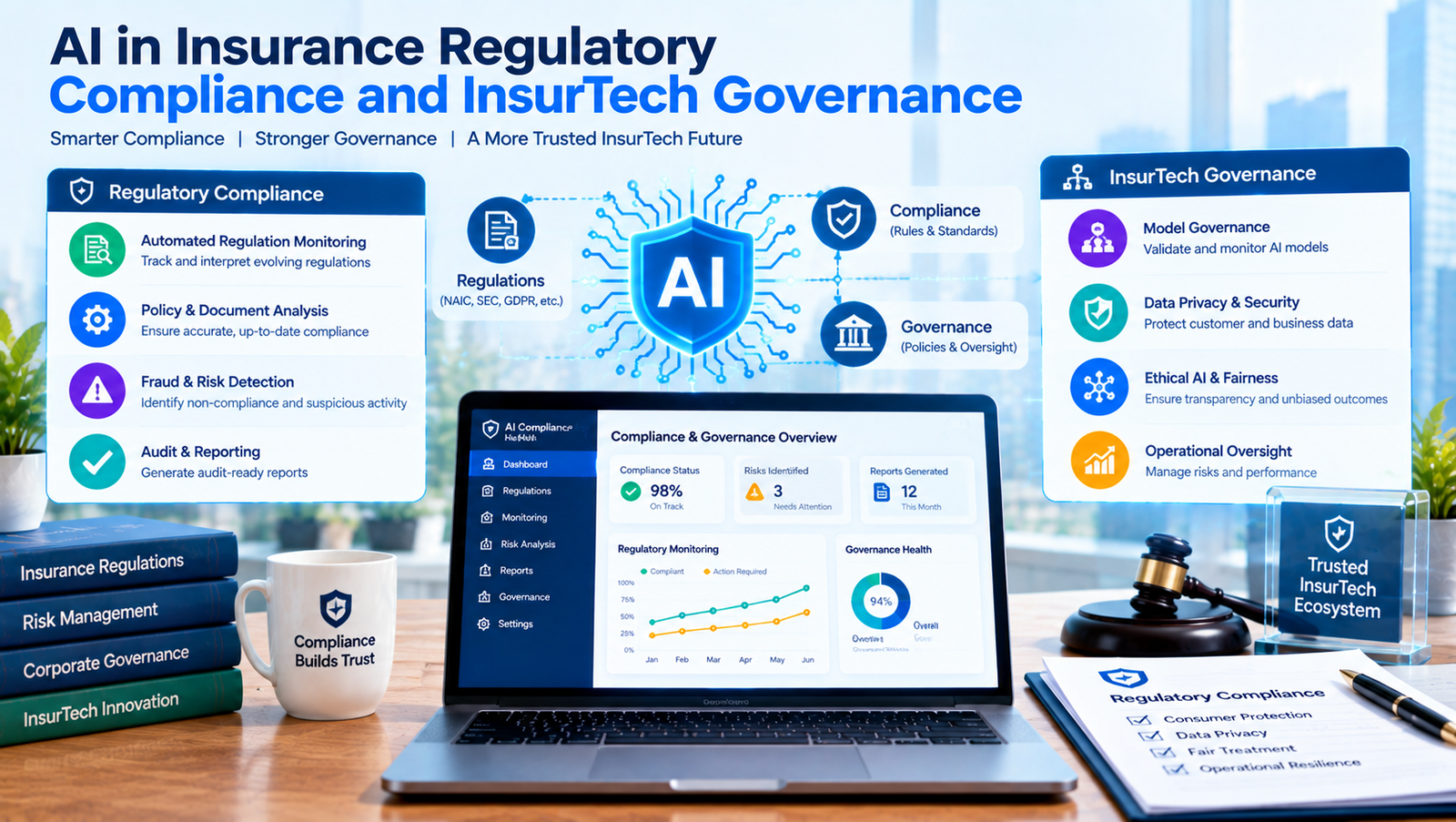
Primary topic: AI in Insurance Regulatory Compliance and InsurTech Governance
Research focus: AI regulatory compliance, insurer model governance, algorithmic fairness, underwriting oversight, claims automation, third-party AI risk, explainability, regulatory reporting, consumer protection, model validation, audit trails, and responsible InsurTech innovation
What Is AI in Insurance Regulatory Compliance?
AI in insurance regulatory compliance refers to the use and governance of artificial intelligence systems that support regulated insurance activities while helping insurers meet legal, supervisory, operational, and consumer-protection obligations.
This includes two connected areas. The first is using AI to support compliance work, such as reviewing policies, checking regulatory documents, monitoring claims processes, identifying potential conduct issues, and preparing regulatory reports. The second is governing AI systems that make or influence insurance decisions, including underwriting, pricing, claims handling, fraud detection, renewals, and customer eligibility.
These areas should not be confused. An AI tool that summarizes a regulatory document creates different risks from a model that influences whether a customer receives insurance or how much they pay. The level of governance should reflect the system’s purpose, the consequences of an error, the data it uses, and the degree of human control.
The National Association of Insurance Commissioners (NAIC) explains that insurers use AI across underwriting, pricing, claims, marketing, customer service, and fraud detection. It also emphasizes that insurers remain responsible for complying with applicable insurance laws when AI supports or makes decisions.
Source: NAIC, Artificial Intelligence in Insurance
Why Insurance AI Governance Is Different
Insurance decisions depend on predicting uncertain future events and distributing financial risk across policyholders. AI can improve how insurers estimate risk, detect patterns, and process information, but a model’s predictive accuracy does not automatically make its decisions legally compliant or fair.
For example, a model may predict claims costs accurately across a portfolio while producing materially different error rates for particular customer groups. A claims model may identify suspicious patterns but also send legitimate claims into unnecessary investigation. An underwriting model may rely on third-party data that is difficult for the insurer to explain or validate.
Insurance governance therefore needs to consider both model performance and the consequences of using the model.
Consumer fairness
Check whether model outcomes create unjustified differences in access, pricing, claims, or service
Actuarial soundness
Assess predictive validity, risk segmentation, calibration, and consistency with the insurance product
Accountability
Maintain clear responsibility for decisions, approvals, exceptions, and customer outcomes
Evidence and auditability
Retain records showing what the system did, why it did it, and who reviewed the result
The challenge is not to eliminate all risk differentiation. Risk assessment is central to insurance. The governance challenge is to ensure that data, models, and resulting decisions comply with applicable law and are supported by appropriate evidence.
Research Study: Artificial Intelligence and Insurance Regulation, 2026
A 2026 article in the NAIC’s Journal of Insurance Regulation examines how AI and machine learning are being used by insurers, the adoption of the NAIC AI Model Bulletin, and the development of state and federal legal approaches.
The authors review insurer use cases and discuss how regulatory guidance may evolve as AI adoption grows. The paper is especially relevant because it focuses on the relationship between insurance-specific regulation and the broader challenges created by algorithmic decision-making.
Its practical contribution is the focus on regulatory implementation. Publishing principles is only the beginning. Supervisors also need ways to assess whether insurers have effective controls, while insurers need consistent methods to demonstrate compliance across different jurisdictions.
For governance teams, this supports maintaining a current inventory of AI systems, mapping each system to the relevant regulatory requirements, and retaining evidence of validation, oversight, and corrective action.
Research Study: Algorithmic Bias Under the EU AI Act, 2025
A 2025 study published in Risks examines algorithmic bias and regulatory compliance in life and health insurance underwriting. The authors analyze 12.4 million quote, policy-binding, and claims observations from four European insurers covering the period from the first quarter of 2019 through the fourth quarter of 2024.
The study compares gradient-boosted decision-tree models, including XGBoost, with generalized linear model benchmarks for mortality, morbidity, and lapse-risk prediction. It also uses SHAP-based methods to examine model explanations.
This research is directly relevant to insurance governance because it connects model performance with regulatory questions about fairness, pricing, and risk classification. It illustrates why insurers need to assess more than aggregate predictive performance when evaluating AI-based underwriting.
A model comparison should examine calibration, stability, subgroup performance, explainability, and the effect of model outputs on premiums or eligibility. The appropriate fairness tests depend on the insurance product, the data, the legal context, and the decision being supported.
The study should not be interpreted as proving that one model type is universally compliant. Rather, it demonstrates the importance of evaluating AI models within the actual insurance context in which they will be used.
Research Study: Comparing Non-Discriminatory AI Regulation Across Jurisdictions
The Society of Actuaries published a 2024 research report comparing regulatory frameworks for non-discriminatory AI use in insurance across the United States, European Union, Canada, and China.
The report identifies shared themes across jurisdictions, including transparency, traceability, governance, risk management, testing, documentation, and accountability. It also describes meaningful differences in regulatory structures and philosophies.
These differences matter for insurers operating internationally. A model developed for one market may be subject to different documentation, testing, disclosure, or oversight expectations when deployed elsewhere. Even when the underlying model remains unchanged, the insurer may need different controls around its use.
A practical response is to maintain a common global governance framework with jurisdiction-specific requirements layered on top. This avoids building completely separate governance processes for every market while recognizing that legal obligations are not identical.
Research Study: Governing Algorithmic Insurance Under the EU AI Act, 2026
A 2026 article in the Connecticut Insurance Law Journal examines how the EU AI Act interacts with insurance-specific frameworks, including Solvency II and the Insurance Distribution Directive.
The authors focus on governance obligations, high-risk classifications, and coordination between regulatory authorities. Their analysis highlights the difficulty of applying a cross-sector AI law alongside rules designed specifically for insurance.
For InsurTech companies, this creates a practical product-design requirement. Regulatory compliance cannot be treated as a final review performed after the technology has been built. Product teams need to identify the intended use, affected insurance activity, relevant jurisdiction, and applicable obligations before choosing the model and designing the workflow.
The article is EU-focused, so its legal analysis should not be automatically applied to US or other markets. Its broader operational lesson is that AI governance must account for overlapping regulatory regimes.
Research Study: Regulatory Compliance for AI-Based Insurance Systems in the United States, 2026
A 2026 legal research paper examines the emerging US framework for AI-based insurance systems. It discusses the NAIC Model Bulletin, Colorado’s algorithmic governance requirements, and New York Department of Financial Services guidance.
The paper identifies challenges created by differences in state-level approaches, reliance on insurer self-governance, and uncertainty about how algorithmic fairness should be assessed in insurance.
This is particularly important for insurers that operate across multiple states. A model governance policy may be centrally managed, but compliance teams still need to track where the model is used and which state requirements apply.
The research also raises a core insurance question: fairness analysis must account for the role of risk classification while still identifying unlawful discrimination or unjustified consumer harm. This cannot be resolved by applying a single statistical fairness metric to every insurance product.
Research Study: Compliance-by-Design for AI-Driven InsurTech, 2026
A 2026 working paper proposes a compliance-by-design architecture for AI-driven financial technology and InsurTech. It examines gaps in post-hoc explainability, privacy-focused training methods, and fairness testing that may fail to capture changes in live production data.
The paper proposes placing governance mechanisms inside the decision process rather than relying only on periodic audits after deployment. Its central idea is that compliance controls should be part of the system architecture, with explanations, checks, and corrective steps integrated into the workflow.
This is a useful design direction, although the paper is a working paper and its proposed architecture should not be treated as an established regulatory standard or proven industry-wide solution.
For implementation teams, the practical takeaway is to make governance controls executable wherever possible. For example, a system can block deployment when required validation is missing, require human approval for high-impact decisions, and create a complete evidence record for each material model-assisted decision.
What the Research Means for Insurance Leaders
Across these studies, several themes recur, but each has a distinct operational implication.
| Research theme | What it indicates | Practical response |
|---|---|---|
| Regulatory fragmentation | Requirements differ across jurisdictions | Maintain a jurisdiction-specific obligations register |
| Algorithmic fairness | Predictive performance alone is insufficient | Test outcomes, errors, calibration, and relevant groups |
| Third-party models | Vendor use does not remove insurer accountability | Require evidence, change notices, and audit rights |
| Explainability | Decisions need understandable supporting evidence | Retain decision-level explanations and input lineage |
| Ongoing monitoring | Model behavior can change after launch | Monitor drift, complaints, overrides, and outcomes |
The US Regulatory Landscape: NAIC and State Insurance Oversight
The United States does not have one single insurance AI rule that replaces state insurance regulation. The NAIC provides model guidance and coordination, while state insurance departments supervise insurers under their applicable laws and rules.
The NAIC adopted its Model Bulletin on the Use of Artificial Intelligence Systems by Insurers in December 2023. The bulletin explains that decisions made or supported by AI must comply with applicable insurance laws and regulations. It also sets expectations around governance, risk management, and information that regulators may request during examinations or investigations.
Source: NAIC, Model Bulletin adopted in December 2023
The NAIC’s current AI work is moving toward more structured evaluation. Its AI Systems Evaluation Tool is intended to help regulators assess insurers’ AI use, governance, risk mitigation, high-risk models, and input data. In 2026, the NAIC reported that the tool was being piloted by participating states, while an AI Risk Evaluation Supplement was exposed for comments with a deadline of September 29, 2026. These are active developments, so insurers should check the current NAIC materials rather than assume that a draft or pilot document is final.
Source: NAIC, Big Data and Artificial Intelligence Working Group
What insurers should document
- Business purpose and intended use of each AI system
- Insurance products, customer groups, and jurisdictions affected
- Model owner, business owner, and accountable executive
- Training data sources, data quality, and known limitations
- Validation results and approval records
- Fairness testing and the rationale for selected metrics
- Human review requirements and override procedures
- Vendor contracts, model updates, and third-party dependencies
- Monitoring results, incidents, complaints, and remediation
EU AI Act and Insurance Governance
The EU AI Act introduces a horizontal framework for AI, while insurance remains subject to sector-specific requirements. The classification of a system depends on its intended purpose and the provisions that apply to that use.
Certain AI systems used for risk assessment and pricing in relation to natural persons in life and health insurance are identified as high-risk under the Act. Insurers should assess the precise use case rather than assume every AI application in insurance has the same classification. A tool that summarizes internal meeting notes is not equivalent to a system that determines insurance pricing or eligibility.
For systems that fall within high-risk requirements, relevant governance work may include risk management, data governance, technical documentation, record keeping, transparency, human oversight, and monitoring. Insurers should also consider how AI Act obligations interact with insurance-specific rules and the roles of relevant supervisory authorities.
The 2026 legal analysis by Marano and Li discusses this interaction with Solvency II and the Insurance Distribution Directive.
Source: Connecticut Insurance Law Journal, 2026
Visual Framework: The Insurance AI Governance Lifecycle
The most reliable governance model treats AI as a lifecycle rather than a one-time model approval.
Define use and impact
Check quality and rights
Test performance and fairness
Record accountable sign-off
Apply controls and limits
Track outcomes and drift
Investigate incidents, correct issues, and reassess material changes
AI Use Cases That Need Different Governance Controls
Not every insurance AI application should be reviewed in exactly the same way. The controls should reflect the impact of the decision and whether the system directly affects a policyholder.
| AI use case | Governance concern | Important control |
|---|---|---|
| Underwriting and pricing | Risk classification, discrimination, explainability | Actuarial validation and appropriate fairness testing |
| Claims triage | Unfair delay or escalation | Review thresholds and monitor claim outcomes |
| Fraud detection | False suspicion and unnecessary investigation | Evidence-based review and appeal routes |
| Customer service assistant | Incorrect information or inappropriate advice | Approved knowledge sources and escalation |
| Regulatory reporting | Incorrect figures, omissions, or unsupported statements | Source reconciliation and accountable approval |
| Compliance document review | Missed clauses or hallucinated summaries | Citation to source text and human verification |
Third-Party AI and InsurTech Vendor Risk
Insurers increasingly depend on external software, cloud infrastructure, data providers, AI APIs, fraud platforms, document-processing tools, and embedded InsurTech services. Outsourcing model development does not remove the insurer’s responsibility for its use of the system.
The NAIC has specifically been examining third-party data and models used by insurers. This is important because a vendor may not disclose every detail of a proprietary model, while the insurer may still need to demonstrate that the model is suitable for its intended use.
Vendor governance should cover more than cybersecurity and service availability.
- Identify the exact model and version used in production
- Understand the model’s intended use and known limitations
- Review data sources, licensing, and permitted uses
- Request validation evidence relevant to the insurer’s portfolio
- Define notification requirements for material model changes
- Establish audit, incident reporting, and regulator cooperation rights
- Set service-level expectations for errors, outages, and remediation
- Maintain an exit plan if the provider becomes unsuitable
A vendor’s general accuracy claim is not enough. The insurer should understand how the system performs on its own products, customers, claims, and operating conditions.
Generative AI in Insurance Compliance
Generative AI can help compliance teams search regulatory material, summarize policy documents, compare procedures, prepare first drafts of reports, and extract information from large document collections.
However, language models can generate plausible but incorrect statements. This creates a particular risk in regulatory work, where a fabricated legal requirement or an inaccurate interpretation can lead to bad decisions.
A controlled workflow should keep the source material visible and require verification before an output becomes an official compliance record.
Example: Regulatory change monitoring
- Collect the official regulatory publication
- Extract the relevant provisions and effective dates
- Use AI to summarize potential operational impacts
- Link each summary point to the original text
- Ask compliance specialists to confirm applicability
- Assign owners and deadlines for required changes
- Retain the approved interpretation and implementation evidence
The AI should accelerate the review process, not become the final legal authority.
Expert Recommendation: Build a Risk-Tiered Governance Framework
Insurance companies should avoid treating every AI tool as equally risky. A low-impact internal summarization assistant does not need the same approval process as a model that influences underwriting eligibility or claim settlement.
A risk-tiered framework can make governance more practical without weakening controls over high-impact systems.
| Risk tier | Example | Governance approach |
|---|---|---|
| Lower impact | Internal meeting summaries | Approved data access, output checks, and user guidance |
| Moderate impact | Compliance document classification | Benchmark testing, sampling, audit logs, and escalation |
| High impact | Underwriting, pricing, claims decisions | Formal validation, fairness analysis, accountable approval, and ongoing monitoring |
The framework should be reviewed whenever the model’s purpose, data, customer impact, or operating environment changes.
Expert Quote
In announcing the NAIC AI Model Bulletin, Maryland Insurance Commissioner Kathleen A. Birrane described the regulatory objective as:
“balancing the potential for innovation with the imperative to address unique risks”
— Kathleen A. Birrane, as quoted by the NAIC, December 2023
The statement captures the central governance challenge. Insurers need room to use AI to improve services and operations, while ensuring that innovation does not weaken consumer protection, accountability, or compliance.
AI Governance Operating Model for Insurers
Governance works best when responsibility is shared across business, technical, legal, and control functions. A model team cannot independently determine every legal, actuarial, and consumer-impact question.
Board and executives
Set risk appetite, accountability, and oversight expectations
Compliance and legal
Map obligations, interpret rules, and manage regulatory engagement
Actuarial and data science
Validate models, test assumptions, and assess performance
Risk and internal audit
Challenge controls and independently assess evidence
Technology and security
Manage access, deployment, logging, resilience, and vendor integration
Implementation Roadmap
AI inventory and regulatory mapping
Begin by identifying every AI system used in insurance operations, including embedded vendor tools and employee-facing generative AI. Record the purpose, owner, affected products, jurisdictions, data categories, decision impact, and current approval status.
Map each system to the relevant legal and regulatory requirements. This inventory should include models that influence decisions, not only systems branded as AI products.
Risk classification and impact assessment
Assess the potential consequences of errors, unfair outcomes, privacy breaches, and operational failures. Consider whether the system affects access to insurance, premium calculations, claims, customer communications, or regulatory submissions.
Use the assessment to determine validation depth, approval requirements, human review, monitoring frequency, and incident escalation.
Data and model validation
Document data provenance, quality, representativeness, permitted use, and limitations. Test model performance on relevant populations and operating conditions, and examine whether the model behaves differently across meaningful customer groups.
For third-party systems, obtain evidence that is relevant to the insurer’s intended use. Where vendor transparency is limited, define compensating controls and determine whether the remaining uncertainty is acceptable.
Controlled deployment
Deploy high-impact models in stages where practical. Compare production outcomes with the approved validation results and retain the version, configuration, and approval record associated with each release.
Establish clear conditions for pausing or rolling back a model when performance, fairness, data quality, or system integrity falls outside approved limits.
Ongoing monitoring and remediation
Monitor model drift, unusual outcome changes, complaints, overrides, exception rates, and operational incidents. Define who investigates an alert, who can suspend the system, and how affected customers or regulators are handled when necessary.
Material changes to data, model logic, vendors, or intended use should trigger reassessment rather than being treated as routine maintenance.
KPIs for AI Insurance Compliance and Governance
| Metric | What it measures | Why it matters |
|---|---|---|
| Inventory coverage | Share of identified AI systems recorded | Reveals unknown or unmanaged AI use |
| Validation completion | Systems with current, approved validation | Shows whether deployment is supported by evidence |
| Fairness test exceptions | Unresolved material outcome differences | Supports investigation and remediation |
| Model drift incidents | Material changes in model behavior | Identifies systems needing reassessment |
| Audit evidence completeness | Availability of decision and approval records | Improves examination readiness |
| Third-party review coverage | Vendor models assessed against policy | Reduces dependency and oversight gaps |
Targets should be set according to the insurer’s risk appetite, regulatory obligations, product portfolio, and baseline performance. A metric should not be optimized in isolation. For example, reducing the number of flagged fairness issues is not a meaningful success if the organization has simply weakened its testing.
Future Outlook: 2027–2030
2027: More structured AI evaluation
Insurance regulators are likely to continue developing practical ways to examine AI governance, including inventories, risk assessments, evidence requirements, and supervisory evaluation tools. The NAIC’s ongoing work suggests that documentation and demonstrable controls will remain important areas of attention.
Insurers should prepare for questions that go beyond whether they have an AI policy. They should be able to show how that policy operates in real systems and decisions.
2028: Stronger governance of third-party models
As insurers integrate more external AI services, vendor oversight will become more closely connected to model governance. Contracts, model-change notifications, testing evidence, and incident response arrangements will be important parts of procurement and renewal.
This is especially relevant when a vendor’s model changes without a corresponding change to the insurer’s own application.
2029: Decision-level evidence becomes more important
Insurers may increasingly organize audit records around individual material decisions. Such records could connect the model version, relevant inputs, recommendation, human review, final action, and explanation.
This would make it easier to investigate complaints, understand overrides, and demonstrate how decisions were reached.
2030: Governance becomes part of the AI product architecture
The direction of travel points toward systems that include compliance controls as standard technical components. Model registries, automated validation checks, policy rules, monitoring, and evidence capture may become integrated into shared platforms rather than maintained through disconnected spreadsheets and manual reviews.
These are forward-looking expectations, not guaranteed regulatory deadlines. Their pace will depend on legislation, supervisory practice, technology adoption, and the results of current regulatory initiatives.
Startup Opportunities in InsurTech Governance
AI governance creates opportunities for specialist software providers that solve concrete operational problems for insurers.
- Insurance AI inventory platform that maps models, vendors, owners, use cases, and jurisdictions
- AI model evidence manager that stores validation reports, approvals, versions, and monitoring results
- Insurance fairness testing software designed for pricing, underwriting, and claims workflows
- Regulatory change intelligence that tracks new rules and maps them to internal controls
- Third-party model risk platform for vendor evidence, change monitoring, and contract obligations
- Decision audit trail API that captures model recommendations, human decisions, and supporting evidence
- AI claims governance tools that monitor triage, escalation, and settlement workflows
- Regulatory reporting assistant that extracts information from approved systems and reconciles it with source records
The most defensible products will be built around insurance-specific workflows, evidence requirements, and integrations. A generic AI policy generator may help with documentation, but it will not solve the harder operational problem of proving that controls work in production.
Frequently Asked Questions
What is AI governance in insurance?
AI governance in insurance is the framework of policies, responsibilities, technical controls, validation processes, monitoring, and evidence used to ensure AI systems are appropriate, accountable, and compliant with applicable insurance requirements.
What is the NAIC AI Model Bulletin?
The NAIC AI Model Bulletin, adopted in December 2023, outlines expectations for insurers’ responsible use of AI systems. It emphasizes that AI-supported decisions must comply with applicable laws and discusses governance, risk management, and information regulators may request.
Does the EU AI Act apply to insurance companies?
Yes, depending on the system and its intended use. Certain AI systems used for risk assessment and pricing for natural persons in life and health insurance are classified as high-risk. Insurers should assess the specific provisions and implementation requirements relevant to each system.
How can insurers test AI fairness?
Insurers can assess model performance, calibration, error rates, and outcomes across relevant customer groups. The appropriate methods depend on the insurance product, applicable law, available data, and the decision being supported. No single metric resolves every fairness question.
Who is responsible when an insurer uses a third-party AI model?
The insurer remains responsible for complying with applicable requirements governing its insurance activities. Vendor contracts and external validation can support governance, but they do not automatically transfer the insurer’s regulatory responsibilities.
Can generative AI automate insurance regulatory reporting?
Generative AI can help gather information, summarize regulatory material, and prepare report drafts. Official reporting still requires source reconciliation, validation, appropriate approvals, and controls against unsupported or incorrect statements.
What should an insurance AI audit include?
An audit should examine the system’s purpose, ownership, data, model version, validation, fairness analysis, approvals, human oversight, vendor dependencies, monitoring, incidents, and evidence supporting material decisions.
Final Perspective
AI governance is becoming a core operating requirement for insurers and InsurTech companies. The challenge is not simply to adopt AI safely in theory, but to demonstrate that each important system is controlled, monitored, and used in a way that fits its purpose and regulatory environment.
The research points to several practical priorities. The 2026 Journal of Insurance Regulation article places AI adoption within the changing insurance regulatory landscape. The 2025 underwriting study connects model performance with fairness and pricing questions using a large European insurance dataset. The Society of Actuaries’ comparative report shows why cross-jurisdiction governance needs both common principles and local regulatory mapping. The 2026 EU-focused legal analysis highlights the interaction between general AI law and insurance-specific regulation, while recent US legal research examines state-level differences and accountability challenges.
Together, these sources show why insurers need a lifecycle approach rather than a one-time compliance checklist.
A mature insurance AI program should be able to answer the following questions clearly:
- What AI systems are being used, and for what purpose?
- Which customers, products, and jurisdictions are affected?
- What evidence shows that the model is suitable for its intended use?
- How are fairness, accuracy, and consumer impact evaluated?
- Who approves the model and remains accountable for its use?
- How are vendor changes, model drift, and incidents managed?
- Can the insurer reconstruct and explain a material decision?
The long-term direction is toward governance that is built into the technology itself. Insurers will still need legal expertise, actuarial judgment, compliance professionals, and human decision-makers, but well-designed AI systems can make the supporting evidence easier to collect, test, and maintain.
For InsurTech builders, this creates an opportunity to develop tools that make compliance operational: systems that connect regulatory obligations to model inventories, validation evidence, live monitoring, vendor oversight, and decision-level audit trails.
The goal is not simply to deploy AI faster. It is to make AI-supported insurance decisions **traceable, explainable, appropriately tested, and accountable**.
Research Sources
- NAIC Journal of Insurance Regulation, Artificial Intelligence and Insurance Regulation, 2026
- Risks, Algorithmic Bias Under the EU AI Act: Compliance Risk, Capital Strain, and Pricing Distortions in Life and Health Insurance Underwriting, 2025
- Society of Actuaries, Comparison of Regulatory Framework for Non-Discriminatory AI Usage in Insurance, 2024
- Connecticut Insurance Law Journal, Governing Algorithmic Insurance: Reconciling the EU AI Act with Insurance-Specific Regulation, 2026
- Kenechukwu Azie, Regulatory Compliance for Artificial Intelligence-Based Insurance Systems in the United States, 2026
- Wang and Wang, Compliance-by-Design for AI-Driven InsurTech: Operationalizing Regulatory Governance via Explainable AI and Federated Learning, 2026
- NAIC, Members Approve Model Bulletin on Use of AI by Insurers, 2023
- NAIC, Big Data and Artificial Intelligence Working Group, 2026 materials and updates
- NAIC, Artificial Intelligence: Insurance Uses, Oversight, and Regulatory Activity

Leave a Reply