
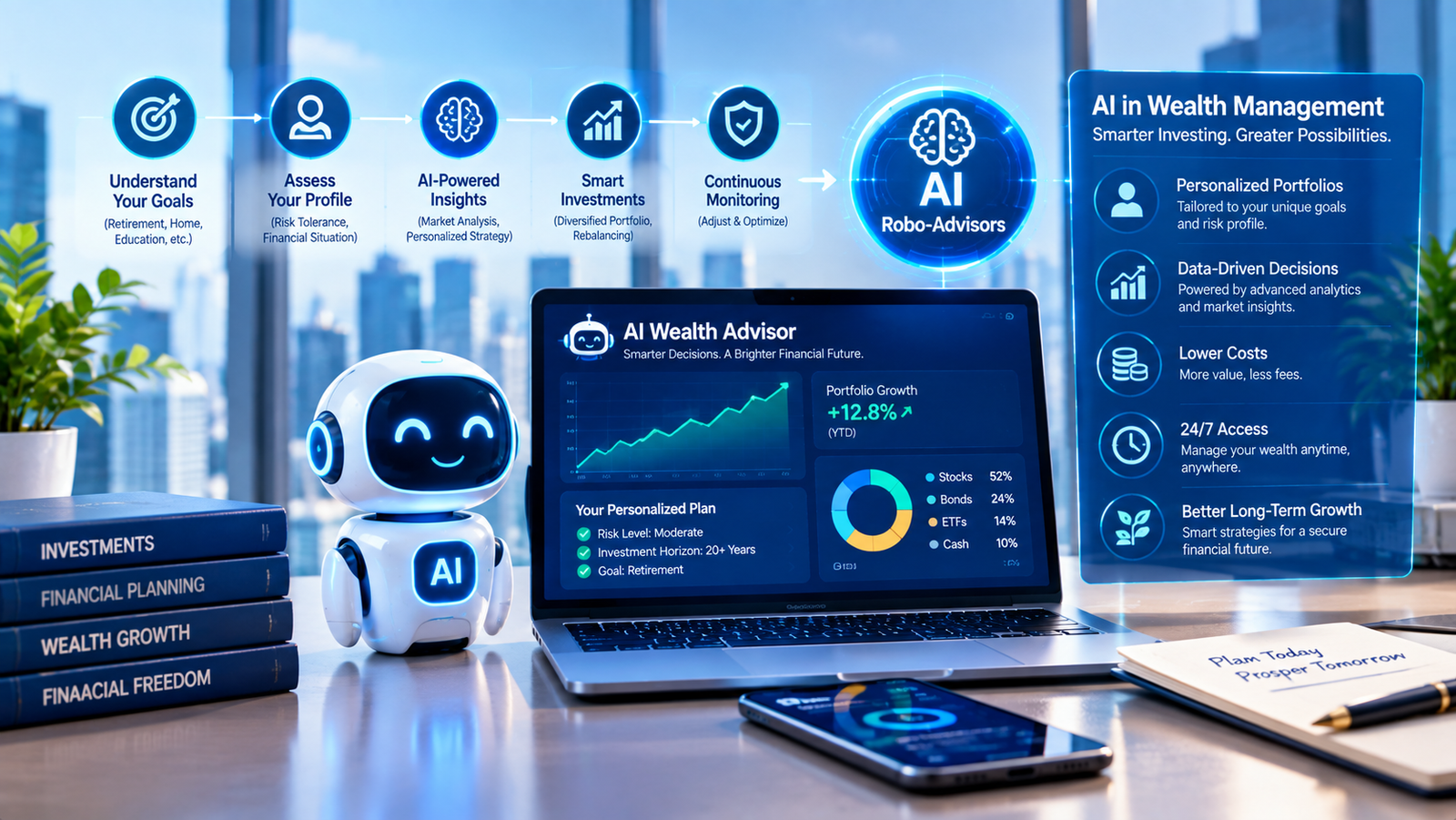
Primary topic: AI in Wealth Management and Robo-Advisors
Research focus: AI-powered investment advice, automated portfolio construction, personalized financial planning, hybrid advisory services, portfolio rebalancing, risk profiling, retirement planning, wealth management analytics, investor behavior, regulatory compliance and the future of digital investment management
Understanding AI in Wealth Management and Robo-Advisors
AI in wealth management refers to the use of machine learning, predictive analytics, optimization algorithms and generative AI to support investment decisions and financial planning. These technologies can help wealth managers understand client needs, analyze portfolios, estimate financial risks, personalize recommendations and automate routine work.
A robo-advisor is a digital investment service that uses algorithms to provide some or all of the functions traditionally performed by an investment adviser. Most services begin by asking clients about their financial goals, investment horizon, income, assets and willingness or ability to take risk. The platform then uses this information to construct and manage a portfolio, often using diversified funds such as exchange-traded funds.
AI-enabled wealth management goes beyond automated portfolio allocation. It can connect investment accounts with cash-flow information, retirement goals, tax considerations, spending patterns and changing life circumstances. A system may identify that a client is falling behind a savings goal, explain how a portfolio responds to market movements or help an adviser prepare for a client review.
The distinction matters because not every robo-advisor uses advanced AI. Many established platforms rely on rules-based questionnaires, portfolio optimization and scheduled rebalancing. These methods can be effective for defined tasks, but they should not automatically be described as machine learning. The next generation of wealth platforms is likely to combine conventional investment algorithms with AI-driven personalization, analytics and client communication.
How AI Is Reshaping the Wealth Management Business Model
Traditional wealth management often requires advisers to spend time collecting client information, preparing portfolio reports, reviewing allocations and explaining investment decisions. These activities can make personalized services expensive, particularly for people with relatively small portfolios.
Robo-advisors reduce some of these costs by standardizing onboarding and automating repeatable investment tasks. Research published in the Journal of Financial Economics examined how access to robo-advisors affects investment participation and investor welfare.
Its findings suggest that reducing account minimums increased participation among middle-class investors, although the effect did not extend equally to poorer households. The study also found that more sophisticated portfolio features contributed to welfare gains for some investors.
Source: Journal of Financial Economics, Robo Advisors and Access to Wealth Management, 2024
This points to a central business opportunity. Automation can make professional investment services available to more people, but affordability alone does not remove every barrier. Customers may still need help understanding risk, setting realistic goals, building emergency savings and deciding how much money they can invest.
Lower service costs
Automate routine portfolio administration and scheduled investment tasks
More personalization
Adapt financial guidance to goals, time horizons and changing circumstances
Continuous monitoring
Track portfolios and financial goals between adviser meetings
Human-AI advice
Give advisers better analysis while preserving personal judgment
Research Evidence: What Recent Studies Tell Us
The strongest evidence does not come from a single question such as whether AI can outperform a human adviser. Wealth management includes several distinct outcomes: investment performance, risk management, accessibility, user trust, financial behavior and the suitability of advice. The following studies examine different parts of that picture.
Research Study: Robo-Advisors and Access to Wealth Management
A 2024 study published in the Journal of Financial Economics investigated how changes in robo-advisor access affected investors. The researchers used a quasi-experimental setting in which a major US robo-advisor lowered its account minimum, making the service available to a broader group of potential customers.
The reduction increased participation among middle-class investors, but the researchers did not find the same effect among poorer households. Their model suggested that investors could benefit from access to more sophisticated portfolio features, including multi-dimensional glide paths and additional priced risk factors.
The study also reported differences in estimated welfare gains across age groups, with middle-aged investors experiencing larger gains than millennials in the setting examined.
The findings are important for product design because they show that digital access and investment value are related but not identical. Lower minimums can bring more people into the market, while the quality of portfolio construction determines what they receive after joining.
A wealth platform should therefore measure more than account openings. It should also examine whether customers build appropriate portfolios, remain invested and make progress toward their financial goals.
The study does not establish that every robo-advisor improves outcomes for every investor. Its results are tied to a particular service change and the population studied.
Research Study: Systematic Literature Review of Robo-Advisors
A 2024 systematic literature review in Finance Research Letters examined research on robo-advisors published between 2017 and 2022. The review organized the literature into four broad streams: robo-advisor classification, investor behavior, performance and algorithm design.
This structure reveals why robo-advisory research can be difficult to summarize with a single performance claim. Some studies investigate how portfolios are constructed, while others examine why people trust automated services, how investors behave when markets fall or how the service changes financial institutions.
For wealth management businesses, the review supports a multi-dimensional evaluation framework. A platform should test the investment method, but it should also assess whether clients understand the recommendations, whether the interface encourages appropriate decisions and whether the service can be supervised effectively.
The review is also useful for firms modernizing legacy advisory systems. It suggests that robo-advisory implementation is not only a software project. It affects the firm’s operating model, customer relationship, investment process and regulatory responsibilities.
Original research: Robo-Advisors: A Systematic Literature Review, Finance Research Letters, 2024
Research Study: AI and Investment Management Across 178 Studies
A 2025 review in International Review of Financial Analysis synthesized 178 peer-reviewed studies on AI in investment management. Rather than focusing only on robo-advisors, it examined the broader investment process, including portfolio optimization, financial forecasting, personalized advisory services, risk management, compliance and strategic decision-making.
The review found that AI is influencing both operational efficiency and the structure of investment management. However, it also identified persistent challenges involving explainability, adoption barriers and ethical concerns. This is particularly relevant when AI outputs affect investment decisions that clients may not be able to independently evaluate.
For robo-advisors, the implication is that portfolio recommendations should be connected to a documented investment process. A model that estimates returns or risk should not be treated as a complete adviser. Its output needs to be considered alongside client objectives, investment constraints, fees, taxes and the limitations of the underlying data.
The review also supports the use of AI across multiple stages of the investment process, while making clear that technology adoption requires organizational and governance changes as well as technical capability.
Research Study: Investor Adoption of Automated and Hybrid Robo-Advisors
A study published in Frontiers in Artificial Intelligence in July 2026 examined the use of established technology-adoption models to understand investor adoption of automated and hybrid robo-advisory services. It considered how people respond to different levels of automation in financial advice.
The research is important because the availability of an AI feature does not mean customers will trust or use it. Investors may care about perceived usefulness, ease of use, confidence in the system and whether they can reach a human when they need help. These factors can influence adoption even when the underlying technology is capable.
For product teams, the study points toward testing the entire customer experience rather than measuring model performance alone. Onboarding questions, explanations, portfolio dashboards, risk disclosures and access to human support all shape how customers experience automated advice.
The research also provides a basis for comparing fully automated and hybrid services. A hybrid model can preserve the convenience of digital investing while giving customers access to professional support for complex decisions.
Research Study: Household Interest in AI-Based Financial Advice
A September 2026 paper in the Journal of Behavioral and Experimental Finance studied US households’ stated interest in receiving financial advice from AI. The researchers used data from the 2024 National Financial Capability Study and examined factors such as digital readiness, risk preferences, investment sophistication and behavioral characteristics.
This research addresses an important distinction between interest in AI and the actual use of AI for consequential financial decisions. Someone may be comfortable using a chatbot to explain an investment term but still prefer a human adviser when deciding how to invest retirement savings.
The study’s nationally representative survey basis makes it relevant to understanding consumer attitudes in the United States, although stated interest should not be treated as proof of actual adoption or better investment outcomes.
For wealth platforms, the practical lesson is to segment customer needs. Some users may prefer self-service tools, while others may want AI-supported guidance with access to a human adviser. Product design should accommodate these differences instead of assuming that all customers want the same degree of automation.
Research Study: AI Financial Advice and Household Decisions
Research discussed by MIT Sloan in May 2026 examined how AI-generated financial advice compares with patterns recommended by standard economic models. The work found that following AI advice could move people closer to recommended saving, spending and investing behavior in the scenarios studied.
It also identified limitations: advice quality varied with the quality of user prompts, and the systems struggled with certain situations, including adjusting spending after income shocks, actively rebalancing portfolios and recommending gradual retirement drawdowns.
This is especially relevant to wealth management because real financial lives are not static. Income can change, a household may face unexpected expenses, and retirement needs evolve over time. An AI system that provides reasonable guidance under stable assumptions may still produce weak recommendations when circumstances change.
The findings suggest that financial coaching should not rely on a single prompt or one-time financial profile. Systems need to gather relevant information, clarify uncertainty and reassess recommendations when important life events occur. They should also distinguish educational guidance from personalized investment advice.
AI Applications Across the Wealth Management Journey
Intelligent Investor Profiling
Investor profiling is one of the first places AI can improve the advisory process. Traditional onboarding questionnaires collect information about financial goals, time horizon, income, assets and risk tolerance. AI can help identify inconsistent answers, detect missing information and translate customer responses into a clearer financial profile.
However, risk tolerance and risk capacity are different. Risk tolerance describes how comfortable a person feels with investment losses, while risk capacity concerns how much loss their financial circumstances can withstand. A customer may be emotionally comfortable with high-risk investments but have near-term expenses that make those investments unsuitable.
A robust profiling system should therefore assess:
- Investment goals and the time available to achieve them
- Income stability, essential expenses and emergency savings
- Existing assets, liabilities and investment concentration
- Ability and willingness to tolerate losses
- Liquidity needs and planned withdrawals
- Relevant tax circumstances and account restrictions
AI can help organize this information, but the platform should not allow an opaque score to replace suitability checks.
AI-Powered Portfolio Construction
Portfolio construction involves choosing investments and determining how much capital to allocate to each one. Traditional approaches may use strategic asset allocation, mean-variance optimization, target-date glide paths or model portfolios. AI can support these methods by estimating risk, identifying relationships among assets and helping adapt portfolios to defined constraints.
For example, a system may recommend a diversified allocation based on a customer’s investment horizon and risk capacity. It can also test how that allocation behaves under different market scenarios.
The key is to avoid treating forecasts as facts. Expected returns, volatility and correlations are estimates, and their relationships can change during market stress. A portfolio that appears diversified under normal conditions may become more concentrated when several assets fall together.
Illustrative AI portfolio workflow
Goals, horizon, constraints
Risk and scenario estimates
Allocation and constraints
Suitability and approval
Conceptual workflow. Actual portfolio recommendations require validated methods, appropriate data and applicable compliance controls.
Automated Rebalancing and Tax Awareness
Over time, market movements can cause a portfolio to drift away from its target allocation. Automated rebalancing brings it back within predefined limits. AI can help estimate when rebalancing may be useful by considering portfolio drift, transaction costs, liquidity, tax consequences and client restrictions.
A practical system should not trade every time an allocation moves slightly. Frequent trading can increase costs and create unnecessary tax consequences. Instead, the platform can use thresholds, scheduled reviews and cost-aware rules to decide when a change is justified.
Tax-aware optimization is especially important for taxable investment accounts in the United States. The system must use accurate account and tax-lot information, and it should not imply that a tax benefit is guaranteed. Tax rules and individual circumstances can materially change the result.
Personalized Financial Planning
Wealth management is broader than choosing investments. Customers may need to plan for retirement, a home purchase, education costs, emergency savings or the transfer of wealth to family members.
AI can connect these goals with financial projections. A planning assistant could show how different savings rates affect a retirement target or how a large planned expense might change the amount available for investing. It can also explain the assumptions behind a projection.
These tools should present scenarios rather than promises. A forecast depends on assumptions about investment returns, inflation, income, expenses and the timing of withdrawals. Clear explanations help customers understand what may change the result.
AI-Powered Client Communication
Generative AI can help wealth managers explain portfolio changes, summarize market information and prepare client review materials. It can translate technical investment language into more accessible explanations and help customers understand why a portfolio is diversified.
For example, after a market decline, a system could explain how the customer’s allocation performed relative to its intended risk level, identify changes in the portfolio and describe the purpose of rebalancing. It should not invent market facts or promise that losses will recover.
Financial firms should ground generated answers in approved product information, portfolio data and reviewed knowledge sources. Important advice should be traceable to its source and reviewed under the firm’s supervisory process.
Robo-Advisors Compared With Human and Hybrid Advice
| Dimension | Robo-Advisor | Human Adviser | Hybrid Model |
|---|---|---|---|
| Service delivery | Primarily digital | Personal meetings and communication | Digital tools plus adviser access |
| Portfolio operations | Highly automatable | Often adviser-led | Automated with professional oversight |
| Complex life events | May require escalation | Can provide contextual support | Digital planning with human guidance |
| Scalability | High for standardized services | Limited by adviser capacity | Scales routine work while retaining support |
| Main design challenge | Trust, suitability and automation limits | Cost and service consistency | Clear handoffs and shared accountability |
No model is suitable for every customer. A standardized robo-advisor may serve investors with straightforward needs, while complex tax, estate, business-sale or retirement decisions may require human expertise. Hybrid services can bridge these needs, provided the responsibilities of the software and adviser are clearly defined.
Current Regulatory and Governance Considerations
AI does not remove existing obligations for investment advisers and broker-dealers. In the United States, FINRA’s 2026 Regulatory Oversight Report explains that existing rules continue to apply when member firms use generative AI. The report highlights supervision, communications, recordkeeping, accuracy, data sensitivity and the risks of AI agents acting beyond their intended authority.
Source: FINRA, 2026 Regulatory Oversight Report: GenAI
A separate SEC enforcement action announced in March 2026 illustrates why disclosure and conflicts of interest matter in robo-advisory services. The SEC’s order concerning Ally Invest Advisors addressed disclosures related to a 30% cash allocation in certain cash-enhanced robo-advisor accounts, including the role of the allocation in replacing revenue from advisory fees.
Source: SEC, Settled Order Concerning Robo-Advisor Disclosure Failures, March 2026
These developments make governance a product requirement, not a final compliance check. Firms should document how recommendations are generated, how conflicts are disclosed, how models are tested and how customer data is protected.
Key Risks and Practical Controls
| Risk | Potential impact | Practical control |
|---|---|---|
| Unsuitable recommendations | Portfolio does not match goals or risk capacity | Suitability rules, profile refreshes and escalation |
| Biased or incomplete data | Unequal or unreliable outcomes | Data testing and outcome monitoring |
| Overconfidence in forecasts | Clients mistake scenarios for guarantees | Show assumptions, ranges and uncertainty |
| Conflicts of interest | Recommendations may favor firm economics | Transparent fees and independent review |
| Generative AI errors | Incorrect financial explanations | Grounded responses, testing and human review |
| Cybersecurity and privacy | Exposure of financial or identity data | Encryption, access controls and vendor review |
Recommended AI Architecture for a Wealth Management Platform
A production-grade platform should separate financial calculations from conversational AI. Portfolio construction, eligibility checks, order generation and risk limits should run through validated services with controlled inputs and outputs. A language model can explain results, help retrieve information and prepare summaries, but it should not be allowed to invent portfolio figures or bypass investment controls.
Reference architecture
Goals, holdings, cash flow, preferences and consent
Data quality, exposure calculations, risk estimates and scenarios
Allocation, constraints, rebalancing and goal projections
Suitability, limits, audit logs and approvals
Explanations, summaries and client assistance
Recommendations, approvals, monitoring and review
Expert Recommendation
Wealth management firms should begin with a clearly defined customer problem instead of adding AI simply to make a platform appear more advanced. A strong starting point is an explainable digital planning experience that combines goal tracking, portfolio visibility and timely prompts. This creates value without immediately handing complex investment decisions to a generative model.
A practical implementation strategy should include:
- Build on a validated investment process: Use established portfolio methods and clearly document where AI contributes
- Separate advice from explanation: Keep calculations and trading controls in deterministic, testable systems
- Personalize around financial circumstances: Consider liquidity, debt, income stability and goals, not only risk appetite
- Offer human escalation: Make it easy to request professional support for complex decisions
- Measure investor outcomes: Track goal progress, portfolio suitability, fees and customer understanding
- Make conflicts visible: Explain fees, cash allocations, product incentives and other material interests
- Test difficult scenarios: Evaluate performance during market stress, income shocks, withdrawals and major life changes
- Monitor the system after launch: Review model behavior, customer complaints, errors and changes in data quality
The goal should be to build a service that customers can understand and trust, rather than one that simply produces more recommendations.
Expert Perspective
In its 2026 Regulatory Oversight Report, FINRA emphasizes that existing regulatory obligations continue to apply when firms use generative AI. It also highlights risks involving autonomy, scope of authority, auditability and sensitive data.
Source: FINRA, 2026 Regulatory Oversight Report
This is a useful operating principle for robo-advisors. Technology can scale analysis and communication, but responsibility for the service, its disclosures and its recommendations remains with the firm.
Implementation Roadmap
Choose a measurable need such as onboarding, portfolio explanations, goal tracking or adviser workflow support
Connect account, portfolio and customer information with consent, access controls and quality checks
Test portfolio logic, risk estimates, personalization and AI-generated explanations against defined standards
Start with a limited customer group or adviser team, with clear escalation and rollback procedures
Review customer outcomes, model errors, complaints, service costs and compliance findings before scaling
KPIs for AI Wealth Management and Robo-Advisors
| KPI | What it measures | Why it matters |
|---|---|---|
| Onboarding completion | Share of users completing setup | Shows whether onboarding is understandable |
| Portfolio suitability | Alignment with client constraints | Measures whether recommendations fit the client |
| Goal progress | Progress against financial targets | Connects product use with customer objectives |
| Rebalancing efficiency | Cost and timeliness of portfolio adjustments | Helps avoid unnecessary trading |
| Advice accuracy | Correctness of generated explanations | Reduces misleading customer guidance |
| Customer retention | Continued use of the service | Indicates whether the service remains useful |
| Cost to serve | Operational cost per client | Measures business sustainability |
Future Outlook: 2027–2030
2027: AI Moves From Chat to Connected Financial Planning
Wealth platforms are likely to move beyond standalone financial chatbots toward assistants connected to a customer’s authorized financial data. These systems may explain spending, portfolio exposure and progress toward goals in one interface. The key challenge will be ensuring that the assistant uses current, verified data and distinguishes general education from personalized advice.
2028: Hybrid Advice Becomes More Integrated
Digital platforms may increasingly route customers between automated guidance and human advisers based on the complexity of the task. Routine portfolio questions could be handled digitally, while major life events, tax-sensitive decisions or unusual financial circumstances trigger human support. This model will depend on clear responsibility and reliable handoffs.
2029: More Adaptive Retirement and Cash-Flow Planning
AI-enabled planning tools may become better at connecting income, spending, savings and investment decisions over time. More advanced systems could update scenarios when income changes, a customer approaches retirement or spending needs shift. Such forecasts will still depend on uncertain assumptions and should be presented as scenarios, not guarantees.
2030: Wealth Management Becomes More Continuous
The longer-term direction is toward continuous financial monitoring, where a customer’s goals, portfolio and cash-flow situation are reviewed as new information becomes available. This could make financial planning more responsive, but it will also increase the importance of consent, data security, explainability and limits on automated actions.
Expected evolution of AI wealth management
Connected financial assistants
Integrated hybrid advice
Adaptive financial planning
Continuous wealth management
These are forward-looking scenarios based on current technology and research directions, not guaranteed outcomes.
Startup Opportunities in AI Wealth Management
The market offers opportunities beyond building another automated portfolio app. New products can focus on specific customer needs or help existing financial institutions modernize their advisory services.
- AI Financial Planning Assistant: Connect savings goals, cash flow and investment plans with clear scenario explanations
- Portfolio Intelligence Platform: Explain concentration, risk exposure, fees and portfolio drift in plain language
- Hybrid Adviser Copilot: Prepare client reviews, summarize account activity and retrieve approved product information
- Retirement Planning AI: Model withdrawal scenarios, longevity assumptions and changing household expenses
- AI Suitability Monitoring: Detect missing or outdated client information and flag recommendations requiring review
- Tax-Aware Portfolio Analytics: Help advisers evaluate tax lots, transaction costs and rebalancing options
- Financial Wellness Platform: Combine budgeting, emergency savings, debt planning and investment education
- AI Governance Toolkit: Track model versions, testing results, disclosures, approvals and audit evidence
For established financial institutions, the opportunity is often modernization rather than full replacement. AI can be added around existing portfolio engines, CRM systems and account infrastructure, provided integrations are secure and data definitions are consistent.
Frequently Asked Questions
What is AI in wealth management?
AI in wealth management uses machine learning, analytics, optimization and generative AI to support investment research, portfolio construction, financial planning, risk assessment and client communication. The level of automation varies by platform.
How does a robo-advisor work?
A robo-advisor typically collects information about a customer’s goals, financial situation and risk profile, recommends a portfolio and automates tasks such as monitoring and rebalancing. Some services also provide access to human advisers.
Can AI robo-advisors guarantee better investment returns?
No. AI can support analysis and portfolio management, but investment returns remain uncertain. Results depend on the portfolio, market conditions, fees, taxes, implementation and the quality of the underlying assumptions.
What is the difference between a robo-advisor and an AI financial adviser?
A robo-advisor generally automates a defined investment process, while an AI financial adviser may use conversational AI and broader financial data to support planning and explanations. The labels are not standardized, so customers should examine the actual service and its regulatory status.
Are hybrid robo-advisors useful for complex financial needs?
Hybrid services can combine automated portfolio management with access to human expertise. They may be useful when customers need help with retirement, tax-sensitive decisions or major life changes, but the quality of the service depends on adviser access and clear responsibilities.
What are the main risks of AI wealth management?
Key risks include unsuitable recommendations, inaccurate forecasts, biased data, misleading AI-generated explanations, privacy breaches, conflicts of interest and inadequate supervision. Firms need controls that address both the investment process and the AI systems supporting it.
How can wealth management firms measure AI success?
Firms should measure portfolio suitability, progress toward client goals, onboarding completion, advice accuracy, customer retention, operational cost and compliance outcomes. Investment performance alone does not capture the full value or risk of an advisory service.
Final Perspective
AI is creating a new operating model for wealth management, but the most important change is not simply the automation of portfolio allocation. It is the ability to connect investment decisions with a customer’s wider financial life.
Research on robo-advisor access shows that digital delivery can expand participation and provide sophisticated investment features to some investors. Systematic reviews show that robo-advisory research spans portfolio algorithms, investor behavior, performance and institutional change. More recent research on AI adoption and financial advice highlights the role of trust, financial literacy, user behavior and the limitations of AI-generated guidance.
Together, these findings suggest that wealth management firms should avoid treating AI as a substitute for sound investment design or responsible advice. A well-designed platform should use automation for repeatable tasks, AI for analysis and communication, and human expertise where context and judgment matter.
The strongest long-term model is likely to combine:
For financial institutions, fintech startups and wealth management providers, the opportunity is to make financial guidance more accessible, understandable and responsive without overstating what AI can deliver. Firms that build around suitability, transparency, measurable customer outcomes and strong governance will be better positioned to create durable value as automated and hybrid advisory services continue to evolve.
Research Sources
- Journal of Financial Economics, Robo Advisors and Access to Wealth Management, 2024
- Finance Research Letters, Robo-Advisors: A Systematic Literature Review, 2024
- International Review of Financial Analysis, Artificial Intelligence and Investment Management: Structure, Strategy, and Governance, 2025
- Frontiers in Artificial Intelligence, Assessing the Utility of Advanced Adoption Models for AI-Based Financial Services, 2026
- Journal of Behavioral and Experimental Finance, Household Interest in Artificial Intelligence for Financial Advice: Evidence from the United States, 2026
- MIT Sloan, Half of Americans Now Ask AI for Financial Advice, But How Good Is It?, May 2026
- FINRA, 2026 Regulatory Oversight Report: Generative AI
- US Securities and Exchange Commission, Settled Order Concerning Robo-Advisor Disclosure Failures, March 2026

Leave a Reply