
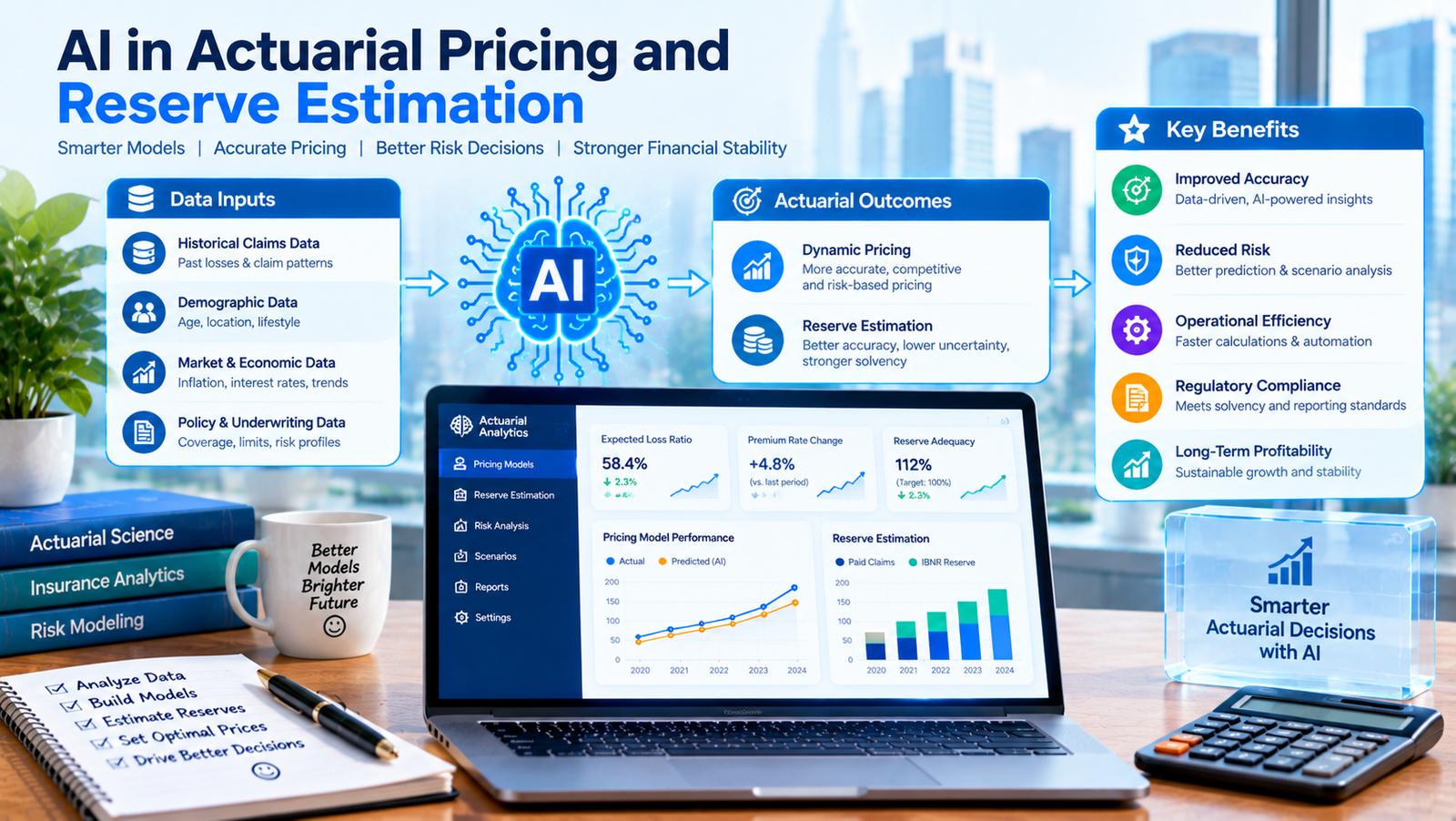
Primary topic: Artificial intelligence in insurance actuarial science
Research focus: AI-powered premium pricing, claims frequency and severity prediction, loss reserving, incurred but not reported claims, individual claim development, actuarial forecasting, insurance fairness, model validation, and financial reporting
Target audience: Insurance companies, actuarial teams, insurtech startups, reinsurers, risk managers, and financial technology providers
Understanding AI in Actuarial Pricing and Reserve Estimation
Actuarial pricing and reserve estimation are closely related, but they answer different questions. Pricing estimates the cost of future insurance claims and other expenses so that an insurer can set premiums for the risks it accepts. Reserving estimates the money an insurer needs to cover claims that have already occurred but have not yet been fully paid or settled.
AI can support both tasks by learning patterns from historical claims, policy information, exposure data, economic conditions, and other relevant variables. Unlike a traditional model that may rely on a predefined mathematical relationship, machine learning can capture more complex interactions between risk factors. This flexibility can be useful when claim outcomes depend on several variables acting together.
The challenge is that insurance data has characteristics that make it different from many other machine learning datasets. Claims can take years to develop, large losses may be rare, historical records can be incomplete, and the underlying risk environment can change. A model that performs well on past data may fail when inflation, legislation, repair costs, medical expenses, weather patterns, or customer behavior changes.
How AI Changes the Actuarial Workflow
Policies, claims, exposure and economic variables
Risk factors, claim history and development patterns
Frequency, severity and reserve forecasts
Benchmarking, uncertainty and fairness
Pricing, reserving and capital planning
Actual versus expected results
The key is to keep a clear connection between the model’s output and the actuarial decision it supports. A premium model should explain how risk estimates translate into a proposed rate. A reserving model should show how claim-level forecasts contribute to the total outstanding liability. Both should preserve a reproducible record of the data, assumptions, model version, validation results, and human adjustments.
Research Evidence: Six Studies Relevant to AI Actuarial Practice
Research Study: Neural Networks for Insurance Pricing with Frequency and Severity Data
A benchmark study published online in April 2025 in the North American Actuarial Journal examined deep learning approaches for insurance pricing. The researchers evaluated neural-network structures across four insurance datasets, considering both claim frequency and claim severity, alongside different types of input features.
This distinction matters because the expected cost of claims is often built from two separate questions: how frequently claims occur and how expensive those claims are when they happen. A pricing model needs to handle both dimensions appropriately. A portfolio may have frequent small claims, infrequent large claims, or a combination of the two.
The study places neural networks within a direct actuarial comparison rather than treating them as a general-purpose prediction technology. That is an important design choice. A model that predicts individual claim outcomes well does not automatically produce a better insurance tariff. The final premium structure must also reflect exposure, risk differentiation, calibration, and the insurer’s pricing objectives.
For insurers, the study supports testing deep learning against established frequency-severity methods using the same data and evaluation process. It does not justify assuming that neural networks will always outperform generalized linear models.
Practical implication: Insurers should evaluate AI models at both the claim-prediction level and the final premium level. The comparison should include calibration, stability across customer groups, and the effect on the distribution of proposed premiums.
Research Study: Machine Learning and Frequency-Severity Decomposition for Insurance Pricing
A study published in Mathematics in May 2026 investigated pure-premium estimation using traditional actuarial techniques alongside machine learning approaches. The research compared the frequency-severity decomposition framework with direct modeling methods, including XGBoost and Tweedie models. It also examined Poisson-based models and generalized additive models for claim frequency.
The actuarial importance of this comparison is the difference between estimating the components of claim cost separately and estimating the expected claim cost more directly. Frequency-severity decomposition gives actuaries a natural way to understand whether a change in expected losses comes from claim counts, claim sizes, or both. Direct approaches can offer a different modeling structure, but they may make it harder to explain the contribution of each component unless additional analysis is performed.
XGBoost can capture nonlinear relationships and interactions among risk factors. Tweedie models are also relevant to insurance pricing because they can accommodate outcomes that combine a probability of zero claims with a continuous positive claim amount under an appropriate compound distribution.
This study is especially relevant to insurers deciding whether to replace an existing pricing framework or improve it incrementally. The comparison should be performed on the same portfolio and should preserve the actuarial meaning of the target variable.
Practical implication: Use frequency-severity decomposition when separate claim-count and claim-cost insights are important. Compare it with direct pure-premium models to determine whether additional predictive value justifies the change in complexity.
Source: Mathematics, Machine Learning and Frequency-Severity Decomposition for Insurance Pricing, 2026
Research Study: Advancing Loss Reserving with a Hybrid Neural Network
A 2025 paper in the Journal of Risk and Insurance developed a hybrid neural-network approach for predicting the development of individual reported but not settled claims. The researchers tested the model on proprietary datasets from a large industrial insurer, using two real claim portfolios.
The model combined neural networks for static claim information with a long short-term memory network and an attention mechanism for information that changes over time. It also used bootstrapping to assess prediction stability and SHAP values to explain the contribution of input features.
This is a meaningful development for reserving because aggregate development triangles can hide differences between individual claims. Two claims with similar initial estimates may follow very different settlement paths. One may close quickly, while another may develop over several years because of litigation, injury severity, or changing estimates.
The study reported that its model outperformed benchmark approaches, including the chain ladder method, on the examined portfolios. Its results were particularly relevant to granular claim-level estimation. However, the evidence comes from the datasets and benchmarks used in that study, not every insurance line or market.
Practical implication: Claim-level AI can help identify which outstanding claims are likely to develop differently from their current estimates. Actuaries can use those predictions to review complex claims, test aggregate reserve adequacy, and understand which features drive expected development.
Research Study: Recurrent Neural Networks for Multivariate Loss Reserving
Research published online in 2025 in the North American Actuarial Journal introduced a recurrent neural-network approach called Deep Triangle for multivariate loss reserving. The method was designed to model incremental paid losses across multiple lines of business and to account for relationships between them.
This matters because insurance portfolios do not always develop independently. A large catastrophe can affect property, business interruption, motor, and other lines at the same time. Inflation, legal changes, supply-chain disruption, and shifts in claims handling can also influence multiple portfolios.
Traditional reserving methods can model dependence, but the research explores how a recurrent neural network can learn patterns across development periods and lines of business. The use of an asymmetric loss function is also relevant because underestimating and overestimating reserves can have different practical consequences.
The paper introduces a methodology rather than establishing that recurrent neural networks should replace existing reserving methods across the industry. The value depends on the data available, the stability of relationships between lines, and how well the model forecasts unseen development periods.
Practical implication: Multivariate AI reserving is worth testing for insurers with several connected business lines. Validation should include both line-level estimates and the aggregate portfolio result, including the effect on reserve uncertainty and risk capital.
Research Study: Dual Evaluation of Pricing Performance and Fairness
Published online in January 2026 in the British Actuarial Journal, this study compared generalized linear models with regularized linear models and tree-based ensemble models for non-life insurance pricing. The researchers assessed performance and fairness on two open-access motor insurance datasets covering different types of cover.
The study is important because predictive accuracy alone does not determine whether a pricing model is suitable. An algorithm may distinguish risk more precisely while also producing materially different premium outcomes across groups. Insurers therefore need to evaluate risk differentiation and fairness together.
The researchers assessed measures including estimation bias, deviance, risk differentiation, competitiveness, loss ratios, discrimination, and fairness. Their results did not identify one machine-learning model that outperformed across every pricing and discrimination measure. The generalized linear model underperformed on many of the examined measures, but the authors emphasized the need to benchmark models on the portfolio being priced.
Practical implication: A pricing model review should include both predictive metrics and the distribution of premium outcomes. Insurers should document which fairness measures they use, why they are relevant, and how any identified disparities are investigated.
Research Study: Society of Actuaries Research Institute on AI and Reserving
The Society of Actuaries Research Institute published a 2026 bulletin discussing AI in actuarial practice, including the use of AI as an independent benchmark for loss-reserving decisions. The publication highlights a central difficulty in reserving: the ultimate cost of claims may not be known for years, which makes direct validation challenging.
The bulletin explains that insurers often assess whether assumptions are reasonable and whether model outputs are consistent with experience. These checks are necessary, but they may not reveal every source of inconsistency between teams, companies, or reporting periods.
An independent AI estimate can provide another perspective. If it agrees with the established actuarial method, it may increase confidence in the result. If it differs materially, the disagreement can reveal changes in the portfolio, data problems, hidden assumptions, or areas where expert judgment has a strong effect.
The bulletin also warns that insurance data is often limited, interdependent, and affected by structural change. Flexible models can overfit, particularly when recent development periods are incomplete. It recommends careful validation, domain knowledge, transparent components, and uncertainty-aware methods.
Practical implication: Introduce AI as a parallel reserving benchmark before using it to determine booked reserves. Investigate material differences rather than automatically accepting either the traditional estimate or the AI output.
Source: Society of Actuaries Research Institute, 2026 AI Bulletin
AI in Insurance Pricing: From Risk Factors to Technical Premiums
An insurance premium is not simply a prediction of the next claim. It is a pricing decision that uses expected losses alongside expenses, reinsurance costs, capital considerations, and the insurer’s commercial objectives.
AI can support the risk-estimation part of this process by learning complex relationships between policyholder characteristics and claim outcomes. In motor insurance, for example, relevant variables may include vehicle characteristics, driver history, location, usage, and prior claims. In commercial insurance, the relevant factors may include industry, revenue, property characteristics, safety controls, and prior losses.
A typical technical pricing workflow can be represented as follows:
Exposure and Policy Data
Claim Frequency Model
Claim Severity Model
Expected Loss Cost
Expenses, Reinsurance and Risk Adjustments
Technical Premium and Actuarial Review
AI can improve individual stages, but the complete pricing framework must remain coherent. If a model improves frequency prediction but systematically underestimates severe claims, the resulting premium may still be inadequate.
Comparing Traditional Actuarial Models with AI
| Method | Strengths | Limitations | Suitable role |
|---|---|---|---|
| Generalized linear models | Interpretable structure and established actuarial use | May require manual specification of complex relationships | Baseline pricing and explainable rate factors |
| Gradient boosting | Captures nonlinear effects and interactions | Can be harder to explain and calibrate | Risk segmentation and prediction |
| Neural networks | Flexible modeling of complex data | Data demands, overfitting and explainability challenges | Complex pricing and claim-level forecasting |
| Recurrent neural networks | Can model sequences and development patterns | Requires careful temporal validation | Claims development and multivariate reserving |
| Hybrid actuarial models | Combines actuarial structure with flexible prediction | Requires careful integration and governance | Production pricing and reserving |
The choice should be based on evidence from the insurer’s own portfolio. Model complexity is useful only when it improves the decision being made and the organization can validate, explain, and maintain the result.
AI in Claims Reserving: IBNR, RBNS and Development Patterns
Reserving involves estimating liabilities for claims that have already occurred. Two important categories are incurred but not reported claims, commonly called IBNR, and reported but not settled claims, commonly called RBNS.
IBNR estimates address events that have occurred but have not yet been reported to the insurer. RBNS estimates address claims already reported but not fully settled. These categories have different data characteristics, so they should not automatically be treated as one prediction problem.
Traditional actuarial techniques, including chain ladder and other development-based methods, remain important because they use historical patterns of claim emergence and settlement. AI can complement these methods by incorporating individual claim characteristics, time-varying information, and relationships between different portfolios.
IBNREstimate claims that have occurred but have not yet been reported
Potential AI inputs
- Exposure and policy data
- Historical reporting delays
- Accident period and seasonality
- Portfolio and external risk indicators
RBNSEstimate the future development of reported, unsettled claims
Potential AI inputs
- Claim characteristics
- Payments and case reserves
- Settlement history
- Litigation and complexity indicators
The most useful systems will connect individual claims to aggregate reserve estimates. This allows actuaries to see whether a portfolio-level change is being driven by a small number of large claims, a broad shift in claim severity, or a change in settlement patterns.
Visual Framework: Where AI Can Create Actuarial Value
Pricing IntelligenceMore detailed risk segmentation, nonlinear effects, and improved frequency-severity estimates
Reserve IntelligenceClaim-level development forecasts, unusual claim identification, and alternative reserve estimates
Portfolio IntelligenceCross-line dependencies, emerging loss trends, and changes in portfolio composition
Governance IntelligenceFairness testing, uncertainty analysis, model monitoring, and documented decisions
Inflation, Catastrophe Risk and Changing Claims Environments
Actuarial models are exposed to changes in the world around them. Claims inflation can increase repair costs, medical expenses, legal settlements, and replacement values. Catastrophe events can create sudden changes in claim frequency and severity. Changes in policy terms, claims handling, and the mix of insured risks can also make older experience less representative of future outcomes.
AI can help identify these changes by monitoring residuals, shifts in input data, and differences between expected and actual claims. However, a model trained on historical data cannot reliably predict every unprecedented event simply because it uses a sophisticated algorithm.
For example, a model trained on ordinary weather years may not capture the full cost of a severe catastrophe. Similarly, historical motor claims may not reflect future repair costs if vehicle technology or parts availability changes substantially.
A robust actuarial process should therefore combine AI forecasts with scenario analysis and expert judgment. The objective is not to make uncertainty disappear, but to make it more visible and measurable.
Explainability, Fairness and Actuarial Accountability
Insurance pricing can affect whether customers can obtain cover and how much they pay. AI models may identify highly predictive variables that also act as proxies for sensitive or protected characteristics. A model can therefore improve predictive accuracy while raising fairness, legal, or conduct concerns.
Fairness cannot be reduced to one universal metric. Different measures may produce different conclusions, and the relevant legal requirements vary by jurisdiction and insurance product. Actuaries should assess the effect of a model on premium distributions, examine the role of input variables, and document the rationale for using each material factor.
Useful controls include:
- Reviewing data quality and representativeness
- Testing outcomes across relevant customer groups
- Examining proxy variables and indirect discrimination risks
- Comparing AI results with established actuarial models
- Recording model assumptions and limitations
- Providing explanations for material pricing differences
- Monitoring outcomes after deployment
The 2026 British Actuarial Journal study discussed earlier is especially relevant because it evaluates pricing performance and fairness together. Its findings support portfolio-specific benchmarking rather than assuming that a particular model family is inherently fair or unfair.
Reserve Uncertainty and Model Validation
Reserve estimates are uncertain by nature. The ultimate amount paid on a claim may not be known for years, and the observed development data may change as claims mature. A single point estimate can hide this uncertainty.
AI systems should therefore provide more than a predicted reserve total. Where feasible, they should support uncertainty analysis, sensitivity testing, and comparison with alternative methods.
| Validation check | Question to answer | Why it matters |
|---|---|---|
| Backtesting | How well did prior forecasts match later outcomes? | Tests predictive performance |
| Temporal validation | Does the model work on later, unseen periods? | Reduces leakage and unrealistic testing |
| Segment analysis | Are errors concentrated in a line, region, or claim type? | Finds hidden weaknesses |
| Uncertainty analysis | How sensitive are estimates to assumptions and data? | Supports capital and reserve decisions |
| Benchmark comparison | Does AI add value over existing actuarial methods? | Prevents complexity without benefit |
For reserving, temporal validation is especially important. Randomly splitting claims into training and test sets can create an unrealistic evaluation if the model indirectly sees information from later development periods. The validation design should reflect the actual task: forecasting what will happen after the valuation date using only information available at that date.
Current Actuarial AI Developments in 2026
The actuarial profession is moving from general discussion of AI toward practical guidance, task-specific benchmarking, and governance.
The Casualty Actuarial Society’s 2026 midyear research digest highlights work across AI, ratemaking, reserving, climate risk, and predictive modeling. It also points to the CAS AI Primer as a practitioner resource intended to evolve as AI capabilities and professional needs change.
In September 2026, the CAS Artificial Intelligence Working Group announced a request for proposals to develop a transparent, repeatable benchmark for evaluating large language models on property and casualty actuarial tasks. The initiative aims to test performance on actuarially relevant work and re-evaluate models as they change. This is a significant development for insurers considering generative AI in actuarial workflows because it emphasizes measured task performance rather than broad claims about model capability.
Sources:
- Casualty Actuarial Society, 2026 Midyear Research Digest
- Casualty Actuarial Society, 2026 Request for Proposals: Evaluating LLMs for a P&C Actuarial Task Benchmark
These developments suggest that insurers will increasingly need evidence showing what an AI system can do, where it fails, and how its performance changes over time.
Expert Recommendation: Use AI as a Controlled Actuarial Partner
The practical recommendation is to introduce AI through a parallel-model framework. Keep the established actuarial method in place while testing AI on the same portfolio, valuation date, and information set. Compare results, investigate material differences, and expand the model’s role only when its performance and governance are sufficiently demonstrated.
A production-ready framework should include:
- Actuarial ownership: Assign a qualified actuary responsibility for assumptions, interpretation, and approval
- Clear model purpose: Define whether AI supports pricing, reserve estimation, claims triage, or analysis
- Reliable data: Validate policy, exposure, claims, and development data before training
- Relevant benchmarks: Compare AI with GLMs, chain ladder, and other established methods suited to the task
- Temporal testing: Evaluate forecasts on genuinely unseen periods
- Uncertainty reporting: Show sensitivity and limitations, not only point estimates
- Fairness review: Examine pricing outcomes and relevant legal obligations
- Independent governance: Maintain version control, documentation, review, and audit trails
- Ongoing monitoring: Track changes in claims experience, input data, and model performance
The Society of Actuaries Research Institute’s 2026 bulletin captures the value of independent benchmarking:
Expert quotation: “AI can help reduce that inconsistency by providing an independent benchmark derived directly from the data.”
Source: Society of Actuaries Research Institute, 2026 AI Bulletin
The quotation reflects a practical use of AI in actuarial work: it can provide an additional evidence-based estimate that helps actuaries test assumptions and investigate differences. It does not imply that an AI estimate should automatically replace professional judgment.
Implementation Roadmap for Insurers
Phase 1: DefineSelect one pricing or reserving problem and agree on measurable objectives
Phase 2: PrepareAudit data quality, feature availability, claim maturity, and leakage risks
Phase 3: BenchmarkTrain candidate models and compare them with established actuarial methods
Phase 4: ValidateTest temporal stability, uncertainty, fairness, and performance by segment
Phase 5: PilotRun AI in parallel and require actuarial review before operational use
Phase 6: MonitorTrack actual outcomes, drift, model changes, and reserve or pricing impacts
A sensible first project is often a narrowly defined use case with reliable historical data. For example, an insurer could test AI for claim severity prediction in one line of business before extending it to the full pricing portfolio. For reserving, a pilot could focus on reported but unsettled claims where individual claim histories are sufficiently detailed.
Key Performance Indicators for AI Actuarial Systems
| KPI | Purpose | Application |
|---|---|---|
| Prediction error | Measures difference between predicted and observed outcomes | Pricing and reserving |
| Calibration | Checks whether predicted levels align with observed experience | Frequency, severity and pure premium |
| Reserve development error | Tracks reserve forecasts against later claim outcomes | IBNR and RBNS |
| Stability by segment | Identifies uneven performance across portfolios | Pricing and reserving |
| Fairness measures | Evaluates relevant differences in model outcomes | Pricing governance |
| Forecast stability | Measures changes in outputs across valuation dates | Reserve monitoring |
| Actuarial review time | Tracks whether the system improves analysis efficiency | Operational effectiveness |
KPI thresholds should be set according to the product, portfolio, materiality, and intended use. A single universal target would be inappropriate for every insurer.
Future Predictions: 2027–2030
2027: More Formal AI Benchmarking in Actuarial Work
Insurers are likely to place greater emphasis on repeatable tests for AI tools used in pricing, reserving, and actuarial analysis. The CAS initiative to benchmark large language models on property and casualty actuarial tasks is an early example of this direction. Model selection will increasingly depend on task-specific evidence, not general-purpose AI claims.
2028: More Claim-Level Reserving
As insurers improve claims data quality and modeling infrastructure, individual-claim forecasting may become a more common complement to aggregate development methods. This could help actuaries identify claims driving reserve changes and analyze the development of complex claims in greater detail. Adoption will depend on data availability, validation, and the value demonstrated in each line of business.
2029: Pricing and Reserving Models Become More Connected
Insurers may increasingly use shared data and modeling infrastructure across pricing, claims, reserving, and portfolio risk. This could make it easier to investigate how changes in risk selection, claims inflation, and settlement behavior affect both new-business pricing and outstanding liabilities. Separate actuarial controls will still be needed because pricing and reserving have different objectives and regulatory consequences.
2030: Hybrid Models Become More Established
A likely direction is a broader use of hybrid frameworks that combine actuarial structure, machine learning, uncertainty estimation, and expert review. Traditional methods will remain relevant where they provide reliable, interpretable estimates. AI will be used where it demonstrates measurable additional value, particularly in complex data, nonlinear risk patterns, claim-level prediction, and model benchmarking.
These are reasoned projections based on current research and professional initiatives, not guaranteed outcomes.
Startup and Product Opportunities
AI creates opportunities for insurtech companies that solve specific actuarial problems rather than offering generic AI dashboards.
- AI Pricing Workbench: Compare GLMs, gradient boosting, neural networks, and hybrid models on insurer data
- Claim-Level Reserve Forecasting: Predict individual claim development and identify cases driving reserve changes
- Actuarial Model Validation Platform: Automate temporal backtesting, calibration checks, and segment-level reporting
- Reserve Reconciliation Assistant: Explain differences between traditional and AI reserve estimates
- Pricing Fairness Analytics: Evaluate model outcomes, premium distributions, and proxy-variable risks
- Claims Inflation Monitoring: Detect changes in severity patterns and relevant cost drivers
- Multivariate Reserving Tools: Model dependencies between lines of business and aggregate risk
- Actuarial AI Governance: Manage documentation, approvals, model versions, and audit trails
For a software provider, a practical product strategy is to begin with a clear actuarial workflow, such as reserve benchmarking or claim-severity modeling. This gives customers a measurable problem to evaluate and avoids the complexity of replacing an insurer’s entire actuarial platform.
Frequently Asked Questions
How is AI used in actuarial pricing?
AI can estimate claim frequency, claim severity, and expected loss costs using policy, exposure, claims, and other relevant data. These estimates can support risk segmentation and technical premium calculations, subject to actuarial review and applicable pricing rules.
Can AI replace generalized linear models in insurance pricing?
Not universally. Machine learning can capture complex relationships, but GLMs remain useful because of their established actuarial structure and interpretability. Insurers should compare candidate models on their own portfolios and assess predictive performance, calibration, fairness, and governance.
How does AI improve loss reserve estimation?
AI can use individual claim characteristics and development histories to estimate future claim costs. It can also provide an independent benchmark against aggregate reserving methods and help identify claims or segments that explain changes in the total reserve.
What is the difference between IBNR and RBNS?
IBNR refers to claims that have occurred but have not yet been reported to the insurer. RBNS refers to claims that have been reported but are not yet fully settled. Their data and modeling requirements differ.
What are the main risks of AI in actuarial science?
Key risks include overfitting, data leakage, model drift, limited data, poor calibration, lack of explainability, unfair pricing outcomes, and inaccurate uncertainty estimates. These risks require independent validation, documentation, monitoring, and human oversight.
Why is explainability important in actuarial AI?
Actuarial decisions can affect premiums, reserves, financial reporting, and capital planning. Insurers need to understand the factors behind model outputs, investigate unexpected results, and demonstrate that decisions follow appropriate methods and controls.
What is the best way to introduce AI into an actuarial team?
Start with a specific use case and run AI alongside the existing actuarial method. Compare results on the same data, validate performance on unseen periods, investigate differences, and expand use only after the model demonstrates value and satisfies governance requirements.
Final Perspective
AI in actuarial pricing and reserve estimation is moving beyond experimentation toward more focused, evidence-based applications. Research from 2025 and 2026 demonstrates how neural networks, gradient boosting, recurrent models, and hybrid architectures can support insurance pricing and claims forecasting. The strongest studies do not simply claim that AI is more accurate. They compare models with actuarial benchmarks, examine different portfolios, and consider issues such as fairness, uncertainty, and explainability.
The evidence also shows why implementation must be specific to the problem. Pricing requires a reliable estimate of expected loss cost and a defensible premium structure. Reserving requires estimates of outstanding liabilities that reflect claim development, uncertainty, and the information available at the valuation date. A method that is useful for one task may not be suitable for the other.
For insurers, the most practical route is to preserve sound actuarial foundations while introducing AI where it adds measurable value. Use machine learning to improve predictions, identify patterns, and provide independent benchmarks. Use actuarial expertise to assess assumptions, interpret results, and determine how outputs should influence business decisions.
The long-term opportunity is not simply faster actuarial work. It is a more transparent and responsive actuarial process in which pricing and reserving decisions are supported by better evidence, stronger validation, and a clearer understanding of uncertainty.
Research Sources
- Neural Networks for Insurance Pricing with Frequency and Severity Data: A Benchmark Study from Data Preprocessing to Technical Tariff, 2025
- Machine Learning and Frequency-Severity Decomposition for Insurance Pricing, 2026
- Advancing Loss Reserving: A Hybrid Neural Network Approach for Individual Claim Development Prediction, 2025
- Recurrent Neural Networks for Multivariate Loss Reserving and Risk Capital Analysis
- Dual Evaluation of Performance and Fairness from Machine Learning Models for Non-Life Insurance Pricing, 2026
- Society of Actuaries Research Institute, 2026 AI Bulletin
- Casualty Actuarial Society, 2026 Midyear Research Digest
- Casualty Actuarial Society, 2026 Request for Proposals: Evaluating LLMs for a P&C Actuarial Task Benchmark

Leave a Reply