
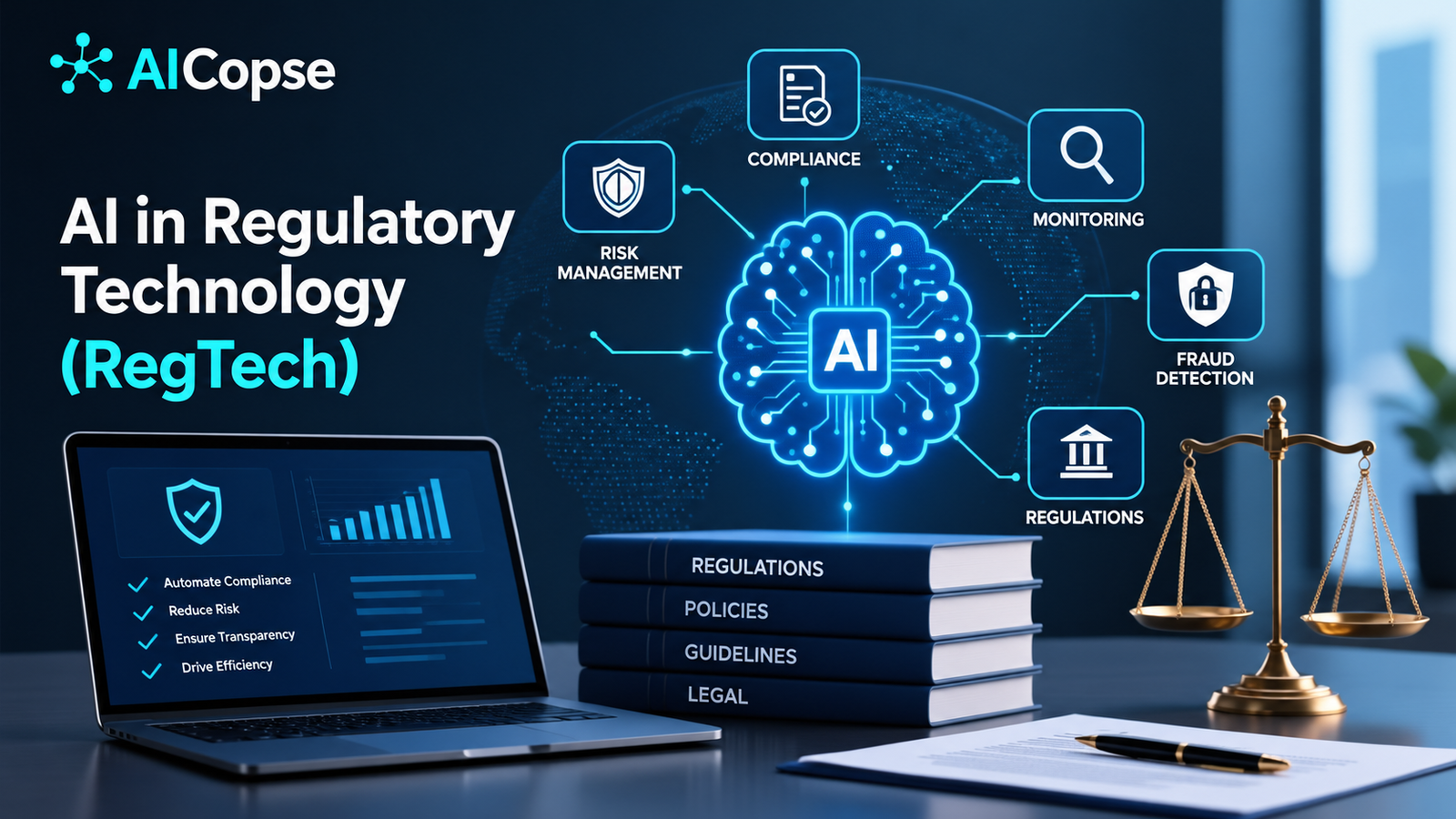
Primary topic: AI in Regulatory Technology (RegTech): How Artificial Intelligence Is Transforming Financial Compliance
Research focus: AI-powered regulatory change management, compliance monitoring, regulatory reporting, financial crime prevention, policy interpretation, risk intelligence, audit automation, explainable AI, governance and RegTech product development
Executive takeaway
AI is changing RegTech from a collection of rule-based compliance tools into a connected system for understanding regulations, mapping obligations to business processes, monitoring controls and producing evidence. The most valuable applications are not simply chatbots that answer regulatory questions. They are systems that connect regulatory text with internal policies, transaction data, customer records, control owners and reporting workflows. Recent research on AI agents, explainable AML models and regulatory supervision points toward more automated compliance operations, but also highlights the importance of reliable evidence, model validation and human accountability. For financial institutions, the practical opportunity is to automate repetitive analysis while keeping regulated decisions traceable, reviewable and under appropriate control.
What Is AI in Regulatory Technology?
Regulatory Technology, commonly called RegTech, refers to technologies that help organizations meet regulatory and compliance requirements. In financial services, these requirements can cover anti-money laundering, customer due diligence, sanctions screening, transaction monitoring, regulatory reporting, conduct risk, data protection, operational resilience and record keeping.
Traditional compliance systems often rely on fixed rules, manually maintained spreadsheets, periodic reviews and staff who interpret regulatory updates and translate them into internal procedures. These methods remain useful for clearly defined requirements, but they can become difficult to maintain when an institution operates across multiple products, legal entities and jurisdictions.
AI can support this work by extracting information from regulatory documents, identifying changes, classifying obligations, comparing policies, detecting unusual activity and helping compliance teams prepare evidence.
Natural language processing can interpret text, machine learning can identify patterns in structured data, graph analytics can reveal relationships between entities, and generative AI can summarize evidence or assist with investigations.
Regulatory interpretation
Extract obligations, dates, definitions and exceptions from regulatory text
Risk detection
Identify anomalies, suspicious patterns and changes in risk indicators
Compliance assistance
Summarize evidence, draft explanations and support policy analysis
Relationship analysis
Connect customers, transactions, entities, controls and risk events
The central distinction is that AI can help interpret and analyze information, but it does not automatically establish that an institution is compliant. Compliance depends on the applicable rules, the institution’s actual conduct, the quality of its controls and the evidence supporting its decisions.
Why Financial Institutions Need More Intelligent RegTech
Financial institutions face a moving set of obligations. A new regulation may affect onboarding, product disclosures, transaction monitoring, data retention, reporting formats or the responsibilities of a particular business unit. The difficulty is not only finding the new rule. It is understanding which systems, controls, policies and teams must change.
The UK Financial Conduct Authority’s Digital Regulatory Reporting work illustrates the scale of the challenge. The FCA says it receives around 500,000 scheduled regulatory reports each year.
Its digital reporting initiative explores ways to improve the efficiency and quality of reporting, including common data definitions and machine-readable regulatory requirements.
Source: Financial Conduct Authority, Digital Regulatory Reporting
For a financial institution, the operational burden typically appears across several connected activities:
- Monitoring regulatory publications across multiple authorities
- Identifying which legal entities, products and jurisdictions are affected
- Translating regulatory language into internal policies and control requirements
- Collecting data from core banking, payments, CRM, lending and compliance systems
- Testing whether controls operate as intended
- Preparing regulatory submissions and supporting evidence
- Maintaining audit trails that explain what changed, who approved it and when it took effect
AI is useful when it connects these tasks into one workflow. A regulatory update should not end as a summary in an employee’s inbox. It should be traceable to the affected obligation, the relevant internal control, the accountable owner, the implementation deadline and the evidence required to demonstrate completion.
Research Study: A 2025 Review of RegTech Evolution, Applications and Challenges
A comprehensive review published in the Journal of Financial Reporting and Accounting examined the development of RegTech and its implications for financial regulation and compliance. The researchers used bibliometric analysis of 89 scholarly articles and content analysis of 47 key studies, covering literature from 2010 to 2023.
The review organized the field around four connected themes: RegTech applications in fintech and banking, compliance management and fraud prevention, digital transformation and governance, and the integration of big data, AI, machine learning and blockchain. This matters because RegTech is not a single software category. It is an ecosystem of technologies that support different regulatory responsibilities.
The study identifies opportunities to improve compliance efficiency and risk management, while also pointing to challenges involving governance, implementation and the interaction between technology and regulatory requirements. For product developers, the implication is that an AI compliance platform should be designed around a real regulatory workflow rather than marketed as a general-purpose AI assistant.
What this research means for product design
- Connect regulatory obligations with internal controls
- Support both compliance operations and financial crime prevention
- Build governance and auditability into the product architecture
- Measure operational outcomes instead of relying on AI accuracy claims alone
Research Study: AI-Enabled RegTech for KYC, Compliance and Regulatory Reporting
A research article published in September 2026 examines how AI-enabled RegTech can support know-your-customer processes, financial compliance and regulatory reporting. The review describes an architecture combining digital identity services, entity resolution, rules, machine learning, graph analytics, natural language processing and workflow automation.
The value of this combined approach is that compliance problems often cross system boundaries. A KYC review may require identity information, company ownership data, sanctions results and transaction behavior.
A regulatory reporting task may require information from several business systems, together with definitions that determine how each field should be reported.
AI can help reconcile names, extract information from documents, identify missing fields and route exceptions to the appropriate team. However, identity matches and regulatory interpretations must be supported by evidence. A name similarity score, for example, should not be treated as conclusive proof that two records belong to the same person.
The article is a useful architecture-level reference, but it is a narrative review rather than a controlled trial demonstrating a specific percentage reduction in compliance costs. Its value is in describing how different AI capabilities can be combined into a practical RegTech system.
Research Study: TRIAG and Multi-Agent Generative AI for Financial Compliance
A May 2026 research article in Intelligent Systems with Applications introduced TRIAG, a framework that coordinates three generative AI agents to support financial regulatory compliance. The system uses a hierarchical multi-agent reinforcement learning approach and a retrieval-augmented generation pipeline. Its agents are assigned distinct responsibilities, including policy-related work and regulatory horizon scanning.
The researchers report a regulatory retrieval F1 score of 0.93 and a 96% reduction in inference costs in their evaluation. These are results from the study’s specific framework and evaluation conditions.
They should not be interpreted as a guarantee that a production compliance department will achieve the same accuracy or cost reduction.
The architectural idea is nevertheless relevant. Regulatory compliance involves different tasks that require different evidence. One component can locate the applicable rule, another can identify the policy or control affected, and an orchestrator can assemble the result for review. A modular design also makes it easier to test each component separately.
For real-world deployment, a multi-agent system should not be allowed to invent regulatory obligations or independently approve high-impact changes. It should return the source text, the relevant section, the reasoning trail and any uncertainty that requires human attention.
Source: TRIAG: Tri-reinforced infused generative agents for financial risk compliance, 2026
Research Study: Explainable and Fair AI Models for Anti-Money Laundering
A February 2026 study published in Discover Artificial Intelligence presents a reproducible machine-learning pipeline for anti-money laundering detection. The framework combines synthetic data generation, methods for addressing class imbalance and post-hoc explainability using SHAP.
Class imbalance is a central problem in financial crime detection. In many datasets, suspicious transactions represent a small share of all activity. A model can appear highly accurate by classifying most transactions as legitimate while missing important suspicious cases.
Evaluation therefore needs to consider measures such as precision, recall, false-positive rates and the operational cost of missed detections.
Explainability is equally important. SHAP-style methods can help show which features contributed to a model’s prediction. This can help analysts understand why an alert was generated, compare patterns across cases and identify potential problems in the model.
However, an explanation of a model prediction is not proof that the prediction is correct, and synthetic training data cannot fully reproduce every pattern found in live financial activity.
For RegTech developers, this research supports a design in which detection, explanation and validation are built together. A model should be evaluated not only on predictive performance but also on fairness, stability, data quality and usefulness to investigators.
Research Study: Explainable AI for Regulatory Early-Warning Systems
A 2026 study in the Journal of Financial Regulation and Compliance proposes an explainable AI early-warning system for financial and economic risk. It combines macroeconomic, financial, governance and labor-market indicators within a supervisory framework.
The research is relevant to RegTech because regulatory technology is not limited to checking whether a transaction violates a rule. It can also help institutions and supervisors identify emerging risks before they become serious problems. Early-warning systems may monitor changes in risk indicators, identify combinations of signals and direct analysts toward areas requiring closer examination.
However, an early-warning signal should not be confused with a confirmed event or a reliable prediction in every market condition. Financial data can change, relationships between indicators can break down, and a model trained on past crises may not capture a new type of shock. A responsible implementation should show the indicators behind each alert and track how often the alerts prove useful.
Source: Explainable AI–RegTech early warning systems for financial crisis detection, 2026
Research Study: U.S. Government Accountability Office on AI in Financial Services
The U.S. Government Accountability Office published a report in May 2025 examining the use and oversight of AI in financial services. It describes applications across areas such as customer service, automated trading, credit decisions and regulatory functions.
It also identifies risks, including lending bias and cybersecurity concerns, and discusses oversight challenges facing financial regulators.
For RegTech providers, the report highlights an important distinction between adopting AI and governing AI. A financial institution may use an AI tool to make a workflow faster, but it still needs to understand the risks created by the tool, establish accountability and ensure that relevant oversight processes can evaluate its use.
The report is not a controlled evaluation of one RegTech product. It is a government review of AI use and oversight in financial services. Its relevance lies in the governance questions that financial institutions must address when introducing AI into regulated activities.
Source: U.S. GAO, Artificial Intelligence: Use and Oversight in Financial Services, 2025
Research Study: Global AI Adoption in Financial Services and Regulatory Functions
The Cambridge Centre for Alternative Finance’s 2026 Global AI in Financial Services report examines AI adoption, impact and risks across industry participants and regulators. The findings describe widespread use of external foundation models alongside internal customization, while also highlighting difficulties measuring enterprise value and concerns around data privacy.
The report indicates that productivity benefits are more readily perceived in functions such as technology, data, product and operations than in the form of clearly measured enterprise-wide value. It also identifies regulatory uses including supervision, anti-money laundering and consumer protection.
For RegTech teams, this points to a practical measurement problem. A compliance assistant may save time drafting summaries, but the institution still needs to measure whether the result is accurate, whether reviewers spend less time correcting it, whether important issues are missed and whether the workflow becomes easier to audit.
Source: Cambridge Centre for Alternative Finance, 2026 Global AI in Financial Services Report
Where AI Creates Practical Value Across RegTech
The strongest RegTech applications are tied to specific operational bottlenecks. A firm should begin by identifying a costly, repetitive or error-prone process and then determine whether AI can improve it without weakening control quality.
| RegTech function | AI application | Operational value | Human control |
|---|---|---|---|
| Regulatory change management | Compare new and existing regulatory text | Faster identification of relevant changes | Compliance validates applicability |
| Policy management | Map obligations to internal policies | Find gaps and outdated language | Policy owner approves changes |
| AML monitoring | Detect unusual transaction patterns | Better alert prioritization | Investigator reviews evidence |
| Regulatory reporting | Validate fields and detect anomalies | Fewer preventable data errors | Authorized sign-off before submission |
| Compliance testing | Analyze control evidence and exceptions | More continuous monitoring | Control owner resolves exceptions |
| Audit preparation | Retrieve and summarize evidence | Less manual evidence collection | Auditor verifies source records |
AI-Powered Regulatory Change Management
Regulatory change management is one of the clearest opportunities for AI because the process begins with large volumes of text and ends with operational tasks. Regulations, consultation papers, supervisory statements, enforcement notices and guidance documents may all affect a financial institution.
A useful AI workflow should detect new documents, identify what has changed, extract relevant obligations and connect those obligations to the institution’s existing compliance inventory. The system should then identify affected policies, controls, products and business owners.
Regulatory change intelligence workflow
Regulator publications
Obligations and dates
Policies and controls
Owners and deadlines
Evidence and approval
The AI proposes mappings and tasks. Authorized compliance staff confirm applicability and approve consequential changes.
The difficult part is not summarizing a regulation. It is determining whether the rule applies to a particular legal entity, product, customer segment or jurisdiction. A well-designed system must represent applicability conditions, effective dates, exceptions and dependencies rather than treating every sentence as a universal requirement.
AI for Regulatory Reporting and Data Quality
Regulatory reporting depends on consistent definitions and reliable data. A reporting error can begin far upstream: a field may be missing in a source system, a product may be classified incorrectly, or two departments may interpret the same reporting definition differently.
AI can help identify unusual values, compare submitted figures with historical patterns, detect missing information and explain why a record failed a validation check. Generative AI can also help staff understand reporting instructions and locate the relevant internal documentation.
However, AI should not become the authoritative source for regulatory calculations. Where a report requires a defined formula, threshold or classification rule, the production process should use controlled logic that can be tested and reproduced. AI can assist with interpretation and exception handling, while deterministic validation checks enforce the approved specification.
Track where each reported value originated and how it was transformed
Apply approved rules, cross-field checks and reconciliation controls
Use AI to explain anomalies and direct them to the right team
The FCA’s Digital Regulatory Reporting initiative also emphasizes standardization: firms and regulators need to align on data definitions, interpretation and implementation. This is a foundational requirement for reliable automation. Source: FCA, Digital Regulatory Reporting
AI for Compliance Monitoring and Control Testing
Many compliance controls are tested periodically, which means an issue may remain undetected between reviews. AI can help analyze operational evidence more frequently, looking for exceptions such as missing approvals, overdue reviews, unusual access patterns or transactions that do not follow an expected process.
For example, a compliance platform could compare customer-risk ratings with the timing of enhanced due diligence reviews. It could identify cases where a review was due but no evidence of completion exists.
A separate rules engine would determine the applicable deadline, while AI helps locate and interpret the relevant records.
Continuous monitoring should not mean that a model silently changes control requirements. Each control needs an approved definition, an owner, a testing method and a process for resolving exceptions. AI can make testing more frequent and evidence easier to review, but control design and accountability remain organizational responsibilities.
AI for AML, KYC and Sanctions Compliance
Financial crime compliance is a mature area for data analytics, but it is also one of the most sensitive. AI can help connect customer information, beneficial ownership, transaction behavior, adverse media, sanctions data and known-risk entities. Entity resolution can identify records that may refer to the same person or organization, while graph analytics can reveal relationships that are not obvious from individual records.
The principal challenge is balancing detection with fairness and accuracy. A false match can delay a legitimate customer’s access to financial services, while a missed match can create serious compliance exposure.
Models therefore need carefully selected thresholds, strong data provenance, clear explanations and a reliable process for human review.
- Use AI to prioritize alerts and identify relationships that need investigation
- Preserve the underlying records and evidence behind each risk indicator
- Distinguish a potential match from a confirmed identity or sanctions hit
- Monitor false positives and false negatives across relevant customer groups
- Document how investigators resolve alerts and how those outcomes affect future model evaluation
Generative AI and the Compliance Copilot
Generative AI can make regulatory information easier to access, but a general chatbot is not enough for a regulated environment. A compliance copilot should answer from approved source material, show citations to the relevant regulation or internal policy, identify when information is missing and avoid presenting uncertain interpretations as settled requirements.
One useful application is evidence preparation. An investigator may need to review several documents, transaction records and prior case notes. A grounded AI assistant can summarize the available material, create a timeline and identify unanswered questions. The investigator can then verify the summary against the original records.
A safe compliance copilot should provide
- Answers grounded in approved regulatory and internal documents
- Direct links to the passages supporting each answer
- Clear separation between regulatory text and AI-generated interpretation
- Version and effective-date awareness
- Escalation when the evidence is incomplete or conflicting
- An audit log of prompts, retrieved sources, outputs and reviewer actions where appropriate
The UK FCA’s published approach to AI describes its use of AI to support staff by retrieving information and analyzing unstructured text, while retaining human expertise for judgment. This is a useful model for compliance products: automate information-intensive work, but preserve accountable human decisions.
Source: FCA, AI and the FCA: Our Approach
Visual Framework: The AI RegTech Operating Model
Laws, rules, guidance, reporting standards
Document ingestion, NLP, versioning, obligation extraction
Policies and obligations
Alerts and anomalies
Data validation and returns
Approvals, evidence, escalation, model validation and audit trail
This operating model separates regulatory interpretation, analytical processing and final accountability. It also allows institutions to replace individual components without rebuilding the entire compliance platform.
Key Risks of AI in RegTech
| Risk | Why it matters | Control |
|---|---|---|
| Hallucinated interpretation | AI may invent a requirement or misstate an exception | Retrieval from authoritative sources and legal review |
| Outdated information | The model may use superseded rules | Version control and effective-date tracking |
| Bias and unfair outcomes | Certain customers may be disproportionately flagged | Fairness testing and human review |
| Data leakage | Sensitive financial or customer data may be exposed | Access controls, approved environments and data minimization |
| Automation bias | Staff may accept outputs without checking evidence | Reviewer training and evidence-based sign-off |
| Model drift | Performance can decline as rules and behavior change | Ongoing monitoring and periodic revalidation |
Regulatory Direction: Governance Matters as Much as Automation
Regulators are increasingly discussing how AI should be used safely in financial services. The details differ by jurisdiction, but recurring themes include accountability, consumer protection, governance, data quality, explainability and effective oversight.
The FCA’s current approach states that it intends to rely on existing regulatory frameworks rather than introduce a separate set of AI-specific rules in the UK. Its guidance highlights existing responsibilities such as Consumer Duty, accountability and senior-management governance. Firms still need to assess how their use of AI interacts with the rules that apply to their activities.
Source: FCA, AI and the FCA: Our Approach, updated February 2026
In the United States, the GAO’s 2025 review identifies both potential benefits and risks from AI in financial services and discusses challenges in regulatory oversight. For institutions operating internationally, this reinforces the need for jurisdiction-aware compliance architecture rather than a single generic rulebook.
A RegTech platform should therefore maintain a regulatory inventory that records the jurisdiction, regulator, legal entity, effective date, source document and internal owner for each obligation. AI can assist with mapping and analysis, but the institution must maintain the approved interpretation and implementation record.
Expert Recommendation: Build an Evidence-First RegTech Platform
The recommended strategy is to build RegTech around evidence, workflow and accountability rather than around a single AI model. The model is one component of a larger operating system that includes authoritative regulatory sources, structured obligations, internal policies, business data, control testing and human approval.
- Start with one high-friction workflow: Choose a measurable use case such as regulatory change mapping, reporting validation or compliance evidence collection
- Use authoritative sources: Keep source documents, publication dates, versions and effective dates connected to every AI-generated interpretation
- Separate suggestions from decisions: AI can propose an obligation mapping, risk classification or report correction, but consequential actions should follow approved controls
- Combine AI with deterministic rules: Use machine learning for pattern recognition and text analysis, while approved rules handle calculations, thresholds and required validations
- Make every output traceable: Store the supporting evidence, model version, relevant inputs and reviewer decision
- Evaluate real workflow outcomes: Measure review time, error rates, alert quality, rework and audit findings rather than relying only on model benchmark scores
- Design for jurisdictional differences: Make regulatory scope, definitions and reporting requirements configurable by market and legal entity
Expert Quote
“Our people remain integral, using their expertise for judgement, while AI focuses on pulling out facts and analysing unstructured text.”
— Financial Conduct Authority, AI and the FCA: Our Approach
This statement captures a useful design principle for financial compliance. AI is well suited to processing large volumes of documents and data, but regulatory interpretation and consequential decisions require clear accountability. A good RegTech product should make expert review faster and better informed, not hide the evidence behind an automated answer.
Implementation Roadmap for Financial Institutions
Define the Regulatory Data Model
Identify the regulatory sources, legal entities, obligations, policies, controls, data fields and accountable owners. Establish a consistent way to represent each obligation and link it to evidence.
Automate a Bounded Workflow
Choose a use case with clear inputs and measurable outputs, such as comparing regulatory updates against internal policies. Run the AI system alongside the existing process and record disagreements.
Connect Systems and Evidence
Integrate document repositories, case management, reporting systems and control inventories. Apply role-based access, retention rules, version control and audit logging.
Monitor, Validate and Expand
Track quality and operational outcomes, test for drift, review failures and expand to additional workflows only when the evidence supports the next deployment.
KPIs for Measuring AI RegTech Performance
RegTech success should be measured through both operational efficiency and control quality. A faster process is not a success if it creates more reporting errors, missed obligations or unreviewed risk decisions.
| KPI | What it measures | How to use it |
|---|---|---|
| Regulatory change review time | Time from publication to validated assessment | Track workflow speed |
| Obligation mapping accuracy | Correctness of links to policies and controls | Validate against expert-reviewed samples |
| Reporting error rate | Errors detected before or after submission | Monitor data quality |
| Alert precision | Share of alerts judged useful after review | Assess investigation workload |
| False-negative rate | Known issues missed by the system | Assess residual risk |
| Evidence completeness | Whether decisions have required supporting records | Support audit readiness |
| Human override rate | Frequency of reviewer disagreement with AI | Investigate systematic model weaknesses |
Future Predictions for AI in RegTech, 2027–2030
Regulatory Intelligence Will Become More Connected
RegTech platforms are likely to move beyond document alerts toward connected obligation management. A regulatory update will increasingly be linked to the affected policy, control, business process, data field and evidence requirement. This will make it easier to understand the operational consequences of a regulatory change.
Agentic AI Will Support Multi-Step Compliance Workflows
AI agents may increasingly coordinate tasks such as finding a new rule, comparing it with internal policy, identifying affected controls and preparing an implementation plan. The most practical systems will operate within defined permissions, cite their sources and request human approval before changing policies, submitting reports or closing material compliance issues.
Continuous Control Monitoring Will Expand
As financial institutions connect more operational data, AI will help identify control exceptions closer to the time they occur. This could reduce dependence on periodic manual testing, although institutions will still need to validate the monitoring logic and ensure that important exceptions are not hidden by noisy alerts.
Explainability Will Become a Product Requirement
Institutions will increasingly expect AI systems to show the evidence behind a recommendation. This includes the source regulation, relevant policy, input data, model version and reviewer decision. Explainability will be especially important when AI affects customer access, financial crime investigations, regulatory submissions or risk classifications.
RegTech Will Become More Jurisdiction-Aware
Financial institutions operating across borders will need systems that understand differences in regulatory scope, definitions, deadlines and reporting formats. AI may help compare requirements across jurisdictions, but authoritative legal interpretation and local accountability will remain essential.
Compliance Value Will Be Measured More Rigorously
As AI budgets grow, institutions will face pressure to demonstrate measurable results. Future implementations are likely to be judged on the time required to interpret regulatory changes, the quality of reporting, the number of preventable control failures, the effort required to prepare audit evidence and the reliability of AI-assisted decisions.
Startup Opportunities in AI RegTech
There is room for specialized products that solve a narrow, expensive compliance problem better than a broad platform. Strong opportunities include:
- Regulatory Change Intelligence: Monitor official publications and map changes to policies, controls and business owners
- AI Regulatory Reporting QA: Validate reporting data, identify anomalies and explain rejected records
- Compliance Evidence Copilot: Retrieve evidence and prepare source-linked summaries for auditors and compliance teams
- AI Control Testing: Monitor evidence and flag exceptions against approved control definitions
- Regulatory Obligation Graph: Connect regulations, legal entities, products, policies, controls and reporting fields
- Explainable AML Analytics: Prioritize alerts and provide investigators with transparent reasons for each risk score
- Cross-Jurisdiction Compliance Mapping: Compare requirements across markets while preserving local applicability and review
- RegTech Model Governance: Track AI inventories, validation results, approvals, incidents and model changes
For a startup, the product should solve a clearly defined problem for a specific buyer. A tool that reduces the time required to map regulatory changes to internal controls may be easier to validate and deploy than an ambitious platform that attempts to automate every compliance function at once.
Frequently Asked Questions
What is AI in Regulatory Technology?
AI in RegTech uses technologies such as machine learning, natural language processing, graph analytics and generative AI to support regulatory compliance, reporting, risk monitoring, policy analysis and audit preparation.
How does AI help financial institutions with regulatory compliance?
AI can help identify regulatory changes, map obligations to internal policies, detect unusual activity, validate reporting data, retrieve evidence and prioritize compliance investigations. Human review and approved controls remain important for consequential decisions.
Can AI automate regulatory reporting?
AI can assist with document interpretation, data-quality checks, anomaly detection and exception handling. Regulatory calculations and submissions should use approved definitions, reproducible validation rules, appropriate authorization and auditable controls.
What is the difference between RegTech and SupTech?
RegTech generally refers to technology used by regulated firms to meet compliance requirements. SupTech refers to technology used by supervisory authorities to support regulatory oversight, data analysis and supervision.
What are the main risks of AI in RegTech?
Key risks include inaccurate regulatory interpretation, outdated source material, biased risk scores, data leakage, weak explainability, model drift and overreliance on automated outputs. Institutions should use source-linked evidence, validation, access controls and human oversight.
Will AI replace compliance officers?
AI can automate parts of document review, data analysis, monitoring and evidence preparation. Compliance professionals remain necessary for regulatory interpretation, accountability, investigations, escalation and decisions that require professional judgment.
What should a company automate first?
A company should begin with a repetitive workflow that has clear inputs, measurable outcomes and manageable risk. Regulatory change mapping, reporting validation and evidence retrieval are potential starting points when the institution has reliable source data and an accountable process owner.
Final Perspective
AI in RegTech is most valuable when it makes compliance more connected, measurable and evidence-driven. The opportunity goes beyond faster document summaries or automated alerts. A well-designed platform can connect regulatory obligations to internal policies, business processes, reporting data, control tests and audit evidence.
Recent research supports several important directions: AI agents can coordinate specialized compliance tasks, explainable models can help make financial crime detection more transparent, and regulatory early-warning systems can combine different sources of risk information. Reviews of RegTech also show that technology adoption depends on governance, implementation quality and the way systems fit into real compliance operations.
The main limitation is that regulatory compliance is not simply a text-processing problem. The same rule can apply differently depending on the institution, product, jurisdiction, customer and effective date. An AI system that produces a fluent but incorrect interpretation can create more risk than a manual process.
Financial institutions should therefore build AI RegTech around a clear operating principle:
That approach creates a practical path toward more efficient compliance without treating automation as a substitute for governance. The long-term value of RegTech will come from helping institutions understand what has changed, identify what is affected, act on the right evidence and demonstrate that their controls are working.
Research Sources
- RegTech advancements: a comprehensive review of its evolution, challenges, and implications for financial regulation and compliance, 2025
- Artificial Intelligence-Enabled RegTech for KYC, Financial Compliance, and Regulatory Reporting: Applications, Risks, and Future Directions, 2026
- TRIAG: Tri-reinforced infused generative agents for financial risk compliance, 2026
- Explainable and fair anti-money laundering models using a reproducible SHAP framework for financial institutions, 2026
- Explainable AI–RegTech early warning systems for financial crisis detection, 2026
- U.S. GAO, Artificial Intelligence: Use and Oversight in Financial Services, 2025
- Cambridge Centre for Alternative Finance, 2026 Global AI in Financial Services Report
- Financial Conduct Authority, Digital Regulatory Reporting
- Financial Conduct Authority, AI and the FCA: Our Approach
- Financial Conduct Authority, RegTech
- Bank for International Settlements, Managing Explanations: How Regulators Can Address AI Explainability, 2025
- Financial Stability Board, The Financial Stability Implications of Artificial Intelligence, 2024

Leave a Reply