
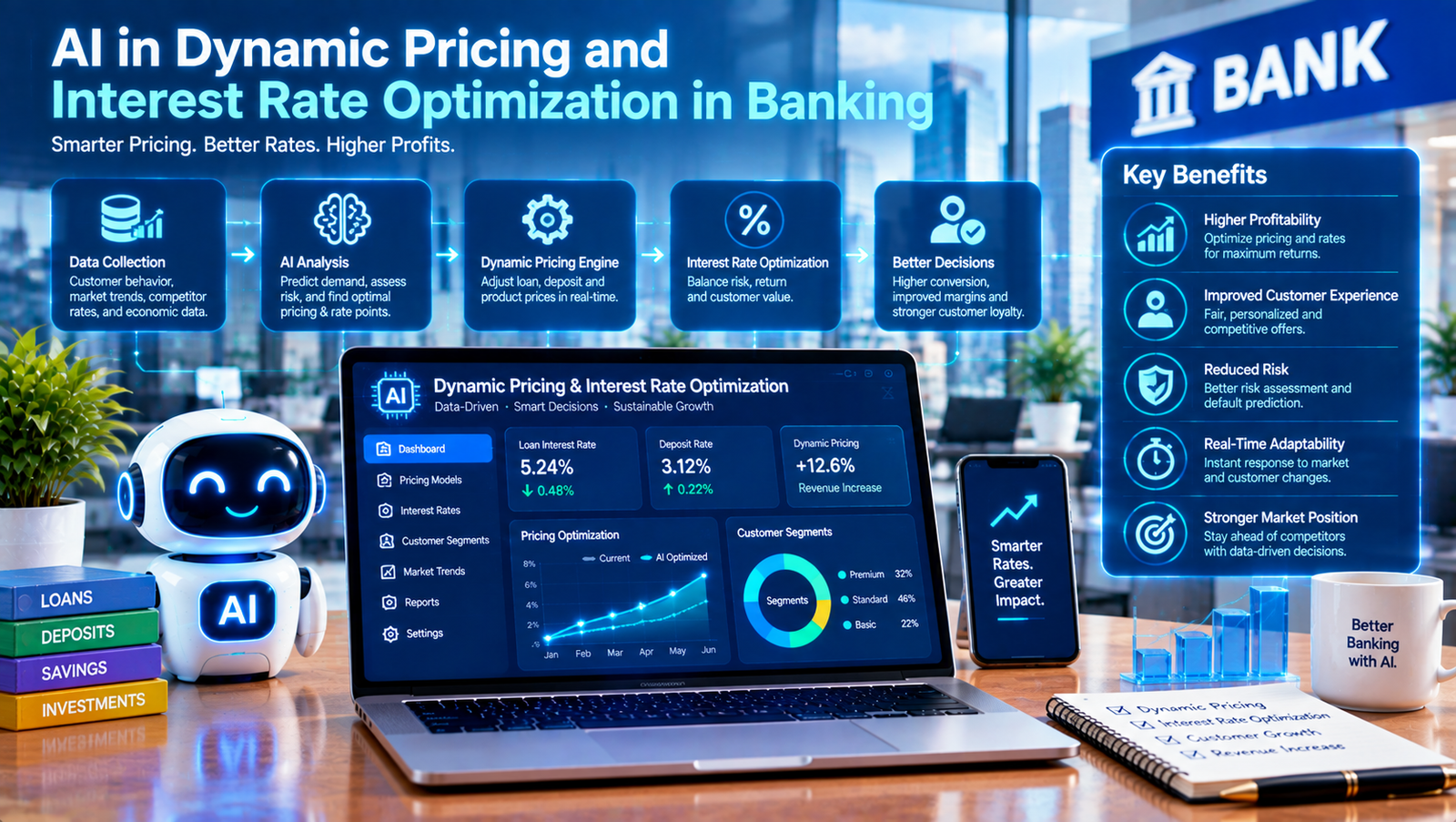
Primary topic: AI in Dynamic Pricing and Interest Rate Optimization in Banking
Research focus: AI-powered loan pricing, personalized interest rates, deposit rate optimization, customer-level pricing, credit risk, causal inference, interest rate forecasting, profitability, customer retention, fairness, and banking risk management
What Is AI in Dynamic Pricing and Interest Rate Optimization?
Dynamic pricing in banking means adjusting the price of a financial product as relevant conditions change. Depending on the product, that price may be an interest rate, a deposit yield, an origination fee, a credit limit, or a combination of these terms.
AI-based interest rate optimization uses data and machine learning to estimate which pricing options are appropriate for a particular customer, product, risk category, or market condition. It can help a bank understand how a rate change may affect loan acceptance, deposit balances, refinancing, customer retention, expected losses, and net interest income.
This is different from simply predicting whether a borrower will default. A credit-risk model estimates the likelihood or cost of a credit event. A pricing model must also consider what happens when the bank changes the rate offered to that borrower.
For example, a bank may identify a customer as low risk but still need to determine whether a discount is necessary to win the loan, whether the customer would accept a standard rate, and whether the expected revenue covers funding and operating costs. These are connected questions, but they require different analytical methods.
Expected credit cost
Estimate default probability, loss severity, and exposure over the product’s life
Customer response
Estimate how rate changes affect acceptance, switching, borrowing, and retention
Cost of capital
Account for deposit costs, market rates, liquidity, and balance-sheet needs
Governance
Keep pricing within approved policies, fairness limits, and regulatory requirements
Why Banks Are Exploring AI-Based Pricing
Banks operate in markets where small changes in rates can affect both customer behavior and financial performance. A lower loan rate may increase applications or reduce refinancing to competitors, but it also reduces the interest income earned on each loan. A higher deposit rate may attract or retain deposits, but it increases funding costs. The value of a pricing decision therefore depends on the customer, product, market, and balance-sheet context.
AI can help banks analyze these relationships at a level of detail that traditional spreadsheets and broad pricing bands may not support. It can combine historical product performance, borrower characteristics, market rates, customer interactions, and funding information to generate forecasts and compare pricing scenarios.
However, more precise pricing is not automatically fairer or more profitable. A model can reproduce historical discrimination, confuse correlation with causation, or optimize a narrow business metric at the expense of long-term customer trust.
The Bank of England’s April 2026 discussion of dynamic and personalized pricing explains that AI and greater data availability are enabling firms to adjust prices more frequently and tailor offers to customer behavior. It also highlights questions around fairness, competition, and the wider effects of personalized prices. Although that article focuses on consumer pricing across the economy rather than banking alone, its analysis is relevant to financial institutions considering more individualized offers.
Source: Bank of England, April 2026
Research Evidence: Six Studies Relevant to AI Pricing in Banking
Research Study: Optimizing Preferential Interest Rates with Causal Inference and Domain Adaptation
A 2026 study published in the Proceedings of the AAAI Conference on Artificial Intelligence examines how retail lenders can optimize preferential interest rates. The research focuses on a practical commercial problem: a lender may offer a discount to win or retain a customer, but an unnecessarily large discount reduces the return on the loan. A discount that is too small may fail to change the customer’s decision.
The researchers propose combining causal inference with domain adaptation to estimate customer-specific responses to interest-rate discounts. This matters because a conventional prediction model may identify customers who are likely to accept an offer, but it may not establish whether a lower rate caused that acceptance. Customers who receive discounts may already differ from those who do not.
The study also addresses operational constraints such as tiered rate grids, marketing budgets, and regulatory guardrails. These constraints make the problem more complex than selecting the rate with the highest predicted response.
For banks, the practical lesson is to estimate the incremental effect of a discount, not simply the probability that a customer will accept a loan. A rate offer should be evaluated against a credible alternative, including the possibility that the customer would have accepted without a discount.
Research Study: Artificial Intelligence and Relationship Lending
A Bank for International Settlements working paper published in February 2025 examines how AI-based credit scoring interacts with relationship lending. Relationship lending uses information accumulated through ongoing contact between a bank and its customer. Some of that information is difficult to capture in a standard dataset, such as a firm’s operating context, management practices, or changing business circumstances.
The paper explains that AI can improve the analysis of hard, verifiable, and codifiable information while coexisting with more traditional ways of reducing information gaps between banks and borrowers. This distinction matters for interest-rate optimization because a pricing system that relies only on easily measured variables may overlook relevant customer context.
For business lending, a model may estimate risk using financial statements, repayment history, account flows, and other structured information. Yet a relationship manager may hold additional context about a temporary cash-flow disruption, a new contract, or a change in the firm’s operating model.
The research supports a blended approach: AI can strengthen credit analysis, while relationship information and responsible human review remain relevant to pricing decisions. The paper is not a universal proof that AI lowers loan rates or improves every bank’s profitability. Its value is in examining how AI-based scoring interacts with the information banks gather through customer relationships.
Research Study: Does Data Improve Welfare in Credit Markets?
A research article published online in September 2026 in Research in International Business and Finance examines differentiated interest-rate pricing in credit markets. It studies how data-based pricing affects borrowers, lenders, and broader welfare rather than treating bank revenue as the only outcome.
The article’s reported findings indicate that data-based pricing can redistribute welfare among market participants and may increase overall social welfare under the study’s framework. It also examines how welfare changes as pricing becomes more granular, noting that the outcomes for firms and banks do not necessarily move in the same way.
This is important for AI pricing because better customer-level predictions can change who receives a lower rate, who pays more, and how the gains from improved information are distributed. A bank may improve its own pricing accuracy without producing the same effect for every borrower.
The study encourages banks to evaluate more than average portfolio yield. A responsible pricing assessment should also examine affordability, customer access, distributional outcomes, and how different groups experience the pricing system.
The findings should be interpreted within the paper’s model and empirical setting. They do not establish that every form of personalized interest-rate pricing improves social welfare.
Research Study: Fairness Versus Profitability in Automated Machine Learning
Published in September 2026 in AI and Ethics, this study examines the trade-off between fairness and profitability using data from a real credit-lending platform. The researchers assess fairness using the principle of separation and evaluate profitability through a loan-level profit function aggregated across the portfolio.
The study is directly relevant to automated loan pricing because pricing models can affect both who receives credit and the financial return associated with each loan. A model optimized for profitability may produce different outcomes across groups, while a fairness intervention may alter the distribution of approved loans or expected returns.
The study evaluates whether fairness-processing methods can improve this trade-off. Its real-platform setting makes the work relevant to banks that need to test fairness controls against actual lending outcomes rather than relying only on theoretical examples.
For implementation, banks should define the fairness measures that matter for the product and jurisdiction, then assess them alongside risk and profitability. A single fairness metric cannot capture every legal, ethical, or commercial concern, and the appropriate test depends on the decision being made.
Research Study: Algorithmic Pricing and Its Implications for Strategy and Regulation
A 2026 article in the International Journal of Research in Marketing examines algorithmic pricing as a strategic and regulatory issue. It considers how automated pricing uses data inputs, decision rules, and price outputs, while discussing the relationship between pricing strategy, competition, and potential price discrimination.
Although the research spans markets beyond banking, its framework is useful for financial products. An AI-based pricing engine has inputs such as customer data, market conditions, funding costs, and risk estimates. It applies models and business constraints to those inputs, then generates an offer or rate recommendation.
The article emphasizes that algorithmic pricing is not merely a technical upgrade. It is a business decision shaped by market structure, customer response, management choices, and regulation.
For banks, this means that model governance should cover the entire pricing process. Reviewing the model alone is insufficient if the data, pricing rules, or deployment practices create unfair or anti-competitive outcomes.
Research Study: AI-Driven Multiscenario Interest-Rate Forecasting
An August 2026 research preprint presents an AI-supported approach to multiscenario interest-rate forecasting for banking asset management. The prototype was tested in a major European bank and combines traditional econometric methods with AI-based analysis.
The system brings together topic modeling, sentiment analysis, market information, and econometric forecasting. A Bayesian vector autoregression model supports scenario analysis, allowing analysts to consider different economic developments rather than relying on one forecast.
This work is relevant to interest-rate optimization because banks need to price loans and deposits while managing changing funding costs, market yields, and balance-sheet exposure. A customer-level pricing model may estimate demand accurately but still produce poor decisions if it relies on an unrealistic assumption about future interest rates.
The research illustrates the value of combining market forecasting with interpretable scenario analysis. However, it is a proof-of-concept preprint, not evidence that all banks will achieve a particular level of forecast accuracy or profitability.
Where AI Can Improve Banking Pricing
Personalized Loan Pricing
AI can help lenders estimate risk, predict acceptance, and compare rate offers for personal loans, auto loans, mortgages, and small-business credit. The model should account for the full economics of a loan rather than maximizing the chance of acceptance alone.
Relevant inputs may include:
- Credit history and repayment behavior
- Verified income and affordability information
- Loan amount, term, collateral, and product type
- Funding costs and expected credit losses
- Customer response to previous offers
- Competitive conditions, where reliable data is available
- Applicable pricing rules and lending constraints
The output should be a permitted pricing range or recommendation, not an unconstrained rate that bypasses underwriting or policy requirements.
Deposit Rate Optimization
Deposit pricing presents a different problem. A bank must decide how much interest to offer to attract or retain deposits while managing the cost and stability of its funding.
AI can estimate how depositors may respond to rate changes, identify accounts with a higher likelihood of switching, and model how different offers affect deposit balances. It can also help distinguish between short-term rate-sensitive balances and more stable customer relationships, provided the data supports that distinction.
A useful system should consider the total relationship rather than treating every account as an isolated funding source. It should also test whether its retention predictions remain reliable during periods of market stress, when customer behavior may change quickly.
Relationship-Based Pricing
A customer may use a bank for deposits, payments, credit cards, mortgages, and business services. AI can help estimate the economics of the broader relationship and support consistent pricing across products.
However, relationship value should not become an excuse for opaque or unfair treatment. Banks need clear rules for which customer data may be used, how it affects offers, and whether the resulting differences are permissible.
Refinancing and Retention Offers
AI can identify customers who may refinance or move deposits to another provider. The bank can then estimate whether a targeted offer is likely to change the customer’s decision.
Causal models are particularly useful here. A customer who is likely to leave may not necessarily be persuaded by a discount. The relevant question is whether the offer changes the outcome enough to justify its cost.
How an AI Pricing Engine Works
Customer, product, credit, market, funding, and behavioral data
Credit risk, customer response, deposit behavior, and market scenarios
Compare permitted rates against risk-adjusted value and customer outcomes
Rate floors, caps, eligibility rules, fairness tests, and approval limits
Approved quote, outcome tracking, drift monitoring, and audit trail
The system should separate prediction from decision-making. Forecasting models estimate what may happen; the optimization layer evaluates possible actions; policy controls determine which actions are allowed.
Comparing AI Methods for Interest Rate Optimization
| AI method | Banking use | Key limitation |
|---|---|---|
| Gradient-boosted trees | Risk estimates, acceptance prediction, deposit behavior | Predictions do not automatically identify causal effects |
| Causal inference and uplift modeling | Estimate the incremental effect of a rate discount | Requires suitable data, assumptions, or experiments |
| Time-series forecasting | Market rates, funding costs, deposit balances | Forecast errors increase during structural changes |
| Optimization algorithms | Choose rates within business and regulatory constraints | Results depend on the objective and constraints selected |
| Fairness testing models | Detect differences in pricing outcomes across groups | Metrics can conflict and require contextual interpretation |
Dynamic Pricing Must Include Risk-Adjusted Economics
A rate that maximizes customer acceptance is not necessarily the rate that produces sustainable value. The bank must account for the expected income and costs over the product’s life.
A simplified pricing framework can be expressed as:
Interest and fee income
Funding cost
Expected credit loss
Operating and acquisition costs
Capital and liquidity costs
This is a conceptual framework rather than a complete regulatory or accounting formula. Actual calculations depend on the product, accounting treatment, risk methodology, capital framework, and the bank’s internal policies.
AI can estimate some of these components and compare possible offers. The bank should make assumptions visible, test sensitivity to changing conditions, and avoid treating uncertain forecasts as guaranteed returns.
Visual: What a Rate Change Can Affect
May improve acceptance or retention
Reduces income per unit of lending
Expected losses and funding costs still apply
Evaluate risk-adjusted value and customer impact
Key point: A rate discount should be evaluated against the likely outcome without the discount, not simply against the original rate.
Fairness, Explainability, and Customer Trust
Personalized interest rates can create legitimate differences when they reflect relevant factors such as credit risk, loan term, collateral, or funding costs. They can also create concerns when differences are driven by inappropriate variables, unreliable proxies, or historical patterns that disadvantage protected or vulnerable groups.
A bank should test whether the pricing model produces unexplained disparities, whether the data is suitable for the intended use, and whether customers can receive clear information about the factors that determine their offers.
Fairness review should include more than one point in the process. The data, risk model, offer optimization, and final policy rules can each affect outcomes.
Recommended controls include:
- Document the legitimate purpose of every major pricing variable
- Test pricing outcomes across legally and operationally relevant customer groups
- Check whether proxy variables create unjustified differences
- Monitor approval rates, offered rates, acceptance, and realized outcomes
- Provide meaningful explanations for material pricing decisions
- Keep a record of model versions, inputs, policy rules, and approvals
- Provide a process for correcting inaccurate customer information
The 2026 scoping review of fairness and bias mitigation in financial AI identifies a need for more standardized metrics and greater attention to intersectionality and causal analysis. For banks, this reinforces the need to select fairness tests based on the actual lending or pricing decision rather than treating one metric as universally sufficient.
Regulatory and Governance Considerations
AI pricing systems operate within existing banking, consumer-protection, privacy, fair-lending, model-risk, and competition requirements. The exact obligations depend on the jurisdiction, product, customer type, and how the model is used.
In the United States, for example, lenders should assess relevant fair-lending and consumer-protection requirements, including the Equal Credit Opportunity Act and applicable Regulation B provisions. The use of complex models does not remove the need to provide required adverse-action reasons where applicable. Banks should obtain legal and compliance review before deploying a new pricing approach.
Governance should establish clear ownership across:
| Function | Responsibility |
|---|---|
| Pricing and product | Define objectives, rate boundaries, and customer proposition |
| Credit risk | Validate risk assumptions and expected-loss treatment |
| Model risk | Review methodology, performance, limitations, and drift |
| Compliance and legal | Review fairness, disclosure, privacy, and regulatory obligations |
| Technology and data | Maintain secure pipelines, access controls, and reliable deployment |
| Internal audit | Assess control design, evidence, and adherence to approved processes |
Expert Recommendation
Banks should begin with a narrow pricing problem where the business objective is measurable and the customer impact can be monitored. Preferential-rate optimization for a specific loan product or deposit-retention offers may provide a manageable starting point, provided the bank has sufficient data and an appropriate control framework.
The recommended approach is to combine predictive models with causal analysis and constrained optimization. Predictive models estimate risk and behavior; causal methods estimate how a price change affects outcomes; optimization selects among permitted options. A separate policy layer should enforce approved rate ranges, eligibility rules, fairness requirements, and escalation procedures.
Before deployment, banks should run the system in shadow mode, comparing AI recommendations with existing decisions without allowing the model to set customer rates. They should then use a controlled pilot with clear monitoring and stop conditions. Results should be assessed across profitability, customer outcomes, fairness, and operational reliability.
Practical recommendations:
- Start with one product and a clearly defined pricing decision
- Separate risk prediction from customer-response estimation
- Use causal methods to estimate the incremental effect of discounts
- Include funding costs, expected losses, and capital considerations
- Keep pricing within approved policy and regulatory boundaries
- Test for fairness before launch and throughout the model’s life
- Use human approval for exceptions and high-impact decisions
- Track outcomes over time and recalibrate when market conditions change
Expert Perspective
This principle is particularly relevant to pricing. A model may identify a statistically attractive rate, but the bank still needs to understand the customer relationship, the economic assumptions behind the recommendation, and the consequences of applying that rate. The goal should be better-supported decisions, not automatic pricing without context.
Implementation Roadmap
Select the product, business objective, customer outcomes, permitted data, and decision boundaries
Build risk, demand, and market forecasts; document assumptions and data quality
Back-test pricing, run scenario analysis, assess group outcomes, and test model stability
Compare recommendations with current pricing and define escalation and rollback procedures
Monitor realized margin, customer behavior, fairness, drift, complaints, and policy compliance
KPIs for AI-Based Banking Pricing
| KPI | What it measures | Why it matters |
|---|---|---|
| Risk-adjusted margin | Return after relevant risk and funding costs | Prevents optimizing headline yield alone |
| Offer acceptance | Share of offers accepted | Measures customer response |
| Incremental conversion | Change attributable to the pricing intervention | Separates causal impact from correlation |
| Deposit retention | Retention of balances or accounts | Measures funding stability and offer effectiveness |
| Pricing disparity | Differences in offers across relevant groups | Supports fairness monitoring |
| Customer complaints | Pricing-related complaints and disputes | Signals potential trust or communication issues |
| Model drift | Changes in data or model performance | Identifies when recalibration may be needed |
Future Predictions: 2027–2030
2027: Causal Pricing Models Gain Practical Importance
Banks are likely to place more emphasis on estimating the incremental effect of rate changes. Rather than relying only on customer acceptance predictions, pricing teams will increasingly ask whether a discount actually changes behavior and whether the resulting benefit exceeds its cost.
2028: Pricing and Balance-Sheet Forecasting Become More Connected
AI pricing systems will increasingly incorporate funding forecasts, deposit behavior, and interest-rate scenarios. This should help banks evaluate loan and deposit offers within a broader balance-sheet context, although the quality of decisions will remain dependent on forecast reliability and risk controls.
2029: Fairness Testing Becomes More Integrated into Pricing Workflows
Fairness checks are likely to move from periodic reviews toward routine monitoring during model development and deployment. Banks may increasingly require pricing systems to explain material differences in offers and demonstrate that they remain within approved policy boundaries.
2030: Constrained AI Pricing Becomes More Automated
More banks may automate routine pricing recommendations within tightly defined limits. High-impact exceptions, unusual market conditions, and cases with incomplete information will still require escalation. The direction is toward greater automation of analysis and execution, with governance determining what the system is permitted to change.
These are informed projections based on current research directions, not guaranteed outcomes or predictions of adoption rates.
Business Opportunities for Fintech and Banking Technology Providers
The shift toward AI-based pricing creates opportunities for vendors building specialized banking infrastructure.
- AI Loan Pricing Engines that combine risk, demand, and margin forecasts
- Preferential Rate Optimization for retention and acquisition offers
- Deposit Pricing Analytics for funding cost and balance retention
- Fairness Monitoring Platforms for rate and lending outcome analysis
- Interest-Rate Scenario Tools for treasury and asset-liability management
- Pricing Model Governance for validation, audit trails, and monitoring
- Causal Experimentation Platforms for testing rate offers and customer response
- Relationship Pricing Analytics for evaluating customer-level product economics
The strongest product concepts will fit into existing lending, core banking, treasury, customer relationship management, and decision-engine workflows. Banks are unlikely to benefit from an isolated AI dashboard if its recommendations cannot be validated, approved, and implemented within their existing controls.
Frequently Asked Questions
What is AI-based dynamic pricing in banking?
AI-based dynamic pricing uses data and machine learning to help determine or adjust financial product prices, including loan rates, deposit rates, and fees. The system can consider credit risk, customer behavior, funding costs, and market conditions within approved pricing rules.
How does AI help banks optimize loan interest rates?
AI can estimate credit risk, forecast customer acceptance, and evaluate the effect of alternative rates. Causal inference can help determine whether a discount is likely to change a customer’s decision, while an optimization layer compares permitted offers against risk-adjusted value.
Can AI personalize interest rates for every customer?
Technically, models can generate customer-level recommendations, but banks must determine whether that level of personalization is appropriate, explainable, lawful, and operationally manageable. A bank may choose to use customer-level estimates within a smaller set of approved rate bands.
How can AI optimize deposit rates?
AI can forecast how depositors may respond to rate changes, estimate retention, and model the funding impact of different offers. The bank should also consider deposit stability, liquidity needs, and how customer behavior may change during market stress.
What is the difference between credit scoring and interest-rate optimization?
Credit scoring estimates a borrower’s risk or creditworthiness. Interest-rate optimization uses risk estimates alongside funding costs, expected losses, customer response, and business constraints to evaluate the terms of an offer.
What are the main risks of AI-based banking pricing?
Key risks include unfair pricing differences, inaccurate forecasts, poor data quality, model drift, weak explanations, inappropriate use of customer data, and optimization that focuses on short-term margin while overlooking long-term customer outcomes.
Can AI automatically change bank interest rates?
AI can support automated pricing within approved limits, but the degree of automation should depend on the product, risk, legal requirements, and governance framework. Banks should define approval thresholds, monitoring, escalation, and rollback procedures before deployment.
Final Perspective
AI-based dynamic pricing is not simply a way to change interest rates more frequently. It is a decision system that connects credit risk, customer behavior, funding costs, market forecasts, profitability, and customer outcomes.
The most important distinction is between predicting a customer’s behavior and understanding how a pricing decision changes that behavior. A model may accurately predict which customers will accept an offer, yet still fail to identify which customers actually need a discount. Research on causal inference and preferential rates addresses this gap directly.
The research also shows why pricing cannot be treated as a purely technical optimization problem. AI-based credit scoring interacts with relationship lending, data-driven pricing can redistribute outcomes among borrowers and lenders, and fairness constraints can affect the relationship between model performance and profitability. Interest-rate forecasting adds another layer because a pricing decision made today may be exposed to changing market and funding conditions.
For banks, the practical goal should be to make pricing more evidence-based without making it opaque. That requires a clear distinction between risk prediction, customer-response modeling, pricing optimization, and policy enforcement. Each component should be validated, and the complete system should be monitored after deployment.
A mature AI pricing platform should combine:
Banks that follow this approach can evaluate pricing decisions with a broader view of their financial and customer consequences. The objective is not to automate every rate decision at any cost. It is to make appropriate pricing decisions more consistent, measurable, explainable, and responsive to changing conditions.
Research Sources
- Choi et al., Optimizing Preferential Rate in Retail Lending with Causal Inference and Domain Adaptation, AAAI 2026
- Bank for International Settlements, Artificial Intelligence and Relationship Lending, 2025
- Li et al., Does Data Improve Welfare in Credit Market? Evidence from Differentiated Interest Rate Pricing, 2026
- Giudici, Hadji Misheva and Piana, Fairness Versus Profitability in Automated Machine Learning, 2026
- Spann et al., Algorithmic Pricing: Implications for Marketing Strategy and Regulation, 2026
- AI-Driven Multiscenario Interest Rate Forecasting: A Proof of Concept for Banking Asset Management, 2026
- Wecchi and Berton, Algorithmic Fairness and Bias Mitigation in Financial Artificial Intelligence: Scoping Review, 2026
- Bank of England, The Rise of Dynamic, Personalised Pricing and What It Means for Inflation, April 2026

Leave a Reply