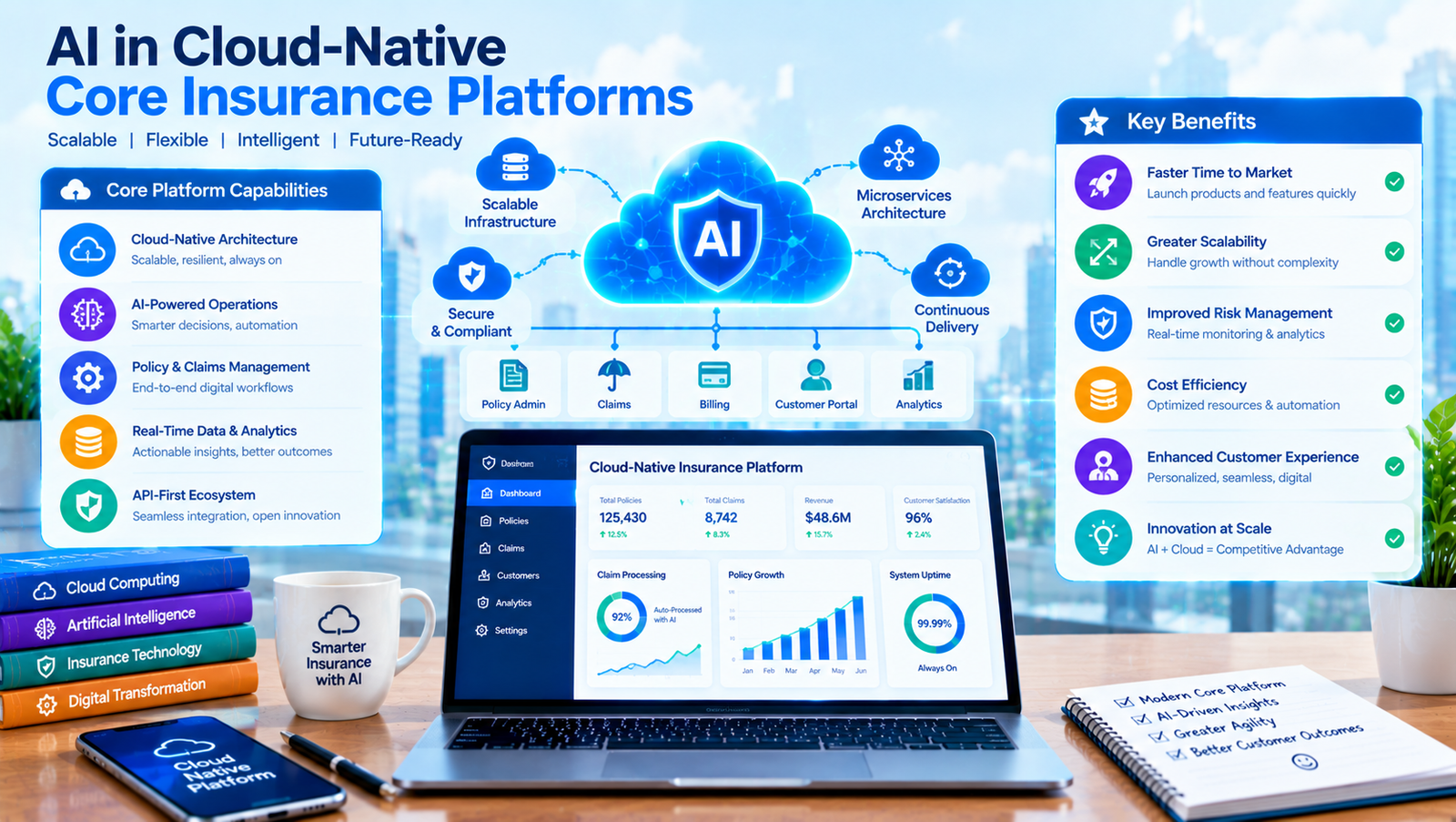
Primary topic: AI in Cloud-Native Core Insurance Platforms: Research, Architecture, Applications, and Future
Research focus: AI-native insurance architecture, policy administration, underwriting automation, claims processing, billing, product configuration, cloud modernization, microservices, event-driven systems, agentic AI, model governance, and legacy insurance transformation
What Is a Cloud-Native Core Insurance Platform?
A core insurance platform supports the essential systems an insurer uses to operate its business. Depending on the insurer and product line, this can include policy administration, product configuration, underwriting, billing, claims, customer servicing, commissions, and reinsurance.
A cloud-native platform is designed to use cloud infrastructure and modern software practices such as independently deployable services, automated delivery, elastic scaling, API-based integration, and managed data services. Cloud-native does not simply mean moving an older application to a cloud server. A traditional application can run in the cloud while retaining the same tightly coupled architecture and release limitations it had on-premises.
For insurers, this distinction matters because insurance products and operating rules change frequently. A carrier may need to introduce a new coverage option, update underwriting rules, respond to a regulatory change, or handle a sudden rise in claims after a catastrophe. A flexible platform can make these changes easier to deliver, test, and monitor.
AI adds an intelligence layer to this architecture. It can interpret unstructured information, identify patterns, generate recommendations, and coordinate tasks across systems. When connected to reliable insurance data and controlled business services, AI can help turn the core platform into a more adaptive operating environment.
Why AI and Cloud-Native Architecture Belong Together
AI projects often struggle when they are built on fragmented systems. An underwriting model may use one data warehouse, a claims model may rely on a separate application, and customer service may have only partial access to policy history. These disconnected systems create inconsistent information, duplicated integration work, and delays when a model needs to trigger a real business action.
A cloud-native core can provide a shared operational foundation. APIs expose approved business functions, event streams communicate changes, and data services make relevant information available to authorized models. AI can then participate in a workflow without taking uncontrolled ownership of the underlying insurance transaction.
Visual: The AI-enabled insurance operating model
Web, mobile, brokers, partners
Prediction, extraction, copilots
Policies, billing, claims
Events, audit, governance
The architectural goal is to separate intelligent recommendations from authoritative transactions. An AI service may recommend a risk class, summarize a claim, or identify a missing document. The core platform should validate whether the proposed action is permitted, apply the relevant product and regulatory rules, and record the resulting decision.
Research Study: A Unified Cloud-Native AI Platform for Insurance Analytics
A 2026 IEEE conference paper, titled “A Unified Cloud-Native Artificial Intelligence Platform for End-to-End Insurance Risk, Pricing, and Claims Analytics,” addresses a problem that is highly relevant to insurance modernization: AI capabilities are often developed as separate models and pipelines rather than as parts of one governed operating framework.
The paper describes a unified architecture intended to support risk assessment, pricing, and claims analytics within a cloud-native environment. Its motivation is that fragmented AI deployments can create inconsistent data pipelines, limited explainability, weak monitoring, and difficult integration into production decisions.
The significance is architectural rather than simply algorithmic. An insurer may have a strong pricing model, but if its inputs are delayed, its outputs cannot be traced, or the result cannot be consumed safely by policy administration, the model’s practical value is limited.
A unified platform can help standardize how models access data, publish outputs, undergo monitoring, and connect to business workflows. It can also make it easier to apply consistent controls across multiple insurance products.
What insurers can learn:
- Build reusable AI infrastructure instead of creating a separate technology stack for every model
- Connect models to policy, pricing, and claims workflows through controlled interfaces
- Include explainability and monitoring in the platform design
- Measure production usefulness, not only offline model accuracy
The paper presents an architectural approach, so its proposed benefits should not be interpreted as proof that every insurer will achieve a particular cost reduction or accuracy improvement.
Research Study: Intelligent Risk-Aware Release Governance for Cloud-Native Insurance
A 2026 IEEE conference paper examines the challenge of governing software releases in cloud-native property and casualty insurance environments. Microservices and continuous delivery allow teams to release changes more frequently, but they also increase the number of components, dependencies, and deployment decisions that must be controlled.
The paper proposes an agentic AI framework for assessing release risk, applying regulatory requirements, and supporting approval decisions in continuous integration and continuous delivery pipelines. Its reported evaluation uses experiments and simulations to compare the proposed approach with conventional rule-based governance.
This research is relevant because an insurance platform is not only a collection of business applications. It is also a regulated production environment where a faulty release can affect policy issuance, premium calculations, claims handling, customer records, or reporting.
AI-assisted release governance could examine a proposed change alongside service dependencies, test results, known vulnerabilities, operational history, and compliance requirements. It could then recommend whether the release needs additional testing, a staged rollout, or human approval.
The important boundary is that an AI agent should not be allowed to bypass mandatory deployment controls. A release system needs deterministic policies for access, approval, rollback, and evidence retention, even when AI helps assess risk.
What insurers can learn:
- Use AI to identify high-risk changes before deployment
- Connect release assessments to service dependencies and test evidence
- Keep mandatory approvals and rollback controls outside unrestricted model discretion
- Track release failure rates, recovery time, and compliance evidence
Research Study: AI Governance in Regulated Cloud-Native Insurance Platforms
Research published in the International Journal of AI, BigData, Computational and Management Studies discusses how cloud-native architecture and AI governance can work together in regulated insurance environments. The paper focuses on themes including explainability, fairness, accountability, privacy, zero-trust architecture, data governance, and federated AI.
These issues become especially important when models influence decisions such as underwriting, claims triage, fraud investigation, or customer eligibility. A cloud platform can scale a model quickly, but scale alone does not establish that its decisions are fair, appropriate, or compliant.
The paper’s central relevance is that governance should be part of the architecture rather than an additional review performed after deployment. Identity controls, data permissions, audit records, model monitoring, and human review need to be designed into the platform.
For example, an AI claims assistant should only retrieve records that the current user or service is authorized to access. Its output should identify the source records used, and any action that changes a claim’s status should pass through approved business logic.
This source is best treated as an architectural and governance contribution, not as a large-scale clinical or operational trial demonstrating measured insurer outcomes.
What insurers can learn:
- Apply role-based access and least-privilege permissions to AI services
- Record the data and model version behind consequential recommendations
- Monitor performance across relevant customer and risk groups
- Separate AI-generated suggestions from authorized insurance decisions
Research Study: ISG’s 2026 Findings on Agentic AI in P&C Insurance Operations
In July 2026, Information Services Group reported that property and casualty insurers were moving beyond task-level automation toward AI-enabled decision workflows. The research described insurers applying agentic AI to areas such as underwriting, claims, and customer service.
One notable architectural observation was the use of orchestration layers that connect legacy platforms with AI-based systems. Rather than requiring every insurer to replace its core systems before adopting AI, this approach allows new capabilities to be introduced around existing applications.
This is a practical point for insurers with older policy administration or claims systems. Replacing the entire core can be expensive, time-consuming, and operationally risky. An orchestration layer can expose selected business functions, coordinate work across applications, and introduce AI where data and controls are sufficiently mature.
However, orchestration is not a substitute for fixing unreliable data or unclear business rules. If a legacy system provides inconsistent policy status or incomplete coverage information, an AI agent may simply automate the confusion more quickly.
What insurers can learn:
- Use orchestration to connect AI services with existing core applications
- Modernize high-value workflows without assuming a full replacement is immediately necessary
- Make system-of-record ownership explicit
- Measure end-to-end outcomes rather than counting automated tasks
Source: ISG, Agentic AI Reshapes Property, Casualty Insurance Operations, July 2026
Research Study: BriteCore’s AI Copilots and Open Agentic Core Strategy
In May 2026, BriteCore announced an AI strategy for property and casualty insurers that included eight embedded AI copilots and a Model Context Protocol service layer intended to connect insurer-developed and third-party AI agents with its platform.
The announcement is a vendor product release rather than an independent evaluation. Nevertheless, it provides a concrete example of how core insurance vendors are approaching AI integration: embedded assistants for operational tasks, an integration layer for external AI capabilities, and centralized governance around access to insurance data and services.
The design raises an important platform question. Should every insurer build its own AI applications from scratch, or should it use capabilities embedded in its core platform and extend them where needed?
The answer depends on the insurer’s operating model, data requirements, vendor strategy, and ability to govern AI. Embedded tools may reduce integration work, while an open service layer can provide flexibility. Both approaches still require security review, performance validation, and clear responsibility for model behavior.
What insurers can learn:
- Evaluate embedded AI capabilities against real workflow requirements
- Use governed integration layers for external agents
- Define which systems can read data and which can execute transactions
- Test vendor claims through controlled pilots and measurable outcomes
Source: BriteCore, AI Strategy and Embedded AI Copilots, May 2026
Research Study: BCG’s Technology Framework for Embedded Insurance
Boston Consulting Group’s 2025 research on embedded insurance examines the technology foundations needed to distribute insurance through non-insurance businesses and digital channels. It highlights flexible product capabilities, rapid product launches, data analytics, scalable infrastructure, and privacy protection.
Although embedded insurance is not identical to a carrier’s internal core modernization, the two are closely connected. When insurance is offered through an e-commerce checkout, travel platform, mobility service, or SaaS product, the insurer’s core must support partner integration, product eligibility, pricing, policy issuance, billing, and servicing.
AI can help interpret partner data, identify suitable product options, detect unusual applications, and improve conversion analysis. Yet these capabilities depend on a product engine and APIs that can reliably return eligibility, price, and coverage information.
The research also emphasizes that embedded insurance requires collaboration between insurers and distribution partners. This makes data governance and API design commercial requirements, not merely technical considerations.
What insurers can learn:
- Design APIs around reusable insurance capabilities
- Make product rules configurable rather than hard-coded into partner integrations
- Use analytics to measure quote completion, attachment, claims, and customer outcomes
- Protect customer data across insurer and partner environments
Source: Boston Consulting Group, For Embedded Insurance Success, Get Your Tech Stack Right, June 2025
Where AI Creates Value Across the Insurance Core
AI value differs by workflow. Document extraction may be useful in submission intake, predictive models may support risk assessment, and generative AI may help service teams explain policy information. A cloud-native platform makes it possible to connect these capabilities to the systems that own the relevant business records.
| Core function | AI capability | Platform requirement | Key control |
|---|---|---|---|
| Product configuration | Assist with product-rule analysis and test generation | Versioned product models and test environments | Approved product rules |
| Underwriting | Submission extraction, risk signals, decision support | Structured risk data and decision APIs | Underwriter oversight and reason codes |
| Policy administration | Servicing assistance and document interpretation | Reliable policy state and transaction history | Core-system validation |
| Claims | Triage, document summarization, anomaly detection | Claim events, evidence, and workflow APIs | Human review for consequential decisions |
| Billing | Payment pattern analysis and service support | Accurate ledger and payment status | Reconciliation and authorization |
| Customer service | Policy Q&A and case summarization | Permission-aware retrieval | Source-grounded answers |
AI in Underwriting and Submission Processing
Commercial and specialty insurers often receive submissions containing applications, spreadsheets, broker emails, loss runs, inspection reports, and supporting documents. Much of this information is unstructured, and underwriting teams may spend substantial time collecting it before they can assess the risk.
AI can extract relevant fields, identify missing information, summarize the submission, and compare the information with underwriting guidelines. A cloud-native workflow can then send validated fields to the underwriting workbench or request additional documents from the broker.
A practical workflow looks like this:
↓
AI extracts and classifies documents
↓
Validation checks required fields
↓
Risk data is enriched
↓
Underwriting rules and models assess the submission
↓
Underwriter reviews recommendation
↓
Approved quote or referral enters the core system
This design helps keep AI-generated extraction separate from the authoritative policy record. Low-confidence fields should be flagged for review rather than silently written into the core.
AI in Claims Processing
Claims workflows involve multiple stages, including first notice of loss, coverage verification, document collection, triage, investigation, reserving, settlement, and closure. Different stages have different risk levels, so they should not all be automated in the same way.
AI can summarize a claimant’s account, extract information from invoices and repair estimates, identify missing evidence, route a claim to the right team, and highlight inconsistencies for investigation. These functions can reduce repetitive handling while preserving human authority over complex or disputed cases.
For example, a model may identify that a claim contains a mismatch between the reported incident date and a supporting document. That should trigger a review, not an automatic denial. The claim system should retain the source documents, the model’s explanation, and the investigator’s final decision.
Microservices, APIs, and Event-Driven Insurance
A cloud-native core often separates capabilities into services that can be deployed and scaled independently. This can help insurers update a document service without releasing the entire policy administration system, provided that service boundaries are well designed.
APIs allow authorized applications and AI services to request specific functions. Event-driven architecture allows systems to react to business changes, such as a policy being issued, a payment failing, or a claim being opened.
Visual: Event-driven policy lifecycle
Each event can trigger approved downstream workflows, analytics updates, or AI-assisted tasks. The core remains responsible for the authoritative policy state.
Event-driven systems also create engineering responsibilities. Teams need idempotent processing, retries, dead-letter queues, event versioning, and reconciliation. Without these controls, a retry or duplicated event could create duplicate notifications, billing actions, or records.
Agentic AI: From Copilots to Controlled Workflow Execution
Agentic AI systems can plan and coordinate multi-step tasks using tools and services. In insurance, an agent might collect submission documents, check whether required fields are present, retrieve approved underwriting guidance, prepare a summary, and route the case to an underwriter.
The difference between a useful agent and an unsafe one is the scope of authority.
A low-risk agent can summarize a claim file or draft a broker email. A higher-risk agent might change a policy, approve a payment, or make a coverage-related decision. Those actions need stronger controls, explicit authorization, and clear accountability.
| Autonomy level | Example | Recommended control |
|---|---|---|
| Assist | Summarize a claim file | Source references and user review |
| Recommend | Suggest a claim triage category | Confidence thresholds and review rules |
| Execute bounded tasks | Request a missing document | Approved templates and action limits |
| High-impact decision | Deny a claim or bind complex coverage | Formal authority, validation, and human governance |
Cloud Security and AI Governance
Insurance platforms hold sensitive personal, financial, medical, property, and commercial information. Moving workloads to cloud infrastructure does not remove the insurer’s responsibility for protecting that information.
AI introduces additional risks because prompts, retrieved documents, model outputs, logs, and external tools may all contain sensitive data. Insurers need to know where information is processed, who can access it, whether it is retained, and whether it can be used to train a third-party model.
Core controls should include:
- Strong identity management and least-privilege access
- Encryption in transit and at rest
- Segmentation between production, testing, and development environments
- Secrets management and controlled service identities
- Data minimization for model prompts and retrieval
- Audit logs for model access and consequential actions
- Vendor assessment and contractual controls
- Incident response and tested recovery procedures
- Model versioning, evaluation, and change approval
For US insurers, applicable obligations depend on the business, state, product, and data involved. Organizations should map requirements such as state insurance rules, privacy obligations, cybersecurity requirements, and relevant model-governance guidance to their actual operations rather than assuming that one general AI policy covers every jurisdiction.
Legacy Modernization Without Replacing Everything
Many insurers operate core systems that are expensive to replace but still perform essential functions reliably. A full replacement can introduce migration risk, lengthy testing, data conversion problems, and disruption to policyholders or distribution partners.
A staged approach can create a path toward modernization.
Document existing systems, data ownership, and business rules
Expose stable capabilities through APIs
Add AI to bounded workflows with human review
Modernize high-value services and retire duplication
The most important first step is to identify which system owns each business fact. A policy’s status, premium balance, coverage terms, and claim payment status should not become ambiguous because several services maintain competing copies.
Implementation Roadmap
Foundation: Data and Architecture
Begin by mapping policy, billing, claims, customer, product, and underwriting data. Identify the authoritative system for each field, document existing integrations, and establish data-quality measures. Before adding advanced AI, make sure the relevant workflows have reliable APIs, access controls, and operational monitoring.
Pilot: Select One Measurable Workflow
Choose a process with clear inputs, measurable delays, and a manageable risk profile. Submission document extraction, claims summarization, or service-agent assistance may be suitable starting points. Establish a baseline before deployment and compare the pilot against that baseline.
Production: Add Governance and Resilience
Introduce model monitoring, audit trails, human escalation, fallback behavior, and controlled releases. Test how the workflow behaves when the model is unavailable, the output is malformed, a downstream service times out, or source data is incomplete.
Scale: Reuse Shared Capabilities
Once the pilot is stable, reuse identity controls, retrieval services, evaluation tools, event infrastructure, and monitoring across additional workflows. Avoid creating a separate platform for every AI use case.
KPIs for AI-Enabled Core Insurance Platforms
| KPI | What it measures | How to use it |
|---|---|---|
| Submission handling time | Time from receipt to underwriting-ready submission | Compare by product and submission complexity |
| Straight-through processing rate | Share completed without manual intervention | Track alongside error and exception rates |
| Claims cycle time | Time from claim notification to defined milestone | Segment by claim type and complexity |
| AI recommendation acceptance | How often users accept model suggestions | Review reasons for overrides and acceptance |
| Data quality | Completeness, accuracy, and consistency | Track by source and workflow |
| Service reliability | Availability, latency, and recovery | Include AI dependencies and core services |
| Control exceptions | Policy violations, access failures, or unapproved actions | Treat severe exceptions as release blockers |
Expert Recommendation
Insurers should treat cloud-native modernization and AI adoption as one connected operating-model program, but they should not attempt to transform every core function at once.
Start with the data and transaction boundaries. Establish which systems own policy, billing, and claims records, then expose stable capabilities through secure APIs. Introduce AI in workflows where its output can be checked against source data and where errors can be contained without creating irreversible customer or financial consequences.
For early deployments, prioritize tasks such as document extraction, submission completeness checks, claim summarization, knowledge retrieval, and service assistance. These use cases can reduce manual work while leaving formal underwriting, coverage, payment, and denial authority within governed workflows.
Before scaling, require each AI use case to demonstrate measurable operational value, acceptable error rates, consistent performance across relevant customer groups, and a clear audit trail. Keep a fallback path for model or cloud-service outages, and ensure that human reviewers can understand and challenge consequential recommendations.
Expert Quote
“AI is not diminishing the value of the insurance core. It is making the core more critical than ever.”
Hardeep Gulati, CEO of Duck Creek, September 2026
The quote reflects a key architectural point: AI depends on the systems that hold authoritative insurance data, execute transactions, and enforce business rules. The core becomes more important as more AI-driven activity is connected to it.
Source: Duck Creek, FY2026 Results and AI Adoption, September 15, 2026
Future Predictions: 2027–2030
2027: AI Moves Deeper Into Core Workflows
Insurers are likely to expand from isolated copilots toward AI capabilities embedded in underwriting, claims, billing, and customer servicing. The main differentiator will be how safely these tools connect to core transactions, not simply whether they can generate text or summaries.
2028: Orchestration Becomes a Major Modernization Pattern
More insurers may use orchestration layers to connect legacy systems, cloud-native services, and AI agents. This approach can support incremental modernization, although insurers will still need to address duplicated data, brittle integrations, and unclear ownership of business rules.
2029: Insurance-Specific Agents Become More Specialized
AI agents are likely to become more focused on bounded insurance tasks, such as submission intake, renewal preparation, claims evidence collection, and product configuration support. Specialized tools connected to approved data and APIs may be easier to govern than general-purpose agents with broad access.
2030: The Core Becomes an Intelligent, Governed Platform
A likely direction is a core platform that combines configurable insurance products, real-time event processing, AI-assisted decisions, and continuous monitoring. The level of autonomy will vary by insurer, product, regulation, and risk tolerance. Human oversight and deterministic controls will remain important for high-impact decisions.
Visual: Expected evolution of the insurance core
Record keeping
Accessible services
Decision support
Orchestrated workflows
This is a directional framework, not a guaranteed industry timeline. Insurers will progress at different speeds depending on legacy complexity, regulation, data readiness, and investment capacity.
Startup and Product Opportunities
The combination of cloud-native insurance systems and AI creates opportunities for vendors that solve specific operational problems rather than offering generic AI functionality.
- AI submission intake platform: Extracts and validates underwriting information from broker submissions
- Core modernization assistant: Helps map legacy business rules, dependencies, and data structures
- Insurance API orchestration: Connects policy, billing, claims, and partner systems through governed workflows
- AI claims workbench: Summarizes evidence, identifies missing documents, and supports claim triage
- Product configuration copilot: Helps teams draft product changes and generate test scenarios
- Model governance platform: Tracks versions, evaluations, approvals, drift, and audit evidence
- Insurance data quality service: Detects inconsistencies across policy, customer, billing, and claims records
- AI release-risk platform: Assesses software changes and recommends testing or staged deployment
The strongest product opportunities are likely to be those that integrate with existing insurance platforms, demonstrate clear operational value, and fit within the insurer’s security and governance requirements.
Frequently Asked Questions
What is a cloud-native core insurance platform?
A cloud-native core insurance platform uses cloud-oriented architecture and modern software practices to support essential insurance functions such as policy administration, underwriting, billing, and claims. It is designed for flexible deployment, integration, scaling, and continuous improvement.
How does AI improve core insurance systems?
AI can help extract information from documents, assess risk, identify unusual claims patterns, summarize case files, support customer service, and coordinate workflow tasks. Its effectiveness depends on reliable data, suitable integration, and appropriate human and technical controls.
Does an insurer need to replace its legacy core before using AI?
No. An insurer can introduce AI through APIs and orchestration layers around existing systems. However, legacy data quality, integration limits, and unclear business rules may constrain the value of those capabilities.
What is agentic AI in insurance?
Agentic AI refers to systems that can plan and carry out multi-step tasks using approved tools and services. In insurance, this might include collecting submission documents, checking completeness, preparing a summary, and routing the case for review.
What are the main risks of AI in core insurance platforms?
Key risks include inaccurate recommendations, biased outcomes, data leakage, unauthorized actions, model drift, unreliable integrations, and weak auditability. These risks require technical controls, validation, monitoring, and clear decision authority.
Which AI use cases should insurers implement first?
Document extraction, submission completeness checks, claims summarization, knowledge retrieval, and customer-service assistance can be practical starting points. Insurers should choose based on data readiness, measurable value, risk, and workflow complexity.
How should insurers measure AI success?
Measure outcomes such as handling time, error rates, straight-through processing, customer service quality, system reliability, data quality, model performance, and control exceptions. Productivity improvements should be evaluated alongside accuracy and customer impact.
Final Perspective
AI is changing what insurers expect from their core technology. The platform is no longer only a place to store policy records, calculate premiums, and process claims. It is becoming the foundation through which data, rules, models, employees, partners, and automated workflows interact.
The research and industry developments reviewed here point toward several connected changes. Cloud-native architecture can make insurance capabilities easier to expose and update. Unified AI platforms can reduce fragmentation between models and operational systems. Agentic AI can coordinate bounded tasks across workflows. Governance and release-risk research highlights the need to control how these capabilities are deployed and operated.
The evidence should still be interpreted carefully. Some sources are research papers proposing architectures or evaluating frameworks, while others are industry reports and vendor announcements. They demonstrate active technical development and adoption, but they do not establish that every AI-enabled core platform will deliver the same business results.
For insurers, the practical path is to modernize around clear business capabilities, establish trustworthy data, and introduce AI in measurable stages. The core platform should remain the authoritative place for insurance transactions, while AI helps people and systems interpret information, prepare decisions, and coordinate work.
The long-term opportunity is not simply to add a chatbot to an insurance application. It is to build a cloud-native, AI-connected insurance operating platform that can adapt to new products, changing customer expectations, evolving risks, and regulatory requirements without sacrificing reliability or accountability.
Research Sources
- IEEE Xplore, A Unified Cloud-Native Artificial Intelligence Platform for End-to-End Insurance Risk, Pricing, and Claims Analytics, 2026
- IEEE Xplore, Intelligent Risk-Aware Release Governance Using Agentic AI in Cloud-Native P&C Insurance Ecosystems, 2026
- International Journal of AI, BigData, Computational and Management Studies, AI Governance in Regulated Cloud-Native Insurance Platforms
- ISG, Agentic AI Reshapes Property, Casualty Insurance Operations, July 2026
- BriteCore, AI Strategy and Embedded AI Copilots, May 2026
- Boston Consulting Group, For Embedded Insurance Success, Get Your Tech Stack Right, June 2025
- Boston Consulting Group, Building a Seamless Tech Framework for Embedded Insurance, March 2025
- Duck Creek, FY2026 Results and AI Adoption, September 15, 2026
- Duck Creek, Insurance-Native Agentic AI Platform for Underwriting and Claims, April 2026
- ISG, Trend Toward Cloud-Native Core Insurance Platforms, April 2026

Leave a Reply