
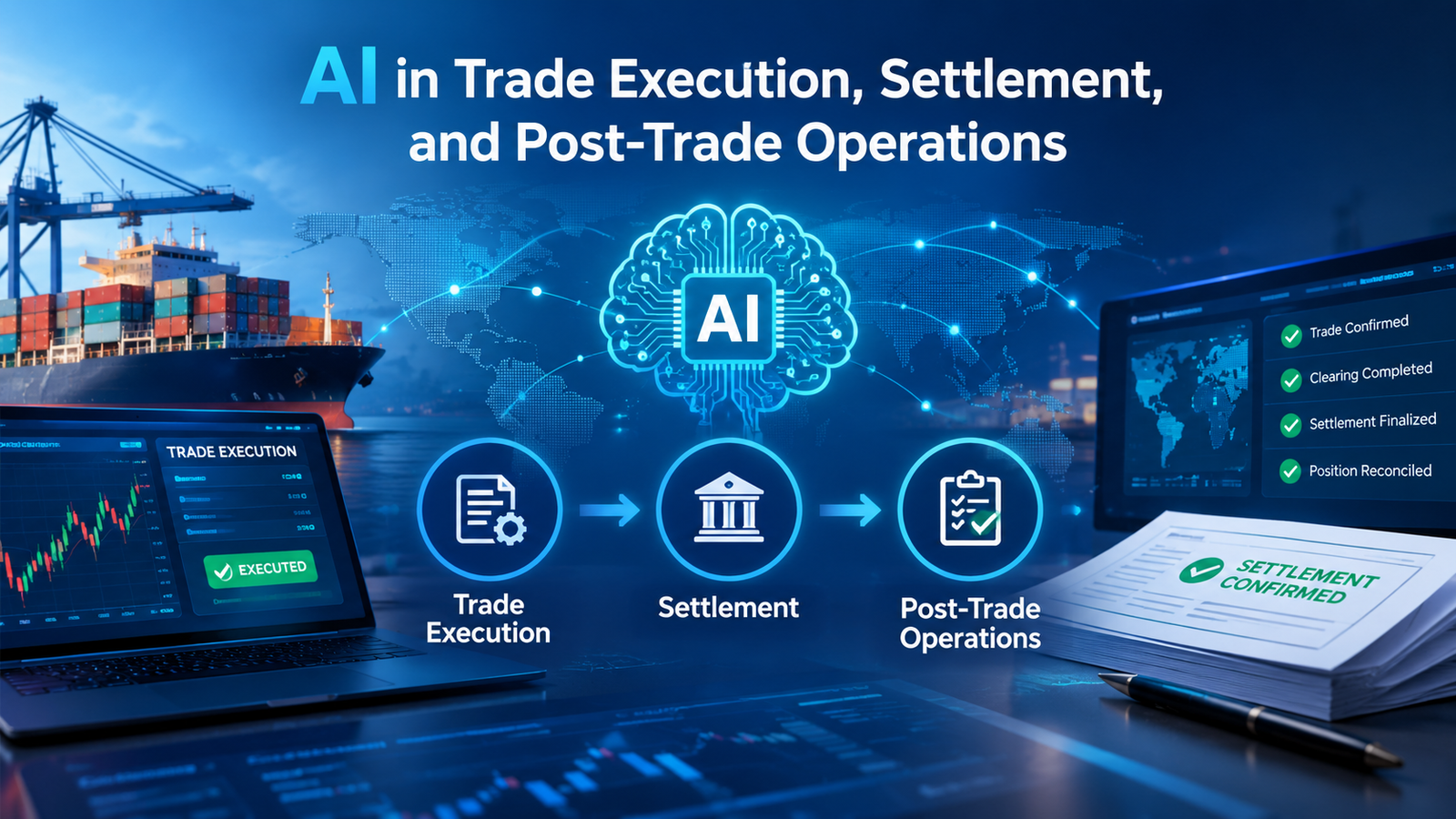
Primary topic: AI in Trade Execution, Settlement, and Post-Trade Operations
Research focus: AI-powered order execution, transaction cost analysis, trade matching, allocation, clearing, settlement optimization, reconciliation, exception management, collateral optimization, corporate actions, regulatory reporting and financial market infrastructure
Why AI Matters Across the Trade Lifecycle
A securities trade does not end when a buyer and seller agree on a price. The complete lifecycle includes order execution, trade capture, allocation, confirmation, clearing, settlement, reconciliation and reporting. Each stage depends on accurate data moving between trading platforms, brokers, custodians, central counterparties, central securities depositories and internal books and records.
These processes are connected, but many financial institutions still operate them through separate systems. A trade may execute successfully while an allocation remains incomplete, a confirmation contains inconsistent information or a settlement instruction fails validation. Operations teams then need to identify the problem, contact the relevant party and correct the records before a deadline.
AI can help connect these stages through shared data, prediction and exception intelligence. Rather than treating each operational issue as an isolated ticket, an AI-enabled platform can assess the trade’s full context, identify likely causes and recommend the next action.
Visual: The AI-enabled trade lifecycle
Price, routing, market impact
Enrichment, validation
Confirmations, allocations
Instructions, funding
Reconciliation, reporting
The business case is not simply faster processing. Better execution can reduce trading costs, while better post-trade controls can reduce manual repair, failed settlements, operational risk and the amount of capital tied up in unresolved transactions.
What Has Changed in the Market?
Two developments are making trade lifecycle modernization more urgent.
The first is the move toward shorter settlement cycles. The United States moved to T+1 settlement for most covered securities transactions on May 28, 2024. A shorter cycle reduces the time between trade execution and settlement, but it also compresses the time available for allocation, confirmation, funding and exception resolution. Firms must complete critical operational tasks earlier and with fewer opportunities to repair errors.
The second is the growing interest in tokenized assets and distributed ledger technology. These systems may allow certain asset transfers, cash movements and records to be coordinated more directly. Yet new infrastructure introduces its own questions around interoperability, legal finality, liquidity, governance and resilience.
The Bank of England’s 2025–26 Financial Market Infrastructure Annual Report discusses the UK’s work toward T+1 and the operational changes needed to support the transition. Its 2025 Project Meridian Securities work also examined how existing central bank settlement infrastructure could connect with tokenized securities systems.
Sources: Bank of England, FMI Annual Report 2025–26 and Project Meridian Securities
Research Study: AI in Securities Markets and Post-Trade Operations
The International Monetary Fund’s December 2025 paper, Regulatory Considerations Regarding Accelerated Use of AI in Securities Markets, examines AI applications across capital markets. It identifies use cases that span trade execution, post-trade settlement, trade anomaly detection, risk management, asset management and customer-facing services.
The paper is particularly relevant because it places post-trade AI within the wider structure of securities markets rather than treating it as a back-office productivity tool. AI can influence how orders are handled, how risks are assessed and how operational processes are coordinated. These applications also create supervisory questions when models become complex or when multiple market participants depend on similar technologies.
For implementation, the implication is that firms should evaluate AI across the complete control environment. A model that improves execution speed may create downstream operational pressure if trade data arrives late or in an unusable format. Likewise, an automated settlement workflow must remain consistent with the firm’s obligations, risk limits and approved instructions.
The IMF paper is a regulatory analysis, not a controlled experiment proving that a specific AI system improves settlement outcomes. Its value is in mapping the use cases and supervisory considerations that financial institutions need to address.
Source: IMF, Regulatory Considerations Regarding Accelerated Use of AI in Securities Markets, December 2025
AI in Trade Execution
Execution algorithms decide how to carry out an order while balancing price, speed, market impact and the risk of not completing the trade. Common strategies include time-weighted average price, volume-weighted average price, implementation-shortfall approaches and participation-based execution.
AI can support these strategies by estimating market conditions and adapting execution parameters. A model may forecast short-term liquidity, estimate the likely price impact of an order or identify when market conditions differ from the assumptions used to create an execution schedule.
For example, a large institutional order may be split into smaller child orders. An AI model can estimate how aggressively those orders should be submitted based on available liquidity, volatility, spread, recent volume and the remaining time before the execution deadline.
| Execution task | AI contribution | Control required |
|---|---|---|
| Market impact estimation | Predict likely price movement caused by order size and urgency | Compare forecasts with realized execution costs |
| Venue selection | Estimate execution quality across venues | Apply best-execution obligations and venue rules |
| Order scheduling | Adapt order timing to liquidity and volatility | Enforce limits, deadlines and maximum participation |
| Execution surveillance | Identify unusual order patterns and potential anomalies | Human review and documented escalation |
AI execution should be evaluated against realistic benchmarks, not just forecast accuracy. A model that predicts prices well may still produce poor execution if it ignores fees, spread, market impact, queue position or incomplete fills.
AI for Trade Matching and Confirmation
After execution, trade details must be captured and compared across relevant parties. Differences in quantity, price, settlement date, account, currency or counterparty information can prevent a trade from progressing smoothly.
AI can help identify mismatches and suggest likely corrections. Natural language processing can extract relevant fields from unstructured confirmations, while anomaly detection can identify records that differ from expected patterns. Entity resolution can help match records when organizations use different identifiers or naming conventions.
However, AI-generated corrections should not be accepted blindly. A settlement instruction is a financial instruction, not merely a text field. Changes to account details, beneficiary information or settlement instructions should pass through approved validation and authorization controls.
A useful workflow is:
↓
Extract and normalize fields
↓
Compare with counterparty record
↓
AI identifies mismatch and likely cause
↓
Apply approved correction or route to an operator
↓
Store evidence and confirmation
This use case is particularly suitable for AI because it combines repetitive data comparison with clear business rules and a human-review path for uncertain cases.
AI in Settlement Failure Prediction
A failed settlement can create additional costs, operational workload and counterparty exposure. The causes may include insufficient securities or cash, incorrect settlement instructions, unmatched trade details, late confirmations, market holidays or a delay at an external participant.
AI can estimate the probability of failure before the settlement deadline. Useful features include historical failure patterns, instrument type, counterparty behavior, market, settlement currency, instruction status, available inventory and the time remaining before cutoff.
The model should not simply predict whether a trade will fail. It should also identify the likely cause and the action that could reduce the risk.
For example, an alert might indicate that a trade has a higher-than-usual failure risk because the confirmation remains unmatched and the relevant market cutoff is approaching. The system can prioritize the case and recommend contacting the responsible counterparty.
Visual: Settlement risk prioritization
Instruction matched, funding confirmed, no known blockers
Missing data or unresolved confirmation
Critical mismatch, funding issue or approaching cutoff
The categories are illustrative. A production system should define risk thresholds using its own historical data, settlement obligations and operational policies.
Settlement risk models must be tested carefully across different instruments, markets and counterparties. A model trained on one market may not perform reliably in another because settlement conventions, operating hours and failure causes can differ.
Research Study: The Cognitive Settlement Layer Framework
A 2026 paper titled The Cognitive Settlement Layer: A Multi-Agent AI Framework for Dynamic Securities Settlement Routing proposes an AI-based overlay for settlement routing.
The paper frames settlement routing as a multi-objective optimization problem. Instead of relying only on static settlement instructions, a decision layer could assess available routes using factors such as operational constraints, liquidity and processing conditions. The proposed design sits above existing custodians, central securities depositories and settlement infrastructure.
Its important contribution is architectural: AI can support decisions around how a transaction should be routed without replacing the systems that establish settlement finality.
The paper is conceptual and identifies empirical validation using live settlement and custodial data as future work. It should therefore be treated as a proposed framework, not evidence that autonomous AI routing has already delivered measurable production benefits.
For financial institutions, the idea suggests a practical development path. Begin with recommendations and simulations, measure routing outcomes against current processes, and only consider greater automation after operational, legal and risk controls have been validated.
Source: Saumyajit Ghosh, The Cognitive Settlement Layer, 2026
AI for Reconciliation and Break Management
Reconciliation compares records held by different systems to confirm that transactions, balances and positions agree. Break management begins when they do not.
The difficulty is often not detecting a difference. It is understanding why it occurred and determining which team or system must resolve it.
AI can classify breaks by likely cause, connect related exceptions and recommend the next operational step. A model may recognize that several discrepancies are linked to the same upstream data issue, preventing teams from treating every affected record as a separate incident.
Generative AI can also summarize a case using structured records, operational notes and approved documentation. It can produce a concise explanation for an analyst, but source records should remain accessible so that the summary can be verified.
Potential applications include:
- Matching cash and securities positions across internal and external books
- Grouping breaks caused by the same upstream event
- Identifying recurring data-quality issues
- Prioritizing breaks based on financial impact and deadline
- Drafting investigation summaries and handover notes
- Tracking recurring root causes for process improvement
The key performance measure is not how many breaks AI can classify. It is whether the system reduces resolution time and repeat incidents without increasing incorrect adjustments.
Research Study: Project FuSSE and the Future of Settlement Infrastructure
The Bank for International Settlements Innovation Hub published its Project FuSSE report in January 2026. The project explored a modular, microservices-based settlement engine designed to support scalability, adaptability, security and operational resilience.
The project is not a direct trial of AI-powered settlement decisions. Its relevance lies in the infrastructure that AI-enabled operations would need to use. An intelligent settlement layer cannot operate reliably if the underlying systems cannot exchange data, handle stress or maintain clear operational boundaries.
Project FuSSE demonstrated the technical feasibility of its proposed architecture while highlighting operational trade-offs that must be managed. This reinforces an important design principle: AI capabilities should be added to settlement infrastructure that has been engineered for reliability, rather than used to compensate for weak foundations.
For technology teams, modular APIs, clear service boundaries, observability and resilient data pipelines can make it easier to introduce AI in controlled stages.
Source: BIS Innovation Hub, Project FuSSE, January 2026
Research Study: Project Samara and Tokenized Settlement
The Bank of Canada published its Project Samara research paper in March 2026. The project was a limited real-world experiment involving a tokenized bond issued by Export Development Canada to a closed investor group. Settlement used wholesale central bank money through a purpose-built distributed ledger platform connecting securities and cash ledgers.
The experiment found that DLT-based issuance and settlement of real financial instruments was technically feasible. It also indicated potential benefits for data integrity and the reduction of counterparty and settlement risk through atomic settlement.
The results were not uniformly positive. The project identified additional system complexity, governance and liquidity costs, operational risks and legal or regulatory friction. Its narrow scope means the findings are preliminary and illustrative rather than proof that tokenized settlement is ready to replace existing market infrastructure.
For AI strategy, Project Samara shows why settlement optimization must account for more than speed. An AI system operating across traditional and tokenized infrastructure would need to understand liquidity availability, operational dependencies, legal arrangements and the precise status of each transaction.
Source: Bank of Canada, Project Samara Research Paper, March 2026
Research Study: Project Meridian Securities
The Bank of England’s Project Meridian Securities explored how a synchronization interface could connect the UK’s existing real-time gross settlement infrastructure with emerging tokenized securities systems.
The central problem is coordination. A securities transfer and a cash transfer may take place on different systems, but the transaction must ensure that the intended movements are coordinated and that settlement arrangements preserve the required legal and operational safeguards.
This is relevant to AI because an intelligent workflow may need to monitor the readiness of both legs of a transaction, identify a delay and route an exception to the correct operator. However, AI should not be allowed to redefine the legal conditions for finality or improvise settlement instructions.
Project Meridian Securities is an infrastructure experiment, not a study demonstrating AI-driven settlement performance. Its value for this report is the way it illustrates the complexity of coordinating existing and tokenized systems.
Source: Bank of England, Project Meridian Securities, 2025
Research Study: Citi’s Securities Services Evolution 2025
Citi’s 2025 securities-services research surveyed market participants about changes in post-trade operations. The report highlighted accelerated settlement, digital assets, asset servicing, settlement efficiency and shareholder participation as major areas of change.
It also reported that 76% of survey respondents were working on T+1 in 2025. In a related post-trade report, Citi said only around one-quarter of respondents reported live generative AI projects in the post-trade ecosystem.
These figures should be read as survey findings, not universal adoption rates across all financial institutions. They nevertheless point to a practical gap: firms are preparing for faster settlement and digital-asset infrastructure, while generative AI adoption in post-trade remains less mature than general enterprise AI adoption.
For technology leaders, this creates an opportunity to target specific operational workflows rather than deploy a broad AI assistant without a defined purpose. Reconciliation summaries, exception classification, document extraction and operational knowledge search are examples of bounded applications that can be measured and governed.
Sources: Citi, Securities Services Evolution 2025 and Citi, The Future of Post-Trade
Comparing the Research and Industry Evidence
| Research or project | Main contribution | Evidence type | AI implication |
|---|---|---|---|
| IMF AI in securities markets | Maps AI use cases and supervisory concerns | Regulatory analysis | Governance across the lifecycle |
| Cognitive Settlement Layer | Proposes dynamic AI settlement routing | Conceptual framework | Test recommendations before automation |
| Project FuSSE | Explores modular settlement infrastructure | Proof of concept | Build reliable integration foundations |
| Project Samara | Tests tokenized bond issuance and settlement | Limited real-world experiment | Account for liquidity and governance trade-offs |
| Project Meridian Securities | Tests synchronization with tokenized securities | Infrastructure experiment | Coordinate workflows without changing finality rules |
| Citi post-trade research | Tracks industry priorities and AI adoption | Industry survey | Focus on measurable operational use cases |
The evidence is diverse. Some sources assess AI directly, while others examine settlement infrastructure that AI may eventually support. Keeping this distinction clear prevents technology experiments or conceptual proposals from being presented as proven AI outcomes.
AI for Collateral and Liquidity Operations
Settlement and clearing depend on available cash, securities and collateral. Firms must forecast obligations, maintain appropriate buffers and respond to changes in market conditions. Poor visibility can leave assets idle in one account while another account faces a funding need.
AI can improve forecasts of settlement cash requirements and identify potential collateral shortfalls. Optimization models can compare eligible assets, haircuts, concentration limits, liquidity needs and operational constraints. The system can then recommend transfers or substitutions for authorized teams to approve.
Useful applications include:
- Forecasting intraday cash and securities requirements
- Predicting collateral shortfalls before cutoffs
- Identifying eligible collateral across accounts
- Prioritizing time-sensitive funding actions
- Estimating the operational impact of settlement delays
- Explaining why a liquidity buffer is likely to be insufficient
These systems must respect contractual terms, regulatory requirements, collateral eligibility rules and institution-specific limits. An optimization engine should never assume that an asset is transferable simply because it appears available in a database.
AI in Corporate Actions and Asset Servicing
Corporate actions create complex operational workloads. Dividends, stock splits, tender offers, rights issues, elections and reorganizations can involve different deadlines, market conventions and client instructions.
AI can extract key information from notices, compare terms across sources, identify affected positions and flag missing elections. Natural language processing can help convert unstructured notices into structured fields for review.
Generative AI can also summarize an event for operations teams, but it should not invent missing terms or make discretionary elections on behalf of clients. The authoritative notice and the institution’s approved processing rules must remain the source of truth.
A practical workflow combines document extraction, structured validation, position matching, deadline monitoring and exception escalation. This can reduce manual reading while preserving control over actions that affect client assets.
AI Architecture for Trade Lifecycle Operations
A production architecture should separate intelligence from transaction execution. AI models can make recommendations, but approved services should validate and execute actions according to deterministic rules.
Visual: Reference architecture
Order management, execution venues, custodians, settlement systems, reference data
Prediction, anomaly detection, NLP, optimization, graph analytics
Policy checks, risk limits, confidence thresholds, approvals
Existing approved APIs, workflow engines, settlement instructions
Audit logs, monitoring, access controls, incident response
Key architectural requirements include:
- Consistent identifiers across orders, trades, accounts and counterparties
- Reliable event timestamps and traceable data lineage
- Role-based access and separation of duties
- Version control for models, prompts and business rules
- Replayable decision logs for investigations and audits
- Fallback procedures when models or data feeds are unavailable
- Monitoring for drift, latency, data quality and unexpected outputs
Expert Recommendation
Financial institutions should start with workflows where the problem is frequent, measurable and reversible. Reconciliation classification, settlement-failure prediction, document extraction and exception prioritization are practical starting points because the results can be compared with existing processes and reviewed by operations staff.
Execution and settlement decisions require more caution. Models that influence orders, routing, collateral or settlement instructions should be tested in simulation and shadow mode before they are allowed to affect live operations. Their performance should be measured under normal conditions and during stressed markets, when data quality, liquidity and system availability may change quickly.
A sound implementation strategy is to:
- Establish a baseline for cost, error rate, processing time and failure rate
- Choose one workflow with a clear operational owner
- Build data quality and integration controls before training complex models
- Test against historical periods and out-of-sample data
- Run AI recommendations alongside the existing process
- Require approval for material or irreversible actions
- Monitor performance by market, asset class and counterparty
- Keep a tested manual or rules-based fallback
The objective is not maximum autonomy. It is reliable automation that improves the quality and speed of operational decisions without weakening accountability.
Expert Perspective
In the Bank of England’s 2026 DLT Innovation Challenge report, Deputy Governor Sarah Breeden described the broader opportunity in financial infrastructure:
“Applying the technologies currently employed in crypto-asset markets to real-world retail and wholesale payments offers the potential to be embedded more efficiently and deeply into our increasingly digital economy.”
Source: Bank of England, DLT Innovation Challenge 2025 Final Report, published May 2026
This is a statement about the potential of emerging financial infrastructure, not a claim that AI alone will deliver these benefits. The same report emphasizes the need to preserve operational resilience, accountable governance and settlement finality.
Implementation Roadmap
| Phase | Work | Exit criteria |
|---|---|---|
| Foundation | Map systems, data, controls and operational pain points | Trusted baseline and data ownership |
| Pilot | Deploy one model for breaks or settlement risk | Measured benefit and acceptable error rates |
| Shadow mode | Compare recommendations with current decisions | Stable performance across conditions |
| Controlled rollout | Integrate approved recommendations into workflows | Approvals, monitoring and fallback tested |
| Scale | Extend across products, markets and counterparties | Consistent governance and operational results |
KPIs for AI Trade Operations
A useful measurement framework should cover both efficiency and risk. Faster processing is not a success if it produces more settlement failures or incorrect instructions.
| KPI | What it measures | How to use it |
|---|---|---|
| Implementation shortfall | Execution cost relative to a defined benchmark | Compare execution strategies fairly |
| Settlement fail rate | Share of trades that fail to settle as intended | Track operational risk outcomes |
| Straight-through processing | Trades completed without manual intervention | Measure workflow automation |
| Break resolution time | Time required to resolve reconciliation exceptions | Measure operational efficiency |
| False alert rate | Alerts that do not require the expected action | Reduce unnecessary investigation |
| Manual repair rate | Share of records needing correction | Identify upstream data problems |
| Model drift | Change in model performance over time | Trigger review and retraining |
Targets should be established from the institution’s own baseline. A universal target would be misleading because trade volumes, asset classes, settlement markets and operating models differ.
Risks and Governance
AI in capital markets creates risks beyond ordinary software errors. A faulty recommendation can affect execution quality, funding needs, client assets or settlement obligations. A model can also perform well in normal markets but fail during volatility, liquidity stress or an infrastructure outage.
| Risk | Potential impact | Control |
|---|---|---|
| Poor data quality | Incorrect predictions or mismatched records | Validation, lineage and reconciliation |
| Model drift | Performance declines as market behavior changes | Monitoring and periodic revalidation |
| Automation error | Incorrect or unauthorized financial action | Deterministic checks and approval gates |
| Cybersecurity | Data exposure or manipulation | Access controls, testing and incident response |
| Third-party dependency | Disruption at a model or data provider | Fallbacks and provider oversight |
| Poor explainability | Slow investigations and weak audit evidence | Decision logs and interpretable explanations |
Generative AI requires additional safeguards. It can summarize records and help analysts navigate documentation, but it may produce unsupported explanations or omit important details. Any output used in a financial decision should be grounded in approved data and checked against the underlying records.
Future Outlook: 2027–2030
2027: AI-Assisted Exception Management Becomes More Common
As institutions adapt to shorter settlement timelines, AI-assisted exception classification, matching and operational summaries are likely to attract continued investment. These applications have clear workflows and can be evaluated against existing manual processes.
The key development will be tighter integration with trade and settlement systems, so that recommendations are based on current transaction status rather than disconnected reports.
2028: Settlement Risk Becomes More Predictive
Institutions may increasingly combine counterparty history, instruction status, inventory, market calendars and intraday liquidity data to identify potential settlement failures earlier. This could shift operations from reacting to failed trades toward resolving likely causes before the deadline.
The benefit will depend on data completeness and whether counterparties can act on the warning in time.
2029: AI Connects Traditional and Tokenized Workflows
If tokenized securities and related settlement arrangements expand, institutions will need tools that coordinate records across traditional infrastructure and distributed ledgers. AI may help monitor readiness, detect inconsistencies and prioritize exceptions across these environments.
Legal finality, authorization and settlement rules will still need to be enforced by the relevant systems and institutions.
2030: More Adaptive, Governed Trade Operations
A likely direction is a shared operational intelligence layer that supports execution analytics, settlement forecasting, reconciliation, collateral planning and reporting. Instead of deploying separate AI assistants for every team, institutions may connect specialized models through common data, workflow and governance services.
This is a reasoned outlook, not a guaranteed forecast. Adoption will depend on demonstrated performance, regulatory expectations, integration costs and the ability to maintain resilient operations.
Startup and Product Opportunities
There is room for specialized fintech and RegTech products that solve narrow problems across the trade lifecycle.
- Settlement Failure Prediction API: Predict settlement risk and explain the factors behind each alert
- AI Reconciliation Copilot: Group breaks, identify likely causes and prepare evidence-based summaries
- Execution Cost Intelligence: Analyze realized costs and identify opportunities to improve execution quality
- Corporate Actions Intelligence: Extract event details, validate fields and monitor deadlines
- Collateral Forecasting Platform: Estimate funding needs and identify potential shortfalls
- Trade Data Quality Monitor: Detect inconsistent identifiers, missing fields and recurring upstream errors
- Post-Trade Operations Assistant: Search approved procedures and summarize operational cases
- Cross-System Exception Graph: Connect related breaks across brokers, custodians and internal systems
A focused product can be more practical than attempting to replace an entire trade processing platform. The strongest starting point is a workflow with measurable costs, a clear data owner and an existing process against which results can be compared.
Frequently Asked Questions
How is AI used in trade execution?
AI can estimate market impact, forecast liquidity, support venue selection, adjust execution schedules and identify unusual order behavior. Its performance should be measured using realized execution costs and appropriate benchmarks, not prediction accuracy alone.
Can AI prevent settlement failures?
AI can identify patterns associated with settlement risk and help teams address problems earlier. It cannot guarantee settlement because failures may depend on counterparties, funding, market infrastructure, legal restrictions or events outside the model’s control.
How can AI improve post-trade reconciliation?
AI can match records, classify breaks, connect related exceptions and suggest likely causes. Human review and deterministic controls should remain in place for material adjustments and financial instructions.
Can generative AI automate settlement instructions?
Generative AI can help extract information and prepare recommendations, but it should not independently create or change sensitive settlement instructions without validation and authorization. Approved systems should enforce the required controls.
What is the relationship between AI and tokenized settlement?
AI may help monitor and coordinate workflows across traditional and tokenized systems. Distributed ledger technology can change how records and asset transfers are handled, but legal finality, governance, liquidity and operational resilience remain essential.
What is the best first AI use case for a post-trade team?
Exception classification, reconciliation support or settlement-failure prediction can be practical starting points because they have measurable outcomes and can operate with human oversight. The right choice depends on the institution’s data quality and operational pain points.
Final Perspective
AI in trade execution, settlement and post-trade operations is not one technology project. It is a set of connected opportunities across market decisions, operational processing and financial infrastructure.
In execution, AI can help institutions understand market conditions and evaluate the cost of carrying out orders. In trade matching and reconciliation, it can identify inconsistencies and reduce the time needed to investigate them. In settlement, it can forecast operational risk, prioritize exceptions and support liquidity planning. In corporate actions and reporting, it can extract information and reduce repetitive manual work.
The research and industry evidence also shows why implementation needs to be grounded in the realities of financial infrastructure. The IMF’s analysis maps AI applications and supervisory concerns across securities markets. The BIS Project FuSSE report explores the foundations of scalable and secure settlement engines. Project Samara and Project Meridian Securities demonstrate both the potential and the trade-offs involved in tokenized settlement. Citi’s industry research points to continued pressure for faster settlement and operational modernization, while its survey findings suggest that generative AI adoption in post-trade remains an area of development.
The next stage of progress will depend on connecting AI to trusted data and well-governed workflows. Institutions should start with measurable operational problems, validate performance under realistic conditions and preserve deterministic controls over financial commitments.
The strategic goal is clear: **use AI to make trade operations more predictive, transparent and efficient, while keeping settlement, authorization and accountability firmly controlled.**
Research Sources
- IMF, Regulatory Considerations Regarding Accelerated Use of AI in Securities Markets, December 2025
- Saumyajit Ghosh, The Cognitive Settlement Layer: A Multi-Agent AI Framework for Dynamic Securities Settlement Routing, 2026
- BIS Innovation Hub, Project FuSSE: Exploring Flexible, Scalable and Secure Settlement Engines, January 2026
- Bank of Canada, Project Samara Research Paper, March 2026
- Bank of England, Project Meridian Securities, November 2025
- Citi, Securities Services Evolution 2025
- Citi, The Future of Post-Trade
- Bank of England and BIS Innovation Hub, DLT Innovation Challenge 2025: Final Report, May 2026
- Bank of England, Financial Market Infrastructure Annual Report 2025–26
- Citi Institute, The Future of Post-Trade

Leave a Reply