If you have used ChatGPT, Gemini or Midjourney, you already know generative AI. But in the last two years, a new word has taken over tech news: agentic AI. Many people mix the two up, and the confusion is fair, because they are closely related.
In this guide, we explain both ideas in plain words, show real examples, and give you a clear way to decide which one you need.
What is Generative AI?
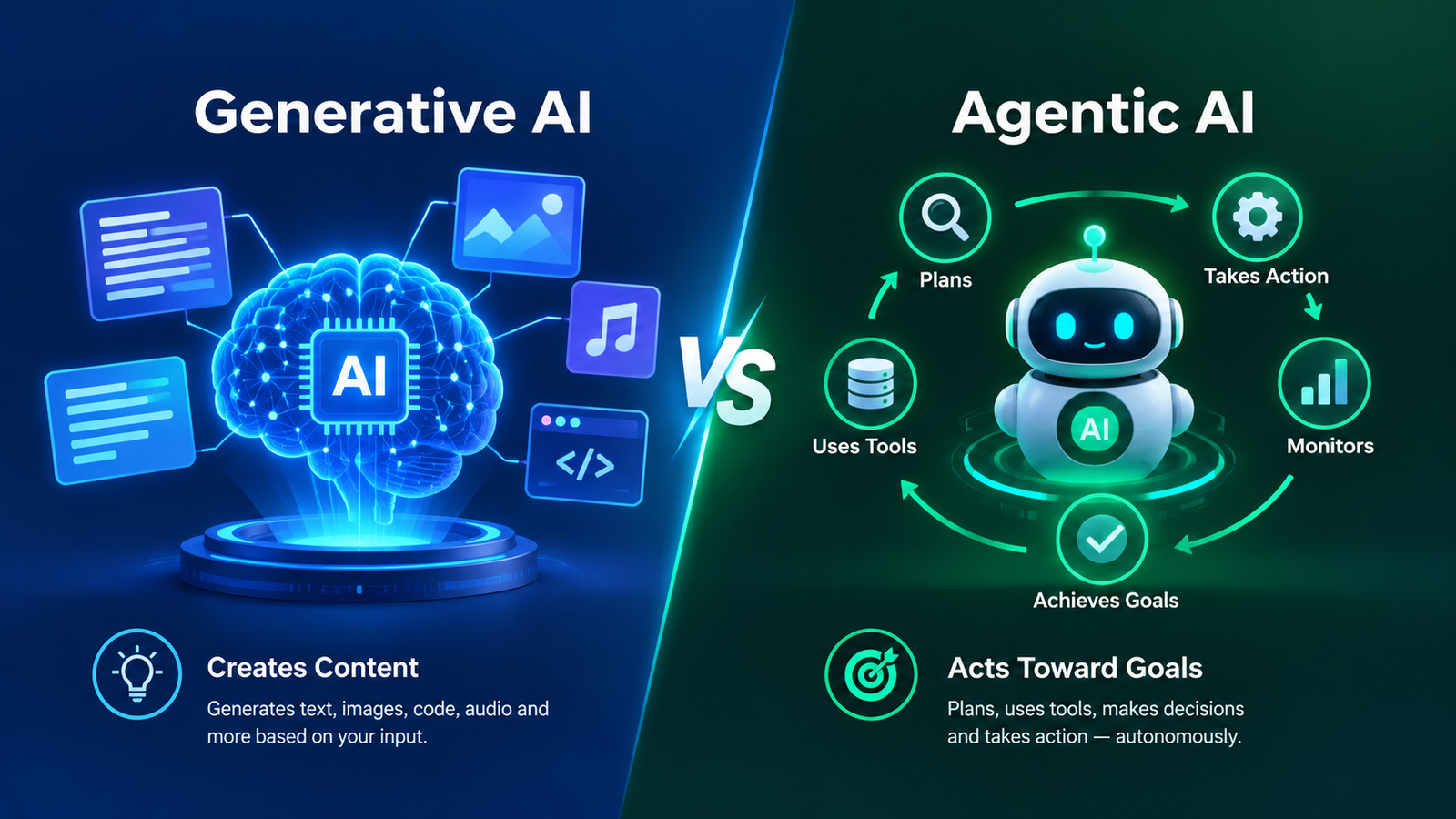
Generative AI is a type of artificial intelligence that creates new content based on patterns it learned from huge amounts of data. You type a prompt, and it produces an output: an email, a poem, a picture, a piece of code, or a summary.
The key point is that generative AI is reactive. It waits for you. You ask, it answers, then it stops. It does not go and do things in the real world by itself.
Common generative AI examples
ChatGPT, Claude and Gemini write blog posts, emails and summaries.
Midjourney, DALL·E and Adobe Firefly turn a prompt into artwork.
Tools like Sora and Veo create short clips from a sentence.
GitHub Copilot suggests the next lines of code as you type.
Suno and ElevenLabs make music and realistic voices.
Strengths: very fast, great for first drafts, easy to use, good for brainstorming.
Weaknesses: it needs a human to guide every step, it can make mistakes (hallucinations), and by default it cannot book, buy or send anything outside the chat.
What is Agentic AI?
Agentic AI is a system that can pursue a goal on its own. You do not give it one prompt for one answer. You give it an objective, such as “Find five suppliers and email them for quotes,” and it figures out the steps.
The word “agentic” comes from agency, the ability to act and make decisions. An agentic system usually has four abilities:
It works toward an outcome, not just a reply.
It breaks a big task into smaller steps.
It searches the web, runs code, opens apps and calls APIs.
It checks its work and tries again if something fails.
How an AI Agent Works (The Agent Loop)
Most AI agents follow the same loop. A generative model (an LLM) sits in the middle as the “brain”. Around it are memory, tools and rules.
2. Plan the steps →
3. Pick a tool →
4. Take action →
5. Check the result
The “go back and try again” part is what separates an agent from a simple chatbot. It keeps going until the goal is met or it asks a human for help.
The building blocks
- The model (brain): understands the goal and decides the next move.
- Memory: remembers what happened earlier in the task.
- Tools: browsers, databases, code runners, email and calendars.
- Guardrails: rules about what the agent may do and when it must ask for approval.
Agentic AI vs Generative AI: Comparison Table
| Feature | Generative AI | Agentic AI |
|---|---|---|
| Main job | Create content | Complete tasks and reach goals |
| Input | A prompt | A goal |
| Behavior | Reactive | Proactive |
| Steps | Usually one per prompt | Many, in a loop |
| Tool use | Limited or none | Core feature |
| Human involvement | High, at every step | Low, mostly start and end |
| Memory | Inside one chat | Short and long term |
| Risk | Wrong or biased text | Wrong actions with real effects |
| Examples | ChatGPT chat, Midjourney | Claude Code, Devin, browser agents |
Autonomy at a glance
This chart is illustrative, not a measured statistic.
How they connect
(the brain)
Memory
Tools
Self-checking loop
Guardrails
Agentic AI does not replace generative AI. It is built on top of it. The model is the brain, and the agent system adds hands, memory and a plan.
Real-World Examples
Generative AI in action
- Marketing: a writer asks for 10 headline ideas and picks the best.
- Design: a shop owner makes a product banner from a short prompt.
- Study: a student asks for a simple explanation of photosynthesis.
- Coding: a developer gets a suggested function while typing.
Agentic AI in action
Claude Code and Devin read a project, write code, run tests, fix errors and prepare a pull request.
Related: Grok Build and Claude Code memory.
An agent reads a complaint, checks the order, issues a refund within a limit and updates the ticket.
Related: AI in front-office operations.
Deep research agents search many sources, compare them and deliver a cited report.
Example: Roche’s autonomous AI labs.
Browser agents compare flights, fill forms and book within your budget after approval.
Related: OpenAI’s Dots AI assistants.
An agent finds leads, writes personal emails, sends them and logs replies in the CRM.
An agent watches stock levels and reorders from suppliers when numbers drop.
Agentic AI examples across industries
Agentic AI is not limited to one field. Here is how agents are used in eight sectors, with deeper guides from AICopse for each.
🏥 Healthcare
Agents can book visits, monitor patients, handle billing and flag issues for doctors.
💳 Fintech
Agents can approve small loans, spot wallet fraud and route payments in real time.
🛡️ Insurance
Agents can collect evidence, check policies, detect fraud and propose claim decisions.
📊 Investment
Agents can screen deals, review data rooms and rebalance portfolios within set rules.
🏦 Banking
Agents can run KYC checks, watch for money laundering and guide customers across channels.
🏛️ Capital Markets
Agents can model prices, stress-test risk and support IPO valuation work.
📈 Trading
Agents can build strategies, watch markets and execute orders automatically.
🪙 Crypto
Agents can run trading bots, audit smart contracts and trace suspicious transactions.
Side-by-side story: planning a trip
| Generative AI | Agentic AI |
|---|---|
| You ask for a 5-day Dubai itinerary. It gives a nice list. You then search flights, hotels and tickets yourself. | You say “Plan and book a 5-day Dubai trip under $1,500.” It compares options, builds the plan, asks you to approve, then books. |
Which One Should You Use?
You need ideas, drafts, images or explanations. The task is one step and you want full control.
The task has many steps, repeats often and touches several tools. You want results, not just text.
A good rule: if you would normally copy the AI’s answer and then do the next step yourself, an agent can probably do that next step for you.
Risks and Limits
- Errors compound: a small mistake in step 2 can spoil step 10. Read how OpenAI halted model training over rogue agents.
- Security: agents that read web pages can be tricked by hidden instructions (prompt injection). See AI agents hacking a Canadian government site.
- Cost: many steps mean many model calls.
- Accountability: someone must be responsible for what the agent does. Learn about AI agent liability rules for deployers and why California bans AI-only boss decisions.
Best practices: start with low-risk tasks, require approval for payments, deletions and external emails, give the agent only the access it needs, and keep logs of every action. Tools like Nvidia’s agent safety platform are emerging to help, and the debate on a AI kill switch is growing.
📰 Latest AI agent news on AICopse
The Future: Working Together
The two are not rivals. Generative AI gave machines the ability to understand and create language. Agentic AI turns that ability into action. Expect more tools to blend both: you chat naturally, and the system quietly does the work. The people who benefit most will be those who delegate clearly: set a goal, set limits, and review the result.
Frequently Asked Questions
What is the main difference between agentic AI and generative AI?
Generative AI creates content when prompted. Agentic AI takes a goal, plans steps, uses tools and completes tasks with little human input.
Is ChatGPT agentic AI?
ChatGPT is mainly generative AI. It behaves agentically when it browses, runs code and finishes multi-step tasks using tools.
Does agentic AI replace generative AI?
No. Agents are usually built on top of generative models. The model thinks, and the agent system acts.
What are examples of agentic AI?
Coding agents like Claude Code and Devin, research agents, support agents that issue refunds, and browser agents that book travel.
Is agentic AI safe?
It can be, with limits, permissions and human approval for important actions. Without them, mistakes can have real consequences. See our banking AI security governance and healthcare AI security governance guides.
Conclusion
Generative AI and agentic AI are not competitors. They are two stages of the same shift. Generative AI creates. Agentic AI completes. The first gives you words, images and code. The second uses that intelligence to plan, use tools and finish real work.
Key takeaways
- Generative AI is reactive: you prompt, it answers.
- Agentic AI is goal-driven: it plans, acts, checks and repeats.
- Agents are built on top of generative models, not instead of them.
- More autonomy means more risk, so set limits and keep a human in the loop.
- Start small: use generative AI for drafts, and agents for repeatable multi-step tasks.
Where to go next: If you are still building your foundation, read our guide to the types of AI and AI terms explained.

Leave a Reply