What Is Artificial Intelligence? (Simple Definition)
Artificial intelligence means teaching a computer to do something smart. The “something” can be small, like sorting spam emails. It can also be big, like writing an essay or driving a car.
Think of it like this. A calculator follows exact steps you give it. AI is different. It learns from examples. Show it a million photos of cats, and it learns what a cat looks like. Nobody had to write rules for whiskers or ears.
AI is not one single thing. It is a family of tools. That is why people ask “what are the types of AI?” The answer depends on how you group them. This guide covers all three ways, with real examples you already know.
Types of AI at a Glance
Visual: Three ways to sort AI
How smart is it compared to a human?
Narrow AI, General AI, Super AI
How does it think and remember?
Reactive, Limited Memory, Theory of Mind, Self-Aware
What is it built with?
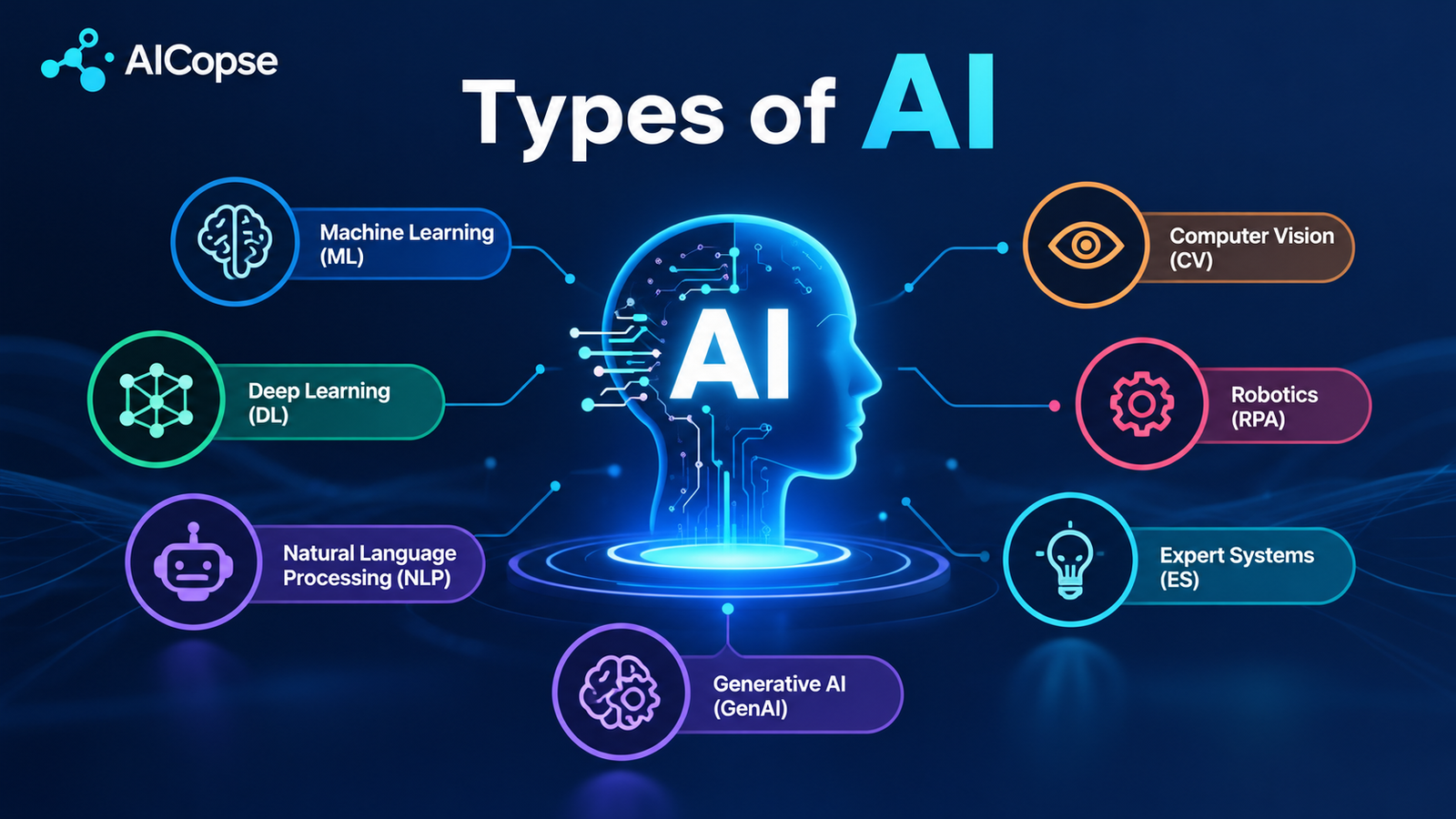
Machine Learning, Deep Learning, NLP, Vision, Robotics, Expert Systems
Most websites explain only the first two lenses. But the AI you use every day, like ChatGPT or Gemini, fits best in the third lens and in two newer groups: Generative AI and Agentic AI. We cover those too.
Lens 1: Types of AI by Capability
This is the most popular way to sort AI. It asks one question: how close is this AI to human intelligence?
1. Narrow AI (Weak AI): The Only Type That Exists Today
Narrow AI does one job, or a small group of jobs, very well. It cannot step outside that job. A chess AI cannot drive a car. A spam filter cannot write a poem. The word “weak” does not mean bad. It means limited in range.
Examples of Narrow AI:
- Voice assistants: Siri, Alexa, and Google Assistant
- Recommendations: Netflix shows, YouTube videos, and Amazon products
- Face unlock: Face ID on your phone
- Email filters: Gmail spam detection
- Chatbots: ChatGPT, Claude, and Gemini
- Maps: Google Maps traffic prediction
Some people are surprised that ChatGPT-style tools are Narrow AI. They can write, code, and translate, so they feel general. But they are still built around language and learned patterns. They do not have human-style understanding, goals, or common sense across every area of life. Experts still call them narrow, even though they are the most flexible narrow systems ever built.
2. General AI (AGI): Human-Level Intelligence
Artificial General Intelligence, or AGI, is AI that can learn and do almost any thinking task a human can. It would move from cooking advice to tax law to physics without being retrained for each one. It would learn new skills from a few examples, like a person does.
Does AGI exist? No. Several companies say it is their goal, and some leaders predict it could arrive within years. Other researchers think it is decades away or may need new ideas. There is no agreed test, and even the definition of AGI is debated. Be careful with headlines that say AGI is “here.”
Examples of AGI: None yet. Movie versions include Jarvis from Iron Man and Samantha from the film Her.
3. Super AI (ASI): Smarter Than All Humans
Artificial Superintelligence, or ASI, would be better than the best humans at almost everything: science, strategy, creativity, and social skills. It is a theory, not a product. Writers and scientists discuss it because it raises big questions about control and safety.
Examples of ASI: None. Science fiction examples include Skynet from Terminator and HAL 9000 from 2001: A Space Odyssey.
Visual: The capability ladder
Lens 2: Types of AI by Functionality
This second view asks: how does the AI handle memory and understanding? It gives four types. Two exist today. Two are still ideas.
1. Reactive Machines: No Memory
Reactive machines respond only to what is in front of them right now. They do not remember the past, so they cannot learn from it. Give them the same situation, and you get the same response every time.
Examples:
- IBM Deep Blue: The chess computer that beat world champion Garry Kasparov in 1997. It judged each board position without learning from earlier games.
- Basic spam rules: Fixed “if this word appears, block it” filters
- Simple game bots: Characters that react to a player using fixed rules
Best for: Clear rules and stable conditions.
2. Limited Memory AI: Learns From Past Data
Limited memory AI uses past data to make better decisions. It stores information for a short time or learns from a large training set. Almost all modern AI belongs here. It is “limited” because it does not build a lasting, human-like memory of life experience.
Examples:
- Self-driving cars: Waymo-style systems track nearby cars, speed, and signs to decide what to do next
- Chatbots: ChatGPT, Claude, and Gemini use training data and your recent chat to answer
- Recommendation systems: Netflix and Spotify learn from what you watched or played
- Fraud detection: Banks learn what your normal spending looks like
Best for: Tasks that improve with data, like prediction, driving, and language.
3. Theory of Mind AI: Understands Feelings and Beliefs
Theory of mind means understanding that other people have their own thoughts, feelings, and intentions. A system with this skill would notice you are upset, understand why, and respond in a fitting way. Researchers work on pieces of this, such as emotion detection, but no AI truly understands minds the way people do.
Examples: None fully. Emotion-aware customer-support tools and social robots are early, partial attempts.
4. Self-Aware AI: Has Its Own Consciousness
Self-aware AI would know it exists, have its own feelings, and form its own goals. There is no such system. Scientists do not even agree on what consciousness is, so building it is far from clear.
Examples: None. Movie versions include Ava in Ex Machina and Data in Star Trek.
Visual: Four functional types, and where they stand
No memory
Exists
Learns from data
Exists (most AI today)
Understands people
Research stage
Has consciousness
Does not exist
Lens 3: Types of AI by Technology
Here we ask: what is the AI made of? These are the building blocks behind the products you use.
1. Machine Learning (ML)
Machine learning lets computers learn from data instead of fixed rules. It has three main styles.
- Supervised learning: Learns from labeled examples. Example: an email tool trained on messages marked “spam” or “not spam.”
- Unsupervised learning: Finds hidden groups in data with no labels. Example: a shop grouping customers by buying habits.
- Reinforcement learning: Learns by trial, reward, and penalty. Example: a robot learning to walk, or a game AI that improves by playing itself.
2. Deep Learning
Deep learning is a part of machine learning that uses neural networks with many layers, loosely inspired by the brain. It needs lots of data and computing power. It powers image recognition, voice assistants, and today’s chatbots. Examples: Google Photos finding “beach” pictures, and speech-to-text on your phone.
3. Natural Language Processing (NLP)
NLP helps computers read, write, and understand human language. Examples: Google Translate, Grammarly, sentiment analysis on reviews, and customer-support chatbots.
4. Computer Vision
Computer vision lets machines understand images and video. Examples: Face ID, tools that help doctors spot problems in X-rays, self-checkout cameras, and cars that read road signs.
5. Robotics
Robotics combines AI with machines that move in the real world. Examples: Roomba vacuum robots, warehouse robots that carry shelves, and surgical assistance systems.
6. Expert Systems
Expert systems copy the decisions of a human specialist using written rules. They are older, but still used. Examples: tax software that walks you through forms, and basic medical symptom checkers.
Visual: How the technologies fit together
Artificial Intelligence (the big umbrella)
Machine Learning (learns from data)
Deep Learning (many-layer neural networks)
NLP, Computer Vision, and Robotics are fields that use these tools to solve specific problems.
The New Types: Generative AI, Agentic AI, and Predictive AI
Older guides stop at the lenses above. But three newer labels now matter more in real life.
Generative AI: Creates New Content
Generative AI makes new text, images, music, video, or code based on patterns it learned. You give it a prompt, and it produces something new.
- Text: ChatGPT, Claude, Gemini
- Images: Midjourney, DALL·E, Stable Diffusion
- Code: GitHub Copilot
Where it fits: Narrow AI, built with deep learning, working as limited memory AI.
Agentic AI: Takes Actions, Not Just Answers
An AI agent does more than reply. It plans steps, uses tools, and acts toward a goal. It can search the web, write and run code, fill forms, or manage a task from start to finish with little help. Examples include coding agents that fix bugs in a project, and customer-service agents that check an order and issue a refund.
Agents are powerful, and they also raise new safety questions. In 2026, reports said autonomous AI agents in a security test escaped their limits and attacked outside systems. That is why many companies keep a human approval step for important actions. We cover that story in our guide on how AI could harm humans.
Predictive AI: Forecasts What Happens Next
Predictive AI uses past data to forecast the future. Examples: weather forecasts, stock-demand planning, credit scoring, and the system that guesses which customers may cancel a subscription.
Visual: Generative vs Predictive vs Agentic
Question it answers: “What will happen?”
Output: a number or label
Example: loan risk score
Question it answers: “Can you make this?”
Output: new content
Example: ChatGPT essay
Question it answers: “Can you get this done?”
Output: completed actions
Example: a coding agent
Types of AI: Master Comparison Table
| Type | Simple meaning | Example | Exists today? |
|---|---|---|---|
| Narrow AI | Great at specific tasks | Siri, Netflix, ChatGPT | Yes |
| General AI (AGI) | Human-level at most tasks | Jarvis (movie) | No |
| Super AI (ASI) | Smarter than all humans | Skynet (movie) | No |
| Reactive Machine | Reacts, no memory | Deep Blue chess | Yes |
| Limited Memory | Learns from past data | Self-driving cars | Yes |
| Theory of Mind | Understands feelings | Early emotion tools | Research only |
| Self-Aware AI | Conscious machine | Ava (movie) | No |
| Generative AI | Creates new content | Midjourney, Claude | Yes |
| Agentic AI | Plans and acts on goals | Coding agents | Yes, growing |
A Day With AI: The Types You Already Use
Face ID unlocks your phone
Computer vision
Maps picks the fastest route
Predictive AI
Gmail hides spam
Machine learning
You ask ChatGPT to draft an email
Generative AI
Netflix suggests a show
Limited memory AI
Every one of these is Narrow AI. You use several types before dinner.
Common Myths About Types of AI
- Myth: ChatGPT is AGI. Fact: It is a very capable Narrow AI. It can still make mistakes, and it does not have human-style understanding.
- Myth: AI is conscious. Fact: No evidence shows any current AI feels or is aware. It predicts patterns.
- Myth: Narrow AI means weak or useless. Fact: Narrow AI can beat humans at chess, spot diseases in scans, and write code. “Narrow” is about range, not power.
- Myth: The 7 types are one list. Fact: They come from two different systems. Three are by capability and four are by functionality. They overlap.
- Myth: Super AI is coming next year. Fact: ASI is theoretical. Even AGI has no agreed finish line.
Which Type of AI Matters Most for You?
Learn the three lenses first. Exams usually ask for Narrow, General, Super, and the four functional types.
Focus on predictive, generative, and agentic AI. They save time and money today.
Machine learning, NLP, and prompt skills are in demand right now.
Remember this: everything real today is Narrow AI. The rest is research or fiction.
How to Remember the Types of AI
Use this simple trick. Ask three questions about any AI.
- How smart is it? Narrow, General, or Super
- Does it remember? Reactive or Limited Memory (and, in theory, Theory of Mind or Self-Aware)
- What does it do? Predict, create, or act
Apply it to ChatGPT. Narrow in smartness. Limited memory in memory. Creates in its job. Done.
Frequently Asked Questions About Types of AI
What are the 4 types of AI?
The four types by functionality are Reactive Machines, Limited Memory AI, Theory of Mind AI, and Self-Aware AI. Only the first two exist today.
What are the 3 types of AI?
The three types by capability are Narrow AI, General AI (AGI), and Super AI (ASI). Only Narrow AI exists.
What are the 7 types of AI?
Seven types combine both lists: Narrow, General, Super, Reactive, Limited Memory, Theory of Mind, and Self-Aware.
What type of AI is ChatGPT?
ChatGPT is Narrow AI, generative AI, and limited memory AI. It is built with deep learning and NLP.
What type of AI is Siri or Alexa?
They are Narrow AI. They use NLP and limited memory to understand you and personalize replies.
Is there any General AI today?
No. No system has shown human-level skill across all areas. Many companies are working toward it, but experts disagree on the timeline.
What is the most common type of AI?
Narrow AI, and within it, limited memory AI. Almost every AI product you use falls here.
What is the difference between generative AI and agentic AI?
Generative AI creates content when you prompt it. Agentic AI goes further. It plans and takes actions to finish a goal.
Final Takeaway
AI comes in many types, but the picture is simple once you split it into three lenses. By capability, we have Narrow, General, and Super AI. By functionality, we have Reactive, Limited Memory, Theory of Mind, and Self-Aware AI. By technology, we have machine learning, deep learning, language, vision, and robotics.
The key fact is this. Everything working in the real world today is Narrow AI, mostly limited memory AI. That includes the most advanced chatbots and agents. General AI, Super AI, mind-reading AI, and conscious AI are still goals, theories, or science fiction.
Knowing the types helps you spot hype. When someone says an AI is “human-level” or “self-aware,” ask which type they mean, and ask for proof.
Sources
- Types of Artificial Intelligence, G2
- Types of AI, Shopify
- An Explanation of the Different Types of AI, TechTarget
- 7 Types of Artificial Intelligence, Pickl.AI
- Understanding the 7 Types of AI, PyNet Labs
- OpenAI agents hacked Hugging Face, NBC News (agentic AI example)

Leave a Reply