
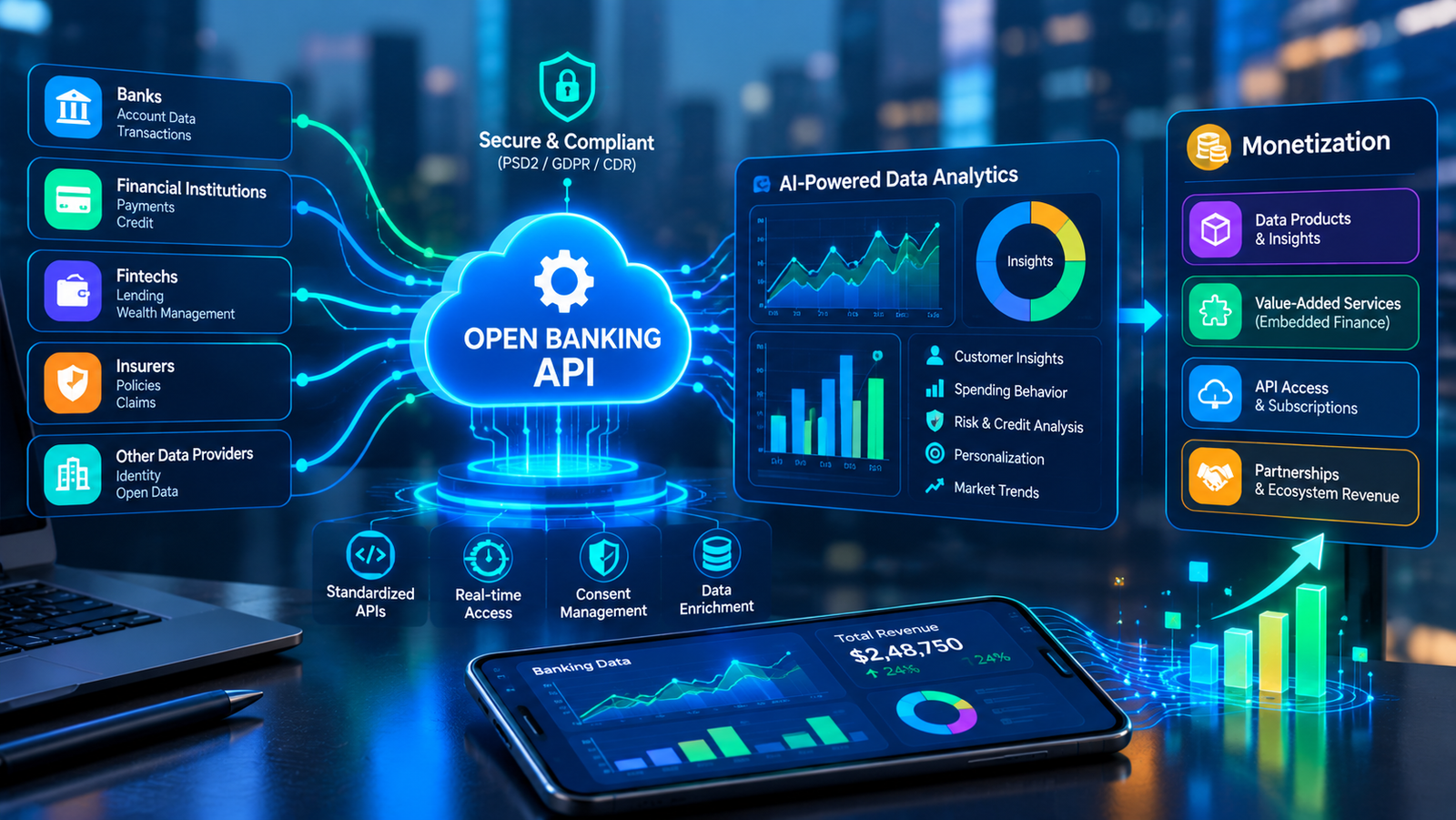
Primary topic: AI in Open Banking API Monetization and Data Analytics
Research focus: Open banking APIs, financial data monetization, AI-powered transaction analytics, personalized financial services, cash-flow forecasting, customer intelligence, SME analytics, API-as-a-product business models, consent-based data sharing, revenue optimization, embedded finance and responsible AI
Understanding Open Banking API Monetization
Open banking allows customers to authorize regulated or otherwise appropriately authorized providers to access selected financial information held by their banks. Depending on the market, the ecosystem may also support payment initiation. APIs provide the technical connection between account providers and third-party applications, allowing data to move through standardized interfaces rather than relying on screen scraping or manual document uploads.
API monetization means generating revenue from the products, services or business relationships built around these connections. It does not necessarily mean charging customers for every API request. A bank may earn revenue by offering premium financial insights, while a fintech may charge a subscription for cash-flow forecasting or receive revenue from a lending product that uses consented account data.
AI creates an additional layer of value because raw transaction data is often difficult for customers and businesses to interpret. A bank statement may show hundreds of transactions, but an AI-powered analytics service can turn them into categorized spending, recurring-payment detection, income estimates, cash-flow forecasts and actionable financial insights.
The commercial opportunity is therefore a combination of three capabilities:
Trusted data access
Secure APIs, customer consent, reliable connections and accurate financial records
AI-powered intelligence
Transaction understanding, forecasting, segmentation and personalized recommendations
Commercial products
Subscriptions, analytics services, lending tools, business APIs and partner solutions
The distinction matters because access to data alone is rarely a durable competitive advantage. The value comes from using that data responsibly to solve a real customer or business problem.
Why the Open Banking Market Matters
Open banking is moving beyond early adoption into more routine financial infrastructure. Open Banking Limited reported that the UK ecosystem had more than 15 million active users and recorded over two billion API calls in a single month in 2025. Its impact report also reported approximately 31 million open banking payments in March 2025, equivalent to around 8% of Faster Payments that month. These figures demonstrate the scale of the ecosystem, although API activity should not be confused with paid usage or revenue.
Source: Open Banking Limited, Impact Report, May 2025
The commercial opportunity is growing alongside the infrastructure. Open Banking Limited’s 2025 API article reported more than two billion API calls in July and described the role of API connections in payments and financial services.
These figures support three business conclusions.
- A large API ecosystem can create opportunities for specialized analytics providers
- Financial data products can reach customers through banks, fintechs and non-financial platforms
- Reliability, consent management and data quality become core parts of the product rather than background technical details
API volume alone does not prove that a monetization model is profitable. A provider still needs to measure customer acquisition costs, API connection costs, data refresh frequency, customer retention and the willingness to pay for the resulting service.
How AI Turns Open Banking Data into Products
Open banking data commonly includes account balances, transaction amounts, dates, descriptions and account identifiers, subject to the permissions and data available through the relevant API. Some products may also combine this information with customer-provided details, business accounting data or other legally obtained sources.
AI systems can transform these records into higher-level features.
| Data input | AI capability | Potential product value |
|---|---|---|
| Transaction descriptions | Classification and entity matching | Spending dashboards and bookkeeping automation |
| Historical balances | Time-series forecasting | Cash-flow alerts and liquidity planning |
| Recurring transactions | Pattern detection | Subscription management and bill reminders |
| Income and payment history | Cash-flow feature generation | Affordability assessment and lending support |
| Business inflows and outflows | Forecasting and anomaly detection | SME finance and working-capital insights |
| Customer-approved account history | Personalized analytics | Premium financial management features |
The model should not treat every transaction description as reliable evidence of a customer’s intentions. Descriptions may be abbreviated, ambiguous or generated by payment processors. High-impact conclusions should include confidence measures, traceable source transactions and a way for customers to correct errors.
Research Study: Machine Learning and Cash-Flow Data in Consumer Underwriting
FinRegLab’s empirical research, published in 2025, directly examined the value of combining machine learning with electronic bank-account information. The study compared models using credit bureau data, cash-flow data, and both sources together. It evaluated predictions against the actual credit performance of new accounts opened in 2018–2019.
The strongest-performing model combined machine learning with both credit bureau and cash-flow data. FinRegLab reported that this model was the most predictive overall and across the subgroups it evaluated. It also produced the highest approval rates overall and for most subgroups at most risk thresholds, while maintaining relatively low false-positive rates. The researchers noted that data limitations made it difficult to assess the impact on some consumers most likely to benefit from additional data, including people with limited credit histories.
This research is relevant to API monetization because it demonstrates how consented account data can support a service with a clear commercial purpose. A fintech can use open banking connections to help lenders assess cash flow, while a lender may pay for a verified income or affordability signal rather than raw transaction access.
However, the results should not be interpreted as proof that every open banking dataset will improve every lending model. Results depend on data coverage, customer population, feature design, model validation and the quality of the underlying account records.
Research Study: Cash-Flow Underwriting System Implementation
A 2024 implementation paper by Amol Gote and Vikas Mendhe described a cash-flow underwriting system built around open banking connections and machine learning analytics. The proposed system included four main components: secure bank-account linking through an aggregator, machine-learning analysis of transaction data, underwriting rules that use the resulting cash-flow score and income estimates, and integration into a mobile application and backend service.
The paper is useful because it describes the operational chain between API access and a customer-facing financial product. Open banking data does not automatically become a lending decision. The provider must connect accounts, normalize transactions, estimate income and cash flow, apply decision rules and deliver the result through a usable application.
For API businesses, this suggests a product opportunity in providing specific components of the workflow. A provider might sell transaction categorization, income verification, cash-flow scoring or underwriting data services to multiple lenders, subject to appropriate permissions and contractual controls.
The paper is an implementation-focused contribution, not evidence that a particular commercial pricing model or revenue level will succeed. Its value lies in showing how several technical and product components fit together.
Research Study: Bank Transaction Data for Malaysian MSME Credit Scoring
A 2025 research paper examined whether bank-statement data could improve credit assessment for micro, small and medium-sized enterprises in Malaysia. The researchers introduced a dataset of 611 loan applicants and compared models using application information with models that also used features derived from bank transactions.
The study reported that incorporating transaction-derived features improved the performance of the evaluated models. A later version of the work, titled AI-BAAM, reported a validation AUROC of 0.806 for its best model, a 24.6% improvement over models using application information alone. These are results on the study’s dataset, not a universal performance guarantee for MSME lending.
This research points toward a valuable B2B API product: financial data analytics for small businesses that lack long credit histories or formalized financial statements. An API provider could generate cash-flow summaries, recurring revenue estimates, expense patterns and liquidity indicators from customer-authorized bank data.
For monetization, the important question is whether the output improves a business decision enough to justify the price. A lender may pay for underwriting insights, while an accounting platform may bundle the same transaction intelligence into a paid business dashboard.
Research Study: Interoperable Payment Data for Loan Screening and Monitoring
A 2026 paper in the *Journal of Financial Intermediation* studied the value of interoperable payment data for lending. It linked borrowers’ payment histories with non-bank small-business loans in India and examined whether payment information could improve loan screening and monitoring beyond traditional sources such as credit bureaus.
The paper found that payment data improved screening and monitoring. It also found that payment histories and credit bureau records captured complementary information: payment data reflected current repayment ability, while credit bureau information more strongly reflected willingness to repay. The study identified distributional trade-offs, including disadvantages for some borrowers with poor credit scores and thin payment records.
This is especially relevant to open banking analytics because it demonstrates that data interoperability can change what lenders know about a borrower. It also highlights the need to evaluate who benefits and who may be disadvantaged when new data sources are introduced.
A responsible API monetization strategy should therefore avoid selling a score without explaining its purpose, limitations and appropriate use. The product should help clients understand cash flow while maintaining controls against unfair or unsupported inferences.
Research Study: Deep Learning for Transaction Classification and Cash-Flow Prediction
A study published in the *Journal of Big Data* explored a hybrid approach to transaction categorization and cash-flow prediction for banking services. It combined a transaction-classification model with a recurrent neural network-based cash-flow prediction component. The authors also examined explainability, using LIME and SHAP to help interpret the classification results.
The research is important for open banking products because transaction categorization is often a foundational step. Before an application can explain spending or forecast a balance, it needs to distinguish meaningful transaction types and organize them consistently. The study presents this combination as a basis for business financial-management services and other banking microservices.
For commercial products, transaction classification can support multiple features from the same data pipeline:
- Personal spending analysis
- Business expense categorization
- Cash-flow forecasting
- Budget monitoring
- Financial anomaly alerts
- Bookkeeping and reconciliation support
This creates an opportunity to monetize a reusable analytics capability across several products, rather than building a separate model for every customer-facing feature.
Research Study: Machine Learning Adoption in Financial Services
The Bank of England and Financial Conduct Authority’s 2022 survey of machine learning in UK financial services provides wider industry context. Respondents reported machine-learning applications across critical activities, including compliance, AML, KYC, credit underwriting, cash-flow prediction, delinquency prediction, fraud detection and customer-facing services.
The survey is not a direct study of open banking API revenue. Its relevance is that it shows how machine learning can support several financial-service functions that may use data accessed through APIs.
Source: Bank of England, Machine Learning in UK Financial Services
The implication for API providers is to design analytics capabilities that can be safely reused across products while keeping each use case’s permissions, model validation and regulatory obligations clear.
Open Banking API Monetization Models
There is no single monetization model that fits every open banking provider. The right approach depends on who owns the customer relationship, what the API enables, whether the service is regulated, the cost of obtaining and processing data, and the value delivered to the buyer.
| Model | How it works | Potential customer | Main challenge |
|---|---|---|---|
| Subscription | Monthly fee for analytics or account tools | Consumers and SMEs | Demonstrating recurring value |
| Usage-based API | Pricing by calls, accounts or processed records | Fintechs and software platforms | Predictable costs and fair limits |
| Premium analytics | Charge for forecasts, insights or reporting | Banks and business users | Accuracy and customer trust |
| Embedded finance | Analytics support a financial product inside another service | E-commerce and SaaS platforms | Partner economics and compliance |
| Enterprise licensing | Annual contract for analytics infrastructure | Banks, lenders and large platforms | Integration and service-level commitments |
| Outcome-linked pricing | Fees linked to an agreed measurable outcome | Lenders and financial-service partners | Attribution and fair measurement |
A provider should avoid assuming that charging per API call is always the best choice. Customers generally care about the outcome, not the number of requests made behind the scenes. A hybrid model can combine a platform fee, usage tiers and premium analytics features, provided the pricing is understandable.
High-Value AI Products Built on Open Banking
Personal Financial Management
AI-powered personal finance tools can categorize spending, identify recurring payments, estimate upcoming bills and explain changes in account balances. A free tier can provide basic transaction views, while a paid tier may offer multiple-account forecasting, personalized budgets or household financial reports.
The product must avoid making customers feel that their financial data is being used to push unnecessary products. Recommendations should be relevant, explainable and easy to control.
SME Cash-Flow Intelligence
Small businesses often need to understand whether incoming payments will cover payroll, rent, supplier invoices and debt obligations. An AI system can combine historical bank transactions with user-provided payment schedules to estimate upcoming cash positions.
A SaaS provider could sell this as a premium dashboard or as an API to accounting, invoicing and business-management platforms. The value proposition is strongest when the insight leads to a clear operational action, such as identifying a likely cash shortfall or a delayed customer payment.
Income and Affordability Analytics
With appropriate consent and lawful use, AI can estimate income regularity, essential spending and available cash flow. These signals may support lending, rental affordability or financial planning workflows.
Such products require special care because errors can affect access to credit or other important services. Providers should validate the model on relevant populations, monitor for unequal outcomes and make sure the result is not treated as a complete measure of a person’s financial circumstances.
Subscription and Recurring-Payment Intelligence
Transaction patterns can help identify recurring merchant payments, possible duplicate subscriptions and changes in regular bills. A consumer app may offer subscription tracking, while a bank may use the feature to improve its account-management experience.
The system should distinguish a genuinely recurring payment from similar transactions that happen only occasionally. Incorrectly labeling payments can damage trust and create customer-service costs.
Business Intelligence APIs
A provider can package transaction classification, revenue estimates, cash-flow forecasts and financial summaries into APIs for third-party applications. This can be useful for accounting software, lending platforms, vertical SaaS products and business dashboards.
The API product should expose clear data definitions, confidence indicators, update timestamps and error handling. Clients need to know what a metric means before using it in a business decision.
Visual: From Customer Consent to Monetized Analytics
This flow makes an important point: monetization occurs after the provider has created a useful service. Consent, data quality and analytics are not separate concerns. They determine whether the product can deliver value reliably.
API Reliability Is Part of the Business Model
An AI analytics product can only be as dependable as the data it receives. If bank connections fail, balances are stale or transaction histories are incomplete, the AI may produce misleading outputs.
Open Banking Limited’s operational standards describe the need for highly available and well-performing interfaces, with clear performance indicators and service-level targets. Its API specifications cover account information, payment initiation, security, identity and related interactions.
Source: Open Banking Standards, Availability and Performance and Open Banking API Specifications
For monetized APIs, reliability should be measured through:
- API availability and response time
- Successful account connections
- Data freshness
- Transaction completeness
- Categorization accuracy
- Forecast error
- Consent and reconnection success
- Support response time
A low-cost API that frequently returns incomplete data may be more expensive for customers than a higher-priced service that consistently delivers reliable results.
Data Governance, Consent and Privacy
Open banking depends on customer trust. Customers should understand what information is being accessed, why it is needed, how it will be used and how they can withdraw permission where applicable.
AI introduces additional questions because transaction data may reveal sensitive patterns about a person’s life, business relationships, habits or financial stress. Providers should collect only the data needed for the stated purpose and avoid repurposing it for unrelated products without an appropriate legal basis and customer permissions.
A responsible governance framework should include:
- Clear consent records and purpose limitation
- Data minimization and retention controls
- Encryption in transit and at rest
- Role-based access and audit logs
- Separation of customer identity from analytics where practical
- Model documentation and validation
- Monitoring for bias and unexpected outcomes
- Procedures for correcting inaccurate transaction classifications
- Clear partner contracts and restrictions on onward use
Data monetization should not mean selling identifiable bank transactions to unrelated parties. A more sustainable model is to provide a customer-requested service or share appropriately limited outputs with an authorized partner under transparent terms.
How to Measure the Commercial Value of AI Analytics
Open banking providers should measure both financial performance and the quality of the service. Revenue growth is not sufficient if the product has high connection costs, weak retention or unreliable outputs.
| Metric | What it reveals | Why it matters |
|---|---|---|
| Revenue per connected account | Commercial value generated by an active connection | Helps assess monetization efficiency |
| Gross margin per customer | Revenue after direct service costs | Shows whether the model can scale profitably |
| Connection success rate | How often customers connect accounts successfully | Affects onboarding and conversion |
| Data freshness | How current the available information is | Affects forecast and alert usefulness |
| Forecast error | Difference between predicted and actual cash flow | Measures model usefulness |
| Customer retention | Whether customers continue using the service | Tests sustained value |
| Consent withdrawal rate | How often users disconnect data access | Can signal trust or product-value issues |
The best performance dashboard combines commercial metrics with service quality, customer outcomes and governance indicators.
Expert Recommendation
The recommended strategy is to monetize a specific customer outcome rather than raw data access. Start with one use case where open banking data solves a clear problem, then use AI to improve the service in measurable ways.
For a consumer product, that may be recurring-payment insights or cash-flow forecasting. For an SME product, it may be liquidity planning, bookkeeping automation or revenue visibility. For a lender, it may be cash-flow analysis that complements existing underwriting data.
A practical implementation approach is:
- Select one customer segment and one high-value problem
- Confirm that the required data can be accessed lawfully and reliably
- Build a normalized transaction-data layer
- Test AI classification and forecasting against real outcomes
- Make outputs understandable and correctable
- Price the service according to customer value and operating cost
- Monitor API reliability, model performance, retention and complaints
- Expand to additional features only after the initial product proves useful
Avoid launching a broad “AI financial insights” product without a clear job to be done. Customers are more likely to pay for a reliable answer to a specific question, such as whether cash will cover next month’s bills, than for a dashboard full of unexplained scores.
Expert Quote
Research perspective: “The machine learning model that combined credit bureau data with cash flow data was the most predictive overall and across all subgroups.”
Source: FinRegLab, Advancing the Credit Ecosystem: Machine Learning & Cash Flow Data in Consumer Underwriting
This finding supports a broader product principle: AI becomes more useful when it combines relevant data sources rather than treating one dataset as a complete picture. In open banking products, transaction information can add context, but it should be evaluated alongside the other information needed for the specific decision.
Implementation Roadmap
DiscoveryIdentify the customer problem, data requirements, consent model and commercial buyer
Data foundationIntegrate APIs, normalize transactions and monitor data quality
AI validationTest classification, forecasting and confidence measures on representative data
Product launchRelease a focused service with clear pricing, support and customer controls
Scale and optimizeImprove retention, unit economics, reliability and model performance
Future Predictions: 2027–2030
AI Analytics Will Become a Standard API Layer
More providers are likely to offer higher-level endpoints for transaction categorization, income estimation, recurring-payment detection and cash-flow summaries. These services can reduce the work required for fintechs and SaaS platforms to build their own analytics pipelines.
The differentiator will increasingly be the quality, coverage and explainability of the outputs rather than the mere availability of an API.
Open Finance Will Expand Beyond Current Accounts
As data-sharing frameworks develop, products may combine bank-account information with other permitted financial data, such as savings, investments, pensions or insurance information. The pace and scope will vary by jurisdiction, so providers should design flexible architectures rather than assume one global standard.
SME Financial Intelligence Will Grow
Small businesses can benefit from financial insights that connect bank transactions with invoices, accounting records, payment schedules and inventory systems. AI may help forecast liquidity, identify late-paying customers and explain changes in operating cash flow.
The strongest products will integrate into the software businesses already use instead of requiring them to adopt a separate financial dashboard.
Pricing Will Shift Toward Measurable Outcomes
API usage fees will remain useful, especially for infrastructure providers, but analytics businesses may increasingly combine usage pricing with subscriptions or enterprise licensing. Where outcomes can be measured fairly, some contracts may include performance-linked elements.
Providers should avoid outcome-based pricing when results depend heavily on factors outside their control or when the incentive could encourage harmful decisions.
Governance Will Become a Competitive Requirement
Customers and enterprise partners will increasingly expect clear consent records, explainable outputs, reliable data lineage and evidence of model testing. Providers that cannot explain how financial insights are produced may find it harder to win trust-sensitive enterprise contracts.
Frequently Asked Questions
What is AI in open banking?
It is the use of machine learning and other AI techniques to analyze financial information accessed through authorized open banking connections. Common applications include transaction categorization, cash-flow forecasting, recurring-payment detection and financial insights.
How can open banking APIs generate revenue?
Providers can monetize APIs through subscriptions, usage-based pricing, enterprise licensing, premium analytics and financial products built on authorized data access. The model should reflect the value delivered, operating costs and applicable regulatory requirements.
Can AI improve open banking data analytics?
AI can help turn raw transaction records into useful categories, forecasts and patterns. Its performance depends on data quality, model design, validation and the relevance of the information to the intended use case.
Is it safe to monetize customer banking data?
It can be done responsibly when the service has an appropriate legal basis, clear customer permissions, suitable security controls and transparent data-use practices. Monetization should not be treated as permission to sell identifiable financial data for unrelated purposes.
Which industries can use open banking analytics?
Banks, fintechs, lenders, accounting platforms, e-commerce companies, payroll providers, expense-management tools and vertical SaaS platforms may use authorized financial data to deliver relevant services.
What is the biggest challenge in open banking API monetization?
The challenge is turning reliable, consented access into a product customers value enough to use or pay for. Data access, AI accuracy, API reliability, customer trust and sustainable unit economics all matter.
Final Perspective
AI in open banking API monetization is about turning financial data into useful services. APIs provide the connection, but AI can help transform transaction records into cash-flow forecasts, spending insights, business intelligence and decision-support features.
The research points to several practical opportunities. FinRegLab’s empirical work found that machine learning combined with cash-flow data improved predictive performance in its consumer underwriting evaluation. Research on Malaysian MSME applicants found that bank-transaction features improved the evaluated credit-scoring models. A 2026 study of interoperable payment data found that payment histories can complement credit bureau information in lending. Other research demonstrates how transaction classification and cash-flow prediction can form the basis of banking microservices.
These findings do not mean that every dataset or AI model will deliver the same results. They show that financial data can create value when it is relevant, sufficiently reliable and used for a well-defined purpose.
For banks, fintechs and SaaS companies, the opportunity is to build products that customers can understand and trust. A provider might begin with one service, such as SME cash-flow forecasting, then expand into payment insights, financial reporting or lending support once the first use case proves its value.
The long-term business model should combine:
The strongest open banking businesses will not simply sell access to financial data. They will use authorized data to deliver better decisions, more useful financial experiences and measurable value for customers and business partners.
Research Sources
- FinRegLab, Advancing the Credit Ecosystem: Machine Learning & Cash Flow Data in Consumer Underwriting
- Gote and Mendhe, Building a Cash Flow Underwriting System: Insights from Implementation, 2024
- Ng, Low and Boon, Cash Flow Underwriting with Bank Transaction Data: Advancing MSME Financial Inclusion in Malaysia
- Beyond the Bureau: Interoperable Payment Data for Loan Screening and Monitoring, Journal of Financial Intermediation, 2026
- Deep Learning Enhancing Banking Services: A Hybrid Transaction Classification and Cash Flow Prediction Approach, Journal of Big Data
- Bank of England, Machine Learning in UK Financial Services
- Open Banking Limited, Impact Report, May 2025
- Open Banking Limited, Behind the Numbers: Open Banking APIs and the Infrastructure of Financial Innovation
- Open Banking Standards, Availability and Performance
- Open Banking Standards, API Specifications

Leave a Reply