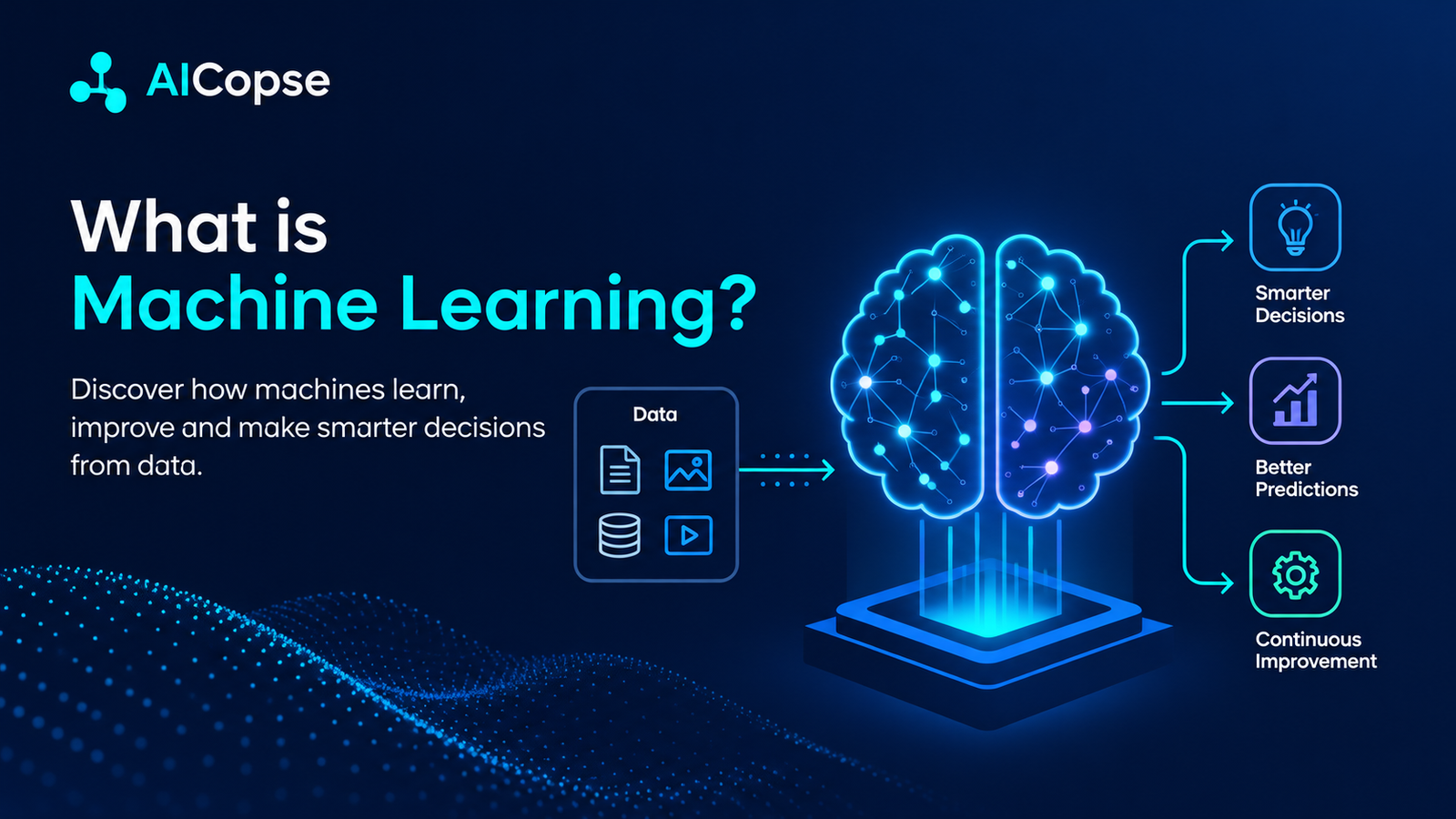
This guide explains machine learning in plain language for both technical and non-technical readers. You will see how it works step by step, run three small working examples, learn how ML differs from AI, deep learning and generative AI, and find out where it goes wrong. We follow this field daily at AICopse, so we also connect it to what is happening in the news right now.
What Is Machine Learning?
Machine learning is a branch of artificial intelligence in which computers improve at a task by learning from data, rather than by being given step-by-step instructions. The term was coined in 1959 by Arthur Samuel, an IBM researcher who built a checkers program that got better the more it played.
The simplest way to understand it
Imagine teaching a child what a dog is. You do not hand over a rulebook (“four legs, fur, a tail, barks”). You point at dogs and say “dog,” point at cats and say “cat,” and the child works out the pattern. After enough examples, the child recognises a breed they have never seen. Machine learning works the same way, with data as the examples.
Traditional programming vs machine learning
How Machine Learning Works, Step by Step
Every ML project follows the same five steps. We use a spam filter as the running example.
Two words you will see everywhere: the model is the finished “brain” that makes predictions, and training is the process of building it from data. The saved model can be used millions of times without repeating the learning.
Try It Yourself: 3 Working Examples
You do not need to be a programmer to follow these. Each one is only a few lines of Python using scikit-learn, the most popular beginner ML library. We ran every example, and the outputs shown are the real results.
Example 1: Learn a pattern from numbers (regression)
We give the model six students’ study hours and exam scores, then ask for a prediction for 7 hours. The data is made up for teaching.
from sklearn.linear_model import LinearRegression

hours  = [[1], [2], [3], [4], [5], [6]]
scores = [52, 58, 65, 71, 78, 84]

model = LinearRegression().fit(hours, scores)
print(round(model.predict([[7]])[0], 1))   # 90.6
What happened: the model found that each extra hour adds roughly 6.5 marks and predicted about 90.6 for 7 hours. Nobody wrote that rule. It came from the data.
Example 2: A tiny spam detector (classification)
from sklearn.feature_extraction.text import CountVectorizer
from sklearn.naive_bayes import MultinomialNB

msgs = ["win free money now", "claim your free prize", "urgent offer click now",
        "free cash winner", "lunch at noon tomorrow", "meeting moved to 3pm",
        "can you send the report", "see you at dinner tonight"]
labels = ["spam"] * 4 + ["not spam"] * 4

vec = CountVectorizer()
clf = MultinomialNB().fit(vec.fit_transform(msgs), labels)

print(clf.predict(vec.transform(["free prize now"]))[0])                 # spam
print(clf.predict(vec.transform(["report for tomorrow meeting"]))[0])   # not spam
What happened: the model never saw those two sentences, yet it classified both correctly because it learned which words lean toward spam. Real filters do the same with millions of emails.
Example 3: Testing on unseen data (and why it matters)
from sklearn.datasets import load_iris
from sklearn.model_selection import train_test_split
from sklearn.tree import DecisionTreeClassifier
from sklearn.metrics import accuracy_score

X, y = load_iris(return_X_y=True)                    # 150 flowers
X_train, X_test, y_train, y_test = train_test_split(
    X, y, test_size=0.2, random_state=42)             # 120 to learn, 30 to test

tree = DecisionTreeClassifier(random_state=42).fit(X_train, y_train)
print(accuracy_score(y_test, tree.predict(X_test)))  # 1.0
What happened: we hid 30 flowers from the model, trained on the other 120, and it identified all 30 correctly. The iris dataset is famously easy, so do not expect 100% on real problems. The habit to copy is always testing on data the model has not seen. A model that scores well on its training data but poorly on new data has memorised instead of learned, which is called overfitting.
The Types of Machine Learning
| Type | How it learns | Everyday example |
|---|---|---|
| Supervised | From examples with the right answers attached (labelled data) | Spam filters, price prediction, medical image checks |
| Unsupervised | Finds hidden groups and patterns in data with no answers given | Grouping customers by behaviour, spotting unusual transactions |
| Reinforcement | Learns by trial and error, earning rewards for good actions | Game-playing systems like AlphaGo, robot control |
| Self-supervised | Creates its own practice questions from raw data, such as predicting the next word | The training behind large language models like ChatGPT |
Beginner rule of thumb: if you have the correct answers, use supervised learning. If you only have raw data and want to find structure, use unsupervised learning. Most business ML today is supervised.
Machine Learning vs AI vs Deep Learning vs Generative AI
These terms are used as if they were interchangeable. They are not. Think of nested boxes: each one sits inside the one before it.
| Term | In one line | Example | Exists today? |
|---|---|---|---|
| AI | The big umbrella, including systems that follow hand-written rules | A chess engine built on fixed rules and search | Yes |
| Machine learning | Learns patterns from data instead of rules | Spam filter, recommendation engine | Yes |
| Deep learning | ML with neural networks that have many layers | Face recognition, speech-to-text | Yes |
| Generative AI | Deep learning that produces new content | ChatGPT, Claude, image generators | Yes |
| Superintelligence | Intelligence far beyond the best humans in nearly everything | None yet; a hypothetical future level | No |
The key point: all machine learning is AI, but not all AI is machine learning. A rule-based chess program is AI without any learning. And today’s generative AI, however impressive, is still machine learning at its core.
Where You Already Use Machine Learning
| Where | What ML does |
|---|---|
| Streaming and social feeds | Predicts what you will want to watch or read next from your past behaviour |
| Filters spam and suggests replies | |
| Phones | Face unlock, voice assistants, photo search, predictive text |
| Banking | Flags unusual card activity that looks like fraud |
| Maps | Estimates arrival times from live and historical traffic patterns |
| Healthcare and science | Helps analyse medical images; AlphaFold has predicted over 200 million protein structures |
| Chatbots and writing tools | Generate text by predicting likely next words, learned from huge amounts of text |
A Short History of Machine Learning
Machine Learning and the “Super Intelligence” Label
On September 29, 2026 President Trump signed an executive order telling federal agencies to use “super intelligence” and “SI” instead of “AI” in official communications. The order says the term refers to the same technologies already covered by the existing legal definition of AI. That legal definition describes machine-based systems that make predictions, recommendations or decisions, which is exactly what machine learning models do. We covered the announcement in Trump’s push for the super intelligence label.
What this means in practice: in US federal documents the new word covers the technology scientists call AI, and machine learning is the engine inside nearly all of it. The science did not change; the label did. Real superintelligence, a system far beyond human ability across almost everything, is still hypothetical. For the safety debate around that idea, read our report on the superintelligence doomsday warnings from AI industry leaders.
What Can Go Wrong with Machine Learning
ML is powerful, but it is only as good as its data and its testing. These are the failures that matter most:
| Problem | What it means | The usual fix |
|---|---|---|
| Bad or biased data | A model trained on skewed examples repeats the skew, for example a hiring model trained on past hires from one group | Audit the data, balance it and test results across groups |
| Overfitting | The model memorises its training data and fails on new data | Test on unseen data, use simpler models, gather more data |
| Black-box decisions | Complex models cannot easily explain why they decided something | Use explainability tools and keep humans in high-stakes decisions |
| Confident mistakes | Generative models can produce fluent but false answers | Verify important facts against trusted sources |
| Privacy | Training often needs large amounts of personal data | Collect less, anonymise, and follow data-protection law |
What Experts Say
| Voice | Position |
|---|---|
| Nobel Committee for Physics | Said the 2024 laureates used tools from physics to build the foundation of today’s machine learning, and that neural networks are now used across physics, for example to design new materials. |
| Geoffrey Hinton Nobel winner, deep learning pioneer |
Believes machine learning will bring huge benefits but has put the chance of AI causing human extinction within 30 years at 10–20% (BBC Radio 4, December 2024). |
| Yann LeCun Turing Award winner |
Argues that language models alone will not reach human-level intelligence and that AI is more likely to help humanity than endanger it. |
| Sam Altman and Dario Amodei OpenAI and Anthropic CEOs |
Both build large machine learning systems and both have called for government guardrails. |
AICopse take: the scientists who built modern machine learning now disagree about where it leads, yet agree on the basics: it learns from data, it needs careful testing, and humans must stay responsible for the results.
How to Start Learning Machine Learning
You can go from zero to building real models in about six months of steady practice. A reliable path:
| Stage | Learn | Goal |
|---|---|---|
| 1. Python basics | Variables, loops, functions, lists and dictionaries | Solve beginner coding challenges comfortably |
| 2. Data skills | NumPy, pandas and basic charts | Clean and explore a real dataset |
| 3. Core maths | Averages, probability and the idea of a line of best fit | Understand what a model is doing, not only how to call it |
| 4. Classic ML | scikit-learn: regression, classification, train/test split | Rebuild the three examples above on your own data |
| 5. Projects | Kaggle datasets, a spam or price predictor, a simple recommender | Three projects on GitHub with a clear README |
| 6. Deep learning | Neural networks with PyTorch or TensorFlow | Train an image or text model |
Free starting points: freeCodeCamp and Kaggle Learn for Python and data skills, Google’s Machine Learning Crash Course, and fast.ai for deep learning. Practise the coding foundations first; ML makes far more sense once loops and dictionaries feel natural.
Want daily plain-language AI updates while you learn? Follow the AICopse AI Updates section.
Common Myths About Machine Learning
| Myth | Reality |
|---|---|
| “Machine learning and AI are the same thing.” | ML is one part of AI. Some AI, like a rule-based chess engine, involves no learning. |
| “The computer understands like a human.” | It finds statistical patterns in data. It can be extremely useful without human-style understanding. |
| “You need a PhD in maths to use it.” | Libraries like scikit-learn let beginners build working models in a few lines, as shown above. |
| “More data always means a better model.” | Quality matters as much as quantity. Biased or messy data produces biased or messy results. |
| “A model that is 100% accurate in training is perfect.” | It may have memorised the training data. Only performance on unseen data counts. |
| “Machine learning is superintelligence.” | Today’s ML is narrower and less reliable than that. Superintelligence remains hypothetical. |
Mini Glossary
- Algorithm: the method a computer follows to learn from data.
- Model: the trained result that makes predictions.
- Training data: the examples a model learns from.
- Features: the measurable details used as input, such as word counts or house size.
- Label: the correct answer attached to a training example.
- Overfitting: memorising training data instead of learning general patterns.
- Neural network: a model made of layers of connected units, loosely inspired by the brain.
- Deep learning: machine learning with neural networks that have many layers.
- Inference: using a trained model to make a prediction.
Frequently Asked Questions About Machine Learning
What is machine learning in simple words?
It is teaching computers to learn from examples instead of programming every rule by hand. The more good examples the computer sees, the better its predictions become.
What is a simple example of machine learning?
A spam filter. It studies thousands of emails labelled spam or not spam, learns which words and patterns signal spam, and then sorts new email on its own.
What is the difference between AI and machine learning?
AI is the broad goal of making machines act intelligently. Machine learning is a method inside AI that learns from data. All machine learning is AI, but not all AI is machine learning.
What are the 3 types of machine learning?
Supervised learning (learning from labelled examples), unsupervised learning (finding patterns in unlabelled data) and reinforcement learning (learning by trial and error with rewards). Self-supervised learning, used to train large language models, is now commonly counted as a fourth.
Is ChatGPT machine learning?
Yes. ChatGPT is a large language model, a deep learning system trained on huge amounts of text to predict likely next words. That makes it generative AI, which is a subset of deep learning and machine learning.
Do I need to know coding to learn machine learning?
To build models, yes, and Python is the standard language. To understand what machine learning is and use AI tools wisely, no coding is needed.
Is machine learning the same as “super intelligence”?
No. Since September 2026 the US government uses “super intelligence” as a label for the technology previously called AI, which is largely built on machine learning. In science, superintelligence still means a hypothetical system far beyond human ability.
Is machine learning a good career?
Machine learning skills are used across technology, finance, healthcare and science, from data analyst to ML engineer roles. A strong foundation in Python, data handling and testing models is what employers look for first.
Key Takeaways
- Machine learning means computers learning patterns from data instead of following hand-written rules.
- The workflow is always: collect data, choose features, train a model, test it on unseen data, then predict and improve.
- ML sits inside AI, deep learning sits inside ML, and generative AI sits inside deep learning.
- You already use it daily, from email filters to recommendations and chatbots.
- Its main risks are biased data, overfitting, black-box decisions and confident mistakes.
- The “super intelligence” label in US government documents covers the same technology; real superintelligence is still hypothetical.
- You can start learning today with Python and scikit-learn.
We will keep this guide current as the technology and the policy around it develop. Bookmark it and follow AICopse for daily AI news in plain language.
Sources and further reading:
- Harvard SITN: Nobel Prize in Physics 2024 for foundations of machine learning
- University of Arizona HPC: the 2024 Nobel Prizes and AlphaFold’s 200 million structures
- Bernama/Anadolu: Executive order replaces “artificial intelligence” with “super intelligence”
- Al Jazeera: How does Trump’s White House AI accord work?
- Geoffrey Hinton on BBC Radio 4, December 2024
- scikit-learn documentation

Leave a Reply