
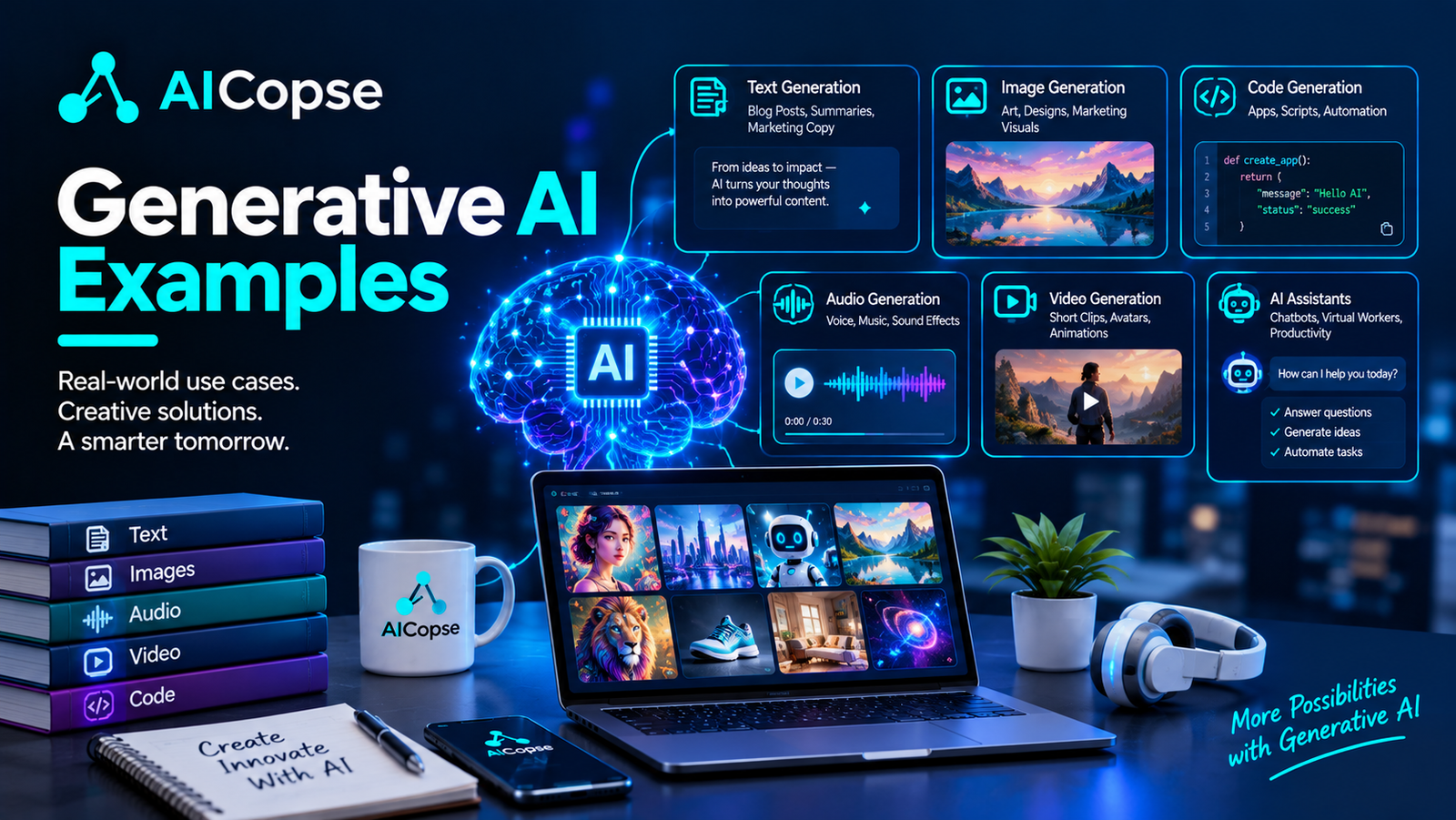
Most Americans now use generative AI without ever calling it that. It writes the suggested reply in your email, cleans up the background of a photo, summarizes the meeting you missed, and powers the chatbot on your bank’s website. This guide collects the clearest generative AI examples for U.S. readers, grouped by how you will actually meet them: in real life, in chat assistants like ChatGPT, in Microsoft Copilot, in images and video, in Python code, in healthcare, in education and in the apps on your phone.
For each example you will see what the AI really generates, how it works, what the evidence says and where it can go wrong. We also run three small Python experiments that show how generation works under the hood. We cover AI daily at AICopse, and every statistic below is dated and attributed. If you want the concept behind the examples first, start with our explainers on what machine learning is, the types of AI and agentic AI vs generative AI.
What Is Generative AI?
Generative AI is artificial intelligence that creates new content, such as text, images, audio, video, code or data, that resembles the examples it learned from. Where older AI mostly sorted, scored or predicted (is this email spam? will this customer leave?), generative AI produces something that did not exist before: a paragraph, a picture, a song, a function.
| Aspect | Predictive AI | Generative AI |
|---|---|---|
| What it does | Classifies or forecasts from data | Creates new content from a prompt |
| Output | A label, score or number | Text, image, audio, video, code or data |
| Everyday example | Spam filter, fraud alert, product recommendation | A chatbot reply, an AI-generated image, a meeting summary |
| Main risk | Wrong or biased predictions | Fluent but false content (hallucination), copyright and deepfake issues |
The model types behind the examples
| Model type | How it works | Used for |
|---|---|---|
| Transformer (LLM) | Predicts the next piece of text, one token at a time, after training on huge text collections | ChatGPT-style assistants, Copilot, translation, code |
| Diffusion model | Starts from noise and removes it step by step toward an image or video that matches the prompt | Midjourney, Adobe Firefly, Stable Diffusion, video generators |
| GAN | Two networks compete: one generates, one judges realism | Some face and image synthesis, data augmentation |
| VAE | Compresses data into a compact code and decodes new variations from it | Synthetic data, image variations, drug-design research |
The key idea in every case is the same: the model learns the patterns in its training data, then samples new outputs from those patterns. You will see that in miniature in the Python section. For how models are built, see our guide on how to train an AI model, and for the language side, natural language processing.
How many Americans already use it?
Pew also found that about 24% of U.S. adults use an AI chatbot daily. Sources: Pew Research Center and Gallup, as summarized in the sources below. U.S. Census Bureau business surveys put AI use at roughly 20% to 24% of U.S. businesses during 2026.
Generative AI Examples in Real Life
These are the examples most people meet before they ever open a chatbot. Each one generates something specific, and each one still needs a human check.
| Where you meet it | Example | What the AI generates |
|---|---|---|
| Email and writing | Gmail’s Help me write, Grammarly, ChatGPT | Draft emails, rewrites, tone changes and summaries of long threads |
| Your phone | Apple Intelligence Writing Tools, Genmoji and Image Playground | Rewritten text, custom emoji and quick illustrations |
| Photo editing | Adobe Photoshop Generative Fill, Google Photos Magic Editor | New background, extended edges or removed objects in a photo |
| Meetings | Microsoft Teams Copilot, Zoom AI Companion, Google Meet notes | Meeting summaries, action items and follow-up drafts |
| Search | AI answer summaries in Google and Bing, Perplexity | A written answer with sources, instead of a list of links |
| Social apps | Meta AI in Instagram and WhatsApp, Snapchat My AI | Chat replies, images and suggested messages |
| Learning a language | Duolingo Max | Role-play conversations and explanations of your mistakes |
| Customer service | Chat assistants on bank, airline and retail sites | Draft answers grounded in the company’s help pages |
| Work documents | Microsoft 365 Copilot in Word, Excel and PowerPoint | First drafts, formulas, charts and slide decks |
What to watch: these tools are convenient because they generate a confident first draft, and that is exactly why you should read it before you send it. We cover the failure modes in the risks section.
Generative AI Examples Like ChatGPT
ChatGPT is the best-known example, but it is one of many AI assistants. In Pew’s February 2026 survey of U.S. adults, ChatGPT was the most used, followed by Gemini and Copilot:
Share of U.S. adults who said they use each chatbot. Source: Pew Research Center, February 2026 (5,119 adults), as summarized by UseCarly. Adults could name more than one.
| Assistant | Maker | Where it shines |
|---|---|---|
| ChatGPT | OpenAI | General writing, brainstorming, coding help and analysis, with a very large user base |
| Gemini | Built into Gmail, Docs, Android and Google search | |
| Claude | Anthropic | Long documents, careful writing and coding |
| Copilot | Microsoft | Built into Word, Excel, PowerPoint, Outlook, Teams and Windows |
| Meta AI | Meta | Built into Facebook, Instagram, WhatsApp and Messenger |
| Grok | xAI | Built into X, with access to posts on the platform |
| Perplexity | Perplexity AI | Answer engine that cites its web sources |
How to pick one for your task
| If you… | Start with |
|---|---|
| Live in Microsoft 365 all day | Copilot, because it can see the file you have open |
| Live in Gmail, Docs and Google Calendar | Gemini inside Google Workspace |
| Need a general-purpose assistant | ChatGPT, Gemini or Claude, and compare their answers on a real task |
| Want an answer with web sources to check | Perplexity, or any assistant with web search turned on |
| Handle confidential or regulated data | Only an approved business plan with data controls, never a personal free account |
Because these tools overlap heavily, the best test is your own work: give two assistants the same real task and compare the results. Our guide on how to measure AI performance shows how to do that fairly.
Generative AI Examples: Microsoft Copilot
“Copilot” is not one product. Microsoft uses the name for a family of assistants, and GitHub uses it for an AI coding tool. Here is what each one generates, with a prompt you can try:
| Copilot | What it generates | Example prompt |
|---|---|---|
| Copilot in Word | First drafts, rewrites and summaries of long documents | “Draft a one-page project update from these notes in a friendly, concise tone.” |
| Copilot in Excel | Formulas, summaries, charts and pivot tables from plain English | “Show revenue by region for Q3 and highlight the top three.” |
| Copilot in PowerPoint | Slide decks from a prompt or a Word document | “Turn this report into a 10-slide deck for the sales team.” |
| Copilot in Outlook | Email drafts, thread summaries and tone coaching | “Summarize this thread and draft a polite reply that declines.” |
| Copilot in Teams | Meeting transcripts, summaries and action items | “List the decisions and the action items by owner.” |
| GitHub Copilot | Code suggestions, tests and multi-step coding tasks | “Write a Python function that validates U.S. ZIP codes, with tests.” |
| Copilot Studio | Custom agents connected to company data | “Build an HR assistant that answers from our benefits handbook.” |
| Dragon Copilot | Clinical notes drafted from patient visits | Used by clinicians, not typed as a prompt (see healthcare below) |
What changed in 2026
- Microsoft says Agent Mode, in which Copilot takes multi-step actions inside Word, Excel and PowerPoint, became generally available on April 22, 2026, according to news coverage.
- On September 25, 2026, Microsoft announced a redesigned Copilot app with Home (chat and Cowork in one place), Code (built on the same technology as GitHub Copilot) and Autopilot, a persistent agent that keeps working in the background.
- Microsoft also moved part of its AI pricing toward usage-based billing, alongside per-user licenses.
Examples by Type: Images, Video, Audio, Code and Science
| Type | Examples (2026) | What to know |
|---|---|---|
| Images | Midjourney, Adobe Firefly, Stable Diffusion, Canva Magic Studio, Microsoft’s MAI-Image-1 in Copilot | Firefly is trained on licensed content and backed by IP indemnification, which matters for brand work. In the U.S., purely prompt-generated images may not be copyrightable (see below). |
| Video | Google Veo, Runway, Kling, Luma, Pika, Adobe Firefly Video | OpenAI’s Sora app closed on April 26, 2026 and its API was retired on September 24, 2026, so any list that still recommends Sora is out of date. |
| Voice | ElevenLabs | Text-to-speech, dubbing and voice cloning. Only clone voices you have permission to use, because cloned voices are used in scams. |
| Music | Suno, Udio, ElevenLabs Music, Google’s Lyria in Gemini | Licensing and lawsuits with record labels are still being settled, so check the terms before you publish a track commercially. |
| Code | GitHub Copilot, Cursor, Claude Code, OpenAI Codex | Tools can now complete multi-step coding tasks. Review and test everything they write. |
| Science | AlphaFold | Predicted protein structures for over 200 million proteins, and its creators shared the 2024 Nobel Prize in Chemistry. |
| Design | Canva, Figma, Adobe Express | Layouts, brand-matched templates and image edits from a text description. |
For how image models differ from language models, see the model-type table at the top of this guide. If you work with AI-generated media commercially, read the copyright section below before you publish.
Generative AI Examples in Python
You can see generative AI work in about 20 lines of Python. The three experiments below use only the standard library, NumPy and scikit-learn, so they run on any laptop with no download and no API key. We ran all three, and the outputs shown are real.
Example 1: The smallest text generator (a bigram model)
This model reads a tiny corpus, records which word follows which, and then generates new text by repeatedly sampling a next word. A large language model does the same thing in spirit, with billions of parameters instead of a lookup table.
import random
from collections import defaultdict, Counter

corpus = ("the doctor reviewed the scan and the doctor wrote the note . "
          "the teacher reviewed the essay and the teacher wrote the feedback . "
          "the model reviewed the data and the model wrote the report .").split()

follows = defaultdict(list)
for a, b in zip(corpus, corpus[1:]):
    follows[a].append(b)                      # "learn" which word follows which

def generate(start, n, seed):
    rnd = random.Random(seed)
    word, out = start, [start]
    for _ in range(n):
        word = rnd.choice(follows[word])      # sample the next word
        out.append(word)
    return " ".join(out)

for seed in (1, 2, 3):
    print(generate("the", 12, seed))
print(dict(Counter(follows["the"])))
# the doctor reviewed the scan and the feedback . the scan and the
# the doctor reviewed the essay and the model wrote the data and the
# the note . the data and the data and the doctor wrote the
# {'doctor': 2, 'scan': 1, 'note': 1, 'teacher': 2, 'essay': 1, 'feedback': 1, 'model': 2, 'data': 1, 'report': 1}
What this shows: every sentence is new, yet each word pair came from the training text. The model knows only that “the” can be followed by doctor, scan, note and so on, so it produces fluent-looking nonsense like “the doctor reviewed the scan and the feedback.” That is the core of hallucination: the model samples what is statistically plausible, not what is true. A bigger model produces far better text, but it is still sampling.
Example 2: Temperature controls how random the output is
When you set a “temperature” in an AI tool, you change how the model turns its raw scores into probabilities. We gave a pretend model scores for four candidate next words and sampled 1,000 times at three temperatures.
import numpy as np
from collections import Counter

words  = ["report", "essay", "note", "banana"]
logits = np.array([3.0, 2.5, 2.0, -1.0])      # the model's raw preference for each next word

def softmax_t(l, t):
    z = l / t
    z = z - z.max()
    p = np.exp(z)
    return p / p.sum()

rng = np.random.default_rng(0)
for t in (0.2, 1.0, 2.0):
    p = softmax_t(logits, t)
    picks = Counter(str(w) for w in rng.choice(words, size=1000, p=p))
    print(t, [round(float(x), 3) for x in p], dict(picks))
| Temperature | report | essay | note | banana | 1,000 samples |
|---|---|---|---|---|---|
| 0.2 (focused) | 91.8% | 7.5% | 0.6% | 0.0% | report 920, essay 73, note 7 |
| 1.0 (balanced) | 50.2% | 30.4% | 18.5% | 0.9% | report 535, essay 272, note 184, banana 9 |
| 2.0 (creative) | 39.7% | 30.9% | 24.1% | 5.4% | report 401, essay 312, note 242, banana 45 |
What this shows: at a low temperature the model almost always picks the top word, which is good for facts and code. At a high temperature even the unlikely word (banana) appears in 4.5% of outputs, which adds variety and also errors. This is why the same prompt can give different answers each time, and why creative tasks and factual tasks need different settings.
Example 3: Generating synthetic data
Generative models do not only write text. This one learns the shape of three real medical measurements and then generates 500 brand-new rows, a technique used to create test data and to share research without sharing patient records.
import numpy as np
from sklearn.mixture import GaussianMixture
from sklearn.datasets import load_breast_cancer

X = load_breast_cancer(return_X_y=True)[0][:, [0, 1, 3]]    # three real measurements, 569 rows
gm = GaussianMixture(n_components=3, random_state=0).fit(X)
synthetic, _ = gm.sample(500)                               # generate 500 NEW rows

print("real means     ", np.round(X.mean(0), 1), "std", np.round(X.std(0), 1))
print("synthetic means", np.round(synthetic.mean(0), 1), "std", np.round(synthetic.std(0), 1))
print("correlation real / synthetic:",
      round(float(np.corrcoef(X[:, 0], X[:, 2])[0, 1]), 3),
      round(float(np.corrcoef(synthetic[:, 0], synthetic[:, 2])[0, 1]), 3))
# real means      [ 14.1  19.3 654.9] std [  3.5   4.3 351.6]
# synthetic means [ 13.9  19.4 634.6] std [  3.5   4.1 347.2]
# correlation real / synthetic: 0.987 0.986
What this shows: the synthetic rows have almost the same averages, spread and correlation as the real ones, yet none is an exact copy of a real record in this run. Synthetic data is useful, but “looks like the real data” is not the same as “is private.” Real systems still test whether generated records can leak details about real people.
Using real models from Python
To call a real language model you need either an open-source model on your machine or an API key from a provider. These two reference snippets show the pattern. We did not run them here because the first downloads a model and the second needs a paid key, so check each library’s current documentation.
# Reference snippet A: an open-source model with Hugging Face (downloads the model on first run)
from transformers import pipeline
generator = pipeline("text-generation", model="distilgpt2")
print(generator("Generative AI is", max_new_tokens=30, do_sample=True, temperature=0.8)[0]["generated_text"])

# Reference snippet B: a hosted model through an API (needs your own API key)
import anthropic
client = anthropic.Anthropic()                # reads ANTHROPIC_API_KEY from your environment
reply = client.messages.create(
    model="claude-sonnet-5-5", max_tokens=300,
    messages=[{"role": "user", "content": "Explain generative AI to a high school student in three sentences."}])
print(reply.content[0].text)
| Python tool | What it generates | Good for |
|---|---|---|
| scikit-learn | Synthetic tabular data (Gaussian mixtures) | Learning and testing, no GPU needed |
| Hugging Face Transformers | Text with open-source models | Running models on your own machine |
| Hugging Face Diffusers | Images from open diffusion models | Image generation experiments |
| PyTorch or TensorFlow | Any model you build yourself | Research and custom models |
| Provider SDKs (OpenAI, Anthropic, Google) | Text, images and tool use through an API | Adding generative AI to an app |
If you are new to Python, build your base first with coding challenges for beginners, and ask for help in the places listed in our guide to the best coding forums.
Generative AI Examples in Healthcare
Healthcare is where generative AI shows both its promise and the need for caution. Every example below produces a draft or an idea that a licensed professional must review.
| Example | What it generates | Notes |
|---|---|---|
| Ambient AI scribes | A draft visit note, written from the conversation between doctor and patient | Products include Abridge, Microsoft Dragon Copilot, Ambience, Nabla and Suki. Microsoft has said Dragon Copilot is used by more than 100,000 clinicians. |
| Protein and drug discovery | Predicted 3D protein structures and candidate molecules | AlphaFold predicted structures for over 200 million proteins, and its creators shared the 2024 Nobel Prize in Chemistry. |
| Synthetic data | Artificial patient-like records for research and software testing | See Example 3. It must be checked for privacy leakage. |
| Patient communication | Plain-language drafts of discharge instructions and portal replies | A clinician should review before anything is sent. |
| Imaging and pathology reports | Draft impressions to speed up report writing | The radiologist or pathologist signs off. |
| Billing and appeals | Draft appeal letters and code suggestions | Errors can cost money, so staff verify the output. See our posts on medical billing and health insurance claims. |
Do AI scribes really save time?
Ambient scribes are the most widely adopted clinical use of generative AI, so they have been studied closely. The honest picture is more modest than the marketing, but real:
| What was measured | Finding |
|---|---|
| Vendor claim | Savings of about five minutes per patient encounter, as cited in company materials. |
| Peer-matched study of 99 providers | About 46 seconds less documentation time per patient, as summarized in a 2026 research review. |
| Pre/post study of 332 physicians | Time in notes fell from 5.1 to 4.2 minutes per note, about 57 seconds. |
| Perception versus measurement | In a study of 252 physicians, 86.5% perceived less documentation time, but the perception did not track measured time. |
| Burnout | A study led by Mass General Brigham found an absolute reduction in burnout prevalence of 21.2 percentage points at 84 days. |
The lesson: scribes save modest minutes but may help most with mental load and burnout, and clinicians’ feelings about time saved are not a reliable measure. That is the same trap as in the METR study we describe in our guide on how to measure AI performance. An AMA survey cited by IntuitionLabs put physician use of AI at 81% in 2026, up from 38% in 2023.
More on how AI is entering clinics: AI in healthcare, AI in primary care, diagnostic imaging, healthcare AI security and governance and AI in mental health. For the mental-health risks of heavy chatbot use, read our guide to what AI psychosis is.
Generative AI Examples in Education
| Example | What it does | Notes |
|---|---|---|
| Khanmigo (Khan Academy) | Acts as a tutor that asks guiding questions instead of handing over answers, and helps teachers plan lessons | One of the best-known AI tutors in U.S. schools. |
| Duolingo Max | Role-play conversations and explanations of your mistakes in a new language | Generates practice dialogue on demand. |
| MagicSchool and SchoolAI | Teacher tools for lesson plans, rubrics and texts rewritten at different reading levels | Many include teacher oversight of student chats. |
| Gemini for Education and Copilot for Education | Assistants inside school Google or Microsoft accounts | Administrators control data and access. |
| ChatGPT study tools and NotebookLM | Step-by-step study help; summaries and quizzes built from your own class notes | Works best when you check answers against the source. |
What U.S. data shows
| Group | Finding |
|---|---|
| Public K-12 teachers | About 60% used AI during the 2024-25 school year, and weekly users reported saving about 5.9 hours a week (Gallup and the Walton Family Foundation). |
| High school students | 84% of U.S. high school students said they used generative AI for schoolwork by May 2025 (College Board). |
| Teens (Pew) | 26% of U.S. teens used ChatGPT for schoolwork in 2024, double the 13% in 2023. |
Using it well
- Students: ask for hints and explanations, not finished answers, and follow your school’s AI policy. Teachers can usually tell when the voice is not yours.
- Teachers: use AI for first drafts of materials and differentiation, and keep grading judgment for yourself.
- Parents and schools: prefer district-approved tools. U.S. student-privacy laws such as FERPA and, for children under 13, COPPA apply to student data.
- Everyone: remember that the goal is learning. Our piece on why AI should enhance, not replace, learning makes the case.
Generative AI Examples in Business
| Function | Example | Tools in the news |
|---|---|---|
| Customer support | Draft replies, summarize tickets, answer routine questions | Salesforce Agentforce, HubSpot, Microsoft Copilot Studio |
| Marketing | Draft copy, create image variations, personalize email | Adobe Firefly, Canva, ChatGPT, Gemini |
| Sales | Summarize calls, draft follow-ups, research accounts | Copilot, Gemini, CRM assistants |
| Software | Write code, tests and documentation | GitHub Copilot, Cursor, Claude Code |
| Manufacturing | Generate machine instructions and troubleshoot with plain-language questions | Siemens Industrial Copilot |
| Finance and legal | Draft memos, summarize filings and contracts, with expert review | General assistants and specialist platforms |
| HR | Draft job descriptions and answer policy questions | Copilot Studio and HR platforms |
These examples work best when the task is repetitive, the result is easy to check and a person stays accountable. To turn them into automated workflows, and to see what the research says about why many pilots fail, read AI agents for business. For ways to earn from these tools, see how to make money with AI.
Generative AI Apps by Need
| Need | App examples |
|---|---|
| General chat and questions | ChatGPT, Gemini, Copilot, Claude, Meta AI, Grok |
| Writing and editing | Grammarly, Notion AI, Word and Google Docs assistants |
| Images and design | Midjourney, Adobe Firefly, Canva, Stable Diffusion tools |
| Video | Google Veo, Runway, Kling, Luma, Pika, Adobe Firefly Video |
| Voice and music | ElevenLabs, Suno, Udio |
| Meetings and notes | Microsoft Teams Copilot, Zoom AI Companion, Otter and other note-takers |
| Coding | GitHub Copilot, Cursor, Claude Code, OpenAI Codex |
| Research and study | Perplexity, NotebookLM, ChatGPT study tools |
Free tiers, limits and prices change often, so check each app’s current plan before you rely on it. For note-taking in particular, see our roundup of the best AI note-taking apps.
Limits, Risks and U.S. Rules
| Risk | What it looks like | What to do |
|---|---|---|
| Hallucination | Confident answers with invented facts, quotes or citations (Example 1) | Check anything important against a primary source. |
| Privacy and confidentiality | Pasting patient data, student records or trade secrets into a public chatbot | Use approved business tools and follow HIPAA, FERPA and your employer’s policy. |
| Copyright | Who owns an AI-generated image, and what was the model trained on? | See the rules below, and prefer licensed tools for commercial work. |
| Deepfakes | Fake images, audio or video of real people | Never create or share intimate or deceptive fakes. See the TAKE IT DOWN Act below. |
| Bias | Stereotypes in generated text and images | Review outputs, especially for hiring, lending and health. |
| Security | Hidden instructions in a web page or email that hijack an AI agent | Limit what AI tools can access and do. See AI agents for business. |
| Mental health | Over-reliance and, in rare cases, delusions reinforced by a chatbot | See our guide to AI psychosis. |
| Energy | Large models use real electricity | See how much energy AI uses. |
Key U.S. rules in plain language
- Copyright: The U.S. Copyright Office’s January 2025 report says that prompts alone do not make you the author of AI output, while human selection, arrangement and edits can be protected. In March 2025 the D.C. Circuit held that an AI system cannot be an author.
- Training data: Courts and settlements are still shaping the rules. News coverage reports that a $1.5 billion settlement of authors’ claims against Anthropic received court approval on July 20, 2026.
- Deepfakes: The TAKE IT DOWN Act, signed May 19, 2025, makes it a federal crime to publish nonconsensual intimate images, including AI-generated ones, and since May 19, 2026 requires covered platforms to remove them within 48 hours of a valid request. The FTC enforces the platform duty.
- Disclosure: Your school, employer or client may require you to disclose AI use. Check before you submit.
This is general information, not legal advice. Talk to a lawyer about your specific situation.
How to Start Using Generative AI
A good prompt has five parts. Spend 30 extra seconds on them and the result improves a lot:
| Part | What to include | Example |
|---|---|---|
| Role and context | Who the AI should act as and what it needs to know | “You are a high school biology teacher. My class is 10th grade.” |
| Task | The one thing you want done | “Write a 20-minute lesson plan on photosynthesis.” |
| Format | How the answer should look | “Use a table with time, activity and materials.” |
| Constraints | Length, tone, what to avoid | “Under 400 words, no jargon, include one hands-on activity.” |
| Check | Ask it to flag uncertainty | “List any facts I should verify.” |
A five-step habit for safe use
- Know your rules: check what your employer, school or clinic allows.
- Protect data: never paste confidential, personal or regulated information into a public tool.
- Ask for sources: then open them, because assistants can invent citations.
- Verify the important parts: numbers, names, quotes, medical, legal and financial claims.
- Own the result: you are responsible for what you send, submit or publish.
Common Myths About Generative AI
| Myth | Reality |
|---|---|
| “Generative AI is just ChatGPT.” | ChatGPT is one example. Generative AI also makes images, video, music, code and synthetic data. |
| “It understands what it writes.” | It samples plausible output from patterns, as Examples 1 and 2 show. Fluent does not mean true. |
| “Recommendation engines are generative AI.” | Netflix-style recommendations are predictive AI. They pick from existing items and do not create new content. |
| “AI-generated work is automatically copyrighted to me.” | Under current U.S. Copyright Office guidance, prompts alone are not enough. Human creative input matters. |
| “Sora is the best AI video tool.” | OpenAI shut the Sora app on April 26, 2026 and retired its API on September 24, 2026. |
| “Once my company buys Copilot, everyone uses it.” | About 7% of Microsoft’s commercial seats were paid Copilot seats by July 2026. Adoption takes training and process change. |
| “More creative means better.” | A higher temperature adds variety and errors. Use low settings for facts and code. |
Mini Glossary
- Generative AI: AI that creates new text, images, audio, video, code or data.
- LLM (large language model): a very large model trained to predict text, the engine behind ChatGPT-style assistants.
- Prompt: the instruction you give a generative AI.
- Token: a small piece of text a language model reads and writes.
- Hallucination: a fluent but false output from a generative model.
- Temperature: a setting that controls how random the output is.
- Diffusion model: an image or video generator that removes noise step by step.
- Synthetic data: artificial data generated to resemble real data.
- Ambient scribe: an AI that drafts a clinical note from a patient visit.
- Agent: an AI system that takes multi-step actions with tools, covered in our agents guide.
- More terms: see AI terms explained.
Frequently Asked Questions About Generative AI Examples
What are examples of generative AI?
ChatGPT, Gemini, Claude and Microsoft Copilot (text), Midjourney and Adobe Firefly (images), Google Veo and Runway (video), ElevenLabs (voice), Suno (music) and GitHub Copilot (code) are all generative AI. So are AI scribes that draft doctor’s notes and tutors such as Khanmigo.
What are generative AI examples in real life?
Suggested email drafts in Gmail, Photoshop’s Generative Fill, meeting summaries in Teams or Zoom, AI answer summaries in search, role-play practice in Duolingo and chatbots on company websites.
What are generative AI examples like ChatGPT?
Google Gemini, Anthropic’s Claude, Microsoft Copilot, Meta AI, xAI’s Grok and Perplexity. In Pew’s February 2026 survey, 44% of U.S. adults used ChatGPT, 24% Gemini and 17% Copilot.
What are generative AI examples with Copilot?
Copilot drafts documents in Word, builds formulas and charts in Excel, creates decks in PowerPoint, summarizes email threads in Outlook and turns Teams meetings into notes. GitHub Copilot writes and tests code, and Dragon Copilot drafts clinical notes.
What are generative AI examples in Python?
A bigram text generator, temperature sampling and synthetic-data generation with scikit-learn (all shown above), plus Hugging Face Transformers for open-source text models and Diffusers for images, and provider SDKs for hosted models.
What are generative AI examples in healthcare?
Ambient AI scribes that draft visit notes, AlphaFold’s protein structures, synthetic patient-like data, drafts of patient messages and report impressions. Studies show modest documentation time savings and possible burnout benefits, and clinicians must review all output.
What are generative AI examples in education?
Khanmigo as a Socratic tutor, Duolingo Max for conversation practice, teacher tools like MagicSchool and SchoolAI, and study tools like NotebookLM. About 60% of U.S. public K-12 teachers used AI in 2024-25, and 84% of high school students used it for schoolwork by May 2025.
What are generative AI apps?
ChatGPT, Gemini, Copilot, Claude and Meta AI for chat; Midjourney, Firefly and Canva for images; Runway and Veo for video; ElevenLabs and Suno for audio; and Perplexity and NotebookLM for research. Check each app’s current plan and limits.
Is Netflix or Spotify recommendation generative AI?
No. Recommendations are predictive AI that selects existing content. Generative AI creates new content.
Is Sora still available?
No. OpenAI closed the Sora app on April 26, 2026 and retired its API on September 24, 2026. Current alternatives include Google Veo, Runway and Kling.
Can I copyright something made with generative AI?
The U.S. Copyright Office says prompts alone do not make you the author, but human selection, arrangement and modification can be protected. Courts have held that an AI cannot be an author.
Is generative AI free?
Most major tools offer limited free plans and paid plans for heavier use. Business features and data controls usually require a paid or enterprise plan.
What are the risks of generative AI?
Hallucinated facts, privacy leaks, copyright disputes, deepfakes, bias, security attacks on AI agents and over-reliance. Verify important output and follow your organization’s rules.
Key Takeaways
- Generative AI creates new content by sampling from patterns learned in training data, which explains both its fluency and its errors.
- Most Americans already use it: 49% of adults use AI chatbots, and 52% of employees use AI at work.
- ChatGPT leads in U.S. usage, with Gemini, Copilot, Meta AI, Grok and Claude following in Pew’s 2026 survey.
- “Copilot” is a family of tools, from Word and Excel assistants to GitHub Copilot to clinical note-taking.
- In healthcare, AI scribes save modest minutes and may help with burnout, but clinicians must review every note.
- In education, the best examples guide students to answers instead of giving them away.
- OpenAI’s Sora is gone, so current video examples are Google Veo, Runway, Kling and Adobe Firefly Video.
- Protect data, verify facts and know the U.S. rules on copyright and deepfakes before you publish.
We update this guide as tools and rules change. Bookmark it, and follow the AICopse AI Updates section and the AICopse homepage for daily AI coverage.
Sources and further reading:
- UseCarly: How many people use AI, 2026 statistics (Pew Research Center, February 2026 survey data)
- UseCarly: AI statistics 2026 (Gallup workplace AI use)
- Programs.com: AI adoption among U.S. businesses (U.S. Census Bureau survey data)
- GeekWire: Microsoft unveils all-in-one Copilot app (paid seat figures)
- Microsoft Blog: Introducing the new Copilot with Home, Code and Autopilot (September 25, 2026)
- Microsoft Learn: Microsoft 365 Copilot overview
- Copilot Agent Mode general availability, April 22, 2026
- Intermedia: Ambient AI scribes in healthcare and Dragon Copilot
- American Hospital Association: Health systems using ambient AI scribes (April 2026)
- arXiv: Quantifying the expectation-realization gap for agentic AI systems (ambient scribe studies)
- IntuitionLabs: HIPAA-compliant AI tools for healthcare (AMA survey figures)
- Third Rock Techknowledges: AI in education use cases (Gallup and Walton Family Foundation teacher data)
- 5WPR: EdTech AI index (College Board student survey)
- Pixflow: Best AI video generators, including the Sora shutdown dates
- Teamday: Best AI video models, September 2026
- DIY AI: Best AI video tools (Adobe Firefly Video licensing)
- GitHub: Media AI tools master list (image, music and voice tools, June 2026)
- Jones Day: U.S. Copyright Office on copyrightability of AI outputs
- Library of Congress blog: Copyright and Artificial Intelligence, Part 2
- Slash Digital: Rights, licenses and provenance of AI-generated content (settlement reporting)
- Fenwick: TAKE IT DOWN Act signed
- ComplianceHub: TAKE IT DOWN Act FTC enforcement and 2026 compliance

Leave a Reply