
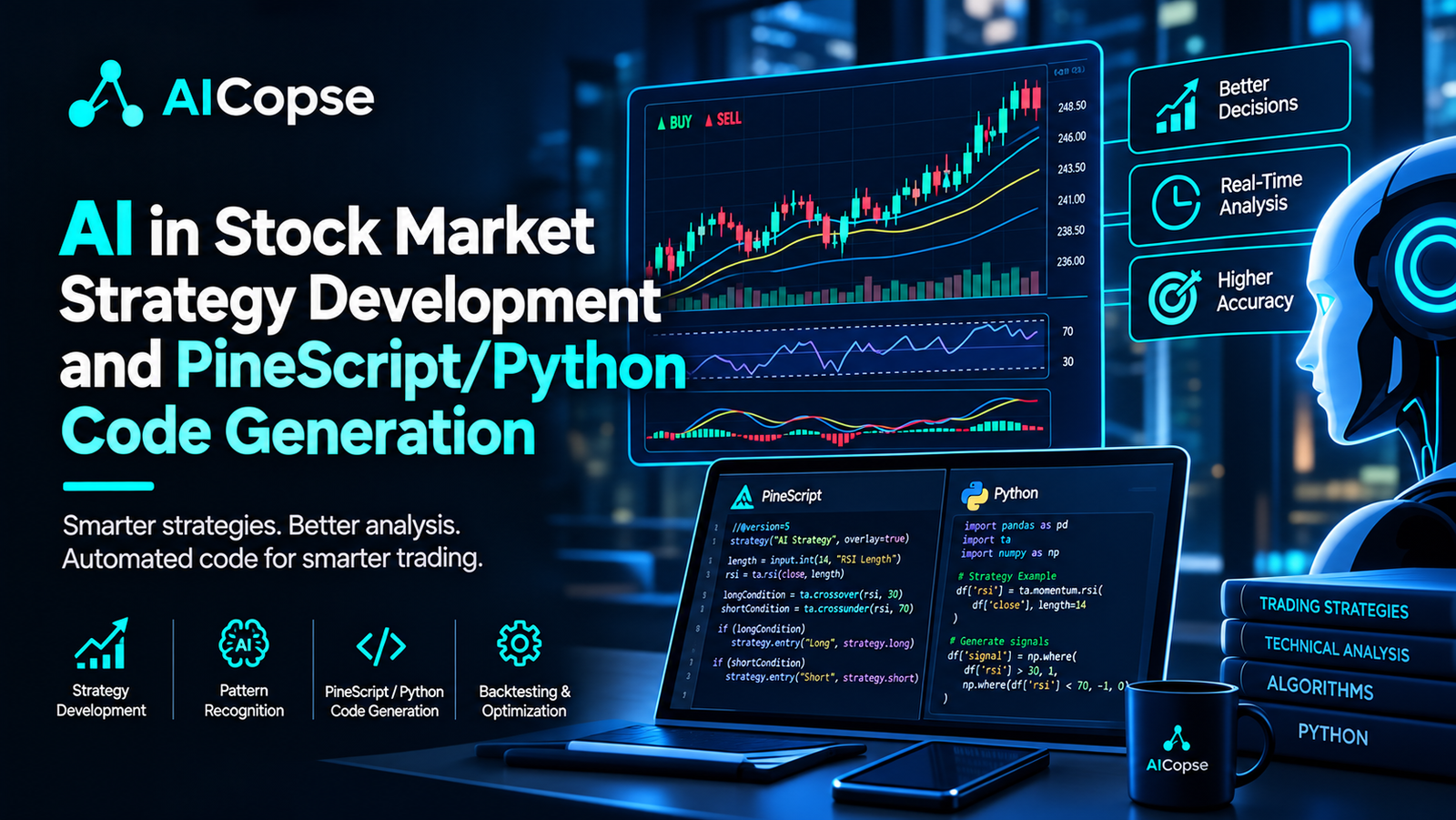
Key finding: AI can reduce the time required to draft and modify trading-strategy code. The strongest workflow does not trust generated code blindly. It defines the strategy precisely, generates code, compiles it, tests its logic, checks for look-ahead bias, evaluates realistic trading costs, and only then considers deployment.
Developing a stock-market strategy has traditionally required several different skills. A trader may understand price action and technical indicators but struggle to write code. A developer may know Python but lack experience with financial-market data. A quantitative researcher may build a promising backtest but need additional work to turn the model into a usable TradingView indicator, alert system, or trading application.
AI coding assistants are bringing these tasks closer together. A user can describe a strategy in ordinary language, ask an AI model to generate Pine Script for TradingView, request a Python version for research, and use the same assistant to explain errors or create tests. This can make strategy development more accessible to independent traders, fintech startups, software developers, and financial research teams.
However, generating code is only one part of the process. A script can compile correctly and still implement the wrong trading rules. A backtest can look profitable because it uses future information, ignores transaction costs, or overfits a historical period. A working alert can also fail to execute a real trade because the receiving service, broker connection, or order-handling system is unreliable.
This report examines the complete workflow: strategy specification, Pine Script and Python generation, research evidence, backtesting, validation, integration, security, business opportunities, and future developments. It also includes practical code examples that developers can use as starting points for their own testing.
Research at a glance
- Primary opportunity: Turn a clearly defined trading idea into a testable prototype more quickly.
- Core technologies: Large language models, Pine Script v6, Python, data-processing libraries, and backtesting frameworks.
- Most important limitation: Syntactically correct code does not prove that a strategy is logically correct or profitable.
- Best development approach: Generate, compile, test, inspect, backtest, and validate each version separately.
- Business opportunity: Build tools that help users create, debug, compare, document, and monitor strategies.
What Is AI-Powered Stock Strategy Development?
AI-powered stock strategy development uses artificial intelligence to help create, explain, modify, test, and document trading strategies. The user supplies a trading idea, technical requirements, or existing code. The AI model then generates a possible implementation and can help refine it in response to compiler errors, test failures, or additional requirements.
For example, a trader might ask for a strategy that buys when a 20-period moving average crosses above a 50-period moving average, enters only when the RSI is above 50, and closes the position when the moving averages cross in the opposite direction. An AI assistant can translate these rules into Pine Script for TradingView or Python for a separate research environment.
The important requirement is that the idea must be precise enough to implement. Terms such as “strong trend,” “good entry,” or “safe trade” are subjective unless the developer defines measurable conditions. AI may fill these gaps with assumptions that the user did not intend.
Four ways AI can help
These tasks have different levels of difficulty. Generating a standard moving-average crossover is relatively straightforward. Creating a realistic portfolio backtest, managing multiple instruments, accounting for market impact, or connecting live alerts to a broker requires more careful engineering.
Why Pine Script and Python are often used together
Pine Script is designed for creating indicators and strategies within TradingView. It can plot signals on charts, simulate trades, and make alert events available through the platform’s alert interface. Python offers a broader programming environment for data analysis, model training, portfolio research, database operations, and integrations with external services.
A practical system can use Pine Script for chart-based signals and Python for deeper analysis. However, the two implementations must follow the same rules. Differences in timestamps, candle construction, order timing, missing data, and position management can cause their results to diverge.
TradingView describes Pine Script as a language for creating indicators and strategies that run on its servers. Its official documentation also explains that scripts operate within platform resource limits. See the official Pine Script documentation.
Competitive Landscape and Content Opportunities
Content about AI-generated trading strategies generally falls into three groups. The first group teaches Pine Script syntax and common indicators. The second promotes AI tools that generate code from natural-language prompts. The third focuses on quantitative research, backtesting, and trading-system engineering.
Each group serves a different user need. Syntax tutorials help people learn a programming language, while AI code-generation tools reduce the effort needed to draft a script. Quantitative research content explains whether the strategy’s reported results are meaningful and how to test its assumptions. A strong industry guide should connect all three instead of treating code generation as the final step.
| Content category | What it usually covers | Opportunity for a deeper guide |
|---|---|---|
| Pine Script tutorials | Syntax, indicators, entries, exits, and chart visuals. | Explain strategy requirements, test design, repainting, and realistic execution assumptions. |
| AI code generators | Natural-language prompts, automatic code drafting, and debugging. | Show how to verify generated code and compare it against a separate implementation. |
| Quantitative research | Statistical validation, portfolio performance, and risk analysis. | Make research methods understandable to developers, founders, and non-technical traders. |
| Broker and automation integrations | Alerts, APIs, webhooks, and order execution. | Explain authentication, duplicate-event prevention, order reconciliation, and fail-safe controls. |
This comparison describes the main types of competing content rather than claiming that every competitor follows the same structure. Before publishing, AICOPSE should review the current top-ranking pages for the target queries and record their actual titles, coverage, freshness, and gaps. Search rankings can change, so no ranking outcome should be promised.
A useful SEO and AEO strategy
The article can target a connected set of search intents instead of repeating one keyword throughout the page. The main topic is AI in stock-market strategy development and code generation, while supporting sections answer narrower questions that developers and traders are likely to ask.
- AI stock trading strategy development
- AI Pine Script generator
- Generate Pine Script with AI
- Convert trading strategy to Python
- Pine Script v6 vs Python
- AI-generated trading strategy backtesting
- Debug AI-generated Pine Script
- Python backtesting for stock strategies
- AI coding tools for quantitative finance
- How to validate an AI-generated trading bot
These terms should appear naturally where the relevant question is answered. The goal is to make the report useful to several reader types, not to insert every phrase into every section. Search visibility depends on content quality, relevance, site authority, technical performance, competition, and other factors beyond keyword usage.
How AI Turns Trading Ideas into Code
The most reliable process begins with a written strategy specification. The user and developer should agree on the trading rules before asking an AI assistant to implement them. This reduces the chance that the model will invent missing conditions or silently change the intended behavior.
Step 1: Define the strategy precisely
Suppose the trading idea is to enter a long position when a short moving average crosses above a longer moving average. The strategy should also define whether the signal is evaluated on a candle close, whether short selling is allowed, how exits work, and how much capital is allocated to each trade.
A useful specification should include:
- Market and timeframe: For example, daily bars for a selected stock universe.
- Entry conditions: The exact indicator calculations and conditions that must be true.
- Exit conditions: Opposite signals, stop-loss rules, profit targets, time-based exits, or a combination.
- Position rules: Whether multiple entries are allowed and how position size is determined.
- Signal timing: Whether signals are confirmed at candle close or may change during an unfinished candle.
- Costs and assumptions: Commission, spread, slippage, and order-fill behavior.
- Evaluation criteria: Metrics and test periods used to judge the strategy.
Step 2: Ask AI to explain the plan before coding
Instead of asking for code immediately, ask the model to restate the strategy in plain English, list its assumptions, identify ambiguous requirements, and suggest test cases. This gives the user a chance to correct the plan before implementation begins.
Example prompt for strategy specification
“I want to develop a long-only moving-average crossover strategy for daily stock charts. Before writing code, restate the rules, identify ambiguous requirements, list the entry and exit conditions, explain the order-timing assumptions, and propose tests that could reveal logic errors or look-ahead bias. Do not claim the strategy is profitable.”
Step 3: Generate code in small, reviewable stages
Ask for the smallest working implementation first. Once it compiles, request additional features one at a time, such as a stop-loss, date filter, volume condition, or alert message. Adding many features in a single request makes it harder to identify which change caused a bug.
For Pine Script, the model should use the appropriate version and platform-specific functions. For Python, it should specify the expected data columns, timestamps, libraries, and assumptions about signal generation and order execution. The developer should not accept an implementation merely because it looks plausible.
Step 4: Compile, run tests, and inspect the result
For Pine Script, compile the code in TradingView and review the Strategy Tester output. For Python, run the script in a controlled environment and check its output against a small dataset where the expected behavior is known. A successful run proves only that the tested execution completed; it does not prove that the strategy logic is correct.
Step 5: Compare the implementation with the specification
Review each rule individually. If the specification says that a signal should be confirmed at candle close, verify that the code does not trigger earlier during an unfinished candle. If the specification says long-only, check that the strategy cannot accidentally open short positions. If it specifies a stop-loss, confirm that the exit order behaves as intended under the chosen execution assumptions.
Step 6: Test before connecting live execution
Run historical tests, compare against a simple baseline, and use a separate out-of-sample period. Then use paper trading or alert-only monitoring to compare live signal behavior with the backtest. Only consider live execution after the system’s operational and risk controls have been reviewed.
Pine Script vs Python
Pine Script and Python solve related but different problems. Pine Script is optimized for chart-based analysis and TradingView’s strategy-testing environment. Python is a general-purpose language with a broad ecosystem for financial data, statistical analysis, machine learning, portfolio research, and system integration.
| Capability | Pine Script | Python |
|---|---|---|
| Primary purpose | Chart indicators, strategies, and TradingView alerts. | Data analysis, modeling, backtesting, and application development. |
| Chart integration | Native chart visuals and platform integration. | Requires plotting libraries or an external charting interface. |
| Historical strategy testing | Built-in Strategy Tester and simulated order logic. | Flexible custom backtesting or established third-party frameworks. |
| Machine learning | Not intended as a general machine-learning training environment. | Broad support for model training, feature engineering, and statistical evaluation. |
| External integrations | Commonly uses alerts and external services for additional workflows. | Can connect to databases, APIs, research pipelines, and approved broker interfaces. |
| Best starting point | A chart-based indicator or a straightforward trading rule. | A research workflow requiring custom data processing or model evaluation. |
A common mistake is to assume that a Python backtest and a TradingView backtest must produce identical results because both use the same entry signal. They may differ in bar timestamps, price adjustments, order timing, commissions, slippage, and position handling. These differences must be reconciled before comparing performance.
What changed in Pine Script v6?
TradingView introduced Pine Script v6 in December 2024. Its documentation describes changes including dynamic requests, revised Boolean behavior, and other language improvements. Subsequent release notes have documented further additions and refinements, so AI-generated code should be checked against the current language reference instead of relying on older examples copied from the internet.
For example, TradingView’s release notes describe newer strategy-calculation options, including calc_on_every_history_tick in July 2026. This option changes how a strategy calculates across available historical ticks and should be used only when the intended simulation and data assumptions are understood. Feature availability and plan requirements should be checked in the official documentation.
Sources: Pine Script v6 migration guide and official release notes.
Pine Script and Python Code Examples
The following examples demonstrate a basic moving-average crossover. They are educational starting points, not validated investment strategies. They do not account for every market-specific condition, and their performance must be evaluated separately for the intended instrument, timeframe, and execution assumptions.
Example A: Pine Script v6 strategy
This example enters a long position when a 20-period simple moving average crosses above a 50-period simple moving average. It exits when the fast average crosses below the slow average. The script includes commission and slippage assumptions in the strategy declaration, but users should adjust them to match the market they are studying.
//@version=6
strategy("AI-Assisted MA Crossover Example", overlay=true, initial_capital=10000, commission_type=strategy.commission.percent, commission_value=0.05, slippage=1)

fastLength = input.int(20, "Fast MA Length", minval=1)
slowLength = input.int(50, "Slow MA Length", minval=2)

fastMA = ta.sma(close, fastLength)
slowMA = ta.sma(close, slowLength)

longSignal = ta.crossover(fastMA, slowMA)
exitSignal = ta.crossunder(fastMA, slowMA)

if longSignal
    strategy.entry("Long", strategy.long)

if exitSignal
    strategy.close("Long")

plot(fastMA, title="Fast MA", color=color.teal)
plot(slowMA, title="Slow MA", color=color.orange)

plotshape(longSignal, title="Long Signal", style=shape.triangleup, location=location.belowbar, color=color.lime, size=size.tiny)
plotshape(exitSignal, title="Exit Signal", style=shape.triangledown, location=location.abovebar, color=color.red, size=size.tiny)
What to check: Confirm that the strategy compiles in TradingView, verify that the selected moving-average lengths behave as intended, and inspect the simulated orders in Strategy Tester. The example uses a basic long-only rule and does not include a stop-loss, position-sizing model, portfolio exposure control, or a guarantee that simulated fills match live execution.
Example B: Python research implementation
The Python example below calculates the same moving averages from a DataFrame containing a Close column. It produces a signal when the fast average crosses the slow average. The position is shifted by one row to model execution on the next bar rather than assuming that a strategy can act on a closing price before that price is known.
import pandas as pd

def build_ma_signals(data, fast_length=20, slow_length=50):
    """
    Expected input:
    A pandas DataFrame with a Close column.
    The index should be ordered by timestamp.
    """
    if "Close" not in data.columns:
        raise ValueError("Input data must contain a Close column.")

    df = data.copy().sort_index()

    df["Fast_MA"] = df["Close"].rolling(
        window=fast_length,
        min_periods=fast_length
    ).mean()

    df["Slow_MA"] = df["Close"].rolling(
        window=slow_length,
        min_periods=slow_length
    ).mean()

    df["Long_Signal"] = (
        (df["Fast_MA"] > df["Slow_MA"]) &
        (df["Fast_MA"].shift(1) <= df["Slow_MA"].shift(1))
    )

    df["Exit_Signal"] = (
        (df["Fast_MA"] < df["Slow_MA"]) & (df["Fast_MA"].shift(1) >= df["Slow_MA"].shift(1))
    )

    # Position taken after the signal bar has closed.
    df["Position"] = 0
    in_position = False
    positions = []

    for long_signal, exit_signal in zip(
        df["Long_Signal"].fillna(False),
        df["Exit_Signal"].fillna(False)
    ):
        if not in_position and long_signal:
            in_position = True
        elif in_position and exit_signal:
            in_position = False

        positions.append(1 if in_position else 0)

    df["Position_After_Signal"] = positions
    df["Position_For_Return"] = df["Position_After_Signal"].shift(1).fillna(0)

    df["Market_Return"] = df["Close"].pct_change().fillna(0)
    df["Strategy_Return_Before_Costs"] = (
        df["Position_For_Return"] * df["Market_Return"]
    )

    return df
Important implementation note: This function demonstrates signal construction and a basic next-bar position convention. It is not a complete production backtester. A proper evaluation must model transaction costs on entries and exits, actual order timing, position sizing, missing data, corporate actions, and the trading calendar. The Python results should be compared with the Pine Script results using aligned market data and equivalent assumptions.
Example C: A stronger prompt for AI code generation
Reusable development prompt
“Act as a quantitative developer. Implement the following strategy from a written specification. First list all assumptions and ask questions about any ambiguous rule. Generate Pine Script v6 and a separate Python implementation. Do not add indicators or trading filters that are not specified. Use confirmed-bar logic unless otherwise requested. Explain signal timing, position handling, and exit behavior. Add unit tests or manual test cases for crossovers, missing values, repeated signals, and exits. Identify possible look-ahead bias, repainting risks, and execution differences. Do not describe the strategy as profitable without independent test evidence.”
The prompt works because it requests a process, not simply a block of code. It asks the model to identify ambiguity, keep the implementation faithful to the specification, and explain the checks that remain necessary after generation.
Six Research Studies and Their Findings
The evidence relevant to AI-driven strategy development comes from several fields: financial forecasting, financial-language models, backtest statistics, and AI-assisted software development. These studies answer different questions. Research showing that an AI model can interpret financial news does not prove that it can generate a profitable Pine Script strategy, and research showing faster coding does not prove that the resulting code is financially sound.
Study 1: Can ChatGPT Forecast Stock Price Movements?
Alejandro Lopez-Lira and Yuehua Tang, Journal of Financial Economics, 2026 publication
The researchers investigated whether large language models could interpret financial news headlines and help predict stock-price reactions. Their study used U.S. stock data and news over a historical sample extending from October 2021 to May 2024. They reported that GPT-4 assessments contained information about the market’s initial reaction and subsequent price drift, with differences across news categories and stocks.
The paper is relevant to AI strategy development because it illustrates a possible role for language models in turning unstructured information into structured research inputs. A developer could, for example, use an LLM to classify a news event or summarize its possible financial relevance, then pass that information into a separately tested quantitative model.
What this means for developers: LLM outputs may help construct research features, but they should be timestamped, recorded, and tested independently. A model’s interpretation of a headline should not be treated as a confirmed trading signal.
Important limitation: The study investigates financial-news interpretation and return predictability, not automatic generation of Pine Script or the universal profitability of AI-written trading strategies.
Study 2: FinGPT and Open-Source Financial Language Models
Hongyang Yang, Xiao-Yang Liu, and Christina Dan Wang, 2023
The FinGPT paper explores an open-source, data-centric approach to financial large language models. It discusses the importance of financial-data curation and techniques that make model adaptation more accessible. The authors describe possible applications that include financial analysis, algorithmic trading, and other finance-related workflows.
For stock-strategy development, this work helps explain why a general-purpose coding assistant and a finance-oriented language workflow may serve different roles. One component may translate strategy requirements into code, while another analyzes financial text or organizes domain-specific information. Neither component removes the need to validate the resulting trading logic.
What this means for startups: Teams can investigate open-source financial models where licensing, infrastructure, privacy, and maintenance requirements fit their product. A specialized model should be evaluated against a general-purpose baseline rather than assumed to be better simply because it is finance-focused.
Important limitation: FinGPT is a financial-language-model research project, not evidence that any generated strategy will outperform the market. Results depend on the particular task, data, and implementation.
Study 3: The Deflated Sharpe Ratio
David H. Bailey and Marcos López de Prado, Journal of Portfolio Management, 2014
This paper addresses a central problem in quantitative finance: testing many strategies and selecting the one with the best historical result can produce misleading performance estimates. The authors propose the Deflated Sharpe Ratio, which accounts for selection bias arising from multiple testing and for non-normal return distributions.
This issue becomes particularly important when AI can generate many strategy variations quickly. A user might ask an assistant to change moving-average lengths, RSI thresholds, stop-loss distances, volume filters, and entry timing. If hundreds of versions are tested and only the best result is reported, the chosen backtest may reflect luck rather than a robust relationship.
What this means for developers: Keep an experiment log, record how many configurations were tested, and avoid reporting only the most favorable result. For sophisticated research programs, consider statistical tools designed to account for selection bias.
Important limitation: The Deflated Sharpe Ratio is a statistical tool, not a guarantee of future performance. It does not replace sound data handling, independent testing, or realistic execution assumptions.
Study 4: The Probability of Backtest Overfitting
David H. Bailey, Jonathan M. Borwein, Marcos López de Prado, and Qiji Jim Zhu, 2015
This research examines the risk that a strategy selected using historical performance will fail to perform well on new data. It presents a framework known as combinatorially symmetric cross-validation for estimating the probability of backtest overfitting under the method’s assumptions.
The central lesson applies directly to AI-generated trading code. Automated code generation makes it easier to produce more strategy variants, but it also makes it easier to search the same historical dataset repeatedly until an attractive result appears. The ability to generate more strategies does not necessarily create more reliable discoveries.
What this means for developers: Use time-aware validation, preserve an untouched evaluation period, and document all material experiments. A strategy that performs well only in one optimized period should not be treated as robust evidence.
Important limitation: No statistical method can fully rescue a strategy built on flawed data, unrealistic fills, or incorrectly specified rules. The validation design still matters.
Study 5: AI-Assisted Coding and Developer Productivity
GitHub’s randomized controlled trial, reported in 2024 and updated in 2025
GitHub reported a controlled study involving 202 developers, with half receiving access to GitHub Copilot and half completing the task without AI coding assistance. The task involved implementing API endpoints for a web server. The company reported improvements in several measures of functionality, readability, and overall code quality in the Copilot group.
This evidence is relevant to the productivity question: an AI assistant can help developers produce and refine code. However, the study did not test trading strategies, financial backtests, Pine Script correctness, or investment performance. It should therefore be used to support the narrower claim that AI assistance may improve aspects of coding work, not that AI-generated financial code is automatically reliable.
What this means for businesses: Measure productivity using real task completion, test results, review effort, and defect rates. Time saved while drafting code is only one part of the total engineering cost.
Important limitation: This was a vendor-led study of a particular coding task. Its findings should not be generalized to every programming language, developer, or financial application without further testing.
Study 6: HumanEval-XL and Code-Generation Evaluation
Qiwei Peng, Yekun Chai, and Xuhong Li, LREC-COLING 2024
HumanEval-XL is a benchmark designed to evaluate code generation across multiple natural languages and programming languages. The paper highlights limitations in earlier code-generation benchmarks, which often focused on a narrow range of English-language prompts and programming tasks. It introduces a much broader evaluation set with prompts spanning 23 natural languages and 12 programming languages.
The relevance to financial code generation is methodological. A model should be evaluated on more than its ability to produce a plausible-looking answer. It needs tests that establish whether the generated program behaves correctly for the intended task. Trading strategies require additional domain-specific tests because their behavior depends on timestamps, market data, order handling, and financial assumptions.
What this means for developers: Build a test suite for the strategy domain rather than assuming general coding benchmarks establish Pine Script or financial-model reliability.
Important limitation: HumanEval-XL is a general code-generation benchmark. It does not evaluate stock-market profitability or the correctness of Pine Script trading systems specifically.
What the six studies mean together
The combined evidence supports a balanced conclusion. Language models can help interpret financial information and assist with coding tasks. Open-source financial models offer options for domain-specific experimentation. At the same time, quantitative research has long documented the danger of selecting strategies based on repeated historical testing, and code-generation research shows why output must be evaluated with suitable tests.
The most useful development principle is therefore to separate the AI assistant’s role from the evidence required to trust the result. AI can draft the implementation, explain its reasoning, and help generate tests. The final decision should depend on whether the implementation passes technical checks and whether the strategy survives a disciplined evaluation.
How to Validate AI-Generated Strategies
Validation should test three separate questions. First, does the code compile and run? Second, does it implement the intended trading rules? Third, does the strategy show credible performance under realistic assumptions? Each question requires a different kind of evidence.
| Validation layer | Questions to ask | Evidence to keep |
|---|---|---|
| Technical correctness | Does the script compile? Does it handle expected inputs and missing data? | Compiler output, test results, and reproducible examples. |
| Strategy correctness | Do entries, exits, and position rules match the written specification? | Known-case tests, trade logs, and code review notes. |
| Statistical robustness | Does the strategy work beyond the period used to design it? | Out-of-sample results, walk-forward tests, and sensitivity analysis. |
| Execution readiness | Can signals be delivered and orders managed safely? | Paper-trading records, monitoring logs, and incident tests. |
Use more than one performance metric
- Net return: Strategy performance after the transaction costs included in the test.
- Maximum drawdown: The largest peak-to-trough decline in the measured equity curve.
- Sharpe ratio: A measure of excess return relative to return variability, calculated with consistent assumptions.
- Win rate: The proportion of closed trades that are profitable. This metric does not show the size of gains and losses.
- Profit factor: Gross profits divided by gross losses under the chosen accounting method.
- Trade count: The number of trades supporting the reported result. Very small samples can create misleading impressions.
- Turnover: How frequently the strategy changes its positions, which affects costs and operational demands.
No single metric establishes quality. A strategy with a high win rate may still lose money if its losing trades are much larger than its winning trades. A strategy with a high historical return may also have a drawdown that is unacceptable for the intended user.
A practical backtesting checklist
- Define the strategy and evaluation metrics before inspecting the final test results.
- Check data quality, timestamp alignment, corporate actions, and missing observations.
- Separate training, development, and final testing periods by time.
- Use walk-forward validation to see how the strategy behaves as the market period changes.
- Include realistic commissions, spread, slippage, and order execution assumptions.
- Compare the strategy with simple rules and relevant benchmarks.
- Record every major strategy variation and avoid selecting a winner without accounting for repeated testing.
- Use paper trading or alert-only monitoring before connecting the strategy to live execution.
Important: Backtesting is a simulation, not proof of future results. TradingView’s official strategy documentation also warns users to understand the biases and limitations of simulated strategy results. See the TradingView strategy documentation.
Common Errors and How to Prevent Them
Mistake 1: Ambiguous prompts
A request such as “write a powerful breakout strategy” does not define the breakout level, confirmation rule, volume threshold, stop-loss, or exit behavior. The model may invent its own assumptions. Prevent this by writing a complete specification and asking the model to identify unresolved questions before generating code.
Mistake 2: Treating compilation as validation
A script can compile while calculating the wrong condition or entering a position at the wrong time. Check the code against known examples and inspect the plotted signals and trade list. When possible, compare the output with an independent implementation of the same rule.
Mistake 3: Look-ahead bias
Look-ahead bias occurs when a strategy uses information that would not have been available at the time of the decision. This can happen when future values leak into features, when a pattern is confirmed only after the strategy has already acted on it, or when a test assumes execution at an unavailable price. Every feature and signal should have a clear availability timestamp.
Mistake 4: Repainting and unfinished candles
Some signals can change while a candle is forming. Higher-timeframe requests and intrabar calculations can introduce additional complexity. Developers must understand whether their strategy uses confirmed bars, how data from other timeframes is requested, and whether historical behavior matches real-time behavior. Review TradingView’s official repainting documentation before relying on such signals.
Mistake 5: Ignoring costs and order timing
Signals are not the same as filled orders. An order may be delayed, rejected, partially filled, or executed at a different price from the assumed price. Python and Pine Script can also apply different order-timing conventions. Test these assumptions explicitly instead of comparing headline returns alone.
Mistake 6: Repeated optimization on one dataset
AI makes it easy to generate many variations of a strategy. If every variation is tested on the same historical period, the selected version may simply fit that period’s noise. Maintain an experiment log, preserve a final holdout dataset, and evaluate how results change across different market conditions.
Mistake 7: Sending alerts without checking delivery
Adding an alert function to Pine Script does not automatically create a running alert in the TradingView interface. The user must configure the alert using the appropriate script condition or order-fill event. TradingView also explains that an alert uses a saved copy of the script and its settings, so code changes may require recreating the alert.
See TradingView’s alert documentation for the current behavior and configuration options.
System Architecture and Integration
A production-grade AI strategy tool needs more than a prompt box and a code output panel. It needs a workflow for saving strategy requirements, generating versions, compiling or executing code, recording tests, comparing results, and controlling any deployment permissions.
Recommended technology choices
- Backend: Python with FastAPI or a comparable framework.
- Data processing: pandas or Polars, with appropriate validation for market timestamps and missing observations.
- Research libraries: scikit-learn for common machine learning tasks and PyTorch or TensorFlow when deep learning is justified.
- Data storage: PostgreSQL for users, strategy metadata, versions, and audit records, with suitable storage for historical market data.
- Code execution: Isolated workers with restricted permissions, execution limits, and no unnecessary access to secrets or external systems.
- Monitoring: Structured logs, alert-delivery tracking, test reports, and service-health monitoring.
- Deployment: Separate development, testing, and production environments with controlled release approvals.
AI-generated code should never be executed with unrestricted access to a production environment. Treat generated code as untrusted input. Use sandboxing, resource limits, restricted network access, and a review process before allowing a generated script to access financial accounts or live trading infrastructure.
Business Models for Startups and Developers
AI-assisted strategy development creates several possible products. The most sustainable opportunity may not be a service promising automated profits. It may be a tool that reduces the technical effort involved in writing, checking, documenting, and comparing trading strategies.
Opportunity 1: AI Pine Script generator
Help users turn explicit strategy requirements into Pine Script v6, explain code, and identify common syntax or logic issues.
Possible business model: Free basic generation with paid access to version history, advanced testing, and team features.
Opportunity 2: Pine Script to Python conversion assistant
Generate a Python research implementation from a Pine Script strategy, then compare signals and document differences in data and execution assumptions.
Possible business model: Subscription plans for developers and research teams, or API-based pricing.
Opportunity 3: AI backtest review platform
Analyze strategy code and test reports to flag missing cost assumptions, suspicious timing, repeated optimization, and incomplete validation.
Possible business model: Research subscriptions, team plans, or enterprise licenses.
Opportunity 4: Strategy collaboration workspace
Help analysts and developers document strategy assumptions, review code changes, compare experiments, and maintain approval records.
Possible business model: Per-seat subscriptions, team plans, and enterprise deployments.
How to validate a startup idea
Before building a full platform, interview a small group of target users and learn which part of strategy development costs them the most time. Traders may want easier code generation, while developers may care more about reliable debugging and reproducible tests. Institutional users may prioritize governance, auditability, and integration with existing research workflows.
Build a narrow prototype that solves one problem and measure whether it saves time without introducing unacceptable defects. Track the proportion of generated scripts that compile, the number that pass predefined tests, the time needed to correct failures, and how often users must rewrite the generated code. These metrics provide a more useful picture than counting how many lines the AI produces.
A responsible product should communicate the difference between code generation and investment performance. Do not market a strategy as profitable based solely on a model’s claims or a historical backtest. Financial products may also trigger licensing, data-use, privacy, or regulatory obligations depending on how they are offered.
Security, Governance, and Compliance
AI-generated strategy code can create operational risk if it is connected to live financial systems without suitable controls. A bug may cause repeated orders, incorrect position sizing, or an unintended short position. An integration failure may also leave the platform with an outdated view of its holdings or open orders.
Essential controls for production systems
- Credential protection: Store API keys and broker credentials in a secure secrets manager, not inside prompts or source code.
- Least privilege: Give research services only the permissions they need. Do not grant order-execution access by default.
- Code isolation: Run generated Python code in restricted environments with resource limits and limited network access.
- Order controls: Set position limits, exposure limits, order-rate limits, and safeguards against duplicate orders.
- Human approval: Require authorized review before enabling live execution or changing important strategy rules.
- Audit trail: Record the code version, model version, strategy configuration, test results, approvals, alerts, and relevant execution events.
- Monitoring: Detect missing market data, delayed alerts, unexpected position changes, and failures in downstream services.
- Emergency procedures: Provide a reliable way to pause execution, revoke credentials, and reconcile outstanding orders.
Privacy and intellectual property
Users may submit proprietary strategies, paid data, broker information, or internal business logic to an AI coding assistant. Before using an external model, businesses should review its data-handling terms, retention settings, access controls, and suitability for confidential material. Avoid placing account credentials or unnecessary personal data in prompts.
Generated code should also be reviewed for copied snippets, dependency licenses, insecure patterns, and platform-specific restrictions. A business should understand the licensing terms of its model, market-data provider, charting platform, and any code library it distributes to customers.
Financial and regulatory considerations
The applicable rules depend on the country, product design, customer type, and whether the service provides general software, personalized investment recommendations, portfolio management, or automated execution. A code-generation tool is not automatically exempt from financial regulation merely because AI produces the code.
Before launch, obtain suitable legal and compliance advice for the intended market. Review relevant financial-services rules, market-data licensing, consumer-protection requirements, advertising claims, privacy obligations, and recordkeeping duties. A disclaimer cannot replace compliance with applicable law.
Predictions for 2027–2030
The following are informed forecasts based on current developments in code-generation tools, financial AI research, and TradingView’s evolving Pine Script capabilities. They are not guaranteed outcomes or claims that every platform will adopt the same features.
Prediction 1: Strategy generation will become more specification-driven
AI tools are likely to place greater emphasis on structured strategy requirements before generating code. Instead of accepting a broad instruction and producing a complete script immediately, more systems may ask clarifying questions, list assumptions, and generate test cases alongside the implementation.
What businesses should do: Store strategy rules in a structured format so that the same specification can support code generation, tests, documentation, and version comparison.
Prediction 2: Code generation and testing will become more tightly connected
AI-assisted development workflows are likely to combine code generation with automated compilation, test execution, and iterative correction. The key improvement will not simply be producing code faster. It will be identifying failures earlier and giving developers clearer evidence about what has and has not been verified.
What businesses should do: Invest in domain-specific test suites for signal timing, order logic, data quality, and backtesting assumptions.
Prediction 3: Pine Script and Python workflows will become easier to compare
More development tools may help translate strategy rules across languages and compare their signals. This could reduce repetitive work, but it will not eliminate the need to reconcile platform differences in data, timestamps, order handling, and costs.
What businesses should do: Define a shared strategy specification and create comparison tests that flag differences between implementations.
Prediction 4: Validation tools may become a stronger product category
As AI makes it easier to generate more strategy variations, traders and financial teams may place greater value on tools that identify data leakage, unrealistic assumptions, and overfitting risks. Testing quality can become a more meaningful differentiator than the number of strategies a product can generate.
What businesses should do: Build transparent reports that distinguish code quality, logical correctness, statistical evidence, and live operational reliability.
Prediction 5: Financial AI products will need clearer evidence and explanations
Users are likely to expect more detail about how a generated strategy works, which assumptions it uses, what the backtest includes, and what risks remain. A single confidence score or headline return is unlikely to be enough for serious professional workflows.
What businesses should do: Provide traceable strategy versions, clear methodology notes, reproducible test results, and honest limitations.
Prediction 6: Human review will remain important for high-impact automation
Even better code-generation tools cannot remove all uncertainty from financial markets or all operational risks from trading systems. Human review, authorization, and safe shutdown mechanisms will remain important wherever a software error could lead to material financial loss.
What businesses should do: Match the level of automation to the strength of the evidence, the potential impact of failure, and the reliability of available safeguards.
Expert Recommendations for Developers and Business Leaders
The recommendations below synthesize the research and engineering considerations discussed in this report. They are practical recommendations, not direct quotations attributed to a particular researcher.
For developers and quantitative researchers
- Specify before coding. Write down the exact entry, exit, timing, position, and risk rules before requesting implementation.
- Ask the AI to identify ambiguity. Require it to state assumptions and ask questions rather than silently inventing missing rules.
- Generate one feature at a time. Small changes are easier to compile, test, review, and reverse when something goes wrong.
- Build independent tests. Verify important calculations using known examples and compare separate implementations when practical.
- Use a simple benchmark. Do not assume that a more complex AI-generated strategy is better than a transparent baseline.
- Keep a research log. Save code versions, model settings, data assumptions, test results, and reasons for accepting or rejecting each variation.
For startups and product managers
- Choose a narrow initial use case. Start with code generation, debugging, strategy documentation, or backtest review instead of building every feature at once.
- Measure quality, not just speed. Track compilation success, test pass rates, defect rates, and the amount of human correction required.
- Protect proprietary inputs. Establish data-handling rules for strategy code, customer information, market data, and credentials.
- Explain what has been tested. Separate code compilation, logic verification, historical performance, and live operational evidence.
- Make the product useful without promises of profit. Clearer research workflows and less repetitive engineering can be valuable even when a strategy is not profitable.
For financial institutions
- Use independent review. The team that generates a strategy should not be the only team responsible for approving its performance claims.
- Integrate with risk controls. Apply position limits, order controls, access management, and audit logging to any execution workflow.
- Monitor model and system changes. Revalidate material code changes and monitor live behavior for unexpected differences.
- Keep accountability clear. Define who owns strategy approval, model updates, incident response, and production deployment.
- Communicate limitations honestly. Avoid presenting historical results as guaranteed returns or treating AI output as a substitute for due diligence.
Frequently Asked Questions
Can AI generate Pine Script code from a trading idea?
Yes. AI coding assistants can turn a well-defined trading idea into a Pine Script draft. The result still needs to be compiled in TradingView, checked against the intended rules, and tested for signal timing and strategy behavior.
Can AI convert Pine Script into Python?
AI can help translate the logic into Python, but the conversion is not always a direct line-by-line process. The developer must account for differences in data handling, timestamps, order execution, position management, and the assumptions used by each backtesting environment.
Is Pine Script v6 better for new strategy development?
Pine Script v6 is the current major version documented by TradingView, and its newer features can be useful for modern scripts. Developers should still consult the current language reference and migration guide because behavior and feature availability can change over time.
Does AI-generated trading code guarantee profitable results?
No. Code generation is a software-development task, while profitability is a separate empirical question. A strategy must be tested with suitable data, realistic costs, out-of-sample evaluation, and appropriate risk analysis. Historical results do not guarantee future performance.
What is the best language for AI trading strategy development?
Pine Script is useful for chart-based strategies, indicators, and TradingView alerts. Python is useful for broader data analysis, machine learning, portfolio research, and integrations. Many projects use both, provided their rules and assumptions are carefully aligned.
How can I test whether AI-generated code is correct?
Compile or execute the code in a controlled environment, test known scenarios, inspect the resulting signals and trades, and compare the implementation with the written specification. For financial strategies, also check look-ahead bias, repainting, transaction costs, and order timing.
Can an AI-generated Pine Script strategy send trading alerts?
Yes, if the script defines supported alert events and the user creates the appropriate alert through TradingView’s interface. Adding alert-related code does not automatically create a running alert. Users should verify the alert configuration and confirm that the expected events are delivered.
Should a startup launch an AI trading bot immediately?
A safer development path is to begin with research and alert-only functionality, then validate the strategy and its integrations. Paper trading and operational testing can reveal issues before live execution is considered. Any production system should have suitable authorization, monitoring, risk limits, and emergency controls.
What is the biggest risk when using AI for trading code?
A major risk is trusting a plausible-looking script without verifying what it actually does. The code may implement the wrong rules, use future information, ignore trading costs, or behave differently in real time. Independent tests and disciplined backtesting are essential.
Sources and Further Reading
- TradingView. Pine Script User Manual, version 6. Official documentation for language features, indicators, strategies, and platform limitations. Read the manual.
- TradingView. Pine Script v6 migration guide. Read the guide.
- TradingView. Pine Script release notes. Review recent changes.
- TradingView. Strategies and simulated trading behavior. Read the strategy documentation.
- TradingView. Alerts and alert events. Read the alert documentation.
- Lopez-Lira, Alejandro, and Yuehua Tang. “Can ChatGPT Forecast Stock Price Movements? Return Predictability and Large Language Models.” Journal of Financial Economics, 2026. Read the paper.
- Yang, Hongyang; Liu, Xiao-Yang; Wang, Christina Dan. “FinGPT: Open-Source Financial Large Language Models.” 2023. Read the paper.
- Bailey, David H., and Marcos López de Prado. “The Deflated Sharpe Ratio: Correcting for Selection Bias, Backtest Overfitting, and Non-Normality.” Journal of Portfolio Management, 2014. Read the paper.
- Bailey, David H.; Borwein, Jonathan M.; López de Prado, Marcos; Zhu, Qiji Jim. “The Probability of Backtest Overfitting.” 2015. Read the paper.
- GitHub. Research on the quality of code authored with GitHub Copilot, reported in 2024 and updated in 2025. Read the study summary.
- Peng, Qiwei; Chai, Yekun; Li, Xuhong. “HumanEval-XL: A Multilingual Code Generation Benchmark for Cross-lingual Natural Language Generalization.” LREC-COLING, 2024. Read the paper.
Related AICOPSE reading
- AI in Algorithmic Trading and Automated Strategy Execution
- AI in Stock Market Trading Strategy Development
- AI in Predictive Financial Modeling and Market Forecasting
Conclusion
AI is changing stock-market strategy development by making it easier to turn written ideas into code, explain existing scripts, explore alternative implementations, and build repeatable research workflows. Pine Script is useful for chart-based strategies and TradingView alerts, while Python supports broader data analysis, model development, and system integration.
Research into financial language models and AI-assisted software development shows why these tools deserve serious attention. At the same time, research on backtest overfitting demonstrates why generating more strategies can make it easier to find misleading historical results. The ability to write code quickly is not the same as the ability to build a reliable financial system.
Developers should define strategy rules precisely, test generated code against known cases, and verify that all information used by the strategy would have been available at the time of the decision. Startups should focus on measurable customer problems and make validation a central product feature. Financial institutions should combine AI-assisted development with independent review, security controls, monitoring, and clear accountability.
The strongest long-term opportunity is not simply an AI tool that writes trading scripts. It is a trustworthy development workflow that helps users understand what the code does, test whether it behaves as intended, measure the quality of its evidence, and control the risks of putting it into use.
Important Disclaimer
This report is for educational and informational purposes only. It is not financial, investment, legal, or tax advice and does not recommend buying or selling any financial instrument. The code examples are educational starting points and have not been presented as validated investment strategies. AI-generated code may contain errors, and historical backtests do not guarantee future performance. Trading involves risk, including the possible loss of capital. Readers should conduct their own testing and due diligence and consult appropriately qualified professionals where necessary.
Published by AICOPSE | AI News, Research, Technology, and Industry Insights

Leave a Reply