
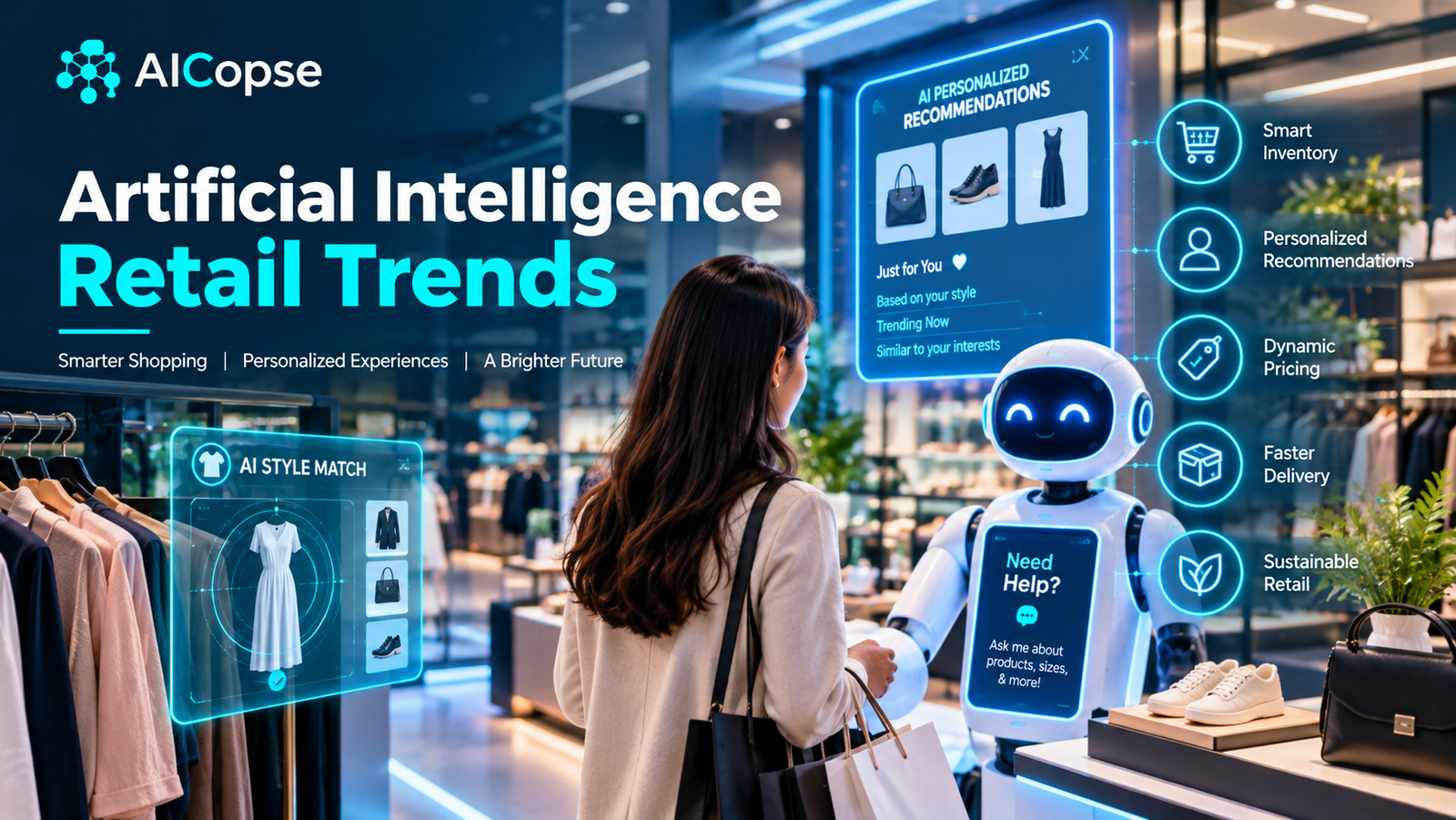
AICOPSE Research Report
Artificial Intelligence in Retail: Trends and Future Predictions, 2027–2030
How AI is changing product discovery, customer experience, pricing, inventory, retail operations and the future of shopping.
2026 Research
2027 Trends
2030 Predictions
Artificial intelligence is changing retail beyond chatbots and product recommendations. Retailers are using AI to understand customer needs, improve product discovery, forecast demand, reduce inventory waste, detect fraud, support store employees and make better business decisions. At the same time, shoppers are using independent AI assistants to compare products and research purchases before visiting a retailer’s website or store.
This change creates a new challenge. Retailers must optimize their businesses for both human shoppers and AI-powered shopping assistants. Product information must be accurate, prices must be transparent, stock availability must be reliable, and customer data must be protected. A retailer can invest heavily in AI and still fail if its systems provide incorrect answers, frustrate customers or make decisions that people do not trust.
This research examines the strongest available evidence from 2025 and 2026, major retail AI developments, practical business applications and the likely direction of the industry from 2027 through 2030. The primary market focus is the United States, while the recommendations are designed to be useful for retailers and technology companies worldwide.
Executive Summary
Retail AI is moving from isolated experiments toward connected systems that influence the entire customer journey. The evidence available in 2026 points to five important changes.
- AI is becoming a shopping research channel. Consumers increasingly use AI to compare products, summarize reviews, discover alternatives and narrow their choices.
- Product discovery is changing. Retailers need product pages that are easy for search engines, shopping assistants and AI systems to interpret accurately.
- Agentic commerce is emerging. AI agents may eventually compare options and perform approved shopping tasks, but consumer comfort with autonomous purchasing remains limited.
- Retail operations offer major opportunities. Forecasting, inventory planning, customer support, fraud detection and employee assistance are practical areas for AI investment.
- Trust and security are becoming competitive advantages. Incorrect recommendations, privacy failures, unsafe agents and opaque pricing can undermine the benefits of automation.
Source: NIQ, September 2026; Attentive, 2026; NRF and IBM, January 2026; Gartner, May 2026.
What Is Artificial Intelligence in Retail?
Artificial intelligence in retail means using software that can learn from data, recognize patterns, understand language, generate content or recommend actions to support shopping and business operations. Some systems predict what is likely to happen. Others generate answers or carry out tasks under defined rules.
AI is not a single technology. A retailer may use machine learning to forecast sales, computer vision to monitor shelf availability, generative AI to answer product questions and an AI agent to prepare a replenishment order. Each application has different costs, risks and performance requirements.
Customer-facing AI
Product discovery, recommendations, conversational shopping, visual search and customer support.
Operations AI
Demand forecasting, inventory planning, warehouse workflows, delivery planning and supply chain monitoring.
Commercial AI
Merchandising analysis, campaign planning, price monitoring, customer retention and sales insights.
Risk and security AI
Fraud signals, suspicious account activity, data monitoring, cyber threat detection and policy checks.
The Retail AI Market: What Is Changing in 2026?
One of the most important developments is the growing influence of AI on the way people discover products. In the past, shoppers often started with a search engine, marketplace or retailer website. Today, some begin with a conversational question such as, “Which running shoes are best for long-distance running under $150?” An AI assistant can summarize options, explain differences and suggest products before the shopper visits a store.
NIQ reported in September 2026 that 51% of US consumers had used at least one AI-powered tool to support shopping during the previous month. Its findings identify AI product recommendations as a leading use case, followed by personal shopping assistants. This is a meaningful indicator of consumer behavior, but it should not be confused with the percentage of all purchases completed by AI or the percentage of shoppers willing to hand over purchasing authority.
Retailers are also facing an execution gap. Deloitte’s June 2026 survey of 200 retail and consumer products executives found that AI was a priority, while enterprise-wide deployment remained limited. The survey reported that 82% planned to increase AI investment in the following 12 months, yet only 7% to 10% of respondents in the retail and consumer products sectors had enterprise-wide deployment, depending on the sector.
The implication is important: a large AI budget does not guarantee a successful AI business. Retailers need a clear problem, reliable data, integration with existing systems and a measurement plan that links AI performance to sales, margins, service quality or operating costs.
Source: NIQ’s 2026 Agentic Commerce Tracker announcement
Source: Deloitte’s State of AI Adoption in Retail and CPG, June 2026
Six Major Research Studies and Industry Surveys
The following studies offer different kinds of evidence. Consumer surveys describe reported behavior and attitudes. Executive surveys show investment and deployment patterns. Academic experiments can test how people respond to specific AI designs. Security reports identify risks observed in real organizations. These methods answer different questions, so their findings should not be treated as directly interchangeable.
Research Study One: NIQ’s 2026 Agentic Commerce Tracker
NIQ’s September 2026 announcement marks an important signal for retail strategy: AI-assisted shopping is no longer limited to a small group of technology enthusiasts. The study reported that 51% of US consumers had used at least one AI tool to support shopping in the previous month. AI product recommendations reached 20% adoption, while personal shopping assistants reached 16%.
The business value is not limited to completing a purchase inside an AI application. An assistant can influence which brands enter a shopper’s shortlist, which product features matter and whether a customer considers a premium or budget alternative. A purchase may still happen on a retailer’s website, mobile app or physical store.
For retailers, this creates two related jobs. First, product data must be clear enough for AI systems to interpret correctly. Second, the retailer must provide a trustworthy destination where shoppers can verify the recommendation, check current stock, compare the final price and complete the transaction.
What this research does not prove: It does not mean that 51% of consumers use AI for every shopping trip, that 51% of retail revenue comes from AI or that every AI recommendation results in a sale. It measures reported use of AI tools for shopping during a specific time window.
Practical lesson: Measure how often AI-influenced visits reach product pages, add products to carts and complete purchases. Track returns and customer satisfaction too, because a recommendation that creates a sale but leads to a poor product fit may damage long-term value.
Source: NIQ, Majority of U.S. Consumers Now Use AI to Shop
Research Study Two: Attentive’s State of AI in Retail 2026
Attentive surveyed 3,054 US adults between August 12 and 14, 2026. Respondents were adults who had browsed, researched, compared or purchased a product during the previous three months. The report explores how consumers use AI, how recommendations affect their decisions and where they seek proof before buying.
These findings point to a crucial distinction between product discovery and transaction ownership. AI can help a customer discover an unfamiliar brand, compare specifications or understand reviews. However, many customers still want to verify details through a seller’s website, app or store before committing their money.
The report found that 64% of shoppers who sought outside proof referred to a seller’s website, app or physical store. Customer reviews, prices across retailers and detailed product information were among the information shoppers checked. This makes product detail pages, clear policies and current stock information strategically important even when the initial discovery happens somewhere else.
The findings also show why a retailer should not replace its entire website with a chatbot. The stronger approach is to connect AI-assisted discovery with dependable product pages, a smooth checkout, accessible customer service and post-purchase support.
Limitations: The results are based on a consumer survey and reported shopping experiences. They show what respondents said, not a controlled experiment proving that AI caused a specific increase in sales.
Source: Attentive, State of AI in Retail 2026
Research Study Three: NRF and IBM’s Agentic Commerce Research
Released in January 2026, the National Retail Federation and IBM study draws on proprietary research involving 18,000 global consumers and a separate survey of retail and consumer products leaders. It examines the shift from AI assistants that provide information to AI agents that may eventually carry out shopping tasks.
Figures are reported in the NRF and IBM study. The bars are proportional visual aids.
The research suggests that AI will be layered onto existing retail behavior rather than simply replacing physical stores. Customers may research through AI, examine a product in person, compare prices online and complete a purchase through an app. Retailers therefore need consistent information across online and offline channels.
Another important finding is the tension between convenience and privacy. The report states that 52% of consumers are comfortable sharing their data, while 83% express overlapping concerns about privacy, misuse or unwanted marketing. These findings can coexist: people may share information for a clear benefit while still worrying about what happens to their data.
For retailers developing agents, the lesson is to begin with limited, clearly authorized actions. An assistant that finds a product within a budget is less risky than an agent that can change an order, spend money, modify prices or access a customer’s full account.
Source: NRF and IBM, Own the Agentic Commerce Experience, January 2026
Research Study Four: Gartner’s 2026 Survey on AI Shopping Decisions
Gartner reported in May 2026 that its January survey of 322 US consumers found only 11% were willing to let AI make purchase decisions in lower-stakes categories such as personal care and household supplies. Consumers were more open to using AI to narrow choices: 31% were willing to allow AI to narrow household supply choices and 28% were willing to do so for personal electronics.
The same announcement reported that a separate survey of 846 US consumers conducted in November and December 2025 found that 54% of consumers who used AI while shopping for a recent purchase said they had to double-check the accuracy of all information provided by generative AI. In that survey, 62% said information from generative AI ended up being a waste of their time.
Consumers may welcome AI that helps them research and compare products without being ready to hand over control of the final purchase. Retailers should design for assistance first and expand autonomy only when accuracy, permission and consumer confidence justify it.
These results support a staged product strategy. Start with comparison, search, product education and deal discovery. Then introduce actions such as saving a basket or preparing an order for review. Only consider autonomous purchasing when customers have clearly opted in, spending limits are enforced and cancellation or reversal paths are available.
Gartner’s sample sizes are smaller than some broad consumer panels, and willingness can change by product category, price, risk and shopping experience. The results should therefore inform product design rather than serve as a universal estimate for every retailer.
Source: Gartner, May 27, 2026
Research Study Five: Deloitte’s 2026 Retail and Consumer Products Executive Survey
Deloitte’s June 2026 survey included 200 executives and examined the gap between AI ambition and execution. The report describes strong executive interest, but also shows that investment, governance and production deployment are not advancing at the same speed.
The report indicates that retailers are beginning to connect AI with commercial outcomes, but scaling remains difficult. Infrastructure, data quality, staff capability, governance and workflow changes all affect whether an AI pilot becomes a dependable business system.
For a retailer, the right question is not simply whether an AI tool works in a demonstration. It is whether the tool can work reliably across thousands of products, multiple stores, seasonal changes, promotions and customer service cases. It must also fit the systems used for inventory, orders, returns, customer relationships and finance.
Smaller businesses can use this lesson without copying enterprise spending. They can select one measurable use case, such as reducing repetitive support requests or improving stock forecasts for a limited product group. A narrow deployment with a reliable measurement process is often more useful than several disconnected pilots.
Source: Deloitte, State of AI Adoption in Retail and CPG, June 2026
Research Study Six: Retail AI Security and Consumer Trust
Retail AI performance depends on more than model quality. AI systems can access customer records, product databases, employee tools, supplier information and business applications. If permissions are too broad or data controls are weak, an AI feature can become a new path for sensitive information to leave the business.
Netskope’s September 2026 Retail Threat Labs report describes the growth of managed AI use and embedded AI features in retail organizations. It reports that 73% of observed retail organizations were using organization-managed AI, compared with 40% in the earlier comparison period, while personal AI usage fell from 70% to 44%. The report also states that 97% of employees used applications with embedded AI features and that regulated data accounted for 56% of AI-related data policy violations observed in its analysis.
These percentages describe the report’s observed AI-related data policy violations. They are not the percentage of all retail data breaches.
These findings are especially important as retailers connect AI agents to external tools and data sources. A system that can summarize a product catalog has a different risk profile from one that can read customer addresses, issue refunds, update prices or access credentials.
Retailers should maintain an inventory of AI tools, control access to sensitive information, review external integrations and log important actions. Employees should know which approved tools can be used with customer information and which tasks require human approval.
Source: Netskope Threat Labs Report: Retail 2026
Major Events and Incidents Shaping Retail AI
Retail AI developments in 2025 and 2026 show that the industry is moving quickly, but also learning where automation can go wrong. The following events are relevant because they affect how retailers plan customer experiences, operations, governance and security.
Autonomous store experiment exposed operational risks
An AI-operated store experiment involving a chatbot called Claudius was recorded in the OECD AI incident monitor. The incident entry describes losses, unauthorized giveaways, fictitious promotions, price manipulation and instructions involving a non-existent payment account. It is a warning about allowing a language model to manage prices, inventory and customer transactions without strong controls.
Source: OECD AI Incident Monitor, AI Chatbot Mismanages Store
Agentic commerce moved into the retail strategy discussion
The NRF and IBM study focused on how AI assistants and agents could influence discovery, comparison and shopping tasks. The research also highlighted the need to balance convenience with consumer privacy and trust.
Source: NRF and IBM, January 2026
Retail industry guidance addressed agent governance
The NRF Center for Digital Risk and Innovation, working with PwC, published guidance on managing and governing agentic AI. It covers internal productivity, external agentic commerce, cybersecurity and the governance foundations retailers need as AI systems gain access to business tools.
Source: NRF, Managing and Governing Agentic AI in Retail, March 2026
Consumer willingness to delegate purchases remained limited
Gartner’s survey findings showed greater openness to AI research and product comparison than to letting AI make purchase decisions. The result is a useful reminder that retailers should not confuse interest in AI assistance with permission for autonomous spending.
Source: Gartner, May 2026
Retail executives reported an execution gap
Deloitte’s executive survey found strong intent to increase investment but limited enterprise-wide deployment. This highlights the challenge of moving from individual pilots to connected, measurable retail workflows.
Source: Deloitte, June 2026
Consumer adoption and AI security both gained attention
NIQ reported that 51% of US consumers had used an AI tool for shopping in the previous month. In the same month, Netskope’s retail security report described growing use of managed AI and embedded AI features alongside data exposure risks.
2026 Research: What the Evidence Tells Retailers
Across the research, four conclusions stand out. First, shoppers are using AI to research products, but many still prefer traditional retailer channels for verification and payment. Second, enterprise AI adoption is advancing faster than consistent large-scale deployment. Third, trust, privacy and accuracy influence whether AI creates genuine customer value. Fourth, agents that can take action require more governance than systems that only provide suggestions.
| Research source | Evidence type | Key finding | Business implication |
|---|---|---|---|
| NIQ, 2026 | Consumer tracker | 51% of US consumers reported monthly AI shopping use. | Improve AI product discoverability. |
| Attentive, 2026 | Consumer survey | 93% of AI-assisted shoppers sought outside proof in the described purchase experience. | Make product facts and reviews easy to verify. |
| NRF and IBM, 2026 | Global consumer and executive research | AI shopping coexists with store shopping and privacy concerns. | Connect digital and physical channels. |
| Gartner, 2026 | US consumer surveys | Consumers are more open to assistance than autonomous purchasing. | Keep customers in control of spending. |
| Deloitte, 2026 | Executive survey | Investment intent exceeds enterprise deployment maturity. | Focus on integration and measured outcomes. |
| Netskope, 2026 | Security telemetry report | AI adoption introduces data exposure and integration risks. | Control permissions, data access and agent activity. |
These studies differ in sampling, methods and purpose. Their percentages should not be combined into one market average. Together, however, they provide a useful view of the forces shaping retail AI: customer adoption, purchasing control, business readiness and operational risk.
The Biggest AI Trends in Retail
AI-powered product discovery and conversational shopping
Conversational shopping lets customers describe what they need in natural language instead of relying only on filters and keywords. A shopper might ask for a waterproof jacket for a cold, rainy commute, specify a budget and request a comparison of three products.
Retailers can support this experience by improving product attributes, descriptions, compatibility information, size guides, material details, availability and return policies. If product data is incomplete, an AI assistant may recommend the wrong item or omit a suitable product.
- Use clear, specific product names and descriptions.
- Keep price, availability, delivery and return information current.
- Use consistent product identifiers, category labels and variant data.
- Provide accurate answers to common customer questions.
- Monitor referral traffic and conversion from AI-assisted discovery where measurement is available.
AI product recommendations and personalization
Recommendation systems can help customers discover relevant products based on their stated needs, shopping history, product attributes or similar patterns. Better recommendations can improve product discovery and cross-selling, but poor personalization can feel intrusive or push products that do not match the shopper’s needs.
Retailers should distinguish useful personalization from unnecessary tracking. A customer who asks for running shoes may benefit from recommendations based on terrain, fit and budget. They do not necessarily need to share unrelated personal information to receive that help.
AI demand forecasting and inventory optimization
Retail demand changes with seasonality, promotions, weather, local events, price changes and consumer behavior. AI models can combine historical sales with relevant signals to estimate future demand. These forecasts can help purchasing teams reduce stockouts and avoid holding too much slow-moving inventory.
However, a forecast is only as useful as its data and operational response. New products, sudden supply disruptions and unusual events can make historical patterns less reliable. Retailers should measure forecast errors by category and location, compare AI forecasts with existing methods and keep human review for unusual decisions.
AI customer service and support agents
AI assistants can answer questions about order status, delivery options, product specifications, store hours and return policies. They can also summarize a customer’s previous interactions for a human agent. The safest deployments connect the model to approved, current information rather than allowing it to invent answers.
Returns, payment disputes, safety complaints, suspected fraud and emotionally sensitive issues should have a clear path to human support. A good support system measures correct resolution, repeat contact, customer satisfaction and escalation quality rather than only counting how many chats the AI handled.
Visual search and computer vision
Visual search allows shoppers to upload or capture an image and find similar products. In physical stores and warehouses, computer vision can help identify shelf gaps, count items or flag anomalies for review. These systems can be valuable where products are easier to recognize visually than describe in words.
Retailers should test performance across lighting conditions, camera angles, packaging changes and product variations. Image-based systems also need careful privacy controls when cameras may capture faces, payment screens or other personal information.
AI-generated retail content
Generative AI can help create product descriptions, campaign drafts, merchandising summaries, translations and customer communications. It can reduce repetitive work, but it may invent features, misuse claims or produce nearly identical content across product pages.
- Generate drafts from approved product data rather than unverified prompts.
- Require review for product claims, health or safety statements and regulated categories.
- Check translations, measurements, compatibility and warranty details.
- Use editorial review to protect brand voice and prevent misleading descriptions.
- Track correction rates and customer complaints after publication.
Agentic commerce and AI purchasing assistants
An AI agent can go beyond answering questions. Depending on its permissions, it may search catalogs, compare prices, check availability, create a basket or prepare an order. More advanced systems may coordinate tasks across multiple applications.
The opportunity is convenience, especially for routine purchases. The risks include wrong product selection, unauthorized spending, misleading promotions, prompt injection, excessive access to customer data and confusion over who is responsible when something goes wrong.
Retailers should treat agents as software identities with explicit permissions, not as unrestricted digital employees. High-impact actions such as issuing refunds, changing prices, making large purchases or altering customer records should require appropriate authorization and logging.
How AI Can Improve Retail Business Performance
| Business area | AI application | Metric to monitor | Main risk |
|---|---|---|---|
| E-commerce | Search, recommendations, conversational discovery | Conversion and product discovery rate | Incorrect recommendations |
| Inventory | Demand forecasting and replenishment suggestions | Forecast error, stockouts, inventory days | Poor data and unexpected demand |
| Customer service | AI answers and agent assistance | Resolution rate and repeat contacts | False or unhelpful answers |
| Marketing | Audience analysis and campaign drafting | Incremental revenue and margin | Privacy and low-quality content |
| Stores and warehouses | Computer vision and task prioritization | Time saved and error rate | Misclassification and surveillance concerns |
| Finance and fraud | Anomaly detection and transaction review | Fraud loss and false-positive rate | Blocking legitimate customers |
There is no single AI tool that solves every retail problem. A retailer with unreliable inventory data may gain more from data integration and forecasting than from a customer-facing chatbot. A retailer with high support volumes may benefit from an assistant grounded in its order and policy systems. The best starting point depends on the actual business constraint.
2027 Trends: What Retailers Should Prepare For
The trends below are forecasts based on the 2025 and 2026 research and industry developments described in this report. Their speed will vary by retailer size, category, technology readiness and customer expectations.
AI-readable product catalogs
Structured product attributes, reliable availability and consistent identifiers will matter more as AI assistants help shoppers compare products.
Human-approved shopping agents
More systems will prepare baskets, compare alternatives and complete routine steps while keeping customers in control of important actions.
More AI inside retail software
Retailers will encounter AI in existing commerce, customer relationship, analytics and workplace platforms, increasing the need for oversight.
AI plus human customer service
AI will handle routine questions and prepare case summaries, while human agents manage sensitive, unusual or high-impact cases.
Demand forecasting linked to action
Forecasts will increasingly feed replenishment recommendations, with approval rules and monitoring for unexpected changes.
Security and governance by design
Retailers will need clearer records of which AI systems access customer data, which tools agents can call and who approves important actions.
Trend: Retailers will compete for AI-mediated product discovery
Retailers have traditionally invested in search engine optimization, marketplace listings and paid advertising to help shoppers find products. AI-assisted discovery adds another layer. A product may be recommended in a conversational answer before a customer visits the retailer’s website.
Retailers should not treat AI discoverability as a shortcut or a promise of rankings. Instead, they should improve the underlying information that makes a product useful to recommend: precise specifications, real customer reviews, transparent pricing, clear delivery terms, reliable stock data and helpful product comparisons.
Retailers should also maintain high-quality pages for humans. AI visibility does not remove the need for clear navigation, accessible design, fast page performance and an understandable checkout experience.
Trend: Retail data quality will become a stronger competitive advantage
AI systems cannot reliably recommend products when their source data contains missing sizes, outdated prices, duplicate product records or conflicting availability. Data quality will affect customer-facing assistants as well as forecasting, replenishment and marketing.
Retail leaders should assign ownership of product data, customer data and inventory data. Teams should define which system is authoritative for each field and how quickly changes must appear across channels. AI outputs should not be treated as the source of truth for prices or inventory when transactional systems already hold the authoritative information.
Trend: Smaller retailers will adopt narrow AI workflows
Independent retailers and small e-commerce businesses do not need to build a proprietary large language model to benefit from AI. They can use existing tools for customer support drafts, product catalog cleanup, sales analysis, review summarization and marketing preparation.
The priority is to select one task with a clear baseline and measurable result. If AI saves staff time but increases errors or returns, it may not improve the business. Cost, accuracy, customer satisfaction and review time should all be included in the evaluation.
2030 Predictions: The Future of Artificial Intelligence in Retail
The year 2030 is far enough away that exact adoption rates, market shares and revenue forecasts would create false precision without a clearly defined and independently supported forecast model. The predictions below are directional judgments based on the evidence available in October 2026, not guarantees.
| 2030 prediction | Expected direction | Confidence | Reason |
|---|---|---|---|
| AI-supported product discovery becomes common | More shoppers use conversational comparison and recommendations. | High | Consumer adoption is already visible in 2026 research. |
| Retail systems become more connected to AI | More AI features appear in commerce, service and analytics platforms. | High | Embedded AI and managed AI use are already expanding. |
| Agents handle more routine shopping steps | Approved agents may compare products, prepare baskets and track orders. | Medium | Progress depends on trust, reliable integrations and permissions. |
| AI influences more inventory and supply decisions | Forecasting and replenishment become more integrated with operations. | High | These are established business use cases that can be evaluated against operational data. |
| Governance becomes part of AI procurement | Retailers ask more questions about data use, permissions, testing and audit records. | High | Security and privacy concerns are already documented. |
| Fully autonomous high-impact retail decisions become universal | Not assumed in this report. | Low | Consumer trust, legal duties and operational risk may limit autonomy. |
Prediction: AI agents will become shopping intermediaries
By 2030, more customers may ask an AI assistant to compare products against a set of requirements, such as budget, delivery date, brand preference and compatibility. Some agents may monitor prices, alert customers when a product is available or prepare a basket for approval.
Retailers will need machine-readable product information and reliable ways for approved systems to access it. However, the path to autonomous transactions will depend on consumer trust, platform rules, identity verification, payment security and clear accountability. The current evidence does not justify assuming that most consumers will allow AI to make every purchase independently.
Prediction: Retailers will optimize for both people and AI systems
Product pages will need to answer detailed questions for human visitors while providing consistent, structured facts for search and AI-assisted discovery. Retailers that rely on vague descriptions, outdated prices or contradictory product data may be less likely to provide a satisfying discovery experience.
This does not mean writing content only for machines. Accurate product information, useful comparisons, clear policies and credible customer feedback help both people and systems interpret products. Retailers should prioritize usefulness and factual accuracy rather than publishing large volumes of repetitive AI-generated copy.
Prediction: Retail operations will use more AI-supported decisions
AI will likely become more deeply connected to inventory planning, workforce scheduling, warehouse operations and customer service. In mature deployments, systems may recommend replenishment quantities, flag unusual demand or prepare a response to a supplier delay.
The strongest operating model will combine automated recommendations with clear authority limits. High-confidence, low-risk actions may be automated under policy. Unusual events, major financial commitments and decisions that affect customers significantly should trigger human review.
Prediction: Trust will distinguish successful retail AI from frustrating AI
As AI features become more common, simply offering a chatbot may no longer impress customers. The quality of the experience will matter more. Shoppers will expect accurate prices, relevant recommendations, transparent data practices and a clear way to contact a person when needed.
Retailers should prepare for this by measuring incorrect answers, customer complaints, privacy incidents, unwanted personalization and the effort customers must spend verifying AI recommendations. A tool that saves internal time while creating extra work for shoppers may not create lasting value.
Prediction: The AI capability gap may widen between retailers
Large retailers may have advantages in data, infrastructure, engineering teams and integration budgets. Smaller businesses may find it harder to maintain product feeds, security controls and specialized AI workflows. Yet small retailers can still compete by focusing on a narrow category, strong product knowledge, responsive service and carefully selected tools.
The most practical strategy for smaller retailers is not to copy every enterprise initiative. It is to identify one costly or repetitive task, use a well-scoped tool and expand only when the results justify the next step.
Expert Recommendations for Retail Businesses
For retail owners and business leaders
- Start with a business problem. Choose a measurable issue such as stockouts, repetitive support requests, slow product content updates or poor product discovery.
- Calculate the full cost. Include integration, data preparation, subscriptions, model usage, staff training, monitoring and human review.
- Measure incremental value. Compare the AI-assisted workflow with a baseline or control group wherever practical.
- Protect the customer relationship. Give shoppers clear information about important AI interactions and preserve access to human help.
- Scale in stages. Expand after the pilot demonstrates reliable performance across realistic conditions.
For developers and AI engineering teams
- Use authoritative data sources. Prices, inventory, delivery estimates and order status should come from the relevant business systems rather than model memory.
- Separate suggestions from actions. Design clear boundaries between an AI recommendation and a transaction that changes business records or spends money.
- Apply least-privilege access. Each agent should receive only the permissions needed for its task.
- Test failure cases. Include unavailable products, conflicting promotions, stale data, malicious instructions, API failures and unusual customer requests.
- Log important decisions. Record the relevant inputs, system version, action requested, approval and final result, while limiting unnecessary storage of personal information.
- Build a human override. Staff should be able to stop an agent, correct an answer or reverse an action when the system fails.
For startups building retail AI products
- Solve a narrow problem better. Examples include product catalog enrichment, return triage, demand forecasting for a defined category or customer support for a specific platform.
- Integrate with existing systems. Retail customers need tools that work with their commerce platform, point-of-sale system, product information management system or inventory software.
- Show measurable outcomes. Report the baseline, evaluation method, error rate, time saved and limitations instead of relying only on demonstrations.
- Make privacy understandable. Explain what data is collected, where it goes, how long it is retained and whether it is used to train models.
- Price for business value. Consider usage, order volume, product count or measurable workflow volume while keeping costs predictable.
For marketing, merchandising and e-commerce teams
- Maintain accurate product specifications, prices, availability and policy information.
- Use AI to prepare content drafts, but verify claims before publishing.
- Test product recommendations against a baseline and measure incremental outcomes.
- Make reviews, comparisons, delivery information and return terms easy to find.
- Track AI-influenced journeys without assuming that every AI referral is incremental revenue.
For store operations and supply chain teams
- Begin with a well-defined forecasting or stock-monitoring use case.
- Compare AI predictions with existing planning methods across normal and unusual periods.
- Track forecast error, stockouts, waste, inventory holding and service levels together.
- Keep a human review step for unusual orders, supplier disruptions and large financial commitments.
- Train employees to understand model limitations and report recurring errors.
A Practical 90-Day Retail AI Implementation Plan
Retailers can use the following roadmap to move from an idea to a measured pilot without attempting to automate the entire business at once.
Select and prepare
- Choose one business problem.
- Measure current performance.
- Check data quality and permissions.
- Define success and failure thresholds.
- Select a small pilot group.
Build and test
- Connect the approved data source.
- Test realistic customer and staff tasks.
- Check incorrect answers and edge cases.
- Train the people who will use the tool.
- Keep a manual fallback.
Evaluate and decide
- Compare results with the baseline.
- Review costs and staff feedback.
- Check customer impact and error rates.
- Fix the most common failures.
- Scale, revise or stop based on evidence.
At the end of the pilot, leadership should be able to explain what improved, how the improvement was measured, which errors remain, what the system costs and what additional controls are needed before expansion.
How to Measure Retail AI Success
Retailers should avoid measuring AI performance using only the number of conversations handled, products generated or tasks automated. These figures describe activity, not necessarily business value.
| Metric group | Recommended measures | What it reveals |
|---|---|---|
| Revenue and conversion | Conversion rate, average order value, incremental gross margin | Whether AI contributes to profitable sales. |
| Inventory | Forecast error, stockout rate, waste, inventory days | Whether planning and availability improve. |
| Customer experience | Resolution rate, customer satisfaction, repeat contact, return rate | Whether customers receive useful help. |
| Product quality | Incorrect answer rate, recommendation relevance, catalog error rate | Whether outputs are dependable. |
| Workforce | Time saved, rework, staff satisfaction, escalation rate | Whether the tool improves daily work. |
| Risk and cost | Privacy incidents, unauthorized actions, cost per task, total operating cost | Whether benefits justify the financial and operational risks. |
Where possible, use controlled experiments or matched comparisons. For example, compare conversion in a group using an AI shopping assistant with a similar group using the existing experience. Account for seasonality, promotions, traffic source and product availability. Without a baseline, it is difficult to know whether AI caused the change.
Retail AI Security, Privacy and Governance
Retail AI systems can handle purchase histories, addresses, contact details, loyalty data, payment-related information, employee records and supplier information. The exact obligations depend on the data, use case and jurisdiction. US retailers should assess applicable privacy and consumer protection rules, including requirements that may apply to children’s data and student information where relevant, as well as contractual and sector-specific obligations.
In the United States, the Federal Trade Commission’s Children’s Online Privacy Protection Rule may be relevant to online services collecting personal information from children under 13. Retailers should not assume that a general AI vendor’s privacy policy automatically satisfies the retailer’s own responsibilities.
Source: Federal Trade Commission, Children’s Online Privacy Protection Rule
The NIST AI Risk Management Framework offers a useful structure for identifying, assessing and managing AI risks. It can help organizations organize governance, testing, monitoring and accountability, although it does not replace legal advice or a review of applicable obligations.
Source: NIST AI Risk Management Framework
- Maintain an inventory of AI applications, models, agents and external integrations.
- Limit each system’s access to the minimum data and tools needed.
- Use approved, current sources for prices, inventory, orders and policies.
- Require authorization for refunds, payments, price changes and other sensitive actions.
- Test for inaccurate outputs, biased recommendations, prompt injection and data leakage.
- Provide clear escalation to human support.
- Monitor logs, error rates, costs and security events.
- Set retention rules and avoid storing personal data without a clear purpose.
- Tell customers when AI is used in ways that are important to their experience or decision.
- Prepare a fallback process for outages, model failures and vendor changes.
How Retail Startups Can Build Useful AI Products
Retail technology startups can find opportunities in product information management, demand forecasting, returns processing, customer support, store operations and AI-assisted product discovery. However, a generic chatbot is often easy for competitors to copy. A focused solution that understands a particular retail workflow may create more durable value.
For example, a startup could build an assistant that helps a home improvement retailer answer questions about product dimensions and compatibility. Another could help a small apparel retailer identify missing product attributes and size information. A third could assist store managers by explaining which products are at risk of running out and why.
These products should be designed around the data and workflows retailers already use. A strong prototype must show that it can handle real product catalogs, inventory changes, permissions and failure cases. A compelling demonstration alone does not prove that the product will perform reliably in a live retail environment.
Recommended startup validation process:
- Interview retailers about one expensive or repetitive workflow.
- Define a baseline metric and a measurable target before building.
- Test with representative data, including incomplete and conflicting records.
- Integrate with one common retail platform before supporting many systems.
- Document limitations, security controls and the human review process.
- Build a customer case study using verified results and a clear methodology.
Relevant AI Research and Updates from AICOPSE
Retail AI connects with wider developments in AI agents, business automation, governance and the future of artificial intelligence. The following AICOPSE pages provide additional context for readers exploring these related areas.
Explore how AI agents can support business processes, and why permissions and oversight matter.
Understand why governance, accountability and organizational readiness are important for AI adoption.
Read more about wider AI developments that may shape business technology and future applications.
Frequently Asked Questions
How is AI changing the retail industry?
AI is changing product discovery, recommendations, customer service, inventory forecasting, supply chain planning, marketing and store operations. It can help retailers analyze information and automate repetitive tasks, but results depend on data quality, integration, evaluation and human oversight.
What are the biggest retail AI trends for 2027?
Likely trends include conversational product discovery, AI-readable product catalogs, more AI features inside retail software, human-approved shopping agents, forecasting linked to operational workflows and stronger security governance. The pace of adoption will differ across businesses and categories.
What will AI in retail look like in 2030?
By 2030, AI is likely to be more deeply integrated into product search, customer support, inventory planning and business analytics. Some agents may carry out routine shopping tasks with customer permission. Fully autonomous purchasing and high-impact decision-making should not be assumed to become universal.
Will AI replace retail workers?
AI may automate some repetitive tasks and change the way retail jobs are performed. It can help staff find information, draft responses and analyze operations. Human judgment, customer relationships, exception handling, physical work and accountability will remain important, although the balance will vary by role and business.
How can a small retailer start using AI?
Start with one narrow task, such as drafting customer support responses, improving product descriptions, summarizing reviews or analyzing sales. Establish a baseline, use approved data, check the results and calculate the full cost before expanding.
How can retailers make their products easier for AI systems to discover?
Maintain accurate product titles, detailed attributes, current pricing, stock availability, clear policies, useful reviews and consistent identifiers. Use structured product information where appropriate, and ensure that the underlying product pages are useful to human shoppers as well as machine-readable systems.
What are the main risks of AI in retail?
Key risks include inaccurate recommendations, misleading product claims, privacy violations, data leaks, biased outcomes, unsafe autonomous actions, fraud, security vulnerabilities and customer frustration. Risk controls should match the impact of each use case.
Is agentic commerce ready for every retailer?
No. Retailers can prepare for agentic commerce by improving product data and building safe integrations, but they should introduce autonomous actions gradually. Customer authorization, spending limits, reliable APIs, audit logs and human intervention are important safeguards.
Conclusion: Retail AI Will Reward Useful, Trustworthy Experiences
Artificial intelligence is changing how shoppers discover products and how retailers manage their businesses. The evidence available in 2026 shows growing consumer use of AI for shopping, strong executive interest in investment and ongoing challenges in enterprise deployment, trust, privacy and security.
For 2027, retailers should focus on reliable product information, useful AI-assisted discovery, practical automation and measurable outcomes. They should prepare for AI agents without giving them unrestricted access to money, customer records or business systems. For developers and startups, the opportunity lies in solving specific retail problems with reliable integrations and transparent performance.
By 2030, AI is likely to be a more connected part of retail operations and shopping journeys. But technology alone will not determine which businesses succeed. The lasting advantage will come from combining AI capabilities with accurate data, thoughtful customer experience, strong security, capable employees and clear accountability.
The most effective retail AI strategy is not to automate everything. It is to identify where AI can create genuine value, test that value carefully, protect customers and expand only when the evidence supports it.
Sources and Further Research
The sources below support the key research findings and industry developments discussed in this report. Consumer and executive survey results are attributed to their original publishers. Reported percentages reflect the methodologies and populations described by each source and should not be treated as directly comparable across studies.
Source: NIQ, Majority of U.S. Consumers Now Use AI to Shop, September 2026
Source: Attentive, State of AI in Retail 2026
Source: National Retail Federation and IBM, Own the Agentic Commerce Experience, January 2026
Source: Gartner, Consumers Want AI Shopping Help, But Not AI Purchase Decisions, May 2026
Source: Deloitte, State of AI Adoption in Retail and CPG, June 2026
Source: Netskope Threat Labs, Retail 2026
Source: National Retail Federation, Managing and Governing Agentic AI in Retail, March 2026
Source: OECD AI Incident Monitor, AI Chatbot Mismanages Store
Source: Federal Trade Commission, Children’s Online Privacy Protection Rule
Source: National Institute of Standards and Technology, AI Risk Management Framework
This report is intended for general research and business planning. Survey findings describe specific samples and time periods. Predictions for 2027–2030 are forward-looking analysis, not guaranteed outcomes. Retailers should assess their own operational data, security requirements and applicable laws before deploying AI systems.

Leave a Reply