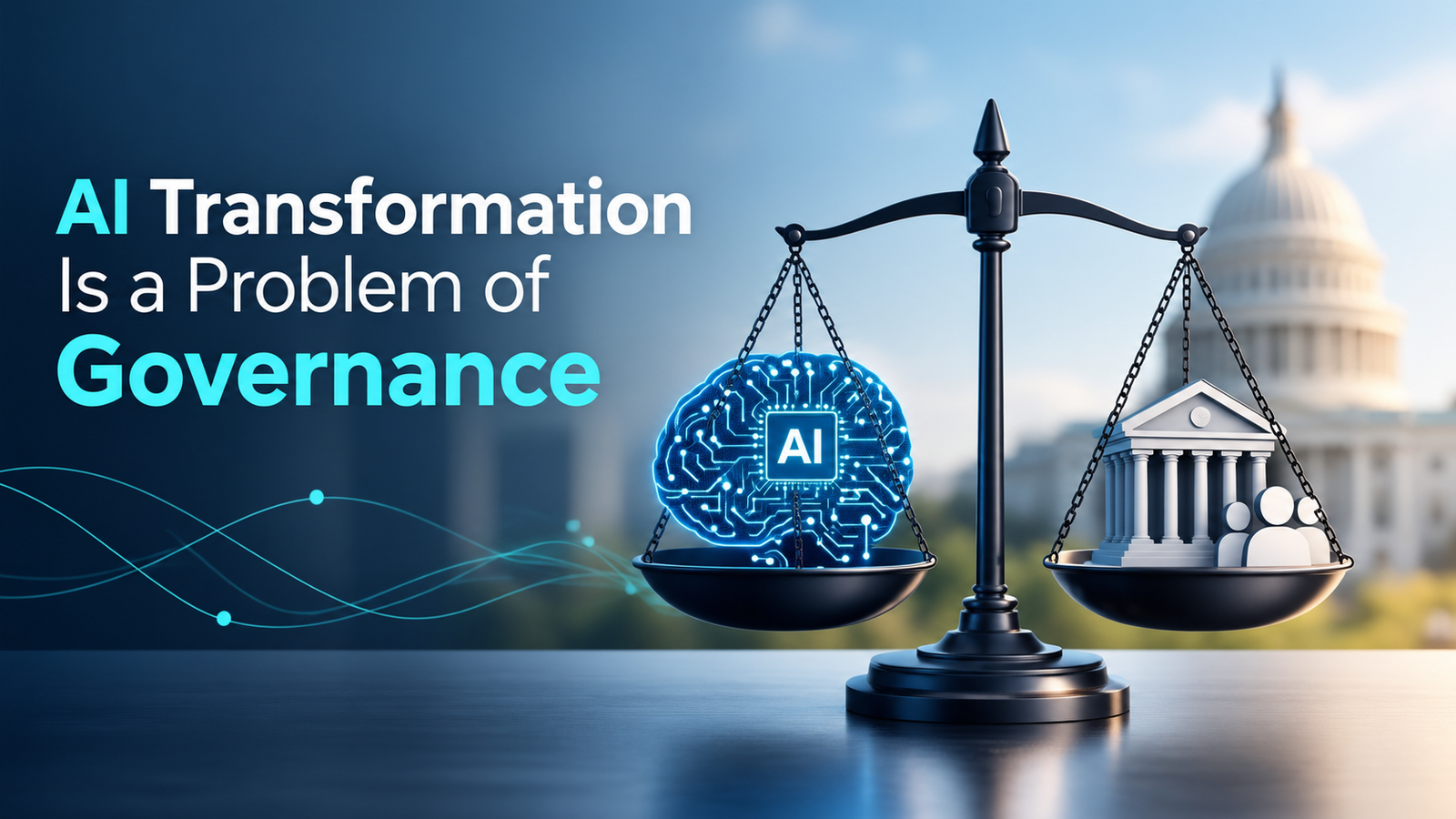
American businesses are moving from AI experiments to systems that can make decisions, handle customer information, write code, and take action. The challenge is no longer simply building better AI. It is deciding who controls it, who is accountable when it fails, and how companies can scale it without losing visibility.
The central argument
AI transformation is often treated as a technology project. In practice, it is also a management, risk, and accountability challenge. A company can have advanced models, skilled engineers, and a clear AI strategy, yet still struggle if employees use unapproved tools, automated systems access sensitive data, or nobody has the authority to stop an unsafe deployment.
For US companies, this challenge is becoming more visible as generative AI and autonomous agents enter everyday business operations. Employees are using AI to write reports, analyze financial information, support customers, develop software, and automate internal workflows. At the same time, executives must consider cybersecurity, privacy, discrimination, intellectual property, consumer protection, and the legal responsibilities that already apply to their businesses.
The governance question is straightforward: how can an organization move quickly with AI while keeping meaningful control over what the technology can do?
Research published in 2026 suggests that many organizations are still working through this problem. The findings do not mean AI transformation has failed. They show that deploying AI and governing it effectively are separate tasks, and progress on one does not guarantee progress on the other.
Why AI Transformation Has Become a Governance Problem
Traditional enterprise software usually follows defined permissions, workflows, and business rules. AI introduces a different operating model. A generative AI system can produce unexpected answers, while an AI agent may be able to use tools, retrieve information, write code, or initiate actions on behalf of an employee.
That flexibility creates value, but it also changes how companies must manage risk. A chatbot that drafts an internal email has a different risk profile from an agent that can issue refunds, modify customer records, approve transactions, or access production systems.
When AI is introduced into a business process, several questions arise at once:
- Who approved the system and its intended use?
- What company data can it access?
- Can it take actions without a person reviewing them?
- How are errors, bias, and security weaknesses detected?
- Who is responsible when the system causes financial or customer harm?
- Can the company disable the system quickly if something goes wrong?
These are not questions that a model upgrade can answer. They require decisions about authority, process, risk ownership, and oversight. That is why AI governance must be part of business transformation from the beginning, rather than a review performed after a tool has already been deployed.
What the Latest US Research Says About the Governance Gap
One of the clearest signals comes from EY’s September 15, 2026, US AI Risk and Governance Survey. It surveyed 202 senior AI decision-makers at publicly traded companies with at least $1 billion in annual revenue. The results show a gap between having formal policies and applying those policies consistently.
Reported having formal AI governance policies.
Said governance processes had been bypassed for urgent deployments.
Reported an AI incident or failure with a materially negative impact.
These figures reveal an important distinction. A written policy is evidence that a company has established rules. It does not prove that employees follow those rules under pressure, that technical controls enforce them, or that leadership receives a complete picture of AI activity.
The survey also found that 91% of respondents said their organizations were using agentic AI, through pilots or full deployments. Among organizations using agents, 49% said their existing governance framework had not been updated specifically for agentic AI risks. Another 26% said their organization could not detect unauthorized AI agents operating internally.
These results should be read in context. The survey covered senior decision-makers at large US public companies, not every American business. Still, it highlights a practical problem for enterprise leaders: AI activity can spread faster than the processes designed to monitor it.
Source: EY US, AI Risk and Governance Survey, September 15, 2026
A second signal: AI readiness is not just about technology
Deloitte’s August 2026 research examined how organizations are preparing for agentic AI. Among the leaders surveyed, only 5% said their business processes were highly prepared for AI agents, while 15% reported having scaled orchestrated, cross-functional multi-agent adoption.
The distinction matters because an agent rarely operates in isolation. It may depend on data from one department, permissions managed by another, and a workflow owned by a third. If these teams do not agree on responsibilities, an apparently simple automation project can create gaps in accountability.
Deloitte also reported that 74% of surveyed leaders expected nearly half of their business processes to be redesigned or rebuilt around AI agents within four years. This is a forecast based on executive expectations, not a confirmed outcome. It nevertheless points to the scale of organizational change leaders are considering.
Source: Deloitte US, August 12, 2026
The US AI Governance Landscape: What Companies Need to Understand
AI governance in the United States does not come down to one universal rulebook. Companies need to consider the laws and obligations that apply to their industry, customers, data, and use case. They must also understand the difference between voluntary guidance, company commitments, and enforceable legal requirements.
The National Institute of Standards and Technology (NIST) provides one of the most useful foundations for organizations building an AI risk management program. Its AI Risk Management Framework is intended for voluntary use and helps organizations incorporate trustworthiness into the design, development, use, and evaluation of AI systems.
NIST’s Generative AI Profile extends this approach to risks associated with generative systems. It provides guidance for identifying, evaluating, and managing risks across the AI lifecycle. NIST notes that the broader AI RMF is being revised, so organizations should check the current official materials rather than treating an older framework document as permanently final.
Explore the NIST AI Risk Management Framework
Important distinction
NIST’s AI RMF is voluntary guidance, not a single federal AI law. A company may use it to organize its risk program, but it must separately identify applicable legal, contractual, and industry requirements.
| Governance area | What US organizations should examine | Practical action |
|---|---|---|
| Risk management | Potential harm, reliability, security, and business impact | Maintain an AI system inventory and risk register |
| Privacy | Personal information, consent, retention, and access | Limit data access and review vendor terms |
| Consumer protection | Misleading claims, unfair outcomes, and customer harm | Test claims and outcomes before deployment |
| Sector obligations | Requirements applicable to financial, health, employment, or other regulated activities | Involve legal and compliance teams early |
| Accountability | Decision ownership, escalation, and oversight | Assign a named business owner to each system |
For many businesses, the Federal Trade Commission’s consumer protection role is also relevant. AI does not remove existing obligations concerning deceptive or unfair business practices. A company should not assume that a decision or marketing claim is acceptable simply because an AI system generated it.
In regulated sectors, organizations should map AI use to the rules that already govern their activities. For example, a financial institution using AI in lending needs to consider applicable fair lending and consumer protection requirements. A healthcare organization must examine privacy and other healthcare obligations that apply to its specific operations. The exact legal analysis depends on the use case and should involve qualified counsel.
The 2026 US AI Accord: Why Governance Still Needs Operational Controls
President Donald Trump announced a voluntary accord involving major AI companies. Public reporting described commitments around internal controls, risk reviews, external evaluation, and oversight. The announcement placed industry self-regulation at the center of the discussion about how advanced AI should be managed.
The announcement is relevant to businesses because it reflects a broader debate in the United States: how much AI oversight should come from companies themselves, and what role should government standards and enforceable rules play?
A voluntary industry commitment can encourage organizations to establish common practices. However, a public commitment is not the same as a detailed operational control. Businesses still need to determine which systems are covered, how assessments are conducted, who verifies the results, what happens when a control fails, and how decisions are documented.
As of the announcement, reporting described the accord as voluntary. Companies should not treat it as a substitute for applicable law, contractual duties, or their own risk controls.
Source: Associated Press, September 29, 2026
AI Agents Make Governance More Urgent
AI agents introduce a different level of operational risk because they can move beyond generating information. Depending on their configuration, they may call software tools, retrieve files, execute code, update records, or trigger workflows.
The key issue is not whether every agent is dangerous. It is whether the permissions granted to an agent match the task it is supposed to perform, and whether the organization can observe and interrupt its activity.
A practical model for AI autonomy
Level 1
Drafts and suggestions. A person reviews the output.
Level 2
Prepares actions, but approval is required before execution.
Level 3
Executes approved tasks within defined limits and monitoring.
This is an illustrative governance model, not an official NIST classification.
For example, an AI assistant that drafts a customer response may need access to a limited set of support documents. An agent that can issue refunds needs stricter permissions, transaction limits, logging, and escalation rules. An agent that can modify production code requires testing, review, and controls over deployment.
Companies should avoid granting broad access simply because it makes an early demonstration easier. Permissions should be tied to the job, not to the maximum capabilities of the model.
The Main Governance Risks for American Businesses
Security and unauthorized access
AI systems can create new paths into company information and software. Risks include prompt injection, unsafe tool use, exposed credentials, insecure integrations, and agents with excessive permissions. Some risks come from the model itself; others come from the applications and infrastructure surrounding it.
Organizations should treat AI systems as part of their security environment. That means identity controls, least-privilege access, logging, vulnerability management, incident response, and testing of the complete application rather than only the model’s answers.
Privacy and sensitive information
Employees may paste customer records, financial information, source code, contracts, or internal strategy into AI tools. Depending on the service and configuration, this information may be processed or retained by a third party.
Governance should define which data can be used, which tools are approved, how information is retained, and whether vendors can use submitted data for model improvement. Companies should also evaluate access controls, deletion terms, data processing agreements, and the location of data processing where relevant.
Accuracy and fabricated information
Generative AI can produce confident answers that are incomplete or wrong. In low-risk tasks, a human correction may be enough. In legal, financial, medical, or safety-related workflows, an incorrect answer can affect real people and create significant business exposure.
Organizations need task-specific evaluation, clear limits on use, and human review where the consequences justify it. A generic statement that employees should “check AI output” is not a complete control unless the company defines what must be checked and by whom.
Bias and unfair outcomes
AI systems used in hiring, lending, insurance, pricing, or customer eligibility can influence access to important opportunities and services. Historical data may contain patterns that lead to unfair results, while seemingly neutral variables can sometimes act as proxies for protected characteristics.
Testing should examine outcomes across relevant groups, document limitations, and provide a route for people to challenge consequential decisions. The appropriate tests and legal obligations depend on the system and the decision being made.
Vendor and model dependency
Many US businesses rely on external model providers, cloud platforms, data vendors, and AI application developers. A provider can change a model, its terms, or its capabilities. An AI feature may also depend on several suppliers at once.
Vendor review should cover security, privacy, data use, service availability, model updates, audit evidence, incident notification, and exit options. Companies should know what happens if a provider changes its service or the business needs to move to another model.
Governance Must Change by Industry
A single company-wide AI policy can establish shared principles, but it cannot address every operational risk. A customer service assistant, an insurance underwriting model, and an AI system that supports financial trading should not receive identical controls.
| Industry | Example AI use | Governance priority |
|---|---|---|
| Banking and FinTech | Fraud detection, customer support, credit analysis | Data protection, explainability, fair outcomes, oversight |
| Healthcare | Clinical documentation, patient communication, decision support | Patient privacy, clinical validation, human responsibility |
| Insurance | Claims review, underwriting support, fraud detection | Fairness, traceability, accuracy, appeal processes |
| Retail and e-commerce | Personalization, inventory planning, service agents | Customer data, misleading outputs, pricing and service controls |
| Software and technology | Code generation, testing, IT operations | Code security, permissions, review, production access |
| Human resources | Resume screening, job descriptions, workforce analytics | Discrimination risk, transparency, human review |
These examples are not legal conclusions. They show why governance should begin with the business decision being supported, the people affected, and the consequences of an error.
A Practical AI Governance Model for Companies
Organizations do not need to build a large bureaucracy before they can govern AI. They need a clear operating model that connects business ownership, technical controls, legal review, and ongoing monitoring.
Step 1: Create a complete AI inventory
Start by identifying AI systems used across the organization, including tools purchased by departments, AI features embedded in existing software, internal models, and agents built by employees. Record the business owner, vendor, purpose, data access, users, and level of autonomy.
Step 2: Classify systems by risk
Assess what could happen if a system produces a wrong answer, exposes information, makes an unfair recommendation, or takes an unauthorized action. Consider the sensitivity of the data, the number of people affected, the reversibility of decisions, and the level of human involvement.
Step 3: Assign a real business owner
Every material AI system should have a named owner who is accountable for its purpose, performance, and continued use. Technical teams can maintain the system, but business leaders must own the consequences of using it.
Step 4: Set permissions and approval limits
Define what the system can read, write, change, approve, or send. Use restricted permissions by default. Require human approval for high-impact or difficult-to-reverse actions until the organization has evidence that a more autonomous approach is appropriate.
Step 5: Test before deployment
Evaluate the system using realistic tasks and failure scenarios. Test accuracy, privacy, security, bias where relevant, and resistance to misuse. Document known limitations and define the conditions under which the system should not be used.
Step 6: Monitor after launch
AI performance can change as models, data, users, and business processes change. Track incidents, user complaints, unusual activity, cost, output quality, and changes in the underlying service. Reassess the system when its purpose or permissions change.
Step 7: Prepare to pause or shut down
A governance program needs a practical way to stop an AI system. Define who can suspend it, how access is revoked, how affected users are informed, and how the business process continues while the issue is investigated.
A 90-Day Roadmap to Improve AI Governance
A focused 90-day program can help an organization move from informal AI use to a more structured operating model. The timeline below is a suggested implementation plan, not a guarantee that every company can complete the work in three months.
DAYS 1–30
Discover and assign ownership
- Build an inventory of known AI tools and systems.
- Identify high-impact and sensitive use cases.
- Assign business, technical, security, and compliance owners.
- Publish interim rules for sensitive data and unapproved tools.
DAYS 31–60
Assess and establish controls
- Classify systems by risk and business impact.
- Review vendor contracts, permissions, and data handling.
- Define testing and approval requirements.
- Create incident escalation and shutdown procedures.
DAYS 61–90
Test, monitor, and improve
- Test priority systems against realistic failure scenarios.
- Launch monitoring and reporting for material AI systems.
- Train employees on approved tools and safe use.
- Review results with leadership and set the next-quarter plan.
How to Measure Whether AI Governance Is Working
Companies should measure governance through operational evidence, not just policy documents or training completion. A dashboard should help leadership understand where AI is being used, which risks remain open, and whether controls work in practice.
| Metric | What it reveals | Example reporting approach |
|---|---|---|
| Inventory coverage | Whether the organization knows what AI is in use | Share of discovered systems registered |
| Risk review coverage | Whether material systems receive appropriate assessment | Share of high-risk systems reviewed |
| Access exceptions | Whether permissions exceed approved needs | Open exceptions and time to close |
| Incident response | Whether problems are detected and contained | Time to detect, contain, and resolve |
| Output quality | Whether the system remains fit for its task | Error rates and task-specific evaluations |
Targets should reflect the organization’s risk profile. A low-risk drafting assistant and an AI system involved in consequential financial decisions should not be judged by the same thresholds.
What AI Governance Could Look Like by 2030
Forecasts about AI regulation and adoption remain uncertain. However, current research and enterprise developments point to several areas that US organizations should prepare for.
Governance may become part of the AI product itself
Businesses are likely to demand clearer permission settings, audit trails, evaluation tools, and controls from AI vendors. These features make it easier to understand what a system did and why it was allowed to do it. They may also become important factors in enterprise purchasing decisions.
AI inventories may become continuous
As employees use AI features across cloud software, development tools, and business applications, periodic spreadsheets may not provide enough visibility. Organizations may move toward automated discovery and monitoring, especially for systems that can access sensitive data or take actions.
Agent permissions may become more granular
Companies will have to decide not only which employees can use AI, but also what each agent can do, on whose behalf, and under which conditions. Temporary permissions, transaction limits, approval gates, and automatic revocation may become standard controls for sensitive workflows.
Evidence may matter as much as policy
As customers, business partners, auditors, and regulators ask more detailed questions, organizations will need evidence that controls operate as intended. A policy may describe the expected process, but test results, logs, incident records, and documented approvals show how that process works in practice.
Governance may influence the economics of AI
AI investments are often measured through productivity, revenue, or cost savings. A fuller business case should also include the cost of monitoring, security, evaluation, human review, and incident response. These costs are not simply overhead. They help determine whether a system can be used reliably at scale.
A practical prediction
By 2030, mature AI programs are likely to treat governance as an ongoing operating capability rather than a one-time approval. The exact pace will vary by industry, company size, regulation, and the capabilities of AI systems. The direction is already visible in the shift toward agents, enterprise controls, and lifecycle risk management.
Expert Recommendations for Business Leaders
NIST’s risk management approach offers a useful starting point: govern the organization’s approach, understand the context and risks, measure them, and manage them throughout the system lifecycle. Its framework is designed to support risk management rather than replace business judgment or applicable law.
For US executives, that translates into several practical priorities:
- Make governance a leadership responsibility. Give a senior owner the authority to resolve conflicts between speed, risk, and business goals.
- Start with the business process. Define the decision or task before selecting the model or agent.
- Match controls to risk. Apply stronger testing, review, and access restrictions where errors could cause greater harm.
- Keep humans accountable. Automation can perform tasks, but the organization must retain clear responsibility for consequential outcomes.
- Build security and privacy into design. Avoid treating them as checks that happen only before launch.
- Measure real performance. Use incidents, test results, access logs, and business outcomes to improve the program.
- Review vendors continuously. Reassess important changes to models, tools, data handling, and service terms.
The goal is not to slow every AI project. It is to make the safe path clear enough that teams can move quickly without bypassing essential controls.
Frequently Asked Questions
What does AI governance mean for US businesses?
AI governance is the set of policies, responsibilities, technical controls, and review processes a business uses to manage AI. It covers how systems are selected, tested, deployed, monitored, and retired, as well as who is accountable for their effects.
Is the NIST AI Risk Management Framework mandatory?
NIST describes the AI RMF as intended for voluntary use. It can help organizations structure AI risk management, but it is not a single law that replaces applicable federal, state, sector-specific, or contractual requirements.
Why is AI governance important for AI agents?
AI agents may be able to use tools and take actions, not just generate text. Organizations need to control their permissions, monitor their activity, test their behavior, and define when human approval is required.
Who should be responsible for AI governance?
Responsibility should be shared across business leadership, IT, security, legal, compliance, data teams, and the owners of individual AI systems. A named executive or governance group should coordinate the program, while business owners remain accountable for their use cases.
Can small US businesses use the same governance approach as large enterprises?
Small businesses can use the same basic principles, but the process should match their size and risk. A small company may need a simple inventory, approved-tool list, data rules, vendor checks, and human review rather than a large governance committee.
How often should AI systems be reviewed?
Review frequency should depend on risk and how quickly the system changes. Material updates, new data access, expanded permissions, incidents, or a change in business purpose should trigger reassessment. Higher-risk systems may also need scheduled reviews and ongoing monitoring.
Conclusion: AI Transformation Needs Clear Accountability
For American businesses, AI transformation is becoming a test of how well organizations manage change. The technology can help teams work faster, improve analysis, support customers, and automate complex tasks. But those benefits depend on more than model performance.
EY’s 2026 findings show why the distinction matters: formal governance policies can exist while teams still bypass processes, agents operate without adequate visibility, and AI incidents create material harm. Deloitte’s research points to another challenge: organizations may expect substantial process redesign while relatively few say their operations are highly prepared for agents.
The practical response is to make governance part of the operating model. Know which systems are in use. Assign clear owners. Limit access. Test for realistic failures. Monitor performance. Keep a human accountable for consequential decisions. And make sure the organization can intervene when a system behaves outside its approved limits.
AI transformation is not complete when a company deploys a model. It is complete when the company can use that model responsibly, reliably, and with clear accountability.
Sources and Further Reading
- EY, AI Risk and Governance Survey: Autonomous AI Implementation and the Governance Gap, September 15, 2026.
- Deloitte, AI Agents are Only the Beginning: AI Readiness and Agentic AI Success, August 12, 2026.
- National Institute of Standards and Technology, Artificial Intelligence Risk Management Framework.
- NIST, Artificial Intelligence Risk Management Framework: Generative Artificial Intelligence Profile.
- Associated Press, Reporting on the US voluntary AI accord announced September 29, 2026.
- NIST, AI Research: Security and Resilience.
Disclaimer
This article is for informational and educational purposes only. It is not legal, regulatory, cybersecurity, or financial advice. AI laws and regulatory requirements can change and may vary by state, industry, business activity, and the type of data involved. Organizations should consult qualified legal, compliance, privacy, and security professionals to assess their specific obligations. Survey findings reflect the populations and methods described by the original publishers. Future-looking statements are scenarios or expectations, not guaranteed outcomes.

Leave a Reply