
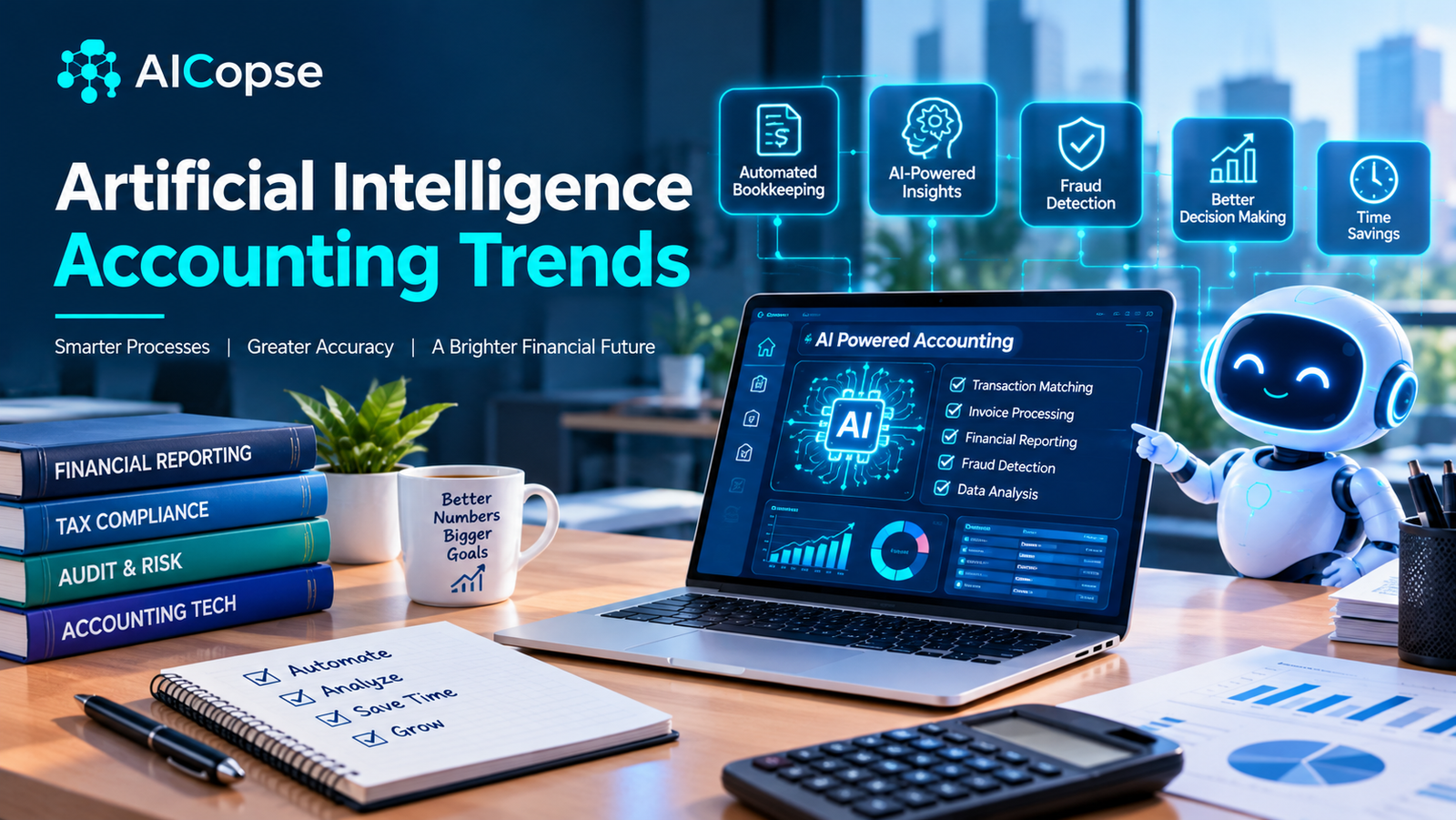
AICOPSE Research Report | Accounting and Finance
Artificial Intelligence in Accounting: Trends and Future Predictions for 2027–2030
How AI is changing bookkeeping, financial reporting, tax preparation, auditing, fraud detection, and accounting careers, with evidence-based predictions for the next four years.
2027 Trends
2030 Predictions
Research-backed analysis
Artificial intelligence is changing accounting from a process built around manual data entry and periodic reports into a more connected system for recording transactions, checking financial information, identifying risks, and supporting business decisions. Accountants are already using AI to summarize documents, review transactions, prepare explanations, extract invoice information, and investigate unusual financial activity.
But the future of AI in accounting is not simply about doing the same work faster. The larger change is how accounting information is collected, checked, explained, and used. A system that can prepare a journal entry in seconds may also create a serious problem if the transaction is wrong, the supporting evidence is missing, or nobody reviews the result.
Research published in 2026 offers early evidence of productivity and reporting improvements, while professional bodies are issuing guidance on AI risks in financial reporting and audits. At the same time, AI-assisted invoice fraud and executive impersonation show why accounting teams need stronger payment controls.
This report examines the evidence available as of 2026, and separates current findings from forward-looking predictions. Its primary business context is the United States, with lessons applicable to accounting firms, startups, corporate finance departments, software developers, and organizations operating internationally.
Key finding
The strongest near-term opportunity is not fully autonomous accounting. It is combining AI speed with reliable financial data, documented evidence, clear approval rules, and accountable human review.
Key Findings at a Glance
74%
Report faster tasks
Accounting professionals surveyed in an ICAS research project said GenAI speeds up their tasks.
Source: ICAS research
72%
Worry about errors
The same ICAS research found concern about incorrect AI outputs and decisions.
Source: ICAS research
200,000+
Transactions analyzed
A 2026 field study analyzed transaction-level data from AI-enabled accounting software used by 79 small and medium-sized businesses.
Source: Journal of Accounting Research
1 million+
Fraud emails observed
Microsoft reported an AI-assisted impersonation campaign involving more than one million financial fraud emails in August 2026.
Source: Microsoft Security
Important: These figures come from different studies and measure different things. They should not be treated as one representative global survey or as proof that every accounting team will achieve the same results.
Table of Contents
- What AI in accounting means
- Where accounting teams use AI today
- 2026 Research: six major studies and reports
- Competitive and technology landscape
- Major Events and Incidents
- Risks, controls, and governance
- 2027 Trends
- 2030 Predictions
- Impact on industries and business sizes
- Guidance for developers and startups
- Practical implementation roadmap
- How to measure results
- Expert recommendations
- Frequently asked questions
- Research sources
What Artificial Intelligence in Accounting Really Means
Artificial intelligence in accounting refers to software that uses machine learning, language models, document recognition, statistical methods, and related techniques to assist with financial tasks. Some tools recognize patterns in transaction data. Others read invoices, answer questions about financial records, or draft explanations for managers.
These capabilities are not all the same. Traditional automation follows fixed rules. Machine learning detects patterns from data. Generative AI creates or summarizes content. AI agents can take a series of steps toward a goal, such as collecting supporting documents and preparing a proposed reconciliation. Each type needs different controls.
Traditional automation
Follows predefined rules, such as matching an invoice number to a purchase order or moving approved data between systems.
Predictive AI
Uses patterns to estimate cash flow, forecast revenue, detect unusual transactions, or identify potential payment risks.
Generative AI
Reads and summarizes documents, drafts reports, explains variances, and helps staff query financial information in natural language.
AI agents
Can plan and execute multiple connected steps, subject to their permissions, tools, instructions, and approval limits.
The most reliable systems combine these approaches. For example, AI can extract the details from an invoice, a rules engine can check required fields and purchase-order limits, and an authorized employee can approve the payment. The system becomes more useful because each part has a defined job.
AI does not change the underlying need for accurate records, appropriate accounting treatment, evidence, and professional judgment. It can help prepare financial information, but an AI-generated explanation is not automatically proof that a transaction is valid.
Where Accounting Teams Are Using AI Today
| Accounting function | AI application | Expected benefit | Required control |
|---|---|---|---|
| Bookkeeping | Suggests transaction categories and draft journal entries | Less manual coding | Account mapping and exception review |
| Accounts payable | Reads invoices and compares them with purchase orders | Faster invoice processing | Vendor validation and payment approval |
| Accounts receivable | Matches remittances and flags overdue accounts | Improved collections workflow | Reconciliation and dispute handling |
| Month-end close | Finds missing entries and drafts variance explanations | Shorter close cycles | Sign-offs and audit trails |
| Audit | Analyzes large transaction populations for unusual patterns | Better risk targeting | Evidence quality and independent testing |
| Tax preparation | Extracts documents and organizes tax research | Less repetitive preparation | Verify current law and source documents |
| Management accounting | Explains variances and creates forecast scenarios | Faster decision support | Assumption checks and scenario review |
| Fraud prevention | Flags duplicate invoices and suspicious payment patterns | Earlier investigation | Human investigation and verified approvals |
These are practical use cases, not a guarantee that every accounting platform provides all of them or that every AI feature performs accurately in every environment. Results depend on data quality, system integration, workflow design, and the strength of controls.
2026 Research: What the Evidence Tells Us
The most useful way to assess AI in accounting is to compare academic field evidence, professional surveys, regulator guidance, and security research. Surveys reveal what practitioners report. Field studies show how tools behave in real workflows. Guidance identifies professional obligations. Security reports help explain where attackers may exploit the same technology.
Research evidence map
6+
Major studies and professional reports reviewed
277
Accountants in a 2026 academic survey
79
Small and medium-sized businesses in field data
1,446
Finance and accounting leaders in a 2025 survey
Human + AI in Accounting: Early Evidence from the Field, 2026
A study by Jung Ho Choi and Chloe L. Xie, published in the Journal of Accounting Research in June 2026, provides particularly relevant evidence because it examines both professional accountants and real accounting transactions. The researchers surveyed 277 professional accountants and analyzed more than 200,000 transaction-level records from an AI-enabled accounting platform serving 79 small and medium-sized enterprises.
The researchers found that AI adoption was associated with productivity gains and a shift away from routine data entry toward communication and quality assurance. They also reported improvements associated with more detailed ledgers and faster month-end closing. This matters because accounting value is not limited to recording transactions. A more detailed ledger can make it easier to trace why a number changed, while a shorter close may give managers more time to act on financial results.
The study also examined human interaction with AI. Accountants appeared more likely to intervene when confidence scores were low. In a framed experiment, AI assistance improved classification accuracy on average, but following AI recommendations that differed from the consensus could increase the risk of error.
What this means for accounting teams
Use AI to prepare and classify work, but design an exception process that sends uncertain, unusual, or high-value transactions to a qualified reviewer. Do not assume that a confidence score alone proves an entry is correct.
Limitations: The findings are early evidence, not a universal promise of a particular percentage improvement. The field data came from a specific platform and a limited group of businesses. Association between AI use and better outcomes does not establish that every implementation will produce the same result.
Source: Journal of Accounting Research, Human + AI in Accounting: Early Evidence from the Field
ICAS Research on AI and Professional Judgment, 2026
The Institute of Chartered Accountants of Scotland reported findings from a year-long research project that included surveys of more than 200 accounting professionals, 50 in-depth interviews, skills-development activities, and four case studies. Its findings highlight the difference between making individual tasks faster and improving the whole accounting process.
74%
Said AI speeds up tasks
22%
Reported a substantial increase in overall work rate
72%
Worried about errors or incorrect decisions
52%
Raised client data privacy concerns
The results suggest that AI can speed up document extraction, document analysis, and information cross-checking. However, the relatively small share reporting a substantial increase in overall work rate signals a process problem: saving time on one task does not automatically remove delays elsewhere. Staff may still need to correct errors, wait for approvals, request missing documents, or transfer data between disconnected systems.
ICAS also reported that 53% of respondents used GenAI to write emails or edit text, 46% used it to summarize meetings or documents, and 33% used it to support spreadsheet or other software tasks. These are useful examples of early adoption because they assist existing professional work without necessarily giving AI the authority to post transactions or approve payments.
Implication: Measure the full workflow, not only the time spent on a single task. Include review, correction, exception handling, and approval time when calculating savings.
Source: ICAS, AI can’t replace human judgement in accounting
AICPA and CPA.com AI in Accounting Report, 2025
The AICPA and CPA.com published a major AI in Accounting report in June 2025, examining the changing role of AI in accounting firms. The report discusses workflow automation, AI assistants, emerging agentic capabilities, and the shift toward advisory services. It provides useful context for interpreting the faster developments reported in 2026.
The important takeaway is that firms need to move beyond isolated experiments. A chatbot that drafts emails may be helpful, but an accounting practice gains more strategic value when AI is connected to documented workflows, staff training, approved systems, and a clear process for checking outputs.
The report is also relevant to firm owners deciding how to compete. If AI reduces repetitive work, the resulting time can be used for forecasting, business performance reviews, tax planning support, and conversations with clients. These services still require qualified judgment and cannot be delivered responsibly from unverified AI-generated answers alone.
What businesses should take from it:
- Start with defined accounting problems instead of buying AI simply because competitors are discussing it.
- Train staff to check AI outputs and understand where the tool can fail.
- Evaluate how AI changes service quality and client value, not just staff hours.
- Keep financial records, approvals, and source evidence accessible for review.
Source: CPA.com, 2025 AI in Accounting Report
AICPA Guidance for Financial Statement Auditors, October 2026
On October 13, 2026, the AICPA announced a new practice aid covering two situations: businesses that use AI in financial reporting or internal controls, and auditors who use AI tools during an audit. This is an important development because AI-generated financial information can affect audit planning, risk assessment, evidence evaluation, and the controls used to prepare accounts.
The guidance highlights data quality, accuracy, completeness, relevance, model risk, hallucinations, explainability, bias, staff competence, and supervision. It also reinforces that audit teams remain responsible for their work and audit conclusions when they use AI technology.
Why this matters in 2027
Auditors will increasingly need to understand not only the financial figures produced by a business, but also whether AI-supported processes affect the reliability of those figures and the controls around them.
The practice aid is described as guidance, not a replacement for applicable professional standards. Accounting firms should consult the complete material and relevant requirements rather than treating a short summary as a complete compliance checklist.
Source: AICPA, AI Considerations for Financial Statement Auditors, October 2026
IRS Guidance on Responsible AI Use in Federal Tax Practice, June 2026
On June 24, 2026, the IRS Office of Professional Responsibility issued introductory guidelines explaining how existing professional obligations apply when tax practitioners use AI. The message is practical: using AI does not remove a tax professional’s responsibility for the work.
For tax preparation, AI can help organize records, summarize tax documents, extract figures, and support research. However, a practitioner still needs to confirm the applicable law, verify the underlying records, protect confidential client information, and review the final work. A plausible answer from a language model is not enough to establish that a tax position is correct.
This guidance is especially relevant to smaller firms that may use general-purpose AI assistants before implementing specialized tax software. Client documents can contain Social Security numbers, payroll details, bank information, and other confidential data. Staff should only use approved tools and should understand how the provider handles submitted information.
Practical takeaway: Tax research should be checked against authoritative sources and current requirements. AI can help locate or explain information, but it should not be treated as the final legal or tax authority.
AICPA and CIMA Future-Ready Finance Survey, 2025
The AICPA and CIMA Future-Ready Finance survey collected responses from 1,446 senior finance and accounting leaders and managers during August and September 2025. Its findings show that technology adoption is as much a people and organizational challenge as a software challenge.
| Survey finding | Reported result | Business meaning |
|---|---|---|
| GenAI identified as a major skills gap | 56% | Training is a core implementation need |
| Lack of human capital, skills, and talent as an adoption barrier | 50% | Technology alone will not solve capability gaps |
| Safety and security concerns | 47% | Controls must be designed before broad access |
| Technology maturity concerns | 42% | Pilot projects need measurable acceptance criteria |
| On-the-job training seen as effective upskilling | 61% | Training should use real, controlled workflows |
The survey suggests that the strongest accounting AI programs will combine technical implementation with practical training, security reviews, and changes to the way teams work. A firm can purchase an advanced model and still struggle if employees do not understand its limits or if its systems cannot exchange reliable data.
Source: AICPA and CIMA, Future-Ready Finance: Technology, Productivity, and Skills Survey
Journal Research on AI Adoption in Accounting Firms, 2026
A 2026 article in the Journal of Accounting and Public Policy compares AI adoption in accounting firms with adoption in the accounting functions of other businesses. It highlights how technology, organizational conditions, external pressures, and individual factors can shape adoption differently across these environments.
This distinction matters. A public accounting firm may need to manage client confidentiality, engagement quality, professional standards, and work across many clients. An internal accounting department may be more focused on its own enterprise systems, reporting calendar, internal controls, and data access rules. Both can use AI, but their implementation requirements are not identical.
The research also points to the importance of AI literacy, supervision, and appropriate audit standards. It supports a more careful approach than assuming a tool that works in one accounting environment can be copied unchanged into another.
Supporting Study: AI-Assisted Learning in Accounting Education, 2025
A study published in the Journal of Accounting Education examined 312 students in an accounting data analytics course. It explored how students used ChatGPT to seek help and how their experience with the tool related to academic performance. The findings suggest that familiarity and skill in using AI were important factors, rather than simply having access to a more advanced model or using AI more frequently.
Although student learning is not the same as professional accounting work, this research has implications for the accounting workforce. A new employee who knows how to ask precise questions, verify calculations, and challenge an AI answer may gain more value than someone who simply copies model output. Training should teach reasoning, verification, and responsible use, not just prompt writing.
Competitive and Technology Landscape: Who Is Shaping AI Accounting?
The accounting AI market is not one product category. It includes established accounting platforms, specialist automation providers, audit and tax software, data analytics tools, and general-purpose AI models. Buyers should compare products by workflow fit and control quality rather than by AI branding alone.
| Technology segment | Examples | Typical role | What buyers should check |
|---|---|---|---|
| Accounting and enterprise platforms | Intuit QuickBooks, Xero, Sage, Oracle NetSuite, Microsoft Dynamics 365 | Books, invoices, reconciliations, reporting, workflow automation | Feature availability, permissions, audit trails, integration and export options |
| Tax and professional research | Thomson Reuters, Wolters Kluwer, Bloomberg Tax | Tax research, document analysis, professional workflows | Source currency, jurisdiction coverage, citations and review process |
| Audit and assurance technology | Audit analytics and evidence-management platforms | Risk analysis, transaction testing, evidence organization | Evidence reliability, repeatability, documentation and professional standards |
| Document and workflow automation | Invoice extraction, accounts payable automation, reconciliation tools | Capture and process invoices, receipts and supporting documents | Field-level accuracy, exception rates, duplicate detection and human review |
| General-purpose AI | ChatGPT, Claude, Gemini and other language models | Drafting, summarization, explanation, analysis and coding assistance | Data protection, factual verification, access control and integration limits |
This is a category-level market map, not a ranking of product quality or a claim that every named product offers the same features. Product functions, plans, regional availability, and integrations change frequently. Buyers should confirm current functionality directly with vendors and test it using their own controlled data.
How the competition is changing
Established software companies already own important assets: accounting records, customer relationships, payroll data, tax workflows, and system integrations. Their competitive advantage is not only the AI model. It is the ability to put AI into the place where financial work already happens.
New companies can still compete by solving narrower problems more effectively. A startup that reliably reconciles a specific class of transactions, identifies duplicate supplier invoices, or produces a well-documented audit evidence package may offer more practical value than a broad chatbot that cannot safely take action.
For accounting firms, the competitive question is shifting from “Do we use AI?” to “Which services can we deliver more accurately, quickly, and transparently because of AI?” Firms that turn saved time into better advisory work may gain an advantage, while firms that automate without improving review processes may create additional risk.
For related coverage, see AICOPSE’s future of artificial intelligence and AI agents for business.
Major Events and Incidents Shaping AI in Accounting
AI-related accounting risks are not limited to inaccurate answers from chatbots. The technology can also increase the scale and credibility of payment scams, affect the reliability of financial reporting, and create new questions about responsibility when software takes action. The events below illustrate why AI adoption and governance must develop together.
AI-assisted executive impersonation and invoice fraud, 2026
On September 10, 2026, Microsoft described a financial fraud campaign detected between August 3 and August 5 that involved more than one million emails. The messages impersonated company executives and a technology vendor, included fabricated invoice material and fake email conversations, and attempted to persuade accounts payable teams to make automated clearing house payments of nearly $50,000.
Microsoft reported that 87.7% of the campaign’s emails were sent to users in the United States. The messages combined executive impersonation, vendor branding, fabricated invoice details, and convincing narrative context. The investigation found indicators consistent with AI-assisted template creation, but those indicators did not independently establish the full extent of generative AI involvement.
Accounting lesson
Never approve a new bank account or unusual payment solely because an email appears to come from a senior executive. Verify the request through a known, independent channel and require the normal approval process.
The incident demonstrates that payment controls must verify the transaction, not just the appearance of the supporting documents. AI can help a scammer write polished messages and assemble plausible paperwork, but independent verification, separation of duties, and payment limits can interrupt the attack.
The growing concern about AI-enabled fraud, 2026
A survey reported by The Institute of Internal Auditors and AuditBoard in 2026 examined internal audit leaders’ awareness of AI-enabled fraud. It identified AI-powered phishing as a major concern, alongside fabricated invoices and financial documents, automated social engineering, and deepfake audio or video impersonation.
88%
Identified AI-powered phishing as a top concern
65%
Identified fabricated invoices or financial documents as a concern
58%
Identified automated social engineering as a concern
45%
Identified deepfake audio or video impersonation as a concern
These percentages describe concerns among the surveyed audit leaders. They are not the percentage of all businesses that experienced each type of fraud. Nevertheless, they help explain why accounting teams need to treat identity, payment authorization, and document authenticity as connected risks.
Source: The IIA and AuditBoard, 2026 survey on AI-enabled fraud
New AICPA audit guidance, October 2026
The AICPA’s October 2026 practice aid is a major professional development because it addresses both AI used by the company being audited and AI used by the audit team. It directs attention to data reliability, model risk, internal controls, staff capability, supervision, and the quality of audit evidence.
The key change is practical rather than a claim that a new technology replaces existing professional responsibilities. Auditors must understand how AI affects financial information and how the audit team uses AI when performing its work. Organizations should be ready to explain which processes use AI, what controls apply, and how errors are detected and corrected.
Source: AICPA, October 2026 AI audit guidance
IRS guidance on AI in tax practice, June 2026
The IRS Office of Professional Responsibility clarified how existing professional standards apply to AI use by tax practitioners. This is important for firms using AI to prepare tax documents, summarize source material, or support tax research. A generated answer does not remove the obligation to verify the underlying facts, protect confidential information, and exercise professional judgment.
Source: IRS, responsible AI use in federal tax practice
AI agents move from experimentation toward controlled workflows
AI agents are receiving greater attention because they can use tools, retrieve information, and carry out sequences of actions. In accounting, that might mean gathering invoices, checking whether supporting documents are present, preparing a reconciliation, and sending an exception to a reviewer.
The same capability introduces a new risk: an agent may take a series of individually plausible steps that lead to an incorrect financial result. A system with access to vendor records, email, and payment tools needs stronger restrictions than a system that only drafts text.
Organizations should therefore limit agent permissions, separate preparation from approval, log actions, and require human authorization for material financial decisions. Agentic AI should be introduced as a controlled workflow, not as an unrestricted digital employee.
For a broader view of business applications and risks, see AICOPSE’s guide to AI agents for business and analysis of AI transformation and governance.
Risks, Controls, and Governance for Accounting AI
Accounting depends on trustworthy numbers and a clear record of how those numbers were produced. AI creates new ways to process information, but it can also introduce errors that are difficult to spot if a system produces confident explanations without reliable evidence.
| Risk | Example | Recommended safeguard |
|---|---|---|
| Incorrect output | AI assigns a transaction to the wrong account | Validate against rules, source records, and exception thresholds |
| Invented explanation or citation | AI creates an unsupported tax or accounting reference | Check authoritative sources and preserve evidence |
| Confidentiality breach | Staff upload client payroll or tax data to an unapproved service | Approved tools, access controls, data minimization, and vendor review |
| Fraud and impersonation | A fake executive email requests an urgent transfer | Independent verification and separation of duties |
| Automation overreach | An agent changes a vendor record without authorization | Least-privilege access, approval gates, and action logs |
| Biased or inconsistent results | A model treats similar transactions differently | Test representative cases and monitor errors by category |
| Vendor dependence | A model or API changes and alters outputs | Version monitoring, regression tests, fallback procedures, and export access |
A practical governance framework
Businesses should assign clear ownership for AI systems used in accounting. The finance leader may own the process, IT may manage integrations and security, and legal, compliance, or audit teams may review specific risks. Smaller firms can use a simpler structure, but responsibility should still be explicit.
- Inventory AI use: Record which tools process financial information, who uses them, and what decisions they support.
- Classify the risk: Drafting an internal summary is not the same as changing bank details or posting a material journal entry.
- Control access: Limit access to the data and systems each tool actually needs.
- Keep evidence: Store the source documents, material AI outputs, approvals, and changes needed to reproduce the result.
- Test before release: Use representative transactions, known edge cases, and deliberate error scenarios.
- Monitor continuously: Track accuracy, exceptions, overrides, unauthorized actions, and changes in model behavior.
- Train staff: Explain privacy rules, hallucination risks, fraud tactics, and when to stop an automated process.
- Prepare for failure: Maintain a way to pause the system and return to a verified manual or conventional workflow.
Organizations can use the NIST AI Risk Management Framework as a starting point for structured risk management. Its value is not that it automatically certifies an accounting system as safe, but that it provides a common way to identify, assess, manage, and monitor AI-related risks.
Source: NIST AI Risk Management Framework
2027 Trends: What Accounting Teams Should Prepare For
The trends below are forward-looking assessments based on the 2025–2026 research and professional guidance discussed in this report. They are not guaranteed outcomes. Adoption speed will depend on software maturity, data quality, regulation, cost, and the risk tolerance of each organization.
AI-assisted month-end close
Systems will increasingly prepare reconciliations, highlight missing entries, summarize changes, and organize review tasks. Human sign-off will remain important for material judgments.
More detailed exception handling
Instead of automating every transaction equally, accounting systems will route uncertain, unusual, or high-value cases to people who can investigate them.
AI-supported audit planning
Auditors will use AI to organize evidence, analyze transactions, summarize risk indicators, and focus attention on unusual patterns.
Controlled accounting agents
Agents will connect document collection, validation, reconciliation, and task routing, but material transactions will require strict permissions and approvals.
Stronger AI governance
Firms will document approved tools, access rules, model limitations, review requirements, and responsibility for AI-assisted work.
Fraud detection and payment verification
AI will help detect suspicious patterns, while businesses strengthen independent verification for vendor changes and unusual payments.
AI will become more useful inside existing accounting software
In 2027, many businesses are likely to prefer AI embedded within their existing accounting, tax, and enterprise systems over separate tools that require repeated copying of financial data. This can reduce friction and preserve a clearer connection between the original record and the AI-generated suggestion.
However, embedding AI inside software does not guarantee accuracy. Businesses still need to know what information a feature can access, whether the output is stored, whether a human must approve changes, and how the system records its actions.
The role of accountants will move toward review and interpretation
As routine work becomes easier to automate, accountants may spend more time reviewing exceptions, explaining financial performance, checking assumptions, advising clients, and improving internal controls. The shift will not be identical for every job. Some roles will remain focused on transaction processing, while others will become more analytical or advisory.
Organizations should avoid assuming that AI automatically eliminates the need for junior staff. Entry-level employees often learn accounting by preparing records and tracing errors. Firms will need deliberate training paths so that automation does not remove the practical experience required to develop professional judgment.
Continuous accounting will become more practical
Traditional accounting teams often complete large parts of reconciliation and reporting at the end of a month. Better integrations and AI-supported exception detection could allow some businesses to review selected balances and risks throughout the month.
This does not mean every company will achieve real-time financial statements. Delayed invoices, estimates, returns, payroll adjustments, and unresolved transactions still affect the completeness of the records. The likely direction is more frequent visibility into selected accounts and fewer surprises at closing time.
Fraud defenses will need to adapt to synthetic content
AI-generated emails, invoices, voice messages, and supporting documents can make a fraudulent request appear convincing. In response, finance teams are likely to strengthen multi-person approval, independent vendor verification, bank-account change controls, and staff training.
AI detection tools may help prioritize suspicious activity, but they should not become the only line of defense. A detector can miss a new fraud pattern or flag legitimate business activity. The most resilient approach combines technical alerts with reliable payment procedures.
Accounting skills will become more technical and more human
AI literacy will become more important, but accountants will also need communication, skepticism, ethics, and business understanding. Someone who can explain why an AI-generated number is unreliable may be more valuable than someone who can generate a report quickly without checking it.
Training should include spreadsheet and data analysis, system integration basics, source verification, privacy, model limitations, and the ability to explain findings to nontechnical stakeholders. This is consistent with the AICPA and CIMA survey, where skills gaps and organizational readiness were prominent barriers.
2030 Predictions: The Future of Artificial Intelligence in Accounting
Predictions through 2030 are necessarily uncertain. The following outlook is a reasoned assessment of likely directions based on observed adoption, research findings, new professional guidance, and the capabilities of current AI systems. These are not guaranteed market statistics or claims that every accounting business will reach the same level of automation.
The likely direction by 2030
More continuous
Financial monitoring and exception review throughout the month
More connected
Accounting software, document systems, payments, and analytics
More supervised
AI agents with permissions, logs, approvals, and clear ownership
More advisory
Accountants helping businesses understand risk and performance
Prediction: Routine transaction processing will become increasingly automated
By 2030, many repetitive accounting tasks are likely to be handled by integrated automation and AI, particularly when transactions are standardized, data is clean, and business rules are clear. Examples include invoice field extraction, initial transaction coding, receipt matching, recurring reconciliations, and preparation of draft journal entries.
The extent of automation will vary by business size and complexity. A business with consistent supplier formats and strong system integration is a better candidate for automation than one with fragmented records, frequent manual adjustments, or unclear approval processes.
High-risk transactions, unusual accounting judgments, disputes, and material estimates will still need review. Even if a system can propose an entry, the organization must retain appropriate control over who can approve and post it.
Prediction: AI agents will handle multi-step workflows under defined limits
By 2030, more accounting systems may support agents that gather documents, compare records, prepare reconciliations, request missing information, and assemble workpapers. Their value will come from coordinating steps across systems rather than merely generating text.
For example, an agent could identify an unmatched supplier invoice, retrieve the purchase order, compare the amounts, request a missing receipt, prepare an exception note, and send the case to an employee. A more advanced workflow might draft a proposed correction after an authorized reviewer resolves the issue.
The critical boundary is authority. Businesses should not assume that an agent capable of preparing a transaction should also be allowed to approve a payment, change vendor banking details, or submit a tax filing. Permission levels should reflect the financial impact of an action.
Prediction: Continuous financial visibility will become more common
By 2030, integrated accounting systems are likely to offer more frequent visibility into cash balances, receivables, payables, spending, and selected financial risks. AI may help explain changes and identify missing information before a formal reporting deadline.
This could help business owners make earlier decisions about spending, collections, hiring, and cash reserves. But faster information is only useful if it is reliable. A dashboard that updates continuously can still be misleading when transactions are missing, classifications are wrong, or assumptions are not disclosed.
Prediction: Audit work will become more data-driven
Auditors are likely to use AI more often to summarize documents, analyze transaction populations, identify unusual patterns, and focus testing on areas that deserve attention. These tools may help teams use their time more effectively, particularly when financial records are available in consistent digital formats.
However, a model-generated risk score is not itself sufficient audit evidence. Auditors will still need to assess the source, completeness, accuracy, and relevance of information and determine whether the evidence supports the conclusions reached. The AICPA’s October 2026 practice aid is an early signal of how these issues are becoming part of professional practice.
Prediction: Accounting firms will compete through advisory value
When routine processing takes less time, firms may have more capacity to help clients understand cash flow, profitability, budgets, business risks, and financial decisions. This does not mean advisory work becomes automatic. Clients still need an accountant who understands their circumstances and can explain the trade-offs behind a recommendation.
Firms that invest in industry knowledge, client communication, reliable data, and responsible automation may be better positioned than firms that compete only on the number of transactions processed. Pricing models may also change as clients compare fixed-fee services, subscriptions, and advisory packages.
Prediction: AI governance will become a normal accounting control
By 2030, businesses using AI in material financial processes are likely to face stronger expectations to document tools, responsibilities, data sources, approvals, and monitoring. The exact legal and professional requirements will depend on jurisdiction, industry, and the purpose of the system.
AI governance will increasingly overlap with internal controls, cybersecurity, vendor management, and financial reporting quality. Organizations should expect to explain how an AI-assisted process works, how errors are identified, who reviews exceptions, and what happens when the system fails.
Prediction: Human expertise will remain central to high-stakes decisions
AI systems will improve, but accounting decisions often depend on context, contracts, judgment, materiality, business intent, and applicable professional standards. These are not always reducible to a simple pattern in historical data.
By 2030, the strongest accounting teams are likely to combine automation with experienced reviewers who understand the business and can challenge the output. The objective should be to remove avoidable manual work while protecting professional skepticism, accountability, and the ability to explain financial decisions.
Forecast confidence by trend
| 2030 outlook | Directional confidence | Reason |
|---|---|---|
| More automation of routine tasks | High | Already supported by existing workflows and early field evidence |
| More AI-assisted analysis and reporting | High | Current adoption and professional guidance point in this direction |
| Wider use of controlled AI agents | Medium to high | Depends on reliability, permissions, integration, and accountability |
| Fully autonomous financial close for most businesses | Low to medium | Judgment, missing data, materiality, controls, and exceptions remain difficult |
| Human accountability disappears | Very unlikely | Professional responsibilities and financial control requirements remain essential |
These confidence labels are qualitative assessments for this report, not probabilities produced by a statistical forecasting model.
How AI in Accounting Will Affect Different Businesses
Small businesses and startups
Smaller businesses often have limited finance staff and cannot afford to spend large amounts of time on manual recordkeeping. AI-assisted invoice extraction, receipt organization, cash-flow summaries, and reconciliation can reduce repetitive work when the underlying systems are connected and the process is controlled.
Start with one frequent task, such as collecting receipts or matching supplier invoices. Keep the accounting platform as the system of record, review exceptions, and measure whether the workflow actually saves time. Avoid giving a new AI tool direct authority to move money or change banking information.
Accounting and bookkeeping firms
Firms can use AI to organize client documents, draft routine communications, summarize records, prepare first-pass reconciliations, and support financial analysis. These uses may improve turnaround time and allow staff to spend more time explaining results to clients.
Client data protection and professional accountability remain essential. Firms should establish a list of approved AI services, train employees, review vendor terms, and make sure AI-assisted work can be checked before it is delivered to a client.
Large businesses and enterprise finance teams
Large organizations may have more data and stronger technical resources, but they also face more complex integrations, permissions, reporting requirements, and system dependencies. AI can help detect unusual transactions across large datasets, but its effectiveness depends on reliable data and a clear process for investigating alerts.
Enterprise teams should coordinate finance, IT, cybersecurity, internal audit, procurement, and legal stakeholders. They should also assess whether an AI system’s output changes the organization’s internal control environment or the evidence needed for an audit.
Banks, insurance, and financial services
Financial institutions may apply AI to reconciliation, document processing, anomaly detection, expense analysis, and internal reporting. These environments require special attention to access control, sensitive customer data, model risk, and the explanation of decisions that affect customers or financial outcomes.
AI can prioritize suspicious activity, but a flagged transaction still needs investigation. A model can produce false positives, miss unfamiliar patterns, or learn from incomplete data. A good process records why a case was flagged and how the final decision was reached.
Developers building accounting products
Developers should treat accounting systems as high-integrity applications rather than ordinary chat interfaces. Financial outputs need traceability, reproducibility, clear permissions, and predictable behavior when the model cannot determine an answer.
For product teams, a useful starting point is an AI layer that proposes an action while the accounting engine applies deterministic rules and the user approves material changes. This approach can be safer than allowing a language model to invent calculations or directly update the ledger without validation.
Practical Guidance for Developers and Accounting AI Startups
There is room for new accounting products, especially when they solve a clearly defined problem that established platforms do not handle well. However, accounting customers need more than a convincing demonstration. They need accuracy, security, reliable integration, and evidence that the system behaves correctly in real workflows.
Choose a narrow problem before building a broad assistant
Potential product opportunities include:
- Invoice and receipt extraction with field-level validation.
- Reconciliation assistance that explains unmatched transactions.
- Duplicate invoice detection and supplier-change alerts.
- Month-end close checklists with evidence tracking.
- Financial document search with citations to original records.
- Audit workpaper organization and exception summaries.
- Cash-flow scenario analysis based on verified accounting data.
- AI governance tools that inventory models, permissions, and financial workflows.
Each product should have a clear customer, a measurable problem, and a defined boundary. For example, a reconciliation assistant might prepare suggested matches but leave approval and posting to the accountant. That is a more testable product than promising to automate all accounting work.
Build a reliable architecture
A safer accounting AI workflow
Source records
Invoices, ledgers, receipts, bank data
Data validation
Required fields, totals, formats, access
AI assistance
Extract, classify, explain, propose
Rules and review
Thresholds, evidence, approvals
Accounting system
Authorized posting and audit trail
The model should propose or explain actions. Deterministic validation, access permissions, approval rules, and the accounting system should control what is ultimately accepted.
Use evidence-based testing
Before releasing a product, create a test set from realistic but appropriately protected financial records. Include ordinary cases and difficult cases, such as duplicate invoices, missing purchase orders, inconsistent vendor names, credit notes, unusual tax treatment, currency conversions, and transactions near approval limits.
- Measure accuracy for each important field, not only overall task success.
- Track false positives and false negatives for fraud and anomaly detection.
- Test whether the model cites the correct source document for its explanation.
- Check that unauthorized users cannot access financial records or execute actions.
- Test behavior when source data is incomplete, contradictory, or unavailable.
- Repeat tests when a model, prompt, data pipeline, or integration changes.
- Maintain a safe fallback process for outages and uncertain results.
For a financial product, an impressive demo is not enough. Buyers should be able to see how it handles errors, what it records, how it integrates with their existing systems, and how they can recover or export their data.
Protect customer data and model access
Accounting products may process bank details, payroll information, customer records, tax documents, invoices, contracts, and confidential business plans. Startups should minimize the information sent to external models, encrypt data in transit and at rest, enforce role-based access, and review the provider’s retention and training policies.
Keep secrets out of prompts and source code. Use secure credential management, log important system actions, and separate development data from live customer records. If an AI agent can call tools, restrict it to the actions required for its job and require explicit approval for sensitive operations.
AI governance should be part of product design rather than a document created after launch. AICOPSE’s related discussion of AI transformation and governance offers further context on this issue.
A Practical 90-Day AI Implementation Roadmap
Businesses do not need to automate every accounting function at once. A staged plan allows them to identify value, measure errors, train staff, and improve controls before expanding the system.
DAYS 1–30
Assess and select
- Map current accounting workflows.
- Identify repetitive work and bottlenecks.
- Measure current processing time and error rates.
- Review data privacy and vendor requirements.
- Choose one low-risk, high-volume use case.
DAYS 31–60
Pilot and test
- Use approved data and controlled access.
- Test ordinary and difficult transactions.
- Require review of AI-generated results.
- Track errors, exceptions, and time saved.
- Train staff and document limitations.
DAYS 61–90
Evaluate and expand
- Compare results with the baseline.
- Investigate failure patterns.
- Improve validation and approval rules.
- Document the business case and risks.
- Expand only if quality and value are proven.
Which accounting task should a business automate first?
Choose a task that occurs frequently, follows reasonably stable rules, and has a clear way to check the result. Avoid starting with the most sensitive financial decision simply because it appears to offer the largest theoretical savings.
| Use case | Potential starting suitability | Reason |
|---|---|---|
| Document summarization | Often suitable | Human reviewers can compare the summary with the source |
| Invoice data extraction | Often suitable with validation | Required fields and totals can be checked against source documents |
| Draft variance explanations | Suitable with review | AI can prepare a draft, but managers must verify the reasons |
| Fraud alerts | Suitable as decision support | Alerts require investigation and should not automatically prove fraud |
| Unsupervised payment approval | Poor starting choice | Financial impact and fraud exposure are high |
| Final tax position or material accounting judgment | Keep qualified review | Requires current authoritative evidence and professional judgment |
How to Measure Whether Accounting AI Is Working
Businesses should set a baseline before deploying AI. Without a baseline, it is difficult to tell whether a tool improved performance or simply moved work from one employee to another.
Productivity
- Minutes per invoice
- Time to close the books
- Manual entries per period
- Hours spent on repetitive work
Quality
- Classification accuracy
- Correction rate
- Reconciliation exceptions
- Missing supporting evidence
Risk
- Unauthorized actions
- False fraud alerts
- Missed suspicious transactions
- Privacy or access incidents
Business value
- Total operating cost
- Rework and overtime
- Client turnaround time
- Useful advisory capacity
A simple way to calculate time savings is to compare the average time per transaction before and after implementation, then multiply the difference by the number of transactions. But the business case should also include software costs, implementation time, review effort, error correction, training, and ongoing monitoring.
For example, suppose a business processes 2,000 invoices each month. If the verified average processing time falls from 6 minutes to 4 minutes, the gross time saved is 4,000 minutes, or about 66.7 hours each month. This is an illustrative calculation, not a claim about the performance of a specific AI product. The company should subtract any additional review and correction time before estimating net savings.
Do not measure success only by how many tasks the AI completes. A system that processes more transactions but creates expensive errors may be worse than a slower system with reliable controls.
Expert Recommendations for 2027–2030
The research and professional guidance reviewed in this report support a consistent set of recommendations for accounting firms, developers, finance leaders, and business owners.
For accounting firms
- Start with repeatable workflows such as document organization, reconciliation support, and first-pass analysis.
- Measure total workflow time, including review, correction, and approval.
- Create written policies for approved AI tools, client data, and quality checks.
- Train staff to verify AI-generated claims and retain source evidence.
- Use productivity gains to improve client communication and advisory services.
For CFOs and finance leaders
- Identify where AI affects financial reporting and internal controls.
- Require a clear owner for each AI-supported accounting process.
- Use independent verification for payment changes and unusual requests.
- Make sure management reports distinguish verified results from estimates and generated explanations.
- Ask vendors about security, data retention, model updates, audit logs, and system access.
For developers and AI startups
- Build a narrow, testable product before attempting a broad autonomous accounting platform.
- Use deterministic calculations and validation for critical financial rules.
- Return links or references to original evidence whenever possible.
- Implement least-privilege permissions, approval gates, and logs for every consequential action.
- Test failure cases and report limitations honestly to customers.
For accountants and students
- Learn data analysis, spreadsheets, accounting systems, and the basics of AI model behavior.
- Practice checking outputs against source documents and authoritative guidance.
- Build communication and business analysis skills alongside technical skills.
- Understand privacy, professional ethics, and the limits of AI-generated advice.
- Keep developing core accounting judgment rather than relying on AI to make every decision.
One useful principle captures the direction of the profession: automate the repetitive work, strengthen the controls around consequential actions, and preserve human responsibility for important financial decisions.
Frequently Asked Questions
Will AI replace accountants by 2030?
AI is likely to automate more routine accounting tasks, but that does not mean all accounting jobs will disappear. Financial reporting, tax decisions, audit conclusions, complex judgments, client advice, and control oversight require accountability and context. Roles are more likely to change unevenly than to disappear at the same rate across the profession.
What is the biggest benefit of AI in accounting?
The main opportunity is reducing repetitive work while improving the speed of document processing, reconciliation, financial analysis, and reporting. The value depends on whether time savings survive review and correction and whether the resulting information is accurate enough to support decisions.
Can AI prepare financial statements accurately?
AI can assist with data collection, draft explanations, classification suggestions, and selected reporting tasks. Accuracy depends on the source data, system design, accounting rules, and controls. Material financial statements should be reviewed through the organization’s established accounting and reporting process.
How can small businesses start using AI in accounting?
Begin with a repetitive, low-risk task such as invoice extraction, receipt organization, or document summarization. Use approved software, verify results, and measure total time and error rates. Do not begin by giving an AI tool unrestricted access to payments or vendor banking details.
Is generative AI safe for tax preparation?
It can support document organization and research, but it can also produce incorrect or invented information. Tax practitioners should verify applicable rules using authoritative sources, protect client data, and review all consequential work. The IRS Office of Professional Responsibility’s 2026 guidance explains that existing professional obligations continue to apply when AI is used.
What are AI agents in accounting?
AI agents are systems that can coordinate multiple steps, such as retrieving documents, comparing records, preparing a reconciliation, and routing an exception for review. Their access should be limited according to risk. The ability to prepare an action should not automatically grant permission to approve a payment or post a material entry.
What should accounting AI developers prioritize?
Developers should prioritize data accuracy, traceability, secure integrations, permissions, audit logs, and controlled testing. A useful product explains where its result came from, identifies uncertainty, and gives users a safe way to review or reject a proposed action.
What is the most important accounting AI trend for 2027?
A major trend is the integration of AI into existing accounting and finance workflows, including document processing, reconciliation, reporting, and audit support. More organizations will also need policies that define approved tools, human review, and responsibility for AI-supported work.
What will accounting look like in 2030?
Accounting is likely to be more connected, data-driven, and automated for routine work. AI agents may coordinate more tasks, and finance teams may gain faster visibility into financial performance. Human judgment, independent evidence, and accountability will remain important for high-impact decisions.
Research Sources and Further Reading
The following primary research, professional guidance, academic publications, and security reports support the findings in this article. Their methodologies differ, so their statistics should be interpreted in the context of each source.
- Source: Journal of Accounting Research, Human + AI in Accounting: Early Evidence from the Field, 2026
- Source: ICAS, AI can’t replace human judgement in accounting, 2026
- Source: CPA.com, AICPA and CPA.com 2025 AI in Accounting Report
- Source: AICPA, AI Considerations for Financial Statement Auditors, October 2026
- Source: IRS Office of Professional Responsibility, Responsible AI Use in Federal Tax Practice, June 2026
- Source: AICPA and CIMA, Future-Ready Finance: Technology, Productivity, and Skills Survey
- Source: Journal of Accounting and Public Policy, AI adoption in accounting and non-accounting firms, 2026
- Source: Journal of Accounting Education, Generative AI and accounting data analytics education, 2025
- Source: Microsoft Security, AI-assisted executive impersonation and invoice fraud, September 2026
- Source: The Institute of Internal Auditors and AuditBoard, AI-enabled fraud survey, 2026
- Source: National Institute of Standards and Technology, AI Risk Management Framework
- Source: Financial Reporting Council, Generative and Agentic AI Guidance for Audit, March 2026
Related AI Research on AICOPSE
AI in accounting connects with wider changes in business automation, AI agents, governance, and the future of artificial intelligence. These AICOPSE resources provide additional context:
AI Agents for Business
Explore how AI agents can support connected business workflows and why permissions, oversight, and reliable execution matter.
AI Transformation and Governance
Understand why successful AI adoption requires ownership, risk management, and changes to business processes.
Future of Artificial Intelligence
Explore broader developments that may influence AI adoption across accounting, finance, and other industries.
AI Security Testing
Learn why AI security testing and careful evaluation matter as organizations connect models to sensitive data and tools.
The Future of Accounting Is AI-Assisted, Not Accountability-Free
By 2030, artificial intelligence is likely to change how accounting work is prepared, checked, and delivered. Routine tasks will become easier to automate, financial analysis may become more accessible, and AI agents may coordinate more steps across accounting systems.
The organizations most likely to benefit will combine these capabilities with reliable data, secure systems, strong review processes, and skilled people who can explain and defend financial decisions. The goal is not simply to produce numbers faster. It is to produce financial information that people can trust and use.
Research note: This report reflects publicly available research and guidance reviewed as of 2026. Survey findings, vendor reports, academic studies, and forward-looking assessments vary in evidence and should not be treated as interchangeable. Predictions describe plausible directions, not guaranteed outcomes.

Leave a Reply