
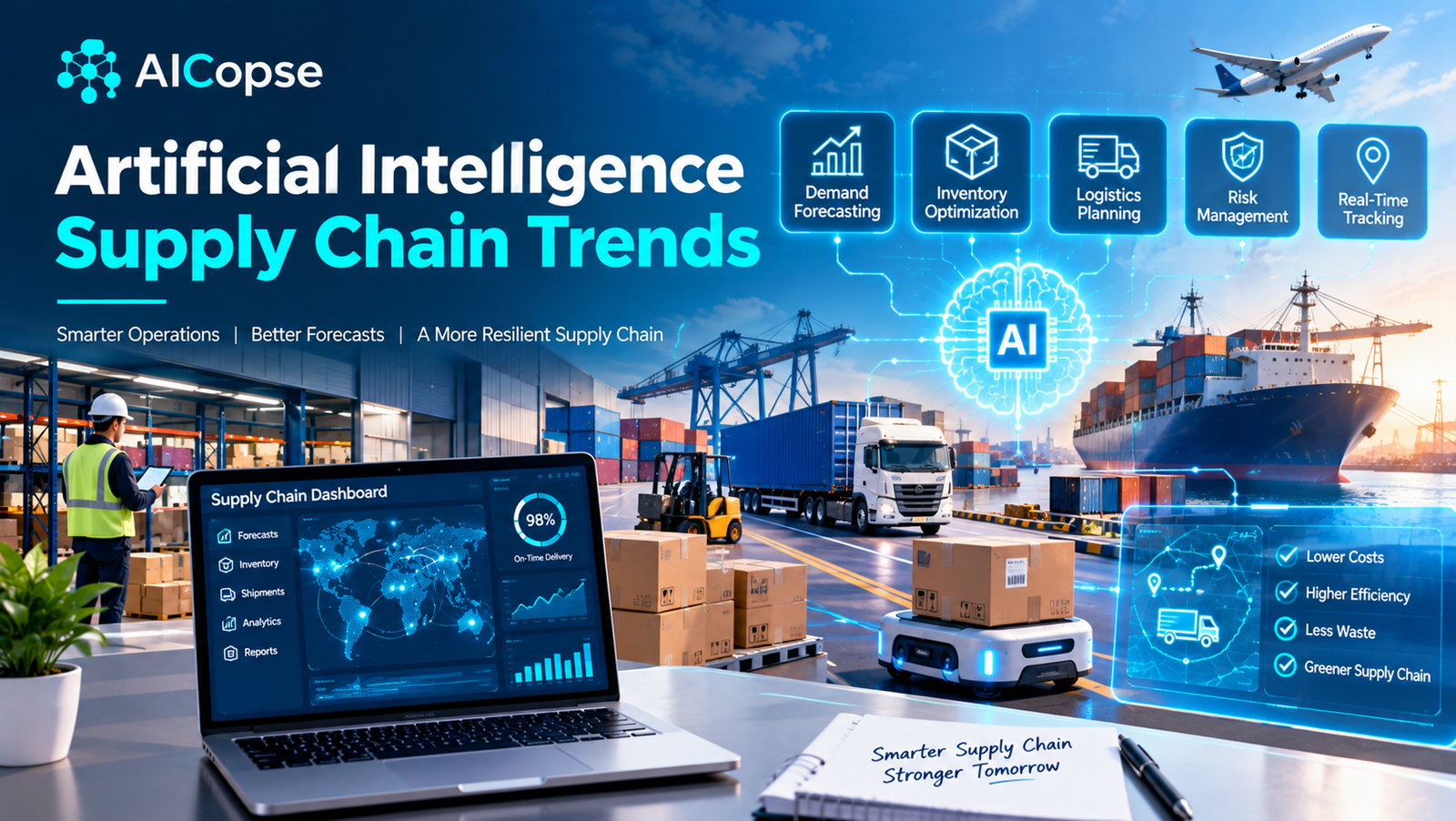
AICOPSE RESEARCH REPORT
Artificial Intelligence in Supply Chain: Trends and Future Predictions 2027–2030
How AI is changing demand forecasting, inventory, procurement, logistics, risk management, and supply chain resilience.
2027 Trends
2030 Predictions
Business Strategy
Key finding: AI in supply chain management is moving beyond demand forecasts and dashboards. The next stage connects forecasting, inventory decisions, supplier information, transport planning, and operational actions. However, the latest research also shows a gap between experimenting with AI and scaling it safely. By 2030, competitive advantage will depend less on simply owning AI tools and more on connecting reliable data, business processes, people, and measurable decisions.
Executive Summary
Supply chains connect manufacturers, suppliers, warehouses, shipping companies, retailers, and customers. A delay at one point can affect the entire network. A factory may have enough raw materials but still miss its delivery target because a port is congested. A retailer may have high total inventory but still run out of a popular product in a specific location. Traditional planning tools often struggle when many changes happen at the same time.
Artificial intelligence can help companies predict demand, identify risks, optimize inventory, plan transport, analyze supplier documents, and respond to disruptions. More advanced systems can recommend or carry out selected actions, provided they have the right data, permissions, and controls.
of surveyed supply chain leaders said integration with legacy systems was a major AI scaling challenge.
Source: Gartner, 2026
of respondents in an HFS Research survey had completed an AI deployment.
Source: HFS Research and EY, 2026
Gartner forecast for spending on supply chain management software with agentic AI capabilities by 2030.
Source: Gartner, 2026
of European businesses in Maersk’s research reported using AI to make logistics more efficient.
Source: Maersk, September 2026
These figures describe different surveys and populations. They should not be treated as one global adoption rate. Together, however, they show an important pattern: AI use is expanding, while integration, data quality, skills, governance, and operational scale remain difficult.
For the 2027–2030 period, the strongest opportunities are likely to include AI-supported planning, real-time disruption response, agentic workflows, supplier risk intelligence, digital twins, and sustainability measurement. The best results will come from targeted systems that improve real business decisions, not from adding a chatbot to every process.
Why Artificial Intelligence in Supply Chains Matters
Supply chain decisions are connected. A demand forecast influences purchasing. Purchasing affects inventory. Inventory affects warehouse capacity. Warehouse capacity affects delivery speed and transport costs. A change in one part of the system can create problems somewhere else.
AI helps by processing large amounts of historical and current information, detecting patterns, estimating future conditions, and supporting decisions across connected operations. Depending on the use case, a system may combine machine learning, optimization algorithms, computer vision, natural language processing, generative AI, and real-time data from business systems.
The main problems AI can help solve
- Uncertain demand: Sales change with seasonality, prices, promotions, weather, and customer behavior.
- Excess inventory: Companies may spend money holding products that customers are unlikely to buy soon.
- Stockouts: Poor forecasts or delayed replenishment can leave important products unavailable.
- Supplier risk: A company may depend on suppliers affected by financial problems, weather, trade restrictions, or transport disruption.
- Transport complexity: Route choice, fuel costs, capacity, delivery windows, and congestion change continuously.
- Disconnected information: Purchasing, inventory, transport, and finance teams may work from different systems and inconsistent records.
- Slow response: Teams may discover a disruption early but take too long to compare options and approve a response.
AI is not a replacement for supply chain expertise. A model can estimate that demand will increase, but it may not know that a key supplier has changed its production schedule unless that information is available. It can recommend a cheaper route, but that route may be unsuitable for temperature-sensitive goods. Human knowledge and reliable operating rules remain essential.
Businesses exploring this wider transformation can also review AICOPSE’s coverage of the future of artificial intelligence and why AI transformation depends on governance.
2026 Research: What the Latest Evidence Shows
Research published in 2026 shows that supply chain AI is moving from isolated pilots toward connected operational use. However, different reports measure different things. Some survey executives about deployment, others measure technology spending, and academic studies test models in specific datasets or simulated environments. These findings are useful when read in context, rather than treated as interchangeable proof.
AI deployment maturity in the 2026 HFS Research survey
HFS Research, in partnership with EY, surveyed 402 supply chain executives in 2026 and compared the results with a 2024 baseline of 460 executives.
Source: HFS Research, Build an Autonomous Supply Chain. Figures represent survey findings, not a census of all supply chain organizations.
The gap between interest and completed deployment matters. Many companies can test a forecasting model or connect a general-purpose AI assistant to a small workflow. Scaling it across multiple facilities, suppliers, regions, and business systems is much harder. Real deployment requires data ownership, integration, security, operational training, exception handling, and clear responsibility for decisions.
What supply chain leaders are struggling with
In a Gartner survey of 140 senior supply chain leaders at organizations with annual revenue of at least $250 million, 56% said legacy integration was a major challenge when scaling AI. Half reported limited internal expertise or talent to implement and manage AI. The survey was conducted in October and November 2025 and published in April 2026.
These barriers suggest that the next stage of adoption will be as much about data engineering, process design, and staff capability as it will be about selecting a powerful model.
Source: Gartner’s 2026 survey on AI scaling challenges.
AI is spreading across logistics
McKinsey’s 2026 State of Digital Logistics Survey, based on 278 respondents, found that nearly 90% of surveyed shippers had adopted at least one of the transportation AI use cases covered in the survey. In warehousing, 96% had deployed at least one surveyed AI or digital use case. These numbers refer to the use cases included in that research, not to every possible AI technology or every business worldwide.
Adoption alone does not guarantee value. McKinsey’s findings point to the importance of embedding tools into operating decisions so that insights lead to better transport plans, warehouse execution, and measurable results.
Source: McKinsey’s 2026 research on AI and digital capabilities in logistics.
Research Studies and Reports Explained
The following studies provide different types of evidence. Industry surveys describe adoption and business priorities. Systematic reviews summarize published research. Individual academic papers test specific approaches. A useful strategy combines all three and checks whether the findings apply to the company’s products, operating conditions, and data.
Research One: Gartner’s 2026 Supply Chain Technology Trends
Published: June 30, 2026
Gartner identified agentic AI and physical AI among the important supply chain technology trends for 2026. Its analysis describes a shift toward more autonomous and connected operations, supported by specialization, intelligence, and governance.
Agentic AI refers to systems that can work through a sequence of tasks, use approved tools, gather information, and recommend or perform actions within defined limits. Physical AI connects intelligence to real-world systems such as robots, autonomous equipment, and warehouse machinery.
The important point is that these technologies do not remove the need for operating controls. A planning agent needs current inventory, supplier commitments, transport capacity, and cost rules. A warehouse robot needs safe movement rules, reliable sensing, and a process for dealing with unexpected conditions.
Business implication: Companies should prepare for AI that coordinates workflows, but should first make their data, systems, and approval processes reliable.
Source: Gartner, Top Supply Chain Technology Trends for 2026.
Research Two: Gartner’s Forecast for Agentic AI Software Spending
Published: April 7, 2026
Gartner forecast that spending on supply chain management software with agentic AI capabilities could grow from less than $2 billion in 2025 to $53 billion by 2030. This is a forecast, not confirmed future spending, and it depends on how the market develops and how the category is defined.
The forecast matters because supply chain systems are moving from tools that display information toward tools that can perform selected tasks. A simple agent might compare a purchase order with a supplier confirmation and flag a mismatch. A more advanced workflow might detect a potential shortage, compare approved suppliers, estimate the cost of alternatives, and prepare a replenishment recommendation.
Yet multi-step automation can magnify mistakes. An incorrect inventory record may lead to an incorrect purchase recommendation. If an agent can place orders without appropriate limits, a small data error can become a real financial problem.
Business implication: Build permission limits, approval thresholds, audit logs, and rollback procedures into agentic workflows from the beginning.
Research Three: Systematic Review of AI in Demand Planning
Published: February 2025
Arne Walter, Kamrul Ahsan, and Shams Rahman published a systematic literature review in The International Journal of Logistics Management. The authors identified and analyzed 141 peer-reviewed articles covering AI applications in demand planning, with the reviewed literature published from 2012 through 2023.
The review organized the research into three broad areas: AI methods and tools, applications across supply chain functions, and the impact of AI on digital supply chain management. It also highlighted that much of the literature was still dominated by modeling studies.
This distinction is important. A forecasting model can perform well in a historical dataset without proving that a business can deploy it profitably. Real demand changes because of promotions, new products, missing data, competitor actions, and unexpected events. A model also needs to work with purchasing lead times, inventory policies, and replenishment constraints.
Business implication: Evaluate models using historical backtests and live trials, and measure stockouts, service levels, inventory costs, and forecast bias rather than relying only on an accuracy score.
Research Four: AI and Supply Chain Resilience
Published: August 2025
A study published in Economics Letters examined the relationship between AI adoption and corporate supply chain resilience. The authors considered three stages: preparation before a disruption, response while the disruption is happening, and recovery afterward.
The study reported that AI adoption was associated with improved resilience across these stages, including through lower dependence and better continuity and efficiency. The work is valuable because it treats resilience as a complete process rather than only a forecasting problem.
For example, a risk model might identify that several critical products depend on one port or one supplier. A response system could estimate the impact of a delay, compare alternative suppliers, and calculate how long existing inventory would last. After the event, the company could examine which decisions worked and update its contingency plans.
However, an association between AI adoption and resilience does not mean that every AI system automatically prevents disruption. Companies with stronger management, better data, and more resources may also be more likely to adopt AI successfully.
Business implication: Use AI to improve preparation, response, and recovery, while testing recommendations against real operational constraints.
Source: Smarter supply chains, stronger resilience? The impact of AI on preparation, response, and recovery.
Research Five: AI and Inventory Optimization During Disruptions
Published: January 19, 2026
A study in the Journal of King Saud University Computer and Information Sciences explored how large language models could support simulation-based inventory optimization during supply chain disruptions. The researchers compared three human-AI collaboration approaches: direct automated optimization, a two-stage process using automated simulation and optimization, and simulation-based optimization guided by human input.
The research is relevant because inventory decisions involve trade-offs. Ordering too little can create shortages, while ordering too much ties up cash and warehouse space. During a disruption, normal assumptions about lead times and supplier availability may no longer hold.
Simulation allows decision-makers to compare possible outcomes before committing resources. AI can help interpret the problem, generate options, and support analysis, while optimization methods calculate feasible choices under defined constraints.
The study should not be read as proof that an LLM can independently manage every real-world inventory network. The results depend on the model, scenarios, constraints, and experimental setup.
Business implication: Combine language models with structured inventory data and established optimization methods. Keep final approval for costly or risky decisions with qualified staff until the workflow has been validated.
Research Six: The 2026 Systematic Review of Intelligent Inventory Algorithms
Research update: 2026
A systematic literature review published in Algorithms examined 37 primary studies on intelligent algorithms for inventory management. The review followed PRISMA 2020 guidance and updated its literature search in July 2026, covering eligible work available up to June 2026.
The reviewed research included deep learning, reinforcement learning, hybrid models, graph neural networks, Transformer-based methods, and prescriptive analytics. The main application areas included inventory control, optimization, replenishment, and demand forecasting.
The authors found that reported improvements commonly involved cost efficiency, service levels, stockout reduction, and system performance. However, the size of the benefit varied by algorithm, dataset, sector, and whether a result came from simulation or real-world use.
This variation is a practical warning for buyers. A model that works for a retailer with stable demand and short lead times may not perform well for industrial spare parts, where demand is intermittent and a stockout can stop production.
Business implication: Select algorithms based on the problem and data, and ask vendors for evidence from settings similar to your own operation.
Source: Intelligent Algorithms in Inventory Management: A Systematic Literature Review.
Research Seven: OECD’s 2026 Analysis of AI, Resilience, and Environmental Performance
Published: June 3, 2026
The OECD report Strengthening Supply Chains through Efficiency, Resilience, AI and Environmental Performance examines how AI and environmental requirements are reshaping global supply chains. It considers the relationship between operational efficiency, resilience, and environmental performance.
This is an important addition to AI research because the cheapest or fastest operational choice is not always the most sustainable. A model may recommend extra safety stock to protect service levels, but that stock can increase storage needs or lead to waste. A transport system may reduce delivery time by choosing routes that use more fuel. The right decision depends on the complete set of business and environmental goals.
The report supports a broader view of supply chain technology: organizations need to consider environmental requirements, supplier information, risk, and operational efficiency together.
Business implication: Add emissions, waste, and supplier transparency to the measures used to evaluate AI, instead of treating sustainability as a separate reporting exercise.
Source: OECD, Strengthening Supply Chains through Efficiency, Resilience, AI and Environmental Performance.
Research Eight: MIT’s 2026 State of Supply Chain Sustainability Report
Published: October 2026
The MIT Center for Transportation and Logistics reported findings from 1,810 respondents across 91 countries. The research explored sustainability governance, AI, emissions, freight, warehousing, and how organizations turn commitments into action.
MIT News reported that 78% of North American organizations in the research were using AI in sustainability initiatives, and 87% of adopters reported a positive impact on sustainability goals. The findings also show why AI-enabled efficiency must be measured carefully: among mature agentic AI users, 53% reported lower total greenhouse gas emissions, while 29% reported an increase. In advanced and fully automated warehouses using AI, 78% reported higher energy use after implementation, and 76% reported higher waste.
These findings do not prove that AI itself caused every change. They do show that a system can improve one operational measure while worsening another. For example, greater automation can increase electricity use, and faster fulfillment can increase packaging or transport activity.
Business implication: Measure the environmental impact of AI deployments directly. Track energy use, waste, transport emissions, and total emissions alongside productivity and cost.
Source: MIT News, 2026 State of Supply Chain Sustainability Report findings.
Research Nine: McKinsey’s 2026 State of Digital Logistics Survey
Sample: 278 survey respondents
McKinsey’s survey found widespread adoption of at least one surveyed AI or digital use case in transport and warehousing. Around 84% of shippers said warehouse AI and digital tools had met or exceeded expectations, while 88% said the same about transportation use cases.
These are reported expectations and outcomes from survey participants, not a guarantee of savings for every business. Still, they indicate that logistics is a practical area for AI investment because it contains measurable tasks such as route planning, delivery estimates, warehouse capacity, and load utilization.
Business implication: Start with a clearly defined logistics problem where performance can be measured, such as missed delivery windows, empty miles, picking delays, or poor load utilization.
What these studies mean together
- AI adoption is growing, but full operational integration remains difficult.
- Forecasting and logistics are practical starting points because their outcomes can be measured.
- Agentic AI may automate more tasks, but permission controls and human oversight remain important.
- Academic results must be checked against the operating conditions where the model will be used.
- Resilience and sustainability require more than cost optimization; companies must measure the full impact of decisions.
Major Events and Incidents Shaping Supply Chain AI
Supply chain AI is developing in a world affected by shipping disruptions, trade uncertainty, extreme weather, cyber risk, and pressure to prove sustainability claims. These events matter because they test whether AI systems can support decisions when normal assumptions stop working.
Gartner puts agentic AI at the center of supply chain technology discussions
Gartner’s 2026 trends analysis identified agentic AI and physical AI as important technologies, while its software forecast projected substantial growth in agentic-enabled supply chain management software through 2030. This is a market signal, not proof that every organization is ready for autonomous operations.
Red Sea, Strait of Hormuz, and Black Sea disruptions increase the value of risk intelligence
In October 2026, the World Food Programme described how conflict-related disruptions around major trade routes affect food, fuel, and fertilizer movements. Route changes and delays can affect lead times, prices, availability, and vulnerable communities. AI can help estimate exposure and compare alternatives, but it depends on current information and must not treat a forecast as a confirmed event.
Source: World Food Programme, October 2026.
Trade tensions increase the need for supplier and sourcing intelligence
The October 2026 supply chain risk monitor highlighted growing trade tensions and proposals for stronger trade defenses in Europe. Trade policies can change sourcing costs, supplier choices, and the attractiveness of different production locations. Businesses need AI tools that can organize current evidence, show which products and suppliers may be exposed, and clearly identify uncertainty.
Source: Transport Intelligence, Global Supply Chain Risk Monitor: October 2026.
Sustainability research reveals that efficiency does not always mean lower emissions
MIT’s 2026 sustainability research reported that some mature agentic AI users saw emissions increase and many advanced AI-enabled warehouses reported higher energy use. This challenges the assumption that more automation automatically creates a greener supply chain.
Cybersecurity and data integrity become operational supply chain risks
AI systems depend on supplier portals, logistics APIs, planning platforms, warehouse systems, and external data. If an attacker compromises an account or manipulates data, an AI system may produce confident but harmful recommendations. Supply chain AI therefore needs access controls, vendor risk reviews, monitoring, backups, and a clear incident response process.
How AI can help during a disruption
Consider a company that imports components through a port affected by a major disruption. A well-designed decision system could identify shipments using that route, estimate which production lines are at risk, calculate remaining inventory coverage, and compare alternative transport or supplier options. It could then prepare a ranked list of actions for the supply chain team.
The system should show where each fact came from, when it was updated, what assumptions were used, and how confident the estimate is. It should not automatically place expensive orders or change suppliers unless those actions are explicitly permitted and tested.
Key AI Applications in Supply Chain Management
The most useful AI applications are connected to specific decisions. The table below outlines common opportunities, the data they need, and the results businesses should measure.
| Application | What AI does | Useful data | Key measure |
|---|---|---|---|
| Demand forecasting | Predicts demand by product, location, and period. | Sales, prices, promotions, seasonality, weather. | Forecast error and bias. |
| Inventory optimization | Recommends stock levels and replenishment quantities. | Inventory, lead times, demand, service targets. | Stockouts, inventory cost, service level. |
| Supplier risk | Flags supplier, region, and concentration risks. | Supplier records, financial data, shipment history, news. | Detection lead time and risk coverage. |
| Transport planning | Compares routes, loads, and delivery windows. | GPS, traffic, freight rates, vehicle capacity. | Cost per shipment and on-time delivery. |
| Warehouse operations | Supports slotting, picking, visual inspection, and labor planning. | Order profiles, scans, images, staffing, equipment status. | Picking time, accuracy, throughput. |
| Procurement | Extracts contract details and compares supplier offers. | Contracts, quotes, purchase orders, delivery history. | Cycle time, savings, supplier performance. |
| Disruption response | Estimates impact and ranks alternative actions. | Orders, routes, inventory, suppliers, risk signals. | Recovery time and lost sales avoided. |
| Sustainability | Estimates emissions and identifies waste or energy patterns. | Fuel, energy, distances, materials, supplier data. | Emissions per shipment and waste rate. |
Demand forecasting and inventory planning
Forecasting is often a good starting point because many businesses already have sales and inventory records. Machine learning can identify patterns across product categories and locations, while statistical forecasting remains useful for stable products. More advanced systems can include promotions, weather, pricing, and supply constraints.
The forecast is only one input into a decision. A business also needs to consider minimum order quantities, supplier lead times, shelf life, storage capacity, and the cost of a stockout. A forecast should therefore be connected to inventory optimization rather than treated as the final answer.
Supplier intelligence and procurement
Generative AI can help extract information from supplier contracts, certificates, purchase orders, invoices, and audit documents. Machine learning can support risk scoring by combining delivery performance, financial signals, geography, and dependency on specific suppliers.
These systems must distinguish verified information from an estimate. A news article about a supplier’s region does not automatically prove that the supplier itself is affected. Procurement teams should verify critical signals before changing contracts or moving large orders.
Logistics, warehouses, and real-time decisions
Transport optimization can balance delivery time, fuel use, vehicle capacity, freight costs, and customer commitments. In warehouses, AI can support item placement, picking routes, quality inspection, and workload planning. Computer vision can help detect damaged packaging or incorrect items when camera quality and inspection conditions are suitable.
Walmart’s published technology coverage describes using weather intelligence and predictive systems to help teams prepare for severe weather and make inventory, transport, and fulfillment decisions. Such examples show how AI can support planning before a disruption, although results from one company should not be assumed to apply equally to every organization.
Source: Walmart Global Tech, June 2026.
AI Market and Technology Landscape
The supply chain AI market includes established enterprise software providers, specialist planning platforms, logistics technology companies, warehouse automation vendors, data platforms, and AI startups. Businesses should compare products by the operational job they perform rather than assuming that one general-purpose AI model can solve every supply chain problem.
| Technology category | Main strength | Main limitation to test | Best fit |
|---|---|---|---|
| Enterprise SCM suites | Connect planning, procurement, inventory, and execution. | Implementation effort and dependence on clean master data. | Large, connected operations. |
| Specialist planning tools | Demand planning, replenishment, and scenario analysis. | Integration with existing ERP and warehouse systems. | Retailers, manufacturers, distributors. |
| Logistics optimization platforms | Routing, delivery visibility, freight, and load planning. | Real-time data coverage and network constraints. | Shippers, carriers, 3PLs. |
| Generative AI assistants | Searches documents, summarizes exceptions, drafts communications. | Unsupported answers, access controls, and data leakage. | Knowledge work and operational support. |
| Agentic AI workflows | Coordinates multiple tasks and approved tools. | Errors can spread across connected actions. | Repeated, bounded workflows. |
| Custom AI and optimization | Tailored to a specific business’s data and constraints. | Ongoing maintenance, monitoring, and specialist skills. | Distinctive workflows or complex constraints. |
How to compare competitors properly
During vendor research, ask suppliers to demonstrate the same scenario using the same test data. For example, provide a sample of historical orders, supplier lead times, and a simulated port disruption. Ask each vendor to show its recommended actions, supporting data, uncertainty, and expected cost impact.
- Check whether the system connects to your ERP, warehouse management system, transport management system, and supplier platforms.
- Ask how frequently forecasts and risk indicators update, and how the system handles missing or delayed data.
- Require a record of the data and rules behind important recommendations.
- Check whether users can set approval thresholds and stop automated actions.
- Test performance on your own products, regions, and disruption scenarios.
- Compare total cost, implementation time, support, integration work, and vendor lock-in.
Do not select a product only because it uses the newest model or offers a convincing demonstration. A less complex tool with reliable integration and clear controls may produce more value than a sophisticated agent connected to incomplete data.
Supply Chain AI Trends for 2027
The following trends are evidence-based expectations for 2027, not guaranteed outcomes. They reflect current industry surveys, recent research, and the direction of enterprise technology investment.
Trend One: Agentic AI moves from chat to bounded operational tasks
In 2027, more businesses are likely to test agents that can monitor a queue of delayed shipments, compare supplier responses, summarize exceptions, and prepare recommended actions. The first useful deployments will usually be narrow and repeatable rather than fully autonomous supply chain management.
What to do: Choose a task with clear rules, measurable outcomes, and low financial risk. Expand permissions only after the workflow has passed testing.
Trend Two: Connected data becomes a competitive advantage
Fragmented inventory, supplier, transport, and sales data will remain a major barrier to scaling AI. Companies will invest in shared data definitions, APIs, event streams, and more reliable master records so models can work across functions.
What to do: Create a clear data owner for every critical field, including product identifiers, supplier IDs, lead times, inventory status, and delivery dates.
Trend Three: Forecasts become more operationally aware
Forecasting systems will increasingly connect demand estimates with inventory limits, supplier capacity, order quantities, transport costs, and service targets. This can help businesses move from asking what might happen to deciding what to do next.
What to do: Test the full planning decision, not just the forecast. Measure whether the recommended orders actually improve service and reduce avoidable costs.
Trend Four: AI-supported disruption management becomes more proactive
Companies will place greater emphasis on identifying risks before a disruption reaches their own operations. AI can combine weather information, supplier updates, shipping events, inventory coverage, and alternative-route data to estimate exposure.
What to do: Build a disruption dashboard around business impact, not only news alerts. Identify affected products, customers, suppliers, facilities, and recovery options.
Trend Five: Digital twins and simulation support high-cost decisions
Digital twins represent important parts of a supply chain in a digital environment. Companies can use simulation to test a new warehouse layout, alternative supplier, inventory policy, or distribution network before making a costly change.
What to do: Start with a limited system where data is available and decisions are expensive or difficult to reverse. Compare simulation results with real operational performance.
Trend Six: Sustainability becomes part of AI decision rules
Businesses are likely to connect emissions, energy use, packaging waste, and supplier data more directly to planning decisions. The goal will be to balance service, cost, resilience, and environmental impact rather than optimizing one metric alone.
What to do: Define the environmental measures that matter for your products and routes, and verify that reported reductions are based on real activity data.
Trend Seven: Human oversight becomes more structured
As AI systems can initiate more tasks, businesses will need clearer policies for what AI may recommend, what it may execute, and what requires approval. Oversight will shift from informal checking to defined permissions, audit trails, and escalation procedures.
What to do: Establish approval levels by risk and financial value. Ensure employees can pause an automated workflow and understand why an action was recommended.
A practical 2027 priority matrix
| Priority | Business value | Suggested approach |
|---|---|---|
| High | Forecasting and inventory improvements. | Start with reliable historical data and a measurable product group. |
| High | Shipment visibility and exception handling. | Connect event data and automate alerts or recommendations. |
| High | Supplier document processing. | Use document AI with source links and human validation. |
| Medium | Agentic purchasing workflows. | Begin with draft recommendations and strict approval limits. |
| Medium | Digital twins for network redesign. | Use simulation for high-cost decisions with dependable data. |
| Longer-term | Broad autonomous coordination across multiple companies. | Advance only when interoperability, trust, and governance are mature. |
Future Predictions: Artificial Intelligence in Supply Chains by 2030
By 2030, supply chain AI is likely to become more deeply embedded in planning, procurement, transport, warehousing, and risk management. The timing and scale will differ by industry. A large retailer with extensive digital infrastructure may automate faster than a small manufacturer with limited data and older systems.
2030 MARKET SIGNAL
Gartner’s forecast for spending on supply chain management software with agentic AI capabilities by 2030.
This is a forecast, not a guaranteed market outcome.
Prediction One: Supply chain systems will coordinate more work automatically
By 2030, more organizations are likely to use agents that coordinate several approved tasks within a defined process. An agent could detect a delivery delay, identify affected orders, estimate the impact on production, compare alternative shipping options, and prepare a response for approval.
Gartner’s forecast for agentic AI software spending supports the expectation that the market will expand. However, growth in software spending does not prove that fully autonomous supply chains will be common. Many decisions will still require people because they involve large financial commitments, contractual obligations, safety, or customer relationships.
Prediction Two: AI will become a normal part of planning software
Instead of treating AI as a separate application, businesses are likely to see forecasting, recommendations, document understanding, and exception handling built into their existing supply chain systems. Users may ask questions in natural language, but reliable answers will depend on structured data, permissions, and links to the underlying records.
For example, a planner may ask which products are most likely to run out over the next two weeks. The system should return the relevant products, current stock, expected demand, lead time, source data, and recommended next steps rather than producing a general text answer.
Prediction Three: Risk management will become more continuous
Supply chain risk assessment is often performed through scheduled reviews and spreadsheets. By 2030, more businesses are likely to monitor supplier concentration, transport disruptions, inventory exposure, and changes in demand continuously. AI can help prioritize risks based on their potential business impact.
The strongest systems will connect external alerts to internal exposure. A report about a port disruption is useful, but it becomes more valuable when the company can identify its own shipments, orders, inventory, and customers affected by that event.
Prediction Four: Supplier networks will become more data-driven
Companies are likely to use AI to compare supplier performance, assess dependency, analyze contracts, and identify potential alternatives. More advanced workflows may recommend sourcing changes when the cost, reliability, or risk profile of an existing supplier changes.
However, changing suppliers is not a simple prediction task. It can involve quality audits, legal terms, certification, production capacity, intellectual property, and long qualification periods. AI will support the analysis, but supplier decisions will still need business and technical review.
Prediction Five: Small and medium businesses will adopt narrower AI solutions
Smaller businesses may not have the budget or staff for a large supply chain transformation. Their most practical route will be focused tools for demand planning, purchase recommendations, document processing, delivery updates, or stock alerts. Cloud services and existing software integrations can lower the initial cost, although data quality and staff training will still matter.
Startups that solve a specific operational problem and integrate with the software businesses already use may have a clearer path to adoption than platforms that require a complete system replacement.
Prediction Six: Sustainability and resilience will be measured together
Supply chain decisions will increasingly need to account for service levels, financial cost, emissions, waste, and disruption risk at the same time. Businesses may use AI to compare the environmental impact of alternative routes, production locations, inventory policies, and supplier choices.
MIT’s 2026 research shows why this matters: some organizations reported higher energy use or emissions despite AI adoption. By 2030, stronger measurement should help companies distinguish genuine improvements from changes that shift costs or environmental impact elsewhere in the network.
Prediction Seven: AI governance will become part of procurement and vendor selection
Businesses will increasingly ask vendors how their models use data, how often they update, how errors are handled, whether customer information is used for training, and what records are available for auditing. AI governance will become a practical procurement issue rather than a separate policy document.
Companies that cannot explain how a system reaches an important recommendation may find it harder to use that system for high-value purchasing, supplier selection, or production decisions.
Prediction Eight: Human roles will shift toward exception management and decision ownership
AI may reduce time spent on repetitive information gathering, manual comparison, routine reporting, and basic document review. Workers will still need to handle unusual situations, validate important recommendations, manage supplier relationships, and decide how the business should respond when objectives conflict.
The most useful workforce strategy is to train employees to work with AI outputs, identify errors, understand operational trade-offs, and manage exceptions. Removing human review before a system is dependable can create more risk than value.
What is likely by 2030, and what remains uncertain?
More likely: AI-supported forecasting, document analysis, shipment visibility, exception prioritization, and bounded task automation become more common.
Possible but uneven: Multi-agent workflows coordinate purchasing, inventory, and logistics across connected systems.
Uncertain: Fully autonomous end-to-end supply chains become standard across industries. Legacy systems, poor data, regulation, safety, and the cost of mistakes may limit adoption.
Technical Guide for Developers and AI Startups
Developers building supply chain AI should start with the business decision and work backward to the technology. A strong model cannot compensate for incomplete data, unclear operating rules, or a workflow that nobody owns.
Recommended architecture for a supply chain AI system
ERP, WMS, TMS, CRM, supplier portals, sales systems
APIs, validation, product and supplier IDs, timestamps, access control
Forecasting, risk scoring, document AI, search, simulation, optimization
Recommendations, business rules, permissions, approval thresholds
Approved actions, audit logs, monitoring, feedback, rollback
Data sources developers should consider
- Sales orders, shipments, returns, and historical demand.
- Inventory balances, safety stock, shelf life, and warehouse capacity.
- Supplier lead times, purchase orders, confirmations, and delivery performance.
- Transport costs, route data, vehicle capacity, tracking events, and estimated arrival times.
- Weather alerts, port updates, trade notices, and other external risk signals.
- Product attributes, bill of materials, substitutions, and production constraints.
- Energy, fuel, packaging, and emissions information where sustainability is in scope.
Use the right model for the right task
Not every supply chain problem requires a large language model. Time-series models may be useful for demand forecasting. Optimization algorithms can handle routing, capacity, and replenishment constraints. Graph methods may help represent supplier dependencies. Computer vision can support inspection tasks. Language models are useful for reading documents, summarizing exceptions, and helping staff query complex information.
Hybrid systems often make more sense than one model doing everything. For example, a language model can extract delivery dates from supplier messages, while deterministic rules validate the dates and a planning engine calculates the impact on inventory.
Evaluation must reflect real operations
Developers should evaluate models against historical data and compare them with a sensible baseline. For forecasts, test accuracy and bias across products, locations, and time periods. For recommendations, measure cost, feasibility, service levels, and the frequency of actions that require manual correction. For agents, test whether the system follows permissions and behaves safely when information is missing.
- Use time-based train and test splits to reduce leakage from future information.
- Test seasonal peaks, promotions, unusual demand, and new products separately.
- Measure the performance of the complete workflow, not only the underlying model.
- Track model drift when suppliers, lead times, products, or customer behavior change.
- Maintain a record of data versions, model versions, recommendations, approvals, and outcomes.
- Provide a manual fallback when a data feed fails or confidence drops below an acceptable level.
Security and privacy requirements
Supply chain systems may contain confidential supplier prices, product designs, purchase terms, customer information, and operational schedules. Developers should apply least-privilege access, encrypt sensitive information, protect API credentials, separate customer data, and set clear retention rules.
Agents should not receive broad write access merely because they can use a business system. Read-only access is a safer starting point. Actions such as approving purchase orders, changing supplier records, or cancelling shipments should require explicit permissions and appropriate checks.
Startups building in this market can also explore AICOPSE’s coverage of AI agents for business and AI security testing and risk.
Expert Recommendations for Businesses
Organizations do not need to transform every supply chain process at once. A better strategy is to identify one expensive or repeated problem, build a reliable data foundation, run a controlled pilot, and expand only when the results are clear.
For large enterprises
- Build a shared supply chain data strategy across procurement, planning, logistics, and finance.
- Prioritize use cases that affect large amounts of inventory, recurring freight costs, or critical supplier dependencies.
- Connect AI initiatives to enterprise risk management, cybersecurity, and sustainability reporting.
- Set standards for model evaluation, vendor assessment, data access, and incident handling.
- Use digital twins and scenario planning for network changes that are expensive or difficult to reverse.
For small and medium-sized businesses
- Begin with one product category, one warehouse, or one recurring workflow.
- Improve product identifiers, supplier records, lead-time accuracy, and stock data before buying complex tools.
- Prefer systems that integrate with current software and allow exports of your own data.
- Use AI to prepare purchase recommendations or exception summaries before allowing automatic transactions.
- Calculate the cost of implementation, support, staff time, and ongoing monitoring, not just the subscription price.
For supply chain startups
- Solve a specific, measurable problem such as supplier document extraction, stockout prediction, or shipment exception handling.
- Build integrations with systems customers already use rather than demanding a complete replacement.
- Show the evidence behind recommendations and give users a clear way to correct errors.
- Prove value with a pilot that tracks a baseline and a defined success measure.
- Develop pricing around a clear operational outcome where practical, rather than promising general AI transformation.
For developers and data teams
- Work with operations teams to understand real constraints before choosing algorithms.
- Keep model output separate from the rules that authorize a business action.
- Design for missing data, delayed feeds, supplier changes, and unusual events.
- Track the full path from input data to recommendation, approval, and final outcome.
- Make monitoring and incident response part of the initial system design.
“The pressure to demonstrate quick results often leads supply chain leaders to settle for AI as a tool for incremental improvements to legacy workflows.”
Gartner’s 2026 research on the challenges of scaling AI in supply chains. Source: Gartner
A 90-Day AI Implementation Roadmap
A 90-day plan can help a company test one use case without committing to a large transformation before it has evidence. The exact schedule will depend on data access, integration complexity, and approval requirements.
Choose the problem
Select one process, define its current performance, identify its owner, and agree on the target. Estimate the cost of the problem and document data access, operational constraints, and risks.
Audit and prepare data
Check missing values, duplicate records, product identifiers, timestamps, lead times, and data ownership. Create a baseline from historical results and decide which data can be used safely.
Build and test
Develop a prototype, compare it with the existing method, test common and unusual cases, and confirm that recommendations obey business constraints.
Run a controlled pilot
Use the system in a limited setting with human approval. Record recommendations, corrections, response time, and the effect on the selected business metric.
Review and decide
Compare results with the baseline, review risks and user feedback, calculate total cost, and decide whether to expand, improve, or stop the pilot.
A successful pilot does not automatically justify full automation. The next stage should be based on repeatable results, stable data, acceptable risk, and a clear operating owner.
KPIs: How to Measure Supply Chain AI Performance
Companies should define success before deployment. A model can improve forecast accuracy while increasing inventory, or reduce transport time while increasing cost. Balanced measurement helps teams understand whether AI creates real value.
| KPI | What it measures | Why it matters |
|---|---|---|
| Forecast error | Difference between predicted and actual demand. | Shows whether forecasts improve planning. |
| Forecast bias | Whether forecasts repeatedly overestimate or underestimate. | Helps prevent systematic excess or shortage. |
| Inventory turns | How often inventory is sold or used during a period. | Indicates how efficiently stock is managed. |
| Service level | How reliably demand is fulfilled. | Balances efficiency against availability. |
| On-time delivery | Share of deliveries completed within the promised window. | Shows whether logistics changes improve reliability. |
| Cost per order | Operating cost associated with processing and fulfilling an order. | Connects AI to unit economics. |
| Exception resolution time | Time from detecting a problem to resolving it. | Measures the value of connected decision support. |
| Recommendation acceptance | How often users accept or change AI recommendations. | Helps identify trust and quality problems. |
| Energy and emissions | Environmental impact per product, order, or shipment. | Checks whether efficiency gains reduce total impact. |
| Return on investment | Financial value compared with total implementation and operating cost. | Supports decisions about scaling or stopping. |
A simple ROI calculation
Estimate the financial value created over a defined period, subtract the total cost of the AI initiative, and compare the net benefit with the investment.
ROI = (Financial Benefits − Total Costs) ÷ Total Costs × 100
For example, if a pilot produces $120,000 in verified annual benefits and costs $80,000 to implement and operate, the net benefit is $40,000 and the simple ROI is 50%. This is an illustrative calculation, not an industry benchmark. Businesses should also account for implementation risk, working capital, timing, and benefits that are difficult to quantify.
Frequently Asked Questions
How is AI used in supply chain management?
AI is used for demand forecasting, inventory planning, supplier risk analysis, procurement, route optimization, warehouse operations, shipment visibility, document processing, and disruption management. The best application depends on the company’s data, processes, and business goals.
What are the biggest supply chain AI trends for 2027?
Important trends include bounded agentic AI, connected supply chain data, operationally aware forecasting, proactive risk intelligence, digital twins, sustainability measurement, and stronger human oversight.
What will AI in supply chains look like by 2030?
AI is likely to be more deeply integrated into planning and logistics systems, with more automated exception handling and coordination between connected applications. Full autonomy across every supply chain is uncertain because data quality, safety, cost, and accountability remain important constraints.
Can small businesses use supply chain AI?
Yes. Small businesses can begin with forecasting, stock alerts, supplier document extraction, purchase recommendations, or delivery updates. A focused tool that integrates with existing software is often more practical than a large custom platform.
Does AI always improve demand forecasting?
No. Results depend on data quality, product behavior, seasonality, changing market conditions, and the method used. AI forecasts should be compared with reliable baselines and tested across different products and time periods.
What is agentic AI in supply chain management?
Agentic AI describes systems that can work through multiple steps, use approved tools, and recommend or execute tasks within defined limits. Examples include gathering shipment information, identifying affected orders, comparing options, and preparing an action for approval.
What is the biggest barrier to supply chain AI adoption?
Common barriers include disconnected legacy systems, poor data quality, limited technical expertise, integration costs, employee adoption, and unclear governance. Gartner’s 2026 survey found that 56% of surveyed senior supply chain leaders viewed legacy integration as a major scaling challenge.
How should a business measure supply chain AI success?
Measure changes in forecast error, stockouts, inventory cost, on-time delivery, exception resolution time, cost per order, environmental impact, and total ROI. Compare results with a baseline and include the cost of integration, support, and monitoring.
Research Sources and Further Reading
The following sources support the industry statistics, research findings, and forecasts discussed in this report. Survey results, academic findings, and forecasts should be interpreted according to their samples and methods.
- Gartner. Top Supply Chain Technology Trends for 2026. June 30, 2026.
Source: Gartner - Gartner. Supply Chain Management Software with Agentic AI Forecast. April 7, 2026.
Source: Gartner - Gartner. Technology Integration and Talent as Barriers to Scaling AI in Supply Chain. April 29, 2026.
Source: Gartner - HFS Research and EY. Build an Autonomous Supply Chain: Seven Moves That Set Front-Runners Apart. 2026.
Source: HFS Research - McKinsey. Creating Value from AI and Digital Capabilities in Logistics Operations. 2026.
Source: McKinsey - Walter, Ahsan, and Rahman. Application of Artificial Intelligence in Demand Planning for Supply Chains: A Systematic Literature Review. The International Journal of Logistics Management, 2025.
Source: DOI and journal publication - Economics Letters. Smarter Supply Chains, Stronger Resilience? The Impact of AI on Preparation, Response, and Recovery. 2025.
Source: DOI and journal publication - Wu and colleagues. Inventory Optimization Under Supply Chain Disruptions: Leveraging Large Language Models for Human-AI Collaborative Decision-Making. 2026.
Source: DOI and journal publication - Algorithms. Intelligent Algorithms in Inventory Management: A Systematic Literature Review. 2026.
Source: MDPI - OECD. Strengthening Supply Chains Through Efficiency, Resilience, AI and Environmental Performance. June 3, 2026.
Source: OECD - MIT Center for Transportation and Logistics. State of Supply Chain Sustainability Report 2026.
Source: MIT CTL - MIT News. State of Supply Chain Sustainability Report Findings. October 2026.
Source: MIT News - World Food Programme. What Do Disruptions in Major Trade Routes Mean for Food Security? October 2026.
Source: World Food Programme - Transport Intelligence. Global Supply Chain Risk Monitor: October 2026.
Source: Transport Intelligence - Walmart Global Tech. Moving Before the Storm: How Walmart’s Supply Chain Technology Helps Teams Prepare for Severe Weather. June 24, 2026.
Source: Walmart Global Tech
Conclusion
Artificial intelligence is becoming an important part of modern supply chain management, but its value depends on how well it supports real decisions. Forecasting, inventory optimization, logistics planning, supplier intelligence, and disruption response offer practical opportunities today. Agentic AI, digital twins, and connected decision systems are likely to expand through 2027 and toward 2030, but adoption will not be equal across every company or industry.
The strongest organizations will combine reliable data, appropriate models, clear business rules, human expertise, and measurable outcomes. They will also test environmental and operational side effects instead of assuming that automation always reduces costs or emissions.
For developers, startups, and businesses, the most useful next step is to select one important supply chain problem, measure the current baseline, test an AI-supported solution under controlled conditions, and scale only when the evidence supports it.

Leave a Reply