
AICOPSE RESEARCH REPORT | 2026 EDITION
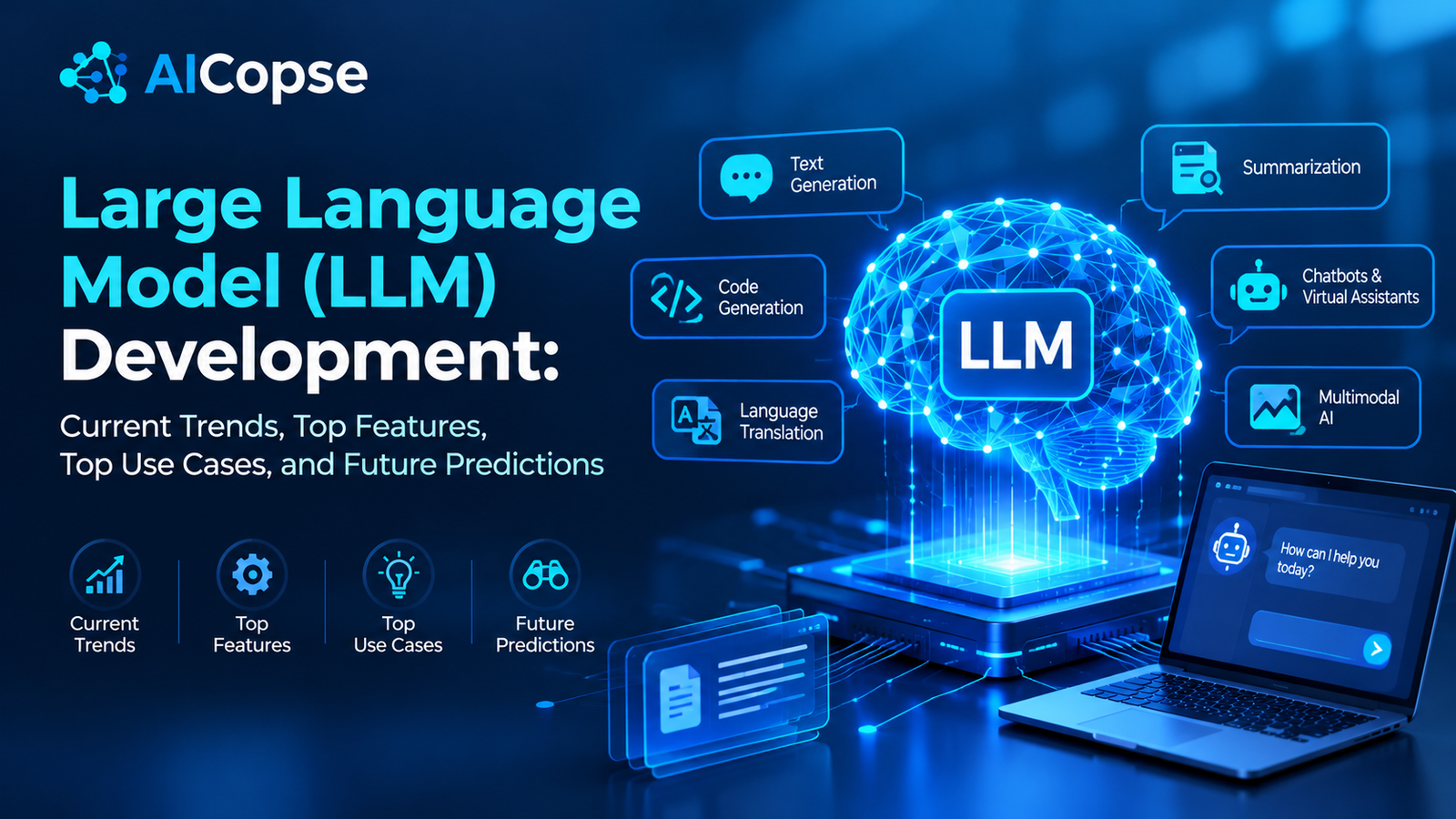
Large Language Model Development: Current Trends, Top Features, Top Use Cases, and Future Predictions (2027–2030)
A practical research guide to LLM architecture, training, fine-tuning, evaluation, deployment, security, business adoption, development costs, and the technologies likely to shape large language models through 2030.
2027 Trends
2030 Predictions
Large Language Model Development Statistics
Executive Summary
Large language model development has moved beyond building chatbots. In 2026, businesses are increasingly concerned with how models perform inside real products, how much each successful task costs, whether outputs can be trusted, and how systems behave when they encounter unfamiliar information. The strongest LLM projects combine model selection, data quality, retrieval, evaluation, security, monitoring, and product engineering.
The most important development decision is often not which model has the highest benchmark score. It is which model and system can solve a specific problem accurately, securely, quickly, and at a cost the business can sustain. Through 2030, progress is likely to come from smaller specialized models, stronger multimodal systems, better reasoning, efficient inference, more reliable tool use, and deeper integration into existing business software.
Key LLM Development Statistics for 2026
Gartner’s 2026 forecast for all AI spending, not LLMs alone.
Gartner’s year-over-year 2026 forecast.
Reported in the Stanford AI Index 2026.
Compared with 233 in 2024, according to Stanford.
Important distinction: These figures describe the wider AI market and AI adoption, not the number of LLMs deployed or the size of the LLM market alone. They show the environment in which LLM development is expanding. Forecasts are not confirmed final spending results.
Source: Gartner, Worldwide AI Spending Forecast for 2026, Gartner, AI Platforms and Models Market Forecast, Stanford HAI, 2026 AI Index Report
Table of Contents
- What Is LLM Development?
- 2026 Market Signals and Industry Direction
- Current LLM Development Trends
- Top Features of Modern LLM Systems
- LLM Development Platforms and Competitor Landscape
- Top LLM Use Cases by Industry
- 2026 Research and Studies Explained
- Major Events, Incidents, and Safety Lessons
- How to Develop an LLM-Powered Product
- Development Costs, ROI, and Performance Metrics
- LLM Development Trends for 2027
- Future Predictions for 2028–2030
- Practical 90-Day Development Roadmap
- Expert Recommendations
- Frequently Asked Questions
- Research Sources
What Is Large Language Model Development?
Large language model development is the process of designing, training or adapting, evaluating, deploying, and maintaining AI models that process and generate human language. Depending on the model, these systems can answer questions, summarize documents, write code, extract structured data, translate text, classify messages, analyze images, and interact with software tools.
Most modern LLMs are based on transformer neural network architectures. During pretraining, a model learns statistical patterns from large collections of text or multimodal data. Many models learn to predict the next token, which may be a word fragment, punctuation mark, or other unit of text. Further training can teach the model to follow instructions, respond in preferred formats, use tools, and perform better on specific tasks.
However, an LLM product is more than a model. A customer support assistant, for example, may require a language model, a document search system, access controls, business rules, a database, an evaluation suite, and a human escalation path. Weakness in any one of these parts can make the complete product unreliable.
LLM Development Compared With Related Technologies
| Technology | Main purpose | Example | Typical development work |
|---|---|---|---|
| Traditional machine learning | Predict values or categories | Predict customer churn | Feature engineering, training, validation |
| LLMs | Understand and generate language | Answer questions about company policy | Model selection, prompting, retrieval, evaluation |
| Retrieval-augmented generation | Ground responses in external information | Search internal technical documents | Chunking, retrieval, ranking, citations |
| Fine-tuning | Adapt model behavior to a task | Produce consistent structured outputs | Curated examples, training, testing |
| Multimodal models | Process multiple data types | Analyze an image and its accompanying text | Cross-modal evaluation, data preparation, safety testing |
These approaches can work together. An LLM may extract information from an invoice, while a conventional machine learning model estimates fraud risk and a rules engine decides whether a payment needs review. The best system uses each technology where it is strongest.
2026 Market Signals and Industry Direction
The LLM market is developing in three connected directions. First, leading model providers continue to improve reasoning, coding, multimodal input, and tool use. Second, businesses are moving from demonstrations to systems embedded in customer service, software development, research, and internal operations. Third, buyers are paying closer attention to reliability, security, latency, and the cost of completing a task.
Gartner forecast worldwide spending on AI platforms for data science and machine learning at approximately $26.445 billion in 2026, rising to $35.552 billion in 2027. This category is broader than LLM infrastructure, but it shows the growing commercial importance of platforms that help organizations develop and manage AI systems.
Gartner Forecast: AI Platforms for Data Science and Machine Learning
Values are Gartner forecasts for the broader AI platforms for data science and machine learning category, not LLM-only revenue.
Gartner also projected that spending on AI models and platforms would reach $64 billion in 2026, up 63.4% from $39 billion in 2025. Its forecast for domain-specific language models and specialized generative AI models rose from $1.583 billion in 2025 to $4.910 billion in 2026, a projected increase of approximately 210%. This is a strong signal that specialized capabilities are becoming commercially important, although the category does not include every kind of specialized LLM development.
Source: Gartner, AI Models and Platforms Spending Forecast
The practical lesson for businesses is straightforward: do not treat a large AI budget as proof that a particular LLM project will succeed. A project still needs a clear business problem, measurable baseline performance, reliable data, a suitable model, and an operating plan. Spending is increasing, but so is pressure to prove value.
Current LLM Development Trends in 2026
Smaller, Specialized Models
A growing development strategy is to use a model sized for the task rather than automatically selecting the largest available model. A smaller model may classify support tickets, extract invoice fields, summarize short documents, or route requests with lower latency and cost. A larger model can handle complex reasoning or unusual cases that smaller models cannot solve reliably.
Specialization can happen through carefully designed prompts, retrieval, fine-tuning, model distillation, or training a model for a narrower domain. The best option depends on whether the problem is missing knowledge, inconsistent behavior, poor reasoning, or an output-format issue.
Retrieval-Augmented Generation and Grounded Answers
Retrieval-augmented generation, often called RAG, connects an LLM to a searchable collection of documents or records. When a user asks a question, the application retrieves relevant information and supplies it to the model as context. This is useful when information changes often or is private to an organization.
RAG does not automatically eliminate hallucinations. A retrieval system may select outdated files, miss the right passage, or retrieve a document the user is not allowed to see. Strong implementations measure retrieval quality separately from answer quality, enforce document permissions, and test whether each answer is supported by its cited evidence.
Long Context and Better Information Handling
Models increasingly support long input sequences, making it possible to analyze large documents, code repositories, contracts, and research collections. But a larger context window is not the same as perfect recall. Important facts may be overlooked, conflicting statements may be merged, and irrelevant information may distract the model.
Developers should compare long-context processing with retrieval, structured extraction, and document summarization. A carefully selected set of relevant passages may be cheaper and more reliable than sending every available document with each request.
Multimodal LLM Development
Multimodal models work with combinations of text, images, audio, video, or structured information. Business applications include analyzing product images, interpreting diagrams, transcribing meetings, extracting information from scanned documents, and helping users navigate visual interfaces.
Multimodal systems need additional tests. A model may understand written instructions but misread a chart, miss a small detail in a photograph, or misunderstand speech in a noisy environment. Teams should test each input type, combinations of input types, and realistic failure conditions before deployment.
Reasoning and Tool Use
LLMs can be connected to tools that retrieve information, run calculations, query databases, or perform approved software actions. This changes the development problem: instead of only judging a generated paragraph, teams must evaluate whether the model selected the correct tool, supplied valid arguments, interpreted the result, and respected permissions.
Tool use is especially useful when a model needs current information or exact calculations. It also creates risks. An incorrect tool call can change a record, send an unwanted message, or expose information. Sensitive actions should require authorization, restricted permissions, logging, and confirmation when appropriate.
LLM Evaluation Before Deployment
Evaluation is becoming a core part of model development rather than a final quality check. Teams need test cases that reflect their users, languages, documents, risk level, and real tasks. General leaderboards are useful for initial screening, but they cannot establish that a model is best for a particular product.
Evaluation should include factual accuracy, instruction following, citation support, structured output validity, latency, cost, privacy, refusal behavior, and robustness to misleading inputs. Human review remains valuable for nuanced cases and for checking whether automated evaluation methods are themselves reliable.
Data Quality, Synthetic Data, and Fine-Tuning
Fine-tuning can help a model learn a consistent style, domain-specific response patterns, or a particular output format. It is not a reliable way to keep changing facts permanently up to date. Frequently changing knowledge is usually better handled through retrieval or a connected database.
Synthetic training examples can increase coverage when carefully generated and checked. However, poor synthetic data can repeat mistakes, narrow the range of examples, or teach the model to imitate incorrect answers. A practical data pipeline removes duplicates, checks licensing and privacy, labels examples consistently, and keeps an independent test set that is not used during training.
Efficient Inference and Cost Control
Model quality matters, but the cost of serving each request can determine whether a product is commercially viable. Teams use smaller models, quantization, caching, batching, prompt reduction, and routing to control expenses. The right optimization depends on the workload and the acceptable quality level.
For example, a short customer classification task may not need the same model used for a complex research question. A routing system can send straightforward requests to a lower-cost model and reserve a more capable model for difficult cases. This should be validated with real tasks because routing mistakes can reduce overall accuracy.
Security, Privacy, and Governance by Design
LLM security includes more than blocking offensive text. Systems can be exposed to prompt injection, data leakage, unsafe tool use, poisoned documents, insecure integrations, and unauthorized access to private information. The threat model should cover the complete application, including data sources, model endpoints, logs, tools, and user permissions.
The NIST AI Risk Management Framework offers a useful structure for governing AI risks through the functions Govern, Map, Measure, and Manage. Organizations can use these functions to assign ownership, identify likely harms, measure risks, and decide how to respond.
Source: NIST, AI Risk Management Framework
Top Features of Modern LLM Development Systems
A modern LLM platform should support the full path from experimentation to reliable production. The following capabilities matter more than a long feature list when selecting a platform or designing an internal development stack.
| Feature | What it does | Why it matters | What to measure |
|---|---|---|---|
| Model selection | Connects to hosted or self-managed models | Balances capability, price, and control | Task success, latency, cost |
| Prompt and version management | Tracks prompts and configuration changes | Makes experiments reproducible | Regression rate, version history |
| RAG and search | Retrieves relevant company or public information | Improves grounding and freshness | Retrieval recall, citation accuracy |
| Structured output | Returns data in a defined schema | Supports APIs and automation | Schema-valid response rate |
| Tool integration | Calls approved services and functions | Connects language to real workflows | Successful calls, unauthorized actions |
| Evaluation suite | Tests quality across fixed examples | Catches regressions before release | Pass rate by task and risk |
| Observability | Records performance, errors, and usage | Makes production failures visible | Latency, error rate, cost per task |
| Security controls | Protects data and limits access | Reduces privacy and misuse risks | Access violations, leakage tests |
| Deployment and rollback | Controls release and recovery | Limits damage from regressions | Availability, recovery time |
LLM Development Platforms and Competitor Landscape
The market includes model providers, cloud AI platforms, open-source libraries, evaluation products, and tools for running models on private infrastructure. These categories overlap, but they solve different parts of the development problem. No single vendor is automatically best for every company.
| Category | Examples | Best suited for | Key decision |
|---|---|---|---|
| Hosted model APIs | OpenAI, Anthropic, Google, other model API providers | Fast product development without managing GPUs | Quality, price, terms, data controls, reliability |
| Cloud AI platforms | AWS SageMaker, Azure Machine Learning, Google Vertex AI | Organizations already using a major cloud | Integration, identity, network, operating costs |
| Data and AI platforms | Databricks, Snowflake, Dataiku, DataRobot | Teams working with large business data estates | Data access, governance, collaboration, portability |
| Open model ecosystem | Hugging Face ecosystem, PyTorch, vLLM, Ollama | Customization, experimentation, private deployment | License, hardware, serving complexity, model quality |
| Evaluation and tracing | MLflow, Weights & Biases, Langfuse, Arize | Teams testing prompts, models, and production behavior | Trace quality, privacy, integrations, evaluation coverage |
| Retrieval and search | Elasticsearch, vector databases, PostgreSQL with vector extensions | Document search and knowledge-grounded applications | Search relevance, access control, operational simplicity |
Gartner’s 2026 AI platforms for data science and machine learning landscape includes vendors such as AWS, Google, Microsoft, Databricks, Dataiku, DataRobot, Domino Data Lab, H2O.ai, IBM, Snowflake, SAS, and others. This is a broad platform category, not a ranking of LLM quality.
Source: Gartner, AI Platforms for Data Science and Machine Learning
How to Compare LLM Providers Fairly
Developers should create a fixed evaluation set using actual product tasks and run candidate models against it. Compare performance using the same inputs, success criteria, and realistic usage conditions. A model that performs well on public benchmarks may still struggle with a company’s legal documents, product terminology, noisy support messages, or strict output schema.
- Quality: Measure correct task completion, grounded claims, and consistency.
- Cost: Estimate the full cost of a successful task, including retrieval, retries, tools, and human review.
- Latency: Measure the time users actually wait, including retrieval and external API calls.
- Privacy: Review data retention, training use, access controls, and contractual terms.
- Portability: Assess how hard it would be to change providers or run a model privately.
- Reliability: Test rate limits, service interruptions, timeouts, and recovery behavior.
- Licensing: Review commercial-use terms for model weights, datasets, and generated outputs.
Top LLM Use Cases by Industry
The strongest LLM use cases usually involve language-heavy work that is repetitive, time-consuming, or difficult to search at scale. The business value depends on the amount of work handled, the quality of the output, and the cost of mistakes. The following examples are practical application patterns, not promises of guaranteed savings.
Software Development and Engineering
LLMs can explain unfamiliar code, generate test cases, summarize pull requests, draft documentation, identify likely causes of errors, and help developers navigate large repositories. They can also support code migration and legacy-system documentation.
Teams should not judge these tools only by the amount of code generated. Useful measures include accepted suggestions, defects introduced, time to complete a task, review time, test coverage, and the rate of security findings. Generated code must still pass normal testing, review, and software security checks.
Customer Support and Contact Centers
LLMs can classify requests, retrieve relevant help articles, draft replies, summarize conversations, and assist agents during calls. A controlled system can answer routine questions and transfer complex or sensitive cases to a person.
Measure resolution accuracy, first-contact resolution, customer satisfaction, escalation quality, average handling time, and cost per resolved case. A shorter conversation is not necessarily better if the customer must contact support again.
Finance, Banking, and Insurance
Potential applications include document extraction, policy comparison, financial research assistance, claims summarization, compliance document search, and preparation of internal reports. LLMs can also help analysts explore large collections of text.
Financial risk scoring, fraud detection, and numerical forecasting often need structured data and conventional statistical or machine learning models alongside the LLM. High-impact decisions should have traceable evidence, appropriate human oversight, and controls against unsupported claims.
Healthcare and Life Sciences
LLMs can help summarize clinical documents, search research literature, organize administrative records, and draft patient-facing material for review. They may also support research workflows by extracting information from papers and structuring findings for scientists.
Healthcare systems must protect patient information and validate outputs for the intended clinical setting. A fluent answer is not proof of medical accuracy. Systems used in clinical decisions need risk-appropriate validation, clear responsibilities, and qualified professional oversight.
Legal Services and Compliance
Useful tasks include finding clauses, comparing contract versions, extracting dates and obligations, summarizing case documents, and searching internal policies. Retrieval with source references is particularly important because a reviewer must be able to verify the exact document and passage behind an answer.
Law firms and compliance teams should test whether the system omits important exceptions, confuses jurisdictions, invents citations, or uses an outdated version of a policy. Final legal conclusions should remain with qualified professionals.
Retail, E-commerce, and Marketing
LLMs can generate product descriptions, classify customer feedback, summarize product reviews, support multilingual customer service, and help teams search product catalogs. They can also assist with campaign drafts and research synthesis.
Use approved product data and brand rules to reduce incorrect claims. Track conversion, returns, support contacts, content correction rates, and customer satisfaction rather than treating the volume of generated text as a success metric.
Manufacturing and Supply Chains
LLMs can turn maintenance manuals into searchable answers, summarize machine logs, help technicians find troubleshooting steps, and explain supply-chain exceptions. They can also provide a natural-language interface to operational data.
For sensor-based failure prediction, demand forecasting, and quality control, specialized machine learning models may be more appropriate than an LLM alone. The LLM can explain the result or help a technician investigate it, while the predictive model handles numerical signals.
Education, Research, and Professional Services
LLMs can help users understand complex concepts, summarize papers, prepare first drafts, organize notes, and generate practice questions. Research teams can use them to extract findings across many documents, provided the evidence is verified.
Evaluation should account for incorrect summaries, missing caveats, fabricated references, privacy, and the risk of users accepting an answer without checking the original source.
LLM Use Case Selection Matrix
| Use case | Useful system pattern | Main risk | Primary KPI |
|---|---|---|---|
| Support assistant | RAG plus controlled actions | Incorrect or outdated answers | Verified resolution rate |
| Code assistant | LLM plus repository tools and tests | Defects or insecure code | Accepted changes and defect rate |
| Document extraction | LLM plus schema validation | Missing or altered fields | Field-level accuracy |
| Research assistant | Retrieval, citations, source checks | Unsupported claims | Evidence-supported answer rate |
| Internal workflow assistant | LLM with limited tool permissions | Unauthorized or mistaken actions | Successful task completion |
2026 Research and Studies: What the Evidence Shows
Market forecasts show investment intentions, while technical studies reveal what systems can and cannot do. Practitioner surveys show what teams experience, and systematic reviews identify recurring problems across research. These evidence types answer different questions. A spending forecast does not prove product success, and a benchmark score does not prove production reliability.
Research One: Stanford AI Index 2026
Source and scope: Stanford Institute for Human-Centered Artificial Intelligence’s annual review of AI development, investment, adoption, technical performance, and risks.
The 2026 AI Index reports that organizational AI adoption reached 88%. It also reports that more than 90% of notable frontier models in 2025 were produced by industry. These figures show how central commercial model providers have become and how widely organizations are experimenting with or using AI.
The report records 362 documented AI incidents in 2025, compared with 233 in 2024. This is a broad AI incident measure, not a count of LLM failures alone. Nevertheless, it reinforces the need to treat reliability and risk controls as part of deployment rather than as optional additions.
For LLM developers, the central lesson is that capability is progressing quickly, but performance varies by task. A model may perform well on coding or formal reasoning benchmarks and still make errors in visual understanding, factual recall, or real-world workflows. Teams need their own task-specific tests.
What businesses should do: Use general benchmarks to narrow the model shortlist. Then test each candidate on representative tasks, including difficult examples, unusual inputs, and high-risk cases. Record quality and cost together.
Source: Stanford HAI, 2026 AI Index Report
Research Two: Gartner’s 2026 AI Models and Platforms Forecast
Source and scope: Gartner’s July 2026 forecast for spending on AI models and platforms, including a separate estimate for specialized generative AI models.
Gartner projected $64 billion in worldwide end-user spending on AI models and platforms in 2026, up 63.4% from $39 billion in 2025. It also forecast specialized domain-specific language models and generative AI models to grow from $1.583 billion to $4.910 billion in the same period.
The forecast matters because it suggests that organizations are looking beyond one general-purpose model for every task. Specialized systems may offer better fit for particular domains, workflows, languages, or business constraints. Still, a market forecast measures expected spending rather than proven return on investment.
Gartner analyst Arunasree Cheparthi said: “Enterprise AI budgets are coming under greater scrutiny, with increased focus on usage efficiency, cost control and measurable outcomes.”
This observation captures an important development priority. An LLM project must be judged by the value it delivers after model usage, integration, monitoring, review, and maintenance costs are included.
What businesses should do: Create a cost-per-successful-task metric before scaling. Compare a general-purpose model, a smaller model, and a specialized approach using the same test set.
Source: Gartner, AI Models and Platforms Forecast
Research Three: State of Production ML 2025 Survey
Source and scope: A practitioner survey based on 135 responses submitted between August 31 and December 1, 2025. It is a self-selected sample, so its percentages should not be treated as a representative estimate of every ML team.
In the survey, 42% of respondents identified model performance monitoring as a production challenge. Thirty-seven percent pointed to access to relevant training data, while 34% cited production-grade data or ML pipelines and another 34% reported inconsistent training or experiment environments.
These results are relevant to LLM products because teams often spend substantial time getting a prototype to work, only to discover that production quality depends on data freshness, repeatable releases, monitoring, and evaluation. An LLM can change behavior when its model version, prompt, retrieval index, tool, or upstream data changes.
The survey also reported that 84% of respondents had CI/CD support, 66% maintained separate development, staging, and production environments, 49% used A/B testing, and 31% used canary deployments. These are different levels of operational maturity, not proof that any one practice guarantees success.
What businesses should do: Keep evaluation cases in version control, test changes before release, monitor real user outcomes, and maintain a rollback plan. Track prompt and model versions alongside retrieval and tool changes.
Source: State of Production ML 2025 Survey
Research Four: Machine Learning Lifecycle Survey, 2026
Source and scope: A systematic literature review published on July 15, 2026, using a PRISMA-based process. The review began with 12,450 records and extracted 22 primary studies covering the ML lifecycle literature from 2015 to 2025.
The review highlights recurring problems involving data dependence, silent performance degradation, concept drift, non-determinism, technical debt, governance, and security. These issues are directly relevant to LLM development, even though the review covers the broader machine learning lifecycle rather than only large language models.
For example, a support assistant may initially perform well because its documentation is accurate. Months later, product policies change, the retrieval index falls behind, and users begin receiving outdated answers. The underlying language model may be unchanged; the surrounding system has degraded.
The review supports a lifecycle view of AI engineering. Teams need repeatable data preparation, model and prompt versioning, continuous evaluation, deployment controls, monitoring, and clear ownership of failures.
What businesses should do: Assign responsibility for the whole application, not just the model API. Review performance after changes to documents, prompts, model versions, business rules, and external services.
Source: Machine Learning Lifecycle: A Survey, 2026
Research Five: Small and Limited Data in Machine Learning, 2026
Source and scope: A survey published in the Journal of Big Data on January 16, 2026, examining ML methods and evaluation strategies for small and very small datasets.
Many startups do not have millions of high-quality examples. A business may have only a few hundred expert-reviewed support answers, specialized legal documents, or labeled product images. This makes it difficult to train a large model from scratch and easy to overestimate performance using a small test set.
The survey discusses methods such as transfer learning, meta-learning, and approaches to training and evaluation under data scarcity. For LLM development, the practical equivalents include adapting a pretrained model, curating a small but high-quality evaluation set, using retrieval for domain knowledge, and fine-tuning only when the expected benefit is clear.
Small datasets require careful testing. If near-duplicate examples appear in both training and testing, results can look stronger than they really are. A test set should reflect unseen users, documents, time periods, or other realistic conditions.
What businesses should do: Invest in high-quality examples and expert review before purchasing more training infrastructure. Measure performance on examples the development team did not use to tune the system.
Source: Journal of Big Data, Review of Machine Learning With Small and Limited Data
Research Six: Predictive Maintenance Review, 2026
Source and scope: A systematic review of 89 studies on predictive maintenance in complex manufacturing systems, including 64 peer-reviewed articles and 25 arXiv preprints, covering research from 2007 to 2026.
This is not an LLM-only study, but it reveals a problem that also affects LLM products: technical performance does not automatically translate into operational readiness. The review found that 65.6% of included studies used weak or unclear validation protocols, and only 15.6% reported using explainable AI.
The same lesson applies when a company evaluates a language model using a small collection of hand-picked questions. A model can appear impressive in a demonstration while failing on real documents, unfamiliar users, multilingual requests, or rare but important cases.
LLM evaluation should therefore include representative test data, adversarial cases, independent review, and operational testing. Where an error can cause financial, legal, health, or safety harm, teams need stronger evidence than a high average score.
What businesses should do: Define a minimum quality threshold for each risk level. Test common cases, edge cases, and failure recovery before giving the system wider access.
Source: Systematic Review of Predictive Maintenance in Complex Manufacturing Systems, 2026
Research Seven: TinyML Research Review, 2026
Source and scope: A bibliometric analysis published in March 2026 that examined 392 peer-reviewed publications from 2020 through 2024 on TinyML.
TinyML focuses on machine learning that can run on resource-constrained devices. It is not the same as running a large language model on a phone or sensor, but it provides useful context for the broader movement toward efficient, local AI processing.
As edge hardware improves, some LLM tasks may be handled locally using compact models, while larger or more difficult tasks are sent to a cloud model. This hybrid approach can reduce network dependence and help protect sensitive information, but local deployment still requires careful memory, battery, latency, and quality testing.
What businesses should do: Decide which tasks need cloud-scale capability and which can be handled on a local device. Do not move a model to the edge until its memory use, performance, update process, and security are understood.
Source: TinyML Bibliometric Review, 2026
Research Eight: NIST AI Risk Management Framework
Source and scope: NIST’s voluntary framework for incorporating trustworthiness considerations into AI design, development, deployment, and evaluation.
NIST provides a useful structure for turning general safety goals into concrete work. Govern establishes accountability and policies. Map identifies the system’s context and likely risks. Measure evaluates those risks. Manage prioritizes responses and controls.
For an LLM product, this can mean documenting intended use, identifying private data sources, testing prompt injection, measuring factual errors, restricting tool permissions, assigning incident owners, and reviewing whether the product remains safe after updates.
What businesses should do: Use a documented risk process before deployment and repeat it when the model gains new tools, access to new data, or responsibility for higher-impact decisions.
Source: NIST AI Risk Management Framework
What These Studies Collectively Tell Us
- Investment is increasing, but buyers are demanding measurable value.
- Model performance is only one part of a reliable LLM product.
- Evaluation must represent real users and real failure conditions.
- Data quality, monitoring, and lifecycle management remain difficult.
- Small specialized systems can be practical alternatives to training large models from scratch.
- Security and governance must be designed into the product.
Major Events, Incidents, and Safety Lessons
By 2026, the AI industry is facing a wider range of risks as systems move from public demonstrations into business processes. The most important lesson is not that every LLM is unsafe. It is that the impact of a failure depends on what the model can access, what actions it can take, who relies on its answers, and how quickly problems are detected.
AI Incidents Increased in the 2025 Record
The Stanford AI Index reports 362 documented AI incidents in 2025, compared with 233 in 2024. That represents an increase of approximately 55.4% based on the two reported counts. This measure covers AI incidents broadly and should not be interpreted as a count of LLM-specific incidents or as an incident rate per deployed model.
Documented AI Incidents
Source: Stanford HAI AI Index 2026. Counts reflect documented AI incidents across the wider field, not an LLM-only incident database.
Prompt Injection and Untrusted Content
Prompt injection occurs when malicious or misleading content attempts to change how an LLM behaves. It can appear in a user message, a retrieved web page, an uploaded file, or content returned by a tool. A system that reads untrusted content and has access to email, files, or business APIs may be at greater risk than a simple question-answering chatbot.
Developers should treat retrieved documents and tool outputs as data, not as trusted instructions. Separate instructions from content, restrict tools, limit access to sensitive records, and test attacks that attempt to override system rules or extract secrets.
Hallucinations and Unsupported Claims
LLMs can produce statements that sound convincing but are false, incomplete, or unsupported. The problem becomes serious when users treat a fluent answer as verified information. A citation can also be wrong, irrelevant, or fail to support the claim it accompanies.
Use source-grounded retrieval, structured output validation, confidence-aware escalation, and automated checks where possible. For important claims, verify that the cited passage directly supports the statement rather than simply mentioning the same topic.
Data Leakage and Excessive Permissions
An LLM application may expose confidential data through its prompt, logs, retrieved documents, connected tools, or outputs. A common design mistake is giving the model access to an entire database when it only needs a small set of approved fields.
Use least-privilege access, user-level document permissions, secrets management, retention controls, redaction where appropriate, and security tests. Avoid putting passwords, API keys, or other secrets into prompts or user-visible debugging logs.
Benchmark Saturation and False Confidence
The Stanford AI Index describes rapid improvement on certain benchmarks, including SWE-bench Verified, where reported coding performance rose from around 60% to near 100% over roughly a year. A result near the top of a benchmark does not mean an LLM can reliably complete every software engineering task. The benchmark’s tasks, scoring method, and test conditions define what the score actually measures.
When a benchmark becomes saturated, businesses need independent task-specific tests. They should also examine how often a model fails, whether it can recover, and how much human correction remains necessary.
Governance Became More Important in Production
The State of Production ML 2025 survey reported that 41% of respondents had AI risk or governance teams, an increase of 21 percentage points year over year. This is a survey result from a self-selected practitioner sample, not a census of the entire industry. Even so, it reflects growing attention to responsibility, policy, and operational controls.
NIST’s Focus on Trustworthy AI in Critical Infrastructure
In April 2026, NIST released a concept note for a profile focused on trustworthy AI in critical infrastructure. This development is relevant to LLM builders working in sectors where incorrect information or unsafe actions could affect essential services. A concept note is not the same as a final binding regulation, and organizations should verify the current status of any guidance they intend to follow.
Source: NIST, AI Risk Management Framework and Related Updates
Incident Response Checklist for LLM Products
- Detect: Monitor unusual outputs, tool calls, access patterns, latency spikes, and complaint rates.
- Contain: Disable risky tools, revoke compromised credentials, or route requests to a safer fallback.
- Investigate: Review model, prompt, retrieval, tool, and application versions while protecting private data.
- Correct: Fix the source data, permissions, prompt, model configuration, or application logic that caused the failure.
- Verify: Re-run the failed case and a wider regression suite before restoring the affected feature.
- Learn: Document the incident, assign corrective actions, and update tests so the same failure is easier to catch.
How to Develop an LLM-Powered Product
A strong LLM development process starts with the user problem, not the model. Teams should define what the product must accomplish, which errors are acceptable, what information it may use, and how success will be measured. Only then should they choose a model and architecture.
LLM Development Lifecycle
1. Define
2. Prepare
3. Select
4. Evaluate
5. Deploy
6. Monitor
The lifecycle is iterative. Monitoring results should feed into evaluation, data improvements, model changes, and future releases.
Step One: Define the Problem and Baseline
Write down the task in measurable terms. For example, a support assistant might need to answer approved product questions using the current help center, cite the relevant article, and escalate questions it cannot safely answer.
Measure the current process before automation. Record time per task, error rates, staff effort, customer satisfaction, and the cost of corrections. Without a baseline, a team cannot determine whether the LLM improved the workflow.
Step Two: Build a Representative Evaluation Set
Collect examples that reflect normal work, rare cases, ambiguous requests, and high-risk situations. Have qualified reviewers define what a correct answer looks like. Separate the development examples from the final test set to reduce the chance of overfitting to familiar questions.
For a first internal evaluation, a few hundred carefully selected examples may be more useful than thousands of unreviewed examples. The required sample size depends on task variability and the level of confidence needed. High-impact applications usually need more extensive validation.
Step Three: Choose the Simplest Effective Architecture
Start with the simplest approach that can meet the requirements. Test a hosted model with a clear prompt before building a complex pipeline. Add retrieval if the model needs current or private knowledge. Add fine-tuning if the desired behavior cannot be achieved reliably through prompting and retrieval. Use tools only when the task genuinely requires external actions or calculations.
| Problem | First approach to test | When to add complexity |
|---|---|---|
| Drafting or rewriting text | Prompt and hosted model | Add examples, style controls, or fine-tuning if results remain inconsistent |
| Answering company policy questions | RAG with access control | Improve chunking, ranking, citations, and permission filtering |
| Extracting fields from forms | Structured output and schema validation | Add document-specific processing and human review |
| Taking actions in software | Limited tool calls with permissions | Add approval gates, audit trails, and recovery procedures |
| Running privately at high volume | Benchmark hosted and self-managed models | Move to self-hosting only if control or economics justify operational complexity |
Step Four: Build Evaluation Into Development
Every important change should trigger relevant tests. A new prompt, model version, retrieval configuration, or tool integration can improve one behavior while damaging another. Track performance by task type rather than relying on a single overall score.
- Measure factual correctness and whether evidence supports the answer.
- Validate JSON, API arguments, and other structured outputs automatically.
- Test prompt injection, data leakage, and unauthorized tool access.
- Measure response time, token use, retries, and full request cost.
- Compare new and previous versions on the same evaluation set.
Step Five: Deploy With Human Oversight Where Needed
Start with a limited group of users or a narrow task. Use staged deployment, clear monitoring, and a way to turn off risky features. For sensitive workflows, require a qualified person to approve important decisions or actions until the system has demonstrated dependable performance under appropriate conditions.
Step Six: Monitor the Whole System
Production monitoring should cover model behavior, retrieval, tool calls, access control, latency, cost, and user outcomes. Avoid collecting more personal data than necessary. Where prompts and outputs are logged for debugging, apply appropriate access restrictions and retention limits.
Teams should also watch for changes in user behavior and source data. A model may not change, yet a product can become less accurate because its documents are outdated, its users ask new types of questions, or an external API changes.
LLM Development Costs, ROI, and Performance Metrics
LLM costs vary widely. A prototype using a hosted API may be relatively inexpensive to build, while a high-volume product with complex retrieval, strict uptime requirements, extensive evaluation, and human review can require a much larger budget. Training a foundation model from scratch is a different scale of project from adapting an existing model.
The Main Cost Categories
- Model usage: Input and output tokens, model calls, and provider charges.
- Infrastructure: Compute, GPUs, storage, networking, and serving systems.
- Data work: Collection, cleaning, labeling, permissions, and document preparation.
- Engineering: Application development, integration, testing, and maintenance.
- Evaluation and review: Human assessment, automated tests, and quality assurance.
- Security and governance: Access controls, monitoring, audits, incident response, and compliance work.
- Operations: Support, reliability engineering, provider changes, and ongoing model updates.
Example: Estimating Monthly Model Usage
Consider a hypothetical application receiving 100,000 requests per month. Suppose each request uses an average of 2,000 input tokens and 500 output tokens. The monthly usage would be 200 million input tokens and 50 million output tokens.
Monthly model cost can be estimated as: input tokens divided by one million, multiplied by the input price per million, plus output tokens divided by one million, multiplied by the output price per million.
This is an illustrative workload, not a vendor price quote. Actual charges depend on the selected model, current pricing, caching, context length, retries, tools, and other services. Add retrieval, monitoring, hosting, and human review before estimating the full cost of operating the product.
Core Metrics for LLM Products
| Metric | Meaning | Why to track it |
|---|---|---|
| Task success rate | Share of tasks meeting defined success criteria | Measures useful outcomes |
| Grounded answer rate | Share of factual answers supported by evidence | Helps reduce unsupported claims |
| Schema validity | Share of outputs matching required structure | Protects downstream software workflows |
| Latency | Time to return a response | Measures user experience |
| Cost per successful task | Total operating cost divided by successful tasks | Connects spending to value |
| Escalation rate | Share of tasks sent to a person or fallback | Shows where automation is limited |
| Incident rate | Frequency of defined safety or security failures | Supports risk management |
A Simple ROI Calculation
Suppose an internal workflow currently costs $12 per completed task when staff time and overhead are included. An LLM-assisted workflow costs $4 per task in model usage, software, review, and operating overhead. If quality remains acceptable, the direct saving is $8 per completed task.
At 5,000 completed tasks per month, the illustrative gross saving is $40,000 per month before one-time development costs and any additional costs not included in the $4 estimate. If implementation costs $120,000, the simple payback period would be three months under these assumptions. Real projects should use measured results and include training, maintenance, errors, and transition costs.
LLM Development Trends for 2027
The following are evidence-informed expectations, not guaranteed outcomes. They are based on the 2026 market direction, documented technical limitations, and the development needs visible across production systems.
More Specialized Models for Business Tasks
Organizations are likely to test more models tuned for particular languages, industries, workflows, and output requirements. The goal will not always be to build a new foundation model. It may be to adapt an existing model with curated examples, domain retrieval, or specialized inference settings.
What to prepare: Build domain-specific evaluation sets and measure whether specialization improves quality enough to justify its cost and maintenance.
Evaluation-First LLM Engineering
As more products enter production, evaluation will become a standard part of development pipelines. Teams will increasingly compare model versions against fixed task suites, track regressions, and use automated checks before a release reaches users.
What to prepare: Maintain a versioned evaluation dataset from the first prototype. Include business outcomes and safety tests, not only answer similarity.
Multimodal Systems in Everyday Software
Text, image, audio, and video capabilities are likely to appear in more business applications. Examples include voice-based customer support, document processing, visual product inspection, and tools that explain diagrams or screen content.
What to prepare: Collect representative examples for every input type and test privacy, transcription quality, accessibility, and failure handling.
Hybrid Systems Instead of One Model for Everything
More applications will combine LLMs with retrieval, conventional ML, databases, rules engines, and APIs. An LLM can interpret a request, a database can provide exact records, and a separate model can score a risk. This architecture can be more reliable than asking a general-purpose model to perform every operation.
What to prepare: Define which component owns each decision and how errors move between components. Keep numerical calculations and access-control decisions in systems designed to enforce them.
Smarter Routing and Inference Efficiency
Developers will have stronger reasons to route easy requests to efficient models and reserve more expensive models for complex tasks. Caching, shorter prompts, batching, quantization, and optimized serving will continue to matter where workloads justify them.
What to prepare: Measure quality and cost together. A cheaper route is not useful if it increases retries, support tickets, or incorrect outputs.
More Mature Security and Governance
Businesses are likely to formalize rules for data access, human review, tool permissions, audit trails, and incident response. Systems with access to internal documents or external actions will need more than prompt-level safety instructions.
What to prepare: Threat-model the entire application, limit permissions, document intended use, and create a repeatable incident response process.
Better Integration With Existing Business Software
Instead of asking employees to use another isolated chatbot, companies will increasingly integrate language models into customer relationship management, document management, support platforms, development environments, and internal portals.
What to prepare: Start with a workflow that has a clear owner, stable data access, and measurable business value. Integrate only the minimum permissions required for the task.
Future Predictions for LLM Development, 2028–2030
Long-term predictions are inherently uncertain. The forecasts below describe plausible directions rather than verified future facts or guaranteed market outcomes. Their confidence levels reflect the strength of the current direction, not a statistical probability.
| Prediction | Expected direction by 2030 | Confidence | What it means for developers |
|---|---|---|---|
| Specialized model portfolios | More companies use different models for different tasks | High | Build model routing and shared evaluation systems |
| Multimodal product design | Text, images, audio, and video become more common in one workflow | High | Test each modality and cross-modal failure cases |
| More local inference | Compact models handle more tasks on devices or private infrastructure | Medium to high | Benchmark memory, battery, privacy, and quality |
| Evaluation as infrastructure | Continuous testing becomes standard in mature LLM products | High | Treat evaluation data as a maintained product asset |
| More automated workflows | Models complete more multi-step tasks under bounded permissions | Medium | Design approvals, audit trails, and recovery paths |
| Stronger governance requirements | More formal risk controls in high-impact deployments | High | Maintain traceability, documentation, and incident records |
| Model provider competition | More pressure on price, reliability, specialization, and portability | Medium to high | Avoid unnecessary dependence on one provider |
Prediction: LLM Development Will Become More Like Standard Software Engineering
By 2030, mature LLM products are likely to use established software practices such as version control, automated testing, controlled deployment, monitoring, incident management, and rollback. The distinctive challenge will be that model outputs are probabilistic and may vary with context, data, or model versions.
Teams will need to test behavior across a range of examples rather than expecting every response to match a single fixed string. Evaluation suites will become important product infrastructure because they help developers identify when an update improves one task but harms another.
Prediction: Small Models Will Handle a Larger Share of Routine Work
Improvements in compression, distillation, hardware, and inference software are likely to make compact models useful for more routine tasks. This does not mean small models will replace the strongest models in every area. It means businesses may use a portfolio in which lightweight models handle simple requests and more capable systems handle difficult ones.
The economic advantage will depend on the task. If a smaller model requires frequent retries or human corrections, it may cost more overall despite a lower price per token. By 2030, successful teams will compare total cost per successful outcome rather than model price alone.
Prediction: Multimodal Interfaces Will Expand
Users will likely interact with more business systems through voice, images, documents, and natural language rather than navigating every screen manually. A technician may ask questions about a machine while showing a photo, or a customer may explain a problem by speaking and uploading a receipt.
These systems will need stronger evaluation for noisy audio, low-quality images, language variation, accessibility, privacy, and ambiguous input. Multimodal convenience will only create lasting value if the system handles mistakes well.
Prediction: Retrieval and Enterprise Knowledge Will Become More Important
As businesses connect LLMs to internal knowledge, the quality of document access will become a major competitive factor. A model that can search the correct policy, use the right version, respect user permissions, and cite its evidence may be more useful than a model with a small benchmark advantage but weak access to the company’s knowledge.
Companies should prepare by improving document ownership, metadata, versioning, permissions, and data quality. These foundations can improve search, analytics, and conventional software systems as well as LLM products.
Prediction: Trust and Control Will Differentiate Business Products
As basic text generation becomes easier to access, differentiation is likely to depend more on reliable workflows, domain expertise, secure integrations, evidence, and clear user experience. A product that produces slightly more impressive prose may lose to one that is predictable, auditable, and easy to correct.
For developers and founders, this means focusing on workflow ownership, proprietary or well-curated data, customer feedback, and operational quality. The long-term advantage may come less from the model itself and more from the complete system built around it.
What Could Change These Predictions?
- A major reduction in the cost of training or inference could change which architectures are commercially practical.
- New hardware could make private and on-device models more attractive.
- Unexpected safety failures or regulation could slow deployment in high-impact industries.
- Breakthroughs in memory, reasoning, or data efficiency could alter model design.
- Changes in data rights, licensing, or access to high-quality training data could reshape development strategies.
Practical 90-Day LLM Development Roadmap
For a startup or business beginning an LLM project, a focused 90-day plan can help turn a promising prototype into a controlled pilot. The schedule below is a planning example. Highly regulated or technically complex projects may need more time.
| Period | Main work | Deliverable | Decision gate |
|---|---|---|---|
| Days 1–15 | Define the user problem, baseline, risks, and success criteria | Use case brief and initial evaluation set | Is the problem worth solving? |
| Days 16–30 | Compare models and test simple prompts or retrieval | Model comparison and prototype | Does quality meet the minimum threshold? |
| Days 31–45 | Improve data, retrieval, output validation, and user experience | Working application with test coverage | Are key errors controlled? |
| Days 46–60 | Run security, privacy, cost, and failure tests | Evaluation report and risk controls | Is the product safe enough for a pilot? |
| Days 61–75 | Launch to a limited user group and collect feedback | Pilot metrics and issue log | Does it help real users? |
| Days 76–90 | Fix failures, measure ROI, and decide on wider rollout | Release recommendation and operating plan | Should the product scale, change, or stop? |
Expert Recommendations for Developers, Startups, and Businesses
For Developers and Engineering Teams
- Learn the complete stack: Understand model APIs, tokenization, embeddings, retrieval, evaluation, structured outputs, and deployment.
- Build a repeatable test suite: Save realistic examples and test them after every important model or prompt change.
- Understand retrieval: Learn how chunking, ranking, metadata, citations, and access controls affect answer quality.
- Use tools safely: Validate tool arguments and restrict permissions instead of allowing unrestricted model access.
- Measure full request cost: Include model calls, retrieval, retries, infrastructure, and human correction.
- Plan for failure: Add timeouts, retries with limits, fallback behavior, logging, and rollback procedures.
For Startups and Founders
- Start with a narrow use case: Solve one costly or repetitive problem before building a broad AI platform.
- Validate willingness to pay: Speak to real users and test whether the product improves a measurable workflow.
- Avoid unnecessary model training: Begin with an existing model and invest in better data, evaluation, and user experience.
- Build a defensible advantage: Focus on workflow integration, domain knowledge, trusted data, customer feedback, and operational reliability.
- Keep provider choices flexible: Separate business logic from model-specific code where practical.
- Protect customer information: Decide what data may be sent to model providers and document retention and access rules.
For Business Leaders
- Set an accountable owner: Assign responsibility for outcomes, risk, costs, and ongoing maintenance.
- Choose measurable targets: Track task success, customer experience, staff time, error costs, and financial return.
- Keep humans involved where necessary: Use review or approval gates for decisions with material financial, legal, health, or safety consequences.
- Improve data foundations: Keep policies, product documents, records, and permissions accurate and current.
- Review risk continuously: Reassess the system when it gains new data, users, tools, or responsibilities.
- Scale based on evidence: Expand only when the pilot meets agreed quality, safety, and business thresholds.
For Researchers and Product Teams
- Separate benchmark performance from real-world task success.
- Document the evaluation dataset, scoring method, and known limitations.
- Compare models under consistent conditions and include multiple task types.
- Test performance across languages, user groups, input formats, and difficult cases relevant to the product.
- Publish clear evidence for major performance claims and avoid presenting forecasts as measured results.
A Practical LLM Technology Stack
A startup does not need every tool available in the market. A practical stack may include one hosted model provider, an application backend, a database, a retrieval layer if needed, an evaluation suite, basic monitoring, and access controls. Add more infrastructure only when a clear requirement justifies it.
User Interface
Application and Permission Layer
LLM Orchestration
Models and Data Sources
Evaluation and Monitoring
For developers exploring the wider AI ecosystem, AICOPSE also covers related topics including AI agents for business, AI transformation and governance, and the future of artificial intelligence.
How to Keep an LLM Product Reliable Over Time
Launching an LLM product is the beginning of the operational work, not the end. Teams should establish a regular review cycle that checks model quality, data freshness, usage costs, security, and user feedback.
| Review frequency | Checks | Expected output |
|---|---|---|
| Daily | Errors, latency, unusual usage, service availability, cost spikes | Incident response where required |
| Weekly | User feedback, failed tasks, escalation patterns, retrieval quality | Prioritized fixes and test updates |
| Monthly | Cost per successful task, quality trends, access review, business ROI | Performance and budget decisions |
| Before each major release | Regression tests, security tests, model comparison, rollback readiness | Documented release approval |
Teams should also maintain a change log. Record when the model, prompt, retrieval index, data source, tool, or business rule changes. Without this history, it can be difficult to explain why an answer became worse or why operating costs increased.
Frequently Asked Questions About LLM Development
What is LLM development?
LLM development involves selecting or training a large language model, preparing data, adapting model behavior, integrating it into an application, testing quality and safety, deploying it, and monitoring its performance. It includes the surrounding software and data systems, not only the neural network.
Can a startup build an LLM without training one from scratch?
Yes. Most startups should begin by evaluating existing models through an API or an available open model. They can add retrieval, prompt engineering, structured outputs, and fine-tuning when tests show that these methods are needed. Training a foundation model from scratch is costly and technically demanding.
What is the difference between RAG and fine-tuning?
RAG supplies relevant external information to a model when it answers a question. Fine-tuning changes model behavior through additional training on selected examples. RAG is often useful for changing knowledge and private documents, while fine-tuning can help with consistent task behavior, style, and output patterns. Some applications benefit from both.
How do developers measure LLM accuracy?
There is no single metric for every LLM task. Teams can measure factual correctness, grounded answers, schema validity, task success, retrieval quality, refusal behavior, latency, and cost. Human review is important when answers require judgment or when errors could cause significant harm.
Are open-source or open-weight LLMs better than hosted models?
Neither option is always better. Hosted models can reduce infrastructure work and provide access to powerful capabilities. Open-weight models can offer greater control, customization, and private deployment, but require teams to assess licensing, hardware, security updates, and serving complexity. The right choice depends on the workload and constraints.
Will LLMs replace software developers by 2030?
It is more defensible to expect changes in software development work than to predict complete replacement. LLMs can assist with code generation, testing, documentation, and debugging, but production software still requires architecture, security, integration, validation, and accountability. The extent of future job changes remains uncertain.
What are the biggest LLM development risks?
Important risks include hallucinations, prompt injection, data leakage, insecure tool use, bias, poor evaluation, outdated retrieval sources, and unexpected changes after deployment. The seriousness of each risk depends on the application’s access, users, and consequences of failure.
What will matter most in LLM development by 2030?
Likely priorities include reliable evaluation, efficient inference, specialized models, multimodal capabilities, secure integration, trustworthy retrieval, and clear business value. Organizations that can maintain quality as their systems and data change will be better positioned than those that focus only on model demonstrations.
Related AI Research From AICOPSE
LLM development connects with wider questions about AI deployment, governance, security, and business transformation. These related AICOPSE resources provide additional context for teams building AI products.
AI Agents for Business
Understand how language models can be connected to tools and business workflows.
AI Transformation and Governance
Explore why AI implementation requires clear ownership and risk management.
The Future of Artificial Intelligence
Review broader developments that may shape AI products and adoption.
AI Security Testing
Learn more about the security challenges that can affect AI systems.
Research Sources
The report draws on market forecasts, technical research, practitioner survey results, systematic reviews, and public AI risk guidance. The sources below support the principal statistics and recommendations. Forecasts are identified as forecasts, and findings from broader AI or ML research are not presented as LLM-only results.
Source: Stanford HAI, 2026 AI Index Report
Source: Stanford HAI, Technical Performance Findings
Source: Gartner, Worldwide AI Spending Forecast for 2026
Source: Gartner, AI Platforms and Models Spending Forecast
Source: Gartner, AI Platforms for Data Science and Machine Learning
Source: State of Production ML 2025 Survey
Source: Machine Learning Lifecycle: A Survey, 2026
Source: Systematic Review of Predictive Maintenance in Complex Manufacturing Systems, 2026
Source: TinyML Bibliometric Review, 2026
Source: Journal of Big Data, Review of Machine Learning With Small and Limited Data
Final Perspective: Build Reliable Systems, Not Just Impressive Demos
The direction of LLM development is clear: models are becoming more capable, more accessible, and more deeply connected to business software. Yet capability alone does not guarantee a useful product. Data quality, evaluation, security, cost control, user experience, and operational discipline determine whether a system delivers lasting value.
For developers, the priority is to build repeatable evaluation and deployment practices. For startups, it is to solve a narrow problem with measurable value before taking on unnecessary complexity. For established businesses, it is to integrate LLMs into real workflows while protecting information and keeping people accountable for important decisions. Through 2030, organizations that combine strong models with reliable engineering are likely to be better positioned to turn AI capability into practical results.
Research note: Market forecasts and survey findings reflect the scope and methodology of their original sources. Predictions for 2027–2030 are forward-looking analysis, not confirmed future outcomes. Model capabilities, prices, product terms, and regulations can change, so important deployment decisions should be checked against current documentation and applicable requirements.

Leave a Reply