
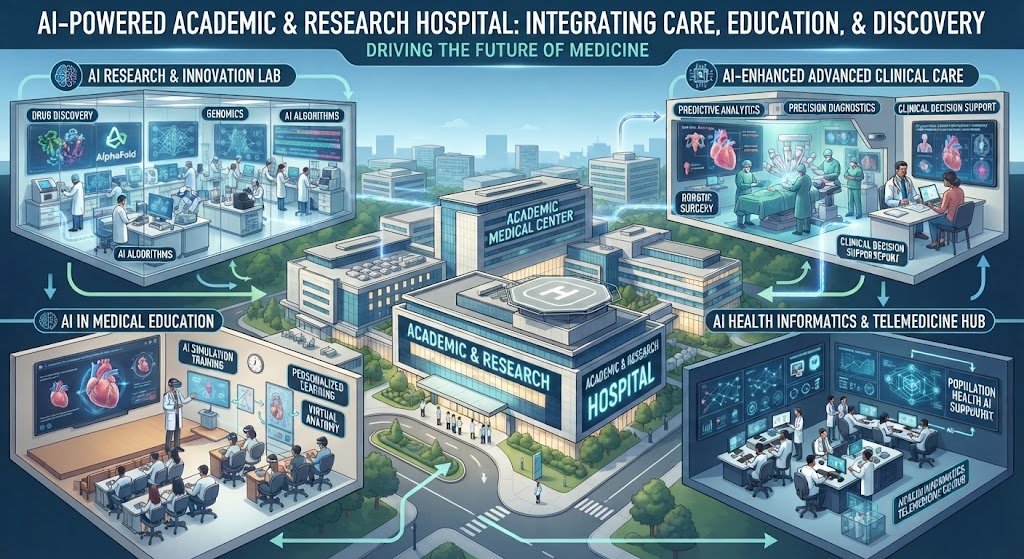
Primary topic: Artificial Intelligence in Academic & Research Hospitals
Research focus: AI adoption, clinical decision support, medical imaging, digital pathology, predictive analytics, electronic health records, clinical research, clinical trial matching, generative AI, biomedical research, workflow automation, AI governance, and the future of academic medicine.
AI in Academic & Research Hospitals: From Research Labs to Real Clinical Work
Academic and research hospitals occupy a unique position in healthcare. They do not only treat patients. They also train physicians, conduct clinical trials, generate biomedical research, develop new treatments, evaluate medical technologies, and manage highly specialized clinical services.
This combination creates an unusually rich environment for artificial intelligence.
A large academic hospital may generate information from electronic health records, medical images, pathology slides, laboratory systems, genetic tests, operating rooms, intensive-care units, wearable devices, clinical trials, research databases, and patient monitoring systems.
AI can potentially connect these information sources and identify patterns that would be difficult to detect manually.
The important point is that academic hospitals should not approach AI as a single technology project.
Different departments have different requirements.
Radiology may need computer vision for image interpretation. Pathology may need digital-slide analysis. Oncology may need predictive models and clinical-trial matching. Emergency medicine may use early-warning systems. Researchers may use natural-language processing to extract phenotypes from electronic health records. Physicians may use generative AI to summarize records or prepare documentation.
This creates a much broader AI environment than a typical software implementation.
Academic hospitals also have an advantage that many commercial organizations do not have.
They can evaluate AI using real clinical populations while involving physicians, researchers, statisticians, data scientists, ethicists, information-technology teams, and institutional review structures.
That multidisciplinary environment can make academic medical centers important proving grounds for responsible healthcare AI.
Research from the World Health Organization emphasizes that AI can support diagnosis, treatment, health research, drug development, and health-system functions, while also requiring strong governance, safety, accountability, and human oversight.
Source: WHO: Ethics and Governance of Artificial Intelligence for Health.
Why Academic Hospitals Are Different From Ordinary Healthcare Organizations
Academic hospitals handle a wider range of clinical complexity.
They often receive referrals for difficult or unusual cases, operate specialized departments, participate in research networks, and manage patients whose conditions require multiple specialties.
That complexity produces both an opportunity and a challenge for AI.
The opportunity comes from the amount and variety of data available.
The challenge comes from the fact that the data is rarely perfectly clean.
Clinical notes may contain abbreviations, incomplete information, conflicting observations, and historical information that is no longer clinically relevant.
Medical images can have different acquisition parameters.
Laboratory values can be recorded through different systems.
Patients can move between hospitals.
Research datasets may use different definitions for the same clinical concept.
AI projects therefore require much more than model development.
A successful academic-hospital AI program needs data engineering, clinical validation, integration, monitoring, cybersecurity, governance, user training, and continuous evaluation.
Diagnosis, treatment, triage and monitoring
Discovery, phenotyping and trials
Learning, simulation and training
Capacity, staffing and workflow
Our Key Findings
Our review of current research shows that AI in academic and research hospitals is developing across several connected layers.
- AI is moving from experimental research toward operational clinical use. Academic hospitals are increasingly validating and deploying AI within real clinical workflows rather than evaluating models only in laboratories.
- Medical imaging and pathology remain major AI application areas. These fields provide large volumes of structured visual information that can be analyzed using computer vision.
- Electronic health records are becoming research datasets as well as clinical records. Natural-language processing and machine learning can extract phenotypes, risk factors, outcomes, and other research variables from routine documentation.
- Clinical trial matching is a major research-hospital opportunity. AI can screen structured and unstructured patient information against eligibility criteria and reduce manual chart-review workload.
- Generative AI is expanding into documentation and research workflows. Large language models can assist with summaries, drafts, literature analysis, clinical communication, and research data preparation.
- AI infrastructure is becoming strategically important. Secure environments are needed when researchers or clinicians work with protected health information and large language models.
- Validation inside the institution matters. A model that works in one population or technical environment may not perform identically in another hospital.
- Academic hospitals need governance alongside innovation. AI programs must address privacy, bias, cybersecurity, clinical responsibility, transparency, monitoring, and appropriate use.
Research Evidence: AI Is Moving Into Real Academic-Hospital Workflows
The strongest evidence for academic hospitals comes from studies that move beyond algorithm development and examine how AI performs in actual clinical or research environments.
AI for Clinical Trial Patient Matching at Yale
Clinical trials are one of the most important functions of academic and research hospitals.
A major problem is finding eligible patients.
Traditional screening can require research staff to manually review medical records and compare patient information with complicated eligibility criteria.
This becomes increasingly difficult as the number of clinical trials grows.
Researchers at Yale Cancer Center, Yale School of Medicine, and Yale New Haven Hospital developed a semi-automated clinical trial patient-matching system using rules-based processing and natural-language processing.
The system used structured and unstructured electronic health record information standardized through the OMOP common data model.
The research initially evaluated the system against a metastatic colorectal cancer trial.
The system achieved 94% retrospective accuracy and 88% prospective accuracy while reaching 100% sensitivity against the study’s reference standard.
More importantly, the practical workflow results were substantial.
The researchers reported a 10-fold reduction in chart-review workload and a reduction in screening time from 3.1 minutes to 1.8 minutes per chart for patients who underwent review.
After implementation across 29 clinical trials, the system had screened 98,348 patients, identified 825 eligible candidates, and facilitated 117 enrollments.
This is a particularly important example because the value was not simply an AI accuracy score.
The system changed the research workflow.
Instead of requiring research staff to manually search every record from the beginning, AI could perform an initial screening layer and allow the research team to focus attention on likely candidates.
That model can be particularly useful in large academic hospitals where dozens or hundreds of trials may operate simultaneously.
Source: Yale Research: Clinical Trial Patient Matching Using AI and NLP.
| Research measure | Reported result | Practical meaning |
|---|---|---|
| Retrospective accuracy | 94% | Strong historical screening performance |
| Prospective accuracy | 88% | Performance in forward-looking evaluation |
| Sensitivity | 100% | Eligible candidates were less likely to be missed in the evaluated setting |
| Chart-review workload | 10× reduction | Major research-team efficiency opportunity |
| Patients screened | 98,348 | Demonstrates large-scale deployment |
| Trials supported | 29 | Shows potential for multi-trial infrastructure |
AI-Assisted Pathology in an Academic Medical Center
Pathology is another area where academic hospitals can gain significant value from AI.
Modern digital pathology converts tissue slides into high-resolution digital images.
These images can contain enormous amounts of visual information.
AI can analyze these images for specific patterns, assist with classification, quantify biomarkers, identify areas requiring review, and support pathologists during diagnosis.
A 2026 study at the University of Texas Medical Branch evaluated the institutional validation and routine implementation of an AI-assisted prostate biopsy decision-support tool.
The validation used routine clinical cases with pathologist-rendered diagnoses serving as the reference.
The AI demonstrated sensitivity between 91% and 100%, specificity of 99%, positive predictive value of 98%, negative predictive value of 96%, and an area under the curve of 0.97.
The more important finding came after implementation.
Diagnostic turnaround time decreased by 30%.
Immunohistochemistry utilization decreased by 38%.
This demonstrates the difference between an AI research project and an operational AI program.
The model was not valuable simply because it achieved high performance during validation.
It created measurable workflow changes after being integrated into a digital pathology environment.
The final diagnosis remained the responsibility of the pathologist.
This human-AI structure is likely to become an important model for academic hospitals.
Source: University of Texas Medical Branch: AI-Assisted Prostate Pathology Implementation Study.
The pathology study demonstrates that AI value can be measured through both clinical performance and operational outcomes. Diagnostic accuracy, turnaround time, ancillary testing, workload, and clinician acceptance can all become part of an AI evaluation framework.
AI for Sepsis Detection Across Five Hospitals
Early clinical deterioration is a major concern in hospital medicine.
Sepsis is especially challenging because symptoms and laboratory findings can develop rapidly and may not always appear as an obvious pattern during the earliest stages.
Researchers evaluated the Targeted Real-Time Early Warning System, known as TREWS, across five hospitals.
The prospective multi-site cohort study monitored 590,736 patients.
Among 6,877 patients with sepsis identified by the system before antibiotic therapy, patients whose alerts were confirmed by a provider within three hours had lower adjusted in-hospital mortality, organ failure, and length of stay compared with patients whose alerts were not confirmed within that period.
The adjusted relative reduction in mortality was reported as 18.7%, with an adjusted absolute reduction of 3.3 percentage points for the evaluated group.
Among patients additionally identified as high risk, the adjusted absolute mortality reduction was larger at 4.5 percentage points.
This research highlights an important concept.
An AI alert is not the intervention by itself.
The clinical response to the alert is part of the intervention.
The system identifies a possible risk.
A clinician evaluates the information.
The care team then decides what action is appropriate.
This makes AI workflow design as important as model development.
Source: Prospective Multi-Site Study of TREWS for Sepsis.
Patients monitored
Hospitals involved
Sepsis cases evaluated
Adjusted relative mortality reduction in the evaluated group
Large Language Models for Electronic Health Record Phenotyping
Academic hospitals are not only places where AI can assist patient care.
They are also large research environments.
One of the most important research tasks is clinical phenotyping.
Researchers need to identify patients who meet specific disease or clinical criteria.
The information may exist in structured fields, diagnosis codes, laboratory values, medications, and free-text clinical notes.
The challenge is that important clinical details are often hidden inside narrative documentation.
Researchers from Vanderbilt University Medical Center investigated whether large language models could help generate electronic health record phenotyping algorithms.
The work evaluated LLMs including GPT-4, GPT-3.5, Claude 2, and Bard for generating executable phenotyping algorithms for type 2 diabetes, dementia, and hypothyroidism.
The importance of this research goes beyond the specific models.
It demonstrates a potential new research workflow in which researchers can use LLMs to accelerate the first stage of algorithm development.
Instead of starting from an empty page, a researcher can generate a candidate phenotype definition, inspect the logic, compare it against the clinical literature, and then validate it against a manually reviewed dataset.
The final algorithm still requires expert validation.
AI-generated research logic should not automatically become the ground truth.
Source: Vanderbilt Research: Large Language Models for EHR Phenotyping Algorithms.
AI and Alzheimer’s Disease Phenotyping
A 2025 study from the Medical University of South Carolina used artificial-intelligence-based text classification to identify Alzheimer’s disease and related dementias from electronic health records.
The study used records for 4,000 patients aged 64 and older from an academic medical center.
The cohort included 1,000 patients identified with Alzheimer’s disease and related dementias according to the study’s reference algorithm and 3,000 matched controls.
Several AI-based text-classification approaches were evaluated against manual chart review.
This type of work is particularly relevant to research hospitals because patient records can become a powerful source of real-world evidence.
AI can help transform unstructured notes into research variables.
That can support retrospective studies, cohort construction, outcomes research, epidemiology, and clinical trial feasibility analysis.
Source: AI Approaches for Alzheimer’s Disease Phenotyping Using EHRs.
Generative AI in Academic Medical Centers
Generative AI has introduced a different category of opportunity.
Traditional machine learning is usually designed to predict, classify, rank, or detect.
Generative AI can work directly with language and other forms of unstructured information.
This makes it relevant to almost every department of an academic hospital.
Physicians can use controlled systems for documentation and record summarization.
Researchers can use AI for literature organization, protocol drafting, data exploration, and research communication.
Students can use AI-based educational tools.
Administrative teams can use AI to summarize policies and prepare routine communications.
However, the risk profile is different from conventional predictive models.
A generative model can produce a confident but incorrect statement.
It can omit an important clinical detail.
It can misunderstand a medical abbreviation.
It can generate a citation that does not support the claim.
This makes retrieval, source grounding, validation, access control, and human review especially important.
Secure Generative AI Infrastructure
Researchers at an academic medical center developed a secure infrastructure for healthcare generative-AI research.
The system used a private Azure OpenAI deployment with secure API-enabled endpoints.
The researchers explored use cases including detection of falls from electronic health record notes and evaluation of bias in mental-health prediction using fairness-aware prompts.
The significance is architectural.
Academic hospitals cannot simply allow sensitive clinical data to flow into arbitrary public AI services.
They need controlled environments with authentication, access policies, logging, data protections, and appropriate governance.
This creates an important opportunity for AI Integration and Deployment.
The future academic hospital may require an internal AI platform that allows approved models to be accessed through controlled workflows.
Source: Secure Infrastructure for Generative AI Research at an Academic Medical Center.
| Generative AI area | Potential hospital use | Required control |
|---|---|---|
| Clinical documentation | Draft notes and encounter summaries | Clinician review |
| Research | Literature synthesis and research drafting | Source verification |
| Patient communication | Plain-language explanations | Clinical approval |
| Education | Study material and simulated cases | Faculty oversight |
| Data analysis | Structured summaries from large datasets | Data governance |
Ambient AI Documentation in Academic Healthcare
Documentation is one of the most visible applications of generative AI.
Physicians spend significant time documenting patient encounters.
Ambient AI systems can listen to clinical conversations and generate draft documentation.
A 2026 pragmatic randomized clinical trial evaluated two ambient AI scribe applications against usual care.
The trial included 238 outpatient physicians across 14 specialties.
Participants were assigned to either one of two AI scribe applications or a usual-care control group.
The study measured time spent writing notes as well as physician workload, professional fulfillment, work environment, stress, safety, accuracy, and usability.
This research is important because it moves the evaluation of generative AI beyond demonstrations.
A healthcare organization can ask measurable questions.
Does documentation time decrease?
Does after-hours work decrease?
Do clinicians feel less administrative burden?
Are generated notes accurate?
Do clinicians trust the system appropriately?
Does patient communication change?
These are the questions that determine whether ambient AI provides real institutional value.
Source: Ambient AI Scribes in Clinical Practice: A Randomized Trial.
AI in Radiology and Medical Imaging
Radiology has become one of the most mature areas for clinical AI.
Academic hospitals generate enormous quantities of imaging data through CT, MRI, X-ray, ultrasound, mammography, and other modalities.
AI can assist with detection, classification, segmentation, triage, reconstruction, quantitative measurements, and workflow prioritization.
The FDA’s AI-enabled medical-device database provides a useful view of the technology landscape.
The current FDA list includes numerous authorized AI-enabled devices across radiology, cardiovascular medicine, pathology, neurology, oncology, gastroenterology, and other areas.
The list includes products for tasks such as image analysis, triage, reconstruction, segmentation, and clinical decision support.
The FDA also states that its AI-enabled device list is not comprehensive and is updated periodically.
Source: FDA: Artificial Intelligence-Enabled Medical Devices.
Academic hospitals are particularly important in this area because they can evaluate imaging AI in diverse populations and complicated referral settings.
A radiology AI system may work well in a controlled study but behave differently when image protocols, scanners, patient populations, or disease prevalence change.
Research on AI implementation in radiology at a large academic medical center in the Netherlands found that successful implementation involves challenges at multiple organizational levels.
The researchers conducted a three-year longitudinal case study involving observations, meetings, interviews, and relevant documents.
The lesson is that AI implementation is not simply a technical deployment.
It is an organizational change project.
Source: A Holistic Approach to Implementing AI in Radiology.
AI in Hospital Operations
Academic hospitals operate complex systems.
They manage emergency departments, operating rooms, intensive-care units, outpatient clinics, diagnostic laboratories, inpatient beds, pharmacies, imaging departments, and specialist services.
AI can support these systems through predictive analytics.
Potential applications include:
- Emergency-department demand forecasting.
- Inpatient bed demand prediction.
- Operating-room scheduling optimization.
- Staffing and workload forecasting.
- Patient-flow optimization.
- Length-of-stay prediction.
- Readmission-risk prediction.
- Appointment no-show prediction.
- Laboratory workload forecasting.
- Imaging-volume prediction.
- Discharge planning support.
- Supply and inventory forecasting.
The important distinction is that operational AI does not always require a high-risk clinical model.
Predicting tomorrow’s imaging volume is fundamentally different from recommending a cancer treatment.
This means hospitals can sometimes begin their AI journey with lower-risk operational use cases while building technical and governance maturity.
Predict demand before resources become constrained.
Match staffing resources with expected workload.
Identify bottlenecks across patient journeys.
Forecast equipment and service demand.
AI for Biomedical and Translational Research
Research hospitals are also becoming AI-powered research environments.
Biomedical research produces enormous datasets.
These can include genomic data, proteomic data, imaging data, clinical records, laboratory measurements, molecular structures, clinical-trial information, and patient-generated data.
AI can help researchers analyze these datasets and identify patterns.
The National Institute of Arthritis and Musculoskeletal and Skin Diseases, for example, identifies data science, AI, machine learning, and computational biology as strategic research priorities.
The agency highlights the opportunity created by large amounts of biomedical research data and advances in computing while emphasizing data sharing, stewardship, and quality assurance.
Source: NIAMS: Data Science, AI/ML and Computational Biology Research Priority.
AI-Assisted Drug Development
Drug development is another major research-hospital opportunity.
AI can support target identification, molecular design, biomarker discovery, patient stratification, trial design, adverse-event analysis, and prediction of treatment response.
A 2025 review in Nature Medicine examined the role of artificial intelligence across drug development.
Academic hospitals can contribute to this ecosystem because they connect laboratory research with human clinical data.
A research team might identify a molecular hypothesis in the laboratory and then use clinical data to investigate how the related disease behaves in real patient populations.
AI can help connect these layers.
Source: Artificial Intelligence in Drug Development.
AI for Research Data Extraction and Knowledge Discovery
Academic hospitals contain years of historical clinical information.
Much of this information exists in free-text notes rather than neatly structured databases.
Natural-language processing can convert narrative information into structured research variables.
This can make large retrospective studies more practical.
Researchers can use AI to identify:
- Patients with specific diseases.
- Clinical symptoms and findings.
- Treatment histories.
- Medication exposure.
- Adverse events.
- Procedure histories.
- Risk factors.
- Clinical outcomes.
- Referral patterns.
- Longitudinal disease progression.
The biggest advantage is scale.
A human research team may review hundreds of records manually.
A properly validated AI pipeline can process a much larger dataset and then direct researchers toward the cases that require detailed review.
The final research dataset still requires quality assurance.
AI should accelerate data preparation, not remove scientific verification.
AI for Medical Education and Physician Training
Academic hospitals have an additional responsibility that ordinary healthcare organizations may not have to the same extent.
They train the next generation of healthcare professionals.
AI can support medical education through interactive clinical cases, simulated patients, personalized learning, question generation, documentation exercises, and feedback.
Generative AI can create simulated conversations that allow trainees to practice clinical communication.
It can also explain complex concepts at different levels.
However, educational AI needs faculty oversight.
A generated explanation can contain subtle inaccuracies.
Students may also become overly dependent on AI-generated answers instead of developing clinical reasoning skills.
The strongest educational model is therefore guided use.
AI can provide additional practice.
Faculty members remain responsible for defining learning objectives, checking accuracy, and evaluating trainee performance.
AI Workflow Inside an Academic Hospital
The most useful way to understand hospital AI is as a connected workflow.
This model can be applied to many hospital departments.
In radiology, the input may be an imaging study.
In pathology, it may be a whole-slide image.
In clinical research, it may be an electronic health record.
In clinical trials, it may be a patient profile and trial eligibility criteria.
In hospital operations, it may be historical patient-flow information.
The model is similar, but the decision and risk level are different.
AI Capability Map for Academic & Research Hospitals
| AI capability | Hospital application | Primary value | Key requirement |
|---|---|---|---|
| Computer Vision | Radiology, pathology, ophthalmology and surgery | Detection and measurement | Validated datasets |
| Machine Learning | Risk prediction and forecasting | Early identification | Reliable longitudinal data |
| NLP | Clinical notes and research phenotyping | Information extraction | Clinical language validation |
| Generative AI | Documentation, research and communication | Information transformation | Human review |
| Predictive Analytics | Capacity, deterioration and outcomes | Proactive decisions | Monitoring and calibration |
| AI Workflow Automation | Trials, referrals and administration | Lower manual workload | Workflow integration |
| AI Integration | EHR, PACS, LIS and research systems | Connected AI environment | Interoperability and security |
AI in Digital Pathology and Cancer Research
Cancer centers inside academic hospitals are particularly well positioned for AI because oncology generates multiple types of data.
A cancer patient may have pathology slides, radiology images, laboratory results, molecular data, treatment history, medication records, physician notes, and outcomes.
AI can potentially analyze these sources together.
Digital pathology is especially important.
AI models can support tumor detection, grading, biomarker quantification, tissue classification, and prognostic analysis.
A 2025 review of AI in cancer pathology described applications involving hematoxylin and eosin images, tumor classification, grading, biomarker quantification, and prognostic and predictive information.
The research also emphasized that interpretability, validation, clinical integration, human oversight, and post-deployment monitoring remain important challenges.
Source: Application of Artificial Intelligence and Digital Tools in Cancer Pathology.
This creates an important opportunity for academic cancer centers.
Instead of using AI only for diagnosis, institutions can investigate whether image-derived information can contribute to treatment-response prediction, patient stratification, clinical-trial selection, and longitudinal outcomes research.
AI for Clinical Research Recruitment
Clinical trial recruitment is one of the strongest examples of where academic hospitals can combine AI with existing institutional data.
Trial eligibility criteria are often written in complex language.
The criteria can include age, diagnosis, laboratory thresholds, previous treatments, disease stage, imaging findings, medications, organ function, and previous procedures.
Many of these variables exist in different sections of the EHR.
AI can extract the information and compare it with trial requirements.
A practical system can therefore operate as a research assistant.
The Yale study provides real-world evidence for this approach.
Its use across 29 trials demonstrates that the concept can extend beyond a single disease or research protocol.
The major opportunity is not merely faster recruitment.
Better screening can also help research teams identify eligible patients who might otherwise remain hidden inside large EHR populations.
AI for Predictive Clinical Decision Support
Predictive AI can estimate the probability of future events using existing patient information.
Academic hospitals can evaluate models for:
- Clinical deterioration.
- Sepsis risk.
- Readmission.
- Length of stay.
- Complications.
- Emergency escalation.
- Medication-related risk.
- Hospital resource utilization.
- Follow-up requirements.
- Potential high-risk patient populations.
The challenge is that prediction does not automatically improve care.
The prediction needs to arrive at the right time.
The clinical team needs to understand what the signal means.
There must be an appropriate action available.
The hospital also needs to measure whether the intervention produces better outcomes.
The TREWS research illustrates this principle clearly.
Patients whose alerts were confirmed promptly by clinicians had better outcomes in the study’s adjusted analysis.
This suggests that AI should be designed as a decision-support workflow rather than an isolated prediction engine.
AI and Research Infrastructure
As AI adoption grows, academic hospitals will need stronger technical infrastructure.
The infrastructure may include:
- Secure AI development environments.
- De-identified research datasets.
- Controlled access to protected health information.
- Model registries.
- Evaluation environments.
- Data-quality monitoring.
- Model-performance dashboards.
- Audit logs.
- Identity and access management.
- Integration with EHR, PACS and laboratory systems.
- Research-computing environments.
- Governance workflows for approving AI tools.
The architecture should separate experimentation from production clinical use.
A research team may be allowed to test a model in a sandbox.
A production model that influences clinical care should pass additional institutional requirements.
This separation can reduce the risk of experimental software accidentally becoming part of patient care without sufficient evaluation.
Responsive AI Implementation Architecture
EHR, imaging, pathology, labs and research data
Authentication, permissions, encryption and auditability
ML, NLP, computer vision and generative AI
Alerts, tasks, documentation and research processes
Accuracy, safety, outcomes and adoption
This type of architecture allows an academic hospital to develop multiple AI applications without rebuilding the entire technology environment for every new project.
Challenges That Academic Hospitals Must Solve
The biggest barriers to healthcare AI are often not the algorithms.
Data Quality
Clinical data is messy.
Missing values, inconsistent terminology, duplicate records, changing documentation styles, and differences between departments can affect model performance.
Data-quality monitoring should therefore be part of AI development rather than an afterthought.
Generalizability
A model trained at one institution may not automatically perform equally well at another.
Patient populations differ.
Equipment differs.
Clinical workflows differ.
Coding practices differ.
Disease prevalence differs.
Academic hospitals should therefore consider local validation before relying on an external AI model for important decisions.
Bias and Health Equity
AI learns from data.
If historical data contains gaps or unequal representation, an AI model can reproduce those limitations.
This can be especially important when models are used across populations with different demographic, socioeconomic, geographic, or clinical characteristics.
Evaluation should examine performance across relevant patient groups.
Privacy and Security
Academic hospitals manage sensitive health information.
AI systems must therefore be designed around appropriate security and privacy requirements.
Generative AI introduces additional considerations because users may accidentally provide sensitive information to systems that were not designed for clinical data.
Secure institutional infrastructure can reduce this risk.
Workflow Resistance
Even a highly accurate AI model can fail if clinicians do not use it.
Too many alerts can create alert fatigue.
Poorly designed interfaces can slow clinicians down.
AI outputs that cannot be easily interpreted may be ignored.
Implementation research therefore needs to evaluate human factors.
Accountability
Hospitals must clearly define who is responsible when AI is involved in a decision.
The clinician, institution, technology vendor, data team, and governance group may have different responsibilities.
These responsibilities should be defined before deployment.
Academic Medical Center AI Governance
Academic hospitals should create governance structures that bring clinical, technical, research, legal, ethical, and operational perspectives together.
A multidisciplinary AI governance committee can evaluate proposed AI applications before deployment.
Potential review areas include:
- Clinical purpose.
- Intended users.
- Risk classification.
- Training and validation data.
- Performance metrics.
- Known limitations.
- Privacy requirements.
- Cybersecurity requirements.
- Human-review requirements.
- Integration architecture.
- Monitoring plan.
- Incident-management process.
- Vendor responsibilities.
- Model-update procedures.
The WHO’s guidance emphasizes that AI in healthcare should be designed and deployed with ethics, human rights, accountability, safety, transparency, and responsible governance.
The WHO’s 2025 guidance on large multimodal models also highlights the expanding role of generative AI across healthcare, scientific research, public health, and drug development.
Source: WHO: Ethics and Governance of Large Multimodal Models.
Research on AI Governance at Academic Medical Centers
A review focused specifically on safe and ethical implementation of healthcare AI at an academic medical center examined the risks that arise when institutions adopt rapidly evolving AI technologies.
The researchers highlighted challenges involving patient safety, equity, clinical practice, and institutional oversight.
This is significant because academic hospitals have to balance two responsibilities.
They must encourage innovation while also protecting patients and maintaining scientific standards.
The solution is not to stop experimentation.
It is to create controlled experimentation.
Researchers should have room to test new ideas, but clinical deployment should require stronger evidence and oversight.
Source: Toward Safe and Ethical Implementation of Healthcare AI: Insights From an Academic Medical Center.
AI Adoption Framework for Academic & Research Hospitals
A useful AI program should move through several practical stages.
Identify the Problem
Start with a clinical, research, educational, or operational problem.
The hospital should define what is currently slow, expensive, inconsistent, difficult to scale, or dependent on repetitive manual work.
Assess the Data
Determine whether the required data exists.
The team should examine data quality, volume, completeness, representativeness, ownership, privacy requirements, and access.
Build or Select the AI System
The institution can then determine whether it needs a commercial product, an open model, a custom model, or a combination of technologies.
The choice should be based on the actual workflow rather than the popularity of a particular AI model.
Validate Locally
Academic hospitals should evaluate AI using representative local data before making important clinical decisions dependent on it.
External validation can provide useful evidence, but local validation can reveal differences in patient populations and workflows.
Integrate Into Workflow
The AI system should connect to the software clinicians and researchers already use.
Integration with EHR, PACS, LIS, clinical-trial systems, research databases, and identity systems can determine whether users actually adopt the technology.
Deploy With Oversight
Production deployment should include appropriate professional review and clear escalation processes.
High-risk applications require stronger safeguards.
Measure Outcomes
The hospital should measure what changed after AI implementation.
The evaluation should include technical performance and real-world outcomes.
AI Opportunity Matrix for Academic Hospitals
| Department | AI opportunity | Technology | Potential KPI |
|---|---|---|---|
| Radiology | Image detection, triage and quantitative analysis | Computer Vision + ML | Turnaround time and diagnostic performance |
| Pathology | Slide analysis and biomarker quantification | Computer Vision | TAT and concordance |
| Emergency Medicine | Deterioration and risk prediction | Machine Learning | Recognition time and outcomes |
| Oncology | Trial matching and patient stratification | NLP + ML | Eligible candidates and enrollment |
| Research | EHR phenotyping and cohort construction | NLP + LLMs | Research time and phenotype quality |
| Administration | Documentation and workflow automation | Generative AI + Automation | Task time and workload |
| Medical Education | Simulation and personalized learning | Generative AI | Learning outcomes |
What Academic Hospitals Should Measure
AI adoption should not be judged by the number of AI tools purchased.
The better question is whether the technology improves a defined outcome.
| Measurement area | Examples |
|---|---|
| Clinical quality | Diagnostic accuracy, missed findings, adverse events and clinical outcomes |
| Workflow | Turnaround time, task completion time and manual workload |
| Research | Recruitment speed, cohort construction time and data quality |
| Patient | Access, satisfaction, follow-up completion and communication |
| Staff | Workload, cognitive burden, adoption and satisfaction |
| Financial | Cost per case, resource utilization and return on investment |
| Safety | Error rates, escalation events, model failures and incidents |
Future Predictions for AI in Academic & Research Hospitals
AI Will Become Embedded Into Clinical Software
Clinicians are unlikely to want a separate application for every AI task.
The more practical future is embedded intelligence.
A radiologist may see AI findings inside the imaging workflow.
A pathologist may receive AI-supported measurements within the digital pathology system.
A researcher may receive trial-matching suggestions inside the research platform.
A physician may see an AI-generated documentation draft inside the EHR.
This reduces workflow friction.
Multimodal AI Will Become More Important
Healthcare information is naturally multimodal.
A single patient can generate text, images, laboratory values, genomic information, audio, physiological measurements, and longitudinal records.
Large multimodal models are being investigated because they can accept multiple types of information.
WHO specifically identifies large multimodal models as a rapidly developing area with potential applications in healthcare, scientific research, public health, and drug development.
Source: WHO Guidance on Large Multimodal Models.
The future academic hospital may therefore use AI systems capable of connecting information that is currently stored in separate systems.
Clinical Trial Recruitment Will Become More Automated
The Yale implementation demonstrates that AI can already screen large patient populations across multiple trials.
Future systems may continuously evaluate eligible patients as new clinical data becomes available.
A newly diagnosed patient could automatically trigger evaluation against appropriate trials.
A research coordinator could receive a ranked list of potentially eligible patients.
The coordinator would then perform the final review and patient-contact process.
AI Will Support Personalized Research
Academic hospitals hold longitudinal data covering years of patient care.
Machine learning can identify subgroups within diseases.
This can support research into why patients with apparently similar diagnoses experience different outcomes.
AI can help identify patterns in treatment response, disease progression, comorbidities, and risk.
AI Will Become Part of the Researcher Toolset
Researchers will increasingly use AI for literature review, coding assistance, dataset exploration, phenotype generation, statistical workflow support, and research documentation.
This will not eliminate the need for scientific expertise.
Instead, it can reduce the time required to move from a research question to a testable analysis.
Model Monitoring Will Become Routine
AI performance can change after deployment.
Patient populations can change.
Clinical workflows can change.
Imaging equipment can change.
Documentation patterns can change.
The model itself may also be updated.
Academic hospitals will therefore need monitoring systems that continuously evaluate whether deployed AI continues to perform as expected.
Strategic Recommendations for Academic & Research Hospitals
Start With High-Value Problems
Do not begin with the question, “Where can we use AI?”
Begin with the question, “Which important problem can AI solve better?”
This approach prevents AI programs from becoming technology demonstrations without measurable institutional value.
Build a Central AI Governance Function
Large hospitals should avoid allowing every department to independently purchase or deploy AI tools without institutional coordination.
A central governance function can establish common standards for security, validation, procurement, monitoring, and clinical oversight.
Develop an Internal AI Platform
Academic hospitals can benefit from shared AI infrastructure.
A centralized platform can provide approved access to models while maintaining security and governance.
Researchers can use controlled environments for experimentation.
Clinical teams can use approved production systems.
Use Interoperable Data Standards
AI becomes more useful when data can move reliably between systems.
Common data models can help research teams create scalable pipelines.
The Yale clinical-trial matching project demonstrates how an OMOP-based approach can support a system that operates across multiple clinical trials.
Prioritize Human-AI Collaboration
The strongest clinical AI model is not necessarily the one that makes the most autonomous decisions.
In many academic-hospital settings, the better system is the one that provides useful information at the right moment and allows an expert to review it.
This can improve trust and maintain professional accountability.
Publish Real-World Evidence
Academic hospitals have a unique opportunity to generate evidence about AI.
They can publish results from implementation studies.
They can evaluate performance across patient populations.
They can document failure modes.
They can compare workflows before and after deployment.
This evidence can improve the broader healthcare AI ecosystem.
What This Means for Healthcare AI Startups
Academic hospitals are attractive partners for healthcare AI companies because they can provide clinical expertise, research infrastructure, patient populations, validation environments, and specialized workflows.
However, startups should not approach an academic hospital with a generic AI product and expect immediate adoption.
The product should solve a clearly defined problem.
A successful proposal should explain:
- What clinical or research problem is being solved.
- What data the system requires.
- How the AI produces its output.
- How the output enters the existing workflow.
- What evidence supports the technology.
- What local validation is required.
- How patient data is protected.
- How clinicians or researchers remain involved.
- How performance will be monitored after deployment.
- Which measurable outcomes define success.
The strongest opportunity may not be the AI model itself.
It may be the complete workflow surrounding the model.
That includes data ingestion, preprocessing, inference, user interfaces, alerts, documentation, audit trails, human review, analytics, and outcome measurement.
Original Research Opportunity Map
| Research area | AI opportunity | Data source | Expected research value |
|---|---|---|---|
| Clinical research | Patient phenotyping | EHR notes and structured records | Faster cohort creation |
| Clinical trials | Eligibility matching | EHR + trial criteria | Recruitment efficiency |
| Pathology | Tumor and biomarker analysis | Whole-slide images | Diagnostic and translational insights |
| Radiology | Detection and quantitative imaging | CT, MRI, X-ray and ultrasound | Earlier detection and workflow support |
| Population health | Risk stratification | Longitudinal EHR data | Identify high-risk populations |
| Drug development | Target and response analysis | Clinical + molecular data | Faster hypothesis generation |
| Medical education | AI simulation and tutoring | Clinical cases and curricula | Personalized learning |
Frequently Asked Questions
How is AI used in academic and research hospitals?
AI is used for clinical decision support, medical imaging, digital pathology, predictive analytics, electronic health record analysis, clinical-trial matching, research data extraction, documentation, patient communication, medical education, hospital operations, and biomedical research.
Why are academic hospitals important for healthcare AI?
Academic hospitals combine complex clinical care with medical education and research. They also generate large amounts of clinical and research data, making them valuable environments for developing, validating, and studying AI systems.
How can AI help clinical research?
AI can help researchers identify patient cohorts, extract information from clinical notes, phenotype diseases, analyze large datasets, identify potential research participants, summarize literature, and support clinical-trial recruitment.
How is AI used for clinical trial matching?
AI can analyze structured and unstructured electronic health record data and compare patient characteristics with trial eligibility criteria. Research at Yale demonstrated that such a system can reduce manual chart-review workload and screening time.
Can AI replace doctors in academic hospitals?
AI should generally be treated as an assistive technology in clinical environments. Qualified professionals remain responsible for clinical judgment, particularly when an AI output can influence diagnosis, treatment, or other high-risk decisions.
How can AI help hospital radiology departments?
AI can support image detection, triage, segmentation, quantitative analysis, reconstruction, prioritization, and selected clinical decision-support workflows.
How can AI help pathology departments?
AI can analyze digital pathology images for selected diagnostic and quantitative tasks. Recent clinical implementation research has shown that AI-assisted pathology can affect diagnostic turnaround time and ancillary-test utilization when integrated into routine digital workflows.
What is AI phenotyping in healthcare research?
AI phenotyping means using computational methods to identify patients with particular diseases, characteristics, or clinical patterns from healthcare data. It can use structured records, clinical notes, and other information sources.
What is Generative AI used for in academic hospitals?
Generative AI can assist with clinical documentation, record summaries, research writing, literature organization, patient communication, educational content, and selected data-analysis workflows.
Why does AI need local validation?
AI performance can change when patient populations, equipment, data quality, clinical workflows, or disease prevalence change. Local validation helps an institution understand whether a model performs appropriately in its own environment.
What is the biggest AI opportunity for academic hospitals?
The strongest opportunity is usually found where a large amount of reliable data is connected to a measurable problem. Clinical imaging, pathology, clinical-trial recruitment, EHR phenotyping, predictive analytics, and documentation are particularly important areas.
What should hospitals consider before deploying AI?
Hospitals should evaluate clinical validity, technical performance, data quality, privacy, cybersecurity, interoperability, usability, workflow impact, professional oversight, regulatory requirements, monitoring, and measurable outcomes.
Credible Data Sources and Original Research References
- Yale Cancer Center and Yale New Haven Hospital: AI-driven clinical-trial patient matching using structured and unstructured EHR data. The system screened 98,348 patients across 29 trials and reduced chart-review workload by 10-fold in the reported implementation. Source: Original research on PubMed.
- University of Texas Medical Branch: Institutional validation and clinical implementation of AI-assisted prostate cancer pathology. The study reported high diagnostic performance and reductions in diagnostic turnaround time and immunohistochemistry utilization after implementation. Source: Original research on PubMed.
- Sepsis and hospital care: A prospective multi-site study evaluated TREWS across five hospitals and examined outcomes associated with provider interaction with AI-generated sepsis alerts. Source: Original research on PubMed.
- Vanderbilt University Medical Center: Research examined whether large language models could help generate electronic health record phenotyping algorithms for diseases including diabetes, dementia, and hypothyroidism. Source: Original research on PubMed.
- Medical University of South Carolina: AI-based text classification was investigated for Alzheimer’s disease and related dementia phenotyping using electronic health record notes from an academic medical center. Source: Original research on PubMed.
- Academic medical center generative AI infrastructure: Researchers developed a secure infrastructure for using large language models with sensitive healthcare data and explored healthcare research use cases. Source: Original research on PubMed.
- Ambient AI documentation: A 2026 pragmatic randomized clinical trial evaluated two ambient AI scribe applications among 238 outpatient physicians across 14 specialties. Source: Original research on PubMed.
- Radiology implementation: A three-year longitudinal case study examined AI implementation in radiology at a large academic medical center and identified organizational and workflow factors affecting adoption. Source: Original research on PubMed.
- Aga Khan University: A 2026 multidisciplinary study developed an evidence-based action plan for integrating AI into medical education, research, and clinical practice at an academic medical center. Source: Original research on PubMed.
- Digital pathology: Research on implementing digital pathology and AI in routine pathology practice examines practical requirements for moving AI from development into clinical environments. Source: PubMed research.
- Computational pathology integration: Research has proposed a standardized open-source framework for integrating deep-learning models into laboratory information systems, addressing the gap between algorithm development and clinical deployment. Source: Original research on PubMed.
- AI in cancer pathology: A 2025 review examined AI applications in cancer pathology, including tumor classification, grading, biomarker quantification, and prognostic and predictive analysis. Source: PubMed research.
- AI in drug development: Research reviewed AI applications across drug-development workflows and its potential role in accelerating biomedical discovery. Source: PubMed research.
- AI in clinical trials: A comprehensive review examined AI applications in clinical-trial design, recruitment, monitoring, and other parts of the trial lifecycle. Source: PubMed research.
- FDA: The FDA maintains an AI-enabled medical-device list covering authorized AI-enabled devices and explains that the list is updated periodically and is not comprehensive. Source: FDA AI-Enabled Medical Devices.
- WHO: WHO guidance addresses ethics and governance of AI in health and emphasizes safety, accountability, human rights, transparency, and responsible implementation. Source: WHO Ethics and Governance of AI for Health.
- WHO Large Multimodal Models: WHO guidance published in 2025 examines ethical and governance considerations for large multimodal models in healthcare, scientific research, public health, and drug development. Source: WHO Guidance on Large Multimodal Models.
- NIAMS: The National Institute of Arthritis and Musculoskeletal and Skin Diseases identifies data science, AI/ML, and computational biology as research priorities for advancing biomedical knowledge and treatments. Source: NIAMS AI/ML Research Priority.
- Academic medical center AI safety: Research examining safe and ethical implementation of healthcare AI in academic medical centers highlights risks involving patient safety, equity, governance, and clinical practice. Source: PubMed research.
Final Perspective
Artificial intelligence is becoming an important part of the academic and research hospital environment because these institutions sit at the intersection of patient care, scientific discovery, education, and technology.
The strongest opportunities are not limited to one department.
Radiology can use computer vision for image-based workflows.
Pathology can use AI to analyze digital slides and support diagnostic processes.
Emergency departments can use predictive models to identify clinical deterioration.
Research teams can use natural-language processing to build patient cohorts.
Cancer centers can use AI to match patients with clinical trials.
Physicians can use generative AI to reduce documentation workload.
Biomedical researchers can use AI to analyze complex datasets and accelerate hypothesis generation.
Hospital administrators can use predictive analytics to improve operational planning.
These applications create a larger vision of the AI-enabled academic hospital.
AI can help clinicians process complex information.
AI can accelerate data extraction, cohort building and trial recruitment.
Predictive analytics can support capacity and workflow planning.
Experts remain central to high-risk clinical decisions.
The evidence increasingly suggests that the next stage of healthcare AI will be defined by implementation quality.
Academic hospitals have the ability to test AI more rigorously than many other environments because they combine clinical expertise, research capabilities, data infrastructure, and multidisciplinary teams.
That advantage also creates responsibility.
Hospitals need to validate models locally, monitor performance, protect patient information, evaluate equity, document limitations, and make accountability clear.
The most successful institutions will not simply deploy the largest number of AI tools.
They will build reliable AI infrastructure that connects high-quality data with validated models and carefully designed human workflows.
The long-term opportunity is therefore much bigger than AI-assisted diagnosis.
Academic and research hospitals can become intelligent research and care environments where AI helps transform large volumes of clinical and scientific information into useful insights while keeping professional judgment, patient safety, and scientific integrity at the center of the process.
Leave a Reply