
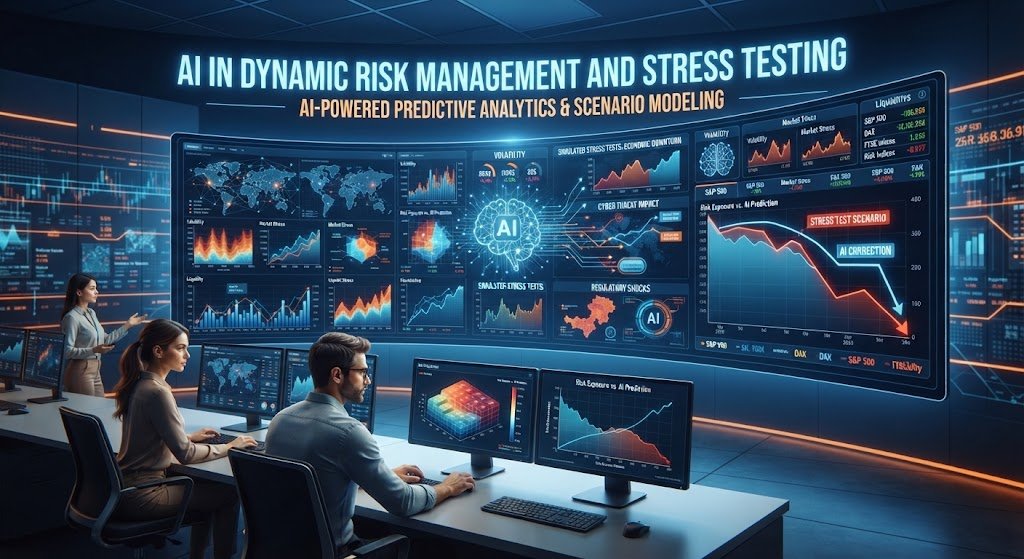
Primary topic: AI in Dynamic Risk Management and Stress Testing
Research focus: Banking, financial institutions, market risk, credit risk, liquidity risk, operational risk, systemic risk, scenario analysis, stress testing, machine learning, dynamic risk monitoring, and AI-powered financial resilience
What Is AI in Dynamic Risk Management?
Dynamic risk management means continuously assessing how the risk profile of a financial institution, portfolio, product, or market is changing rather than relying only on periodic assessments. In traditional systems, risk teams may update models daily, weekly, monthly, or around scheduled regulatory stress tests. AI can shorten this feedback loop by processing new information as it becomes available and identifying changes in relationships between variables.
For a bank, this can involve monitoring loan portfolios, deposits, interest rates, market prices, liquidity positions, customer behavior, payment activity, macroeconomic indicators, news, and operational events at the same time. A machine-learning system can then estimate changing probabilities of default, liquidity pressure, losses, volatility, fraud exposure, or other risk measures.
The objective is not simply to predict a crisis. A more useful objective is to identify changing risk conditions early enough for management to investigate them and potentially adjust exposure, liquidity buffers, capital allocation, hedging, lending standards, or contingency plans.
Identify abnormal movements, changing correlations, emerging vulnerabilities, and unusual behavior.
Estimate future losses, defaults, liquidity pressure, volatility, and capital impacts.
Simulate severe but plausible scenarios across multiple risk factors.
Give risk teams decision-support signals and recommended actions for investigation.
Why Dynamic Risk Management Matters
Financial risk is rarely static. Interest rates can change quickly, credit conditions can deteriorate, asset correlations can move toward one, deposit behavior can change, and liquidity can disappear faster than historical averages suggest. A model trained on relatively stable periods may therefore perform differently when the financial environment becomes stressed.
This is one reason stress testing remains a core part of banking risk management. The Basel Committee describes stress testing as a critical risk-management and supervisory tool that helps institutions identify unexpected adverse outcomes and assess the financial resources required to absorb large shocks. The framework also emphasizes that stress tests should be forward-looking and should inform business decisions rather than operate as isolated exercises.
Source: Basel Committee on Banking Supervision, Stress Testing
AI adds a new layer to this framework because it can help generate, rank, analyze, and continuously update large numbers of scenarios. Instead of asking only what happened during a particular historical crisis, institutions can examine combinations of shocks that have not previously occurred together.
Traditional Stress Testing vs AI-Enhanced Stress Testing
| Area | Traditional approach | AI-enhanced approach |
|---|---|---|
| Data | Mostly structured historical data | Structured, behavioral, market, text, transaction, and alternative data |
| Risk detection | Rules, thresholds, and periodic reviews | Continuous anomaly and pattern detection |
| Forecasting | Econometric and statistical models | ML, neural networks, ensembles, and hybrid models |
| Scenarios | Predefined historical or hypothetical scenarios | Large scenario sets and dynamically adjusted scenarios |
| Response | Periodic management action | Near-real-time decision support |
| Main challenge | Limited scenario breadth and nonlinear relationships | Model risk, explainability, data drift, and systemic AI concentration |
Research Evidence: What Recent Studies Show
Machine Learning Can Improve Bank Stress-Test Forecasting
A 2024 study published in the International Review of Financial Analysis examined machine-learning approaches for stress testing U.S. bank holding companies. The research combined macroeconomic and microeconomic information and evaluated whether ML could improve forecasts used in stress-testing exercises.
The study reported that machine-learning models improved forecasts of pre-provision net revenue and net charge-offs compared with linear models. It also found that ML models better approximated Tier 1 capital ratio density during periods of turmoil, while linear models tended to underestimate systemic risk in stress-test settings.
This finding is important because financial stress is often nonlinear. A small change in unemployment, interest rates, asset prices, or credit quality may have limited effects during normal conditions but substantially larger effects when several vulnerabilities interact. ML models can capture some of these nonlinear relationships without requiring every interaction to be specified manually.
Research meaning:
- ML can improve certain stress-test forecasting tasks.
- Nonlinear relationships may become particularly important during financial turmoil.
- Traditional linear models can underestimate some systemic-risk relationships.
- ML should be evaluated under stressed conditions, not only normal-market validation periods.
Machine Learning for Predicting Bank Failures Has Important Limits
A 2025 Finance Research Letters study examined U.S. financial institutions using data from 2001 through 2023 and compared several machine-learning approaches for predicting bank failures. The models included Random Forest, logistic regression, XGBoost, Support Vector Machine, and neural networks.
Random Forest produced the strongest overall accuracy in the study. The researchers also introduced exponentially weighted moving averages to incorporate the time dimension of financial data. This is particularly relevant to dynamic risk management because recent observations may contain more information about current risk conditions than very old observations.
However, the study also found an important limitation: predictive performance depended heavily on key financial characteristics, and severe stress conditions reduced predictive power. This is a critical warning for financial institutions. A model can perform well during normal conditions and still become less reliable precisely when decision-makers need it most.
AI Can Help Build More Dynamic Stress Scenarios
A 2025 BIS analysis of AI and financial stability explains that AI can potentially improve stress-testing frameworks by learning from historical crises, generating plausible crisis narratives, processing large scenario sets, and supporting dynamic stress simulations. The analysis specifically notes that AI could allow assumptions to change during simulations rather than forcing every scenario to remain static.
This creates a major opportunity for scenario analysis. A traditional scenario might specify a recession, higher unemployment, falling asset prices, and higher defaults. A dynamic AI system could examine how those variables interact and then generate additional paths based on observed relationships, such as a deposit outflow that creates liquidity pressure, which then changes asset sales, capital ratios, funding costs, and market confidence.
Source: BIS, G20 2025 report on the use of artificial intelligence for policy purposes
AI Can Also Create New Systemic Risks
AI does not only improve risk management. It can also change the risk landscape itself. The BIS has highlighted the possibility that widespread use of similar AI models could create correlated behavior across financial institutions, particularly if firms rely on common external providers, similar datasets, or similar objectives.
This matters because diversification can disappear at the model level. If multiple institutions respond to the same market signal in the same way, an apparently rational individual decision can become a source of collective instability. A market shock could therefore be amplified if many AI systems simultaneously reduce risk, sell assets, tighten credit, or change liquidity positions.
In a BIS speech on AI and financial stability, Hyun Song Shin noted that stress testing could be used to examine how AI models used by banks and non-banks might interact and whether their reaction functions could amplify shocks.
Source: BIS, Engaging with the machine: AI and financial stability
Expert quotation
“We could perhaps use stress tests to understand how AI models used for trading … could interact with each other.”
Hyun Song Shin, Economic Adviser and Head of Research, Bank for International Settlements
Climate Risk Makes Dynamic Stress Testing More Important
Climate-related financial risk is another area where conventional static scenarios can become difficult to manage. Climate shocks may develop over long periods, while transition policies, carbon prices, energy markets, technology changes, and physical risks can interact with bank portfolios in complex ways.
A 2025 study in the Journal of Financial Economics developed CRISK, a market-based measure of banks’ expected capital shortfall under climate stress. The researchers constructed climate-risk factors and dynamically estimated banks’ sensitivity to those factors, then connected market-risk exposure with credit-risk information from large U.S. bank loan portfolios.
The research demonstrates how dynamic measures can move beyond a simple question such as “What happens if climate losses increase?” and instead examine how a bank’s exposure and sensitivity evolve as financial conditions change.
A separate 2025 critical survey of climate stress testing identified limitations in existing approaches, including insufficient treatment of some climate shocks, excessive reliance on highly aggregated macro models, incomplete feedback mechanisms, and limited coverage of causal channels and asset classes.
Machine Learning Is Expanding Across Multiple Banking Risk Types
A 2025 systematic review examined 46 recent studies covering machine learning in banking risk management. The review found that academic research has historically concentrated heavily on credit risk but increasingly covers market risk, operational risk, liquidity risk, and other financial risks.
The review identified predictive capabilities and learning ability as important strengths of artificial neural networks and other ML techniques. At the same time, it emphasized that significant research gaps remain and that implementation challenges must be considered alongside algorithmic performance.
This is particularly relevant to dynamic risk management because a modern risk platform should not treat credit, liquidity, market, and operational risks as completely independent systems. A major shock can move through several risk categories at once.
Source: Machine learning in banking risk management: Mapping a decade of evolution
AI Governance Is Becoming Part of Risk Governance
The BIS 2025 report on AI governance in central banks emphasizes that AI adoption creates new risks around data security, confidentiality, model behavior, and reputation. It recommends integrating AI governance with established risk-management structures rather than creating a completely separate control system.
The report specifically discusses the value of using existing three-lines-of-defence structures and proposes an adaptive governance framework. This approach is important for banks because the risk of an AI system is not limited to its prediction accuracy. Data quality, access controls, model changes, vendor dependencies, human oversight, and operational resilience all matter.
Source: BIS, Governance of AI adoption in central banks
Research Evidence Dashboard
| Research area | Evidence | Practical implication |
|---|---|---|
| Bank stress testing | ML improved several forecasting tasks | Use ML alongside established stress models |
| Bank failure prediction | Random Forest performed strongly, but stress reduced predictive power | Continuously test model robustness |
| Dynamic scenarios | AI can process and generate broader scenario sets | Increase scenario coverage |
| Systemic AI risk | Similar models may create correlated reactions | Stress-test model interaction and concentration |
| Climate risk | Dynamic exposure measures can capture changing sensitivity | Connect climate, market, and credit risk |
| AI governance | Governance and model controls remain essential | Integrate AI into enterprise model-risk governance |
Where AI Can Be Used in Dynamic Risk Management
Continuous Credit Risk Monitoring
AI can continuously reassess credit risk by combining borrower financial information with payment behavior, account activity, industry conditions, macroeconomic indicators, and other approved data sources. Instead of updating a risk score only when a scheduled review occurs, models can identify changes in borrower behavior that warrant investigation.
- Early-warning detection for deteriorating borrowers.
- Dynamic probability-of-default estimation.
- Portfolio-level concentration monitoring.
- Sector-specific stress analysis.
- Identification of unusual changes in repayment behavior.
Liquidity Risk Monitoring
Liquidity risk can develop rapidly, making it particularly suitable for continuous monitoring. AI systems can analyze deposit flows, withdrawals, funding costs, collateral values, cash positions, market liquidity, and customer behavior to identify changes in liquidity conditions.
The objective should not be to let a model make autonomous funding decisions. Instead, the system should provide earlier signals to treasury and risk teams so they can examine the underlying drivers and activate appropriate contingency procedures.
Market Risk and Volatility Detection
Machine-learning models can identify nonlinear relationships between market variables and detect changes in volatility regimes. They can also process large amounts of market and text data to identify information that may affect risk conditions.
- Volatility regime detection.
- Correlation monitoring.
- Value-at-Risk and Expected Shortfall support.
- Liquidity and market-depth monitoring.
- Scenario sensitivity analysis.
- News and sentiment signal extraction.
Operational Risk
Operational risk involves system failures, cyber events, process errors, fraud, third-party incidents, and other disruptions. AI can detect unusual transaction patterns, system behavior, workflow anomalies, and operational signals that may precede a larger event.
This makes AI useful not only for predicting financial losses but also for identifying the operational conditions that could create those losses.
Stress Testing Capital Adequacy
AI can accelerate the process of estimating how changes in economic conditions affect revenue, provisions, capital ratios, liquidity, and balance-sheet composition. This can allow risk teams to run more scenarios without treating every scenario as a separate manual modeling exercise.
AI-powered dynamic stress-testing loopLive data → Risk signals → Scenario generation → Portfolio simulation → Loss projection → Capital/liquidity impact → Human review → Management action → New data → Continuous monitoring
AI-Powered Stress Scenario Generation
One of the most important opportunities is scenario generation. Conventional stress tests often begin with a defined set of macroeconomic assumptions. AI can expand the scenario space by examining historical relationships and generating combinations of shocks that may not appear in a standard template.
For example, a bank could examine a scenario involving higher interest rates, falling commercial property values, increasing defaults, deposit outflows, higher wholesale funding costs, and reduced market liquidity. The model could then test different speeds and magnitudes of these changes.
Generative AI may eventually assist with the narrative layer of scenario development, but generated scenarios should not automatically be treated as credible. Every scenario needs economic logic, expert review, traceability, and clear assumptions.
Scenario design should include:
- Baseline conditions.
- Severe but plausible adverse conditions.
- Multiple correlated shocks.
- Reverse stress scenarios.
- Historical crisis scenarios.
- Hypothetical forward-looking scenarios.
- Model-failure and data-failure scenarios.
- AI concentration and common-model scenarios.
Reverse Stress Testing With AI
Traditional stress testing generally asks what happens to the institution if a particular shock occurs. Reverse stress testing starts from an undesirable outcome and asks what combination of conditions could produce it.
AI can make reverse stress testing more computationally practical. A system can search across combinations of interest rates, defaults, market prices, liquidity, funding costs, unemployment, and other variables to identify pathways that could cause capital or liquidity thresholds to be breached.
This approach can be particularly useful for identifying vulnerabilities that are not obvious when risks are examined independently.
Dynamic Risk Management Architecture
Market, credit, liquidity, macro, transaction, operational and approved alternative data
Forecasting, anomaly detection, classification, NLP and scenario models
Loss, capital, liquidity, exposure and stress calculations
Validation, explainability, monitoring, approvals and audit trails
High-Value AI Use Cases
| Use case | AI role | Human role |
|---|---|---|
| Early-warning systems | Detect changing risk patterns | Investigate and confirm drivers |
| Stress scenario generation | Generate and rank scenarios | Approve economic plausibility |
| Portfolio stress testing | Estimate nonlinear loss impacts | Challenge assumptions |
| Liquidity monitoring | Detect unusual flow patterns | Decide funding response |
| Model monitoring | Detect drift and performance changes | Validate and recalibrate |
| Systemic risk | Simulate correlated behavior | Assess broader market implications |
AI Model Risk Is a Core Risk
The introduction of AI does not remove model risk. It changes it. Complex models can contain hidden assumptions, data dependencies, unstable relationships, and performance degradation that may not be visible through traditional validation methods.
The Federal Reserve’s supervisory guidance on model risk management states that model risk can lead to financial losses, reporting errors, and flawed financial and risk-management decisions. The guidance emphasizes active model-risk management and recognizes that model risk depends on the model’s nature, scale, and use.
Source: Federal Reserve, Supervisory Guidance on Model Risk Management
For AI-based stress testing, validation should therefore examine more than predictive accuracy. Risk teams should test whether the model remains stable under distribution shifts, crisis conditions, missing data, unusual market relationships, and changes in the underlying portfolio.
Major Risks of AI in Dynamic Risk Management
| Risk | Why it matters | Control |
|---|---|---|
| Data drift | Relationships can change after deployment | Continuous performance monitoring |
| Model opacity | Risk teams may struggle to explain outputs | Explainability and model documentation |
| False confidence | High historical accuracy can hide crisis weakness | Crisis-period and out-of-distribution testing |
| Common-model risk | Institutions may react similarly | Model concentration monitoring |
| Vendor dependency | Third-party models can become critical infrastructure | Vendor risk and contingency controls |
| Data quality | Bad inputs can produce convincing but incorrect outputs | Data validation and lineage |
| Scenario hallucination | Generative systems can produce unrealistic scenarios | Expert review and deterministic constraints |
AI and Systemic Risk
Systemic risk is one of the most important reasons to avoid looking at AI only from an individual-institution perspective. A model can be highly effective for one bank while still creating broader risks if many banks use similar models, similar data, or similar decision rules.
The BIS has highlighted financial-stability implications from AI adoption, including the potential for AI to change market dynamics, improve risk assessment, and create new vulnerabilities. The organization has also pointed to the possibility of common AI dependencies and interactions between AI-driven financial decisions.
Source: BIS, Financial stability implications of artificial intelligence
A future stress-testing framework should therefore include an “AI-on-AI” layer. Instead of testing only how a bank behaves under a market shock, regulators and institutions can examine what happens when multiple AI systems respond to the same shock simultaneously.
Dynamic Stress Testing Across Risk Categories
| Shock | Primary impact | Secondary impact |
|---|---|---|
| Interest-rate shock | Bond and loan valuation | Funding costs and deposits |
| Credit deterioration | Higher defaults and provisions | Capital and lending capacity |
| Deposit outflow | Liquidity pressure | Asset sales and market impact |
| Market crash | Trading and investment losses | Collateral and liquidity effects |
| Cyber event | Operational disruption | Liquidity, reputation, and customer impacts |
| Climate shock | Physical or transition losses | Credit, market, and capital effects |
AI for Early-Warning Risk Dashboards
One of the most practical applications is an AI-powered early-warning dashboard. Instead of presenting hundreds of individual indicators, the system can organize signals into risk themes and identify which changes deserve human attention.
Example dynamic risk dashboard
Default probability
Delinquency trend
Sector concentration
Deposit flows
Funding costs
Liquidity buffer
Volatility
Correlation
Market depth
System anomalies
Fraud signals
Third-party incidents
Human-in-the-Loop Risk Management
For material financial decisions, AI should operate as decision support rather than a replacement for risk governance. The strongest architecture gives AI responsibility for processing scale and identifying patterns while humans remain responsible for interpretation, challenge, approval, escalation, and accountability.
- AI detects a material change in risk conditions.
- The system explains the primary drivers and supporting indicators.
- Risk officers review the underlying data and model output.
- Independent validation can challenge the model where appropriate.
- Management decides whether exposure or strategy should change.
- The system records the decision and outcome for later evaluation.
This structure also makes it easier to investigate false alarms. A dynamic system will inevitably produce signals that do not result in losses. The objective is not perfect prediction; it is better decision-making with measurable controls.
AI Maturity Model for Financial Risk Management
| Stage | Capability | Typical state |
|---|---|---|
| Foundation | Data and model inventory | Mostly conventional risk systems |
| Assisted | AI analytics and anomaly detection | AI supports analysts |
| Predictive | Dynamic risk forecasting | Continuous early warnings |
| Scenario-driven | Dynamic stress testing | Large scenario coverage |
| Integrated | Cross-risk AI platform | Credit, market, liquidity and operational risk connected |
| Adaptive | Continuous learning with strong governance | Risk intelligence continuously monitored and challenged |
Expert Recommendation
Financial institutions should not begin with a large “AI risk platform” project. A better approach is to start with one clearly defined risk problem where data quality is strong, outcomes can be measured, and human review already exists.
- Start with early-warning analytics: Choose a specific credit, liquidity, market, or operational risk signal.
- Build a reliable data foundation: Establish lineage, quality checks, access controls, and consistent definitions before training complex models.
- Benchmark against conventional models: AI should demonstrate measurable incremental value rather than simply replacing an established model because it is newer.
- Stress the AI model itself: Test performance during recessions, volatility spikes, liquidity events, missing-data conditions, and distribution shifts.
- Keep humans accountable: Material risk decisions should have clear ownership and escalation paths.
- Monitor model concentration: Track whether multiple business units or institutions depend on the same external AI provider or model family.
- Build scenario explainability: Every important stress scenario should have understandable assumptions and documented economic reasoning.
- Use hybrid architecture: Combine conventional statistical models, regulatory models, machine learning, expert judgment, and scenario analysis rather than depending on a single technique.
The Federal Reserve’s stress-testing guidance also emphasizes that financial institutions should use multiple exercises because every stress test has limitations and relies on assumptions. This principle becomes even more important when AI is introduced.
Source: Federal Reserve, Interagency Supervisory Guidance on Stress Testing
Implementation Roadmap
Phase A: Risk inventory
- Map material risks.
- Identify existing models.
- Document data sources.
Phase B: Pilot
- Select one use case.
- Build baseline model.
- Measure incremental AI value.
Phase C: Stress
- Run crisis scenarios.
- Test model stability.
- Challenge assumptions.
Phase D: Integration
- Connect risk systems.
- Add governance controls.
- Create executive dashboards.
Phase E: Continuous monitoring
- Monitor drift.
- Review outcomes.
- Revalidate models.
What Financial Institutions Should Measure
| KPI | What it measures |
|---|---|
| Prediction accuracy | Quality of risk forecasts |
| Early-warning lead time | How much earlier risks are identified |
| False-positive rate | Frequency of unnecessary alerts |
| Stress robustness | Performance under adverse conditions |
| Model drift | Changes in model performance over time |
| Decision impact | Whether AI improves actual risk decisions |
| Explainability | Ability to understand important outputs |
Future Predictions for 2027–2030
Dynamic Stress Testing Will Become More Continuous
Stress testing is likely to move beyond a small number of scheduled exercises toward more frequent internal simulations. Institutions will increasingly run smaller scenario sets throughout the year and reserve deeper exercises for material changes in the macroeconomic or financial environment.
AI Will Combine Multiple Risk Types
Risk platforms will increasingly connect credit, market, liquidity, operational, cyber, and climate risks. This matters because major financial events rarely remain inside one risk category. A market shock can affect collateral, liquidity, credit quality, capital, and customer behavior at the same time.
AI-on-AI Stress Testing Will Become More Important
As AI becomes embedded in trading, lending, fraud detection, portfolio management, and risk systems, regulators and institutions will need to test how these models interact. The question will increasingly move from “Is this model accurate?” to “What happens when thousands of similar models respond to the same shock?”
Scenario Generation Will Become More Automated
AI will increasingly assist analysts in constructing combinations of macroeconomic, market, behavioral, and operational shocks. However, credible financial institutions will retain expert review because plausible-looking scenarios can still contain unrealistic assumptions.
Model Governance Will Become a Competitive Capability
Organizations that can deploy AI quickly while maintaining strong validation, auditability, explainability, and operational controls will have an advantage over institutions that treat AI governance as an afterthought.
Climate and Geopolitical Stress Testing Will Expand
Financial institutions will increasingly combine traditional financial shocks with physical climate events, transition risks, supply-chain disruption, energy shocks, geopolitical events, and policy changes. AI can help manage the computational complexity of these multidimensional scenarios.
Startup Opportunities in AI Risk Management
The growth of dynamic risk management creates opportunities for fintech and enterprise AI companies. Startups do not necessarily need to build another generic risk dashboard. More specialized products can address individual parts of the risk workflow.
- AI-powered early-warning systems for regional banks.
- Dynamic liquidity-risk monitoring.
- AI stress-testing engines for credit portfolios.
- Reverse stress-testing platforms.
- Climate-risk scenario engines.
- AI model-drift monitoring for financial institutions.
- AI scenario-generation platforms with governance controls.
- Cross-risk exposure visualization.
- AI model concentration and vendor-dependency monitoring.
- Stress-testing tools for fintech lenders and digital banks.
- Explainability platforms for financial risk models.
- Risk simulation APIs for fintech software platforms.
Legacy Modernization Opportunity
Many financial institutions do not need to replace their existing core banking, risk, or regulatory systems to adopt AI. In many cases, the better approach is to create an AI layer around established systems.
Existing risk engines can continue calculating regulatory and accounting measures while AI services process additional data, identify patterns, generate alerts, and run supplementary scenarios. This reduces migration risk and allows institutions to compare AI outputs against established models before expanding the system.
Legacy modernization modelCore banking / Risk systems → Secure data layer → AI analytics → Stress engine → Risk dashboard → Human approval
Questions Financial Leaders Should Ask Before Deployment
- What specific risk problem is AI solving?
- Does AI provide measurable value beyond the current model?
- How does the model behave during stress?
- What happens when input data is missing or delayed?
- Can risk officers understand the main drivers of an alert?
- Who is accountable for acting on the output?
- How frequently is the model validated?
- Could multiple business units depend on the same model or vendor?
- What happens if the AI service becomes unavailable?
- Can every important model output be audited later?
FAQs
What is AI-powered dynamic risk management?
It is the use of machine learning, artificial intelligence, and continuously updated data to monitor changing financial risks, forecast potential losses, identify emerging vulnerabilities, and support risk decisions more frequently than traditional periodic risk processes.
Can AI replace traditional financial stress testing?
AI should not automatically replace established stress-testing frameworks. Current evidence supports using AI to improve forecasting, scenario analysis, and dynamic simulation while retaining conventional models, expert review, governance, and independent validation.
What financial risks can AI monitor?
AI can support credit risk, market risk, liquidity risk, operational risk, fraud risk, climate-related financial risk, and systemic-risk analysis. The appropriate model depends on the risk type, data quality, regulatory requirements, and decision context.
What is the biggest challenge with AI stress testing?
One of the biggest challenges is that an AI model may become less reliable under the same unusual conditions that the stress test is designed to study. Model drift, distribution shifts, limited crisis data, common-model risk, and explainability therefore need to be tested explicitly.
Can generative AI create financial stress scenarios?
Generative AI can assist with scenario narratives and scenario exploration, but generated scenarios should be constrained by economic assumptions and reviewed by financial risk experts. A realistic-sounding scenario is not necessarily a credible stress scenario.
Why is AI systemic risk important?
If many financial institutions use similar models, data, or vendors, they may react similarly to the same market signal. This can create correlated behavior and potentially amplify market stress, making AI-model concentration an important part of future systemic-risk analysis.
Final Perspective
AI is changing financial risk management from a largely periodic analytical process toward a more continuous and adaptive system. The strongest opportunity is not simply faster prediction. It is the ability to connect changing data, early-warning signals, scenario analysis, stress testing, and management decisions into one feedback loop.
Recent research provides encouraging evidence that machine learning can improve parts of bank stress testing and risk prediction, particularly when financial relationships become nonlinear. At the same time, research and supervisory guidance make an equally important point: AI can fail under stress, models can become correlated across institutions, and complex systems introduce new forms of model and operational risk.
The practical path forward is therefore a hybrid one. Financial institutions should combine AI forecasting and scenario generation with established financial models, independent validation, human judgment, strong data governance, continuous monitoring, and clearly documented stress-testing assumptions.
In the coming years, the most valuable risk-management systems will likely be those that can answer not only “What is our risk today?” but also “How could that risk change tomorrow, what combination of events could cause it, and how resilient are our models when the environment changes?”
Key Research Sources
- A machine learning approach in stress testing US bank holding companies, International Review of Financial Analysis
- Predicting U.S. bank failures and stress testing with machine learning algorithms, Finance Research Letters
- BIS, G20 2025 report: The use of artificial intelligence for policy purposes
- BIS, Engaging with the machine: AI and financial stability
- CRISK: Measuring the climate risk exposure of the financial system
- Climate risk stress testing: A critical survey and classification
- Machine learning in banking risk management: Mapping a decade of evolution
- BIS, Governance of AI adoption in central banks
- Basel Committee on Banking Supervision, Stress Testing
- Federal Reserve, Supervisory Guidance on Model Risk Management
- Federal Reserve, Interagency Supervisory Guidance on Stress Testing
- BIS, Financial stability implications of artificial intelligence
Leave a Reply