
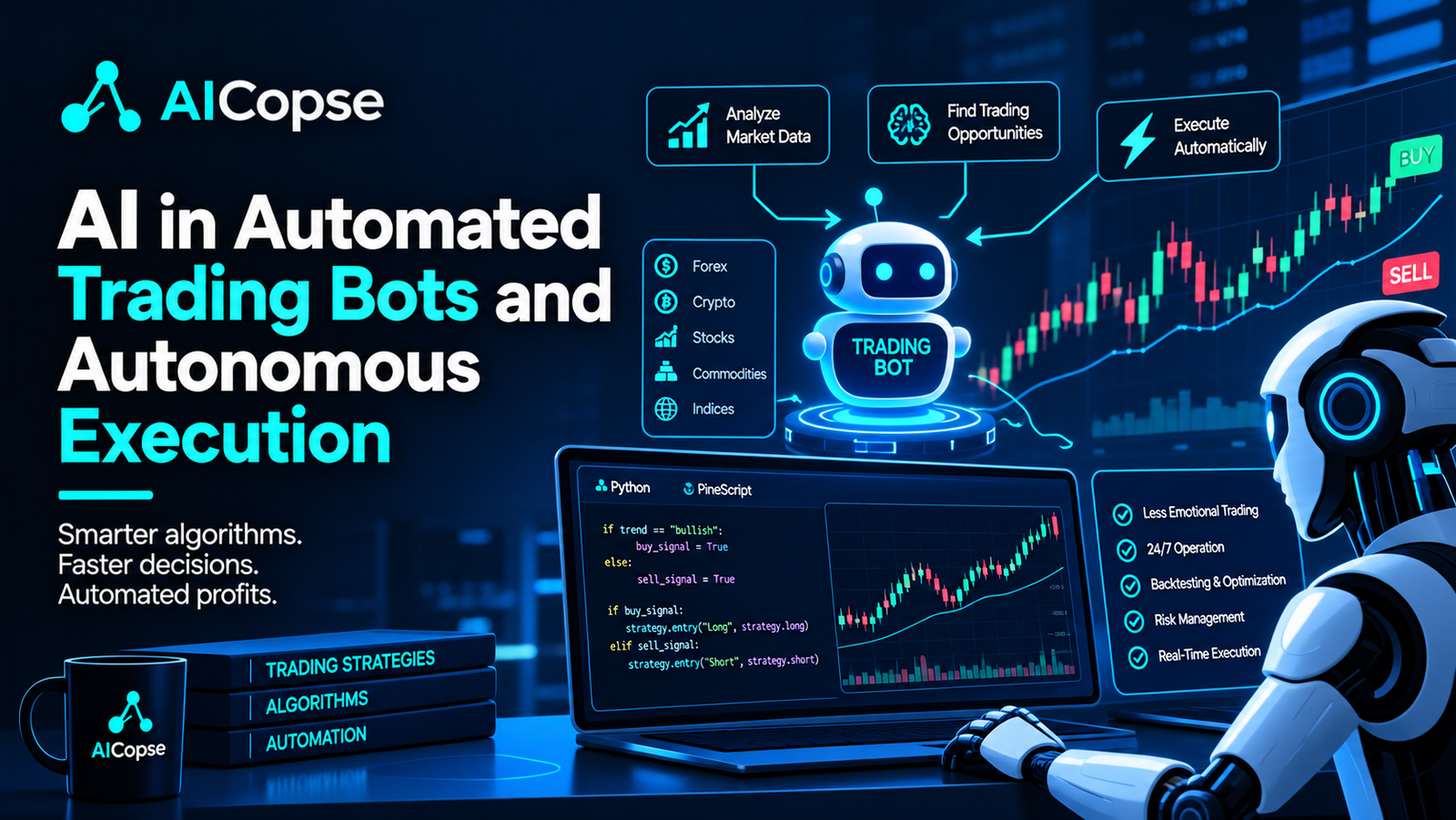
Research focus: AI agents, algorithmic trading, autonomous execution, reinforcement learning, brokerage APIs, crypto trading, transaction costs, model evaluation, operational controls and financial-market governance.
Executive Summary
AI-powered trading is moving beyond software that follows a fixed buy or sell rule. New systems can combine market data, news analysis, portfolio information, risk limits and execution tools to recommend or carry out actions. The important change is not simply that a bot can predict a price movement. It is that an AI system may now connect research, decision-making and order placement inside one workflow.
However, greater autonomy does not automatically mean greater profitability. A model can interpret news incorrectly, learn a pattern that disappears, place an order into an illiquid market or continue trading during a technical failure. The strongest design is therefore not an unrestricted AI trader. It is a controlled execution system in which AI operates within clear permissions, measurable limits, independent risk checks and a reliable process for stopping activity.
For developers, the opportunity is to build more adaptive trading infrastructure. For startups, it is to make complex market workflows easier to use and monitor. For established financial businesses, it is to improve execution quality, surveillance and operational efficiency without weakening existing controls. For individual traders, the most useful role for AI may initially be research assistance, strategy testing and supervised automation rather than completely independent trading.
This report examines the technology, recent developments, six research studies, practical implementation methods, competitive content opportunities and likely direction of autonomous trading through 2030. The central question is not whether AI can place an order. It is whether the entire system can make a defensible decision, execute it correctly and remain safe when the market or technology behaves unexpectedly.
What You Will Learn
- How AI trading bots differ from traditional algorithmic systems.
- What autonomous execution means in stock, futures, forex and crypto markets.
- What six research studies actually tell us, including their limitations.
- How to design a practical architecture for a trading bot.
- How to evaluate strategies beyond headline returns and win rates.
- Which security, financial and regulatory controls belong in a production system.
- What developers, startups and financial firms should prioritize next.
What Is AI in Automated Trading?
An automated trading bot is software that monitors information and carries out trading instructions according to a programmed process. A traditional bot might buy an asset when its short-term moving average crosses above a longer-term moving average. It may sell when the opposite condition occurs. The rules are predetermined, and the software executes them whenever the required conditions appear.
An AI-powered trading system can add models that classify market conditions, estimate risk, interpret financial news, rank potential opportunities or adapt decisions based on new observations. Some systems use machine learning for a specific task. Others use multiple components, including conventional trading algorithms, predictive models, language models and execution services.
The term autonomous execution describes a system that can move from an approved decision to an actual order without requiring a person to manually approve every step. Autonomy can be limited or extensive. A system might automatically adjust the timing of an approved order while a human still decides which asset to trade. A more advanced agent might research an opportunity, propose a strategy, calculate an order and submit it under predefined permissions.
These designs should not be treated as equally safe. The more authority a system receives, the greater the consequences of an incorrect signal, compromised credential or unexpected software behavior.
| System type | How it works | Main limitation |
|---|---|---|
| Rule-based bot | Executes explicit rules written by a developer or trader. | May struggle when market conditions change. |
| ML trading model | Estimates patterns, probabilities or market regimes from data. | Can overfit historical data or fail on new conditions. |
| AI research assistant | Summarizes news, reviews positions and proposes potential trades. | Can produce incorrect facts or unsupported reasoning. |
| Autonomous agent | Connects analysis, decision tools and order execution under assigned permissions. | A faulty decision can become a real financial transaction quickly. |
| Hybrid system | Combines AI forecasts with deterministic strategy and risk rules. | Requires careful integration and clear responsibility between components. |
For many real-world applications, a hybrid system is a sensible starting point. AI can estimate whether market conditions favor a strategy, while conventional code checks order size, available funds, permitted instruments and loss limits. This separates uncertain predictions from rules that should never be ignored.
Why Autonomous Trading Is Becoming More Important
Markets generate more information than a person can continuously review. Prices, order books, earnings releases, economic announcements, exchange notices and portfolio exposures change throughout the day. AI can help process these inputs, identify events that deserve attention and connect them to predefined workflows.
At the same time, software interfaces are changing. Instead of asking users to navigate several screens and manually construct every instruction, newer AI-enabled tools let users describe what they want in ordinary language. The system can help translate that request into research steps or structured trade instructions. The critical engineering requirement is to prevent a natural-language request from bypassing the controls that protect an account.
OPPORTUNITY 01
More context
Combine market prices with news, economic events and portfolio exposure.
OPPORTUNITY 02
Consistent execution
Apply approved order rules without relying on someone to click at the right moment.
CHALLENGE 03
Control the downside
Prevent model errors, excessive orders and infrastructure failures from escalating.
The 2026 shift: from AI assistants to systems that can act
Recent developments show that AI tools are moving closer to financial account infrastructure. On June 1, 2026, Interactive Brokers announced an integration with Claude that allows clients to research stocks, analyze performance and generate trade instructions, with the client approving each trade. The company expanded its AI integration capabilities in June and announced broader compatibility with Model Context Protocol, or MCP, tools in July 2026.
In August 2026, TechCrunch reported that Binance had introduced Agent OS, connecting AI agents with its financial infrastructure and allowing different levels of user-authorized trading access. The report highlighted a central security question: an agent may be allowed to act, but the user must still decide what account permissions and limits it receives. These examples show the direction of the industry; they do not establish that autonomous trading is profitable or safe in every setting.
Sources: Interactive Brokers AI integration announcement, Interactive Brokers MCP integration announcement and TechCrunch report on Binance Agent OS.
The lesson for product teams is that account connectivity is becoming a product feature, but secure authorization remains a separate engineering responsibility. A successful demonstration of an agent submitting an order is not the same as evidence that the agent can manage capital responsibly through market stress.
What Does an Autonomous Trading Bot Actually Do?
A production trading bot is not one model that receives a prompt and magically makes money. It is a chain of services. Each service has a specific responsibility, and the overall system is only as dependable as the weakest important component.
The Autonomous Trading Lifecycle
Step 1. Market data and event ingestion
Collect approved prices, volume, order-book updates, corporate announcements and relevant news.
↓
Step 2. Signal and context analysis
Estimate opportunities, classify market conditions and identify conflicting or unreliable information.
↓
Step 3. Strategy decision
Apply the approved trading strategy, account constraints and position-sizing rules.
↓
Step 4. Independent risk gateway
Reject orders that breach position, exposure, price, loss, liquidity or permission limits.
↓
Step 5. Broker or exchange execution
Submit an approved order, track its status and handle partial fills, rejections and cancellations.
↓
Step 6. Reconciliation and monitoring
Compare actual account positions with internal records, measure execution quality and stop the system when required.
This separation is essential. A language model should not be the only component deciding whether an order is allowed. Its output should be converted into a structured request, checked by deterministic software and then passed to an authorized execution service. The execution service should not assume that an order succeeded simply because an API request was sent.
Three kinds of autonomy
- Decision support: AI reviews the market and proposes an action, but a person submits the order.
- Supervised automation: the system can place orders within defined limits, while a person monitors activity and can intervene.
- Bounded autonomous execution: the system can make and execute decisions inside a tightly restricted mandate, with independent risk controls and emergency shutdown mechanisms.
For a new business or individual developer, supervised automation is generally the most sensible stage to target. It allows a team to measure real execution behavior before granting the software broader authority. Moving to more autonomy should be based on demonstrated reliability, not on the excitement of a new AI model.
Six Research Studies That Explain the Opportunity and the Risks
Research on autonomous trading includes controlled market experiments, reviews of AI-agent systems and models tested through historical backtests. These forms of evidence answer different questions. An experimental market can help reveal how an AI trader affects human participants. A survey can identify weaknesses in published evaluation methods. A backtest can test a specific strategy under stated assumptions, but it cannot prove that the same performance will continue in a live market.
Study 1 | Published 2026
The Impact of an Autonomous AI Trader on Experimental Asset Markets
What the researchers investigated: A study published in the Journal of Economic Behavior and Organization examined experimental asset markets in which a neural-network-based autonomous AI trader interacted with human participants. The research asked whether adding an autonomous trader changed market mispricing and the financial outcomes experienced by human traders.
What they found: The presence of the AI trader did not significantly change the overall level of mispricing in the experimental markets under the reported conditions. However, human participants’ wealth declined significantly when the autonomous trader was present. The AI trader consistently performed as the strongest participant in the experiment, and the findings remained when its market power was doubled.
Why it matters: A capable trading agent can affect the distribution of financial outcomes without necessarily improving the market’s overall pricing efficiency. This is important for developers and policymakers because a profitable agent is not automatically evidence of a healthier market.
What it does not prove: The experiment does not establish that an AI bot will outperform human traders in real stock markets, across different asset classes or after real-world costs. Controlled experimental markets are useful for studying behavior, but they do not reproduce every feature of live trading infrastructure.
Practical lesson: Evaluate both the agent’s own performance and its wider effects. For firms, this means considering liquidity, concentration, order behavior and market impact, not just a bot’s returns.
Source: Journal of Economic Behavior and Organization, 2026.
Study 2 | Published 2024
Humans in Charge of Trading Robots: The First Experiment
What the researchers investigated: Published in the Review of Finance in 2024, this experiment examined markets where participants could use automated trading algorithms while retaining the option to trade manually. The researchers compared conditions in which robots could be halted or replaced with conditions that imposed stronger commitment to automated behavior.
What they found: Automated robots did not eliminate market mispricing. In the early stages of trading, the experiment observed higher bid-ask spreads and more frequent flash crashes or price surges than in the manual-trading comparison. Participants could earn more when they combined robot-assisted trading with manual decisions.
Why it matters: Automation can create consistency, but the wrong strategy can also continue acting when market conditions change. A robot may respond faster than a person while still following an unsuitable rule. The ability to halt or replace an algorithm is therefore part of the system’s design, not an optional convenience.
Practical lesson: Build an emergency stop, exposure limits and human intervention procedures before increasing autonomy. A trading bot should be easy to disable when it produces unexpected orders, not merely easy to start.
Source: Review of Finance, 2024.
Study 3 | Research published in 2026
Agentic Trading: When LLM Agents Meet Financial Markets
What the researchers investigated: This research maps evidence on large language model agents that interpret information, retrieve context, reason about market conditions and generate trading actions. The paper’s central contribution is an audit of how existing studies evaluate such systems, including whether they document execution timing, transaction costs, trading-universe construction and reproducibility.
What they found: The authors screened 77 studies and identified a smaller group of 19 that met their minimum boundary for action output and closed-loop evaluation. Within that primary group, only two reported extractable time-consistent split protocols, one documented an explicit transaction-cost model, and none reached the paper’s highest reproducibility category.
Why it matters: The field is developing quickly, but many reported results are difficult to compare. A strategy that ignores transaction costs or uses inconsistent testing periods may appear stronger than it would in production. An impressive chart is not enough to establish a dependable trading system.
Practical lesson: A development team should publish its data period, asset universe, costs, execution assumptions, benchmark, risk measures and test procedure. Reproducibility should be treated as a core feature of a trading product.
Source: Agentic Trading: When LLM Agents Meet Financial Markets, 2026.
Study 4 | Published 2026
AI Agents in Financial Markets: Architecture, Applications and Systemic Implications
What the research contributes: Hui Gong’s 2026 research proposes a framework for understanding financial AI agents through four layers: data perception, reasoning, strategy generation and execution with control. It also considers how autonomy, the connection between decision-making and execution, infrastructure concentration and the ability to supervise systems can affect market outcomes.
Why it matters: Trading risk is not determined only by how intelligent a model is. It also depends on the permissions it has, the services it can access, the speed at which its actions reach the market and whether other participants are using similar approaches. Several agents can respond to the same event in similar ways, potentially amplifying a market move.
How to interpret it: The article offers an analytical framework and an exploratory empirical application. It does not validate every possible systemic outcome or establish a universal measure of agent risk. Its value lies in expanding the analysis beyond a single model’s accuracy.
Practical lesson: Review the entire deployment environment. Consider shared model providers, cloud dependencies, broker connections, correlated strategies, fallback systems and the quality of audit logs.
Source: FinTech, 2026.
Study 5 | Published 2025
Explainable Zero-Shot Trading Using a Multi-Agent LLM Architecture
What the researchers investigated: A 2025 study in Information Processing and Management proposed a Bitcoin trading framework built around multiple language-model agents. Different agents considered information such as technical indicators, on-chain metrics, macroeconomic signals and text-based sentiment. A GPT-4o-based meta-agent combined these inputs into an overall trading decision.
What the reported results suggest: The authors reported favorable short-term backtest returns and competitive risk-adjusted performance over a historical period of about 1,400 days. The approach also aimed to make the decision process more explainable by having the agents provide reasons for their recommendations.
Why it matters: A multi-agent architecture can separate research responsibilities instead of asking one general-purpose model to handle everything. For example, a news agent can summarize a company announcement, a market-data model can estimate volatility, and a risk service can decide whether a proposed trade meets the system’s rules.
What remains uncertain: Historical Bitcoin performance does not establish that the system will work on other assets or in future markets. Backtests can be sensitive to data selection, costs, market conditions and model choices. An explanation generated by an AI is also not proof that the underlying decision is correct.
Practical lesson: Use specialist components when they improve measurable performance, and require independent validation before turning their combined output into live orders.
Study 6 | Published 2024
AI Trading Controls and the Risk of Weak Governance
Research and supervisory evidence: In August 2025, the UK’s Financial Conduct Authority published observations from a multi-firm review of algorithmic trading controls. The review identified weaknesses in documented deployment procedures and ownership in some firms. It also described good practices, including pre-trade controls applied at an internal gateway so that an order cannot leave the firm when a required check fails.
Although this review is supervisory evidence rather than a controlled academic experiment, it addresses a real operational question: can a firm stop a problematic algorithm before its actions reach the market?
Why it matters for AI: An AI agent can create new paths to an order, but the order still needs to pass through established controls. A model’s confidence, reasoning or explanation should not allow it to bypass limits on exposure, instrument eligibility or order size.
Practical lesson: Place essential risk checks outside the AI model. Log approvals, use version-controlled deployments, test emergency procedures and assign named owners to every stage of the release process.
Overall research conclusion: The evidence supports continued experimentation with AI-assisted analysis and constrained automation, but it does not justify assuming that fully autonomous trading will reliably outperform human-led or rule-based systems. The strongest recurring themes are controlled execution, rigorous evaluation, transparent assumptions, the ability to intervene and a clear distinction between a promising research result and a proven live trading product.
Competitor Research: What Existing Content Often Misses
For SEO, the most useful competitor analysis is not simply to repeat the topics that already appear in search results. It is to identify what readers still need after visiting those pages. The following is a qualitative analysis of common content types in this topic area, rather than a claim about measured keyword rankings, traffic or competitor performance.
| Content type | What it usually explains well | Opportunity for AICOPSE |
|---|---|---|
| Trading platform documentation | Platform syntax, supported functions, order types, alert configuration and technical limitations. | Explain how platform features fit into a full trading system, including monitoring, risk checks and execution failures. |
| AI trading bot tutorials | Quick examples, basic indicators, exchange connections and simple strategy automation. | Add realistic costs, paper trading, API security, failure recovery and out-of-sample testing. |
| Quantitative finance tutorials | Backtesting, statistical models, Python libraries and performance measurement. | Make the workflow accessible to non-specialists and connect the research stage to real execution controls. |
| AI trading product pages | Convenience, dashboards, automation features and simplified user experiences. | Teach readers how to verify performance claims, permissions, fees, custody arrangements and risk disclosures. |
The most useful content gap is the connection between a trading idea and a safe, auditable execution process. Many readers can find a basic explanation of moving averages or a list of AI trading tools. They also need to know what happens when an API times out, an order fills only partially, a model receives misleading information or a strategy starts losing money.
AICOPSE can address this gap by combining current developments, research summaries, implementation examples, operational checklists and risk analysis. That approach can provide value to technical readers while remaining accessible to founders and business decision-makers.
Related AICOPSE research that expands this topic includes AI in Algorithmic Trading and Automated Strategy Execution, AI in Algorithmic and High-Frequency Trading Strategies and AI in Trade Execution, Settlement, and Post-Trade Operations.
The Main Types of AI Trading Bots
Signal-generation bots
These systems analyze historical prices, volume, technical indicators, company information or market sentiment to identify potential opportunities. Their output may be a probability, score, ranking or directional signal. A signal is not a complete trading strategy because it does not automatically specify the order size, acceptable price, risk budget or exit process.
Execution-optimization bots
These systems focus on how an existing order should be executed. An institutional investor may need to buy a large quantity of shares without unnecessarily moving the price. An execution algorithm can split an order into smaller pieces and adjust timing based on liquidity, spread, volatility and the remaining time available. AI can help estimate these conditions, but the execution objective must still be defined clearly.
Market-making bots
Market-making systems quote buy and sell prices and manage the inventory created when orders fill. AI can help estimate short-term price risk or adjust quotes to changing conditions. The challenge is that apparent spreads are not guaranteed profits. Inventory risk, adverse selection, fees, latency and disappearing liquidity can turn a seemingly attractive strategy into a loss.
Arbitrage and cross-market bots
These systems identify price differences between related instruments or venues. AI may help identify opportunities, estimate whether a difference is likely to persist or forecast execution conditions. However, the system must account for fees, funding, latency, transfer delays, settlement rules and the possibility that one side of a paired trade fills while the other does not.
News-driven and event-driven bots
These bots process earnings releases, economic data, company announcements and other events. Language models can summarize documents and extract structured information, while conventional models estimate the possible market response. A major risk is acting on a misleading headline, outdated information or a news item that the market has already priced in.
Portfolio and risk-management agents
Not every useful agent needs to initiate trades. A portfolio agent can monitor exposure, concentration, volatility, drawdown or unexpected correlations. It may recommend reducing risk or automatically apply a previously approved de-risking rule. In many businesses, this is a more defensible first use case than giving a general-purpose AI agent unrestricted authority to open positions.
Choosing the Right Technology Stack
The appropriate stack depends on the market, trading frequency, strategy complexity, data access and operational requirements. A retail crypto bot, a long-only equity portfolio tool and an institutional execution platform do not need the same infrastructure.
| Component | Typical choices | Important consideration |
|---|---|---|
| Research and data | Python, pandas, approved market-data APIs, historical datasets and event feeds. | Data quality, licensing, timestamps, missing values and survivorship bias. |
| AI and modelling | Statistical models, gradient boosting, deep learning and language models. | Out-of-sample performance, model drift and reproducibility. |
| Strategy engine | Deterministic Python services, event-driven logic and backtesting frameworks. | The strategy must behave consistently in research and production. |
| Execution layer | Authorized broker or exchange APIs, order-management services and status tracking. | Authentication, order-state reconciliation, rate limits and failure recovery. |
| Risk and monitoring | Independent rule checks, alerts, audit logs, dashboards and emergency stops. | Critical controls must remain active even if the AI service fails. |
Python is useful for research, data processing, backtesting and building services around AI models. A platform-specific scripting language may be better for implementing chart-based indicators or strategies within that platform. Broker APIs are responsible for actual order submission and account interaction. These pieces can work together, but their responsibilities should not be confused.
Developers should also avoid using a language model as a real-time market-data source. A model may help interpret a verified feed, but live prices, order status, available buying power and positions should come from authoritative system interfaces. Every trade should be based on timestamped data that can be audited later.
A Practical Example: From AI Signal to Controlled Order
Consider a system that trades a liquid asset when a model identifies a favorable market condition. The model returns a structured signal rather than directly accessing a brokerage account. The trading service checks the signal, calculates the proposed order and asks an independent risk gateway to approve it.
The following simplified Python example illustrates the principle. It is an educational example, not a live trading bot. It does not connect to a broker, estimate a profitable strategy or provide complete production risk management.
PYTHON EXAMPLE | SIGNAL VALIDATION
def approve_signal(signal, risk_state):
    required_fields = {
        "symbol",
        "side",
        "confidence",
        "timestamp"
    }

    if not required_fields.issubset(signal):
        return False, "Missing required fields"

    if signal["side"] not in {"BUY", "SELL"}:
        return False, "Unsupported order direction"

    if signal["confidence"] < 0.80:
        return False, "Confidence threshold not met"

    if risk_state["trading_halted"]:
        return False, "Trading is halted"

    if risk_state["daily_loss_limit_reached"]:
        return False, "Daily loss limit reached"

    if signal["symbol"] not in risk_state["allowed_symbols"]:
        return False, "Instrument is not permitted"

    return True, "Signal passed basic checks"
The example demonstrates a basic principle: the model’s output is a proposal, not an authorization. A production implementation would also validate signal freshness, position limits, order notional, buying power, current exposure, price collars, market hours, duplicate requests and the status of the execution service.
The confidence threshold in this example is arbitrary. A confidence score of 0.80 does not mean that an order has an 80 percent chance of making money unless the score has been properly calibrated and validated for that interpretation. Model confidence should never be treated as a substitute for a complete risk assessment.
Why order-state management matters
Suppose the system sends an order to a broker but the network connection fails before the response arrives. The bot does not know whether the order was accepted. If it blindly retries, it may create a duplicate order. A safer process uses a unique client order identifier, queries the broker for the original order’s status and retries only when the state is understood.
Similarly, a partially filled order must not be treated as completely filled. The internal position ledger should reconcile with the broker’s actual position and execution records. These operational details can determine whether an automated strategy behaves safely even when its market prediction is correct.
How to Test an AI Trading Bot Properly
A backtest estimates how a strategy would have behaved under historical assumptions. It is useful for identifying obvious problems, comparing approaches and rejecting weak ideas. It is not proof of future profitability. The quality of a backtest depends on the data, timing assumptions, execution model, costs and testing method.
Start with data integrity
Historical data must reflect what the strategy could actually have known at the time of each decision. If a model uses a financial statement before it was published, or includes information that was revised later, its results may contain look-ahead bias. If a stock dataset excludes companies that failed or were delisted, the strategy may benefit from survivorship bias.
For news-driven systems, timestamps are especially important. The time an event occurred, the time it was published and the time it became available to the trading system may be different. A model should not be credited with reacting to information before the system could have received it.
Use separate testing periods
Divide historical observations into a training period, a validation period and a final test period. Use the training period to fit the model, the validation period to compare design choices and the final test period to evaluate the selected approach without repeatedly tuning it against those results.
Time-series data requires special care because observations are ordered in time. Randomly mixing future and past observations can leak information across the test boundary. Walk-forward testing can provide a more realistic view by fitting the model on an earlier window and evaluating it on a later window, then repeating the process across several periods.
Include real trading costs
Trading costs include commissions, bid-ask spreads, slippage, funding, borrowing charges where relevant and exchange or broker fees. Large orders may also affect the price at which the remaining quantity can be executed. A strategy with many small trades can appear profitable before costs and become unprofitable after them.
Execution assumptions should match the strategy’s intended market and time horizon. A daily strategy and a high-frequency strategy have different requirements. A model tested using closing prices cannot assume it always trades at those prices if its decision is made only after the close.
Measure more than the win rate
| Metric | What it measures | Why it matters |
|---|---|---|
| Net return | Performance after the relevant costs and fees. | Shows whether the strategy retains value after trading expenses. |
| Maximum drawdown | Largest decline from a previous equity peak to a later trough. | Shows the depth of a historical loss period. |
| Sharpe ratio | Risk-adjusted return relative to variability and a stated risk-free rate. | Helps compare returns relative to risk, with assumptions clearly stated. |
| Profit factor | Gross profits divided by gross losses. | Shows the relationship between winning and losing trade amounts. |
| Turnover and exposure | How frequently capital changes hands and how much risk is held. | Helps reveal hidden costs, concentration and excessive activity. |
| Out-of-sample stability | How results change across unseen periods and market conditions. | Helps identify systems that depend too heavily on one historical window. |
No single metric is sufficient. A strategy can have a high win rate and still lose money if its average loss is much larger than its average gain. A high Sharpe ratio can be misleading when the number of observations is small, the returns are not normally distributed or many strategy variations have been tested. Results should be interpreted alongside trade counts, drawdowns, exposure and the stability of performance.
Overfitting: The Hidden Problem Behind Impressive Backtests
Overfitting occurs when a model or strategy captures historical noise instead of a durable relationship. It often happens when developers repeatedly adjust indicators, thresholds, timeframes and model settings until the backtest looks attractive. The more variations a team tests, the greater the chance that one will perform well simply by luck.
Research by Bailey and colleagues on the probability of backtest overfitting provides a framework for examining how strategy selection can fail outside the data used to choose it. The Deflated Sharpe Ratio, developed by Bailey and López de Prado, addresses related problems by adjusting for multiple testing and non-normal returns. These methods do not guarantee that a strategy will work, but they help teams question whether an apparently strong result is credible.
For an AI trading project, this is especially important because modern tools make it cheap to generate many strategy variations. A developer can ask an AI assistant to produce dozens of combinations in minutes. Faster experimentation is useful, but it also makes it easier to accidentally select a lucky result.
- Record every tested strategy and its parameter choices.
- Separate strategy development from final evaluation.
- Use walk-forward and out-of-sample testing.
- Compare the strategy with a suitable benchmark.
- Stress-test costs, delays, volatility and liquidity assumptions.
- Do not choose a model only because it has the highest historical return.
Sources: The Probability of Backtest Overfitting and The Deflated Sharpe Ratio.
Risk Management Must Be Independent of the AI Model
The risk gateway is one of the most important parts of a trading system. It should evaluate every proposed order against the account’s current state and the rules approved by the business. If the model recommends an order that breaches those rules, the gateway should reject it even if the model provides a convincing explanation.
Essential controls before an order reaches the market
- Position limits: restrict the maximum quantity or value that can be held in a single instrument.
- Exposure limits: control the total risk across related assets, sectors, currencies or strategies.
- Loss limits: define thresholds that trigger a halt, review or reduction in activity.
- Price protection: reject orders whose prices fall outside approved collars or acceptable market conditions.
- Order-frequency limits: prevent repeated or excessive submissions when a system malfunctions.
- Stale-data checks: stop trading when prices, account balances or signals are older than permitted.
- Duplicate-order protection: use unique identifiers and reconcile uncertain submissions before retrying.
- Emergency shutdown: provide a tested way to stop new orders and manage outstanding orders safely.
A kill switch needs an explicit operating procedure. Stopping new orders does not necessarily mean cancelling every open order, because the correct action depends on the strategy and market. Teams must decide in advance whether the system should cancel pending orders, reduce positions, preserve protective orders or escalate to an operator.
The UK Financial Conduct Authority’s 2025 review of algorithmic trading controls is relevant here because it emphasizes documented deployment procedures, clear ownership and robust pre-trade controls. The CFTC’s Technology Advisory Committee has also highlighted risks associated with high-impact autonomous AI decisions, including erroneous output, privacy concerns, dependence on a small number of providers and the possibility of correlated behavior across firms.
Sources: FCA algorithmic trading controls review and CFTC Technology Advisory Committee report and recommendations.
Security and Privacy Risks in AI Trading
AI trading systems combine financial accounts, market data, model providers, cloud services and external tools. This creates a larger security surface than a standalone script. The goal should be to give every component the minimum access it needs and prevent a compromised or misled model from gaining control of the entire account.
API credentials and account permissions
Never place broker or exchange API keys directly in source code, public repositories, prompts or ordinary application logs. Use a secrets manager or an appropriately protected environment configuration. Separate development, testing and production credentials, and rotate keys according to a documented policy.
Where supported, use restricted API keys that cannot withdraw funds. Separate account balances or use dedicated subaccounts for automated strategies when the platform provides that capability. Access should be limited to the required instruments and actions. A research agent should not receive withdrawal permissions merely because an execution service needs to place orders.
Prompt injection and untrusted market information
A language model may read public web pages, company announcements, social posts or user-provided documents. These sources can contain false claims or text intended to manipulate the model. Instructions found inside untrusted market content should never be treated as permission to change risk settings, reveal credentials or place orders outside the approved workflow.
Keep external text separate from system instructions and account permissions. Validate extracted facts against trusted sources when the decision depends on them. Require structured outputs, restrict tool access and send every order through deterministic validation. A language model should not be allowed to modify its own safety rules because a news article or external message tells it to do so.
Logs, privacy and auditability
Record the information needed to reconstruct a decision: the model version, strategy version, input timestamps, signal, risk checks, order request, broker response and resulting fills. Avoid storing unnecessary personal data or secrets in the same logs. Apply access controls and retention policies that match the sensitivity of the information.
For businesses, auditability should be designed before launch. If a trade causes a loss, the team should be able to determine what the system knew at the time, which rule it applied and why the order was accepted. A natural-language explanation alone is not a complete audit trail.
Current Regulation and Governance Considerations
Regulatory obligations depend on the jurisdiction, instruments, users, business model and activities performed. A personal research tool does not necessarily face the same requirements as a business that manages client assets, provides investment advice or operates a trading service. Developers should not assume that describing a product as an AI tool removes financial-services obligations.
On February 26, 2026, the European Securities and Markets Authority published a supervisory briefing on algorithmic trading under MiFID II. The briefing focuses on supervisory expectations around pre-trade controls, governance, testing and outsourcing, and it also addresses considerations arising from AI use. It is a nonbinding supervisory convergence tool rather than a new universal rule for every AI application.
In the United States, the CFTC has warned consumers about automated trading services that promise unusually high or guaranteed returns. Its advisory explains that claims about AI do not remove the risk of losses and that investors should examine providers, costs and the underlying assets before entrusting money to an automated service.
For companies launching AI trading products, the practical governance checklist should include:
- Determine which financial, privacy, cybersecurity and consumer-protection requirements apply in each target market.
- Document the strategy’s intended use, users, asset classes and operating limits.
- Assign responsibility for model approval, deployment, monitoring and emergency intervention.
- Maintain records of testing, model changes, incidents and significant decisions.
- Review third-party model, data and infrastructure providers before connecting them to live accounts.
- Provide clear disclosures about risks, costs, limitations and how the product actually works.
- Never market simulated or selectively presented backtest results as guaranteed future returns.
Sources: ESMA supervisory briefing, February 2026 and CFTC advisory on AI trading bots.
How Startups Can Build an AI Trading Product
A startup does not need to build a fully autonomous hedge-fund platform on day one. A narrow, measurable use case is easier to validate, explain and maintain. The product should solve a defined problem for a clear user group before adding more complex decision-making or greater execution authority.
| Stage | What to build | Exit criteria |
|---|---|---|
| 1. Research | Market-data pipeline, strategy definition and a clear benchmark. | Data and assumptions are documented. |
| 2. Backtest | Historical evaluation with costs, realistic timing and out-of-sample testing. | Results survive reasonable sensitivity tests. |
| 3. Paper trading | Live data and simulated order decisions without real capital. | Signals, order states and logs are reliable. |
| 4. Limited pilot | Small authorized allocation, restricted permissions and active monitoring. | Real execution costs and failure handling are understood. |
| 5. Controlled expansion | Broader coverage only after independent review and documented approval. | Monitoring, ownership and rollback procedures are proven. |
Business models worth evaluating
- Research and analytics software: provide market summaries, event monitoring, portfolio diagnostics or strategy evaluation without taking control of client accounts.
- Execution-quality analytics: help teams measure slippage, fill rates, order timing and trading costs.
- Strategy development platforms: support code generation, backtesting, testing reports and deployment workflows.
- Risk monitoring: detect unusual order activity, concentration, unexpected losses or divergence between internal and broker records.
- Broker-integrated assistants: help users research markets and prepare trade instructions while keeping permissions and approvals explicit.
Startups should choose a model that fits their data access, engineering capabilities, regulatory obligations and customer needs. Products that depend on a vague promise of guaranteed trading returns face a very different trust problem from products that clearly measure execution quality or reduce operational workload.
Expert Recommendations for Developers and Financial Businesses
The most practical recommendations follow from the research, the current product direction and established algorithmic-trading controls. They are not a promise of returns. They are a framework for reducing avoidable engineering and operational failures.
For Developers
- Use AI to accelerate coding and research, but review generated code and test its behavior independently.
- Keep order execution separate from the model that generates trading signals.
- Use explicit order states and unique identifiers to prevent duplicate submissions.
- Test stale data, API timeouts, partial fills, rejected orders and unexpected restarts.
- Version data, strategy code, model configurations and production releases.
For Startups
- Begin with one clearly defined problem and a measurable user benefit.
- Publish transparent testing assumptions instead of marketing only a best-case return.
- Use restricted credentials and avoid giving research agents unnecessary account access.
- Build monitoring and emergency controls before increasing automation.
- Seek qualified legal and compliance advice before providing regulated services.
For Banks, Brokers and Investment Businesses
- Apply independent pre-trade controls at a gateway that the AI cannot bypass.
- Require clear ownership for model validation, release approval and incident response.
- Monitor changes in performance, execution costs, model behavior and market conditions.
- Evaluate dependencies on external AI providers and the risk of correlated system behavior.
- Keep an auditable record of decisions, approvals, orders, fills and control failures.
Future Predictions: AI Trading from 2027 to 2030
The following predictions are informed scenarios, not guaranteed outcomes. Their timing will depend on technical progress, market structure, regulation, customer adoption and whether the systems demonstrate dependable performance under real conditions.
2027 SCENARIO
More supervised agents inside existing platforms
More broker and exchange tools may let users request analysis, generate structured trade instructions and automate narrow tasks through controlled interfaces. Many deployments are likely to retain explicit approval steps or bounded permissions because firms need a practical way to manage financial and operational risk.
2028 SCENARIO
More integrated research, testing and execution workflows
Development tools may connect market research, strategy code generation, test execution, monitoring and controlled deployment more closely. The value will depend on whether the entire workflow is reproducible and safe, rather than on how quickly an agent can generate a strategy.
2029 SCENARIO
Greater emphasis on agent security and auditability
As agents gain access to more tools, businesses may demand stronger identity controls, restricted permissions, structured approvals, traceable decisions and standardized incident reporting. Security testing will increasingly need to cover the whole agent workflow, not just the model itself.
2030 SCENARIO
Competition shifts from model access to system quality
Access to capable general-purpose models may become less of a differentiator on its own. Reliable data, execution quality, low operational error rates, measurable risk controls, transparent evaluation and integration with financial infrastructure could become more important competitive advantages.
Three uncertainties that could change this outlook
- Market adaptation: if many systems exploit the same signal, the opportunity may weaken as other participants respond.
- Regulatory limits: rules may constrain how certain services are marketed, operated or connected to client accounts.
- Operational incidents: major failures, cyberattacks or disorderly trading episodes could slow adoption or trigger stricter controls.
The likely future is not a market in which every trader delegates all decisions to an unrestricted AI. A more plausible direction is a mixture of AI-assisted research, automated execution, constrained agents and human oversight, with different levels of autonomy depending on the risk of the task.
A Practical Checklist Before Launching an Autonomous Trading Bot
Use this checklist as a readiness review before connecting a new system to a live account. A team should be able to explain and demonstrate each control rather than simply mark it complete.
Strategy and data
- Trading rules, eligible assets and time horizons are documented.
- Data sources, timestamps, licensing and known limitations are understood.
- Backtests include transaction costs and realistic execution assumptions.
- Out-of-sample and walk-forward results have been reviewed.
Execution and security
- API permissions are restricted to the required actions.
- Secrets are stored securely and are not exposed in code or logs.
- Duplicate orders, partial fills and uncertain API responses are handled.
- Open orders and positions can be reconciled with the broker or exchange.
Risk and operations
- Position, exposure, order-frequency and loss limits are enforced independently.
- Emergency shutdown procedures have been tested.
- Monitoring can detect stale data, unexpected activity and service failures.
- Named people are responsible for deployment, oversight and incident response.
Business and governance
- Marketing avoids guaranteed returns and unsupported performance claims.
- Relevant regulatory and contractual obligations have been reviewed.
- Model changes are versioned, tested and approved before production use.
- The system can be rolled back to a known, controlled state.
Frequently Asked Questions
Can AI trading bots make consistent profits?
They can be profitable in some conditions, but there is no guarantee that a particular bot will remain profitable. Results depend on the strategy, data, execution quality, costs, risk controls and changing market conditions. Historical returns are not proof of future results.
Can an AI agent trade without human approval?
Technically, yes, if the connected platform and account permissions allow it. However, the ability to execute an order is not the same as permission to act without limits. A responsible system should have an explicit mandate, restricted access, independent risk checks, monitoring and an emergency shutdown procedure.
Is an AI trading bot the same as an algorithmic trading bot?
No. Algorithmic trading includes any system that follows programmed trading rules. An AI trading bot uses machine learning or other AI techniques for tasks such as signal generation, classification, decision support or execution. An AI-enabled system can still use conventional algorithms for essential order and risk controls.
Is Python suitable for autonomous trading?
Python is widely used for financial data processing, model development, strategy testing and building trading services. Whether it is suitable for a specific production system depends on its latency requirements, reliability, infrastructure and broker or exchange integration. The language alone does not make a strategy safe or profitable.
What is the biggest risk in AI trading?
There is no single biggest risk for every system. Common threats include overfitting, incorrect data, excessive trading costs, model errors, security failures, uncontrolled order activity and weak operational procedures. The risk profile depends on the strategy and the authority granted to the system.
Why can a successful backtest fail in live trading?
A backtest may rely on unrealistic prices, incomplete cost assumptions, future information, survivorship bias or excessive parameter tuning. Live markets also introduce latency, partial fills, changing liquidity and unexpected events. Forward testing and small, controlled pilots can reveal issues that historical simulations miss.
Should startups build a fully autonomous trading agent first?
Usually, a narrower product is a more practical starting point. Research assistance, execution analytics, portfolio monitoring or supervised trade instructions can solve specific problems without immediately granting a system broad authority over money. Startups should expand autonomy only after demonstrating reliability and reviewing the relevant obligations.
How can users identify misleading AI trading claims?
Be cautious about guaranteed returns, unusually high monthly profits, claims of a perfect win rate and products that will not explain how they work. Ask whether the results are independently verified, whether they include fees and losses, whether the provider is appropriately registered where required, and what permissions the product requests for the account.
Conclusion: Build for Control Before Autonomy
AI is changing automated trading by making it easier to combine market information, predictive models, natural-language interfaces and order-execution services. Recent developments at brokerage and crypto platforms show that AI tools are moving closer to systems capable of taking real financial actions. Research also shows why caution is necessary: autonomous agents can change trading outcomes, published evaluations are often difficult to compare, and automation does not automatically remove market mispricing or operational risk.
For developers, the priority is to build testable components, reliable order-state handling and independent risk checks. For startups, the opportunity is to solve a clearly defined problem and earn trust through transparent performance evaluation. For financial businesses, the challenge is to adopt useful automation while maintaining documented controls, oversight, security and regulatory compliance.
The strongest AI trading architecture is not the one that gives a model the most freedom. It is the one that knows what the model is allowed to do, checks every proposed action, measures the results and stops safely when assumptions no longer hold. Autonomy should be earned through evidence, not granted simply because a system can generate a convincing answer or submit an order quickly.
The AICOPSE Takeaway
The next phase of AI trading will be shaped by the quality of the complete system: its data, strategy, execution, security and governance. Better models may help, but dependable automation comes from engineering the boundaries around them.
Research Sources and Further Reading
- The Impact of an Autonomous AI Trader on Outcomes in Experimental Asset Markets. Journal of Economic Behavior and Organization, 2026. Read the research.
- Humans in Charge of Trading Robots: The First Experiment. Review of Finance, 2024. Read the research.
- Agentic Trading: When LLM Agents Meet Financial Markets. Research preprint, 2026. Read the paper.
- AI Agents in Financial Markets: Architecture, Applications, and Systemic Implications. FinTech, 2026. Read the paper.
- Explainable Zero-Shot Trading Using a Multi-Agent LLM Architecture: A Backtested Approach for Bitcoin Price. Information Processing and Management, 2025. Read the research.
- Multi-firm Review of Algorithmic Trading Controls: High-level Observations. UK Financial Conduct Authority, 2025. Read the review.
- ESMA Issues a Supervisory Briefing on Algorithmic Trading. European Securities and Markets Authority, February 2026. Read the briefing summary.
- CFTC Customer Advisory: AI Won’t Turn Trading Bots into Money Machines. Commodity Futures Trading Commission. Read the advisory.
- CFTC Technology Advisory Committee: Report and Recommendations on Responsible AI in Financial Markets. May 2024. Read the announcement.
- The Probability of Backtest Overfitting. Bailey and colleagues. Read the research.
- The Deflated Sharpe Ratio: Correcting for Selection Bias, Backtest Overfitting and Non-Normality. Bailey and López de Prado. Read the paper.
- Interactive Brokers AI Integration Announcement. June 2026. Read the announcement.
- Interactive Brokers MCP Integration Announcement. July 2026. Read the announcement.
- Binance Agent OS and Autonomous AI Trading. TechCrunch, August 2026. Read the report.
Disclaimer
This report is for educational and informational purposes only. It is not financial, investment, legal or regulatory advice and is not a recommendation to buy or sell any financial instrument. AI-generated signals, historical backtests and simulated performance do not guarantee future results. Automated trading can lead to rapid financial losses, technical failures and security incidents. Readers should independently verify research, evaluate their circumstances, understand applicable requirements and consult appropriately qualified professionals where necessary. Any real-money trading system should be independently tested and deployed with suitable risk controls.

Leave a Reply