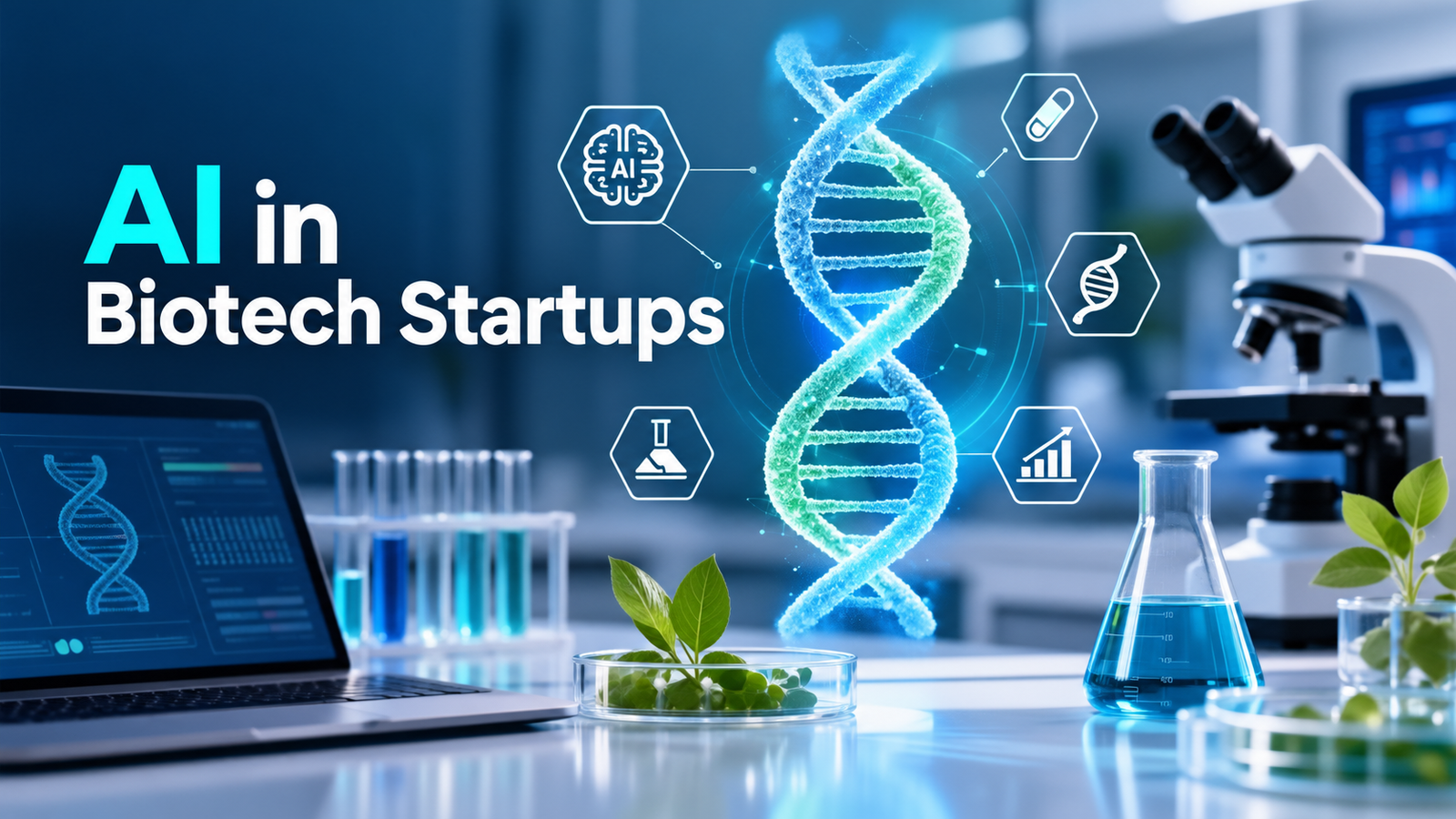
Primary topic: AI in Biotech Startups
Research focus: AI drug discovery, biological foundation models, synthetic biology, genomics, protein engineering, laboratory automation, self-driving laboratories, clinical development, biomanufacturing, regulatory AI, startup opportunities, and AI governance
Why AI Is Becoming a Core Technology for Biotech Startups
Biotechnology has always been data-rich.
Modern laboratories generate genomic sequences, protein structures, microscopy images, chemical measurements, clinical records, assay results, manufacturing data, and thousands of experimental observations.
The problem is that biological systems are extremely complex.
Researchers cannot manually evaluate every possible molecular combination, biological pathway, genetic sequence, or experimental condition.
AI provides a way to search these enormous spaces more efficiently.
The important change is that AI is moving beyond simple reporting and analytics.
It is increasingly being used to generate predictions, identify patterns, propose candidates, design experiments, and support scientific decision-making.
The U.S. National Academies’ 2025 review of AI-enabled biological design describes several important categories of models, including foundation models, generative models, predictive models, and design models. The review highlights substantial progress in protein engineering while noting that genomic and transcriptomic modeling are also developing rapidly. ([ncbi.nlm.nih.gov](https://www.ncbi.nlm.nih.gov/books/NBK614597/))
Source: National Academies / NCBI Bookshelf: Mapping the Landscape of AI-Enabled Biological Design
This means a modern biotech startup can potentially use AI at almost every stage of the scientific lifecycle.
AI-Native Biotech Loop
Biological Data
↓
AI Model
↓
Scientific Hypothesis
↓
Candidate / Experiment Design
↓
Laboratory Experiment
↓
Experimental Data
↓
AI Analysis
↓
Next Experiment
↓
Validated Biological Knowledge
This feedback loop is potentially more important than any individual AI model.
AI Is Moving From Drug Discovery Toward the Entire Biotech Lifecycle
Drug discovery receives most of the attention, but AI applications are spreading across the broader biotech value chain.
A biotech startup can use AI for:
- Target discovery.
- Protein structure analysis.
- Molecular design.
- Virtual screening.
- Protein engineering.
- Genomic analysis.
- Biomarker discovery.
- Cell-image analysis.
- Clinical-trial recruitment.
- Clinical data analysis.
- Manufacturing optimization.
- Quality-control monitoring.
- Regulatory documentation.
- Scientific knowledge management.
This creates a much larger startup opportunity than the traditional definition of AI drug discovery.
AI in Biotech Opportunity Map
Discovery → Targets, molecules, proteins
Design → Biological sequences and therapeutic candidates
Experimentation → Automated laboratory workflows
Clinical → Trial design, recruitment and analysis
Manufacturing → Process optimization and quality monitoring
Regulatory → Evidence organization and documentation
Commercial → Portfolio and partnership intelligence
The startup opportunity therefore exists at both ends of the spectrum.
One company may build a highly specialized molecular-design platform.
Another may build the software infrastructure that connects laboratory systems to AI.
Both can become valuable biotech technology companies.
Research Shows AI Drug Discovery Is Moving Into More Advanced Stages
The AI drug-discovery field has moved beyond purely theoretical research.
A 2026 review in Pharmacological Reviews examined leading AI-driven drug-discovery platforms and described AI-designed therapeutics entering human clinical trials across multiple therapeutic areas. It identified different platform approaches including generative chemistry, phenomics-first systems, integrated target-to-design platforms, knowledge-graph approaches, and physics-plus-machine-learning systems. ([pubmed.ncbi.nlm.nih.gov](https://pubmed.ncbi.nlm.nih.gov/41389441/))
The review also highlighted examples including Insilico Medicine’s drug-development work, the Recursion-Exscientia combination, Schrödinger’s physics-enabled drug design approach, and platforms from companies such as Insitro, Isomorphic Labs, Atomwise, and XtalPi.
This matters for startups because the competitive question is changing.
It is no longer:
“Can AI be used to discover drugs?”
The more important questions are:
- Which biological problems can AI solve better than conventional approaches?
- Can AI produce candidates with better experimental properties?
- Can the startup validate its predictions quickly?
- Can the platform generate proprietary data?
- Can the technology improve across repeated discovery cycles?
The Important Reality: AI Prediction Is Not Biological Validation
One of the biggest mistakes in AI biotech is treating a computational prediction as scientific proof.
A model can predict that a molecule will bind to a target.
That does not prove that the molecule will work in a living biological system.
A model can predict a protein structure.
That does not automatically establish biological function.
A model can identify a biomarker.
That does not prove clinical usefulness.
This distinction is critical because biotechnology ultimately operates in physical biological systems.
A 2025 systematic review of AI in drug development and clinical trials identified major challenges around inconsistent data quality and difficulties with clinical validation. ([pubmed.ncbi.nlm.nih.gov](https://pubmed.ncbi.nlm.nih.gov/39827570/))
Source: PubMed: The use of Artificial Intelligence Algorithms in drug development and clinical trials
A separate 2025 review examining AI-driven clinical trials also emphasized that, despite significant investment and expectations, only a limited number of AI-discovered or AI-designed drugs had reached human clinical trials and clinical approval remained a major challenge. ([pubmed.ncbi.nlm.nih.gov](https://pubmed.ncbi.nlm.nih.gov/39722473/))
Source: PubMed: Progress, Pitfalls, and Impact of AI-Driven Clinical Trials
The implication for startups is straightforward:
AI should reduce the search space. Experiments must establish whether the prediction is actually true.
↓
Experimental Test
↓
Biological Result
↓
Validation
↓
Clinical or Manufacturing Evidence
AI-Powered Drug Discovery Can Reduce the Search Problem
Traditional drug discovery involves searching through enormous numbers of possible candidates.
AI can help narrow that search.
For example, a startup may train models to estimate:
- Binding affinity.
- Solubility.
- Toxicity.
- Metabolic stability.
- Off-target activity.
- Pharmacokinetic properties.
- Potential therapeutic activity.
The objective is not necessarily to eliminate experiments.
The objective is to perform better experiments.
Instead of testing thousands of weak candidates, researchers can prioritize a smaller group with stronger predicted properties.
That creates a potential improvement in laboratory efficiency.
A 2025 review of AI in drug development found machine learning to be the most common AI methodology in the reviewed literature, accounting for 40.9% of identified approaches, followed by molecular modeling and simulation at 20.7% and deep learning at 10.3%. Oncology represented the largest therapeutic area in the reviewed studies. ([pubmed.ncbi.nlm.nih.gov](https://pubmed.ncbi.nlm.nih.gov/40732273/))
Source: PubMed: From Lab to Clinic: How AI Is Reshaping Drug Discovery Timelines and Industry Outcomes
This also shows why AI biotech startups need strong domain specialization.
A general AI model is not automatically a good drug-discovery system.
The biological context matters.
Biological Foundation Models Are Creating a New Startup Layer
Foundation models are becoming increasingly important in biology.
Instead of building one model for one narrow biological task, researchers can train large models on biological sequences, structures, molecular data, or multiple biological modalities.
These models can potentially be adapted to different downstream tasks.
The National Academies’ 2025 review identifies foundation models, generative models, predictive models, and design models as important categories in AI-enabled biological design. ([ncbi.nlm.nih.gov](https://www.ncbi.nlm.nih.gov/books/NBK614597/))
Source: National Academies / NCBI: The Age of AI in the Life Sciences
Potential startup applications include:
- Protein sequence generation.
- Protein function prediction.
- Protein engineering.
- Genomic sequence analysis.
- RNA modeling.
- Small-molecule generation.
- Multimodal biological prediction.
- Patient stratification.
The challenge is that biological data is not as clean as ordinary internet text.
Biological measurements can vary because of:
- Experimental conditions.
- Laboratory protocols.
- Equipment.
- Sample preparation.
- Population differences.
- Batch effects.
- Biological variability.
Therefore, the quality of the dataset can be just as important as model architecture.
AI and Synthetic Biology Are Converging
Synthetic biology is one of the areas where AI can have an especially broad impact.
Synthetic biology involves designing and engineering biological systems.
AI can help researchers search biological design spaces that would be extremely difficult to explore manually.
A 2025 npj Biomedical Innovations review described the convergence of AI and synthetic biology as a major transformation in biological discovery and engineering. ([nature.com](https://www.nature.com/articles/s44385-025-00021-1))
Source: Nature: The convergence of AI and synthetic biology
Potential applications include:
- Protein engineering.
- Enzyme optimization.
- Metabolic pathway design.
- Genetic circuit design.
- Microbial engineering.
- Biomanufacturing.
- Therapeutic protein design.
- Biological material development.
The traditional design-build-test-learn cycle can become more computational.
AI-Enhanced DBTL Cycle
Design
AI proposes biological designs.
↓
Build
Laboratory creates the biological system.
↓
Test
Automated experiments measure performance.
↓
Learn
AI analyzes the results.
↓
Redesign
The next generation of candidates is selected.
This creates a powerful opportunity for startups that can connect software and laboratory infrastructure.
Self-Driving Laboratories Could Become a Major Biotech Startup Category
Self-driving laboratories combine laboratory robotics, software, AI, data systems, and automated experimentation.
The concept is important because it changes the role of AI.
AI does not only analyze an experiment after it happens.
It can potentially help decide what experiment should happen next.
A 2025 review in Royal Society Open Science described self-driving laboratories as systems combining AI and laboratory automation that can potentially automate large portions of the scientific method, including hypothesis generation, experiment design, execution, data analysis, and updating hypotheses for subsequent experiments. ([pubmed.ncbi.nlm.nih.gov](https://pubmed.ncbi.nlm.nih.gov/40852582/))
Source: PubMed: Autonomous ‘self-driving’ laboratories
A 2025 Nature Computational Science article also highlighted the potential of self-driving laboratories to integrate robotic production with AI for faster biotechnology innovation. ([nature.com](https://www.nature.com/articles/s43588-025-00885-8))
Source: Nature Computational Science: Self-driving labs for biotechnology
The startup opportunity here is substantial.
A company could build:
- AI experiment planners.
- Laboratory orchestration software.
- Robotic experiment controllers.
- Automated image-analysis systems.
- Experiment scheduling engines.
- Laboratory data platforms.
- AI optimization systems.
- Cloud laboratory interfaces.
The Future Is More Likely Human + AI Than Fully Autonomous Biology
The idea of a completely autonomous laboratory is attractive.
But biology creates unique challenges.
Biological systems can behave unpredictably.
Experimental conditions can change.
Safety requirements can be strict.
Regulatory requirements can be extensive.
A 2026 review of AI in bioprocess automation argues that hybrid self-driving laboratories combining AI-driven decision-making with continued human oversight are a practical near-term direction. It also highlights biological complexity, regulatory requirements, scale-up challenges, and data standardization as important barriers. ([sciencedirect.com](https://doi.org/10.1016/j.copbio.2025.103392))
Source: Current Opinion in Biotechnology: Perspectives for artificial intelligence in bioprocess automation
This suggests a useful startup maturity model.
| Level | AI Role |
|---|---|
| Level 1 | Research assistant |
| Level 2 | AI recommends experiments |
| Level 3 | AI and robotics execute defined workflows |
| Level 4 | Highly automated experimental loops |
| Level 5 | Highly autonomous scientific discovery |
For most biotech startups today, Levels 1–3 are more realistic than immediately attempting Level 5.
AI Can Improve Protein Engineering
Proteins are central to biology.
They act as enzymes, receptors, antibodies, structural components, signaling molecules, and therapeutic agents.
The possible number of protein sequences is enormous.
AI can help search this design space.
Potential applications include:
- Predicting protein properties
- Identifying useful mutations
- Designing new sequences
- Optimizing enzyme activity
- Improving protein stability
- Predicting protein interactions
- Designing therapeutic proteins
This is an especially interesting startup category because the AI output can be connected directly to laboratory testing.
A company could generate hundreds of candidate proteins computationally, test a selected subset, learn from the results, and repeat.
That creates a scalable design process.
A 2025 review of AI-enabled biological design highlighted protein engineering as one of the areas showing substantial progress. ([ncbi.nlm.nih.gov](https://www.ncbi.nlm.nih.gov/books/NBK614597/))
Source: National Academies: Mapping the Landscape of AI-Enabled Biological Design
AI Can Turn Biological Images Into Data
Computer vision is another major opportunity.
Modern biotech laboratories produce enormous numbers of images through:
- Microscopy
- Cell imaging
- Histopathology
- High-content screening
- Fluorescence imaging
- Organoid experiments
- Cell culture monitoring
Human researchers can inspect these images.
AI can analyze them at much larger scale.
A computer-vision biotech startup could identify:
- Cell morphology
- Cellular changes
- Phenotypic responses
- Drug effects
- Abnormal patterns
- Cell population differences
This can become especially valuable when computer vision is connected directly to automated experimentation.
↓
Computer Vision Model
↓
Cell / Phenotype Classification
↓
Quantitative Biological Data
↓
AI Experiment Selection
The result is a transition from visual inspection toward machine-readable biological phenotypes.
AI Can Improve Clinical Development for Biotech Startups
AI opportunities do not end when a drug candidate leaves the laboratory.
Clinical development is another major area.
A 2025 study from the Tufts Center for the Study of Drug Development surveyed 302 organizations across pharmaceutical, biotechnology, CRO, data, and technology sectors. It examined AI/ML adoption across 36 clinical development and regulatory activities.
The results showed that 36.9% of respondents were not yet using or implementing AI/ML across those activities, 30.3% were beginning implementation or piloting, 22.1% were partially implementing, and only 10.7% were fully implementing AI/ML through repeatable processes across most relevant trials. ([pubmed.ncbi.nlm.nih.gov](https://pubmed.ncbi.nlm.nih.gov/40439837/))
Source: PubMed: The Adoption and Use of AI and Machine Learning in Clinical Development
This finding is important.
It suggests that many organizations are experimenting with AI, but widespread operational maturity remains limited.
For startups, that means there is still room for specialized products.
Potential applications include:
- Clinical trial protocol analysis
- Patient eligibility matching
- Site selection
- Recruitment forecasting
- Patient retention prediction
- Clinical data cleaning
- Safety signal analysis
- Regulatory document preparation
- Trial performance dashboards
AI Can Help Biotech Startups Build Better Scientific Knowledge Systems
Not every AI biotech opportunity requires a new drug or biological model.
Scientific knowledge management is a major opportunity.
Researchers often need to search across:
- Scientific papers
- Patents
- Internal experiments
- Laboratory notebooks
- Protocols
- Clinical trial documents
- Regulatory information
- Company research databases
Generative AI and retrieval-augmented generation can connect these sources.
A useful biotech research copilot should not behave like a generic chatbot.
It should provide evidence.
Biotech Research Copilot Architecture
Scientific Literature
+
Patents
+
Internal Experiments
+
Laboratory Protocols
+
Regulatory Documents
↓
Scientific Knowledge Layer
↓
Retrieval + AI Reasoning
↓
Answer + Evidence + Source + Confidence
↓
Researcher Review
A 2025 review of large language models in synthetic biology and biomanufacturing described applications including literature information extraction, knowledge graphs, retrieval-augmented generation, metabolic modeling, experiment design, and future self-driving laboratory systems. It also emphasized the need for trustworthy benchmarks and biosecurity frameworks.
AI Can Improve Biomanufacturing
Drug discovery is only one part of biotechnology.
Once a biological product has been discovered, it needs to be manufactured consistently.
This creates opportunities for AI in:
- Process optimization
- Batch monitoring
- Predictive maintenance
- Quality control
- Anomaly detection
- Yield optimization
- Equipment monitoring
- Manufacturing documentation
- Process scale-up
The manufacturing environment generates continuous data.
AI can analyze that data to identify unusual patterns.
AI Biomanufacturing Workflow
Sensors + Equipment + Batch Data
↓
Data Integration
↓
AI Monitoring
↓
Anomaly Detection
↓
Process Prediction
↓
Human Review
↓
Corrective / Optimization Action
The advantage is that manufacturing AI can potentially generate recurring value after the initial discovery stage.
This makes it attractive for enterprise software startups serving multiple biotech companies.
AI in Biotech Needs a Strong Data Architecture
One of the biggest challenges for biotech AI is fragmented data.
A startup may have data stored across:
- Laboratory information management systems
- Electronic laboratory notebooks
- Cloud storage
- Research databases
- Instrument software
- Clinical systems
- Manufacturing platforms
If these systems cannot communicate, AI becomes less useful.
A modern biotech AI architecture should therefore include a strong data-integration layer.
AI Biotech Data Architecture
Laboratory Instruments
LIMS
ELN
Genomics
Imaging
Clinical Data
Manufacturing Data
Scientific Literature
↓
Integration & Data Quality Layer
↓
Data Lake / Warehouse / Knowledge Graph
↓
Machine Learning + Foundation Models + Generative AI
↓
Applications
↓
Researchers • Scientists • Clinical Teams • Manufacturing Teams
Data standardization is therefore not a secondary technical issue.
It can become a core competitive advantage.
Proprietary Experimental Data May Become the Strongest AI Moat
Public biological data is increasingly accessible.
That means model architecture alone may not remain a strong competitive advantage.
A more durable advantage may come from proprietary experimental data.
Consider a startup that repeatedly performs protein-engineering experiments.
For every experiment, it records:
Sequence → Conditions → Intervention → Result
After thousands of experiments, the company has a proprietary dataset.
That dataset can improve its models.
Better models can produce better candidates.
Better candidates can generate more valuable experiments.
This creates a flywheel.
AI Biotech Data Flywheel
More Experiments
↓
More Proprietary Data
↓
Better AI Models
↓
Better Predictions
↓
Better Candidate Selection
↓
More Valuable Experiments
↓
More Proprietary Data
This is one of the strongest reasons to connect AI with physical experimentation.
The startup is not only building software.
It is building an information advantage.
AI Can Also Help With Regulatory Intelligence
Biotech companies generate large amounts of regulatory documentation.
AI can potentially assist with:
- Document classification
- Regulatory requirement extraction
- Evidence organization
- Submission document review
- Change tracking
- Data consistency checking
- Regulatory intelligence
However, regulatory AI requires a very different standard from a general-purpose chatbot.
Every important claim needs evidence.
Every important transformation should be auditable.
Human review must remain available.
The FDA has already developed a formal framework around AI used to support regulatory decision-making for drugs and biological products.
In January 2025, FDA issued draft guidance proposing a risk-based credibility assessment framework for AI models used to produce information supporting regulatory decisions about safety, effectiveness, or quality. ([fda.gov](https://www.fda.gov/regulatory-information/search-fda-guidance-documents/considerations-use-artificial-intelligence-support-regulatory-decision-making-drug-and-biological))
FDA also states that it has seen a significant increase in submissions containing AI components and reported experience with more than 500 submissions containing AI components from 2016 through 2023. ([fda.gov](https://www.fda.gov/science-research/science-and-research-special-topics/artificial-intelligence-and-machine-learning-aiml-drug-development))
Source: FDA: Artificial Intelligence and Machine Learning for Drug Development
This means regulatory credibility is becoming part of the AI biotech technology stack.
AI Biotech Startups Need Model Governance
A biotech AI model should not be treated as a black box that is trained once and forgotten.
The startup should monitor:
- Model performance
- Data drift
- Population differences
- False positives
- False negatives
- Experimental reproducibility
- Version changes
- Training data provenance
- External validation
- Human overrides
FDA’s 2025 draft guidance specifically emphasizes establishing AI model credibility for a defined context of use.
Source: FDA: Framework to Advance Credibility of AI Models Used for Drug and Biological Product Submissions
The phrase context of use is especially important.
A model should not be described simply as:
“AI predicts whether this drug will work.”
The claim should be much more precise.
For example:
“AI model predicts a specific molecular property for a defined class of compounds under a specified validation framework.”
That makes the model’s limitations clearer.
Biosecurity Must Be Part of AI Biotech Strategy
AI can increase biological capabilities.
That creates benefits.
It also creates potential risks.
A powerful biological design system should therefore consider:
- Access controls
- User authentication
- Experiment logging
- Model output monitoring
- Safety filters
- Human approval for high-risk workflows
- Secure laboratory integrations
- Audit trails
The 2025 review of AI-enhanced biomanufacturing specifically emphasized the importance of biosecurity frameworks alongside the development of AI systems for synthetic biology.
Source: Trends in Biotechnology: AI-enhanced biomanufacturing and biosecurity
This should not be treated as a late-stage compliance project.
For AI-native biotech startups, safety architecture should be designed into the platform.
High-Value AI Use Cases for Biotech Startups
| Use Case | AI Technology | Startup Potential |
|---|---|---|
| Molecule design | Generative AI | Very high |
| Protein engineering | Foundation models | Very high |
| Biological image analysis | Computer vision | High |
| Scientific copilot | LLM + RAG | High |
| Experiment optimization | ML + optimization | Very high |
| Clinical recruitment | Predictive AI | High |
| Manufacturing analytics | Predictive analytics | High |
| Regulatory intelligence | NLP + RAG | High |
AI Biotech Startup Opportunities Beyond Drug Discovery
One of the strongest conclusions from current research is that founders should not automatically choose drug discovery.
There are potentially lower-risk software opportunities.
- Scientific AI copilots: Secure systems that search internal scientific knowledge and provide evidence-backed answers.
- Laboratory AI: Software that predicts experiment outcomes and recommends the next experiment.
- Computer vision: AI systems that convert biological images into quantitative data.
- Bioinformatics automation: Tools that automate repetitive genomic and biological analysis.
- Clinical trial intelligence: Systems for recruitment, eligibility, site selection, and trial monitoring.
- Biomanufacturing AI: Systems for process monitoring, yield optimization, and quality control.
- Regulatory AI: Platforms that organize evidence and support submission workflows.
- AI laboratory operating systems: Infrastructure that connects AI models, laboratory instruments, scheduling systems, and experiment data.
The last category could become particularly important as self-driving laboratories mature.
AI Biotech Architecture for a Startup
A startup building an AI-powered biotechnology platform can use a layered architecture.
AI Biotech Platform Architecture
Biological Data
Genomics • Proteomics • Assays • Images • Clinical Data • Literature
↓
Data Engineering
ETL • Data Quality • Metadata • Provenance • Standardization
↓
AI Layer
ML • Foundation Models • Generative AI • Computer Vision • Knowledge Graphs
↓
Scientific Decision Layer
Prediction • Candidate Ranking • Experiment Recommendation
↓
Laboratory Layer
LIMS • ELN • Robotics • Instruments • Cloud Labs
↓
Validation Layer
Experimental Testing • Human Review • Quality Control
↓
Governance Layer
Security • Auditability • Model Monitoring • Regulatory Controls • Biosecurity
This architecture is more defensible than simply building an AI chatbot.
The product becomes connected to real scientific workflows.
Why AI Biotech Startups Need Experimental Infrastructure
Software companies can improve models using digital feedback.
Biotech companies often need physical feedback.
That makes laboratory infrastructure strategically important.
A startup that owns or controls experimental capabilities can potentially create a continuous learning system.
The company can:
- Generate predictions
- Select candidates
- Run experiments
- Measure results
- Feed results into the model
- Generate improved candidates
This creates a powerful competitive cycle.
Software + Biology Advantage
AI Model
+
Experimental Platform
+
Proprietary Data
+
Scientific Expertise
+
Validation
=
Defensible Biotech Platform
AI Adoption in Biotech Is Still Early
The Tufts study provides an important reality check.
Although AI adoption is increasing, only 10.7% of surveyed organizations reported full implementation across the clinical-development activities examined.
That means many organizations remain at the pilot or partial implementation stage.
This creates an interesting opportunity for startups.
The market does not necessarily need more generic AI.
It needs products that solve specific biotech problems.
For example:
- AI for protein engineering
- AI for laboratory scheduling
- AI for cell-image analysis
- AI for clinical-trial recruitment
- AI for manufacturing quality
- AI for scientific knowledge management
Specialization can become the differentiator.
What Existing Biotech Companies Should Modernize First
Established biotech organizations often have years of scientific data.
The problem is that the data may be fragmented.
A practical modernization strategy should begin with:
- Data inventory: Identify where scientific data currently exists.
- Data integration: Connect laboratory, research, clinical, and manufacturing systems.
- Data quality: Standardize metadata and experimental information.
- AI pilots: Choose one high-value workflow.
- Validation: Measure whether AI actually improves the workflow.
- Scale: Expand successful applications across departments.
This is better than implementing AI everywhere at once.
AI Biotech Startup Maturity Ladder
| Stage | Startup Capability | Strategic Value |
|---|---|---|
| Foundation | Digitized scientific data | Data foundation |
| Analytics | Dashboards and statistical analysis | Operational intelligence |
| Prediction | Machine-learning models | Scientific prediction |
| Generation | AI-designed biological candidates | Discovery acceleration |
| Automation | AI-connected laboratory workflows | Higher experimental throughput |
| Closed Loop | AI + automated experiments | Continuous scientific learning |
What Investors Should Look for in AI Biotech Startups
AI biotech startups can look impressive during a pitch.
But technical demonstrations do not necessarily prove business value.
Investors should look for:
- Biological validation: Are predictions supported by experiments?
- Data advantage: Does the company have proprietary or difficult-to-recreate data?
- Scientific team: Does the company have deep biological expertise?
- Model performance: Is performance measured on appropriate external datasets?
- Experimental loop: Can the company rapidly test predictions?
- Regulatory strategy: Is the intended use clearly defined?
- Commercial pathway: Who will actually pay?
- Scalability: Can the platform support more programs without proportionally increasing cost?
The most valuable AI biotech startups may therefore look less like conventional SaaS companies and more like hybrid technology-science companies.
High-Value vs High-Risk AI Applications
Strong starting opportunities
- Scientific literature intelligence.
- Internal research knowledge systems.
- Laboratory data automation.
- Image analysis.
- Manufacturing analytics.
- Research workflow automation.
- Experiment prioritization.
High-value but higher-risk opportunities
- De novo therapeutic design.
- Clinical outcome prediction.
- Biomarker discovery.
- Autonomous biological experimentation.
- Gene and cell therapy design.
- AI-supported regulatory decisions.
The difference is not that the second group should be avoided.
The difference is that these applications require substantially stronger validation, governance, and human oversight.
2027–2030 Outlook for AI in Biotech Startups
The next few years are likely to move the industry from experimentation toward more integrated AI-biological systems.
AI-native biotech companies will become more common.
Instead of hiring an AI team after building a traditional biotech company, new startups may be designed around AI from their first day.
Biological foundation models will expand.
Models will increasingly operate across proteins, molecules, sequences, images, and other biological modalities.
Self-driving laboratories will mature.
More laboratories will combine robotics, AI, scheduling systems, and automated data collection.
Experimental data will become a major competitive moat.
The best companies may be those that generate proprietary datasets through repeated physical experiments.
AI will move deeper into manufacturing.
The technology will increasingly monitor and optimize biological production rather than remaining focused on discovery.
Scientific copilots will become standard infrastructure.
Researchers will increasingly interact with internal scientific knowledge through evidence-backed AI systems.
Regulatory AI governance will become more important.
As AI contributes more directly to development decisions, companies will need stronger model validation, traceability, documentation, and monitoring.
Human oversight will remain critical.
Biology is too complex and safety-sensitive for most biotech applications to move immediately toward unrestricted autonomy.
Best AI Startup Opportunities for Biotech
For technology companies looking to enter this market, the strongest opportunities can be grouped into several categories.
| Startup Opportunity | Core Technology | Potential Customers |
|---|---|---|
| Scientific AI Copilot | LLM + RAG + Knowledge Graph | Biotech R&D teams |
| Protein AI Platform | Foundation Models | Drug and synthetic biology companies |
| Lab AI Platform | ML + Robotics | Research laboratories |
| Bioimage AI | Computer Vision | Biotech and pharmaceutical labs |
| Clinical AI | Predictive ML | Biotech, CROs and trial sponsors |
| Biomanufacturing AI | Predictive Analytics | Biomanufacturers |
| Regulatory AI | NLP + RAG | Biotech regulatory teams |
What Will Create the Strongest Competitive Advantage?
The strongest AI biotech company is unlikely to be the company with the biggest generic AI model.
The stronger advantage may come from combining several assets.
Competitive Moat
Proprietary Biological Data
+
AI Models
+
Experimental Infrastructure
+
Scientific Expertise
+
Workflow Integration
+
Regulatory Knowledge
+
Continuous Validation
This combination is difficult for competitors to reproduce quickly.
A startup that only uses a publicly available AI model may be easy to copy.
A startup that owns proprietary experimental data and a validated laboratory feedback loop is much harder to replicate.
Final Takeaway
AI in biotech startups is moving from a promising research concept toward a broader technology architecture for biological discovery.
The biggest change is not simply that AI can analyze more data.
It is that AI can increasingly participate in the full scientific cycle.
It can help formulate hypotheses.
It can design candidates.
It can prioritize experiments.
It can analyze experimental results.
It can recommend the next experiment.
It can support clinical development.
It can monitor manufacturing.
It can organize regulatory evidence.
And, when connected to laboratory automation, it can become part of a continuous design-build-test-learn system.
Research published during 2025 and 2026 shows that this transition is already visible across AI drug discovery, synthetic biology, biological design, clinical development, and self-driving laboratories. At the same time, the evidence also makes clear that major challenges remain around validation, data quality, reproducibility, safety, regulation, and biological complexity.
For startups, the most important lesson is therefore simple:
Do not build AI around biotechnology. Build AI into the scientific workflow.
The most valuable companies may be those that connect computation with real experiments and create a continuous learning system.
That is where AI can move from being a software feature to becoming a fundamental part of how biotechnology is discovered, developed, manufactured, and scaled.
Original Research Sources
- National Academies / NCBI — Mapping the Landscape of AI-Enabled Biological Design
- Pharmacological Reviews / PubMed — Leading AI-Driven Drug Discovery Platforms: 2025 Landscape and Global Outlook
- PubMed — From Lab to Clinic: How AI Is Reshaping Drug Discovery Timelines and Industry Outcomes
- PubMed — AI Algorithms in Drug Development and Clinical Trials: A Scoping Review
- PubMed — Progress, Pitfalls, and Impact of AI-Driven Clinical Trials
- PubMed — Adoption and Use of AI and Machine Learning in Clinical Development
- Nature — The Convergence of AI and Synthetic Biology
- PubMed — Autonomous Self-Driving Laboratories: Technology and Policy Implications
- Nature Computational Science — Self-Driving Labs for Biotechnology
- Trends in Biotechnology — Large Language Models for Knowledge Synthesis and AI-Enhanced Biomanufacturing
- Current Opinion in Biotechnology — Perspectives for Artificial Intelligence in Bioprocess Automation
- FDA — Artificial Intelligence and Machine Learning for Drug Development
- FDA — AI for Regulatory Decision-Making for Drugs and Biological Products
- FDA — Framework for Credibility of AI Models Used in Drug and Biological Product Submissions
Leave a Reply