
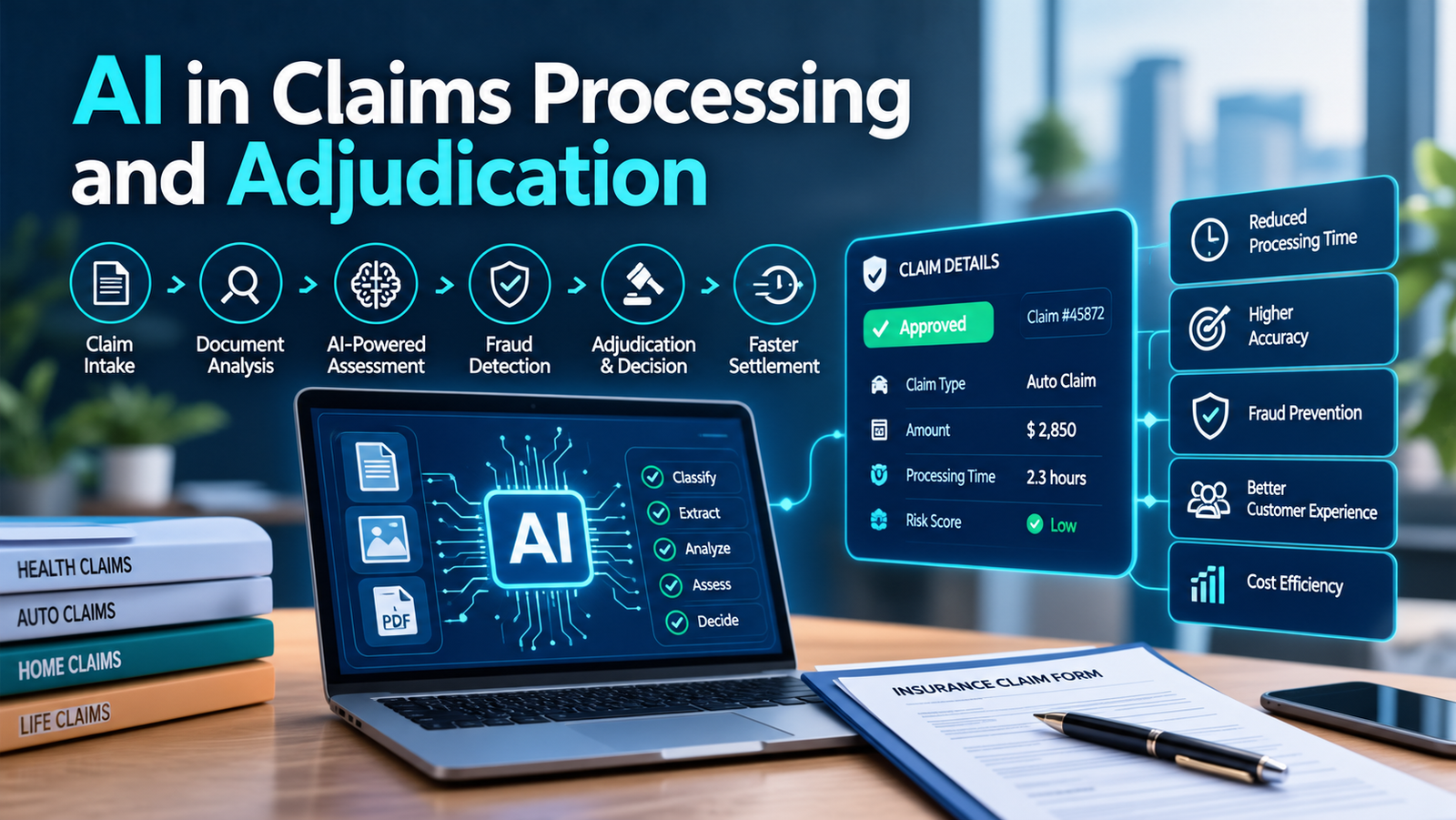
Primary topic: AI in Claims Processing and Adjudication
Research focus: Insurance claims automation, intelligent document processing, claims triage, coverage verification, medical and property claims adjudication, fraud detection, payment accuracy, explainable AI, generative AI, human oversight and claims modernization
Understanding AI in Claims Processing and Adjudication
Claims processing covers the operational steps required to receive, validate, investigate and settle an insurance claim. Adjudication is the decision-making stage in which the insurer determines whether the claim meets the applicable policy or plan requirements, what amount is payable, and whether additional evidence or review is required.
The workflow varies by insurance line. A motor insurer may assess accident photographs, repair estimates, liability and policy exclusions. A health insurer may check eligibility, coding, medical documentation, contractual reimbursement rules and medical necessity. A life insurer may review beneficiary information, policy status, medical records and evidence related to the insured event.
AI can support these workflows through several distinct capabilities:
- Intelligent document processing: Extracts information from claim forms, invoices, medical records, repair estimates and supporting documents
- Natural language processing: Identifies relevant facts, summarizes records and retrieves policy clauses
- Machine learning: Predicts claim complexity, identifies unusual patterns and estimates likely claim severity
- Computer vision: Analyzes photographs and other visual evidence, such as vehicle or property damage
- Generative AI: Drafts claim summaries, requests for missing information and investigator notes
- Rules engines: Applies explicit coverage, eligibility, pricing and payment rules
- Workflow automation: Routes claims, requests information, updates systems and tracks service-level deadlines
These technologies perform different jobs. A language model may interpret a policy document, but it should not independently invent a coverage rule. A fraud model may identify an unusual pattern, but an anomaly is not proof of fraud. A computer vision model may estimate visible damage, but it cannot reliably determine every hidden mechanical issue from a photograph.
The design principle is to assign each task to the method suited to it, then combine the results through a controlled adjudication workflow.
Why Claims Operations Need More Than Basic Automation
Traditional claims systems often automate predictable tasks while leaving complex decisions to human examiners. This creates a gap between receiving a claim and reaching a defensible decision. Documents may arrive in different formats, policy language may be difficult to search, and claim information may be spread across customer relationship management systems, policy administration platforms, medical systems, payment tools and external databases.
A rules-based workflow can handle known conditions, but it may struggle when documents are incomplete, descriptions conflict, or a claim contains unusual combinations of facts. Staff then move between systems, manually compare evidence and repeat data entry.
AI can help connect these steps, but the objective should be controlled straight-through processing, not automatic approval of every claim.
Visual: Where AI Creates Value in a Claim
Forms, invoices, images
Extract facts and clauses
Coverage, risk, amount
Pay, request, investigate
Control at every stage: Preserve source documents, record model outputs, apply policy rules and escalate decisions that exceed approved automation limits.
Research Evidence: What the Studies Actually Show
The research below covers claim prediction, property claim assessment, explainability, automated machine learning, multimodal adjudication and healthcare claims. These studies do not all test the same task. Some predict claim outcomes, while others propose or evaluate components of adjudication. Their results should not be treated as directly comparable measures of end-to-end claims automation.
Research Study: Multimodal AI for Insurance Claims Adjudication
A 2026 publication in the proceedings of the 2025 International Conference on Artificial Intelligence, Systems and Network Security introduced a framework called MMLM-CA. It combines policy-document understanding, visual damage assessment and a decision-consistency verification component. The goal is to connect written policy conditions with visual evidence instead of evaluating each input separately.
The proposed framework contains three main modules. The policy constraint understanding module represents policy clauses and maps them to claim information. The visual damage reasoning unit analyzes images to identify damage areas and estimate their severity. A decision-consistency verifier then checks whether the proposed outcome aligns with the policy and the multimodal evidence.
The paper reports an 8.2% improvement in adjudication accuracy compared with the methods used as its baseline. This result is promising, but it should be interpreted within the paper’s experimental setting. It does not establish that the same improvement will occur across insurers, policy types, accident conditions or real-world claim portfolios.
The important contribution is architectural. Claims adjudication requires more than image recognition or text generation. The system must connect policy wording, claim facts, visual evidence and decision logic. A production implementation would also need to test ambiguous exclusions, low-quality images, conflicting documents and cases involving liability disputes.
Practical implication: Insurers developing multimodal claims systems should build an evidence-linked decision process. Every proposed finding should connect to the source image, document passage or structured policy rule that supports it.
Research Study: Explainable AI for Insurance Claims Prediction
A 2025 study in Technological Forecasting and Social Change examined explainable AI for non-life insurance claims prediction using a substantial vehicle-telematics dataset. The research included 14,642 vehicles and 125 million driver-trip observations, comparing traditional Generalized Linear Models with several machine-learning and deep-learning approaches.
The authors tested models including XGBoost, Random Forest, Decision Trees, Support Vector Machines, Deep Neural Networks and TabNet. They also evaluated explanation methods such as SHAP, LIME, ExplainerDashboard and Dalex.
The research is especially relevant to claims operations because predictive performance alone is not enough for regulated insurance decisions. Claims professionals and auditors may need to understand which factors contributed to a prediction, whether those factors are appropriate, and whether the model behaves consistently across different groups or circumstances.
The study identified XGBoost combined with Dalex or ExplainerDashboard as suitable options in its comparison. This is not a universal endorsement of one model, but it demonstrates how explainability tools can make complex models more usable in insurance settings.
Practical implication: Use explainability to help reviewers understand claim-risk predictions, identify questionable input signals and document decisions. Do not treat an explanation generated after a decision as proof that the model is fair or correct.
Research Study: Machine Learning for Insurance Claim Forecasting
A 2024 study published in Technological Forecasting and Social Change investigated a machine-learning decision-support system for insurance claim forecasting. It used a 57-dimensional dataset and a feature-selection process based on a Modified Boruta algorithm, reducing the selected feature set to 24 variables.
The researchers reported that an improved LightGBM model achieved an AUC of approximately 0.9272 and an accuracy of approximately 92.94%. The paper also reported a classification accuracy of 95.67% for its feature-selection approach, a separate result that should not be confused with the final model’s reported accuracy.
These results concern prediction and risk assessment. They do not directly measure whether a claim was correctly adjudicated, whether a payment was accurate, or whether the model reduced the time needed to settle a claim. Nevertheless, claim forecasting can help insurers anticipate workload, identify claims that may require additional attention and improve operational planning.
Practical implication: Use claim prediction to support triage and resource allocation. Before deploying it, test whether performance holds across different claim types, time periods and customer groups, and ensure that the target variable represents a decision the organization actually needs to improve.
Research Study: Machine Learning for Property Insurance Claim Assessment
A 2024 case study in Procedia Computer Science explored machine learning for property insurance claim assessment. The researchers addressed imbalanced claim data and compared a Random Forest model with logistic regression. They used the Synthetic Minority Over-sampling Technique, commonly known as SMOTE, to address class imbalance.
The study reported that Random Forest achieved a recall value of 96% in its experimental setting. Recall measures the proportion of relevant positive cases identified by a model. In claims analysis, high recall may be useful when missing a particular type of claim is costly, but it does not tell the full story.
A model can achieve high recall while producing many false positives. An insurer would therefore also need to examine precision, calibration, false-alert workload and the financial consequences of incorrect classifications.
The study illustrates a practical challenge in claims AI: the choice of metric must reflect the operational objective. A model designed to identify claims requiring further review should not be evaluated in exactly the same way as a model that estimates repair costs or recommends payment amounts.
Practical implication: Define the decision the model supports before selecting its success metric. For property claims, evaluate missed high-severity claims, unnecessary inspections and the accuracy of estimated claim values separately.
Source: Optimizing Claim Assessment Processes in Property Insurance: A Case Study
Research Study: Automated Machine Learning Designed for Insurance
A 2025 paper in Insurance: Mathematics and Economics examined an automated machine-learning workflow tailored to insurance applications. The authors focused on the fact that model quality depends heavily on data preparation, model selection, feature handling and hyperparameter optimization. These steps can require substantial actuarial and machine-learning expertise.
The proposed AutoML workflow includes data-preprocessing methods, class-balancing steps, ensemble pipelines and customized loss functions. These features matter because insurance datasets often contain rare outcomes, skewed claim amounts and different costs for different types of prediction errors.
AutoML can make experimentation more repeatable and help teams compare candidate models. However, automation does not remove the need for domain expertise. A technically strong model can still be unsuitable if it uses leakage-prone variables, optimizes the wrong business outcome or fails to meet governance requirements.
Practical implication: Use insurance-specific AutoML to accelerate model development, but require actuarial, claims and compliance teams to approve target definitions, features, evaluation criteria and deployment thresholds.
Source: Automated Machine Learning in Insurance
Research Study: AI and Blockchain-Based Healthcare Claims Adjudication
A 2024 paper in Procedia Computer Science proposed an approach that combines AI, data aggregation and blockchain-based smart contracts for healthcare insurance claims adjudication. The framework places AI-enhanced analysis at the data-aggregation layer, with the goal of improving fraud detection and making broader use of information generated across the healthcare ecosystem.
This research explores a different problem from property damage or motor claims. Healthcare adjudication often requires connecting eligibility, provider information, service codes, medical records, contractual terms and payment rules. A data-aggregation architecture can help organize these inputs before a claim reaches the decision stage.
The paper presents an initial framework rather than conclusive evidence of large-scale operational benefits. Blockchain does not automatically make claim data accurate, and a smart contract cannot independently determine whether a medical service was clinically appropriate. The underlying data, policy logic and governance remain critical.
Practical implication: Healthcare payers can explore structured data exchange and tamper-evident audit records, but should keep clinical and contractual decision rules explicit, testable and subject to authorized review.
Research Evidence Dashboard
What the evidence supports
Reported by the MMLM-CA paper; study-specific result, not an industry-wide estimate
Measures ranking performance in the reported experiment, not adjudication accuracy
Study-specific recall; does not indicate precision or end-to-end claim quality
Scale of the dataset used in the explainable-AI comparison
These bars visualize selected reported figures. They use different units and study designs, so their lengths should not be compared as a ranking of model quality.
How AI Can Improve Each Stage of the Claims Lifecycle
Intelligent Claims Intake and Document Extraction
The first opportunity is reducing the manual work involved in receiving and organizing claims. AI-based document processing can classify incoming files, extract policy numbers and dates, identify invoices, recognize claim descriptions and detect missing fields. It can also compare information across documents to identify inconsistencies before an examiner begins a detailed review.
For example, a property claim may include a claim form, photographs, a contractor estimate and proof of ownership. Document AI can organize these materials and produce a structured claim record. If the estimate is missing, the workflow can request it rather than allowing the claim to remain idle in a queue.
The system should preserve the original document and the extracted value together. When OCR is uncertain about a policy number, date or monetary amount, it should request verification instead of silently inserting a potentially incorrect value.
Policy Interpretation and Coverage Verification
Coverage verification is one of the most consequential uses of AI. Policy documents contain definitions, limits, exclusions, deductibles, waiting periods and special conditions. A retrieval-augmented generation system can search the applicable policy version and present relevant clauses to a claims examiner.
A safe workflow should identify the exact policy wording, the effective dates and the claim facts used in the analysis. It should distinguish between a clause that clearly applies and a clause that requires interpretation.
Visual: Evidence-Grounded Coverage Review
Generative AI should not be allowed to invent policy language or rely on a generic policy template when the customer’s actual contract is available. The system should also recognize when an endorsement changes the base policy.
Claims Triage and Complexity Prediction
Not every claim needs the same level of review. A low-value claim with complete documentation and a clear coverage outcome may be suitable for a streamlined workflow. A claim involving conflicting statements, potential fraud, severe injury, disputed liability or unclear policy language needs specialist attention.
AI can predict the likely complexity of a claim and route it to the appropriate team. This is often a safer first step than automating the final decision because it improves how work is allocated without removing the examiner’s authority.
Useful routing signals include:
- Claim value and estimated severity
- Completeness of submitted documentation
- Conflicts between claim records
- Potential fraud indicators
- Policy wording complexity
- Need for medical, legal or technical expertise
- Likelihood that additional evidence will be required
- Applicable response and settlement deadlines
Routing models should be evaluated for whether they send the right cases to specialists, not merely whether they reproduce historical routing decisions. Past routing may reflect staffing shortages or outdated procedures rather than the best handling strategy.
Computer Vision for Property and Motor Claims
Computer vision can analyze submitted photographs to identify visible damage, classify affected components and estimate the likely severity of a loss. In motor insurance, this may help identify damaged panels, broken lights or visible glass damage. In property insurance, it may help classify roof damage, water staining or damaged building materials.
The model can help prioritize inspection and prepare an initial estimate, but image quality and context matter. A photograph may not reveal internal damage, the age of the damage, the cause of the event or whether a repair is economically appropriate.
A responsible workflow should use confidence thresholds and request additional images or an expert inspection when the evidence is incomplete. It should also test performance across lighting conditions, camera quality, vehicle types, property materials and different forms of damage.
Fraud, Waste and Payment Integrity
AI can help identify claims that deserve additional scrutiny by comparing claim details with historical patterns, provider behavior, prior submissions and connected entities. In health insurance, models may identify duplicate billing, unusual service combinations or amounts that differ from contractual expectations. In property and motor insurance, models may flag inconsistent timelines, repeated damage patterns or suspicious relationships among claims.
However, unusual behavior is not automatically fraudulent. A new provider may have a different billing pattern because it serves a different patient population. A cluster of property claims may reflect a genuine storm. A model that treats every unusual pattern as fraud can create unnecessary investigations and harm legitimate customers.
The correct operational design is to use AI as a risk signal and investigation aid. Claims with strong evidence of error can be routed for review, while adverse decisions should follow documented procedures and applicable law.
AI Claims Architecture for Digital Insurers
Policy administration, claims platform, documents, images, provider systems and payment records
OCR, validation, normalization, entity matching and data-quality checks
Document AI, policy retrieval, computer vision, claim prediction and anomaly detection
Policy rules, thresholds, confidence checks, workflow routing and escalation
Examiner review, evidence trail, decision recording and customer communication
Quality audits, model drift, fairness checks, access logs and outcome tracking
This architecture separates model outputs from final business decisions. It also makes it easier to replace a model without rebuilding the entire claims platform.
Claims Automation: What Should and Should Not Be Automated?
| Claims task | Suitable AI role | Recommended control |
|---|---|---|
| Document classification | Automate routine classification | Confidence threshold and exception queue |
| Data extraction | Extract and prefill claim fields | Validate critical fields against source files |
| Coverage review | Retrieve clauses and compare facts | Versioned policy source and authorized decision logic |
| Damage assessment | Classify visible damage and estimate ranges | Escalate uncertain or high-severity cases |
| Fraud detection | Identify risk patterns for investigation | Do not equate a risk score with proof |
| Routine payment calculation | Apply approved contractual calculations | Deterministic calculation and reconciliation |
| Complex denial or dispute | Prepare evidence summaries and recommendations | Qualified human review and appeal pathway |
Generative AI and Claims Copilots
Generative AI can help claims professionals work through large volumes of documentation. A claims copilot can summarize a medical record, compare an invoice with a contract, prepare a chronology of events or draft a request for missing evidence. It can also help a reviewer navigate internal procedures and explain why a claim was routed for further assessment.
The key is to ground generated content in approved source material. A claims copilot should identify which document supports each important statement and make it easy to open that document. If the available evidence does not answer a question, the system should say so rather than filling the gap with a plausible-sounding explanation.
A useful claims summary should contain:
- The reported event and relevant dates
- The applicable policy or plan version
- The evidence received and the evidence still missing
- The relevant coverage, eligibility or payment rules
- Conflicting information that requires review
- The recommended next step and the reason for it
For production use, the system should also protect sensitive claim information, restrict access according to job role and prevent customer data from being sent to unapproved external services.
Regulatory and Consumer Protection Considerations
AI use in claims is not separate from an insurer’s existing legal obligations. In the United States, insurance regulation is substantially state-based, and requirements can differ by product and jurisdiction. The National Association of Insurance Commissioners (NAIC) has developed principles and a model bulletin addressing insurers’ use of AI systems. Its guidance emphasizes governance, compliance with applicable insurance laws, and controls for risks such as unfair discrimination.
The NAIC’s 2026 materials also describe work on an AI Systems Evaluation Tool intended to help regulators examine insurers’ AI use, governance and risk mitigation. This reflects a broader regulatory focus on how AI systems are developed, deployed and monitored, rather than on model performance alone.
Source: NAIC, Artificial Intelligence in Insurance
For health claims, insurers must also consider applicable healthcare, privacy and claims-processing requirements. In all lines, organizations should be able to explain the basis for a decision, preserve records, provide required notices and support review or appeal processes.
Expert Perspective: Human Oversight Is a Control, Not a Formality
The NAIC explains that AI may change how insurance work is performed, while claims professionals and other insurance workers continue to play important roles in reviewing information, exercising judgment and working with consumers.
The NAIC also cautions:
“AI-generated information should be reviewed carefully, especially when used for important decisions.”
For claims operations, this means human oversight should be designed into the workflow. Reviewers need access to the evidence, authority to override a recommendation, and a way to record why they disagreed with the model. Simply placing a human approval button after an opaque automated decision does not provide meaningful oversight.
Implementation Roadmap for Insurance Companies
Phase One: Select a Narrow, Measurable Use Case
Start with a task that has a clear operational definition and enough historical data to evaluate performance. Good candidates include document classification, missing-information detection, claim summarization or complexity-based routing. Avoid starting with fully automated denials or complex liability decisions.
Phase Two: Establish Data Quality and Baselines
Measure current processing time, rework, payment corrections, complaint rates, escalation volumes and examiner workload. Check whether historical claim outcomes are reliable labels. A past decision should not automatically be treated as ground truth if it may have been incorrect or inconsistent.
Phase Three: Build and Validate the Model
Use separate training, validation and test periods. Where possible, evaluate on later claims to test how the system performs on future data. Measure performance across claim types, severity levels, channels and relevant customer groups.
Phase Four: Run a Controlled Pilot
Begin in a recommendation-only mode. Compare AI outputs with examiner decisions, investigate disagreements and record failure cases. Do not use a successful pilot on simple claims as evidence that the model is ready for complex claims.
Phase Five: Integrate with Claims Systems
Connect the AI service to the claims platform through controlled APIs. Store the model version, input references, output, confidence, reviewer action and final outcome. Ensure that failures or unavailable services return the claim to a safe manual workflow.
Phase Six: Monitor and Improve
Track model drift, false positives, missed cases, override rates and customer outcomes. Review changes in policy wording, claim mix, repair costs, provider behavior and regulations. Retrain or recalibrate only through a controlled process with documented testing and approval.
KPIs for AI Claims Processing and Adjudication
| KPI | What it measures | Why it matters |
|---|---|---|
| Cycle time | Time from claim receipt to resolution | Shows whether the process is faster |
| First-pass completeness | Claims that do not require avoidable information requests | Measures intake quality |
| Adjudication accuracy | Agreement with a qualified, independently reviewed outcome | Measures decision quality |
| Payment accuracy | Correct application of contract and payment rules | Reduces overpayment and underpayment |
| False-positive rate | Legitimate claims incorrectly flagged for risk | Controls unnecessary investigations |
| Human override rate | Frequency of reviewer disagreement | Reveals model weaknesses and workflow mismatch |
| Appeal and complaint rate | Customer challenges to claim outcomes | Provides a customer-impact signal |
Future Predictions: 2027–2030
2027: Evidence-Grounded Claims Copilots Become More Common
Insurers are likely to expand copilots that summarize claim files, retrieve policy clauses and prepare examiner notes. The more important development will be integration with source documents and workflow controls, rather than simply adding a chatbot to the claims portal.
2028: Multimodal Assessment Moves into More Claim Types
Text, images, invoices and structured policy data will increasingly be evaluated together. This should support motor and property claims first, while healthcare and life insurance use cases will require stronger privacy, evidence and domain-specific controls.
2029: Decision Quality Becomes a More Important Automation Metric
Insurers will face pressure to demonstrate that automation improves more than speed. Payment accuracy, avoidable rework, complaint outcomes, fairness and consistency are likely to become central measures of whether an AI claims system is delivering value.
2030: Claims Platforms Become More Adaptive, but Not Unsupervised
Claims systems may use AI agents to coordinate document requests, retrieve evidence, call approved services and update workflow status. High-impact decisions will still need controlled authority, clear audit trails and escalation paths. The likely direction is greater automation of the work surrounding adjudication, with explicit boundaries around final decisions.
These are forward-looking expectations, not guaranteed outcomes. Adoption will depend on model reliability, integration costs, available data, regulation and the ability to demonstrate better customer and business outcomes.
Expert Recommendations
For insurers, neobanks offering embedded insurance, third-party administrators and InsurTech companies, the practical recommendations are:
- Automate evidence handling before automating adverse decisions so early gains come from reducing manual work rather than increasing decision risk
- Keep policy rules explicit and use AI to retrieve, interpret and organize evidence around those rules
- Use different models for different tasks instead of forcing one large language model to extract data, detect fraud, estimate losses and decide coverage
- Measure payment and adjudication quality alongside cycle time and operating cost
- Make every important output traceable to a source document, policy clause, calculation or model signal
- Build escalation into the product for low-confidence results, conflicting evidence, high-value claims and sensitive decisions
- Test across claim populations and monitor whether error rates differ across groups or claim types
- Keep a safe fallback so claims can continue through a manual process when an AI service fails
- Review third-party models and vendors for data handling, model updates, explainability, security and audit access
Frequently Asked Questions
What is AI in claims processing?
AI in claims processing uses machine learning, document AI, natural language processing, computer vision and workflow automation to help insurers receive, validate, investigate and settle claims more efficiently.
How does AI help with claims adjudication?
AI can extract claim facts, retrieve relevant policy clauses, identify missing evidence, estimate damage, flag unusual patterns and prepare decision summaries. The final workflow should apply approved policy rules and escalate complex or high-impact cases for appropriate review.
Can AI automatically approve insurance claims?
AI can support straight-through processing for carefully defined, low-complexity claims when the evidence is complete and the applicable rules are clear. Insurers should set limits, validate outcomes and provide a safe route for exceptions. Automated approval should not be assumed suitable for every claim.
Can AI deny an insurance claim?
AI may support the review of evidence and policy conditions, but an automated model should not be treated as a substitute for applicable legal requirements, documented reasoning, required notices or available review and appeal processes. The level of human involvement depends on the decision, product and jurisdiction.
How is generative AI used in claims management?
Generative AI can summarize claim files, retrieve policy wording, draft information requests, prepare case notes and help examiners navigate procedures. Its outputs should be grounded in approved documents and checked for unsupported statements.
What is the difference between claims prediction and claims adjudication?
Claims prediction estimates an outcome, such as claim frequency, severity or the likelihood that a claim needs review. Adjudication determines how a specific claim should be handled under the applicable policy, evidence and rules. Predictive performance alone does not establish adjudication correctness.
What are the main risks of AI claims automation?
The main risks include incorrect extraction, hallucinated policy interpretations, biased or unreliable predictions, false fraud alerts, inaccurate damage estimates, privacy breaches, model drift and inadequate explanations for decisions.
Which AI use case should an insurer implement first?
A practical starting point is often document classification, missing-information detection or claim summarization. These tasks can reduce manual workload while allowing the insurer to build data quality, evaluation and governance capabilities before automating higher-impact decisions.
Final Perspective
AI in claims processing is most valuable when it improves the complete path from evidence collection to a defensible outcome. The research shows several distinct opportunities: multimodal systems can connect policy text with visual damage evidence, machine learning can support claim forecasting, explainable AI can make predictions easier to review, and insurance-specific AutoML can improve the development process.
The evidence also sets clear limits. A reported increase in model accuracy does not automatically mean fewer customer complaints, more accurate payments or faster settlements. Results from one dataset or insurance line may not transfer to another. Claims systems need to be evaluated against real operational outcomes, not only technical benchmarks.
For digital financial institutions and insurers, the strongest strategy is to build an evidence-grounded claims platform. It should automate repetitive work, help specialists focus on complex cases, preserve the reasoning behind decisions and make it possible to challenge or correct an outcome.
The future of claims adjudication is not simply faster automation. It is faster, more consistent and more explainable decisions, supported by AI and governed by clear rules and accountable people.
Research Sources
- MMLM-CA: A Multimodal Large Language Model Framework for Automated Insurance Claims Adjudication Integrating Policy Document Understanding and Visual Damage Assessment, 2026
- Bridging Transparency in Insurance Claims Prediction: A Comparative Study of Explainable AI and Traditional Linear Models Using Vehicle Telematics Data, 2025
- Big Data and Machine Learning-Based Decision Support System to Reshape the Prediction of Insurance Claims, 2024
- Optimizing Claim Assessment Processes in Property Insurance: A Case Study, 2024
- Automated Machine Learning in Insurance, 2025
- AI-Driven Data Aggregation Level Smart Contracts for Blockchain Healthcare Insurance Claims Adjudication, 2024
- National Association of Insurance Commissioners, Artificial Intelligence in Insurance
- NAIC, Big Data and Artificial Intelligence Working Group
- EIOPA, Survey on Generative AI Adoption Among European Insurers, 2026

Leave a Reply