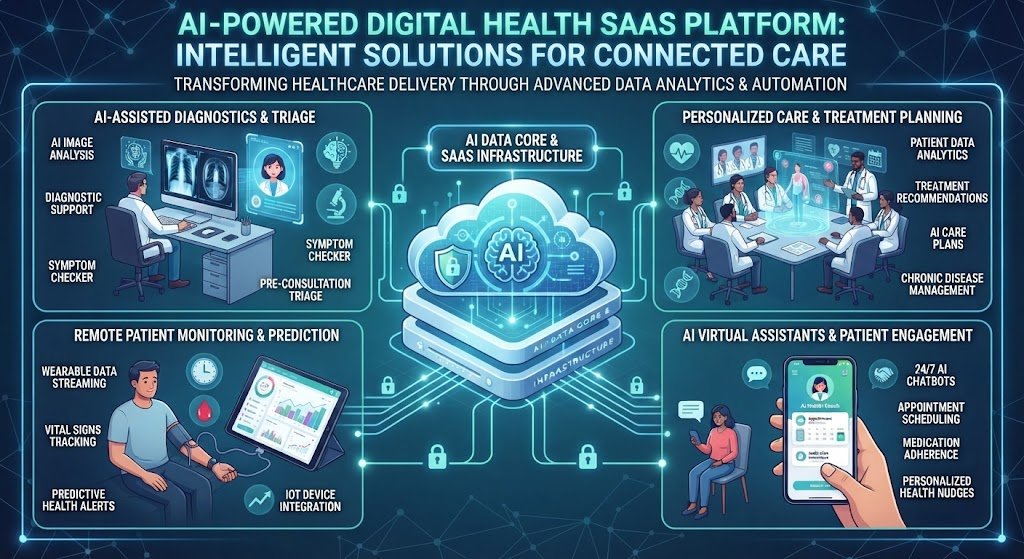
Primary topic: AI in Digital Health SaaS Platforms
Research focus: Artificial intelligence in digital health software, healthcare SaaS, clinical decision support, generative AI, EHR integration, patient engagement, predictive analytics, workflow automation, interoperability, cybersecurity, remote care, healthcare data intelligence, and future digital health infrastructure.
AI in Digital Health SaaS Platforms
Digital health SaaS platforms have become an important part of modern healthcare infrastructure. These platforms support activities such as electronic health records, patient communication, appointment management, clinical documentation, care coordination, remote monitoring, analytics, billing, population health, and healthcare administration.
Artificial intelligence adds another layer to this infrastructure.
Traditional SaaS mainly helps healthcare professionals access information and complete predefined tasks. AI-enabled SaaS can go further by identifying patterns, summarizing information, predicting possible outcomes, generating content, recommending next steps, and automating parts of complex workflows.
This shift is important because healthcare organizations generate enormous amounts of information every day. Clinical notes, laboratory results, diagnostic images, prescriptions, claims, appointment histories, patient messages, remote monitoring data, and operational records can all contain useful signals.
The challenge is that healthcare professionals cannot manually review every piece of information at the same depth.
AI can help organize this information and surface what may require attention.
However, healthcare SaaS has a much higher standard than ordinary business software. Accuracy, privacy, security, explainability, interoperability, reliability, and clinical accountability all matter.
The best AI-enabled platforms therefore combine artificial intelligence with carefully designed workflows instead of treating AI as an isolated feature.
Why Digital Health SaaS Is Becoming an AI Opportunity
Digital health platforms already sit close to the data and workflows that AI needs.
A healthcare SaaS platform may already know when a patient is scheduled, what information was collected during a visit, what documentation was created, what follow-up was requested, and what communication occurred afterward.
This creates a major advantage.
Instead of building AI on top of disconnected information, developers can integrate AI directly into the workflow where the data is created.
For example, a clinical platform can use an AI model to summarize a patient’s previous encounters before a consultation.
A documentation platform can generate a draft clinical note from an approved source of encounter information.
A patient portal can help staff prepare responses to routine messages.
A population-health platform can identify patients who may need follow-up.
An analytics platform can detect unusual changes in appointment volume or care patterns.
The AI becomes useful because it is connected to an action.
Clinical records, messages, images, claims, measurements, and patient-generated information.
Prediction, classification, summarization, pattern recognition, and generation.
Tasks, alerts, referrals, documentation, communication, and follow-up.
Clinician or authorized staff review before higher-risk actions.
This creates a practical AI SaaS model:
Data → AI Analysis → Insight → Human Review → Workflow Action → Outcome Measurement
Our Key Findings
Our review of current research, regulatory guidance, interoperability standards, and healthcare implementation evidence identifies several important findings for digital health SaaS companies.
AI adoption is moving from experimentation toward everyday healthcare work
The American Medical Association’s 2026 Physician Survey provides one of the clearest signals of this transition.
The survey found that 81% of physicians reported using AI professionally, more than double the 38% reported in 2023.
The most frequently reported uses included medical research summaries, discharge instructions and care plans, clinical documentation, chart summaries, patient portal responses, translation, and assistive diagnosis.
This matters for SaaS developers because many of these activities are naturally delivered through software platforms.
AI does not necessarily need to become a separate application.
It can become an embedded capability inside the healthcare software clinicians already use.
Source: American Medical Association 2026 Physician AI Survey.
Generative AI is especially valuable for language-heavy healthcare workflows
Generative AI is well suited to tasks involving clinical text, summaries, communication, and documentation.
Healthcare professionals spend substantial time reading and writing information.
A SaaS platform can use a controlled generative AI layer to summarize long records, prepare draft notes, organize information, or generate patient-friendly explanations.
Research into ambient AI scribes is also becoming more important.
A randomized clinical trial published in 2025 evaluated two ambient AI scribes among 238 outpatient physicians across 14 specialties.
The study compared AI scribe use with usual care and evaluated documentation time, workload, burnout-related measures, safety, accuracy, and usability.
This type of research is important because it evaluates AI inside actual clinical work rather than only testing an AI model on a benchmark dataset.
Source: Ambient AI Scribes in Clinical Practice: A Randomized Trial.
Patient portal AI has real value but requires strong safeguards
Patient messaging is another major opportunity for digital health SaaS.
Generative AI can prepare draft responses to patient questions and reduce the cognitive effort required from clinicians.
However, research also demonstrates the risk.
A 2025 study examined whether primary-care physicians could identify and correct errors in AI-generated patient portal drafts.
The researchers found that some erroneous drafts were submitted without editing, demonstrating that human review cannot simply be assumed to eliminate AI risk.
This has direct implications for SaaS interface design.
An AI-generated message should clearly appear as a draft.
The platform should make review easy.
Potentially important facts should be easy to verify.
The system should also have safeguards against inappropriate medical advice.
Source: Opportunities and risks of artificial intelligence in patient portal messaging.
Interoperability is becoming a core AI requirement
AI cannot provide reliable value if important healthcare information remains trapped in disconnected systems.
FHIR, or Fast Healthcare Interoperability Resources, is a major standard for exchanging healthcare information electronically.
FHIR provides structured resources that allow healthcare applications to exchange information in a consistent way.
This makes interoperability particularly important for AI-enabled SaaS.
An AI platform may need information from an EHR, laboratory system, patient portal, claims platform, imaging system, or remote-monitoring device.
If those systems cannot exchange information reliably, the AI system may receive incomplete context.
Incomplete context can produce weaker results.
FHIR therefore becomes more than an integration convenience.
It can become part of the data foundation for intelligent healthcare applications.
Source: HL7 FHIR Specification.
Regulation is becoming more specific about AI-enabled software
The regulatory environment is also evolving.
In January 2026, the FDA issued final guidance on Clinical Decision Support Software.
The guidance explains which types of clinical decision-support software may fall outside the device definition and which software functions may remain subject to FDA digital-health policies.
This distinction is important for SaaS companies.
A scheduling platform with an administrative AI assistant is not necessarily regulated in the same way as software that provides clinical information or makes a medical-device function.
The intended use, claims, users, inputs, outputs, and clinical role of the software all matter.
Source: FDA Clinical Decision Support Software Guidance, 2026.
Research Evidence: AI and Digital Health Software
Research Study: AI-Generated Patient Portal Responses
A Stanford Health Care implementation study evaluated an EHR-integrated large language model designed to generate draft responses to patient inbox messages.
The study involved 162 clinicians after exclusions and was conducted over five weeks.
The research focused on the use of AI-generated draft replies within an actual clinical inbox rather than evaluating a general-purpose chatbot in isolation.
This distinction is important for SaaS companies.
The value of an AI communication feature depends not only on whether the generated text sounds natural, but also on whether it fits the clinician’s workflow.
The system needs to receive the correct patient context.
It needs to produce an appropriate draft.
The clinician needs to be able to edit it quickly.
The final communication must remain under appropriate professional control.
This research therefore supports an important product principle: AI features should be designed around workflow completion rather than text generation alone.
Source: Artificial Intelligence-Generated Draft Replies to Patient Inbox Messages.
Research Study: Quality of AI-Generated Patient Messages
Another 2025 study analyzed 201 AI-generated replies to real primary-care patient messages using a medical communication framework.
The analysis found that AI responses showed strengths in areas such as rapport building and facilitating next steps.
However, limitations appeared in information delivery, information gathering, and responding to emotion.
This finding is highly relevant to patient-facing SaaS.
A patient communication platform should not judge success only by grammatical quality.
A message can sound professional and still fail to collect the information needed for safe care.
A message can also be polite but miss an important emotional concern.
This means AI communication systems need evaluation frameworks that go beyond language quality.
Important evaluation areas include factual accuracy, completeness, safety, empathy, escalation, readability, and appropriate next steps.
Source: Use of a Medical Communication Framework to Assess the Quality of Generative AI Replies.
Research Study: AI for Emergency Detection in Patient Messages
Research has also explored whether AI can identify potentially urgent or emergency situations within patient portal messages.
A 2025 study evaluated 1,020 patient messages from Vanderbilt University Medical Center.
The researchers compared several approaches, including direct LLM prompting and retrieval-augmented approaches using knowledge-graph information.
The concept is important because healthcare SaaS platforms often receive information that is time-sensitive.
A patient may send a message describing symptoms that should not wait for a routine portal response.
An AI system could potentially identify messages requiring immediate escalation.
However, this should not mean that the AI independently determines that a patient is safe.
A safer architecture is to use AI as an additional triage layer that identifies predefined risk patterns and routes potentially urgent cases for appropriate review.
Research Study: AI-Powered EHR Search and Clinical Discovery
Another study evaluated an AI-powered search and clinical discovery feature integrated into an EHR environment.
After three months, 93% of users in the evaluated implementation were using the AI-based features.
The study also reported significant improvements in user satisfaction and perceived time saved.
This demonstrates another important SaaS opportunity.
Healthcare professionals do not always need an AI system to make a clinical recommendation.
Sometimes the biggest problem is finding information.
An intelligent search layer can help clinicians locate relevant records, prior information, documents, and clinical context more efficiently.
The lesson for digital health SaaS developers is that AI search can be a high-value capability even when it does not make a diagnosis.
Source: User-Centered Delivery of AI-Powered Health Care Technologies in Clinical Settings.
Major AI Applications in Digital Health SaaS
AI-Powered Clinical Documentation
Clinical documentation is one of the clearest SaaS opportunities.
AI can process approved encounter information and prepare a structured draft.
Depending on the system, this may include history, assessment, plan, discharge instructions, referral summaries, or other documentation formats.
The platform should make it easy for clinicians to review, modify, and approve generated content.
The strongest products will also maintain traceability so that users understand where important information came from.
Intelligent Clinical Search
Healthcare records can become extremely large over time.
Finding the right information can consume significant attention.
AI-powered search can allow clinicians to search using natural language instead of relying only on exact keywords.
For example, a clinician could ask for previous medication changes, recent imaging findings, or relevant historical encounters.
The platform can retrieve supporting information from the patient’s authorized record.
Retrieval-augmented generation can then summarize that information while keeping the original records available for verification.
Predictive Analytics
Machine learning can analyze structured healthcare data to identify patterns associated with outcomes.
Potential SaaS applications include:
- Risk stratification.
- Patient deterioration alerts.
- Readmission-risk estimation.
- Appointment no-show prediction.
- Patient churn prediction.
- Demand forecasting.
- Care-gap identification.
- Referral prioritization.
- Resource planning.
- Population-health management.
Prediction should always be connected to a defined workflow.
A risk score without an operational response can become another alert that clinicians ignore.
Generative AI for Patient Communication
Generative AI can create drafts for routine communication.
Examples include:
- Appointment preparation messages.
- Follow-up reminders.
- Discharge instructions.
- Medication-related administrative messages.
- Patient education drafts.
- Care-plan explanations.
- Referral communication.
- Multilingual communication.
The system should distinguish between administrative communication and higher-risk clinical advice.
That distinction can determine how much human review is required.
AI Triage and Routing
SaaS platforms can use AI to classify incoming requests.
A patient message might relate to scheduling, billing, prescription administration, symptoms, test results, referrals, or an urgent issue.
The AI can categorize the message and send it to the appropriate queue.
This can reduce manual sorting.
It can also help staff focus on messages requiring more attention.
AI Workflow Automation
AI workflow automation can connect several steps.
For example:
This is more powerful than a standalone chatbot because the AI participates in the actual business process.
AI Capability Map for Digital Health SaaS
| AI Capability | SaaS Application | Primary Value |
|---|---|---|
| Generative AI | Documentation and communication | Time savings |
| Machine Learning | Risk and outcome prediction | Proactive care |
| Natural Language Processing | Message classification and extraction | Faster information handling |
| Computer Vision | Medical image workflows | Image-based analysis |
| AI Search | EHR and document discovery | Information access |
| RAG | Grounded clinical answers | Context and traceability |
| AI Agents | Multi-step workflow automation | Process efficiency |
| Data Analytics | Operational intelligence | Better management decisions |
Interoperability: The Foundation of AI Healthcare SaaS
AI applications become more useful when they can access the right information from multiple healthcare systems.
FHIR provides a standardized framework for exchanging healthcare information.
Digital health SaaS developers can use standards-based integration to connect applications with EHRs, laboratories, patient portals, payer systems, and other healthcare platforms.
CMS interoperability requirements also show the growing importance of API-based healthcare data exchange.
The 2024 CMS Interoperability and Prior Authorization Final Rule expanded requirements around Patient Access APIs and introduced additional Provider Access, Payer-to-Payer, and Prior Authorization API requirements for impacted payers.
These changes reinforce a broader industry direction toward structured, electronic data exchange.
For AI developers, better data exchange creates better opportunities for intelligent software.
Source: CMS Interoperability and Prior Authorization Final Rule.
Responsive Architecture for AI Digital Health SaaS
A modern AI healthcare SaaS platform should separate the user interface, application logic, AI services, healthcare integrations, and data infrastructure.
Portal, mobile app, messaging, forms, remote data.
EHR, documentation, decision support, care workflows.
LLMs, ML models, RAG, computer vision, analytics.
FHIR APIs, EHR connections, identity, data exchange.
Security, auditing, permissions, monitoring, model controls.
This architecture makes it easier to replace or improve an AI model without rebuilding the entire SaaS platform.
It also creates clearer boundaries between clinical data, AI processing, user actions, and governance controls.
Security and Privacy in AI Healthcare SaaS
Healthcare SaaS platforms handle highly sensitive information.
Adding AI increases the number of components that may process or transmit that information.
A secure architecture should therefore consider:
- Encryption in transit and at rest.
- Role-based access control.
- Strong authentication.
- Audit logging.
- Data minimization.
- Secure API design.
- Vendor and model-provider assessment.
- Access monitoring.
- Data retention policies.
- Incident response procedures.
- Model access controls.
- Protection against prompt injection and data leakage.
The security model should cover both traditional SaaS infrastructure and AI-specific risks.
For example, a generative AI system can accidentally expose information through an inappropriate prompt or poorly designed retrieval layer.
A retrieval system may also return information that the requesting user is not authorized to access if permissions are not enforced correctly.
AI security must therefore be designed around the existing healthcare authorization model.
AI Governance and Regulatory Readiness
AI-enabled healthcare SaaS needs governance throughout its lifecycle.
The FDA’s AI-enabled medical device resources show that AI is already being incorporated into products that receive regulatory authorization.
The FDA maintains a list of AI-enabled medical devices and continues to develop approaches for identifying modern AI technologies, including foundation-model and multimodal functionality.
This demonstrates that AI regulation is not limited to theoretical future systems.
AI-enabled healthcare products are already part of the regulated technology environment.
Source: FDA Artificial Intelligence-Enabled Medical Devices.
ONC’s HTI-1 Final Rule also introduced algorithm-transparency requirements for AI and other predictive algorithms used in certified health IT.
The rule is significant for digital health SaaS because it shows increasing attention to transparency around predictive technologies.
Healthcare organizations need to understand what an AI system does, how it should be used, and what information is available about its performance.
Source: ONC HTI-1 Final Rule.
Responsible AI Design for Digital Health Platforms
The World Health Organization emphasizes that AI in healthcare should be developed and deployed with safety, ethics, equity, accountability, and governance in mind.
WHO’s guidance on large multimodal models identifies healthcare uses including clinical care, patient-guided use, administrative work, education, and research.
At the same time, WHO highlights risks involving inaccurate, incomplete, biased, or misleading outputs.
This is particularly important for SaaS products because a single AI feature may be used by thousands of professionals or patients.
A small model error can therefore become a large-scale operational issue.
Source: WHO Ethics and Governance of Artificial Intelligence for Health.
How AI Can Improve the SaaS User Experience
AI can make healthcare software easier to use.
Traditional healthcare interfaces often require users to navigate multiple screens.
AI can reduce this friction by providing natural-language interaction and context-aware assistance.
A clinician could search for information conversationally.
A patient could receive a simpler explanation of administrative instructions.
A staff member could ask the platform to summarize pending referrals.
A manager could ask for an operational summary.
The important UX principle is that AI should reduce cognitive load.
It should not create another complicated dashboard that users must learn.
Traditional SaaS: User searches → opens records → reads information → finds task → performs task
AI-enabled SaaS: User asks or triggers workflow → AI retrieves relevant context → AI prepares insight or draft → user reviews → action is completed
The interface should also make uncertainty visible.
Users should know whether an AI output is a generated summary, a prediction, a recommendation, or information retrieved directly from a clinical record.
AI for Healthcare Operations
The commercial opportunity for AI SaaS extends beyond clinical workflows.
Healthcare organizations have many operational processes that are repetitive and data-heavy.
AI can support:
- Appointment demand forecasting.
- No-show prediction.
- Staff scheduling.
- Referral management.
- Patient recall.
- Prior authorization preparation.
- Billing workflow support.
- Claims documentation.
- Inventory forecasting.
- Call-center assistance.
- Patient feedback analysis.
- Operational reporting.
These applications can often be easier to validate than high-risk diagnostic systems because their outputs may not directly determine clinical treatment.
That does not eliminate privacy or safety requirements, but it can provide a practical starting point for organizations beginning their AI journey.
AI for Population Health and Predictive Care
Digital health SaaS platforms can aggregate information across patient populations.
Machine learning can identify patterns that may be difficult to see through manual review.
For example, a population-health platform could identify patients who appear to have missed recommended follow-up.
It could also identify changes in utilization or patterns associated with higher risk.
The important step is connecting the prediction to a care-management workflow.
↓
Data Collection
↓
Risk Modeling
↓
High-Priority Cohort
↓
Care-Team Review
↓
Intervention
↓
Outcome Tracking
This turns predictive analytics into an operational healthcare system.
AI Agents in Digital Health SaaS
AI agents represent a potential next stage of SaaS automation.
A conventional AI feature may perform one task.
An agent can potentially coordinate multiple steps.
For example, a healthcare SaaS agent could receive an administrative request, identify the relevant patient record, retrieve required information, prepare a draft, create a task, and route it to an authorized employee.
The major difference is workflow orchestration.
However, autonomous behavior should be limited according to risk.
Administrative actions may be easier to automate.
Clinical actions require substantially stronger controls.
An effective healthcare agent should have clear permissions, limited access, audit logs, escalation rules, and human approval for sensitive actions.
AI and Digital Health SaaS Business Models
AI can also change how healthcare SaaS products are monetized.
Traditional SaaS often uses a monthly or annual subscription.
AI-enabled platforms can continue using subscriptions while adding usage-based pricing for high-compute features.
Possible models include:
- Per-provider subscription.
- Per-clinic subscription.
- Per-patient pricing.
- AI usage-based pricing.
- Premium AI modules.
- Enterprise licensing.
- API-based pricing.
- Custom model deployment fees.
- Implementation and integration services.
The pricing model should reflect the actual value created.
If an AI documentation feature saves substantial clinician time, a premium module may be easier to justify than a generic chatbot feature.
AI SaaS Opportunity Matrix
| Use Case | AI Technology | Main User | Potential KPI |
|---|---|---|---|
| Clinical documentation | Generative AI / LLM | Clinicians | Documentation time |
| Patient messaging | LLM / NLP | Care teams | Response time |
| Clinical search | AI Search / RAG | Clinicians | Search completion time |
| Risk prediction | Machine Learning | Care teams | Predictive performance |
| Message triage | NLP / LLM | Staff | Routing accuracy |
| Patient engagement | Generative AI | Patients | Engagement rate |
| Operational analytics | ML / Analytics | Administrators | Efficiency metrics |
Challenges That Digital Health SaaS Companies Must Solve
Data quality
AI performance depends heavily on input quality.
Healthcare records can contain missing fields, inconsistent terminology, duplicate information, outdated information, and documentation errors.
A sophisticated model cannot automatically turn poor data into reliable intelligence.
Data quality should therefore be treated as part of the AI product.
Model hallucination
Generative AI can produce plausible statements that are not supported by the underlying data.
This is particularly dangerous in healthcare.
Retrieval-augmented architectures, constrained generation, structured outputs, validation layers, and human review can reduce risk, but no single technique eliminates it.
Bias and generalization
A model trained on one population may not perform equally well in another.
Differences can exist between institutions, geographic regions, demographics, devices, documentation styles, and clinical practices.
Digital health SaaS vendors should therefore validate performance in the populations and environments where the product will actually operate.
Integration complexity
Healthcare systems rarely operate on one technology stack.
Integration can involve EHRs, laboratories, imaging systems, identity providers, scheduling platforms, payment systems, and patient portals.
The technical integration layer can therefore become one of the most important parts of an AI SaaS product.
User trust
Clinicians will not consistently use AI if they do not trust its outputs.
Trust does not mean users should believe every AI answer.
Healthy trust means users understand what the system does, where it can fail, and how to verify its outputs.
AI Governance Framework for Digital Health SaaS
A practical governance framework should cover the complete AI lifecycle.
Define intended use and risk.
Test accuracy and safety.
Introduce controlled workflows.
Track real-world performance.
Update models and workflows.
NIST’s AI Risk Management Framework provides a voluntary framework for incorporating trustworthiness considerations into the design, development, use, and evaluation of AI systems.
Its approach is relevant to digital health SaaS because healthcare AI needs risk management throughout the system lifecycle rather than only at launch.
Source: NIST AI Risk Management Framework.
What Healthcare SaaS Companies Should Measure
AI implementation should be measured using both technical and business outcomes.
A model can have strong benchmark performance while creating little practical value.
A SaaS company should therefore measure:
- Model accuracy.
- False-positive rates.
- False-negative rates.
- Human override rates.
- Time saved.
- Task completion time.
- User adoption.
- User satisfaction.
- Patient experience.
- Workflow completion.
- Escalation rates.
- Safety incidents.
- System uptime.
- Integration reliability.
- Cost per AI-assisted transaction.
For generative AI, additional metrics should include factual accuracy, completeness, unsupported-claim rate, appropriate escalation, and clinician editing requirements.
For predictive models, calibration and performance across relevant subgroups should also be considered.
Future Predictions for AI in Digital Health SaaS
AI will become an embedded SaaS feature rather than a separate destination
Healthcare professionals are unlikely to want ten different AI applications for ten different tasks.
Instead, AI capabilities will increasingly appear inside EHRs, patient portals, care-management platforms, analytics systems, and specialty software.
The platform itself will become intelligent.
Multimodal AI will connect text, images, audio, and structured data
Healthcare information is inherently multimodal.
A single patient journey can include written notes, diagnostic images, laboratory results, medication records, voice conversations, questionnaires, and device-generated measurements.
Large multimodal models can potentially process multiple types of input.
WHO has specifically identified large multimodal models as an emerging technology with applications across healthcare and research.
Source: WHO guidance on large multimodal models.
AI agents will automate connected workflows
The future SaaS platform may not simply answer questions.
It may complete controlled sequences of tasks.
The difference between an assistant and an agent will become increasingly important.
An assistant provides information.
An agent can potentially perform actions within defined permissions.
Healthcare platforms will need strong authorization systems before allowing agents to modify records, communicate externally, or trigger clinical workflows.
AI search will become a standard interface
Natural-language search can make complex healthcare records easier to navigate.
Instead of learning complicated filters, users may ask the system for a specific piece of information.
The underlying technology can retrieve supporting records and present the relevant context.
This could become one of the most widely adopted forms of AI in healthcare SaaS.
Smaller specialized models will remain important
Large models attract significant attention, but healthcare SaaS will not always require the largest available model.
A smaller specialized model may be faster, cheaper, easier to control, and better suited to a narrow workflow.
Examples include models for classification, structured extraction, coding assistance, risk scoring, image analysis, or specific clinical documentation tasks.
AI governance will become part of product differentiation
Healthcare customers will increasingly evaluate not just what an AI product can generate, but how safely it operates.
Features such as audit trails, role-based access, source attribution, model monitoring, approval workflows, and explainability can become competitive advantages.
AI Adoption Roadmap for Digital Health SaaS
A healthcare organization should avoid starting with the most complex AI use case.
A controlled adoption roadmap is more practical.
Start with low-risk operational opportunities
Begin with workflows such as administrative summaries, internal search, scheduling support, document organization, or draft communication.
These projects can establish AI governance and user familiarity.
Move into workflow intelligence
After initial adoption, organizations can introduce predictive analytics, triage, care-gap identification, and workflow prioritization.
These systems should have measurable outcomes.
Introduce higher-risk clinical applications carefully
Clinical decision-support and diagnostic AI require stronger validation.
The organization should evaluate regulatory classification, clinical evidence, human oversight, patient safety, and post-deployment monitoring.
Scale through an AI platform layer
Once multiple AI features are in use, organizations can centralize model management, security, monitoring, access control, and integration.
This prevents every department from building isolated AI systems.
What This Means for Healthcare Startups
Healthcare startups have a significant opportunity to build AI-native SaaS platforms.
The strongest opportunities are likely to come from specific workflows where healthcare organizations already experience high administrative burden or information overload.
A startup could build an AI-native clinical documentation platform.
Another could focus on patient communication.
Another could develop intelligent referral management.
Another could build AI-powered population-health analytics.
Another could create a specialized platform that combines EHR information with remote monitoring data.
The common factor is not the AI model.
The common factor is the workflow.
A successful product should answer four questions clearly:
- What healthcare problem does the platform solve?
- What data does the AI need?
- What decision or workflow does the AI improve?
- How will the organization measure the result?
A startup that can answer these questions has a much stronger foundation than a company simply marketing a generic healthcare chatbot.
What This Means for Existing Healthcare Organizations
Established healthcare organizations already have one of the most valuable assets in AI: real operational and clinical workflows.
They also have historical data, clinicians, patients, and existing technology infrastructure.
The challenge is modernization.
Replacing an entire healthcare software environment is expensive and disruptive.
AI can instead be introduced around existing systems.
For example, an organization could add an AI search layer to an existing EHR.
It could add generative documentation to an existing clinical workflow.
It could introduce predictive analytics into population-health software.
It could connect a patient portal to an AI-supported communication system.
It could integrate remote monitoring data into care-management workflows.
This approach makes AI adoption incremental.
Digital Health SaaS AI Implementation Checklist
Before deploying an AI feature, organizations should evaluate the complete system.
- Define the intended use.
- Identify the target users.
- Classify the clinical and operational risk.
- Determine what data the system requires.
- Validate data quality.
- Evaluate model performance.
- Test performance across relevant populations.
- Define human review requirements.
- Establish security controls.
- Confirm privacy requirements.
- Build audit logging.
- Integrate with existing healthcare software.
- Test usability with real users.
- Define escalation rules.
- Monitor performance after deployment.
- Document model changes.
- Measure business and clinical outcomes.
Original Research Asset: Digital Health AI Value Chain
The following framework summarizes how AI can create value across a digital health SaaS platform.
This value chain demonstrates why AI should not be treated as an isolated model.
The model is only one component.
The complete product includes data, integration, user experience, workflow, governance, and outcome measurement.
Frequently Asked Questions
What is AI in digital health SaaS?
AI in digital health SaaS refers to artificial intelligence capabilities integrated into cloud-based healthcare software. These capabilities can include generative AI, machine learning, natural-language processing, computer vision, predictive analytics, intelligent search, and workflow automation.
How is AI changing digital health platforms?
AI is changing digital health platforms by making them more capable of interpreting information, generating drafts, predicting risks, automating repetitive workflows, improving search, and supporting clinical and administrative decisions.
What is the biggest AI opportunity in healthcare SaaS?
The biggest opportunity is usually found in repetitive, data-rich workflows with measurable outcomes. Clinical documentation, patient communication, intelligent search, triage, predictive analytics, and workflow automation are particularly important areas.
Can generative AI be used in healthcare SaaS?
Yes. Generative AI can support documentation, summaries, patient communication, education, information retrieval, and other language-based workflows. Higher-risk clinical uses require appropriate validation and oversight.
How can AI improve EHR software?
AI can improve EHR software through natural-language search, chart summarization, documentation assistance, clinical decision support, message triage, predictive analytics, and workflow automation.
Why is FHIR important for AI healthcare software?
FHIR provides a standardized framework for exchanging healthcare information between applications. Better interoperability can help AI systems receive structured and relevant information from multiple healthcare systems.
Can AI automate patient portal messages?
AI can prepare draft patient portal responses and classify incoming messages. Research shows potential benefits but also identifies risks involving inaccurate information, omissions, and inappropriate responses. Human review is therefore important for clinical communication.
Can AI replace healthcare SaaS users?
AI is more appropriately viewed as an augmentation technology for most healthcare workflows. It can reduce repetitive work and provide decision support, while professionals remain responsible for appropriate clinical and operational decisions.
What is RAG in healthcare AI?
Retrieval-Augmented Generation, or RAG, combines a language model with a retrieval system that provides relevant source information before an answer is generated. In healthcare SaaS, this can help ground generated responses in approved records or knowledge sources.
What are the biggest risks of AI healthcare SaaS?
Major risks include inaccurate outputs, hallucinations, privacy breaches, cybersecurity threats, biased performance, poor data quality, weak integration, model drift, inappropriate automation, and unclear accountability.
How should healthcare organizations evaluate AI SaaS?
Organizations should evaluate clinical validity, technical performance, security, privacy, interoperability, usability, workflow impact, regulatory considerations, human oversight, vendor accountability, and post-deployment monitoring.
What will AI digital health SaaS look like in the future?
Future platforms are likely to combine AI search, generative AI, predictive analytics, multimodal models, workflow agents, interoperability APIs, and continuous monitoring inside existing healthcare software environments.
Credible Data Sources and References
- American Medical Association: The 2026 Physician Survey found that 81% of surveyed physicians use AI professionally, with applications including research summaries, documentation, chart summaries, patient portal responses, translation, and assistive diagnosis. Source: AMA 2026 Physician AI Survey.
- American Medical Association: The AMA’s 2026 physician AI research provides additional information about adoption, physician confidence, anticipated benefits, concerns, and training needs. Source: AMA Physician Survey on Augmented Intelligence.
- Ambient AI Documentation: A randomized clinical trial evaluated two ambient AI scribes among 238 outpatient physicians across 14 specialties and assessed documentation efficiency, workload, burnout-related measures, safety, accuracy, and usability. Source: PubMed research.
- Patient Portal AI: A Stanford Health Care study evaluated an EHR-integrated LLM for generating draft replies to patient inbox messages. Source: PubMed research.
- Patient Portal Communication: A 2025 study evaluated 201 GenAI replies using a medical communication framework and identified both strengths and limitations in information delivery, information gathering, rapport, next steps, and emotional response. Source: PubMed research.
- Patient Safety: Research involving 20 practicing primary-care physicians found that some errors in AI-generated portal drafts were not corrected before submission, highlighting the importance of interface design, training, and error-detection mechanisms. Source: PubMed research.
- Emergency Triage: Researchers evaluated LLM and knowledge-graph retrieval approaches for identifying emergency situations in patient portal messages using 1,020 messages from Vanderbilt University Medical Center. Source: PubMed research.
- AI EHR Search: A mixed-methods clinical study evaluated an AI-powered search and clinical discovery tool integrated into an EHR environment and reported high adoption and improved perceived time savings and user satisfaction. Source: PubMed research.
- FDA: The FDA maintains an AI-enabled medical device list and provides regulatory information concerning software that incorporates artificial intelligence and machine learning. Source: FDA AI-Enabled Medical Devices.
- FDA: The January 2026 final guidance on Clinical Decision Support Software explains FDA’s approach to certain clinical decision-support functions and the distinction between non-device CDS and software functions that remain subject to FDA policies. Source: FDA Clinical Decision Support Software Guidance.
- ONC: The HTI-1 Final Rule introduced algorithm-transparency requirements for AI and predictive algorithms used in certified health IT and advanced interoperability and information sharing. Source: ONC HTI-1 Final Rule.
- HL7: FHIR is a healthcare data-exchange standard designed to provide a consistent and structured way for healthcare applications to exchange information electronically. Source: HL7 FHIR.
- CMS: The CMS Interoperability and Prior Authorization Final Rule expands healthcare API requirements and includes Patient Access, Provider Access, Payer-to-Payer, and Prior Authorization API requirements for impacted payers. Source: CMS Interoperability and Prior Authorization Final Rule.
- WHO: WHO’s guidance on large multimodal models examines healthcare applications, opportunities, and risks associated with generative AI and multimodal systems. Source: WHO Ethics and Governance of AI for Health.
- WHO: WHO emphasizes responsible AI adoption with attention to safety, ethics, equity, governance, regulation, and public trust. Source: WHO Artificial Intelligence for Health.
- NIST: The NIST AI Risk Management Framework provides a voluntary framework for incorporating trustworthiness considerations into the design, development, use, and evaluation of AI systems. Source: NIST AI Risk Management Framework.
Final Perspective
AI is changing the role of digital health SaaS.
The traditional healthcare platform primarily stored information, presented records, and helped users complete predefined workflows.
The AI-enabled platform can understand information, identify patterns, generate drafts, prioritize work, support decisions, and coordinate connected processes.
That does not mean every healthcare platform needs a large language model.
The strongest products will start with a specific problem.
They will use the right data.
They will integrate with existing healthcare systems.
They will provide an interface that fits the user’s workflow.
They will measure real outcomes.
And they will maintain appropriate human oversight.
The direction of the industry is increasingly clear.
AI is becoming part of the healthcare software layer rather than remaining a separate experimental technology.
For digital health SaaS companies, the opportunity is to build systems that are not only intelligent, but also interoperable, secure, explainable, measurable, and useful in real clinical environments.
Leave a Reply