
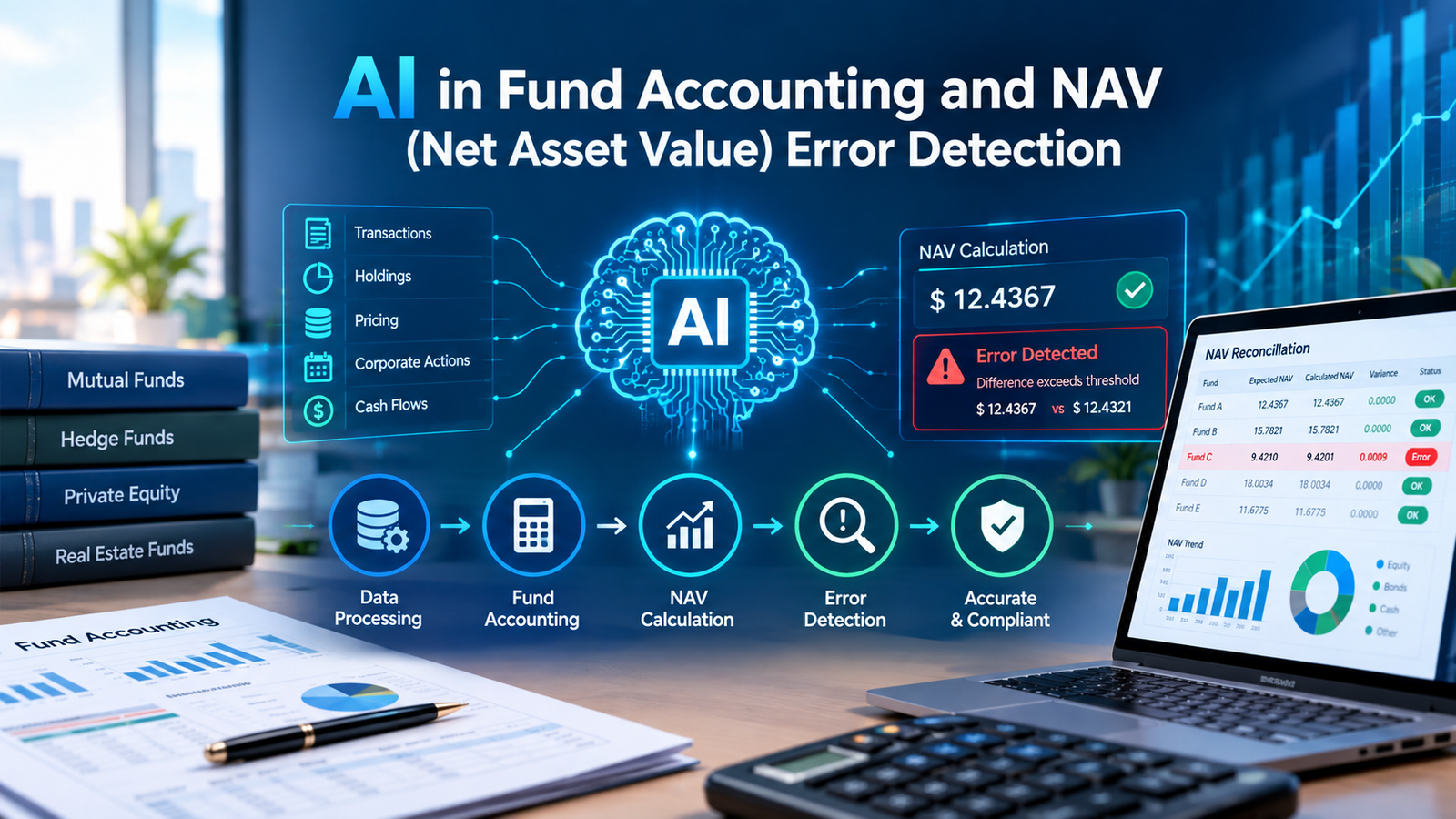
Primary topic: AI in Fund Accounting and NAV Error Detection
Research focus: Net asset value calculation, fund accounting automation, investment data reconciliation, valuation anomalies, pricing errors, machine learning, financial reporting controls, exception management, audit trails, fund administration and operational risk
Why Fund Accounting and NAV Accuracy Matter
Net asset value, or NAV, represents the value of a fund’s assets minus its liabilities. For funds that calculate a per-share or per-unit NAV, the result is divided by the number of outstanding shares or units. Investors, fund managers, administrators and distributors rely on this figure to value holdings, process subscriptions and redemptions, assess performance and maintain accurate financial records.
A simplified calculation is:
The formula is straightforward, but producing an accurate NAV can require data from portfolio management systems, custodians, brokers, pricing vendors, fund accounting platforms, transfer agents, banks and internal spreadsheets. Each system may use different formats, cut-off times, identifiers and valuation conventions.
A small upstream error can flow through several downstream processes. An incorrect security price can distort a fund’s total assets, while a missing liability or incorrect fee accrual can overstate the value available to investors. If the error is discovered after publication, the fund may need to correct its NAV, investigate investor transactions, recalculate fees, notify relevant parties and document the incident.
AI is relevant because these processes generate large volumes of structured data and recurring exceptions. Machine learning can help identify patterns that conventional reconciliation rules may miss, while deterministic accounting controls remain responsible for enforcing approved calculations and release conditions.
Where NAV Errors Originate
A useful AI solution begins with an understanding of the accounting process. NAV errors can arise from data quality problems, valuation decisions, accounting entries or failures in the operational workflow. These categories require different detection methods, so treating every discrepancy as the same kind of anomaly can create unnecessary alerts.
Pricing and valuation
Stale prices, incorrect quotes, bad FX rates, missing prices and unsuitable valuation inputs
Positions and transactions
Missing trades, duplicate bookings, settlement mismatches and incorrect quantities
Accounting entries
Incorrect accruals, expenses, income recognition, corporate actions and liabilities
Process and controls
Late files, failed interfaces, manual overrides and incomplete approval records
These categories also show why a single model is unlikely to solve every NAV problem. Price anomalies may require market context, while a missing transaction may be identified by comparing records from two systems. An incorrect fee accrual may require knowledge of fund terms, the applicable fee schedule and the accounting period.
The system should therefore combine rules, reconciliation logic, statistical models and human review.
Research Study: Machine Learning Approach for Predicting Mutual Fund NAV
A 2024 paper published in Procedia Computer Science examined machine learning methods for predicting mutual fund NAV from portfolio holdings. The researchers explored how the performance of individual stocks could be combined to estimate the value of a mutual fund, using a case study involving the Axis Bluechip Fund and data from Yahoo Finance.
The study evaluated approaches including linear regression, decision tree regression and multivariate regression. It proposed a hierarchical approach that analyzed individual portfolio components before combining their results. The paper reported an R-squared value of 0.86 for its proposed model, indicating that the model explained a substantial proportion of variation in the test data used in the study.
Why this matters for NAV operations: Portfolio-level estimation can provide an independent reference against which a calculated NAV can be compared. If the official figure moves sharply away from an expected range, the discrepancy can trigger a review of prices, holdings, liabilities or accounting entries.
However, the study concerns NAV prediction, not proof that an AI system can detect all accounting errors. A prediction model can be wrong when market conditions change, portfolio holdings are incomplete or the test data do not represent the live fund. It should therefore be used as an additional control rather than a replacement for the official valuation process.
Research Study: Automation and the Quality of Financial Reporting
A study published in Review of Accounting Studies in 2025 examined whether companies’ use of automation, including machine learning, robotic process automation and AI, was associated with improvements in financial reporting.
The research focused on internal controls and reported an association between automation use and fewer material weaknesses in internal controls. This is relevant to fund accounting because reliable NAV production depends on more than accurate arithmetic. It requires controlled data flows, consistent processing, appropriate approvals and evidence that errors are identified and corrected.
For fund administrators, the implication is that automation should be designed around control quality. A system that processes transactions quickly but cannot explain how a value was sourced or changed may create new audit problems. By contrast, automation that records source data, flags exceptions and preserves approval histories can strengthen the evidence available to internal control teams.
The study does not establish that every AI implementation improves financial reporting. Its broader finding supports careful automation of controlled processes, with the results measured through actual control outcomes rather than adoption statistics alone.
Research Study: Systematic Review of AI in Investment Funds
A systematic review published in Discover Artificial Intelligence in October 2025 examined AI applications in investment funds. The authors identified 27 studies published between 2020 and 2024 and organized the findings into front-end and back-end applications.
The back-end applications included predictive analytics, investment screening, automated trading and management of pooled investments. The review demonstrates that AI is being studied across multiple parts of investment-fund operations, but it does not establish that all those applications have reached the same level of maturity.
For NAV operations, this distinction is important. Predictive models used for portfolio analysis are not automatically suitable for accounting control. A model built to forecast returns may tolerate a degree of estimation error that would be unacceptable when determining the value assigned to an investor’s shares.
Fund accounting systems need models evaluated against operational outcomes such as missed exceptions, false alerts, reconciliation breaks and the financial impact of errors.
Research Study: AI Models for Predicting Investment Values
A systematic review and meta-analysis published in Engineering Applications of Artificial Intelligence in February 2025 examined machine learning and deep learning models used to predict investment values. The authors pooled findings from 11 eligible studies and compared model performance using measures including root mean squared error and correlation between predicted and actual values.
The review identified Gradient Boosting Decision Trees as a strong machine learning approach in the studies examined. It also identified an LSTM-GBDT combination as a promising deep learning approach. These findings suggest that different model families may be useful for different forecasting tasks, especially where financial data contain nonlinear relationships and time-dependent patterns.
For NAV error detection, such models could estimate expected values for selected assets or portfolio components. A large difference between the model estimate and the official accounting value could become an exception for investigation.
The limitation is that investment-value prediction and accounting correctness are different objectives. A model can estimate a market value accurately while missing an incorrect liability, an unbooked trade or an investor-level allocation error. Prediction should therefore complement, not replace, reconciliation and accounting validation.
Research Study: Systematic Review of Explainable AI in Finance
A 2024 systematic literature review in Artificial Intelligence Review examined explainable AI in finance. The authors identified 138 relevant articles and discussed the importance of explaining the outputs of complex models used in financial decisions.
Explainability is especially important in NAV error detection because an alert needs to lead to a practical investigation. A fund accountant must understand whether a discrepancy relates to a stale market price, an unexpected position movement, a fee calculation or a data-feed problem.
A useful AI system should show the evidence behind its alert, including the source records, historical comparisons, relevant thresholds and estimated financial impact. This makes it easier for an accountant to validate the issue and document the resolution.
Explainability does not guarantee that a model is correct. It does, however, help users challenge model outputs, identify weak assumptions and maintain a defensible record of decisions.
Research Study: Neural Networks for Automated Accounting and Anomaly Detection
A study published in Scientific Reports in December 2025 proposed a neural-network-based approach to automating accounting information processing. The architecture combined LSTM networks for sequential behavior, autoencoders for anomaly detection and attention-enhanced models for transaction categorization and risk assessment.
The authors reported 96.3% accuracy for risk prediction and a false-positive rate below 3% for anomaly detection in their experimental setting. Those figures should be interpreted in context: the study used a public financial dataset, and its reported performance does not establish the same results for fund accounting data or NAV errors.
The architecture is nevertheless relevant. LSTM models can examine sequences of financial activity, while autoencoders can learn common patterns and flag records that differ from those patterns. An attention-based component can help identify which inputs contribute to a risk classification.
For fund accounting, these techniques could be adapted to detect unusual journal entries, abnormal accrual movements, unexpected position changes or recurring breaks between systems. Before deployment, the model would need testing on representative fund data, including rare but legitimate events such as restructurings, large redemptions and corporate actions.
What These Studies Mean for NAV Error Detection
The research points toward several complementary methods rather than one universal model. Predictive models can estimate expected values, anomaly detection can identify unusual records, and explainable AI can help accountants understand why an alert was raised. Automation research also reinforces the importance of internal controls and measurable reporting outcomes.
| AI method | NAV application | Important limitation |
|---|---|---|
| Regression and forecasting | Estimate expected portfolio or asset values | A forecast is not an accounting source of truth |
| Gradient boosting | Model nonlinear relationships and rank risk factors | Requires representative training data |
| Sequence models | Detect unusual patterns over time | May miss new or infrequent events |
| Autoencoders | Flag records that differ from learned patterns | Unusual does not always mean incorrect |
| Graph and relationship analysis | Find breaks across related records and systems | Depends on reliable identifiers and links |
| Explainable AI | Show why an exception was flagged | Explanations need independent validation |
How AI Can Detect NAV Errors in Practice
Pricing and Valuation Anomalies
Pricing errors can occur when a security is assigned a stale quote, an incorrect price, an inappropriate pricing source or a value that does not reflect an approved valuation policy. AI can compare the latest price with historical movements, related securities, market indicators and other available pricing sources.
For example, if a bond’s price changes sharply while comparable securities remain stable, the system can flag the valuation for review. The alert should show the price source, timestamp, observed movement and relevant comparison data. A large movement may be legitimate, so the model should not automatically overwrite the official price.
Position and Transaction Reconciliation
Fund administrators often reconcile positions and transactions across accounting platforms, custodians and brokers. Traditional matching rules can identify exact differences, but real-world records may contain inconsistent identifiers, timing differences or formatting variations.
AI can help match records that are likely to refer to the same transaction, identify unusual unmatched items and prioritize breaks based on value and historical behavior. Deterministic controls should still confirm the final match, particularly when the records affect material holdings or investor allocations.
Accruals, Fees and Expenses
Accruals and fees can be affected by fund-specific terms, rate changes, performance fees, expense allocations and accounting cut-off rules. AI can learn the historical behavior of recurring entries and flag unusual amounts, missing entries or unexpected changes.
For example, an expense accrual that is several times larger than its normal range could be reviewed before the NAV is finalized. The system should compare the entry with the approved fee schedule and accounting policy rather than treating historical patterns as the sole authority.
Corporate Actions and Income Events
Dividends, stock splits, mergers, coupon payments and other corporate actions can create complex accounting movements. Missing or incorrectly applied events can affect both positions and cash balances.
AI can compare expected events with booked entries, identify unusual timing and detect differences between vendor announcements and internal records. A human reviewer should confirm the event terms and accounting treatment before any correction is posted.
Visual Workflow: From Raw Data to NAV Approval
Custodian files, trades, prices, FX rates and accounting records
Completeness checks, matching, identifiers and cut-off controls
Expected-value comparison, pattern analysis and impact scoring
Evidence, root cause, ownership and documented resolution
Accounting checks, authorized sign-off and release record
The workflow should preserve the original records and the history of every change. AI can recommend a correction or identify the likely source of an error, but adjustments should be posted through approved accounting procedures.
Prioritizing Exceptions by Financial Impact
An AI system can generate more alerts than a team can investigate. The solution is not simply to reduce the alert count. It is to prioritize exceptions according to their potential effect on NAV, the confidence of the evidence and the urgency of the reporting deadline.
| Priority | Example | Suggested response |
|---|---|---|
| Critical | Potential material valuation or position error | Escalate before NAV release |
| High | Unexplained price movement or significant reconciliation break | Assign to an experienced reviewer |
| Medium | Recurring mismatch with limited estimated impact | Review within the normal exception queue |
| Low | Minor formatting or non-material data issue | Resolve through standard data-quality workflow |
These categories are an operational design example, not a universal regulatory materiality scale. Each fund should define its thresholds based on its governing documents, accounting policies, investor impact and applicable requirements.
AI Architecture for Fund Accounting
A production-ready solution should connect to existing fund accounting infrastructure instead of requiring every system to be replaced at once.
Data layerCustodian feeds, portfolio management systems, accounting ledgers, pricing vendors, corporate-action data, FX rates and fund terms
Control layer
Schema validation, source checks, reconciliations, accounting rules, cut-off controls and data lineage
AI layer
Anomaly detection, expected-value models, transaction matching, exception classification and impact estimation
Workflow layer
Exception queues, case ownership, supporting evidence, approvals and escalation
Governance layer
Model validation, access controls, audit logs, performance monitoring and controlled model updates
The architecture should distinguish between the system that calculates official NAV and the AI system that checks the result. This separation reduces the risk of a model silently changing accounting outputs without proper approval.
Expert Recommendation
The practical recommendation for asset managers and fund administrators is to start with **AI-assisted exception detection**, particularly in reconciliations, price validation and recurring accounting entries. These workflows already have source records, established control owners and identifiable outcomes, making them suitable for measured pilots.
Before deployment, organizations should:
- Build a reliable history of resolved NAV errors and reconciliation breaks
- Separate confirmed errors from legitimate unusual events
- Prioritize use cases with measurable financial or operational impact
- Keep official valuation and accounting rules explicit
- Require evidence and explanations for high-risk alerts
- Use human approval for material adjustments and NAV release
- Test across different fund types, asset classes and market conditions
- Monitor false positives, missed errors and changes in data quality
- Maintain versioned models, audit trails and rollback procedures
Grant Thornton’s 2025 discussion of AI in fund administration similarly emphasizes reconciliation, NAV production, reporting and exception management as practical areas for applying AI. It also highlights the value of filtering exceptions so operations teams can focus on the issues that matter.
Industry perspective: Grant Thornton, AI Plays for Smarter, Profitable Fund Administration, 2025
Expert Quote
Karl Rohloff, Grant Thornton Advisory Services Director, on AI-enabled fund administration:
“The real value of AI comes when exceptions are filtered to focus on what matters.”
Source: Grant Thornton, 2025
This principle is particularly relevant to NAV operations. A system that flags every unusual movement can overwhelm accountants, while a system that ranks exceptions by likely impact and explains its reasoning can help teams focus their attention.
Implementation Roadmap
Phase A
Data assessment
Map source systems, identify recurring breaks, review data quality and establish baseline error metrics
Phase B
Focused pilot
Test AI on a bounded use case such as stale-price detection or unexplained reconciliation breaks
Phase C
Controlled integration
Connect alerts to existing accounting and case-management workflows with clear approval controls
Phase D
Scale and monitor
Expand to additional funds and asset classes after independent validation and operational review
KPIs for Measuring Results
AI should be assessed by whether it improves NAV control quality, not simply by how many alerts it generates or how many tasks it automates.
| Metric | What it measures | Why it matters |
|---|---|---|
| Confirmed error detection rate | Share of known errors detected | Measures detection coverage |
| False-positive rate | Alerts that are not actionable errors | Measures investigation burden |
| Time to resolve | Time from alert to closure | Measures workflow efficiency |
| NAV release delays | Delays caused by unresolved exceptions | Measures operational impact |
| Repeat error rate | Recurrence of previously resolved error types | Measures whether root causes are addressed |
| Audit evidence completeness | Availability of source, decision and approval records | Supports accountability and review |
Risks and Governance Requirements
AI introduces its own risks. Models can learn historical mistakes, flag legitimate market movements, miss new error types or behave differently when data formats change. If a model is trained on incomplete records, its output may reflect the weaknesses of the underlying data rather than the true risk of an accounting event.
Financial institutions should maintain governance over model development, validation, deployment and ongoing monitoring. The model should be tested on historical periods and live-like data, including unusual market conditions and rare operational events. Changes to the model should be documented, approved and reversible.
Key controls include:
- Independent validation before production use
- Access restrictions for sensitive financial data
- Source-level data lineage and version control
- Monitoring for model drift and changing error patterns
- Clear ownership for investigating and closing alerts
- Human approval for material accounting adjustments
- Periodic review of model performance and operational impact
The system should also avoid treating historical patterns as unquestionable truth. A legitimate corporate action, market shock or change in fund strategy may look anomalous precisely because it has not happened before.
Future Predictions: 2027–2030
AI Will Move from Detection to Root-Cause Analysis
Fund accounting tools are likely to move beyond identifying a mismatch and toward explaining where it originated. By connecting source records, transformations, accounting entries and approval history, AI assistants may help investigators trace a NAV discrepancy back to the first incorrect or missing input.
Continuous Reconciliation Will Expand
As data platforms and interfaces improve, more controls will run when new records arrive rather than waiting until the end of the NAV cycle. This should give operations teams more time to resolve material issues before the fund’s valuation deadline.
Fund-Specific Models Will Become More Important
A model trained on liquid equity funds may not perform well on private credit, real estate, derivatives or funds holding less frequently priced assets. Future systems will likely combine shared models with fund-specific rules, calibration and validation.
AI Explanations Will Become Part of the Audit Trail
Rather than storing only a risk score, platforms will increasingly preserve the evidence behind an alert, the records reviewed, the human decision and the final resolution. This will help firms evaluate model quality and support internal and external review.
Human Approval Will Remain Central for Material NAV Decisions
Automation will likely expand across matching, data validation and exception triage. However, valuation judgments, material adjustments and NAV release decisions will continue to require controls appropriate to the fund, its policies and applicable rules. The operational direction is toward better-supported human decisions, not unchecked model authority.
Frequently Asked Questions
What is AI in fund accounting?
AI in fund accounting uses machine learning, anomaly detection, document processing and automation to support tasks such as reconciliation, transaction classification, pricing checks, accrual review and financial reporting. Its purpose is to improve the identification and handling of exceptions while preserving accounting controls.
Can AI calculate NAV?
AI can estimate or help calculate components of NAV, but an estimated value is not automatically an acceptable official valuation. Fund accounting systems should use approved valuation methods and accounting rules, with AI supporting validation and exception detection.
How does AI detect NAV errors?
AI can compare accounting records with expected patterns, identify unusual price movements, detect missing or duplicated transactions, estimate the impact of discrepancies and prioritize exceptions for review. The strongest systems combine these methods with deterministic reconciliations and source-data checks.
Can AI detect stale security prices?
Yes. A model can examine price timestamps, historical movements, related securities and available market data to flag potentially stale or inconsistent prices. The alert should be reviewed against the fund’s pricing policy and approved sources.
What is the difference between NAV prediction and NAV error detection?
NAV prediction estimates a likely value based on available information. NAV error detection looks for incorrect inputs, missing entries, mismatched records or calculation problems in the actual accounting process. Prediction can support detection, but it cannot replace reconciliation.
What data does an AI NAV monitoring system need?
Typical inputs include portfolio holdings, transaction records, custodian statements, security prices, FX rates, corporate actions, accounting entries, fee schedules, fund terms and historical exception records. Data quality and reliable identifiers are essential.
Can AI reduce fund accounting operational costs?
AI may reduce manual investigation and repetitive reconciliation work, but the actual benefit depends on data quality, integration effort, alert precision and the complexity of the fund’s operations. Organizations should measure time saved, error detection and control quality rather than assume a guaranteed reduction.
What is the biggest risk of AI in NAV error detection?
A major risk is treating model outputs as facts. AI can produce false alerts or miss genuine errors, so material issues need evidence-based review, validated controls and documented approval before accounting records or published NAV figures are changed.
Final Perspective
AI in fund accounting and NAV error detection is a focused operational opportunity. It addresses a specific problem: producing reliable fund valuations from data that arrives through multiple systems, on different schedules and under different accounting conventions.
The research supports several building blocks. Machine learning can estimate investment values, neural networks can detect unusual accounting patterns, automation can support stronger internal controls, and explainable AI can make model outputs easier to investigate. Yet these findings do not justify treating AI as an independent authority over NAV.
The most effective implementation will connect AI to the fund’s existing accounting and reconciliation processes. It will detect unusual values, match records, identify potential root causes, estimate financial impact and route exceptions to the appropriate reviewer. It will also preserve the source evidence and the human decisions that determine whether an adjustment is necessary.
For asset managers, fund administrators and financial technology providers, the opportunity is to build systems that help teams find material errors earlier and resolve them with less manual effort. Success should be measured through fewer missed errors, more useful alerts, faster resolution, reliable audit evidence and controlled NAV release.
The central principle is simple: **AI should make NAV controls more intelligent, explainable and timely without weakening the accounting discipline that makes the final valuation trustworthy.**
Research Sources
- Machine Learning Approach for Predicting the Net Asset Value (NAV) of Mutual Funds Based on Portfolio Holdings, 2024
- Does Automation Improve Financial Reporting? Evidence from Internal Controls, 2025
- Mapping the Presence of Artificial Intelligence in Investment Fund: A Systematic Review, 2025
- Optimal Machine Learning- and Deep Learning-Driven Algorithms for Predicting the Future Value of Investments: A Systematic Review and Meta-Analysis, 2025
- Explainable Artificial Intelligence (XAI) in Finance: A Systematic Literature Review, 2024
- Research on the Automation of Intelligent Accounting Information Processing Process Driven by Neural Networks, 2025
- Grant Thornton, AI Plays for Smarter, Profitable Fund Administration, 2025
- OnCorps, A Systematic Approach to Predicting NAV Errors, 2025

Leave a Reply