
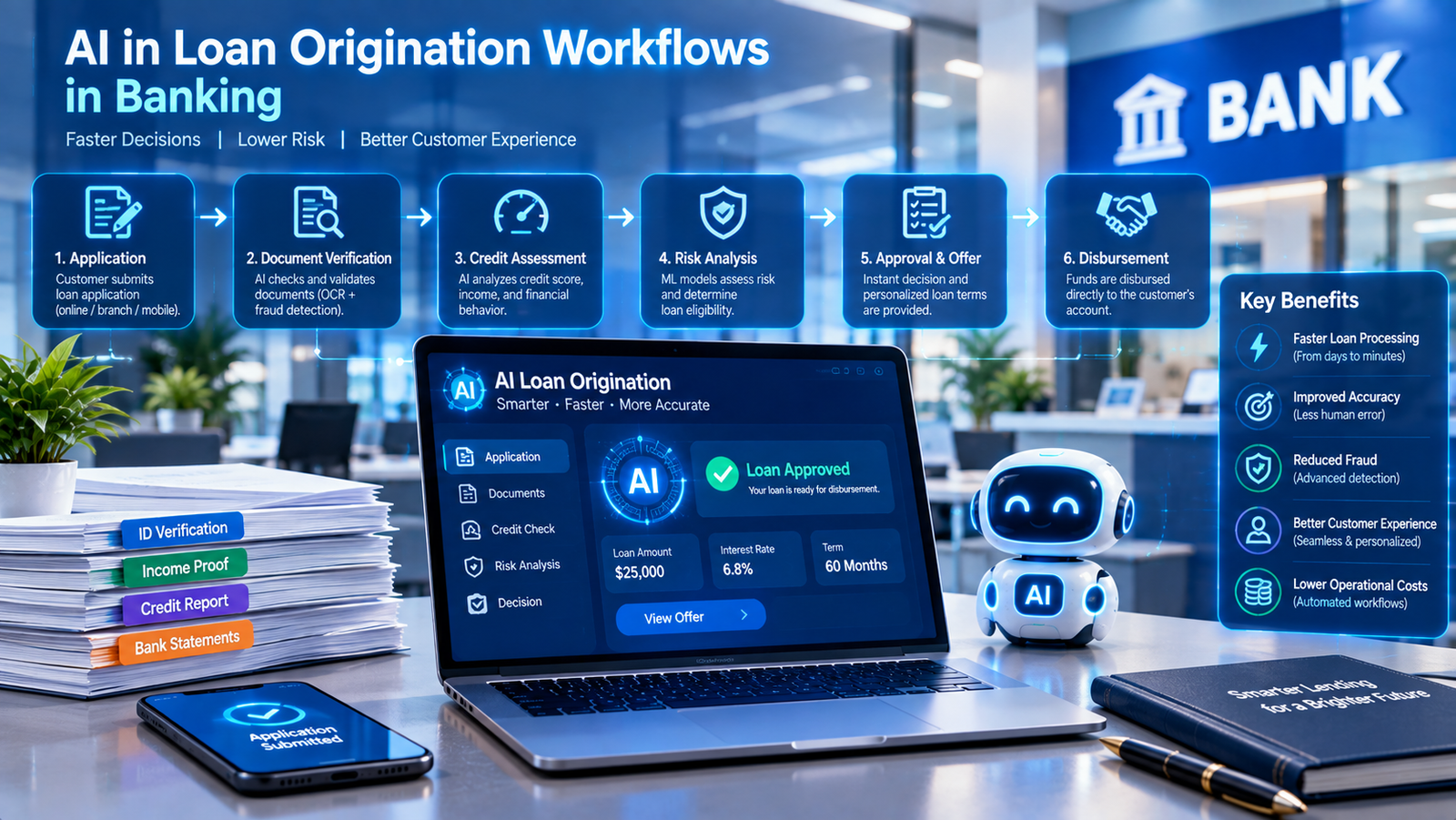
Primary topic: AI in Loan Origination Workflows in Banking: Research, Applications, Risk & Future
Research focus: AI-powered loan applications, borrower onboarding, document intelligence, credit assessment, underwriting, fraud detection, decision automation, loan pricing, explainable AI, fair lending, workflow orchestration and post-approval monitoring
Audience: Banks, digital lenders, fintech companies, credit unions, lending technology providers and financial institutions modernizing legacy loan systems
What Is AI in Loan Origination?
Loan origination covers the process a bank follows from receiving a loan application to making a credit decision and preparing the loan for disbursement. Depending on the institution and loan type, this process can include customer identification, application intake, document collection, income verification, credit checks, affordability assessment, underwriting, pricing, approval, agreement preparation and account setup.
Many banks still manage these activities across a combination of loan origination systems, customer relationship management platforms, core banking software, credit bureaus, document repositories and manual spreadsheets. When these systems do not communicate effectively, employees may need to re-enter information, request documents several times or wait for decisions from separate teams.
AI can help connect these steps by extracting information, identifying missing items, analyzing risk signals and coordinating work between systems.
AI-enabled origination does not mean that every application should be approved or rejected by an autonomous model. In a well-designed system, automation handles repeatable tasks, predictive models support risk assessment, and authorized employees review cases that require judgment or fall outside established policy.
The AI-Enabled Loan Origination Journey
Customer and loan details
Identity and documents
Cash flow and credit risk
Approve, refer or decline
Agreement and disbursement
AI connects the stages, while lending policy and accountable decision-makers control the outcome.
Why Banks Are Rebuilding Loan Origination
Loan origination is both a customer experience and a credit-risk process. Applicants expect clear requirements and timely decisions, while banks need reliable information about repayment capacity, identity, fraud exposure and the economic conditions affecting the borrower. A faster process is valuable only when it preserves the quality of the decision.
AI is particularly relevant where lending teams process large volumes of repetitive information. Consumer lending may involve standardized income records and credit data, while small-business and commercial lending can require analysis of bank statements, invoices, tax records, financial statements and narrative explanations. These differences mean that the most useful AI architecture will depend on the product, borrower segment and evidence available.
Reduce manual handling
Extract data from documents and reduce repetitive entry across lending systems.
Improve risk visibility
Combine credit history, cash flow and relevant borrower information.
Make decisions traceable
Record the evidence, model outputs, policy rules and approvals behind each case.
Research Study: Machine Learning and Cash Flow Data in Consumer Underwriting
FinRegLab published empirical research in 2025 examining how machine learning and cash flow data affect consumer credit underwriting. The study compared models using traditional credit bureau information, cash flow data, and combinations of both. I
t used anonymized information from a national credit bureau and a leading data aggregator, evaluating predictions against the performance of new accounts opened in 2018 and 2019.
The central finding was that machine learning and cash flow information could improve credit-risk prediction and expand access to credit without increasing lender default risk in the study’s analysis. The importance of this research lies in the combination of modeling method and data source.
A more sophisticated algorithm is not necessarily useful if it receives the same incomplete information as the existing model. Cash flow data can provide additional evidence about how a borrower manages money, including income patterns and recurring obligations.
For loan origination, this approach can be particularly relevant to applicants with thin credit files or financial circumstances that are not fully represented by conventional credit scores.
A lender could use verified account data to understand regular deposits, payment obligations, liquidity patterns and potential signs of financial stress. These signals can complement, rather than automatically replace, conventional credit information.
The research does not establish that every cash flow model will improve outcomes for every lender. Results depend on the population, data coverage, model design and validation method.
Banks should also consider whether customers have provided appropriate consent and whether the data used is relevant, accurate and legally permissible.
Practical implication: AI origination systems should make it possible to combine traditional credit data with validated cash flow features, then measure whether the additional information improves prediction and access without creating unacceptable risk.
Source: FinRegLab, Machine Learning and Cash Flow Data in Consumer Underwriting, 2025
Research Study: Machine Learning-Based Loan Approval Automation
A 2026 study published in Expert Systems developed and compared machine learning approaches for loan approval. The researchers evaluated Random Forest, XGBoost, stacking and voting ensembles using a public loan dataset containing 614 records and 13 features.
The dataset was imbalanced, with more approved than rejected applications, so the researchers applied the Synthetic Minority Over-sampling Technique and used five-fold cross-validation for model tuning.
The tuned Random Forest model achieved 85.96% accuracy, an 87.17% F1-score and 95.32% recall in the reported evaluation. The researchers also used SHAP and LIME to help explain model outputs. They tested the framework on the Statlog German Credit dataset, reporting comparable AUC values across the two datasets.
This study is relevant to origination because it demonstrates a practical workflow for model comparison, class-imbalance handling, validation and explanation. In lending, accuracy alone can be misleading.
A model can appear accurate by predicting the majority class while performing poorly on applications that are harder to classify. Recall, precision, calibration and the cost of different errors are therefore important when evaluating a model.
The study also has limitations that banks should not overlook. A dataset of 614 applications is small compared with the scale and complexity of production lending. Public datasets may not represent current applicants, modern products, changing economic conditions or a bank’s own credit policy. A fairness result on one dataset does not establish that a model is fair across all populations or jurisdictions.
Practical implication: Banks can use this type of research to structure model testing, but production deployment requires institution-specific data, independent validation, ongoing monitoring and review of customer-level explanations.
Research Study: How AI Adoption Might Affect Bank Lending
A September 2026 Economic Letter from the Federal Reserve Bank of San Francisco examined the relationship between AI adoption and bank lending. The authors reported that banks using AI more intensively tended to have higher returns on assets and higher shares of problem loans. Greater AI usage was also associated with a decline in the share of small-business lending.
The findings raise an important question for AI-enabled origination: what types of borrower information do models favor? The authors suggest that AI may be particularly effective at processing hard data, such as credit scores and financial statements, while some small-business lending depends more heavily on soft information, including personal relationships and knowledge of the business.
This distinction matters because a model can improve efficiency while changing which borrowers receive attention. Small businesses may have irregular revenue, seasonal cash flow, limited formal financial records or business circumstances that are difficult to represent in structured datasets. If an origination system gives too much weight to easily measured information, it may fail to capture relevant context.
The study reports associations, not proof that AI alone caused these outcomes. Banks differ in size, customer mix, lending strategy and economic exposure. Still, the research gives lenders a reason to measure the composition of their loan portfolios after introducing AI, rather than judging success only by processing speed or operating cost.
Practical implication: AI lending programs should track approval rates, pricing, loan sizes and portfolio performance across borrower segments, including small businesses and applicants with limited conventional credit histories.
Source: Federal Reserve Bank of San Francisco, How AI Adoption Might Affect Bank Lending, September 2026
Research Study: Managing Machine Learning Models in Consumer Credit Underwriting
FinRegLab’s framework for managing machine learning models in consumer credit underwriting was developed through discussions with banks participating in an Office of the Comptroller of the Currency Project REACh technology working group.
It focuses on the practical risk-management processes that financial institutions need when adopting machine learning for credit decisions.
The framework is useful because model performance is only one part of a lending system. A model may be technically strong but still create problems if the bank cannot explain its use, monitor changes, manage third-party dependencies or connect its outputs to established credit policies.
The framework emphasizes the need to adapt model management to the institution’s implementation, risk profile and operating environment.
For loan origination, this means that model governance should begin before deployment. The bank should document the model’s intended use, the population for which it was validated, the data sources it depends on, the limits of its predictions and the circumstances in which human review is required.
It should also define how the model will be monitored after launch. Changes in applicant behavior, economic conditions, data feeds or upstream software can affect performance. A model that performed well during development may become less reliable when the market or applicant population changes.
Practical implication: Build model inventory, validation, change management, monitoring and escalation processes into the origination platform from the beginning.
Source: FinRegLab, Framework for Managing Machine Learning Models in Consumer Credit Underwriting
Research Study: Explainability and Fairness in Machine Learning Credit Underwriting
FinRegLab and researchers from Stanford Graduate School of Business studied the capabilities and limitations of tools designed to improve the explainability of machine learning models used in credit underwriting.
The work addresses a central challenge for lenders: complex models may identify patterns that simpler methods miss, but their outputs can be harder to interpret and communicate.
Explainability matters at several points in origination. Credit officers need to understand why a case has been referred for review. Model risk teams need to assess whether the model behaves as expected. Compliance teams need to evaluate whether the decision process meets applicable requirements. Customers may also need clear information about the reasons behind an adverse decision.
Tools such as SHAP and LIME can help describe which features contributed to a particular model output. However, an explanation is not automatically a causal account of why a borrower will default, nor does it prove that a model is fair. Feature contributions can be unstable, misleading or difficult to translate into a meaningful customer explanation if used without care.
For a production origination workflow, explanation methods should be tested alongside the model. Banks should confirm that explanations are understandable, consistent with the actual decision process and suitable for the intended audience.
They should also assess outcomes across relevant groups and investigate whether apparently neutral variables act as proxies for protected characteristics.
Practical implication: Treat explainability and fairness as measurable system requirements, not as optional features added after the credit model is complete.
Source: FinRegLab, Explainability and Fairness in Machine Learning for Credit Underwriting
Research Study: AI Use and Oversight in Financial Services
The U.S. Government Accountability Office published a review of AI use and oversight in financial services in May 2025. It describes how financial institutions use AI in areas including credit decisions, customer service and other operations, while identifying risks such as lending bias and cybersecurity concerns.
The report is relevant to loan origination because it places AI lending within the broader financial-services oversight environment. Credit decisions are not isolated technical predictions. They affect access to financial products, customer treatment, institutional risk and regulatory responsibilities.
For banks, the lesson is to establish clear accountability across the teams that develop, purchase, validate and operate AI systems. Third-party models and data providers require particular attention because outsourcing technology does not remove the bank’s responsibility for the lending process.
Practical implication: The operating model for AI origination should identify who owns the model, who approves changes, who investigates incidents and who has authority to pause automated decisions when a material problem appears.
Where AI Adds Value Across the Origination Workflow
The strongest implementations use different AI techniques for different tasks. Document extraction, credit prediction, fraud detection and workflow routing solve different problems and should not be treated as one generic AI capability.
| Origination stage | AI application | Operational value | Important control |
|---|---|---|---|
| Application intake | Document classification and field extraction | Less manual entry | Field-level confidence checks |
| Verification | Mismatch and anomaly detection | Earlier identification of inconsistencies | Human review of material flags |
| Credit assessment | Credit-risk and cash-flow models | More evidence for underwriting | Validation and fairness testing |
| Underwriting | Decision support and case summaries | More consistent review | Policy-based approval authority |
| Pricing | Risk-based pricing support | More granular risk estimates | Fairness and pricing governance |
| Fulfillment | Workflow orchestration and document checks | Fewer handoff delays | Final agreement and disbursement controls |
AI Document Intelligence for Loan Applications
Document processing is one of the most practical places to introduce AI because it addresses a specific, measurable source of operational work.
Applicants may submit bank statements, payslips, tax returns, business accounts, invoices, identity documents and proof of address. These files may arrive in different formats, contain inconsistent labels or require information to be reconciled across multiple pages.
Document AI can classify each file, extract relevant fields, detect missing pages and compare values across documents. For example, a system can extract monthly revenue from bank statements and compare it with the income declared on an application. If the values differ materially, it can route the case for review instead of silently choosing one value.
Generative AI can help summarize long financial documents or prepare an underwriter’s case brief. However, extracted figures should be linked to their original source pages, and material calculations should be performed through deterministic, testable logic. A language model should not be trusted to invent a missing financial value or silently resolve a discrepancy.
Document Intelligence: From File to Verified Data
PDF, image, statement
OCR and AI fields
Rules and cross-checks
Verified fields and exceptions
Design principle: Every important extracted value should retain a link to its source document and a record of any correction.
AI Credit Assessment and Cash Flow Underwriting
Credit assessment estimates whether a borrower can and will repay a loan under the proposed terms. Traditional underwriting often uses credit bureau history, income, debt obligations, collateral and financial ratios. AI can help combine these inputs and identify patterns that may be difficult to capture with a small set of manually designed rules.
For consumers, relevant data may include verified income, recurring expenses, debt payments and account balances. For small businesses, it may include revenue volatility, invoice payment timing, supplier concentration, cash reserves and seasonality. The model must distinguish temporary volatility from a persistent inability to repay.
Alternative data can help applicants whose conventional credit files are limited, but it also creates risks. Transaction data may reveal sensitive personal behavior, and a feature that improves prediction in one population may perform differently in another. Banks should assess whether each input is necessary, reliable, permitted and understandable.
AI Fraud Detection During Origination
Fraud detection should operate alongside credit assessment but remain a distinct function. A borrower can have a strong repayment profile and still submit manipulated documents, use a stolen identity or be involved in application fraud. Conversely, an unusual application pattern does not necessarily mean that the applicant is fraudulent.
AI can compare application details with identity records, detect suspicious document alterations, identify repeated devices or contact details and flag inconsistencies across applications.
Graph analytics can help identify connections between applications that share suspicious attributes. These signals should lead to proportionate checks rather than automatic accusations.
- Detect altered payslips, invoices and bank statements
- Identify repeated applications with inconsistent identities
- Flag unusual combinations of device, address and account signals
- Compare declared income with verified financial evidence
- Route high-risk cases for enhanced verification
Generative AI for Underwriter Productivity
Generative AI can help underwriters work through large volumes of documents and information. A controlled assistant can summarize a borrower’s financial position, identify missing evidence, compare documents and draft a preliminary credit memo.
It can also answer questions about the bank’s own lending policy when connected to an approved and maintained knowledge base.
These capabilities are most useful when the system provides source references and separates extracted facts from generated analysis.
For example, a credit memo should identify which financial statement supports a revenue figure and distinguish that figure from an AI-generated interpretation of revenue trends.
Generative AI should not independently change lending policy, approve exceptions or invent missing information. Material outputs need verification, and the system should preserve a record of the documents, model version and instructions used to produce them.
Modern AI Loan Origination Architecture
A bank does not need to replace its entire core banking platform to introduce AI. In many cases, the more practical approach is to build an orchestration and intelligence layer that connects existing systems through controlled APIs.
The architecture should allow the bank to update models and workflow components without losing the audit trail or duplicating customer records.
Reference Architecture
Mobile app, web banking, branch, relationship manager
Application state, document requests, task routing
OCR, extraction, reconciliation
Credit, affordability, fraud
Policy, limits, referrals
Exceptions, high-risk cases, delegated authority
Agreement, account creation, disbursement
Audit logs, model monitoring, access controls, outcomes
Regulatory and Model Risk Considerations
AI in lending operates within existing requirements for fair lending, consumer protection, privacy, data security, model risk management and recordkeeping. The exact obligations depend on the institution, product and jurisdiction.
A bank should not assume that using a third-party model or an AI service removes its responsibility for the decision.
In the United States, the Federal Reserve, Office of the Comptroller of the Currency and Federal Deposit Insurance Corporation issued revised model risk management guidance in April 2026. The guidance replaces the earlier SR 11-7 guidance and emphasizes a risk-based approach tailored to an institution’s model risk profile, size and complexity.
The Federal Reserve states that it is expected to be most relevant to banking organizations with more than $30 billion in total assets under its supervision.
This update reinforces the importance of proportional governance. A large bank with complex credit models may need extensive independent validation and formal controls, while a smaller institution should still maintain governance appropriate to its risks and operational capacity.
Source: Federal Reserve, SR 26-2: Revised Guidance on Model Risk Management, April 17, 2026
| Risk area | Potential failure | Control |
|---|---|---|
| Fair lending | Unequal outcomes or proxy discrimination | Segment testing, outcome monitoring and review |
| Data quality | Incorrect extracted or stale information | Validation, source links and exception handling |
| Model drift | Declining performance as conditions change | Monitoring, back-testing and controlled updates |
| Explainability | Unable to explain a decision adequately | Decision reason codes and tested explanations |
| Third-party risk | Vendor outage, model changes or unclear data use | Due diligence, contracts and fallback processes |
| Automation failure | Incorrect approvals or stalled applications | Approval limits, human escalation and kill switches |
Expert Recommendation
Banks should approach AI loan origination as a connected operating-model transformation, not as a standalone model deployment. The first priority should be to identify a specific bottleneck, such as document intake, application completeness or underwriter preparation, and establish a baseline before introducing AI.
For credit decisioning, banks should compare AI models against existing approaches using out-of-time validation, realistic approval policies and measures of actual repayment performance. They should test performance across borrower segments and economic conditions, and avoid selecting a model solely because it produces a higher headline accuracy score.
For generative AI, begin with tasks where outputs can be checked against source material, such as document summarization, policy retrieval and credit memo preparation. Keep final approval authority within the bank’s approved decision framework. Every important AI output should be traceable to source data, and every automated action should have an owner and a defined fallback.
Recommended priorities:
- Automate document intake and completeness checks before automating credit decisions
- Use cash flow data only where consent, data quality and legal requirements are satisfied
- Separate fraud signals from creditworthiness assessments
- Use explainable models and maintain understandable decision reasons
- Monitor approval rates, default outcomes and customer treatment across relevant segments
- Keep human review for exceptions, uncertain evidence and high-impact cases
- Integrate AI with existing loan systems through secure, auditable APIs
- Measure end-to-end outcomes instead of counting AI tools deployed
Expert Perspective: Connected Execution Matters
“Connected execution, rather than standalone AI adoption”
This phrase from CRISIL Integral IQ’s 2026 analysis captures a central lesson for banking AI: the value of AI depends on how well it is integrated with data, workflows, governance and human judgment. A model that operates separately from the lending process may produce useful analysis without improving the customer’s actual journey or the bank’s end-to-end performance.
Source: CRISIL Integral IQ, More AI Is Not Necessarily Better Credit Decisioning, August 2026
Implementation Roadmap for Banks
Discover
Measure application volume, processing time, manual effort, incomplete files, referral rates and reasons for delays.
Prepare
Standardize key fields, define data access, connect source systems and establish document-level traceability.
Pilot
Start with document extraction, completeness checks or underwriter summaries in a controlled product segment.
Validate
Review extraction accuracy, decision quality, fairness, user acceptance, security and exception handling.
Scale
Extend to additional products only after the pilot demonstrates measurable value and reliable controls.
KPIs for AI Loan Origination
AI performance should be measured across customer experience, operational efficiency, credit quality and governance. A reduction in processing time is useful, but it should be evaluated alongside errors, complaints, approval outcomes and repayment performance.
| Metric | What it measures | Why it matters |
|---|---|---|
| Time to decision | Elapsed time from complete application to decision | Customer experience and operational speed |
| Manual touch rate | Share of applications requiring manual data handling | Automation effectiveness |
| Document extraction accuracy | Correctness of extracted fields | Reliability of downstream decisions |
| Default and delinquency rates | Realized portfolio performance | Credit quality |
| Approval and referral rates | How applications move through decisions | Policy consistency and access |
| Fairness indicators | Differences in outcomes across relevant groups | Consumer protection and governance |
| Cost per originated loan | Total origination cost divided by completed loans | Business value |
Future Predictions: AI in Loan Origination, 2027–2030
2027: More Connected Workflows
Banks are likely to focus on integrating AI into existing origination systems rather than adding isolated copilots. Document extraction, application checks, underwriting summaries and case routing will increasingly share a common workflow and audit trail. Institutions will place greater emphasis on measuring end-to-end improvements instead of reporting the number of AI tools deployed.
2028: More Contextual Small-Business Underwriting
Cash flow analysis, invoice data and other verified business records may become more important in lending to small firms that do not fit conventional scoring models. This could improve the evidence available to underwriters, but only if banks validate the models against real repayment outcomes and avoid treating incomplete digital records as a reliable measure of business quality.
2029: Stronger Model Monitoring Across the Loan Lifecycle
Credit models will increasingly be connected to portfolio monitoring. Information observed after origination can help banks evaluate whether their underwriting assumptions remain reliable. This feedback should be governed carefully so that changes to models are tested and approved rather than introduced automatically from recent outcomes.
2030: Controlled Agentic Workflows
AI agents may coordinate low-risk administrative tasks such as requesting missing documents, updating application status, preparing summaries and routing cases. High-impact actions, including final credit approval, policy exceptions and disbursement authorization, are likely to remain subject to explicit permissions, defined limits and audit controls. The degree of automation will vary by product, institution and regulatory environment.
- Reliable data connected across the lending lifecycle
- Evidence-backed AI outputs that employees can verify
- Credit models tested on relevant populations and time periods
- Clear accountability for automated actions
- Continuous monitoring of risk, fairness and customer outcomes
Startup Opportunities in AI Loan Origination
Financial institutions have different technology stacks, lending policies and data environments. This creates opportunities for focused products that solve a clearly defined part of the origination process rather than attempting to replace every system at once.
- AI Document Processing for Lending: Extract and reconcile information from statements, tax records, payslips and business documents
- Cash Flow Underwriting API: Turn consented account data into validated affordability and cash flow features
- AI Credit Memo Assistant: Prepare source-linked summaries for human underwriters
- Loan Application Quality Engine: Detect missing fields, inconsistent records and incomplete applications
- Explainable Credit Decision Platform: Help lenders document model outputs and decision reasons
- Model Monitoring for Lending: Track drift, calibration, segment performance and outcome changes
- Origination Workflow Orchestration: Connect loan systems, verification providers, credit models and core banking platforms
For a new provider, a focused document intelligence or workflow integration product may be easier to validate than an end-to-end autonomous underwriting platform. It can deliver measurable operational value while leaving the bank’s credit policy and final decision authority intact.
Frequently Asked Questions
What is AI in loan origination?
AI in loan origination uses machine learning, document intelligence, predictive analytics and workflow automation to support the process from application intake through credit assessment, approval and loan fulfillment.
How does AI speed up loan approval?
AI can reduce manual document entry, identify missing information, summarize financial records and route applications to the appropriate team. The actual time saved depends on data quality, integration and how much of the existing process is automated.
Can AI approve loans without human involvement?
Some lenders use automated decisioning for applications that meet predefined criteria. However, institutions need appropriate controls, validation, escalation paths and compliance processes. Complex cases, exceptions and uncertain evidence may require human review.
Can AI help people with limited credit histories?
AI may help lenders assess additional information, such as verified cash flow, when conventional credit records are limited. Whether this improves access depends on the data, model performance, product design and applicable rules.
What is the role of generative AI in underwriting?
Generative AI can summarize documents, prepare preliminary credit memos, identify missing evidence and help employees retrieve lending policies. Material facts and calculations should be checked against source records, and the model should not invent missing information.
What are the main risks of AI loan origination?
Key risks include biased outcomes, inaccurate data extraction, model drift, weak explanations, privacy issues, cybersecurity threats and dependence on third-party vendors. Banks should address these risks through validation, monitoring, access controls and accountable decision-making.
How should a bank measure AI origination success?
Measure processing time, manual effort, document accuracy, cost per originated loan, customer complaints, approval and referral patterns, repayment outcomes, model stability and fairness indicators. Evaluate these measures together rather than optimizing a single metric.
Final Perspective
AI can make loan origination more connected, data-driven and responsive, but its value depends on how well it fits the bank’s actual lending process. Document intelligence can reduce repetitive work, cash flow models can add evidence to credit assessment, and generative AI can help underwriters understand complex applications.
These capabilities become more useful when they operate within a controlled workflow that links source data, model outputs, policy rules and accountable decisions.
The research points to a balanced conclusion. FinRegLab’s empirical work suggests that machine learning combined with cash flow data can improve underwriting predictions and credit access in the studied setting.
A 2026 loan approval study demonstrates how model comparison and explainability techniques can be incorporated into a credit workflow, while also illustrating why small public datasets cannot substitute for institution-specific validation. Federal Reserve research raises a further consideration: AI adoption may change lending patterns, particularly where small-business decisions depend on information that is not easily captured in structured data.
For banks, the priority should be to improve the entire origination journey, not simply automate the final decision. That means improving data quality, reducing avoidable document requests, integrating legacy systems, validating models and ensuring that applicants receive consistent and understandable treatment.
Use AI to make lending evidence easier to collect, understand and evaluate. Keep credit policy, accountability, customer protection and risk governance at the center of every automated workflow.
Research Sources
- FinRegLab, Machine Learning and Cash Flow Data in Consumer Underwriting, 2025
- Expert Systems, Machine Learning-Based Loan Approval Automation, 2026
- Federal Reserve Bank of San Francisco, How AI Adoption Might Affect Bank Lending, 2026
- FinRegLab, Framework for Managing Machine Learning Models in Consumer Credit Underwriting
- FinRegLab, Explainability and Fairness in Machine Learning for Credit Underwriting
- U.S. Government Accountability Office, Artificial Intelligence: Use and Oversight in Financial Services, 2025
- Federal Reserve, SR 26-2: Revised Guidance on Model Risk Management, 2026
- CRISIL Integral IQ, More AI Is Not Necessarily Better Credit Decisioning, 2026
- Federal Reserve Bank of San Francisco, AI Adoption and Bank Lending Research

Leave a Reply