
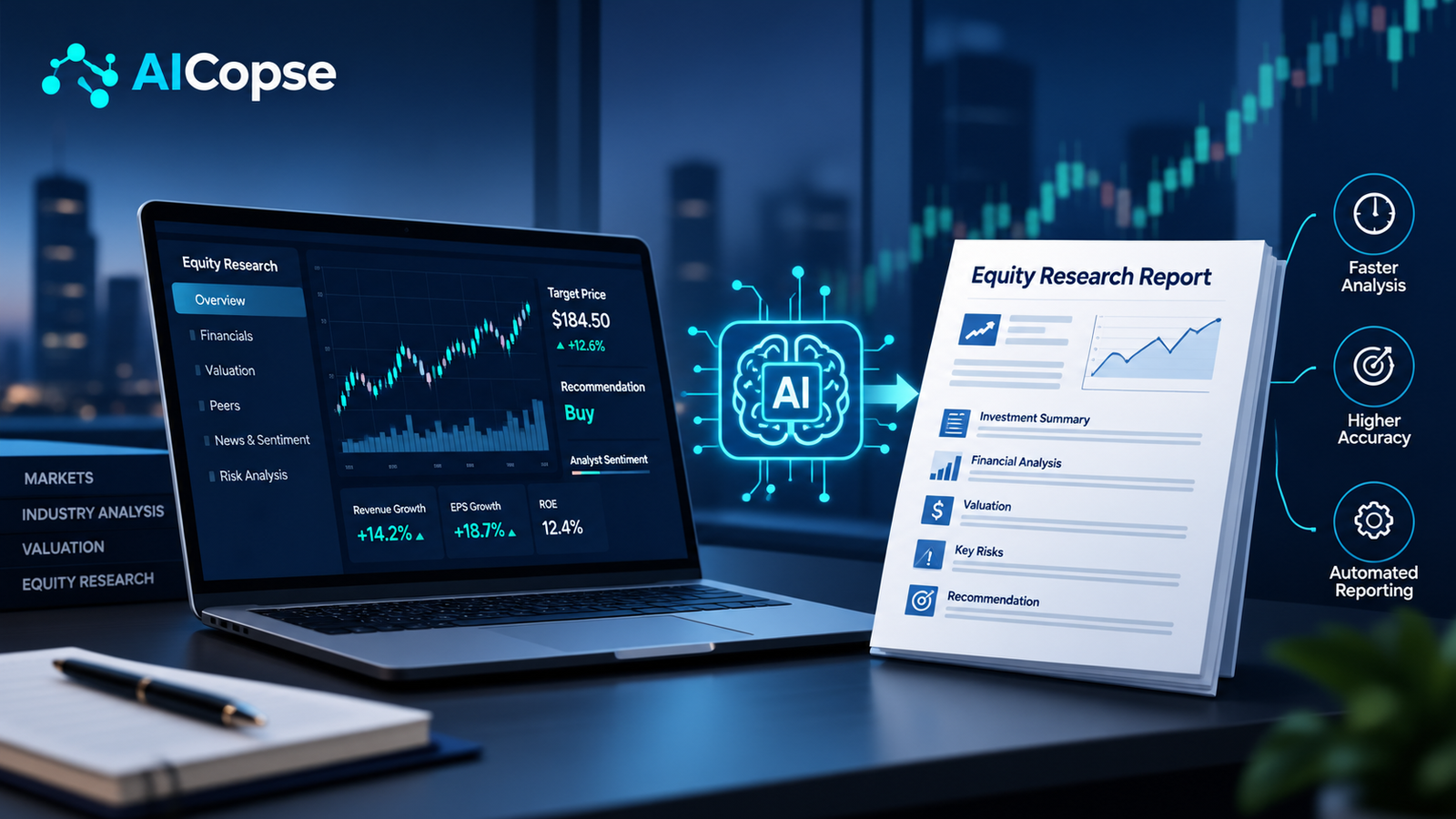
Primary topic: AI in Sell-Side Equity Research and Automated Report Generation
Research focus: AI-assisted drafting and distribution of equity research reports, the AskResearchGPT natural experiment on analyst value, FINRA’s active rulemaking on AI-generated research, the Regulation AC certification tension, and the venture-backed tool landscape competing to replace parts of the research desk
What “AI in Sell-Side Equity Research” Actually Means
Sell-side equity research is the analysis that investment banks and brokerages produce and distribute to institutional clients, covering individual stocks with ratings, price targets, and detailed written notes. The job behind it has always had four distinct stages: gathering data from filings, transcripts, and expert calls; building or updating a financial model; drafting the written note and its narrative argument; and distributing that note to clients in a way that drives trading commissions or asset management fees.
AI automation in this specific context does not mean a single tool that writes a research report end to end. It means a layer of software now sitting inside each of those four stages separately, built by banks internally, by venture-backed startups selling into banks and buy-side firms, and increasingly by general-purpose AI assistants used informally by analysts who were never issued a dedicated research tool at all.
Visual: The Research Production Pipeline, Before and After AI
AI pulls filings, transcripts, and expert network notes into one searchable corpus
AI updates spreadsheet models from new disclosures and flags unusual variances
AI assembles a first-pass narrative note citing the sources it pulled from
A named analyst personally reviews and certifies the final view
AI routes the note and answers follow-up client questions against it
The first, second, and fifth stages are now heavily automated at most large banks. The third stage is automated in draft form only. The fourth stage, by law, cannot be automated at all.
Why This Moment Is Different From Earlier Research Automation
Equity research has absorbed technology shocks before. Electronic distribution, Bloomberg terminals, and the MiFID II unbundling rules that forced asset managers to pay separately for research all reshaped the economics of the business without changing who was legally allowed to write it. Generative AI is the first technology to genuinely compress the drafting stage itself, and it is arriving at the same moment research desks were already under cost pressure from years of unbundling-driven fee compression. That combination, cheaper technology meeting a business already looking to cut cost, is why adoption has moved faster here than in almost any other part of a bank.
| Force | Why it is pushing adoption |
|---|---|
| Post-unbundling cost pressure | Research budgets at asset managers have been under scrutiny since MiFID II, making cheaper production attractive to the banks that supply them |
| Bank-to-bank AI arms race | Every bulge-bracket bank has now deployed a proprietary AI research assistant, creating competitive pressure to match rivals |
| A well-funded startup ecosystem | Venture capital has poured billions into tools purpose-built for financial document search and drafting |
| Regulatory uncertainty, not regulatory blockage | FINRA is actively rewriting its rules rather than banning the practice, which has encouraged firms to move first and adjust later |
Research Study: The Academic Evidence on What AI Actually Changes for Analysts
A 2026 study published in the Journal of Accounting Research, titled “Beyond Automation: AI and the Human Value of Sell-Side Analysts,” used the 2024 launch of Morgan Stanley’s AskResearchGPT as a natural experiment. The researchers measured sell-side analysts’ information acquisition and processing behavior before and after the tool’s introduction, and compared outcomes against banks that had invested less in AI-related hiring over the prior three years, measured by the share of job postings referencing machine learning, learning algorithms, or neural networks.
The study’s central finding reframes a common assumption. Rather than showing AI simply replacing analyst effort, it found evidence that AI investment reshapes where an analyst’s value actually comes from, shifting it away from raw information gathering and toward judgment, synthesis, and client-facing interpretation. That is a meaningfully different claim than either side of the usual debate, which tends to argue AI will either replace analysts outright or barely matter to their work at all.
What startups, developers, and research managers can learn:
- Tools that simply speed up information gathering may increase output without increasing analyst value, since gathering is exactly the part AI is reshaping away from
- Products built to support judgment and synthesis, not just retrieval, are targeting the part of the job the research suggests is actually becoming more valuable
- A bank’s prior AI-related hiring pattern appears to meaningfully predict how much a new AI tool changes analyst behavior, which matters for anyone benchmarking adoption across firms
- This is one of the first peer-reviewed studies to use a real, named commercial AI deployment as its natural experiment, which makes its findings unusually concrete for an academic paper in this space
Research Study: FINRA Is Rewriting Its Rules Specifically Because of AI
In 2025, FINRA issued Regulatory Notice 25-06, formally requesting comment on modernizing its research rules, Rule 2241 covering equity research analysts and Rule 2242 covering debt research analysts. The notice explicitly carves out AI as a dedicated section of its own, asking commenters to weigh in on whether human oversight should be required for AI-generated research, whether responsibility for a report’s content can be attributed to an AI system at all, and how supervision and compliance obligations should adapt when a research note is partly or wholly machine-drafted.
Industry comment letters submitted in response pushed FINRA toward flexibility rather than prescriptive new rules, arguing the framework needs to be able to adapt as the technology keeps changing rather than freezing today’s practice into a rule that will be outdated within a year or two. That request for flexibility is itself a signal: the industry has already moved ahead of the rulebook, and is now asking regulators not to force a rollback.
What startups, developers, and research managers can learn:
- There is currently no settled rule assigning responsibility between a firm, an analyst, and an AI system for a flawed AI-assisted research report, and that gap is the subject of active rulemaking
- Any product in this space should be built assuming a human remains the accountable party for content, since that is the direction both the existing rule structure and industry comment letters point toward
- Firms should expect FINRA’s eventual rule to focus on oversight and attribution of responsibility rather than banning AI assistance outright
- Regulatory Notice 25-06 is a rare, publicly available window into how both the industry and its own regulator think about this exact problem, and is worth reading directly rather than through a summary
Source: Comment Letter on FINRA Regulatory Notice 25-06, Morgan, Lewis and Bockius, June 2025
Research Study: The Regulation AC Tension Nobody Is Fully Resolving Yet
SEC Regulation AC, in force since 2003, requires that every research report carry a certification from the analyst primarily responsible for its content, stating that the views expressed in the report accurately reflect that analyst’s own personal views. This requirement was written for a world where a human wrote every word.
It was never designed to answer a much newer question: if an AI system drafted most of a report’s narrative and supporting analysis, in what sense can a human still certify that the resulting text reflects their personal view, rather than a machine’s synthesis of the inputs they fed it.
No enforcement action or formal interpretive guidance has yet directly tested this exact scenario. But the legal architecture itself creates a structural incentive that works in the industry’s favor so far: because the certification requirement falls on a named human, not a firm or a tool, banks have strong reason to keep a human genuinely reviewing and owning the substance of every AI-assisted report, rather than merely rubber-stamping machine output. That incentive is arguably doing more real-world governance work right now than any explicit AI rule could.
What startups, developers, and research managers can learn:
- Build AI drafting tools that preserve a clear, auditable boundary between machine-generated text and the analyst’s final, reviewed version
- A tool that makes it easy for an analyst to silently accept AI output without meaningful review is building toward a Regulation AC compliance problem, even without a new rule specifically targeting AI
- Products that show an analyst exactly which claims in a draft came from which source document make the certification step easier to perform honestly, which is a genuine product differentiator
- This specific legal tension has received far less attention in industry coverage than the FINRA rulemaking process, despite being arguably the more immediate compliance exposure for any bank already shipping AI-assisted reports today
Source: Regulation Analyst Certification, Securities and Exchange Commission
Research Study: What Happened Inside the Banks That Actually Deployed This
Morgan Stanley’s AskResearchGPT, built on a partnership with OpenAI, now serves investment banking, sales and trading, and research staff, drawing on the firm’s library of roughly 100,000 research reports and documents. By the firm’s own account, the tool cuts the time to answer a typical client research query to roughly one-tenth of what it previously took, and a patented workflow turns its answers directly into a draft client email in a single step. Kaitlin Elliott, Morgan Stanley’s head of firmwide generative AI solutions, described the intended shift in March 2026 as moving analysts “from being the task doers to the mastermind of the task.”
Goldman Sachs took a different path, building Banker Copilot on an Anthropic partnership and extending it toward autonomous agents that already support operations tied to trillions of dollars in assets, with the firm reportedly extending that agent infrastructure toward pitch-book creation next. Bank of America CEO Brian Moynihan made a similar point about the shift in July 2026, stating plainly that the bank’s bankers now automate the research and presentation materials that used to consume the bulk of a junior analyst’s week.
What startups, developers, and research managers can learn:
- The two largest deployments took architecturally different paths, one centered on a retrieval assistant over a proprietary document library, the other centered on autonomous agents, suggesting the market has not converged on one winning approach yet
- A tenfold reduction in query response time is a genuinely large, measurable productivity gain, and is the kind of concrete metric worth demanding from any vendor pitch in this category
- Executive language describing analysts as moving from “task doers” to “the mastermind of the task” matches the academic finding above about value shifting toward judgment, which is a rare case of a bank’s own framing and independent research pointing the same direction
- Banks building these tools internally are doing so specifically to keep proprietary research libraries and client relationships inside their own walls, which is the core competitive threat every outside vendor in this space has to design around
Research Study: The Venture-Backed Market Racing to Serve Everyone the Banks Won’t
Outside the banks, a cluster of New York-based startups has raised substantial capital specifically to sell AI research tools into hedge funds, private equity firms, and the banks themselves. AlphaSense reached a $7.5 billion valuation in a June 2026 growth round on roughly $600 million in annual recurring revenue, built on a combination of AI search and a large library of licensed content, and has been expanding through acquisition, including its purchase of Tegus. Rogo, a more deal-execution-focused platform, closed a $75 million Series C in January 2026 at a $750 million valuation led by Sequoia Capital, with backers including Henry Kravis and Wells Fargo, and later raised a Series D reported to value the company near $2 billion. Hebbia, whose Matrix product runs agentic queries across unstructured documents with citation-backed answers, has raised roughly $160 million to date, with investors including Andreessen Horowitz, Index Ventures, and Peter Thiel.
Independent practitioner comparisons published in 2026 describe the market shifting from simple chat interfaces toward scheduled, autonomous research agents, with AlphaSense launching scheduled custom agents and Rogo building its traction specifically around an agent product called Felix. That shift toward scheduled, standing agents rather than one-off chat queries mirrors the broader move toward agentic AI seen across the rest of financial services.
What startups, developers, and research managers can learn:
- Capital is concentrating in platforms with either a proprietary content library, as with AlphaSense, or deep workflow integration into a specific buyer segment, as with Rogo’s focus on deal execution
- A horizontal, general-purpose AI assistant competing head-on with these platforms faces a real disadvantage without either licensed content or deep workflow lock-in
- The market’s own direction of travel, from chat to scheduled agents, suggests new entrants should design for standing, recurring research tasks rather than one-off question answering
- Valuations in this category have moved fast enough that a 2025 funding figure can already be meaningfully out of date, so any competitive analysis should be revalidated close to publication
Source: AI Tools for Equity Research: Complete Platform Comparison, Marvin Labs, 2026
Research Study: The Jobs Debate Inside the Banks Themselves
Bank leadership has been unusually candid about the scale of change expected. Goldman Sachs CEO David Solomon and JPMorgan CEO Jamie Dimon have both publicly estimated that AI will automate roughly a quarter of total work hours across their institutions, while making remaining staff substantially more productive rather than simply cutting headcount proportionally. JPMorgan has put its in-house LLM Suite in front of roughly 250,000 employees, and Citi’s own internal research has separately flagged research-adjacent roles as carrying high automation potential relative to other functions inside a bank.
This matters specifically for the research function because junior analyst roles have traditionally served as the pipeline through which the industry trained its future senior analysts, portfolio managers, and bankers. If AI absorbs the bulk of the data-gathering and first-draft work that junior analysts historically performed, the open question the research above does not yet answer is where the next generation of analysts will develop the judgment the academic study found becomes more valuable, if they never had to do the grinding information work that judgment was traditionally built on.
What startups, developers, and research managers can learn:
- Any AI tool reducing junior-level research work has a training pipeline problem to think through, not just a productivity story to sell
- Bank leadership’s own public estimates, a quarter of work hours automated, give founders a concrete, citable figure for market sizing conversations with enterprise buyers
- A product that helps junior analysts learn judgment faster, rather than only removing the tasks that used to teach it, addresses a gap the current market has not solved
- This talent-pipeline risk is rarely covered in vendor-published research, since it cuts against the productivity narrative vendors are generally trying to sell
Source: AI in Investment Banking 2026, Whitehat SEO
The Vendor Landscape: Three Categories, Three Very Different Risk Profiles
| Category | Examples | Who it serves | Main constraint |
|---|---|---|---|
| Proprietary bank platforms | Morgan Stanley AskResearchGPT, Goldman Banker Copilot | Internal analysts, bankers, and advisors only | Not sold externally, built to retain proprietary content and client relationships |
| Venture-backed research platforms | AlphaSense, Hebbia, Rogo | Hedge funds, private equity, banks, advisory firms | Competes on proprietary content licensing or workflow depth, not raw model quality |
| General-purpose AI assistants | Enterprise deployments of frontier chat models used informally | Any analyst without a dedicated tool | No native connection to proprietary data, and the weakest audit trail for Regulation AC purposes |
What the Experts Are Saying
Kaitlin Elliott, Head of Firmwide Generative AI Solutions, Morgan Stanley, March 2026
Brian Moynihan, Chief Executive, Bank of America, July 2026
Shanthikumar et al., Journal of Accounting Research, 2026
Expert Recommendation
Based on the research reviewed here, the most defensible path for anyone operating in this space right now follows the same logic Regulation AC itself already enforces: keep a named, accountable human genuinely reviewing anything that reaches a client, and build toward the parts of the workflow where AI’s measured gains are real rather than assumed.
| Stage | Current evidence of reliability | Recommended posture |
|---|---|---|
| Data gathering and retrieval | Strong, with measured tenfold query-time gains reported | Automate with source citation required on every answer |
| Model updates and variance flags | Strong for structured, repeatable tasks | Automate with analyst spot-checks on flagged anomalies |
| Narrative drafting | Useful as a first draft, unproven as a final product | Treat as a starting point an analyst must substantively rewrite |
| Final certification and rating | Not legally automatable under current rules | Keep fully human, with a clear audit trail of what the analyst actually reviewed |
What This Means for Startups
The evidence points toward three specific openings rather than one generic “AI for equity research” pitch. First, the research-pipeline gap identified above is real and currently unaddressed by any major vendor: a tool that helps junior analysts build judgment while AI absorbs their old grinding tasks would solve a problem banks have not yet solved internally.
Second, the Regulation AC tension creates demand for tooling that makes the human certification step more honest and auditable, not less, which is a compliance-forward pitch that differentiates from pure speed-focused competitors. Third, the shift from chat to scheduled, standing agents that the vendor landscape itself is already moving toward suggests the window for a simple chat-interface product is closing, and new entrants should design for recurring, autonomous monitoring tasks from the outset.
What This Means for Developers
Anyone building inside this space should treat source attribution as a first-class feature, not an afterthought, since it is the single technical choice that most directly supports the Regulation AC certification an analyst ultimately has to make. A system that cannot show, for every claim in a draft, exactly which filing, transcript, or data point it came from is building toward both a compliance problem and a trust problem with the analysts who are supposed to use it.
Engineering teams should also design explicitly for the two architectural paths banks have already taken, a retrieval assistant over a proprietary document corpus and an autonomous multi-step agent, since the research shows both are viable and buyers will ask which model a given product follows.
What This Means for Businesses and Buy-Side Consumers of Research
Asset managers and corporate finance teams reading AI-assisted sell-side research should ask a direct question of any report they rely on: how much of this was drafted by AI, and what did the named analyst actually review before certifying it. That question is not yet standard practice, but the FINRA rulemaking process and the structural logic of Regulation AC both point toward it becoming one.
Businesses evaluating AI research tools for their own internal use should prioritize platforms with a demonstrated, named proprietary content advantage or deep workflow integration, per the vendor landscape above, over general-purpose assistants with no audit trail suited to a regulated research function.
Future Predictions: 2027 to 2030
2027: FINRA Finalizes AI-Specific Research Guidance
Given the active rulemaking already underway, expect FINRA to issue formal guidance addressing human oversight requirements and responsibility attribution for AI-assisted research within this window, following the pattern of its own stated priorities in Regulatory Notice 25-06.
2028: Source-Level Citation Becomes a Baseline Expectation
As the Regulation AC tension becomes more widely understood, expect claim-level source citation to shift from a competitive differentiator to a baseline requirement that buy-side and compliance teams simply expect from any research tool.
2029: The Junior Analyst Training Problem Forces a New Role
Expect banks to formally create a distinct early-career role focused on AI output validation and judgment-building, replacing the traditional grinding research-associate track that AI has already begun to compress.
2030: Agentic Research Monitoring Becomes the Default Interface
Following the market’s already-visible shift from chat to scheduled agents, expect most institutional research consumption to happen through standing, autonomous monitoring agents rather than analysts manually querying a tool or reading a static report.
Final Perspective
The evidence reviewed here does not support either extreme in the usual debate about AI and equity research. AI has not eliminated the sell-side analyst, and the clearest academic study available suggests it is reshaping, rather than erasing, what makes an analyst valuable.
At the same time, the technology has moved meaningfully faster than the rules built to govern it, and the specific legal mechanism meant to keep a human accountable for every research report, Regulation AC’s personal certification requirement, was never designed with AI-assisted drafting in mind.
The practical path forward for every group covered in this report is the same one the evidence itself points to. Automate the parts of the research pipeline the data shows are already reliable, gathering, retrieval, and structured model updates. Treat drafting as a genuine first draft a human must substantively own, not a finished product.
And build, buy, or demand tools that make the human certification step more honest and auditable, since that single legal requirement is likely to remain the backbone of accountability in this space long after today’s specific AI tools are replaced by the next generation.
For related coverage on how AI is reshaping adjacent parts of the capital markets and deal lifecycle, see our guides on AI in financial document automation for prospectuses and offering memorandums, AI in due diligence and virtual data room analysis, AI in mergers and acquisitions target sourcing and valuation, and our broader sector guides on AI Security and Governance in Capital Markets and AI Security and Governance in Investment and Asset Management.
Sources
- Beyond Automation: AI and the Human Value of Sell-Side Analysts, Shanthikumar et al., Journal of Accounting Research, 2026
- Comment Letter on FINRA Regulatory Notice 25-06, Morgan, Lewis and Bockius, June 2025
- Regulation Analyst Certification, Securities and Exchange Commission
- AI in Investment Banking: The Systems Five Big Banks Built for Themselves, FinanceAICareers, September 2026
- AI Tools for Equity Research: Complete Platform Comparison, Marvin Labs, 2026
- AI in Investment Banking 2026, Whitehat SEO
- AlphaSense IPO Brief: $7.5B Valuation, $700M ARR, QuantLogix, August 2026
- Rogo Revenue, Valuation and Funding, Sacra
- Sell-Side Analyst: 2026 IB Career Guide, CT Acquisitions

Leave a Reply