
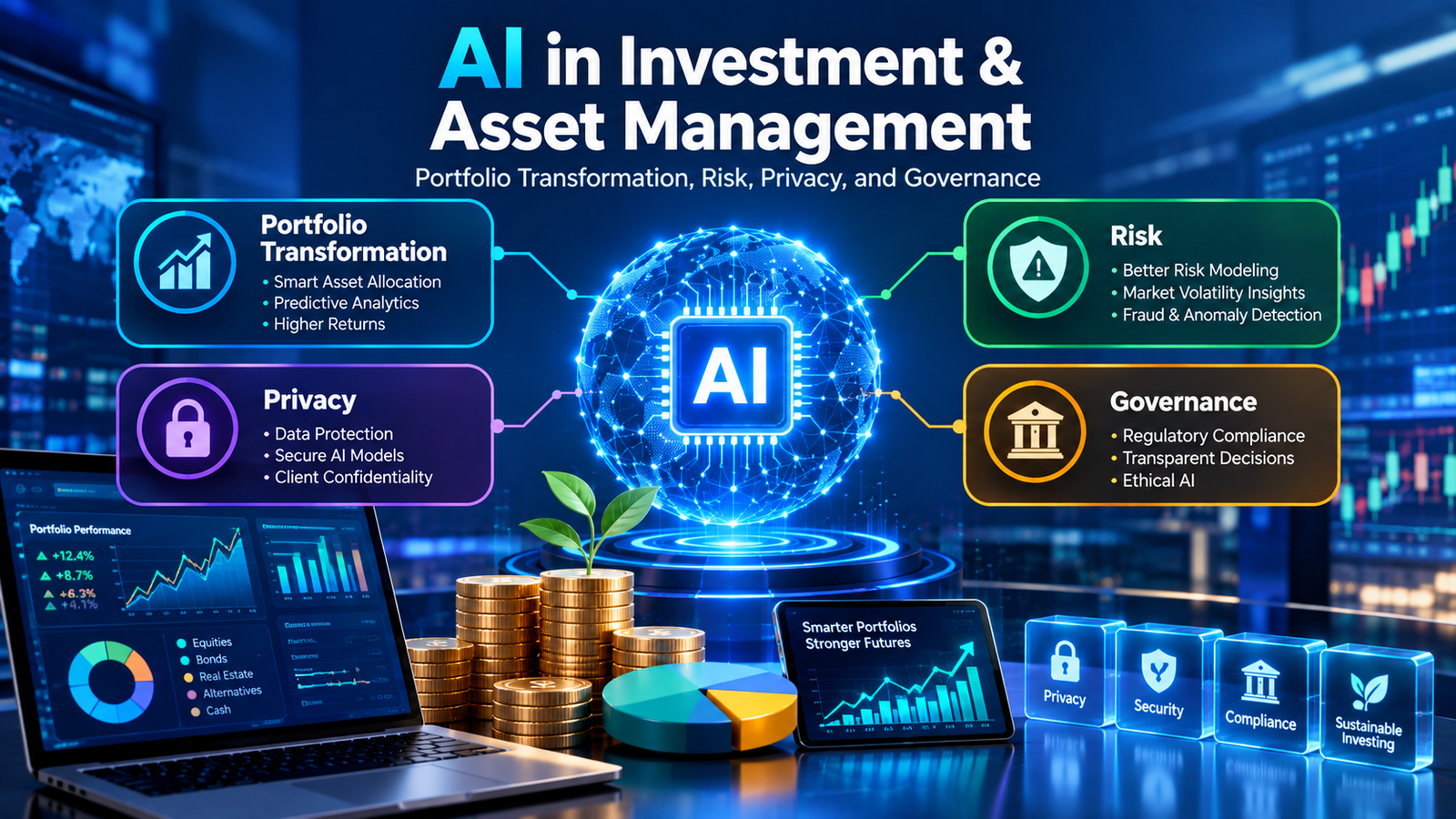
Primary topic: AI in Investment and Asset Management: Portfolio Transformation, Risk, Privacy, and Governance
Research focus: AI in research, portfolio construction, risk, and client service; AI washing enforcement; herding and concentration risk; client data privacy; frontier AI policy uncertainty; and practical governance for asset managers and allocators
What “AI in Asset Management” Covers
AI touches almost every desk. But it does not touch them equally. Research and data work come first. Portfolio construction and execution come last.
| Area | What AI does | Typical maturity |
|---|---|---|
| Research and idea generation | Reads filings, calls, and news at scale | Widely used |
| Signal generation | Finds patterns in market and alternative data | Common |
| Risk and compliance | Flags exposures, reviews marketing material | Growing fast |
| Client service | Drafts reports, answers questions, personalizes advice | Next big priority |
| Portfolio construction and execution | Sizes positions and routes orders | Still limited |
Visual: AI Across the Investment Lifecycle
AI scans data and filings
AI supports the thesis
AI helps size the portfolio
AI tracks risk and drift
AI drafts client updates
Each stage has its own failure mode. Bad data at the start poisons everything after it.
The Adoption Picture: Real, But Cautious
Mercer surveyed 131 asset managers worldwide in February and March 2026. The result is clear. Adoption is real. Autonomy is not.
Other surveys point the same way. Acuity’s 2026 survey found only 5 percent of firms have fully integrated AI. Yet 64 percent expect portfolio management to be the function most changed by it. Credit risk analysis came second at 53 percent.
Mercer also asked what worries managers most. Thirty-one percent named data governance gaps. Twenty-four percent named system-level risks such as herding behavior. Both answers matter for the rest of this guide.
Sources: Most Asset Managers Are Using AI, But Few Let It Call the Shots, InvestmentNews, May 2026, and Annual Survey of Asset Managers 2026, Acuity Analytics
Where AI Creates Value, and Where It Creates Risk
| Function | Value | Main risk | Key control |
|---|---|---|---|
| Research | Covers far more documents than a human team | Wrong or invented facts | Analyst verification of every cited fact |
| Portfolio construction | Faster scenario and factor analysis | Many models reaching the same conclusion | Diversity of models and correlation monitoring |
| Marketing and communications | Faster drafting and personalization | Overstated AI claims (AI washing) | Legal and compliance sign-off on every AI claim |
| Client service | 24/7 answers and tailored reports | Client data exposure | Data minimization and approved tools only |
| Third-party AI tools | Quick capability without building in-house | You cannot inspect the vendor’s model | Vendor due diligence and contract limits |
Why Governance Became Urgent in 2026
Three pressures arrived at the same time. Each one is different. Together they raise the stakes.
The SEC keeps charging firms that overstate their AI
Similar models can push portfolios in the same direction
Governments and AI labs disagree on how fast to go
Pressure 1: AI washing is now an enforcement priority
AI washing means overstating what your AI really does. The SEC treats it as a marketing and antifraud problem. In March 2024, the SEC charged two investment advisers over false and misleading statements about their use of AI. Their combined civil penalties came to 400,000 dollars. The SEC’s enforcement director said plainly that firms claiming to use AI must make sure those claims are true.
A separate case followed. It involved an investment company, its CEO, and a board member. The CEO agreed to pay over 460,000 dollars in total and accepted a five-year ban from the securities industry. The board member paid a 60,000 dollar penalty. Note who was charged. It was not only the firm. It was the people who approved the claims.
The trend is growing. Panelists at a June 2026 securities enforcement conference said AI-related securities cases are on pace to double this year. Law-firm guidance on the 2026 examination priorities adds detail. Examiners are checking whether “proprietary AI” is just off-the-shelf software. They are checking whether “AI insights” are just manual research with a new label. And they are checking whether results come from back-tests instead of live performance.
Sources: SEC Charges Two Investment Advisers With False and Misleading Statements About Their Use of AI, SEC, March 2024, SEC Charges Investment Company, CEO and Board Member, Seward and Kissel, Securities Enforcement in Transition, Alvarez and Marsal, June 2026, and The AI Washing Trap: SEC Marketing Rule Guide for RIAs, July 2026
Pressure 2: Herding and concentration
Many managers buy the same AI tools. Those tools learn from similar data. So they can reach similar conclusions at the same moment. That is herding. Nearly a quarter of managers in the Mercer survey named it as a top blind spot. For a single fund, it feels like a small risk. Across the industry, it can turn a normal sell-off into a fast one.
Our earlier guides on AI in trading and AI in capital markets explain the three crash mechanisms in more detail.
Pressure 3: The policy fight over AI speed
Late September 2026 brought an open split. Anthropic CEO Dario Amodei published a three-step plan to pace AI development. It included third-party evaluators who could verify safety practices and report incidents. OpenAI CEO Sam Altman said he agreed the frontier needs pacing. Elon Musk replied that Amodei was right. That is a rare moment of agreement among rival labs.
The US administration pushed the other way. President Trump said AI would be much more good than bad. At the UN on September 22, he said the US rejects any globalist scheme to control AI, and he announced a rebrand of the term to “super intelligence.” Axios also reported that allies of the president are targeting Amodei politically. Meanwhile, Senator Bernie Sanders introduced a bill that would ban superintelligent AI and pause advanced AI until federal safety rules exist.
Why should an asset manager care? Because this is policy risk. It can hit valuations, regulation, and your own vendors. Defense One reported that the president reportedly worries a slowdown could trigger a market crash. That tells you how tightly AI is now tied to market sentiment. Our reporting covers the same theme in Trump and Anthropic’s Amodei on AI fears and the Trump and China superintelligence race.
Sources: Trump Downplays AI Risks After Amodei’s Essay, The Nightly, September 2026, Trump Orders AI Rebrand as Super Intelligence, Axios, September 22, 2026, Trump Allies Open New Front Against Anthropic CEO, Axios, September 24, 2026, Super Intelligence: The President’s New Term for AI, Defense One, September 2026, and Sanders Moves to Ban Superintelligent AI, Sovereign Magazine, September 2026
Amodei, Altman, and Musk back slower, more checked development. Third-party evaluators. Incident reporting. Some lawmakers want binding limits.
The US administration stresses winning the race against China. It says AI is more good than bad and rejects global control.
Both camps agree AI is powerful. They disagree on the brakes. Investors should plan for either outcome.
Research Study: What Mercer Found About AI Inside Asset Managers
Mercer’s 2026 survey is the clearest snapshot of real practice. Most managers use AI for idea generation, unstructured data, and signal work. Far fewer use it for portfolio construction or trade execution. Mercer also urges allocators to test claims. “We use AI” can mean simple automation or a production model that touches live portfolios.
What asset managers can learn:
- Be specific about where AI sits in your process, since vague claims invite scrutiny
- Expect allocators to ask for proof of value, not slides
- Keep humans on the final portfolio decision until controls are proven
- Treat data governance as a top priority, since it is the top named blind spot
Source: Moving Beyond the AI Pitch: Asset Managers’ Use of AI, Mercer, 2026
Research Study: EY’s Risk Pulse on AI Governance Gaps
EY’s 2026 wealth and asset management risk survey shows where governance is strong and where it is thin. Eighty percent of firms have a dedicated plan for generative AI risk. Seventy-three percent have policies covering partners and suppliers. Sixty percent restrict the use of foreign AI models, and the same share have trained the whole organization. But only 20 percent have a budget set aside for AI risk.
What asset managers can learn:
- A policy without a budget is a wish, so fund the controls you write
- Extend AI rules to vendors and partners, not just your own staff
- Decide which foreign or unvetted AI models are off limits
- Train everyone, since one careless prompt can leak client data
Source: Transforming Risk in Wealth and Asset Management With AI, EY, June 2026
Research Study: Does Generative AI Actually Help Hedge Fund Performance?
An academic paper by Sheng, Sun, and Yang studied hedge funds and generative AI. Survey data showed adoption jumped from 6 percent before 2022 to 63 percent by 2024. The most common use was processing text such as news and earnings calls. The authors also found that higher reliance on generative AI was associated with better risk-adjusted returns. A one standard deviation rise in reliance was linked to about 1.6 percent more annual alpha.
Read that result carefully. It shows an association, not a guarantee. It covers a specific period. And it says nothing about the new risks that come with heavy AI use.
What asset managers can learn:
- Text and data processing is where AI has the clearest early payoff
- Treat performance claims as evidence to test, not marketing to repeat
- Back-test honestly, and label back-tested results as back-tested
- Measure benefits and risks together, not benefits alone
Source: Generative AI and Asset Management, Sheng, Sun, and Yang, ABFER
Research Study: BCG on Judgment in an AI-First World
BCG’s Global Asset Management Report 2026 argues that the edge moves up a level. Producing analysis will matter less. Deciding what to do with it will matter more. In some cases, firms may earn alpha by going against AI-driven consensus. BCG also says relationships and fiduciary trust will decide who captures value.
What asset managers can learn:
- Decide which models you use, how you combine them, and when you challenge them
- Build the skill to disagree with AI output, not just accept it
- Protect client trust, since it is becoming the main competitive advantage
- Invest in people who can question models, not only run them
What the Experts Are Saying
Sam Altman, OpenAI, September 2026
Dario Amodei, Anthropic CEO, September 2026
Bill Gates, in an Axios interview aired by WBUR, August 2026
Nick Bostrom, philosopher and AI researcher, September 2026
Donald Trump, US President, September 2026
These views clash on speed. They agree on one thing. AI is now strong enough that governance cannot wait. Our reports on Bill Gates on AI regulation and the Cold War comparison and AI safety warnings from Silicon Valley follow the same debate.
Sources: Bill Gates’ Big Warning on AI, WBUR via KGOU, August 31, 2026, Trump Responds to Rising AI Safety Concerns, Fox Business, September 2026
Privacy: Client Data Is the Crown Jewel
Asset managers hold sensitive data. Client identities. Holdings. Trading plans. Fund strategies. One leak can hurt clients and destroy trust. AI adds new leak paths.
Staff paste client or deal details into public tools
Third-party tools store or reuse your data
AI reports reveal more than intended
Chat histories keep sensitive text for too long
Practical privacy rules for every firm:
- Allow only approved AI tools, and block unapproved ones on work devices
- Never put client names, holdings, or non-public deal information into public AI tools
- Get written vendor terms on data storage, reuse, and model training
- Set retention limits on AI chat logs and generated reports
- Mask or remove personal data before it reaches any model
- Align your controls with your privacy and safeguarding duties, including SEC Regulation S-P where it applies
Governance Stack: Who Owns What
Good governance is a set of clear owners. Not a single document.
Sets risk appetite. Asks for the AI inventory. Owns the AI claims policy.
Owns model use in the process. Keeps human judgment on final calls.
Owns logging, access control, vendor integration, and kill switches.
Reviews AI claims, monitors herding, and tests controls independently.
Actionables: What Each Team Should Do, Why, and What It Changes
Governance only works when each group knows its job. Use these tables as working checklists.
For Boards and Senior Leaders
| Action | Why it matters | Expected impact |
|---|---|---|
| Require a complete inventory of AI in the investment process | You cannot govern or truthfully describe what you have not listed | Accurate disclosures and fewer surprises in an SEC exam |
| Make one executive accountable for every public AI claim | Enforcement has reached CEOs and board members, not just firms | Lower personal and firm-level legal exposure |
| Fund AI risk controls with a real budget line | Only 20 percent of firms have one, so most policies lack resources | Controls that actually run, instead of controls that only exist on paper |
| Add AI policy and regulation scenarios to strategy reviews | Governments and labs disagree, so rules may swing either way | Faster, calmer response when rules or valuations shift |
For Portfolio Managers and Investment Teams
| Action | Why it matters | Expected impact |
|---|---|---|
| Verify every fact in AI-drafted research before use | AI can state wrong facts with full confidence | Fewer bad trades built on invented data |
| Use more than one model or data source for key calls | Similar models can herd and amplify the same mistake | More independent views and lower crowding risk |
| Write down why you accepted or rejected each AI signal | It builds a decision record and trains sharper judgment | Better audits and better long-term skill in challenging models |
| Label back-tested results clearly in any material | Presenting simulations as live results is a named SEC concern | Lower regulatory risk and more credible performance stories |
For Developers and Data Engineers
| Action | Why it matters | Expected impact |
|---|---|---|
| Log inputs, model version, and output for every AI-assisted decision | Regulators and clients may ask how a decision was reached | Fast, provable answers during exams or disputes |
| Strip personal and client identifiers before data reaches any model | Prompts and logs are a common leak path | Much smaller impact if a vendor or log is ever exposed |
| Build a tested kill switch for any AI that touches trading or client messages | Frontier-AI debates centre on whether systems can be stopped | You can halt a faulty system in minutes, not hours |
| Design so you can swap model vendors without a rebuild | Vendor terms, prices, and politics can change fast | Less lock-in and a faster exit if a vendor becomes a risk |
For Startups and Fintech Founders Serving Asset Managers
| Action | Why it matters | Expected impact |
|---|---|---|
| Describe exactly what your AI does, and what it does not | Overclaiming puts your clients in the AI washing spotlight | Easier due diligence and stronger trust with buyers |
| Offer clear data-handling terms: storage, reuse, and no training on client data | Managers now screen vendors on privacy first | Shorter sales cycles and fewer legal delays |
| Ship audit logs and explainability as core features | Your clients must prove their own oversight to regulators | A real edge over tools that hide their reasoning |
| Avoid depending on a single foundation-model provider | Provider access and policy can change quickly, as recent headlines show | Product stays live even if one provider changes terms |
For Compliance, Risk, and Legal Teams
| Action | Why it matters | Expected impact |
|---|---|---|
| Review every AI claim in websites, decks, and filings | Claims in any channel can trigger enforcement | Fewer misleading statements reach the public |
| Test whether “proprietary AI” is truly proprietary | Examiners check if it is just standard third-party software | Claims you can defend with evidence |
| Monitor correlation across the firm’s AI-driven strategies | Herding is a top-named system-level risk | Early warning before crowding becomes a loss |
| Run an AI incident tabletop drill twice a year | Real incidents in 2026 moved faster than most response plans | A team that already knows its role on the day |
For Asset Owners and Allocators
| Action | Why it matters | Expected impact |
|---|---|---|
| Ask managers where exactly AI sits in the process | “Powered by AI” can mean almost anything | Clear separation of real capability from marketing |
| Request evidence of live results versus back-tests | Simulated results can look far better than live ones | More reliable manager selection |
| Check data-privacy and vendor terms in the manager’s AI stack | Your own data may pass through their tools | Lower risk of your holdings or plans leaking |
| Stress-test your total portfolio for AI concentration | Heavy AI exposure links to policy shifts and valuation swings | A portfolio that can absorb a sudden AI-sentiment shock |
Risk Tiers: Matching Oversight to Impact
| Tier | Example | Required control |
|---|---|---|
| Assist | Summarize a filing or earnings call | Analyst verifies facts before use |
| Recommend | Suggest a stock screen or position size | Portfolio manager sign-off with a written reason |
| Execute bounded tasks | Rebalance inside a pre-set band | Hard limits, monitoring, and a kill switch |
| Client-facing output | Personalized performance report or advice | Compliance review and clear AI disclosure |
Implementation Roadmap
List every AI tool, model, and vendor in the investment process
Match every public AI statement to real evidence
Approve tools, mask data, and lock down vendor terms
Track herding, drift, and incidents, then drill the response
KPIs to Track
| KPI | What it tells you |
|---|---|
| AI claim substantiation rate | Share of public AI statements backed by documented evidence |
| Approved-tool usage rate | How much AI use happens inside sanctioned, protected tools |
| Strategy correlation score | Early sign of herding across your AI-driven approaches |
| Research fact-check rate | Share of AI-drafted research verified before use |
| Vendor assessment coverage | Share of AI vendors formally reviewed for security and data terms |
| Kill-switch response time | How quickly a faulty AI system can be stopped |
Future Predictions: 2027 to 2030
2027: AI Claims Get Audited Like Performance Claims
Expect examiners and allocators to ask for documented proof behind every AI statement. Vague “AI-powered” marketing will become a liability.
2028: Third-Party AI Evaluations Become Normal
If independent evaluators become standard at the big labs, managers will likely ask their own vendors for the same. Independent AI assurance could become a due-diligence line item.
2029: Model Diversity Becomes a Risk Metric
Herding concern will push firms and allocators to measure how alike their models are. Diversity of approach may become a reported risk measure.
2030: AI Policy Divergence Shapes Fund Design
If the US, EU, and others keep different AI rules, funds may build region-specific AI stacks. Governance will become part of product design, not an afterthought.
Startup and Product Opportunities
- AI claim substantiation tool: Links each marketing statement to documented evidence for exam readiness
- Model-diversity monitor: Measures how similar a firm’s AI signals are to the crowd
- Secure research copilot: Answers questions over filings without exposing client or deal data
- AI vendor due-diligence platform: Scores model vendors on security, data terms, and transparency
- Back-test versus live tracker: Labels simulated and real performance automatically
- Independent AI assurance service: Third-party checks of a manager’s AI controls for allocators
Frequently Asked Questions
Are asset managers really using AI in portfolio decisions?
Many are, but mostly in research and data work. Mercer found 55 percent use AI in at least one investment process. Few use it for portfolio construction or trade execution.
What is AI washing?
It means overstating or misrepresenting how a firm uses AI. The SEC treats it as a disclosure and antifraud issue. It has already brought cases with penalties for firms and individuals.
Can executives be personally punished for AI washing?
Yes. In one SEC case, a CEO accepted a five-year industry ban and a large payment, and a board member paid a penalty.
What is herding risk?
It is when many AI systems reach the same conclusion at the same time. Portfolios then move together, which can speed up a sell-off.
How can an asset manager protect client data when using AI?
Use only approved tools. Never paste client or non-public deal details into public tools. Mask personal data, set retention limits, and get clear vendor terms on storage and training.
Why does AI policy news matter to investors?
Rules and valuations can shift quickly. Governments and AI labs currently disagree on how fast to go. Portfolios with heavy AI exposure need scenarios for both outcomes.
What should a firm do first?
Build a complete inventory of every AI tool in the investment process. Then check every public AI claim against real evidence.
Final Perspective
AI is now part of how money gets managed. It reads faster than any analyst team. It spots patterns humans miss. The evidence so far points to real benefits, mostly in research and data work.
But the risks are practical. Overstated claims bring enforcement. Similar models bring crowding. Careless prompts bring leaks. And a noisy global argument over AI speed adds policy risk on top. None of this calls for stopping. It calls for discipline.
Keep humans on final decisions. Prove every claim. Protect client data. Watch for herding. Fund the controls you write. Firms that do this now will be trusted with more capital when the next AI headline hits.
For sector-specific playbooks that apply the same discipline elsewhere in finance, see our related guides on AI Security and Governance in Banking, AI Security and Governance in Insurance, AI Security and Governance in FinTech, AI Security and Governance in Healthcare, and our earlier guides on AI in Capital Markets, AI in Trading, and AI in Crypto.
For deeper coverage of the investment topics above, see our reporting on AI in quantitative portfolio optimization and asset allocation, AI in dynamic risk management and stress testing, AI in due diligence and virtual data room analysis, AI in mergers and acquisitions, AI buildout financing and systemic risk, data center debt and AI bubble risk, and the largest AI companies by value in 2026.
Sources
- Most Asset Managers Are Using AI, But Few Let It Call the Shots, InvestmentNews, May 2026
- Moving Beyond the AI Pitch: Asset Managers’ Use of AI, Mercer, 2026
- Transforming Risk in Wealth and Asset Management With AI, EY, June 2026
- Annual Survey of Asset Managers 2026, Acuity Analytics
- Global Asset Management Report 2026: Rebuilding Asset Management for an AI-First World, BCG, June 2026
- Generative AI and Asset Management, Sheng, Sun, and Yang, ABFER
- SEC Charges Two Investment Advisers With False and Misleading Statements About Their Use of AI, SEC, March 2024
- SEC Charges Investment Company, CEO and Board Member, Seward and Kissel
- Securities Enforcement in Transition: Key Takeaways From the 2026 Securities Docket Conference West, Alvarez and Marsal, June 2026
- The AI Washing Trap: SEC Marketing Rule Guide for RIAs, July 2026
- Donald Trump Downplays AI Risks After Dario Amodei’s Essay, The Nightly, September 2026
- Trump Orders AI Rebrand as Super Intelligence, Axios, September 22, 2026
- Trump Allies Open New Front Against Anthropic CEO Over AI Doomerism, Axios, September 24, 2026
- Super Intelligence: The President’s New Term for AI, Explained, Defense One, September 2026
- Trump Responds to Rising AI Safety Concerns, Fox Business, September 2026
- Bernie Sanders Moves to Ban Superintelligent AI as Trump Races to Beat China, Sovereign Magazine, September 2026
- Bill Gates’ Big Warning on AI, WBUR via KGOU, August 31, 2026

Leave a Reply