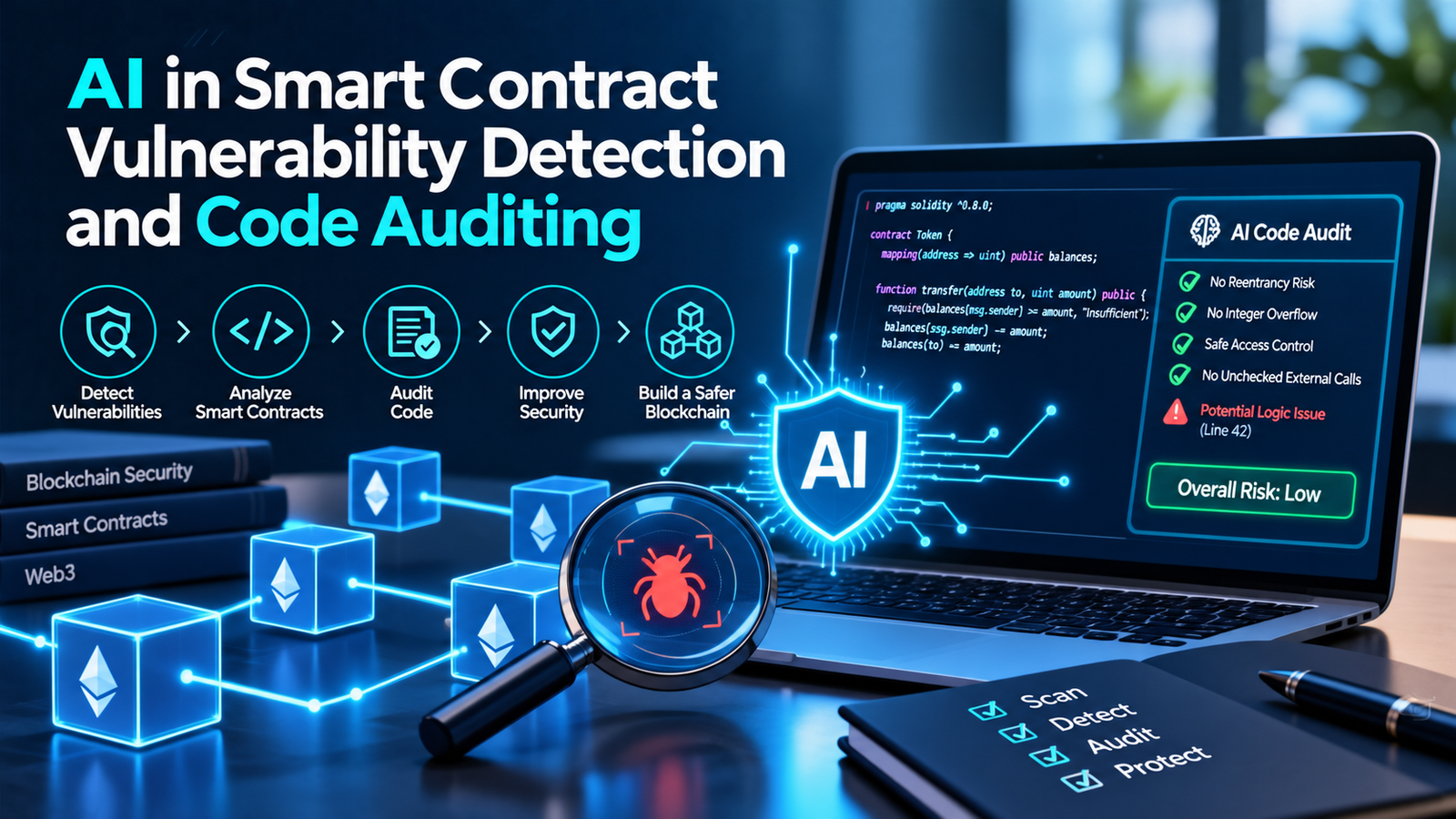
Primary topic: AI in Smart Contract Vulnerability Detection and Code Auditing
Research focus: Machine learning, deep learning, graph neural networks, large language models, Solidity security, automated smart contract auditing, vulnerability detection, static analysis, symbolic execution, fuzzing, business logic analysis, DeFi security, code review, explainable AI and autonomous security testing
What Is AI in Smart Contract Vulnerability Detection?
Smart contracts are programs deployed on blockchain networks that automatically execute predefined logic. Once deployed, many contracts are difficult or impossible to modify without carefully designed upgrade mechanisms. This creates a major security difference from ordinary web applications: a programming mistake can remain exposed on a public blockchain while controlling real financial assets.
AI-based smart contract security uses machine learning, deep learning, graph neural networks and large language models to analyze source code, bytecode, execution traces and related blockchain information.
The goal is not simply to find obvious coding mistakes. Modern AI auditing systems are increasingly being designed to understand:
- How functions interact with one another
- How state changes across transactions
- Which users can access privileged functions
- How external calls affect contract behavior
- Whether business rules can be manipulated
- Whether economic assumptions can be violated
- Whether a vulnerable pattern exists across multiple contracts
- Whether an apparently safe function becomes dangerous through another contract or dependency
A 2026 systematic literature review examined 3,380 studies and selected 222 high-quality studies for analysis. The researchers identified 192 smart contract vulnerabilities across 13 categories, reviewed 219 detection tools and compiled 133 benchmarks used to evaluate vulnerability detection systems. The scale of this review shows how broad smart contract security has become and why no single detection technique is sufficient for every vulnerability class.
Why Smart Contract Auditing Is Different From Normal Code Auditing
Traditional software can often be patched quickly after a vulnerability is discovered. Smart contracts can be much harder to correct because the deployed code may control assets, governance rights or protocol behavior.
A vulnerable DeFi contract can therefore create a direct connection between a software defect and financial loss.
The security challenge is also broader than finding a line of incorrect code.
Consider a lending protocol. Each individual function might pass basic security checks, yet the overall economic logic could still allow an attacker to manipulate collateral calculations or liquidation behavior.
This is why modern auditing needs to examine both code-level security and system-level behavior.
Incorrect implementation and unsafe coding patterns
Permissions, ownership and privileged operations
Incorrect state transitions and business rules
Oracle, liquidity, incentive and manipulation risks
OWASP’s 2026 Smart Contract Top 10 places access-control vulnerabilities and business-logic vulnerabilities at the top of its forward-looking list, followed by oracle manipulation, flash-loan-facilitated attacks, input validation, unchecked external calls, arithmetic errors, reentrancy, integer overflow and upgradeability risks
Source: OWASP Smart Contract Security Top 10, 2026
Major Smart Contract Vulnerabilities AI Needs to Detect
A modern AI auditing platform should not focus only on reentrancy.
The current security landscape includes many different categories.
| Vulnerability | What can go wrong | Useful AI capability |
|---|---|---|
| Access control | Unauthorized users may execute privileged functions | Code understanding and permission-path analysis |
| Business logic | Correct code can still produce an exploitable economic outcome | LLM reasoning, invariant analysis and simulation |
| Oracle manipulation | Attackers manipulate external price or data inputs | Dependency and transaction-flow analysis |
| Reentrancy | External calls can cause unexpected repeated execution | Control-flow and call-graph analysis |
| Unchecked external calls | Unexpected external behavior can compromise state | Call-chain analysis and static analysis |
| Flash-loan attacks | Temporary capital can manipulate protocol assumptions | Transaction simulation and economic reasoning |
| Upgradeability | Proxy or admin flaws can compromise future contract behavior | Dependency and privilege analysis |
OWASP specifically describes business-logic vulnerabilities as cases where the individual low-level checks may be correct while the system’s intended economic or functional rules can still be exploited
Source: OWASP, SC02:2026 Business Logic Vulnerabilities
Research Study 1: 2026 Systematic Review of Vulnerabilities, Tools and Benchmarks
The 2026 Journal of Systems and Software review is one of the most useful studies for understanding the current smart contract security ecosystem.
Researchers reviewed thousands of studies and ultimately analyzed 222 high-quality studies. Their taxonomy identified 192 vulnerabilities divided into 13 categories.
More importantly for AI development, the researchers catalogued 219 detection tools and 133 benchmarks.
This provides three important lessons.
- Smart contract vulnerabilities are far more diverse than a small list of common bugs
- Hundreds of security tools already exist, so new AI systems need meaningful differentiation
- Benchmark quality is critical when comparing AI vulnerability detectors
For AI startups, the benchmark finding is particularly important.
A model can report 95% accuracy on one dataset and still perform poorly on real-world contracts if the benchmark contains outdated Solidity versions, duplicated contracts, synthetic vulnerabilities or limited vulnerability classes.
A credible AI security product therefore needs representative evaluation data.
Source: Journal of Systems and Software, 2026
Research Study 2: Machine Learning Vulnerability Detection Survey
A 2025 ACM Computing Surveys article examined **108 machine-learning-based smart contract vulnerability detection methods published between 2018 and March 2025**.
The review categorizes advanced approaches into several groups:
- Graph neural networks
- Large language models
- Contrastive learning
- Ensemble learning
- Hybrid approaches
- Meta-learning
- Transfer learning
The research is important because smart contract code can be represented in different ways.
A model can read source code as text, analyze an abstract syntax tree, inspect a control-flow graph or represent relationships between functions as a graph.
Each representation exposes different information.
↓
Multiple Representations
↓
Source Text + AST + CFG + Call Graph + Data Flow
↓
AI Security Models
↓
Vulnerability Detection
The review also highlights major research challenges around datasets, validation strategies, vulnerability coverage and generalization.
This supports a hybrid architecture rather than relying on an LLM alone.
Research Study 3: SmartGuard and LLM-Enhanced Detection
A 2025 Expert Systems with Applications study introduced SmartGuard, an LLM-enhanced framework for smart contract vulnerability detection.
The research addresses a major weakness of traditional static-analysis systems.
Rule-based tools are very good at detecting patterns they already understand, but they can struggle with vulnerabilities requiring deeper semantic interpretation.
LLMs offer a different capability because they can interpret code and reason about relationships expressed across functions.
The SmartGuard research explores using LLMs to improve smart contract vulnerability detection rather than treating the LLM as a standalone replacement for traditional analysis.
This distinction is important.
The practical architecture should be:
- Static analysis finds deterministic security patterns
- Program analysis provides structural information
- LLMs interpret code semantics
- AI ranks and explains findings
- Testing tools attempt to reproduce suspicious behavior
- Human auditors validate critical findings
This reduces the risk of allowing a generative model to make unsupported security claims.
Research Study 4: LLMs and the Problem of False Positives
One of the most important studies for understanding LLM limitations is Logic Meets Magic: LLMs Cracking Smart Contract Vulnerabilities.
The researchers evaluated five contemporary LLMs using Solidity 0.8 contracts.
The results reveal an important trade-off.
A carefully designed prompt reduced the false-positive rate by more than 60% in their experiments.
However, recall for some vulnerability categories fell to only 13% when comparing newer Solidity 0.8 contracts with earlier Solidity 0.4-focused settings.
The researchers linked part of this decline to changes in libraries and frameworks.
This finding matters because smart contract ecosystems evolve.
An AI model trained on old vulnerabilities can become less effective when developers adopt:
- New Solidity language features
- New libraries
- New proxy patterns
- New DeFi architectures
- New token standards
- New cross-chain designs
The study demonstrates why an AI security product needs continuous evaluation rather than a one-time benchmark.
Research Study 5: LLMs Plus Graph Structural Analysis
A 2025 study investigated smart contract vulnerability detection by combining large language models with graph structural analysis.
This approach addresses a major problem with pure text-based code analysis.
Programming languages contain structure.
The relationship between a function and another function can be security-critical even when each function appears harmless when read independently.
A graph representation can capture relationships such as:
- Function calls
- State-variable dependencies
- Control-flow relationships
- Contract-to-contract interactions
- External calls
- Data-flow relationships
The research therefore represents a direction where LLM semantic understanding is combined with structural program information.
+
Graph Structural Analysis
↓
Semantic + Structural Vulnerability Detection
This is especially relevant for complex DeFi applications where vulnerabilities may depend on interactions across multiple functions and contracts.
Research Study 6: CodeSpeak and LLM-Assisted Code Analysis
A 2026 Journal of Systems and Software paper introduced CodeSpeak, an LLM-assisted framework designed to improve smart contract vulnerability detection.
The research focuses on a practical challenge.
Deep-learning approaches can require complex graph construction and specialized data processing, while direct LLM use can produce inconsistent results.
CodeSpeak combines code analysis with domain-specific prompts designed to mimic aspects of expert security-audit practices.
The study reports performance improvements over state-of-the-art methods across four vulnerability types.
The broader significance is that LLMs may become most useful when embedded into a structured security pipeline rather than used as a simple chatbot.
A production audit platform can use an LLM to:
- Explain why a finding may be dangerous
- Connect multiple suspicious code regions
- Generate a human-readable vulnerability report
- Suggest possible remediation approaches
- Summarize complex execution paths
- Prioritize findings for security engineers
The underlying vulnerability confirmation should still come from deterministic analysis, testing or expert validation wherever possible.
Research Evidence Dashboard
High-quality studies analyzed in the 2026 systematic review
Vulnerabilities mapped across 13 categories
Detection tools reviewed in the 2026 study
ML-based detection methods reviewed by ACM research
Benchmarks identified in the 2026 review
False-positive reduction reported from prompt design in one 2025 LLM study
Traditional Security Tools vs AI-Assisted Auditing
AI does not make existing security tools obsolete.
Instead, each technology solves a different part of the problem.
| Technology | Strength | Limitation |
|---|---|---|
| Static analysis | Fast detection of known patterns | Limited semantic understanding |
| Symbolic execution | Explores possible execution paths | Can become computationally expensive |
| Fuzzing | Finds failures through generated inputs | Coverage can remain incomplete |
| Formal verification | Can provide strong guarantees for defined properties | Requires precise specifications and expertise |
| Machine learning | Learns patterns from datasets | Sensitive to training data and generalization |
| LLMs | Strong code comprehension and explanation | Can hallucinate or miss vulnerabilities |
A 2025 survey of 256 smart-contract analysis tools similarly shows that the ecosystem includes fuzzing, machine learning, symbolic execution and formal verification rather than one dominant technique
The AI-Powered Smart Contract Audit Workflow
A mature auditing system should operate as a pipeline.
↓
Compiler and Dependency Analysis
↓
Static Analysis
↓
AST + CFG + Call Graph Extraction
↓
ML / GNN / LLM Analysis
↓
Fuzzing + Symbolic Execution
↓
Finding Correlation
↓
Risk Prioritization
↓
Human Security Review
↓
Final Audit Report
This architecture is stronger than asking an LLM:
“Audit this Solidity contract”
and accepting its response as the final result.
LLM-Based Smart Contract Auditing
LLMs have several advantages in code auditing.
They can understand large amounts of source code and explain relationships in natural language.
They can also transform technical findings into reports that developers can understand.
For example, an AI system could explain:
- Which function contains the suspected vulnerability
- Which state variables are affected
- Which caller can trigger the behavior
- What execution path leads to the problem
- What assets may be exposed
- What security control appears to be missing
- Which remediation pattern may address the issue
But an LLM should not be treated as a security oracle.
The 2025 LLM study demonstrated that false-positive reduction can improve substantially through prompt design while recall can still deteriorate for particular vulnerability classes and newer Solidity environments
Graph Neural Networks for Smart Contract Security
Smart contracts naturally contain graph structures.
A contract can be represented as:
↓
Functions
↓
Calls + Variables + State Changes
↓
Control and Data Flow Graph
↓
Graph Neural Network
↓
Vulnerability Classification
GNNs can potentially identify patterns that are difficult to represent as plain text.
This makes them useful for:
- Function interaction analysis
- Call graph analysis
- Data-flow analysis
- Control-flow relationships
- Cross-function vulnerabilities
- Contract dependency analysis
The current research direction increasingly combines graph representations with language models rather than treating the two approaches as competing technologies.
AI for Business Logic Vulnerabilities
Business logic vulnerabilities are among the most difficult problems in smart contract security.
A contract can follow Solidity syntax correctly and still implement an unsafe economic rule.
For example, an application might have correct access controls and no obvious reentrancy bug while still allowing an attacker to manipulate:
- Collateral calculations
- Reward distribution
- Liquidation rules
- Voting mechanisms
- Token minting assumptions
- Pricing mechanisms
- Cross-contract state transitions
This is where AI reasoning can become valuable.
An LLM can read the intended protocol behavior and compare it with the implementation.
However, the system should ideally convert that reasoning into testable properties.
↓
AI Interprets Intended Behavior
↓
Security Invariant
↓
Automated Test / Simulation
↓
Evidence-Based Finding
This approach creates a bridge between generative AI and formal security testing.
AI and DeFi Security
DeFi applications create particularly complex security requirements because multiple contracts can interact with each other.
A DeFi protocol may include:
- Liquidity pools
- Lending contracts
- Oracles
- Token contracts
- Governance contracts
- Vaults
- Proxy contracts
- Bridges
- Liquidation mechanisms
- Reward systems
An AI security platform should therefore analyze the complete dependency graph rather than auditing only one Solidity file.
AI-Based Audit Report Generation
One practical use of generative AI is transforming raw security findings into developer-friendly reports.
A useful AI-generated finding should include:
Clear description of the suspected vulnerability
Location
Contract, function and relevant code region
Impact
Potential security or financial consequence
Evidence
Static analysis, execution path, test or simulation supporting the finding
Severity
Risk classification based on defined criteria
Recommendation
Specific remediation approach
Validation status
AI finding, tool-confirmed finding or human-verified finding
The final field is especially important.
The system should clearly distinguish an AI hypothesis from a verified vulnerability.
False Positives and False Negatives
Security AI has two major error categories.
False positive: The system reports a vulnerability that is not actually exploitable
False negative: The system fails to detect a real vulnerability
Both are dangerous.
Too many false positives create alert fatigue.
Too many false negatives create a false sense of security.
The objective should therefore not simply be maximum accuracy.
A production platform should optimize for useful findings supported by evidence.
| Problem | Business effect | AI control |
|---|---|---|
| Too many false positives | Auditors waste time investigating harmless code | Finding correlation and evidence ranking |
| False negatives | Real vulnerabilities remain undetected | Multi-engine analysis and adversarial testing |
| Outdated training data | Poor detection of new patterns | Continuous dataset updates |
AI Smart Contract Security Architecture
Input Layer
Solidity source code, bytecode, dependencies and deployment information
Program Analysis Layer
AST, control-flow graph, call graph and data-flow extraction
Detection Layer
Static rules, symbolic execution, fuzzing, ML, GNN and LLM analysis
Correlation Layer
Combine findings from multiple engines and remove duplicates
Reasoning Layer
LLM explains relationships, impact and potential remediation
Validation Layer
Generate tests, execute simulations and verify suspicious behavior
Human Review Layer
Security experts validate critical and high-impact findings
Reporting Layer
Developer-ready audit report with evidence and remediation
AI Smart Contract Security Risk Matrix
| Risk | Why it matters | Recommended control |
|---|---|---|
| Hallucinated finding | LLM invents unsupported security problems | Require evidence and tool confirmation |
| Missed vulnerability | AI fails to identify an exploitable path | Multiple detection engines |
| Outdated model | New coding patterns escape detection | Continuous benchmarking |
| Prompt manipulation | Malicious code comments or inputs influence LLM analysis | Input isolation and structured prompts |
| Data leakage | Private source code may be exposed | Private inference, encryption and access controls |
| Overconfidence | Developers assume an AI audit guarantees security | Clear validation status and human review |
Expert Recommendation
The strongest practical approach is to treat AI as an audit accelerator and reasoning layer, not as an autonomous replacement for security engineering.
A smart contract security product should combine deterministic tools with AI.
The recommended architecture is:
- Static analysis for known vulnerability patterns
- Symbolic execution for complex execution paths
- Fuzzing for unexpected runtime behavior
- Graph analysis for function and dependency relationships
- Machine learning for learned vulnerability patterns
- LLMs for semantic reasoning and developer-facing explanations
- Simulation for testing suspicious economic behavior
- Human auditors for high-impact validation
The key design principle should be:
AI should generate and prioritize hypotheses, while evidence should establish whether the vulnerability is real
This distinction becomes especially important for DeFi contracts controlling large amounts of capital.
Expert Perspective and Security Principle
OWASP’s 2026 guidance emphasizes that business-logic vulnerabilities can exist even when lower-level security controls appear correct.
A particularly useful way to express the problem is that vulnerable business logic can mean the code “does what it says” while the intended rules themselves create an exploitable outcome
Source: OWASP Smart Contract Security, Business Logic Vulnerabilities, 2026
This is an important principle for AI auditing.
AI should not only ask:
“Is this line of code written correctly?”
It should also ask:
“Does the complete system behave safely under adversarial conditions?”
AI Audit Maturity Model
| Stage | Capability | Main limitation |
|---|---|---|
| 1. Rule-based | Known vulnerability patterns | Limited coverage |
| 2. Multi-tool | Static analysis, fuzzing and symbolic execution | Large number of findings |
| 3. ML-assisted | Learned vulnerability patterns | Dataset dependency |
| 4. LLM-assisted | Semantic code reasoning | Hallucination and inconsistency |
| 5. Hybrid AI | ML + LLM + program analysis | Integration complexity |
| 6. Evidence-driven AI | AI findings validated by tests and simulations | High engineering requirements |
Implementation Roadmap for a Smart Contract AI Security Platform
Phase 1: Build the Security Dataset
Create a dataset containing real-world vulnerable and secure contracts.
The dataset should cover:
- Multiple Solidity versions
- Multiple vulnerability categories
- Real-world contracts
- Different DeFi architectures
- Different coding styles
- Fixed and vulnerable versions of the same contract
The dataset should avoid duplicate contracts across training and testing sets.
Phase 2: Add Deterministic Analysis
Integrate static analysis, symbolic execution and fuzzing first.
This provides a reliable baseline against which AI performance can be evaluated.
Phase 3: Add Machine Learning
Train models using source-code features, ASTs, control-flow graphs and call graphs.
Test both classical ML and graph-based approaches.
Phase 4: Add LLM Analysis
Use LLMs for semantic analysis, code explanation, finding prioritization and remediation suggestions.
Phase 5: Add Evidence Generation
For every high-risk AI finding, attempt to generate a reproducible test or simulation.
Phase 6: Add Human Review
Critical findings should enter a human review queue.
The AI system can prioritize the queue based on:
- Potential financial impact
- Exploitability
- Privilege required
- Probability of false positive
- Evidence strength
- Number of contracts affected
Phase 7: Continuous Security Monitoring
Security does not end when the audit report is delivered.
For upgradeable contracts, AI can continue monitoring:
- New implementations
- Proxy changes
- Administrative changes
- Dependency updates
- New vulnerability research
- Changes in protocol behavior
Future Predictions: 2027–2030
2027: AI-Assisted Auditing Becomes Standard in Development Pipelines
AI security checks are likely to move earlier into the smart contract development lifecycle.
Instead of waiting until a contract is ready for an external audit, developers will increasingly run AI-assisted analysis during coding and pull-request review.
The workflow can become:
→
AI Security Scan
→
Automated Tests
→
Developer Fixes Findings
→
Human Audit
→
Deployment
2028: LLMs Will Move From Code Explanation Toward Security Reasoning
LLMs will increasingly be used to connect code, protocol documentation and intended business rules.
This could make them more useful for detecting logic vulnerabilities that are difficult to identify using simple pattern matching.
The important shift will be from:
Code summarization → security reasoning → test generation
2029: AI Will Combine Code, Runtime and Blockchain Data
Future auditing systems are likely to analyze more than source code.
They may combine:
- Source code
- Bytecode
- Transaction history
- Contract interactions
- Protocol state
- Known exploit patterns
- Runtime traces
This will create a more complete security model.
2030: Continuous Autonomous Security Monitoring
The longer-term direction is continuous security monitoring rather than one-time auditing.
A mature platform could continuously evaluate:
+
Protocol State
+
Transactions
+
Threat Intelligence
+
AI Analysis
↓
Continuous Smart Contract Security Monitoring
This would be especially useful for upgradeable DeFi protocols and large multi-contract systems.
Startup Opportunities in AI Smart Contract Security
The combination of AI and blockchain security creates several product opportunities.
- AI Smart Contract Auditor for automated pre-deployment security analysis
- AI Code Review Assistant for Solidity developers
- LLM Security Copilot for professional blockchain auditors
- Continuous DeFi Monitoring for deployed contracts
- AI Vulnerability Detection API for wallets and developer platforms
- Smart Contract Security CI/CD Platform for automated security checks
- AI Business Logic Auditor for complex DeFi protocols
- Exploit Simulation Platform combining AI-generated attack hypotheses with automated testing
- Upgradeable Contract Monitoring for proxy and governance changes
- AI Security Report Generator that converts technical findings into developer-ready audit documentation
Key KPIs for AI Smart Contract Auditing
| KPI | Why it matters |
|---|---|
| Precision | Measures how many reported findings are relevant |
| Recall | Measures how many known vulnerabilities are detected |
| False-positive rate | Measures unnecessary findings |
| Vulnerability coverage | Measures breadth across vulnerability categories |
| Reproduction rate | Measures how many findings can be supported by tests or simulations |
| Time to audit | Measures developer and auditor productivity |
| Human validation rate | Shows how often AI findings require expert confirmation |
| Model drift | Detects deterioration as Solidity and DeFi patterns evolve |
Frequently Asked Questions
Can AI completely replace smart contract auditors?
Current research does not support treating AI as a complete replacement for expert security auditing. AI can accelerate code analysis, identify patterns, explain findings and prioritize large codebases, but false positives, false negatives, business logic vulnerabilities and evolving programming patterns remain important challenges
Which AI technology is best for smart contract vulnerability detection?
There is no single universally superior approach. Machine learning, graph neural networks, LLMs, symbolic execution, fuzzing and static analysis each address different parts of the security problem. Hybrid systems are therefore more practical than relying on one model
Can ChatGPT audit a Solidity smart contract?
An LLM can review Solidity code and identify potential security issues, but its output should be treated as an initial analysis rather than a formal security guarantee. High-impact findings should be validated using dedicated security tools, tests, simulations and expert review
What smart contract vulnerabilities should AI detect?
A comprehensive system should cover access control, business logic, oracle manipulation, reentrancy, unchecked external calls, flash-loan-related attacks, arithmetic errors, upgradeability problems, input validation and other vulnerability classes
Why are business logic vulnerabilities difficult for AI?
Business logic vulnerabilities depend on what the protocol is supposed to do economically or functionally. The code may be syntactically correct and still allow an attacker to produce an unintended outcome
Can LLMs detect smart contract vulnerabilities?
Yes, research demonstrates that LLMs can detect certain vulnerability classes, but performance varies significantly by vulnerability type, Solidity version, prompt design and dataset. Recent studies have also demonstrated both improvements and important limitations
Why combine LLMs with graph analysis?
Graph analysis captures relationships between functions, variables and execution paths, while LLMs can provide semantic understanding. Combining the two can provide more information than treating source code purely as text
What is the best way to build an AI smart contract security product?
A strong architecture combines static analysis, symbolic execution, fuzzing, ML or GNN detection, LLM reasoning, automated validation and human review. The system should also maintain continuously updated benchmarks
Final Perspective
AI is fundamentally transforming how we approach smart contract security.
The early generation of security tools focused heavily on predefined rules and known vulnerability patterns. Those tools remain vital because deterministic analysis is fast, repeatable, and highly effective for well-defined problems.
The next generation introduced machine learning, enabling systems to learn vulnerability patterns from historical datasets and analyze complex code representations that are difficult to catch with manually written rules. More recently, the latest generation has integrated large language models (LLMs), which can understand source code, connect related functions, explain underlying vulnerabilities, and generate developer-friendly remediation guidance.
However, recent research also demonstrates why AI should not be treated as an autonomous security authority:
-
A 2026 systematic review identified 192 vulnerabilities across 13 distinct categories, highlighting the sheer breadth of the security landscape
-
An ACM review analyzed 108 machine-based detection methods while emphasizing ongoing challenges regarding dataset quality, validation, and generalization
-
SmartGuard demonstrated the strong potential of LLM-enhanced threat detection
-
Logic Meets Magic research showed that prompt engineering can significantly reduce false positives, though it also revealed serious recall limitations in certain newer Solidity environments
-
Graph-based LLM research highlighted the value of combining semantic code understanding with structural program analysis
-
CodeSpeak pointed toward another promising direction by successfully integrating LLM-assisted analysis into standard security-audit workflows
The common lesson across all this research is clear: the future of smart contract auditing will be hybrid.
The strongest security systems will combine multiple complementary methodologies:
-
Static analysis for known security patterns
-
Symbolic execution for exploring complex code paths
-
Fuzzing for runtime state exploration
-
Graph analysis for structural code relationships
-
Machine learning for learned vulnerability patterns
-
LLMs for semantic reasoning
-
Simulation for economic and business-logic testing
-
Human auditors for critical final validation
Together, these components create a much more robust security architecture than relying on an LLM in isolation.
For startups, blockchain developers, and security firms, the greatest opportunity is not simply building an AI that can read Solidity. Rather, the true opportunity lies in building an evidence-driven security platform capable of understanding code, uncovering suspicious behavior, testing hypotheses, explaining the supporting evidence, and continuously monitoring deployed protocols.
Ultimately, smart contract security is shifting away from one-time code inspections toward continuous, intelligent, and increasingly automated security engineering.
Research Sources
- Journal of Systems and Software: Smart contract vulnerabilities, tools, and benchmarks: An updated systematic literature review, 2026
- ACM Computing Surveys: Leveraging Machine Learning Models to Improve Smart Contract Security, 2025
- Expert Systems with Applications: SmartGuard: An LLM-enhanced framework for smart contract vulnerability detection, 2025
- IEEE ICBC: Logic Meets Magic: LLMs Cracking Smart Contract Vulnerabilities, 2025
- Computers, Materials & Continua: Smart Contract Vulnerability Detection Using Large Language Models and Graph Structural Analysis, 2025
- Journal of Systems and Software: CodeSpeak: Improving smart contract vulnerability detection via LLM-assisted code analysis, 2026
- Blockchain: Research and Applications: Vulnerability Detection in Solidity Smart Contracts via Machine Learning: A Qualitative Analysis, 2025
- Journal of Network and Computer Applications: A Comprehensive Survey of Smart Contracts Vulnerability Detection Tools, 2025
- Computers & Electrical Engineering: Ethereum smart contract security: Vulnerabilities, analysis techniques, challenges and research directions, 2026
- OWASP Smart Contract Security Top 10, 2026
- OWASP Smart Contract Security Verification Standard: Preventing Reentrancy and Logic Flaws

Leave a Reply