
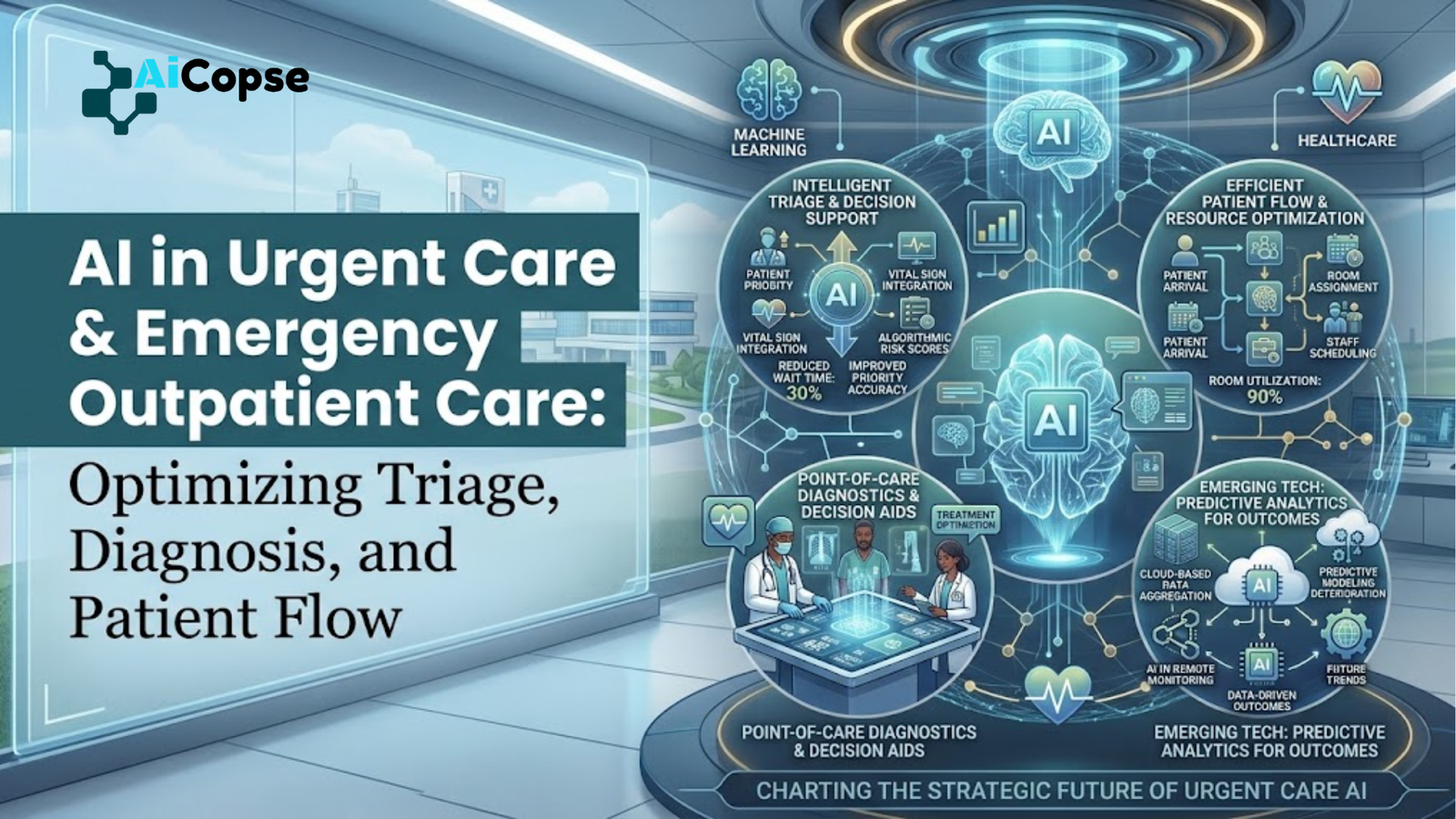
Primary topic: Artificial Intelligence in Urgent Care and Emergency Outpatient Care
Research focus: AI adoption, emergency triage, clinical decision support, predictive analytics, workflow automation, generative AI, computer vision, documentation, patient communication, and healthcare modernization.
Urgent care and emergency outpatient services operate under constant time pressure. Clinicians must evaluate patients quickly while managing incomplete information, unpredictable demand, limited resources, and rapidly changing clinical conditions.
These environments also generate large amounts of structured and unstructured data. Electronic health records, triage notes, laboratory results, imaging, vital signs, patient messages, medication histories, and clinical documentation can all provide signals about patient risk.
Traditional systems often require clinicians to manually review much of this information. AI can process large datasets quickly and identify patterns that may otherwise take considerable time to recognize.
The practical value of AI, however, depends on more than model accuracy. A technically strong model can still create problems if it interrupts clinical workflows, produces poorly calibrated alerts, or operates without appropriate human oversight.
Recent research provides a more useful picture. AI is showing measurable potential in emergency triage, admission prediction, documentation, imaging support, patient-message classification, and operational capacity management.
At the same time, the evidence shows that AI should generally function as a clinical support layer rather than an autonomous decision-maker.
That distinction should guide healthcare startups building new products and existing organizations modernizing emergency and urgent-care infrastructure.
Our Key Findings
Our review of recent research produces seven important findings about AI in urgent care and emergency outpatient services.
1. AI can improve emergency risk prediction
Machine learning can analyze triage information and other patient variables to estimate the probability of hospital admission.
A large study involving 560,486 emergency department visits found that machine-learning models could achieve strong discrimination using information available at triage.
Full-variable models using approaches such as XGBoost and deep neural networks achieved AUC values around 0.92.
The practical opportunity is significant because early risk prediction can support bed planning, staffing, escalation, and patient-flow decisions before the final disposition is known.
2. AI can make triage workflows faster
Emergency triage is information-intensive, and documentation can consume valuable staff time.
A study involving 1,063 triage tasks and 19 emergency nurses found that a real-time voice AI system reduced median triage task time from 231 seconds to 204 seconds.
The system also improved the recording of some additional patient concerns and medical-history information.
This demonstrates how AI can create value without making the clinical decision itself.
3. Domain-specific AI can improve emergency-message detection
Patient portal messages can contain symptoms that require urgent attention.
Researchers evaluated large language models combined with knowledge-graph retrieval for identifying emergencies in 1,020 patient messages.
The strongest model achieved 0.99 accuracy, 0.98 sensitivity, and 0.99 specificity in the reported evaluation.
The study is particularly important because it shows that generic language generation is not necessarily enough.
Clinical AI becomes more useful when the model is connected to structured, domain-specific knowledge.
4. Computer vision can support emergency imaging workflows
AI-assisted imaging is another important area of emergency-care development.
A prospective study evaluated AI-assisted rib-fracture detection across 23,251 real-world chest radiographs from a high-volume emergency department.
The system achieved 74.5% sensitivity and 93.3% specificity.
Its median inference time was 10.6 seconds, compared with approximately 3.3 hours for radiologist reports in the study setting.
The system was designed as a supportive screening tool rather than a standalone diagnostic solution.
This distinction is critical because false positives and false negatives remain possible.
5. Generative AI can reduce documentation time
Emergency departments produce extensive documentation during every patient encounter.
A study of an LLM-based emergency discharge documentation assistant evaluated 592 representative training cases and 50 validation cases.
LLM-assisted documentation achieved higher scores than manual documentation across completeness, correctness, conciseness, and clinical utility in the reported evaluation.
Median documentation time was also reduced from 69.5 seconds manually to 32.0 seconds with LLM assistance.
The result suggests that generative AI can reduce documentation workload when clinicians remain responsible for reviewing and finalizing the content.
6. AI can support emergency department capacity management
Emergency departments frequently face unpredictable demand.
Predicting whether a patient will be discharged, admitted, or transferred can help organizations plan beds, staffing, and operational resources.
A multicenter study analyzed 998,109 emergency encounters across 11 emergency departments.
The strongest machine-learning models achieved an AUROC of approximately 0.89, with recall above 0.83 and accuracy around 0.79.
The researchers also found that information extracted from triage notes using LLMs could improve model performance, particularly recall.
7. Human oversight remains essential
The strongest research does not support removing clinicians from high-risk emergency decisions.
Emergency medicine organizations increasingly emphasize physician-led governance, emergency-specific validation, transparency, equity, privacy, monitoring, and continuous quality improvement.
AI should therefore be designed around human authority rather than around autonomous clinical control.
Research Evidence: Major AI Studies in Emergency and Urgent Care
The following studies provide measurable evidence for organizations evaluating AI adoption in urgent care and emergency outpatient environments.
Study 1: Machine Learning for Emergency Department Admission Prediction
Researchers analyzed 560,486 emergency department visits to determine whether machine learning could predict hospital admission at triage.
The overall admission risk in the study population was 29.7%.
Models using only information available at triage achieved an AUC of approximately 0.87.
When a broader set of variables was available, logistic regression reached approximately 0.91 AUC, while XGBoost and deep neural networks reached approximately 0.92.
The researchers extracted up to 972 variables from each patient visit.
| Model / Approach | Reported AUC |
|---|---|
| Triage-only models | ~0.87 |
| Logistic regression with full variables | ~0.91 |
| XGBoost | ~0.92 |
| Deep neural network | ~0.92 |
The study demonstrates why early prediction can be valuable in emergency operations.
A reliable admission-risk estimate can help hospitals anticipate capacity requirements while patients are still moving through the emergency workflow.
The model does not need to make the final admission decision to create value.
It can instead provide an additional signal for clinicians and operational teams.
Source: PubMed — Predicting hospital admission at emergency department triage using machine learning
Study 2: Voice AI for Emergency Triage
Researchers evaluated a real-time voice AI system designed to assist emergency department nurses during triage.
The study included 1,063 triage tasks performed by 19 nurses.
Median triage task time decreased from 231 seconds without the system to 204 seconds with AI assistance.
That represents a reduction of 27 seconds per evaluated task.
| Measure | Manual | AI-Assisted |
|---|---|---|
| Median triage time | 231 sec | 204 sec |
| Difference | — | 27 sec faster |
| Triage tasks | 1,063 | |
The system also helped capture some additional patient concerns and past medical history.
The significance is operational as well as clinical.
In a high-volume emergency environment, small reductions in repetitive documentation can accumulate across hundreds or thousands of encounters.
Voice AI therefore represents an opportunity for AI Workflow Automation, Generative AI, Natural Language Processing, and AI Integration and Deployment.
Source: PubMed — Real-time medical record input assistance with voice AI
Study 3: LLMs and Knowledge Graphs for Emergency Patient Messages
Patient portal messages can create an unusual triage challenge.
A message may arrive outside normal clinical workflows while containing symptoms that require immediate escalation.
Researchers studied 1,020 patient messages and evaluated large language models using different retrieval approaches.
The clinical knowledge base contained 225 triage protocols.
The strongest global-search knowledge-graph RAG approach achieved 0.99 accuracy, 0.98 sensitivity, and 0.99 specificity.
| Metric | Best Reported Result |
|---|---|
| Messages evaluated | 1,020 |
| Triage protocols in knowledge base | 225 |
| Accuracy | 0.99 |
| Sensitivity | 0.98 |
| Specificity | 0.99 |
The important finding is not simply the reported accuracy.
The study demonstrates the value of connecting an LLM to structured clinical knowledge.
For emergency workflows, organizations should prefer systems that can retrieve approved protocols and provide traceable reasoning inputs rather than relying solely on an unrestricted language model.
Source: PubMed — Detecting emergencies in patient portal messages using LLMs and knowledge-graph RAG
Study 4: Computer Vision for Rib-Fracture Detection
Computer vision can help emergency clinicians process medical imaging more efficiently.
A prospective study evaluated AI-assisted rib-fracture detection using 23,251 real-world chest radiographs from a high-volume emergency department.
The AI system achieved 74.5% sensitivity and 93.3% specificity.
Its positive predictive value was 24.2%, while its negative predictive value reached 99.2%.
The median AI inference time was only 10.6 seconds.
| Performance Measure | Reported Result |
|---|---|
| Chest radiographs | 23,251 |
| Sensitivity | 74.5% |
| Specificity | 93.3% |
| PPV | 24.2% |
| NPV | 99.2% |
| Median AI inference time | 10.6 sec |
The high negative predictive value is particularly relevant to screening workflows.
However, the authors positioned the system as a supportive tool rather than a standalone diagnostic solution.
This is an important design principle for emergency Computer Vision Development.
AI should help clinicians prioritize and review information while preserving appropriate clinical judgment.
Source: PubMed — Prospective AI-assisted rib-fracture detection study
Study 5: Machine Learning and LLM Features for Emergency Department Disposition
A multicenter retrospective study evaluated whether machine learning could predict emergency department disposition.
The dataset contained 998,109 encounters from 11 emergency departments between January 2023 and November 2024.
The strongest CatBoost, XGBoost, and LightGBM models achieved an AUROC of approximately 0.89.
Recall exceeded 0.83, while overall accuracy was approximately 0.79.
The researchers also used LLMs to extract useful features from triage notes.
These additional language-derived features improved performance, particularly recall.
| Study Measure | Reported Result |
|---|---|
| Emergency encounters | 998,109 |
| Emergency departments | 11 |
| AUROC | ~0.89 |
| Recall | >0.83 |
| Accuracy | ~0.79 |
This type of prediction can support proactive capacity management.
Hospitals can potentially use these predictions to improve bed allocation, staffing plans, patient-flow management, and surge preparation.
Source: PubMed — Predicting emergency department disposition using machine learning and LLM features
Study 6: LLM-Assisted Emergency Discharge Documentation
Generative AI can also support the final stage of an emergency encounter.
A study evaluated an LLM assistant for emergency department discharge documentation.
The research included 592 representative training cases and 50 validation cases.
LLM-assisted documentation received higher reported scores than manual documentation for completeness, correctness, conciseness, and clinical utility.
Median documentation time decreased from 69.5 seconds to 32.0 seconds.
| Measure | Manual | LLM-Assisted |
|---|---|---|
| Completeness | 4.03 | 4.23 |
| Correctness | 4.20 | 4.38 |
| Conciseness | 4.11 | 4.23 |
| Clinical utility | 3.85 | 4.17 |
| Median documentation time | 69.5 sec | 32.0 sec |
The results support Generative AI as a documentation assistant.
They do not support removing clinicians from the documentation process.
Clinical review remains important because an AI-generated note can contain omissions or incorrect information.
Source: PubMed — Large Language Model Assistant for Emergency Department Discharge Documentation
Study 7: LLM-Generated Emergency Handoff Summaries
Emergency handoffs require clinicians to communicate important patient information quickly.
Researchers evaluated LLM-generated handoff summaries using 1,600 emergency medicine patient records.
The LLM summaries achieved stronger automated similarity and detail metrics than physician-written summaries.
However, expert reviewers gave slightly higher usefulness and patient-safety scores to physician-written summaries.
| Evaluation | LLM Summary | Physician Summary |
|---|---|---|
| ROUGE | 0.322 | 0.088 |
| BERTScore | 0.859 | 0.796 |
| SCALE | 0.691 | 0.456 |
| Expert usefulness | 4.04 | 4.36 |
| Expert safety | 4.06 | 4.50 |
This is an excellent example of why healthcare AI should not be evaluated using a single metric.
An LLM can produce a highly detailed summary while still requiring professional review for clinical usefulness and safety.
Source: PubMed — LLM emergency handoff summaries
Research Data Visualization
The following visualization compares selected measurable findings from the research discussed above.
Selected Emergency AI Research Indicators
LLM-assisted discharge documentation time
Manual discharge documentation time
Emergency voice-AI triage time
Manual triage time
Note: These values represent different workflows and study populations. They are shown for visual context and should not be interpreted as directly comparable measures of overall AI performance.
Industry Trends and Transformation in Emergency Care
1. AI is moving from standalone tools to integrated clinical systems
The next stage of healthcare AI will increasingly connect multiple systems rather than operate as isolated applications.
An emergency AI platform can potentially connect the EHR, triage system, laboratory information, imaging, patient messaging, scheduling, and operational analytics.
This creates an intelligence layer around the existing clinical infrastructure.
The objective is not to add another application for clinicians to manage.
The objective is to make useful intelligence available inside the workflow where decisions are already being made.
2. Predictive emergency care is becoming more practical
Emergency departments have traditionally responded to problems after they occur.
Predictive AI can help organizations anticipate some events before they happen.
Potential applications include admission prediction, patient deterioration risk, emergency department disposition, staffing demand, bed requirements, return-visit risk, and patient-flow forecasting.
The most valuable predictions are those connected to clear operational or clinical actions.
A risk score without an associated workflow may have limited practical value.
3. Emergency triage is becoming more intelligent
AI can collect patient information before or during triage and organize it into a structured clinical summary.
It can identify potential urgency signals and compare patient information with approved triage protocols.
It can also prioritize messages or encounters that require faster human attention.
High-risk and uncertain cases should remain subject to appropriate clinical escalation.
4. Generative AI is expanding beyond chatbots
Generative AI is increasingly being used for documentation and information processing.
In emergency care, potential applications include discharge summaries, handoff notes, patient instructions, referral summaries, clinical note drafting, patient-message responses, and information extraction.
The strongest applications are likely to be workflow-specific rather than generic chatbot experiences.
5. Computer vision can become an additional screening layer
Emergency departments process large volumes of medical images.
Computer vision can help identify patterns that require additional attention.
Potential applications include fracture detection, chest imaging analysis, stroke-related imaging support, pulmonary findings, and other validated imaging workflows.
The appropriate role depends on the clinical risk and evidence supporting the specific application.
6. Emergency capacity management is becoming data-driven
Operational AI can help healthcare organizations understand demand before the department reaches capacity.
Machine learning can combine historical encounters, current patient volumes, triage information, time patterns, and other operational signals.
This can support staffing forecasts, bed allocation, patient-flow planning, and surge management.
AI therefore has value beyond direct clinical decision support.
Maximum AI Use Cases for Urgent Care and Emergency Outpatient Services
AI-Powered Emergency Triage
AI can collect symptoms, organize patient information, identify potential red flags, and prepare structured triage summaries.
It can also compare information against approved protocols before presenting the case to a clinician.
The final urgency classification should remain under appropriate professional oversight.
Emergency Risk Prediction
Machine learning can estimate the probability of admission, escalation, deterioration, or other clinically relevant outcomes.
These predictions can help clinicians prioritize attention while also supporting operational planning.
The system should clearly communicate uncertainty rather than presenting every prediction as a fact.
Patient Deterioration Detection
AI can continuously analyze available patient information for patterns associated with deterioration.
Potential inputs include vital signs, laboratory values, clinical notes, medication history, and other structured data.
Alerts should be carefully calibrated because excessive false alarms can contribute to alert fatigue.
Emergency Department Disposition Prediction
AI can estimate whether a patient is likely to be discharged, admitted, transferred, or require additional resources.
This can help operational teams anticipate capacity requirements.
The prediction should support planning rather than determine disposition automatically.
Ambient Clinical Documentation
Ambient AI can listen to an authorized clinical conversation and generate a draft note.
The clinician can then review, correct, and finalize the documentation.
This approach can reduce repetitive typing while preserving professional accountability.
Emergency Discharge Documentation
Generative AI can prepare structured discharge documentation from approved clinical information.
It can organize diagnoses, instructions, follow-up information, and patient education into a readable format.
Clinicians should review the final content before it reaches the patient.
Patient Message Triage
AI can analyze incoming patient messages and identify those that may contain urgent symptoms.
It can route potentially high-risk messages to the appropriate clinical team.
This can reduce the chance that important messages remain buried in large communication queues.
Clinical Handoff Support
AI can summarize long patient records before handoff.
It can organize relevant diagnoses, current status, treatments, pending tests, and important events.
The receiving clinician should still verify critical information against the medical record.
Medical Imaging Support
Computer vision can help prioritize selected imaging studies for review.
It can also highlight findings that may require closer attention.
The exact role should depend on clinical validation, regulatory requirements, and the consequences of false results.
Medication Reconciliation
AI can compare medication lists from different sources.
It can identify potential discrepancies, duplicates, and missing information for professional review.
This can reduce repetitive reconciliation work while keeping medication decisions under qualified oversight.
Referral and Follow-Up Automation
AI can identify missing referral information and prepare structured summaries.
It can also support follow-up workflows after emergency visits.
For example, a system could identify patients who need a follow-up appointment and create an appropriate task for staff review.
Emergency Department Capacity Forecasting
Machine learning can analyze historical demand and current operational conditions.
The resulting forecast can help organizations plan staffing and resources.
This is especially valuable when emergency departments experience predictable peaks alongside unpredictable surges.
Translation and Communication Support
Generative AI can assist with multilingual patient communication.
It can help create understandable versions of instructions and educational information.
High-risk clinical communication should use appropriately validated processes rather than relying on an unverified translation workflow.
Population-Level Emergency Analytics
AI can analyze emergency encounter data to identify recurring patterns.
Organizations can use these insights to understand utilization, frequent return visits, referral bottlenecks, and operational inefficiencies.
This can support long-term service redesign.
AI Capability Map for Emergency Outpatient Care
| AI Capability | Primary Application | Main Value |
|---|---|---|
| AI Development | Emergency-specific AI applications | Product innovation |
| AI Integration and Deployment | EHR, triage, imaging, and operational systems | Workflow adoption |
| AI Workflow Automation | Patient-flow and administrative processes | Efficiency |
| Machine Learning | Risk and disposition prediction | Proactive decisions |
| Computer Vision Development | Medical imaging support | Earlier detection |
| Custom AI Model Development | Specialized emergency workflows | Domain-specific intelligence |
| Data Analytics & AI Insights | Emergency operations and population analytics | Better planning |
| Generative AI | Documentation, summaries, and communication | Lower administrative burden |
AI Opportunities for Healthcare Startups
Healthcare startups should avoid building an AI product simply because the technology is available.
The strongest opportunity usually starts with a specific emergency-care problem.
A startup should identify the workflow, establish the baseline, determine where AI can provide an advantage, and define the outcome that will prove whether the solution works.
A useful healthcare AI architecture can follow this model:
For example, a startup could build an AI system that identifies potentially urgent patient messages.
The system could compare the message against an approved clinical knowledge base and route high-risk cases to a designated clinical team.
The organization could then measure response time, escalation accuracy, missed emergencies, and false-alert rates.
This is stronger than simply selling an AI dashboard.
The startup owns a measurable healthcare workflow.
Legacy Modernization for Emergency Healthcare Organizations
Established healthcare organizations often have another challenge.
They may already operate EHRs, laboratory systems, imaging platforms, patient portals, scheduling systems, and operational databases.
Replacing these systems can be expensive and disruptive.
AI integration provides an alternative modernization path.
Organizations can introduce an AI layer around their existing infrastructure and gradually connect new capabilities to established workflows.
Existing Healthcare Systems
↓
AI Integration Layer
↓
Machine Learning + Generative AI + Computer Vision + Analytics
↓
Clinical and Operational Workflow
↓
Human Review and Governance
↓
Outcome Measurement
This approach allows organizations to start with a focused use case.
They can validate the technology in a controlled environment and expand only after demonstrating measurable value.
AI Workflow Automation in Emergency Care
Emergency care contains many repetitive processes that can potentially be automated.
A connected workflow could look like this:
Patient Arrival
↓
AI-Assisted Intake
↓
Triage Support
↓
Clinical Assessment
↓
AI Documentation
↓
Clinical Review
↓
Testing and Imaging
↓
Decision Support
↓
Discharge / Admission / Transfer
↓
Follow-Up Automation
↓
Analytics and Quality Monitoring
The goal should not be to remove humans from this process.
The goal should be to remove unnecessary manual work while giving clinicians better information at the right moment.
Where AI Should Not Operate Alone
Emergency care is a high-risk environment.
AI systems should therefore operate under stronger controls than ordinary business software.
AI should not independently make high-risk clinical decisions without appropriate validation, governance, and professional oversight.
Potential risks include:
- Incorrect clinical recommendations
- Hallucinated or fabricated information
- False-positive alerts
- False-negative detections
- Algorithmic bias
- Data privacy failures
- Model drift
- Weak system integration
- Automation errors
- Patient misunderstanding
- Unclear accountability
The American College of Emergency Physicians and other emergency medicine organizations have emphasized human-centered AI, physician authority, physician-led governance, safety, equity, transparency, privacy, emergency-specific validation, and continuous monitoring.
Healthcare organizations should therefore establish governance before expanding AI across critical workflows.
Future Predictions for AI in Urgent and Emergency Care
Prediction 1: AI will become an invisible clinical layer
Patients may not always know when AI is operating in the background.
It may support triage, documentation, imaging review, communication, patient flow, and follow-up.
The workflow itself will increasingly become the interface.
Prediction 2: Multimodal AI will become more important
Future healthcare AI systems will combine different information types.
These may include clinical text, imaging, audio, laboratory results, vital signs, EHR history, and patient-generated information.
Combining these signals can provide a more complete representation of the patient’s situation.
Prediction 3: AI agents will coordinate multi-step workflows
The next generation of healthcare AI will move beyond simple question answering.
An AI agent may identify a care requirement, retrieve approved information, prepare a draft task, route it to the appropriate team, and monitor whether the workflow was completed.
Sensitive actions should continue to require appropriate human authorization.
Prediction 4: Uncertainty-aware AI will become increasingly important
Emergency medicine often involves incomplete information.
A model that always produces a confident answer can be dangerous.
Future systems will increasingly need to communicate uncertainty and identify cases where the available information is insufficient.
Research into conformal prediction for emergency disposition already demonstrates the potential of explicitly allowing a model to indicate when it does not know.
Prediction 5: Custom AI models will become strategically valuable
General-purpose models provide broad capabilities.
Emergency organizations often need systems optimized for specific populations, workflows, protocols, and operational environments.
This creates an opportunity for Custom AI Model Development.
Prediction 6: Evidence will become a competitive advantage
Healthcare leaders will increasingly ask a simple question:
Does this AI work safely in our environment?
Companies that can provide validation evidence, transparent limitations, subgroup performance, monitoring results, and real-world outcomes will have an advantage.
Future AI Architecture for Urgent and Emergency Care
EMERGENCY CARE AI INTELLIGENCE LAYER
Data Sources
EHR • Triage • Labs • Imaging • Vital Signs • Patient Portal • Clinical Notes
↓
AI Layer
Machine Learning • Generative AI • Computer Vision • NLP • Custom Models
↓
Intelligence
Risk Scores • Summaries • Predictions • Alerts • Recommendations
↓
Workflow Automation
Triage • Documentation • Routing • Referrals • Follow-Up • Capacity Planning
↓
Human Oversight
Clinician Review • Approval • Escalation • Monitoring
↓
Outcome Measurement
Safety • Clinical Quality • Wait Time • Productivity • Patient Experience • Cost
Industry Expert Recommendations
Recommendation 1: Start with measurable problems
Do not begin with an AI model.
Begin with a workflow problem.
Documentation time, triage delays, patient-message queues, imaging review, admission prediction, and capacity planning are examples of measurable problems.
Define the baseline before deployment.
Then measure the AI-enabled workflow against that baseline.
Recommendation 2: Build human-in-the-loop systems
AI should support clinical judgment rather than create false confidence.
High-risk decisions should have appropriate professional review.
The system should also provide clear escalation paths when uncertainty is high.
Recommendation 3: Integrate AI into existing systems
Emergency clinicians should not have to manage several disconnected applications.
AI should fit into the systems they already use.
EHR integration, identity management, auditability, data exchange, and workflow compatibility should therefore be treated as core capabilities.
Recommendation 4: Establish AI governance
Healthcare organizations should define clear rules for AI use before deployment.
These rules should cover:
- Approved AI use cases
- Data access and privacy
- Human review requirements
- Model validation
- Performance monitoring
- Bias and subgroup analysis
- Incident reporting
- Vendor accountability
- Model updates and drift monitoring
- Clinical escalation procedures
Recommendation 5: Measure outcomes, not hype
AI accuracy is only one part of the evaluation.
Healthcare leaders should also measure clinical, operational, patient, safety, and financial outcomes.
| Category | Recommended Metrics |
|---|---|
| Clinical | Diagnostic yield, escalation accuracy, safety events |
| Operational | Wait time, throughput, documentation time |
| Patient | Access, communication, satisfaction |
| Safety | False negatives, false positives, adverse events |
| Financial | Cost per encounter, utilization, AI ROI |
Original Research Asset: Emergency-Care AI Opportunity Matrix
The following matrix provides a practical framework for healthcare organizations evaluating AI opportunities.
| Area | AI Opportunity | Technology | Primary KPI |
|---|---|---|---|
| Triage | Urgency classification support | ML + Generative AI | Safe routing |
| Patient Messages | Emergency detection | LLM + RAG | Sensitivity |
| Documentation | Ambient notes | Generative AI | Documentation time |
| Imaging | Finding detection | Computer Vision | Detection performance |
| Disposition | Admission prediction | Machine Learning | AUROC / recall |
| Handoffs | Patient summaries | Generative AI | Safety and usefulness |
| Operations | Demand forecasting | Machine Learning | Wait time |
| Follow-Up | Risk-based outreach | ML + Automation | Follow-up completion |
| Analytics | Population and workflow insights | Analytics + AI | Outcome improvement |
A Five-Stage AI Adoption Framework
Healthcare organizations can use a simple five-stage process when introducing AI into emergency and urgent-care workflows.
Stage 1 — Identify
Find the workflow creating the greatest clinical or operational friction.
Stage 2 — Validate
Determine whether AI can realistically address the problem and define the evidence required for deployment.
Stage 3 — Integrate
Connect the AI system with the existing EHR, clinical applications, data sources, and operational workflows.
Stage 4 — Deploy
Introduce the system with appropriate clinical oversight, monitoring, escalation, and user training.
Stage 5 — Measure
Track safety, quality, productivity, patient experience, and financial outcomes.
What This Means for Healthcare Startups
For healthcare startups, emergency care presents a large opportunity for specialized AI products.
The strongest products will solve specific problems rather than attempting to automate the entire emergency department.
Startups can focus on triage, documentation, imaging support, patient communication, operational prediction, clinical analytics, or follow-up automation.
The competitive advantage may not come from owning the largest language model.
It may come from owning the best workflow, the strongest clinical validation, and the safest integration.
What This Means for Existing Healthcare Providers
Established healthcare organizations can treat AI as a modernization layer rather than a reason to replace their entire technology stack.
They can start with a single high-value workflow.
They can connect AI to existing systems and establish a measurable baseline.
After validating the result, they can expand into additional departments and workflows.
This incremental approach reduces implementation risk and creates a stronger business case for continued investment.
Does AI Replace Emergency Physicians?
No.
Current evidence supports augmentation rather than replacement.
AI can process large amounts of information quickly.
It can identify patterns, predict risk, draft documentation, analyze images, and prioritize information.
These capabilities can help clinicians work more efficiently.
However, emergency medicine involves uncertainty, incomplete information, and high-risk decisions.
Human clinical judgment therefore remains essential.
The strongest healthcare AI strategy is not to remove the clinician from the workflow.
It is to give the clinician better information at the right time.
Frequently Asked Questions
How is AI used in urgent care and emergency outpatient services?
AI can support triage, risk prediction, documentation, medical imaging, patient-message classification, clinical decision support, disposition prediction, follow-up, and emergency department capacity management.
Can AI perform emergency triage?
AI can support triage by collecting information, identifying potential urgency signals, and organizing patient information. High-risk cases should be escalated to qualified healthcare professionals.
Can AI predict hospital admission?
Yes. Machine-learning research involving hundreds of thousands of emergency visits has demonstrated strong performance for predicting hospital admission using information available during triage.
Can generative AI reduce emergency documentation time?
Research suggests that LLM-assisted emergency documentation can reduce documentation time while improving several evaluated quality measures. Clinician review remains important before documentation is finalized.
Can AI detect emergencies in patient messages?
Research has demonstrated that LLMs combined with domain-specific knowledge retrieval can identify emergency-related patient messages with high reported accuracy in controlled evaluations.
What is computer vision used for in emergency care?
Computer vision can support medical-image analysis and screening. Applications include fracture detection and other imaging workflows where the technology has been clinically validated.
What is machine learning used for in emergency departments?
Machine learning can predict admission, disposition, deterioration risk, demand, patient flow, and other clinical or operational outcomes.
How can healthcare startups use AI in emergency care?
Startups can build specialized products around triage, documentation, imaging, patient communication, predictive analytics, emergency operations, and follow-up workflows.
How can existing hospitals modernize legacy systems with AI?
Healthcare organizations can add an AI integration layer around existing EHRs, imaging platforms, patient portals, and operational systems. This allows gradual modernization without replacing the entire technology stack.
Should AI make emergency clinical decisions independently?
High-risk emergency decisions should not rely on an AI system operating without appropriate professional oversight. AI should generally support clinicians while preserving human accountability.
How should healthcare organizations measure AI success?
Organizations should measure clinical safety, diagnostic performance, workflow efficiency, patient experience, staff workload, operational outcomes, and financial impact. Model accuracy alone is not enough.
Key Original Research References
- Predicting Hospital Admission at Emergency Department Triage Using Machine Learning
560,486 emergency visits were analyzed. Triage-only models achieved approximately 0.87 AUC, while full-variable XGBoost and deep neural-network models reached approximately 0.92 AUC.
Verify the original study on PubMed - Real-Time Medical Record Input Assistance With Voice Artificial Intelligence
The study included 1,063 triage tasks performed by 19 nurses. Median triage time decreased from 231 seconds to 204 seconds with AI assistance.
Verify the original study on PubMed - Detecting Emergencies in Patient Portal Messages Using LLMs and Knowledge-Graph RAG
The study evaluated 1,020 patient messages using a knowledge base containing 225 triage protocols. The strongest reported model achieved 0.99 accuracy, 0.98 sensitivity, and 0.99 specificity.
Verify the original study on PubMed - Prospective AI-Assisted Rib-Fracture Detection on Chest Radiographs
The study evaluated 23,251 real-world chest radiographs. AI achieved 74.5% sensitivity, 93.3% specificity, and 99.2% negative predictive value.
Verify the original study on PubMed - Predicting Emergency Department Disposition Using Machine Learning and LLM Features
The multicenter study analyzed 998,109 encounters across 11 emergency departments. The strongest models achieved approximately 0.89 AUROC, recall above 0.83, and accuracy around 0.79.
Verify the original study on PubMed - Large Language Model Assistant for Emergency Department Discharge Documentation
The study included 592 representative training cases and 50 validation cases. Median documentation time decreased from 69.5 seconds to 32.0 seconds with LLM assistance.
Verify the original study on PubMed - LLM-Generated Emergency Medicine Handoff Summaries
The study evaluated 1,600 emergency medicine patient records. LLM summaries performed strongly on automated similarity measures, while physician-written summaries received higher expert usefulness and safety scores.
Verify the original study on PubMed
Credible Healthcare AI Resources
- American College of Emergency Physicians — Emergency Medicine AI Consensus Statement
- ACEP — The EM Physician’s AI Stack
- U.S. FDA — Artificial Intelligence-Enabled Medical Devices
- World Health Organization — Ethics and Governance of Artificial Intelligence for Health
- WHO — Ethics and Governance Guidance for Large Multi-Modal Models
Conclusion
AI is changing urgent care and emergency outpatient services from highly reactive environments toward more predictive, connected, and data-driven workflows.
The strongest evidence currently comes from focused applications.
These include emergency triage support, admission prediction, patient-message classification, medical imaging, documentation, handoff summaries, and capacity management.
The research also provides an important warning.
AI performance alone does not guarantee better healthcare.
A model can achieve strong benchmark results and still create limited value if it is poorly integrated into the clinical workflow.
Implementation, validation, governance, and human oversight therefore matter as much as model performance.
For healthcare startups, the opportunity is to build AI around specific and measurable emergency-care problems.
For established healthcare organizations, the opportunity is to modernize existing systems without replacing the entire technology stack.
The winning approach is not simply to put AI into an emergency department.
It is to identify the right workflow, integrate the right AI capability, maintain clinical accountability, monitor performance, and prove the outcome.
That is the foundation for responsible, scalable, and effective AI adoption in urgent care and emergency outpatient services.
Research note: Healthcare AI evidence changes quickly. Individual AI products should be validated against their intended patient population, clinical workflow, regulatory environment, data quality, and risk level before deployment. Findings from different studies should not be treated as directly comparable when their populations, interventions, datasets, or outcome definitions differ.
Leave a Reply