
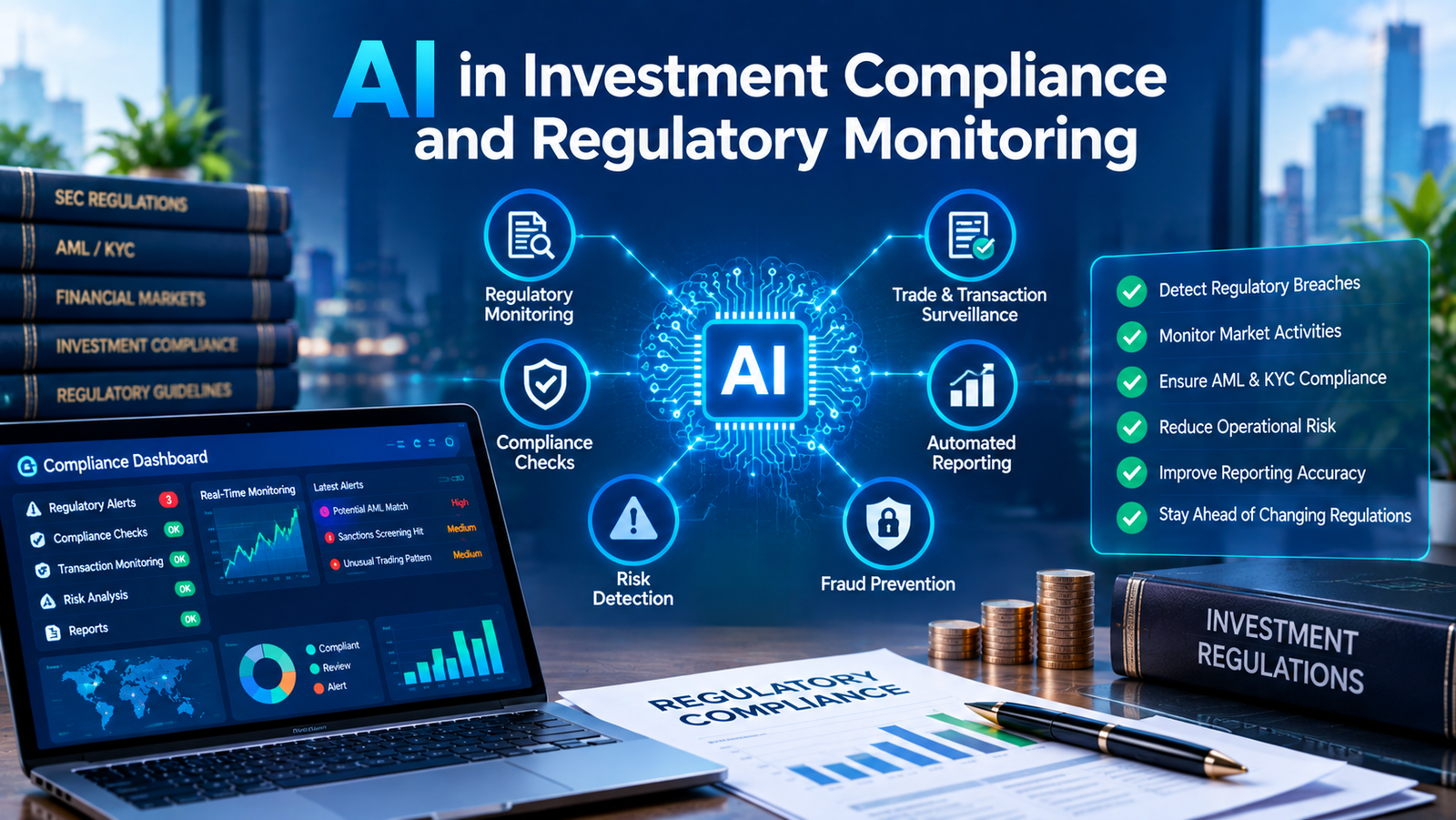
Primary topic: AI in Investment Compliance and Regulatory Monitoring
Research focus: AI-powered investment compliance, regulatory change management, trade surveillance, employee communications monitoring, investment adviser compliance, market abuse detection, portfolio and marketing oversight, regulatory reporting, explainable AI, model governance and automated compliance workflows
What Is AI in Investment Compliance?
Investment compliance is the process of ensuring that investment advisers, broker-dealers, asset managers, investment funds and other financial institutions follow the laws, regulations, internal policies and contractual obligations that apply to their activities.
Traditional compliance programs use written policies, checklists, transaction rules, employee attestations, periodic reviews and manual investigations. These controls remain necessary, but they can become difficult to maintain when firms operate across multiple products, jurisdictions, communication channels and investment strategies.
AI adds capabilities that help compliance teams process information at greater scale. Machine learning can identify unusual patterns in trading or employee activity, while natural language processing can analyze emails, chat messages, research notes, marketing materials and regulatory documents. Generative AI can summarize evidence, compare policies, extract obligations and prepare investigation drafts for human review.
For investment firms, the value is not simply faster document processing. It is the ability to connect evidence that would otherwise remain separated across surveillance systems, portfolio tools, communication archives, compliance records and regulatory updates.
Interpret
Extract obligations from rules, guidance and regulatory announcements
Monitor
Analyze trading, communications, disclosures and business activity
Investigate
Connect evidence, explain alerts and support compliance decisions
Why Investment Compliance Needs More Intelligent Monitoring
Investment firms generate a wide range of information that may be relevant to compliance. A single potential issue could involve an order, a portfolio manager’s communications, a research report, a personal trading declaration, a marketing statement or a change in a regulatory requirement.
A rule-based system is effective when a requirement can be expressed clearly. For example, it can flag a transaction that exceeds a defined limit or identify an employee who has not submitted a required attestation. However, fixed rules may struggle to recognize unusual combinations of activity or understand the meaning of a conversation.
AI can analyze context and relationships across these sources. A communications model might identify language suggesting an undisclosed investment promise, while a surveillance model checks whether related trading activity warrants review. A regulatory intelligence model could identify a new disclosure requirement and help map it to the firm’s existing policies.
The objective is not to label every unusual event as misconduct. It is to identify relevant evidence, prioritize potential risks and help qualified staff decide what action is appropriate.
Research Study: FINRA’s Analysis of AI Applications in the Securities Industry
FINRA’s research on artificial intelligence in the securities industry describes how broker-dealers are exploring AI across customer communications, investment processes, operations, risk management and compliance. The report identifies surveillance and monitoring, customer identification, financial-crime monitoring and regulatory intelligence management as relevant application areas.
For surveillance, FINRA describes AI tools that can process structured and unstructured information, including text, speech, voice, images and video. These systems can look for patterns across employees, customers and business activities. Firms have reported that AI may help reduce false positives and allow compliance staff to focus on alerts that warrant more detailed investigation.
The report also discusses the use of AI to interpret regulatory intelligence. This is especially relevant for organizations that monitor regulatory changes across jurisdictions. Rather than relying exclusively on staff to find, read and manually distribute every update, AI can help identify relevant changes and map them to internal compliance processes.
The distinction is important: identifying a regulatory change is not the same as determining its legal meaning or implementing it correctly. AI can support research and workflow management, while legal and compliance professionals remain responsible for interpretation and approval.
What this means for investment firms:
- Use AI to connect surveillance information across different communication channels
- Prioritize alerts using context rather than relying only on keyword matches
- Use regulatory intelligence tools to identify potentially relevant rule changes
- Keep a documented human review process for legal interpretation and compliance decisions
Source: FINRA, AI Applications in the Securities Industry
Research Study: FINRA’s 2026 Regulatory Oversight Report on Generative AI
FINRA’s 2026 Regulatory Oversight Report, published in December 2025, provides a current view of generative AI adoption and the controls firms should consider. FINRA reports that member firms are implementing generative AI particularly for internal efficiency and information retrieval. It identifies summarization and information extraction as the leading use case observed among its members.
For investment compliance, this points to practical applications such as summarizing examination materials, extracting obligations from regulatory documents, reviewing policies, organizing evidence and preparing first drafts of internal reports. These are tasks where AI can reduce the time required to work through large amounts of text.
The report also emphasizes that generative AI can produce inaccurate information, reflect bias, expose sensitive data or make its actions difficult to audit. AI agents introduce additional risks because they can plan and perform multi-step tasks, potentially acting outside their intended authority if access and controls are poorly designed.
FINRA’s position is operationally significant: existing obligations continue to apply when firms use generative AI. A firm cannot treat AI-generated work as exempt from supervision, recordkeeping or other applicable requirements.
What this means for investment firms:
- Start with controlled internal workflows such as document summarization and information extraction
- Require source-linked outputs for regulatory interpretations and compliance summaries
- Maintain logs of prompts, outputs, model versions and human approvals where appropriate
- Limit AI agents to approved systems, data and actions
- Test for accuracy, privacy, bias and reliability before deployment
Source: FINRA, 2026 Regulatory Oversight Report: GenAI, Continuing and Emerging Trends
Research Study: FINRA’s Guidance on AI Risks and Supervisory Controls
FINRA’s guidance on AI challenges and regulatory considerations explains why model performance alone is not enough to establish a compliant system. Firms need to understand how an AI application works, what activities it influences, what data it uses and how its outputs are reviewed.
The guidance highlights explainability concerns, especially where AI is used in applications that make or influence decisions. It also points to the importance of reviewing supervisory procedures when firms introduce AI-based tools.
This has direct implications for investment compliance. A surveillance model may generate an alert because a trader’s activity differs from historical behavior. Compliance staff need enough information to understand which transactions, patterns or contextual signals contributed to that alert. If the system cannot provide a useful explanation, it becomes harder to investigate the issue, document the decision or demonstrate that the control is operating as intended.
What this means for investment firms:
- Document the purpose and permitted use of every compliance model
- Define which decisions AI can recommend and which require human approval
- Test model performance against relevant scenarios and historical cases
- Monitor changes in false positives, missed detections and data quality
- Update supervisory procedures when AI changes how compliance work is performed
Source: FINRA, Key Challenges and Regulatory Considerations for AI
Research Study: SEC Remarks on AI and Investment Management
In February 2026, Brian Daly, Director of the SEC’s Division of Investment Management, discussed AI’s potential role in investment management. His remarks considered how AI agents might help investors interact with fund and adviser disclosures, including information about investment objectives, fees, redemption procedures, short positions, conflicts of interest and performance comparisons.
This is relevant to compliance because investor-facing AI can change how regulated information is presented and understood. An AI assistant that answers questions about a fund may make disclosures more accessible, but it could also misstate a fee, omit a material limitation or provide an answer that differs from the official documents.
The same concern applies to internal compliance assistants. If a system summarizes a prospectus, investment policy or regulatory obligation, its answer must remain traceable to the authoritative source. A fluent explanation is not enough if the underlying statement is incomplete or incorrect.
What this means for investment firms:
- Ground investor-facing answers in approved disclosures and current documents
- Make it clear when an answer is a summary rather than the authoritative disclosure
- Test responses to questions about fees, conflicts, investment risks and redemption terms
- Escalate questions that require individualized advice or legal interpretation
- Retain appropriate records of AI-generated communications under applicable requirements
Source: SEC, Artificial Intelligence and the Future of Investment Management, February 3, 2026
Research Study: SEC Statement on Predictive Data Analytics and Conflicts of Interest
The SEC’s July 2023 statement on predictive data analytics discussed potential conflicts that may arise when investment advisers and broker-dealers use predictive analytics or similar techniques to shape interactions with investors. The statement highlighted the ability of these systems to make predictions about individuals and the importance of firms meeting their obligations to clients and customers.
Although this statement is not a study measuring AI compliance performance, it is relevant to the design of investment monitoring systems. AI models can influence which products are promoted, which investors receive particular communications and how firms personalize investment experiences. Those choices may create conflicts if the system is optimized for firm revenue without adequate consideration of investor interests.
For compliance teams, this means that model governance should examine not only whether an AI system works technically, but also what objective it is optimizing and who may be affected by its outputs.
What this means for investment firms:
- Assess whether model objectives could create conflicts between firm and client interests
- Review personalization and recommendation systems for potentially harmful incentives
- Document the business purpose and expected investor impact of predictive models
- Monitor outcomes across relevant client groups and product categories
- Ensure compliance reviews consider both model behavior and the surrounding business process
Source: SEC, Statement on Conflicts of Interest Related to Uses of Predictive Data Analytics, July 26, 2023
Research Study: 2026 Investment Adviser Compliance Priorities
A 2026 survey reported by Barron’s, involving the Investment Adviser Association, ACA Compliance Group and Yuter Compliance Consulting, found that AI had become a leading compliance concern among registered investment adviser firms. The report said 85% of surveyed compliance professionals identified AI as a priority, while 80% of firms reported formally adopting AI tools. It also reported that 86% had acceptable-use policies and an inventory of approved AI tools.
These figures describe the surveyed firms and should not be treated as a universal estimate for the entire investment industry. However, they illustrate a practical shift: compliance teams are moving from discussing AI as a future possibility to establishing policies, inventories, training and governance structures around its use.
For firms building AI-powered compliance systems, the lesson is that governance is becoming part of implementation itself. An organization needs to know which tools are in use, which data they can access, which employees can use them and how their outputs are reviewed.
What this means for investment firms:
- Maintain an inventory of approved AI applications and use cases
- Define acceptable and prohibited uses of public and enterprise AI tools
- Train employees on confidentiality, accuracy and verification requirements
- Assign ownership for model risk, compliance review and technology controls
- Reassess policies as models, vendors and regulatory expectations change
Source: Barron’s, AI Outranks Cybersecurity as the Leading Compliance Concern for Investment Advisers, 2026
Where AI Can Improve Investment Compliance
Regulatory Change Management
Regulatory change management involves identifying new rules and guidance, determining which business activities are affected, updating policies and controls, and documenting implementation. For firms operating across multiple jurisdictions, this can involve a large volume of legal and regulatory material.
AI can classify regulatory updates by topic, extract dates and obligations, compare new language with existing policies and route potential changes to the right teams. Retrieval-augmented generation can help staff ask questions against a controlled library of authoritative documents, with answers linked to the source text.
A useful workflow should distinguish between an extracted requirement and an approved interpretation. AI may identify that a rule affects marketing disclosures, for example, but a qualified reviewer should confirm applicability, deadlines and required changes.
Regulatory sources
Dates and obligations
Legal applicability
Controls and evidence
Trade Surveillance and Market Abuse Monitoring
AI can help identify unusual trading patterns that may warrant investigation, including activity across accounts, instruments or time periods. Models can examine combinations of order behavior, timing, price movements, communications and historical patterns.
Potential applications include identifying unusual order placement, possible spoofing patterns, suspicious coordination, insider-trading indicators and activity inconsistent with a trader’s established behavior. These are investigative signals, not automatic findings of misconduct.
A robust surveillance system should combine existing market rules with machine-learning models. Rules are valuable for clearly defined obligations, while AI can identify complex patterns that are difficult to specify in advance.
Employee Communications Monitoring
Investment firms may need to monitor business communications under applicable legal, regulatory and internal requirements. AI can analyze email, chat and other approved records to identify potential policy violations, undisclosed promises, conflicts, misuse of confidential information or discussions that merit review.
Natural language processing can go beyond simple keyword matching by considering context, tone and relationships between messages. However, slang, sarcasm, industry terminology and multilingual conversations can produce errors. Firms should validate models against realistic communications and define clear escalation procedures.
Marketing and Investment Disclosure Review
AI can compare marketing materials with approved disclosures, investment policies, performance data and supporting evidence. It can flag potentially unsupported claims, missing qualifications, inconsistent figures or language that may require compliance review.
Generative AI can also help identify differences between versions of a document. The final approval should remain with authorized staff, particularly where claims relate to investment performance, risks, fees or conflicts of interest.
Personal Trading and Conflicts of Interest
AI can help connect employee declarations, restricted lists, personal trading records, investment activity and relevant communications. The aim is to identify combinations of events that deserve review, rather than relying on one isolated signal.
For example, a personal trade near a restricted-list update may warrant a closer look. The system should account for timing, applicable policies, account ownership and other evidence before raising or escalating a concern.
AI Technology Map for Investment Compliance
| AI capability | Investment compliance use | Key control |
|---|---|---|
| Natural language processing | Communications and regulatory text analysis | Context testing and source traceability |
| Machine learning | Risk scoring and anomaly detection | Validation and drift monitoring |
| Graph analytics | Relationships among accounts, people and transactions | Data quality and relationship verification |
| Generative AI | Summaries, evidence extraction and report drafting | Grounding, review and recordkeeping |
| Document intelligence | Policy comparison and disclosure checks | Version control and approved sources |
| Workflow automation | Routing, reminders and evidence collection | Access limits and approval gates |
Expert Recommendation: Build a Human-Governed Compliance System
Investment firms should avoid treating AI as a single product that can independently manage compliance. A more reliable approach is to assign different responsibilities to different system components.
Use deterministic rules for clear requirements, machine learning for risk patterns, natural language processing for unstructured information and generative AI for tasks such as summarization. Keep legal interpretation, material escalation and final compliance decisions under appropriate human authority.
Every AI-supported workflow should answer five questions:
- What regulatory or business risk is the system designed to address?
- Which data sources and model versions contributed to the output?
- What evidence supports the alert or recommendation?
- Who reviews the output and approves any consequential action?
- How will the firm detect errors, bias, drift or unauthorized use?
The system should also be designed around the firm’s actual regulatory obligations. A broker-dealer, registered investment adviser, asset manager and investment fund may have different duties, records, supervisory structures and risk profiles. A generic AI compliance assistant cannot determine those obligations without appropriate legal and operational context.
Expert Quote: Regulatory Responsibilities Still Apply
This principle should guide implementation. AI may change how a task is performed, but it does not automatically change the standard of care, supervision or recordkeeping that applies to the activity.
AI Compliance Risks and Controls
| Risk | How it can affect compliance | Control |
|---|---|---|
| False positives | Analysts spend time investigating harmless activity | Tune thresholds and measure alert quality |
| Missed detections | Potential violations remain undetected | Test against known cases and multiple scenarios |
| Hallucinations | Incorrect summaries or regulatory interpretations | Use authoritative sources and reviewer approval |
| Model drift | Performance changes as activity or rules evolve | Monitor performance and revalidate models |
| Data leakage | Confidential client or trading information is exposed | Access controls, approved vendors and data minimization |
| Weak auditability | The firm cannot reconstruct why an alert was raised | Retain evidence, model versions and review records |
Implementation Roadmap for Investment Firms
- Identify high-volume tasks
- Assess data quality
- Define accountable owners
- Choose a bounded workflow
- Compare against existing review
- Measure errors and time saved
- Set access permissions
- Log outputs and approvals
- Monitor model performance
- Review false positives
- Test new risk scenarios
- Update controls and training
A practical first project could be regulatory document monitoring or evidence summarization. These use cases can deliver value without immediately allowing AI to make autonomous decisions about trades, clients or regulatory filings.
KPIs for AI-Powered Investment Compliance
AI performance should be measured using both operational and compliance outcomes. A system that produces more alerts is not necessarily better, and a system that saves time may still be unsuitable if it misses important cases.
| Metric | What it measures | Why it matters |
|---|---|---|
| Alert precision | Share of alerts judged relevant | Shows investigation usefulness |
| Detection recall | Share of known relevant cases detected | Helps assess missed-risk exposure |
| Review time | Time required per case or document | Measures workflow efficiency |
| Escalation rate | Share of alerts sent for further review | Shows prioritization quality |
| Source traceability | Outputs linked to supporting evidence | Supports audit and verification |
| Model drift | Change in performance over time | Identifies when revalidation is needed |
Future Outlook: 2027–2030
Regulatory Intelligence Will Become More Connected
Regulatory monitoring tools are likely to evolve from document alerts into systems that connect new requirements with policies, controls, owners, evidence and implementation deadlines. This should make it easier for compliance teams to identify which business processes may need attention after a regulatory change.
The key challenge will be preserving the distinction between machine-extracted text and an approved legal interpretation. Firms will need reliable source links, version histories and reviewer sign-off.
Surveillance Will Become More Contextual
Investment surveillance is likely to combine transaction patterns, communications, account relationships and historical behavior more closely. Rather than treating each alert as an isolated event, systems will increasingly help investigators examine connected activity across multiple sources.
This direction will make data integration and evidence quality as important as model sophistication.
Generative AI Will Support More Compliance Workflows
Generative AI is likely to expand from summarization and information retrieval into policy comparison, evidence organization, draft reporting and workflow coordination. These tasks can reduce manual effort, but firms will need controls for hallucinations, confidentiality, recordkeeping and review.
AI Agents Will Require Tighter Permissioning
As agents gain the ability to search records, create cases and initiate workflows, firms will need stronger limits on what an agent can access or change. High-impact actions should require explicit approval, and agent activity should be logged in a way that supports reconstruction and audit.
Compliance Governance Will Become a Competitive Capability
Organizations that can demonstrate clear model ownership, reliable validation, traceable evidence and effective human oversight will be better positioned to deploy AI responsibly. Governance will not be separate from product design; it will be part of the system’s architecture.
Frequently Asked Questions
What is AI in investment compliance?
AI in investment compliance uses machine learning, natural language processing, document intelligence and generative AI to support regulatory monitoring, trade surveillance, communications review, risk assessment and compliance workflows.
Can AI automate regulatory monitoring?
AI can automate parts of regulatory monitoring, including source monitoring, document classification, obligation extraction and routing updates to relevant teams. Legal interpretation, applicability decisions and approval of control changes should remain subject to appropriate review.
How does AI help with trade surveillance?
AI can analyze transaction patterns, timing, account relationships and other signals to identify activity that may warrant investigation. It can help prioritize alerts, but unusual activity is not automatically evidence of market abuse.
Can generative AI interpret financial regulations?
Generative AI can summarize regulatory text and answer questions using approved source documents. Its outputs can be incomplete or inaccurate, so important interpretations should be checked against authoritative materials and reviewed by qualified professionals.
What are the main risks of AI in investment compliance?
The main risks include false positives, missed detections, inaccurate summaries, model drift, bias, data leakage, weak explainability and inadequate records of how decisions were made.
Will AI replace investment compliance officers?
AI can reduce repetitive work and help teams analyze more information, but compliance officers remain important for legal interpretation, investigations, supervisory decisions, escalation and accountability.
How should an investment firm start using AI for compliance?
Start with a well-defined workflow, such as regulatory document monitoring or evidence summarization. Establish success metrics, approved data sources, access controls, human review and a process for testing errors before expanding the system.
Final Perspective
AI is changing investment compliance by making it possible to analyze more information, connect previously separate sources and identify patterns that may be difficult to detect through fixed rules alone. Its most immediate value lies in regulatory intelligence, document review, communications monitoring, trade surveillance and investigation support.
The research and regulatory guidance point toward a consistent operating model. Firms should use AI to improve detection and prioritization while maintaining clear accountability for decisions. Models need to be tested, their outputs need to be explainable enough for the intended use, and sensitive information must be protected. AI-generated summaries and recommendations should remain traceable to the evidence that supports them.
For investment advisers, broker-dealers, asset managers, compliance technology vendors and RegTech startups, the opportunity is to build systems that do more than generate alerts. They should help compliance teams understand why an issue matters, which evidence supports it, what obligations may apply and what action requires review.
The practical direction is clear:
That combination can make investment compliance more responsive without confusing automation with accountability.
Research Sources
- FINRA, AI Applications in the Securities Industry
- FINRA, 2026 Regulatory Oversight Report: GenAI, Continuing and Emerging Trends
- FINRA, Key Challenges and Regulatory Considerations
- SEC, Artificial Intelligence and the Future of Investment Management, February 3, 2026
- SEC, Statement on Conflicts of Interest Related to Uses of Predictive Data Analytics, July 26, 2023
- Barron’s, AI Outranks Cybersecurity as the Leading Compliance Concern for Investment Advisers, 2026
- FINRA, 2026 Regulatory Oversight Report Announcement
- SEC, Division of Examinations Risk Alerts

Leave a Reply