Primary topic: AI in Trade Finance and Documentation in Banking
Research focus: AI-powered trade document processing, letter of credit examination, invoice and bill of lading verification, documentary discrepancy detection, trade compliance, fraud prevention, trade data interoperability, working capital, intelligent document processing, generative AI, agentic workflows and legacy banking modernization
Why Trade Finance Needs an AI-Led Transformation
Trade finance helps businesses manage the payment, delivery and working-capital risks involved in international trade. Banks provide services such as letters of credit, documentary collections, guarantees, export finance, import finance and supply-chain finance. These services depend on accurate information about the buyer, seller, goods, shipment, payment terms and contractual obligations.
The difficulty is that the information is spread across documents created by different organizations. An exporter may prepare a commercial invoice, a shipping company may issue a bill of lading, an insurer may produce an insurance certificate and a bank may receive a letter of credit containing specific documentary requirements. Even when each document is digitally available, the data may use different formats, terminology or reference numbers.
This creates a costly operational problem. Trade finance teams must determine whether documents are consistent with one another and whether they satisfy the terms of the transaction.
A discrepancy involving a shipment date, amount, currency, beneficiary name or goods description can require clarification, correction or escalation.
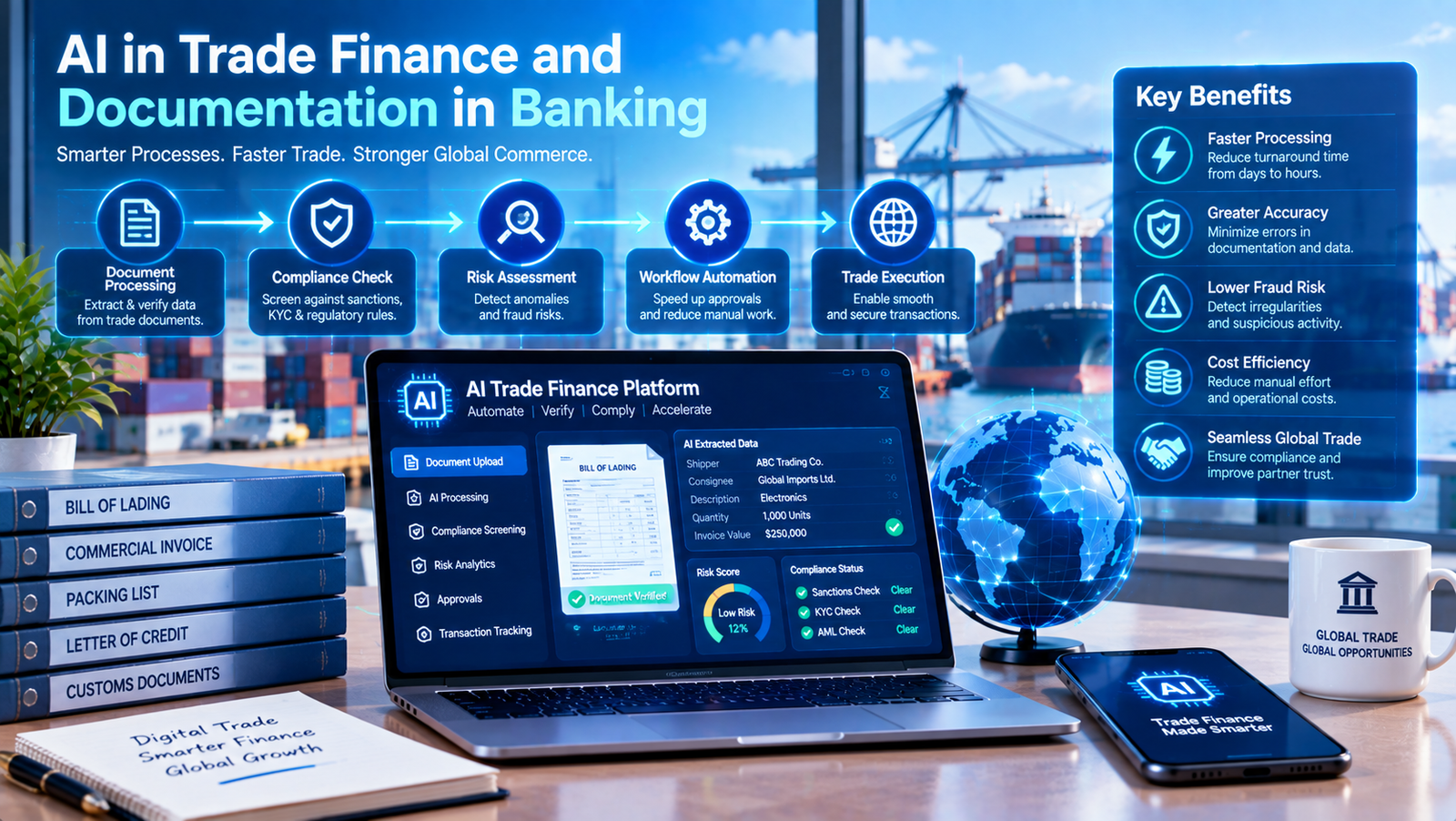
AI can help by transforming unstructured documents into structured data and comparing that information against transaction rules. The bank can then focus staff attention on meaningful exceptions rather than repeatedly reading and rekeying routine information.
Extract parties, amounts, dates, goods and shipment terms from varied documents
Compare information across invoices, letters of credit and transport records
Identify potential sanctions, trade restrictions and suspicious inconsistencies
Route exceptions, prepare case summaries and reduce repetitive handling
Where AI Fits in the Trade Finance Lifecycle
AI can support several stages of a trade finance transaction, but each stage requires different data, controls and levels of human oversight.
Purchase order, sales contract and buyer-seller details
Invoice, packing list, transport and insurance records
Structured fields, document classification and discrepancy checks
Credit, sanctions, trade restrictions and transaction controls
Approval, discrepancy handling, payment or financing
The diagram represents a target operating model, not a claim that every bank can fully automate every step today. The appropriate level of automation depends on document quality, transaction complexity, regulatory requirements and the bank’s own risk appetite.
Research Study: AI-Driven Transformation in Trade Finance and Letter of Credit Examination
A peer-reviewed study published in Digital Business in 2025 examined how AI could be introduced into trade finance, with a specific focus on automating letter of credit document examination.
The researchers used a literature-driven approach supported by expert insights and case-study analysis. Their framework considered technological capabilities alongside organizational readiness and the willingness of employees to adopt new systems.
The study identifies three important opportunities: detecting discrepancies across documents, improving workflow efficiency and strengthening compliance processes. These are closely connected. If a system extracts information accurately and compares it with the letter of credit’s requirements, it can identify issues earlier and provide a clearer explanation of why a document needs attention.
The researchers do not recommend treating full automation as an immediate or universal outcome. Regulatory expectations, trust in AI decisions and the consequences of incorrect document examination make a hybrid AI-human approach more practical. AI can identify potential discrepancies and organize evidence, while trained trade finance specialists review material exceptions and make decisions under the bank’s procedures.
For banks, the study provides a useful implementation principle: begin with a defined workflow, such as extracting and comparing fields in letters of credit, rather than attempting to automate the entire trade finance operation at once.
What this means for implementation:
- Start with document types that have clear fields and established examination rules
- Show the source text or document location behind each extracted value
- Separate confirmed discrepancies from uncertain AI-generated findings
- Keep material document decisions within approved bank controls
- Measure whether the system reduces rework without increasing missed discrepancies
Research Study: Intelligent Document Processing in Banking Automation
A 2025 systematic literature review in Expert Systems with Applications examined intelligent document processing in banking automation. The researchers reviewed 48 primary studies selected from research published from 2016 onward.
The work focuses on loan management rather than trade finance specifically, so its findings should be treated as evidence about banking document automation methods, not as a direct measurement of trade finance outcomes.
The review is relevant because trade finance shares many of the same technical challenges as other document-heavy banking operations. Banks need to ingest documents, classify them, extract fields, validate information, handle exceptions and transfer approved data into operational systems.
Intelligent document processing combines technologies such as optical character recognition, machine learning, natural language processing and workflow automation to support these tasks.
The review also identifies eight major challenges in banking IDP. This is a reminder that document automation is not solved by selecting a powerful model alone. Banks must consider document variability, data quality, integration with existing systems, operational reliability and the handling of exceptions.
For trade finance, these findings support a layered design. OCR or vision models can read scanned documents, language models can interpret context, and deterministic validation rules can check values against the letter of credit or bank policy. The result should be reviewed according to confidence and transaction risk.
What this means for implementation:
- Use separate components for document reading, field extraction and business-rule validation
- Maintain a record of the original document and the extracted value
- Test performance across document layouts, languages and scan quality
- Track exception rates and manual correction rates after deployment
- Integrate with bank systems through controlled APIs rather than uncontrolled direct writes
Research Study: AI in Trade Facilitation Across the Buy–Ship–Pay Process
The 2026 Asia–Pacific Trade Facilitation Report, prepared by the United Nations Economic and Social Commission for Asia and the Pacific and the Asian Development Bank, examines AI across the wider trade process. Its Buy–Ship–Pay framework connects commercial activity, transport and border procedures with financial processes.
The report identifies potential uses for AI in trade documentation, compliance preparation, risk assessment, document verification, inspection and trade finance. This broader view matters because banks do not operate in isolation. A financing decision may depend on information created by exporters, importers, shipping companies, customs agencies, insurers and other financial institutions.
The report also presents an important adoption finding: AI use in trade facilitation across the surveyed Asia–Pacific region remained below 15%, with considerable variation between subregions. It identifies skills shortages and infrastructure costs among the major barriers, alongside institutional fragmentation, data challenges and regulatory uncertainty.
These findings point to a gap between having digital information and being able to use it effectively. A bank may receive scanned PDFs or electronic documents, but if data formats differ and systems cannot exchange information, employees may still need to re-enter details manually.
For trade finance teams, the implication is that AI investments should be paired with data standardization, integration and workforce readiness. A sophisticated model cannot reliably reconcile information that is missing, inaccessible or inconsistently represented.
What this means for implementation:
- Map the full transaction journey, including external parties and data handoffs
- Identify where information is repeatedly entered or reformatted
- Prioritize shared data fields such as parties, amounts, goods, dates and shipment references
- Build staff capability alongside the technology rollout
- Measure end-to-end processing time, not only the speed of AI extraction
Research Study: WTO–ICC Survey on AI Adoption in Trade
A joint survey by the World Trade Organization and the International Chamber of Commerce, released in December 2025, gathered responses from 158 firms across different sizes, regions and levels of economic development. It examined how businesses were adopting AI for trade-related activities.
The survey found a substantial adoption gap between firms in high-income economies and those in low- and lower-middle-income economies. Among respondents, 66% of firms in high-income economies reported adopting AI, compared with 27% in low- and lower-middle-income economies.
Three-quarters of responses indicated AI use in customs-related applications, while 20% reported using AI to identify trade compliance risks.
The survey also highlights obstacles that directly affect bank-led trade finance modernization. Respondents identified regulatory uncertainty, fragmented data policies, access to high-quality training data and limited AI expertise as challenges. These issues are especially relevant when a trade transaction crosses borders and involves several jurisdictions.
The survey is not a controlled trial of AI in banking, and its adoption figures should not be interpreted as proof that AI reduces trade finance costs by a specific amount. Its value is in showing how businesses are using AI around trade and the practical barriers that can prevent deployment from scaling.
For banks, the findings reinforce the importance of designing AI-enabled services that work with clients’ existing systems and comply with different data-protection requirements.
What this means for implementation:
- Design for different levels of digital maturity among corporate customers
- Support secure data exchange with ERP, logistics and trade platforms
- Make data permissions and jurisdictional restrictions explicit
- Provide clear explanations of AI-generated compliance alerts
- Offer onboarding and support for smaller exporters and importers
Research Study: AI and Interoperability in Trade Documentation
The International Chamber of Commerce’s Digital Standards Initiative published a framework in 2024 covering 36 key trade documents. The initiative aligns important data elements across documents to support more consistent digital exchange across business and government processes.
This work is not an AI performance study. It is a standards initiative that addresses one of the foundational problems AI systems face: the same commercial information can appear in different documents and systems, with inconsistent labels, formats or structures.
For example, a buyer’s name, shipment reference, product description or invoice amount may appear in a purchase order, invoice, packing list and letter of credit. AI can help identify these fields, but reliable comparison also depends on knowing which fields are equivalent and how values should be represented.
A shared data framework makes it easier to compare information and build workflows that connect corporate systems with bank platforms. It can also reduce the need to design a separate mapping for every document pair.
The practical lesson is that AI and interoperability should be developed together. Document intelligence can extract information from unstructured records, while common data definitions make the extracted information easier to validate and exchange.
What this means for implementation:
- Define a canonical data model for trade parties, goods, amounts and shipment details
- Map document-specific fields to the common model
- Preserve the original value and normalized value for audit purposes
- Use consistent identifiers to connect documents belonging to the same transaction
- Build integrations around documented data standards wherever possible
Source: ICC Digital Standards Initiative launches complete framework for supply chain digitalisation, 2024
Research Study: Multi-Bank AI Proof of Concept for Trade Finance
In April 2026, Microsoft described a collaborative proof of concept involving ANZ, HSBC and Lloyds. The prototype explored how AI agents could connect corporate ERP data with bank trade finance workflows using structured trade data and common document standards.
The demonstration focused on a letter of credit workflow. An AI agent parsed the letter of credit, extracted important fields and compared them with invoice and shipping data in an ERP system. It identified discrepancies, including differences in currency and amount, and suggested corrections in natural language. After verification, the structured information could be transmitted securely to the bank.
The prototype also demonstrated conversational access to trade data. A treasury user could ask whether a letter of credit matched agreed terms and receive an answer grounded in enterprise and trade-document information.
The article describes a proof of concept, not a production deployment with independently measured cost savings or error-rate improvements.
Its significance is architectural. Rather than placing AI in a separate document portal, the design embeds it into the systems where companies already manage orders, invoices and treasury operations. That could reduce repeated data entry and make trade finance more accessible within existing corporate workflows.
The example also shows why AI agents need clear boundaries. Extracting data, comparing fields and preparing a suggested correction are different from approving financing or executing a payment. The latter actions require authorization, validation and established bank controls.
What this means for implementation:
- Embed AI into ERP and treasury workflows where users already work
- Ground answers in identifiable source documents and structured business data
- Require verification before corrected data is transmitted to a bank
- Keep payment release and credit approval behind explicit authorization controls
- Log agent actions, source references, user approvals and system responses
AI Use Cases Across Banking Trade Finance
| Use case | AI capability | Business value | Key control |
|---|---|---|---|
| Letter of credit examination | Extract terms and compare documents | Faster discrepancy review | Specialist review of material exceptions |
| Invoice processing | Read fields and match references | Less manual rekeying | Field-level confidence and validation |
| Bill of lading checks | Extract shipment, vessel and date data | Earlier identification of inconsistencies | Source verification and document authenticity checks |
| Trade compliance | Screen entities, goods and transaction context | More focused investigations | Approved screening rules and compliance review |
| Guarantees and collections | Classify documents and extract obligations | More consistent case preparation | Legal and operational approval |
| Trade finance servicing | Summarize cases and answer staff questions | Reduced search and handling time | Permission controls and cited source material |
Intelligent Document Processing: From PDF to Verified Trade Data
A useful trade finance AI system should not treat document extraction as a single step. It needs to identify the document, read its contents, understand the relevant fields, validate the values and preserve evidence of how each value was obtained.
A practical pipeline looks like this:
PDF, scan, image or electronic record
Invoice, LC, transport record
Names, dates, values and terms
Rules and cross-document checks
Exception queue and approval
The system should retain the original document, extracted text, normalized data, validation results and reviewer actions. This creates an audit trail and makes it possible to investigate why a value was accepted or changed.
Why OCR Alone Is Not Enough
Optical character recognition can convert text in a scanned document into machine-readable text, but reading text is not the same as understanding its meaning. A document may contain multiple dates, several amounts, references to different parties or conditions that change how a field should be interpreted.
For example, an invoice may show the invoice date, shipment date, payment due date and a separate date associated with a purchase order. An extraction system that identifies a date without understanding its label can select the wrong value.
AI models can help interpret context, while deterministic rules check whether the extracted information satisfies known requirements. Banks should preserve the distinction between a model’s interpretation and a verified business fact.
AI-Powered Letter of Credit Discrepancy Detection
Letter of credit examination is a strong candidate for carefully controlled AI assistance because the workflow involves comparing documentary information against a defined set of terms.
A system can extract the letter of credit’s required shipment date, expiry date, amount, currency, beneficiary, applicant and document conditions. It can then compare these fields with the documents submitted for examination.
| Field | Letter of credit | Submitted document | AI check |
|---|---|---|---|
| Currency | USD | EUR | Flag for review |
| Shipment date | By 15 October | 18 October | Potential date discrepancy |
| Beneficiary | ABC Trading Ltd. | ABC Trading Limited | Check whether names are equivalent |
| Invoice amount | $250,000 | $250,000 | Match, subject to other conditions |
These examples are illustrative, not a statement of formal documentary examination rules. Actual compliance depends on the credit terms, applicable rules, document type and bank procedures. An AI system should not decide that a discrepancy is legally material merely because two text strings differ.
For example, a company name may be written with or without a corporate suffix. The model can identify the difference and suggest that it may be a formatting variation, but the bank’s approved policy must determine whether the variation is acceptable.
AI for Trade Compliance and Financial Crime Risk
Trade finance compliance extends beyond checking whether documents agree. Banks may need to assess sanctions exposure, restricted goods, suspicious counterparties, unusual transaction structures and inconsistencies between the declared trade and supporting information.
AI can help bring information together from multiple sources, including customer records, transaction data, document contents and approved screening systems. Natural language processing can assist with identifying names, locations, goods descriptions and contextual references that are difficult to capture through simple keyword rules.
However, AI-generated risk indicators should be treated as leads for assessment, not proof of a violation. A name match may be coincidental, a goods description may be ambiguous, and a transaction involving a higher-risk location may still be legitimate.
A responsible compliance workflow should:
- Use approved sanctions and restricted-party data sources
- Preserve the source and timestamp of screening results
- Distinguish exact matches from possible matches
- Explain which document fields or transaction patterns triggered an alert
- Route material cases to authorized compliance staff
- Keep records of decisions, overrides and supporting evidence
AI is most useful when it improves the speed and consistency of evidence gathering while preserving the bank’s established compliance responsibilities.
Generative AI and Trade Finance Copilots
Generative AI can provide a conversational interface to trade finance data. Instead of searching several documents manually, a trade operations employee could ask which documents are missing, summarize the outstanding discrepancies or explain the terms relevant to a specific case.
A well-designed copilot should retrieve information from approved documents and bank systems, cite the source of its answers and clearly distinguish verified information from generated summaries.
AI response: The invoice currency differs from the currency stated in the letter of credit. The invoice amount appears to match. The beneficiary name has a formatting difference that requires review.
Evidence provided:
- Letter of credit, currency field
- Commercial invoice, currency field
- Letter of credit, beneficiary field
- Commercial invoice, seller field
Required next step: The employee reviews the original documents and records the appropriate decision under bank policy
The copilot should not invent missing shipment information, silently modify source documents or approve a transaction simply because its answer sounds confident. Retrieval, citations, permission checks and audit logging are essential controls.
Agentic AI: Connecting Corporate Systems and Banks
Agentic AI refers to systems that can carry out a sequence of defined tasks using tools, data sources and workflow rules. In trade finance, an agent could collect relevant documents, extract fields, compare information, identify missing records and prepare a case for review.
The potential value is especially clear when the agent operates inside an ERP or treasury platform. Corporate users may be able to prepare a financing request without manually re-entering information already present in their systems.
- Receive an authorized request from a corporate user
- Retrieve documents the user is permitted to access
- Extract and normalize the relevant trade data
- Validate the data against approved rules
- Prepare a discrepancy report and suggested next action
- Request human approval where required
- Transmit approved data through an authorized API
- Record the action and resulting system response
The agent should operate with least-privilege access. It should not have unrestricted authority to approve credit, release payments, alter contractual terms or bypass compliance checks. High-impact actions should remain subject to the bank’s normal authorization structure.
Expert Perspective: The Industry Is Moving from Documents to Data
The Microsoft proof of concept involving ANZ, HSBC and Lloyds reflects a broader shift in trade finance technology. The objective is not only to digitize documents, but to make their underlying information usable across company and bank systems.
A useful statement from HSBC’s Chief Product Officer for Global Trade Solutions, Bhriguraj Singh, in Microsoft’s April 2026 article captures the challenge:
“Trade finance is still overwhelmingly document-driven”
Source: Microsoft, Reimagining trade finance with AI, April 2026
The quote points to a structural issue. A bank can digitize a document while still requiring employees to re-enter its information into another system. AI can help interpret the document, but lasting efficiency depends on connecting that information to shared data standards, business rules and authorized workflows.
Recommended AI Architecture for Trade Finance
A production-grade solution should separate document understanding from financial decisions. The architecture below is designed to support traceability and controlled automation.
- Trade documents
- ERP and treasury records
- Customer and transaction data
- Approved screening sources
- OCR and document vision
- Document classification
- Entity and field extraction
- Language and discrepancy analysis
- Business rules
- Confidence thresholds
- Access permissions
- Human approval gates
- Trade finance platform
- Core banking systems
- Case management
- Audit and monitoring
The architecture should support versioning and monitoring. If a model changes, the bank should be able to identify which version processed a case and compare its performance with the previous version. Model updates should be tested before being introduced into high-impact workflows.
Key Risks and Controls
| Risk | How it appears | Control |
|---|---|---|
| Incorrect extraction | Wrong amount, date or party name | Field-level validation and source evidence |
| Missed discrepancy | An important inconsistency is not flagged | Benchmark testing and independent checks |
| False alert | A harmless formatting difference is escalated | Contextual rules and review queues |
| Hallucinated answer | A copilot invents a term or explanation | Grounded retrieval and source citations |
| Data leakage | Sensitive trade or customer data reaches an unauthorized system | Access controls, encryption and approved deployment |
| Unsafe automation | An agent performs an action without proper approval | Permission boundaries and approval gates |
| System integration failure | Data is duplicated, lost or sent to the wrong case | API validation, reconciliation and monitoring |
Expert Recommendation: Build Around Verified Trade Data
Banks should treat AI as a way to improve the quality and movement of trade information, not as a substitute for documentary controls or credit judgment. The first deployment should target a clearly defined bottleneck where the bank can establish a reliable baseline and measure the effect of automation.
A practical sequence is to begin with document classification and extraction, then introduce cross-document comparison, followed by case summarization and workflow routing. More consequential tasks, such as compliance decisions, financing approval and payment release, should only be automated within a separately approved control framework.
The following principles should guide implementation:
- Start with one transaction type: Choose a repeatable workflow such as invoice extraction or letter of credit document comparison
- Use a verified data model: Standardize parties, amounts, currencies, dates, goods and shipment references
- Keep evidence visible: Let reviewers open the source document and see exactly where each value came from
- Separate AI from policy: Use models to interpret information and deterministic rules to enforce approved requirements
- Design for exceptions: Make uncertain or conflicting results easy to review and resolve
- Integrate securely: Use authenticated APIs, least-privilege permissions and auditable system actions
- Measure real outcomes: Track total processing time, rework, error rates and customer experience
Implementation Roadmap
Document the steps, systems, handoffs, exception types and processing times for one trade finance product
Include different document formats, scan quality, languages and known discrepancy cases, with appropriate data permissions
Combine document AI with explicit business rules and source-level evidence
Compare AI-assisted processing with the existing workflow and have specialists review results
Connect the validated workflow to bank systems, monitor outcomes and expand only after control requirements are met
KPIs for Measuring AI Trade Finance Performance
A bank should evaluate the system using operational, quality, risk and customer measures. Processing speed alone can be misleading if the system creates more corrections or misses important discrepancies.
| KPI | What it measures | Why it matters |
|---|---|---|
| Document processing time | Time from intake to validated data | Measures operational speed |
| Field extraction accuracy | Correctly extracted values | Shows document-reading quality |
| Discrepancy precision | Share of alerts judged relevant | Indicates review workload |
| Missed discrepancy rate | Important issues not identified | Measures control effectiveness |
| Manual rework rate | Cases requiring correction or repeated handling | Shows whether automation reduces effort |
| Exception resolution time | Time to resolve flagged cases | Measures end-to-end improvement |
| Audit traceability | Cases with complete source and decision records | Supports accountability and review |
Future Outlook: 2027–2030
2027: Document AI Moves into Core Trade Workflows
Banks are likely to continue moving beyond standalone OCR tools toward integrated document intelligence. AI will increasingly extract information, compare fields and prepare exception cases inside trade finance platforms. Adoption will still depend on data quality, system integration and validation requirements.
2028: Standards-Based Data Exchange Gains Importance
The value of AI will increasingly depend on how well banks exchange structured data with corporate ERP systems, logistics platforms and other trade participants. Shared data definitions and secure APIs can reduce repeated data entry and make automated checks more consistent.
2029: AI Agents Handle More Bounded Operational Tasks
Agentic workflows may take on more multi-step tasks, such as gathering documents, checking completeness, preparing discrepancy summaries and routing cases. High-impact actions such as credit approval, payment release and compliance decisions will continue to require carefully defined authority, controls and auditability.
2030: Trade Finance Becomes More Data-Centric
The longer-term direction is a trade finance environment in which documents remain important evidence, but verified data can move more directly between companies, logistics providers and banks. AI could help interpret exceptions and connect information across systems, while shared standards reduce fragmentation. The pace of this change will depend on legal recognition of digital trade documents, interoperability, investment and cross-border regulatory alignment.
Startup and Product Opportunities
AI in trade finance creates opportunities for fintech and enterprise software companies that solve specific workflow problems rather than offering a generic chatbot.
- Letter of Credit Examination Platform: Extract LC terms, compare supporting documents and prepare discrepancy reports
- Trade Document Intelligence API: Convert invoices, bills of lading and certificates into validated structured data
- Trade Compliance Copilot: Help analysts investigate transaction risks with source-linked evidence
- ERP-to-Bank AI Connector: Transfer approved trade data between corporate systems and bank platforms
- Document Authenticity and Consistency Tool: Identify suspicious alterations, inconsistencies and missing information
- Trade Finance Case Assistant: Summarize cases, organize evidence and route exceptions
- Trade Data Standardization Layer: Map different document formats into a shared data model
A focused product can be easier to validate than a platform that attempts to automate every trade finance process. For example, an invoice and letter of credit comparison tool can be evaluated against a known set of documents and discrepancies before the company expands into compliance or financing workflows.
Frequently Asked Questions
How is AI used in trade finance?
AI can extract information from trade documents, compare invoices with letters of credit, identify potential discrepancies, support compliance screening, summarize cases and automate parts of document-heavy workflows. Banks should validate these capabilities before using them in production.
Can AI automate letter of credit examination?
AI can assist with extracting terms and comparing documents, but complete automation is not suitable for every case. Complex discrepancies, ambiguous wording and high-impact decisions require appropriate controls and specialist review.
What is intelligent document processing in banking?
Intelligent document processing combines technologies such as OCR, machine learning and natural language processing to classify documents, extract information and support validation. In trade finance, it can turn invoices, shipping records and other documents into structured data for further checks.
How can AI reduce trade finance processing delays?
AI can reduce manual data entry, identify missing information earlier and route exceptions to the right team. The actual impact depends on document quality, integration with bank systems and the number of cases that still require manual correction.
Can generative AI make trade finance decisions?
Generative AI can summarize information and explain potential discrepancies, but it should not independently approve credit, release payments or override compliance controls. Those actions require authorized decision-making and auditable safeguards.
What are the main risks of AI in trade finance?
Key risks include incorrect document extraction, missed discrepancies, false alerts, hallucinated explanations, data leakage, poor integration and unsafe automation. Banks should address these risks through validation, access controls, source-linked evidence and human oversight.
What is the first AI use case a bank should implement?
A bank can begin with a bounded task such as document classification, invoice data extraction or letter of credit field comparison. The initial use case should have measurable performance criteria, a representative test dataset and a clear process for handling exceptions.
Final Perspective
AI can make trade finance more efficient, but the largest opportunity lies in fixing the information flow across the transaction rather than simply accelerating document reading.
The research points to a consistent direction. The 2025 letter of credit study identifies discrepancy detection and workflow optimization as practical applications, while recommending a hybrid AI-human model. The banking document-processing review shows that automation depends on addressing integration and operational challenges.
The 2026 ESCAP–ADB report highlights the need for data readiness, skills and connected infrastructure. The WTO–ICC survey shows that businesses are adopting AI for trade-related tasks but still face barriers involving data, expertise and regulatory fragmentation. The ICC’s trade document framework provides a foundation for making information more consistent, while the 2026 Microsoft proof of concept illustrates how AI could connect corporate ERP systems with bank workflows.
For banks, the practical strategy is to start with a specific document-heavy process, establish reliable data and validation rules, then expand into cross-document analysis and controlled workflow automation. The system should make its evidence visible, preserve source documents and route uncertainty to qualified staff.
The long-term opportunity is a more connected trade finance environment in which verified data can move securely between companies and banks, documents can be interpreted with less manual effort, and staff can focus on exceptions that require judgment.
The central principle is simple: use AI to make trade information more accurate, connected and actionable, while keeping financial decisions accountable.
Research Sources
- AI driven transformation in trade finance: A roadmap for automating letter of credit document examination, Digital Business, 2025
- From manual to automated: a state-of-the-art review to examine the impact of intelligent document processing in banking automation, Expert Systems with Applications, 2025
- Asia–Pacific Trade Facilitation Report 2026: Harnessing Artificial Intelligence in Trade Facilitation, ESCAP and ADB
- WTO–ICC business survey sheds light on opportunities and challenges for AI use in trade, 2025
- ICC Digital Standards Initiative launches complete framework for supply chain digitalisation, 2024
- Reimagining trade finance with AI: A collaborative proof of concept from Microsoft, ANZ, HSBC, and Lloyds, 2026
- World Trade Report 2025: Making Trade and AI Work Together to the Benefit of All, World Trade Organization
- J.P. Morgan, Eliminating Paper from Trade Finance Flows with Trade Channel
- ITFA, Digitised, Not Yet Interoperable: The Missing Layers in Digital Trade, September 2026

Leave a Reply