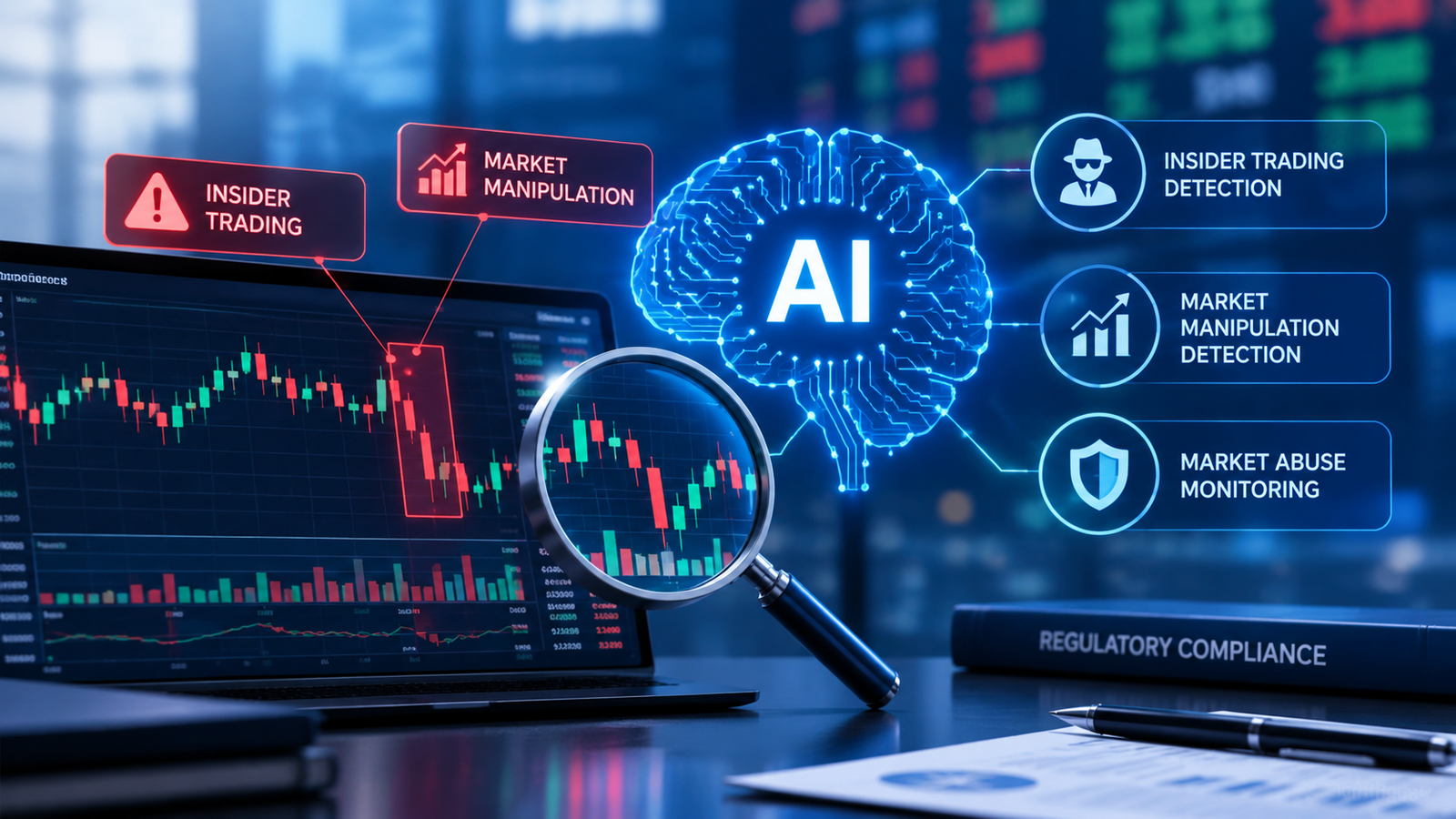
Primary topic: AI in Market Abuse, Insider Trading, and Manipulation Detection
Research focus: Artificial intelligence for market surveillance, insider trading detection, spoofing, layering, wash trading, pump-and-dump, cross-market manipulation, shadow trading, communication surveillance, graph analytics, anomaly detection, explainable AI, regulatory technology and automated financial crime detection
Why AI Is Becoming Important in Market Abuse Detection
Market abuse has always been difficult to detect because suspicious behavior is often hidden inside legitimate trading activity. A single purchase, cancellation, message or price movement may look completely normal when viewed independently. The signal becomes meaningful only when it is connected to timing, market conditions, related accounts, communications, order-book behavior or a later corporate event.
This creates a data problem that is particularly suitable for AI.
Modern markets generate enormous quantities of:
- Orders and cancellations
- Executions and trade records
- Order-book changes
- Market prices and volumes
- Trader and account relationships
- Corporate announcements
- News and research publications
- Email and chat communications
- Voice communications
- Social-media activity
- Cross-venue trading activity
- Algorithmic trading signals
FINRA says firms are exploring AI for surveillance and monitoring across structured and unstructured data, including text, speech, voice, image and video. It also notes that AI can help move surveillance from traditional rule-based systems toward predictive, risk-based models and potentially reduce false positives.
Source: FINRA, AI Applications in the Securities Industry
The key opportunity is therefore not simply faster surveillance.
It is better context.
What AI Can Detect
AI-based surveillance can be designed around several different abuse patterns.
| Market abuse pattern | What the AI looks for | Best-fit AI approach |
|---|---|---|
| Insider trading | Trading before price-sensitive events | Anomaly detection, clustering, graph analysis |
| Shadow trading | Trading economically related securities | Graph neural networks, relationship modeling |
| Spoofing | Orders intended to create false supply or demand signals | Sequence models, classification, order-book analytics |
| Layering | Multiple orders creating artificial market depth | Temporal pattern recognition, anomaly detection |
| Wash trading | Circular or coordinated trading behavior | Graph analytics, clustering |
| Pump and dump | Coordinated promotion, buying and selling | NLP, sentiment analysis, network analytics |
| Cross-market manipulation | Connected activity across products or venues | Multimodal graph and event analytics |
| Rumor-based manipulation | False or misleading information combined with trading | NLP, LLMs, event correlation |
This matters because different forms of manipulation leave different digital footprints. A single model is unlikely to be optimal for all of them.
Why Rule-Based Surveillance Is No Longer Enough
Traditional surveillance systems often depend on thresholds.
For example, a firm might create a rule that generates an alert when a trader:
- Trades an unusually large amount
- Cancels an unusually high percentage of orders
- Trades shortly before an announcement
- Generates an unusually large profit
- Shows unusual order-to-trade ratios
These rules are useful because they are transparent and relatively easy to validate.
The problem is that sophisticated market abuse does not always cross one obvious threshold.
A trader might distribute activity across multiple accounts, trade several related securities, change behavior gradually, coordinate with another participant or use a combination of ordinary-looking actions.
AI can combine these weak signals.
Rule A + Rule B + Rule C → Alert
AI-assisted surveillance
Orders + Trades + Accounts + Communications + News + Market Context + Relationships
↓
Behavioral risk model
↓
Prioritized investigation
The goal is not to eliminate rules.
The strongest architecture combines rules + machine learning + graph intelligence + human investigation.
Research Study: Machine Learning for Insider Trading Detection
One of the most relevant recent studies was published in EPJ Data Science in 2024 and specifically addressed the challenge of detecting potential insider trading from investor trading behavior.
The researchers proposed two complementary unsupervised machine-learning approaches.
The first looked for unusual changes in an investor’s trading activity around price-sensitive events such as takeover bids. Instead of asking only whether the investor traded a large amount, the model considered how that investor’s behavior changed relative to their own historical behavior and the behavior of peers.
The second method looked for small groups of investors acting coherently around price-sensitive events. This is particularly important because insider trading may involve networks rather than a single trader.
The researchers applied the methods to investor-resolved data for Italian stocks around takeover bids.
The study demonstrates a major advantage of unsupervised learning: the system does not need every suspicious pattern to be manually labeled before it can search for unusual behavior.
The practical lesson for developers is important.
Do not design insider-trading AI only around absolute thresholds.
Build features that compare:
- Current behavior against the trader’s historical behavior
- Trader behavior against peer behavior
- Trading activity against event timing
- Profitability against expected market behavior
- Individual activity against connected-account behavior
This makes the system more contextual.
Research Study: Random Forest for Unlawful Insider Trading
A 2025 study published in Computational Economics investigated Random Forest methods for detecting unlawful insider trading.
The research starts from a practical problem: markets can generate thousands of transactions per minute, making purely manual surveillance unrealistic.
Random Forest is useful in this setting because it can capture nonlinear relationships between multiple variables while remaining more interpretable than some deep neural architectures.
The study reinforces an important point for surveillance platforms: AI should be treated as a decision-support system that helps investigators prioritize activity rather than as a machine that independently declares criminal conduct.
For a production system, Random Forest can be especially useful as a baseline model.
Developers can compare it with:
- Gradient boosting
- Isolation Forest
- Autoencoders
- Graph neural networks
- Sequence models
The model that wins should not simply be the one with the highest laboratory accuracy.
It should also perform well on false positives, explainability, stability, drift and investigator usefulness.
Research Study: Graph AI for Shadow Trading
One of the most interesting developments in market-abuse detection is AI designed to identify shadow trading.
Shadow trading refers to using material nonpublic information about one company to trade another economically related company.
This is more difficult than traditional insider-trading detection because the traded security may not be the company at the center of the confidential event.
A 2025 study in Finance Research Letters introduced AMGIN, a graph-based deep-learning approach designed specifically for shadow-trading detection.
The model captures both corporate relationships and dynamic price co-movements.
The researchers tested the approach using the SEC v. Panuwat case and reported that the graph-based method ranked the target stock third compared with two baseline methods ranking it 48th and 78th.
This is a highly valuable direction for financial institutions.
Traditional surveillance often focuses on direct relationships.
Graph AI can model:
Corporate event
Supplier or competitor
Unusual position
Price relationship
The AI does not have to assume that the relationship proves misconduct.
It identifies the relationship as something investigators should examine.
Research Study: Machine Learning Detection of Spoofing and Layering
Spoofing and layering create a different problem.
The suspicious behavior exists inside the order book.
A trader may place orders that create an artificial impression of supply or demand and then cancel them after influencing the market.
Research on spoofing detection has shown that combinations of order-book characteristics can be useful for detecting suspicious activity.
One research stream examined metrics such as:
- Unbalanced quoting activity
- Abnormal cancellation rates
- Market-depth changes
- Trades occurring opposite to cancelled orders
- Cyclical patterns in depth and cancellations
The study found that combining these signals with statistical and machine-learning models can improve detection compared with relying on a single indicator. Its analysis also reported stronger performance when using intraday information for several spoofing characteristics.
Source: Research on Detecting Layering and Spoofing in Markets
The lesson is especially relevant for high-frequency environments.
A surveillance model should not only analyze what was traded.
It should analyze what was displayed, what was cancelled, what was executed and how the order book changed afterward.
Research Study: WALDATA and Adversarial Learning for Anomalous Trading
A 2024 study called WALDATA explored wavelet-transform-based adversarial learning for anomalous trading detection.
The research addresses one of the hardest problems in market surveillance: confirmed manipulative events are rare, while normal market activity is enormous.
This creates a severe class-imbalance problem.
If 99.9% of observations are normal, a model can appear highly accurate simply by predicting that almost everything is normal.
The researchers therefore focused on methods designed to learn anomalous temporal patterns in dynamically changing financial data.
For developers, this research supports an important design principle:
Market-abuse AI should be designed around rare-event detection, not ordinary classification alone.
That means evaluation should include:
- Precision at the top of the alert queue
- Recall for confirmed abuse cases
- False-positive volume
- Detection latency
- Performance across market regimes
- Performance on unseen manipulation patterns
Research Study: AI and Market Manipulation Detection Research Landscape
A broader survey of AI-based stock-market manipulation detectors shows that researchers have used many different methods, including support-vector machines, random forests, neural networks, k-nearest neighbors and other machine-learning approaches.
The research also highlights a recurring weakness: manipulation datasets are often small and highly imbalanced.
Some historical studies have achieved useful classification performance but struggle to generalize across markets, manipulation types or unseen cases.
Source: A Survey on Stock Market Manipulation Detectors Using Artificial Intelligence
This matters for startups building surveillance products.
A model trained on one exchange should not automatically be marketed as a universal market-abuse detector.
Market structure differs across:
- Equity markets
- Options
- Futures
- Fixed income
- Foreign exchange
- Cryptocurrency markets
- Commodity markets
The same order behavior can have different meanings depending on the market.
Research Study: Large Language Models in Market-Abuse Decisions
LLMs introduce a different capability.
Instead of focusing primarily on numerical trading data, an LLM can analyze text and context.
A 2025 ACM International Conference on AI in Finance study evaluated ten state-of-the-art LLMs on market-abuse scenarios derived from 73 anonymized real enforcement cases.
The researchers generated 1,971 scenario variants and tested the models on six tasks relevant to trader and compliance decisions.
An important finding was that larger models were generally more cautious, but model behavior could still be influenced by factors such as expected profit, obfuscated language and compliant framing.
This is a warning against putting an LLM directly in charge of surveillance decisions.
The stronger application is contextual intelligence.
For example, an LLM could help an investigator summarize:
- Relevant communications
- News around the event
- Trading timeline
- Previous investigation notes
- Reasons behind an alert
- Relationships between entities
The final compliance judgment should remain governed by explicit controls and qualified human review.
What the FCA’s AI Market-Abuse TechSprint Revealed
The UK’s Financial Conduct Authority conducted a three-month Market Abuse Surveillance TechSprint beginning in 2024.
The initiative specifically explored whether AI and advanced analytics could improve detection of complex market abuse that traditional systems struggle to identify.
Nine international teams participated, and the FCA provided access to approximately 1TB of pseudonymized market data including transaction reports, order books, news feeds and price feeds.
The experiments included:
- Isolation Forest models for reducing false positives
- Bayesian network analysis for unusual trading patterns
- Order-book analytics
- Econophysics models
- LLMs for contextualizing outliers
- AI correlation of trading orders and communications
Source: FCA, Market Abuse Surveillance TechSprint
This is particularly important because it moves the discussion beyond academic experiments.
A financial regulator itself is testing how these approaches can operate against realistic surveillance problems.
Current Regulatory Direction: AI Is Becoming a Surveillance Issue
The regulatory direction is changing quickly.
In February 2026, ESMA published a supervisory briefing on algorithmic trading. It highlighted governance, testing, pre-trade controls and outsourcing, while specifically discussing emerging AI-related considerations for supervisors.
Source: ESMA, Supervisory Briefing on Algorithmic Trading, February 2026
The European Commission also published a February 2026 proof-of-concept project covering six AI market-abuse detection use cases.
Source: European Commission, Proof of Concept of AI Models in Market Abuse Detection, 2026
This indicates that regulators are not simply asking whether financial firms use AI.
They are increasingly asking whether AI can improve the effectiveness of surveillance while remaining explainable, controlled and resilient.
SEC Enforcement Shows Why Detection Matters
The SEC’s fiscal-year 2025 enforcement results show that market abuse remains a major enforcement priority.
The SEC reported 456 enforcement actions for fiscal year 2025 and $17.9 billion in monetary relief. The agency also highlighted enforcement involving insider trading, spoofing and manipulation schemes.
Source: SEC, Enforcement Results for Fiscal Year 2025
In 2026 remarks, SEC officials also described cases involving alleged manipulation schemes, hacked brokerage accounts and large insider-trading networks.
Source: SEC, Remarks at the MFA Legal & Compliance 2026 Conference
For technology teams, the message is clear.
Surveillance needs to detect not only individual suspicious trades but also networks of behavior.
AI Market Surveillance Architecture
A modern surveillance platform should combine several data layers.
Prices
Volumes
Order books
Orders
Executions
Cancellations
Accounts
Traders
Relationships
News
Social
Corporate events
Known red flags
Unknown behavior
Relationships
Communications
This architecture allows each technology to do the job it is best suited for.
Graph AI Is One of the Biggest Opportunities
Many market-abuse cases are relational.
Consider a simplified scenario:
Inside information
Trading account
Unusual position
Price-sensitive event
A conventional transaction rule may only see the trader’s order.
A graph system can examine the relationships among all four entities.
The same approach can be used for:
- Multiple brokerage accounts
- Related companies
- Family or professional relationships where legally available
- Connected traders
- Shared communication patterns
- Cross-venue trading
- Related financial instruments
This is why graph-based surveillance is likely to become one of the most valuable AI capabilities in this field.
Multimodal AI for Market Abuse
The next generation of surveillance will not be purely numerical.
A sophisticated investigation may require:
Trading data + communications + news + corporate events + relationships + market structure
For example, suppose an employee sends messages discussing an upcoming corporate event.
At the same time, a connected trading account begins accumulating a related security.
The price subsequently moves after the event.
None of these signals alone proves wrongdoing.
Together, they may justify a higher-priority investigation.
FINRA specifically notes that AI surveillance can work across structured and unstructured sources such as text, speech, voice, image and video.
Source: FINRA, AI Applications in the Securities Industry
This is where multimodal AI can create a meaningful advantage.
AI for Communication Surveillance
Keyword-based communication monitoring has a major weakness.
Traders can use:
- Slang
- Abbreviations
- Indirect language
- Code words
- Memes
- Intentional ambiguity
Modern NLP can analyze context rather than searching only for prohibited words.
For example, the difference between:
“Buy this before tomorrow’s announcement”
and
“The stock looks interesting after today’s announcement”
is not simply a keyword difference.
The surrounding conversation, sender, recipient, timing and trading activity matter.
LLMs can help summarize and classify such information, but they should operate under strict governance because research shows that LLM judgments can change when wording, incentives or framing changes.
Reducing False Positives Should Be a Core KPI
A surveillance system that creates thousands of low-quality alerts can become less useful even if it technically detects suspicious behavior.
The FCA’s multi-firm review found that alert calibration is an important consideration and that some firms faced significant resource pressure because a small number of staff had to handle large volumes of alerts.
The FCA also found cases where surveillance systems were not being updated sufficiently as the nature, scale and complexity of trading changed.
Source: FCA, Multi-firm review of algorithmic trading controls
AI should therefore optimize for investigator value, not just model accuracy.
A useful visual target is:
Traditional alert queue
AI-assisted surveillance
The exact numbers will vary by institution.
The principle is what matters: fewer irrelevant alerts and better evidence around the alerts that remain.
Explainable AI Is Not Optional
A compliance investigator should be able to answer:
Why did the model flag this activity?
A useful explanation might say:
- Trading increased 7.4 times relative to the account’s historical baseline
- Activity began 36 hours before a price-sensitive corporate event
- The trader’s behavior differed materially from peers
- A connected account traded the same security
- The account generated unusually high pre-event returns
- Related communications contained event-sensitive language
This is much more useful than:
AI Risk Score: 94
The score is the output.
The evidence is what makes the output useful.
Model Governance and Validation
AI surveillance models should be treated as controlled financial systems.
FINRA’s algorithmic-trading guidance emphasizes risk assessment, software development, testing, validation and controls.
Source: FINRA, Algorithmic Trading Guidance
The FCA has also reviewed how firms test automated surveillance models and has highlighted the importance of formalized testing processes.
Source: FCA Market Watch, Peer review of automated surveillance model testing
A production model should therefore have:
- Documented purpose
- Approved feature definitions
- Training-data controls
- Backtesting procedures
- Out-of-sample testing
- Stress testing
- Drift monitoring
- Explainability controls
- Human override
- Audit logs
- Version control
- Incident management
Risks of AI-Based Market Surveillance
| Risk | Why it matters | Control |
|---|---|---|
| False positives | Legitimate activity can resemble manipulation | Human review and contextual models |
| False negatives | Sophisticated abuse can evade detection | Multiple complementary models |
| Model drift | Trading behavior changes over time | Continuous monitoring and retraining |
| Data bias | Historical enforcement data may not represent future abuse | Diverse data and scenario testing |
| Explainability | Investigators need defensible reasoning | Evidence-linked explanations |
| Adversarial behavior | Bad actors may adapt to detection models | Model diversity and adversarial testing |
| LLM hallucination | Incorrect summaries can mislead investigators | Retrieval grounding and source-linked outputs |
Expert Recommendation
The strongest strategy for banks, broker-dealers, exchanges and RegTech startups is to avoid building a single “AI market-abuse detector.”
Build an AI surveillance operating system instead.
The system should combine:
Known regulatory scenarios
Behavioral risk scoring
Relationships and networks
Communications and news
Investigation assistance
The most important design decision is to keep the human investigator inside the decision loop.
AI should identify, rank, connect and explain.
The investigator should determine what the evidence means.
Expert Quote: AI Must Be Governed by Outcomes
The FCA’s approach provides a useful principle for financial institutions adopting AI.
In discussing its work on AI and market surveillance, the FCA stated that it is “technology-agnostic and focused on outcomes, governance and resilience.”
Source: FCA, Composing the future: Balancing innovation and human expertise in financial markets
That principle is highly relevant to market-abuse AI.
The objective should not be to deploy the most sophisticated model.
The objective should be to create a surveillance process that produces reliable, explainable and actionable results.
What Developers Should Build
For developers, the opportunity is much broader than training a classifier.
A complete platform could contain:
Data ingestion layer
- Real-time market feeds
- Historical trades
- Order-book data
- Reference data
- Corporate actions
- News feeds
- Communication archives
Feature engineering layer
Build features around:
- Order-to-trade ratio
- Cancellation behavior
- Position changes
- Profit before events
- Trading concentration
- Peer deviation
- Account relationships
- Price impact
- Market-depth changes
- Cross-venue activity
AI layer
Use multiple model families:
- Gradient boosting
- Random Forest
- Isolation Forest
- Autoencoders
- Graph neural networks
- Sequence models
- NLP models
- LLMs for contextual investigation
Investigation layer
The user interface should show:
- Risk score
- Reason for alert
- Timeline
- Trading graph
- Related accounts
- Relevant communications
- Relevant news
- Model confidence
- Historical alerts
Startup Opportunity: Market Abuse Intelligence as a Service
A startup does not necessarily need to build an entire exchange surveillance stack.
A more practical opportunity is an API-first model.
↓
AI Surveillance API
↓
Risk Signals + Evidence
↓
Client Compliance Platform
Possible products include:
- Insider trading risk API
- Spoofing detection API
- Layering detection API
- Cross-market manipulation detection
- Shadow-trading analytics
- Communication surveillance
- AI investigation copilot
- Market-abuse case management
This model can be particularly attractive for smaller broker-dealers and fintech companies that cannot build a large internal surveillance team.
For businesses already working in AI development, financial analytics or compliance technology, market-abuse detection can also become a specialized vertical rather than a generic AI service.
Legacy Modernization Strategy for Financial Institutions
Many financial institutions already have surveillance systems.
Replacing everything is usually unnecessary.
A better architecture is incremental modernization.
Legacy layer
Existing rules + alerts + case management
↓
AI augmentation layer
Anomaly scoring + prioritization
↓
Graph intelligence
Relationships + cross-account analysis
↓
Multimodal intelligence
Trading + communications + news
↓
AI investigation assistant
Evidence summary + case reconstruction
This approach reduces implementation risk while creating measurable improvements.
AI Market-Abuse Maturity Model
| Maturity | Capability | Business outcome |
|---|---|---|
| Basic | Rules and thresholds | Baseline compliance |
| Developing | ML risk scoring | Better alert prioritization |
| Advanced | Graph and anomaly detection | Unknown pattern discovery |
| Integrated | Multimodal surveillance | Context-rich investigations |
| Intelligent | Adaptive AI + investigator copilot | Faster and more evidence-driven investigations |
2027–2030 Predictions
AI will move from alert generation to alert ranking
The next major improvement will not necessarily be generating more alerts.
It will be deciding which alerts deserve attention first.
AI systems will increasingly estimate:
- Likelihood of suspicious behavior
- Severity
- Evidence strength
- Network importance
- Investigation priority
Graph surveillance will become mainstream
Research on shadow trading and insider networks shows why graph-based approaches are valuable.
Future surveillance platforms will increasingly connect traders, accounts, securities, issuers, employees, counterparties and venues.
Cross-market surveillance will become more important
FINRA already highlights the importance of monitoring activity across multiple platforms, related financial instruments and cross-border activity.
Source: FINRA, 2025 Annual Regulatory Oversight Report
As trading becomes increasingly fragmented, a surveillance system limited to one venue will have an incomplete view.
LLMs will become investigation copilots
LLMs are likely to become useful for summarizing evidence, searching communications and explaining relationships.
They should not become autonomous compliance decision-makers.
Regulators will increasingly test AI themselves
The FCA TechSprint and European Commission proof-of-concept work suggest that regulators are beginning to experiment directly with AI-based market-abuse detection.
This means financial institutions should expect supervisory questions about AI governance, testing, explainability and model risk.
Adversarial AI will create an arms race
As surveillance improves, market participants engaged in manipulation may deliberately alter behavior to evade detection.
This will increase the importance of:
- Adversarial testing
- Model diversity
- Continuous monitoring
- Unsupervised anomaly detection
- Human intelligence
KPIs Financial Institutions Should Track
| KPI | Why it matters |
|---|---|
| Precision at top alerts | Measures whether the highest-ranked cases are genuinely useful |
| False-positive rate | Measures unnecessary investigator workload |
| Detection latency | Measures how quickly suspicious behavior is identified |
| Investigation time | Measures operational productivity |
| Unknown pattern discovery | Measures the value of anomaly and graph AI |
| Explanation coverage | Measures whether alerts have usable evidence |
| Model drift | Shows whether performance changes over time |
How This Fits Into a Broader AI and Financial Intelligence Strategy
Market-abuse surveillance should not operate as an isolated technology project.
It connects naturally with other AI applications across financial services.
For example, organizations building AI solutions for capital markets can connect market surveillance with portfolio analytics, trading intelligence and risk management.
Similarly, AI in banking increasingly connects fraud detection, customer-risk analytics and transaction monitoring.
For fintech startups, AI in FinTech provides a broader product context for building specialized compliance and financial-intelligence systems.
The opportunity is to move from individual AI features toward connected financial intelligence.
Final Perspective
Market abuse detection is evolving into a fundamentally different technology problem.
While the traditional approach asks whether a transaction violates a predefined rule, the emerging AI paradigm asks a much broader question: Does this combination of behavior, timing, relationships, communication, and market conditions look materially different from what should normally happen?
This distinction matters because modern manipulation tactics are complex and decentralized:
-
Insider trading often involves complex networks of people.
-
Shadow trading can occur across economically related companies rather than just the primary issuer at the center of an event.
-
Spoofing can hide within thousands of seemingly legitimate order-book actions.
-
Pump-and-dump schemes strategically blend trading activity with external communication and information dissemination.
-
Cross-market manipulation fragments activity across multiple products and trading venues.
Because these are inherently relational and contextual problems, state-of-the-art research is increasingly shifting toward unsupervised learning, graph neural networks, anomaly detection, multimodal analytics, and contextual NLP:
-
A 2024 insider-trading study demonstrated how unsupervised models identify behavioral discontinuities and coordinated investor groups around price-sensitive events.
-
2025 Random Forest research underscored the ongoing value of machine-learning classification for detecting unlawful insider trading.
-
2025 shadow-trading research highlighted the power of graph deep learning in identifying economically connected trading patterns.
-
Recent spoofing research shows that order-book behavior becomes significantly more diagnostic when multiple signals are combined.
-
The FCA’s TechSprint proved that regulators are actively testing isolation forests, Bayesian networks, order-book models, LLMs, and multimodal correlation for market-abuse surveillance.
-
The European Commission’s 2026 proof-of-concept initiatives further signal the transition of AI-driven surveillance from academic theory to institutional practice.
However, regulators are making one critical caveat clear: advanced technology does not replace human governance.
-
ESMA’s 2026 algorithmic-trading briefing places heavy emphasis on strict governance and testing.
-
FINRA maintains its focus on robust supervision and internal controls for automated trading environments.
-
The IMF has cautioned that widespread AI adoption in securities markets introduces new data, performance, cybersecurity, and financial-stability risks—including the potential for sophisticated market manipulation and correlated behavior.
Source: IMF, Regulatory Considerations Regarding Accelerated Use of AI in Securities Markets, 2025
For financial institutions, the winning strategy is therefore not to buy the most impressive AI model.
It is to build a surveillance ecosystem where:
work together.
For developers, that means building explainable data pipelines, graph infrastructure, model monitoring and evidence-linked interfaces.
For startups, the opportunity is to solve specific surveillance problems rather than launch another generic AI platform.
For financial institutions, the priority should be modernization without losing control of existing compliance processes.
And for regulators, AI creates an opportunity to monitor increasingly complex markets at a scale that manual analysis cannot match.
The future of market surveillance will not be about AI replacing compliance teams.
It will be about AI giving compliance teams a much deeper view of market behavior.
Frequently Asked Questions
What is AI in market abuse detection?
AI in market abuse detection uses machine learning, graph analytics, natural language processing and other AI methods to identify suspicious trading behavior, relationships, communications and market patterns that may indicate insider trading or manipulation
Can AI detect insider trading?
AI can identify behavioral patterns associated with potential insider trading, including unusual trading before price-sensitive events and coordinated activity among investors. However, an AI alert is an investigative signal, not independent proof of unlawful conduct
How does AI detect market manipulation?
AI can analyze order-book behavior, trading sequences, cancellations, volumes, prices, account relationships and market context to identify patterns associated with spoofing, layering, wash trading and other forms of manipulation
Why are graph neural networks useful for market surveillance?
Graph models are useful because many market-abuse cases involve relationships between traders, accounts, securities, companies, venues and events. Graph AI can analyze these connections instead of evaluating transactions in isolation
Can LLMs be used for market surveillance?
Yes. LLMs can help analyze communications, summarize evidence, classify contextual information and assist investigators. They should not be allowed to independently make final legal or regulatory determinations without appropriate controls and human oversight
What is shadow trading?
Shadow trading refers to trading a security or economically related asset based on material nonpublic information concerning another company. Graph-based AI is particularly relevant because it can model relationships between companies and securities
How can AI reduce false positives?
AI can combine multiple signals and rank alerts according to contextual risk rather than triggering an alert whenever one predefined threshold is crossed. Human feedback can also be used to improve model prioritization over time
What should a financial institution consider before deploying AI surveillance?
Organizations should evaluate data quality, model validation, explainability, governance, cybersecurity, model drift, human oversight, regulatory requirements and the ability to reconstruct evidence behind every important alert
Research Sources
- EPJ Data Science, A machine learning approach to support decision in insider trading detection, 2024
- Computational Economics, A Random Forest Approach to Detect and Identify Unlawful Insider Trading, 2025
- Finance Research Letters, Shadow trading detection: A graph-based surveillance approach, 2025
- Detecting Layering and Spoofing in Markets
- Expert Systems with Applications, WALDATA: Wavelet transform based adversarial learning for the detection of anomalous trading activities, 2024
- A Survey on Stock Market Manipulation Detectors Using Artificial Intelligence
- ACM ICAIF 2025, Evaluating the Ethical Judgment of Large Language Models in Financial Market Abuse Cases
- FCA, Market Abuse Surveillance TechSprint
- European Commission, Proof of Concept of AI Models in Market Abuse Detection, 2026
- FINRA, AI Applications in the Securities Industry
- FINRA, Algorithmic Trading
- FCA, Multi-firm Review of Algorithmic Trading Controls
- FCA, Peer Review of Automated Surveillance Model Testing
- ESMA, Supervisory Briefing on Algorithmic Trading, 2026
- ESMA, Technical Advice Concerning MAR and MiFID II
- SEC, Enforcement Results for Fiscal Year 2025
- SEC, Remarks at the MFA Legal & Compliance 2026 Conference
- IMF, Regulatory Considerations Regarding Accelerated Use of AI in Securities Markets, 2025
- IMF, AI Projects in Financial Supervisory Authorities

Leave a Reply