
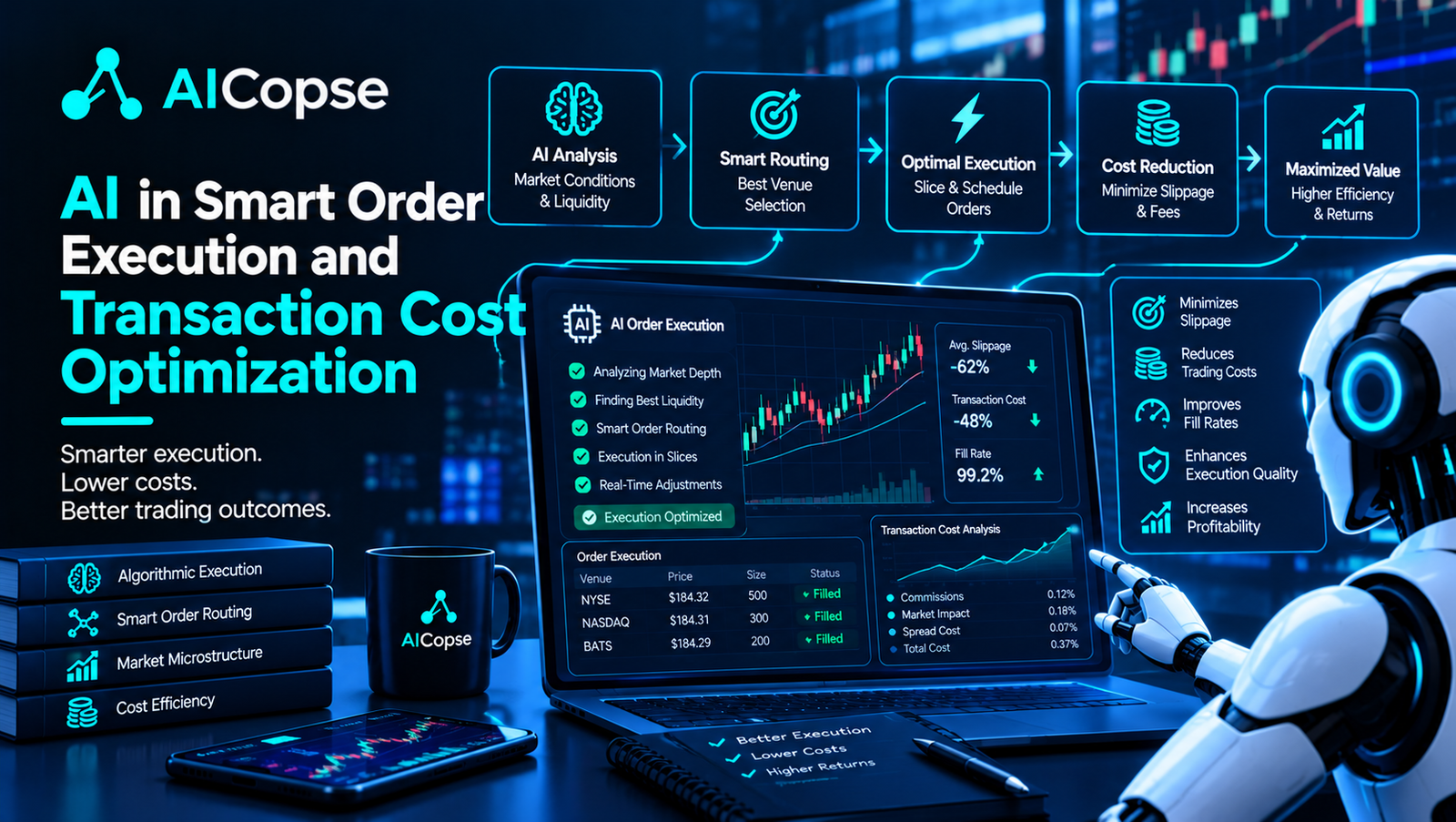
AI in Smart Order Execution and Transaction Cost Optimization
How financial firms can use artificial intelligence to improve order routing, reduce execution costs, manage market impact, and make trading systems more accountable.
Execution Quality
U.S. Market Focus
Research updated October 2026
Executive Summary
A trading strategy can correctly identify an opportunity and still lose much of its expected value through poor execution. The order may reach the market too late, consume available liquidity, receive only a partial fill, or execute at a worse price than expected. These costs matter to investment managers, brokerages, hedge funds, fintech companies, proprietary trading firms, and businesses building automated trading products.
AI-based smart execution attempts to improve the process by estimating liquidity, predicting fill probability, selecting venues, adjusting order sizes, and choosing when to trade. However, AI does not automatically produce better execution. A reliable system must prove that it improves outcomes after transaction fees, slippage, market impact, missed fills, latency, and risk are included.
What this report covers
How order routing, slippage, liquidity, and market impact affect costs.
Machine learning, reinforcement learning, forecasting, and adaptive execution.
Six studies and their findings, limitations, and practical implications.
A development roadmap, risk controls, business opportunities, and future outlook.
Why Smart Order Execution Matters
Smart order execution is the process of deciding how, when, and where a financial order should be sent to the market. A trader might want to buy 50,000 shares, sell a large bond position, or execute a cryptocurrency order across several exchanges. The investment decision determines what to trade. The execution system determines how efficiently that decision becomes a completed trade.
These are separate problems. A forecasting model may predict that a stock will rise, but that forecast does not tell a trading system whether it should buy immediately, divide the order into smaller pieces, use a limit order, wait for liquidity, or route the order to another venue. Execution optimization focuses on those decisions.
Consider a fund that wants to buy 100,000 shares. If it submits the entire quantity as a market order in a thin order book, it may consume the best available selling prices and continue filling at increasingly expensive levels. If it uses limit orders, it may receive a better price but risk missing the trade if the market moves away. An effective execution system must balance price, speed, fill probability, and the risk of not completing the order.
The difference between the intended benchmark price and the price actually achieved.
Price movement caused, in part, by the order consuming available liquidity or revealing demand.
The risk that an order will remain unfilled, partially filled, or filled too late.
These costs are not equally important in every situation. A small order in a highly liquid stock may execute with little market impact. A large order in a thinly traded security can face a very different outcome. Volatility, time of day, order size, venue structure, and the urgency of the trade all affect the best approach.
For related background on the broader trading system, see AICOPSE’s guide to AI in Algorithmic Trading and Automated Strategy Execution. This report focuses on the execution layer rather than treating the entire trading process as one AI problem.
What Is Transaction Cost Optimization?
Transaction cost optimization means reducing the total cost of completing a trade while respecting the investor’s timing, price, and risk requirements. It is broader than minimizing broker commissions. A trade with zero explicit commission can still be expensive if the execution price is poor or the order moves the market against the buyer or seller.
Implementation shortfall is one widely used framework. It compares the cost of the completed trade with a reference price, often the price when the investment decision was made. Depending on the firm’s methodology, the calculation may include commissions, fees, price movement during execution, market impact, and the cost of any unexecuted quantity. Teams must define their benchmark consistently before comparing algorithms.
Commissions and fees
Spread and slippage
Liquidity consumed
Missed or delayed fills
A useful execution scorecard evaluates the full trade, not just one cost component. The exact accounting method should be documented and applied consistently.
AI can estimate some of these costs before an order is sent and update its estimates as market conditions change. A model might predict that immediate execution will be expensive because the spread is wide and the displayed depth is low. It could recommend smaller child orders, a different venue, or a more patient schedule. If volatility rises or fill probability falls, the same system might become more aggressive to avoid leaving the order unfinished.
The objective is not always the lowest possible price. Waiting can reduce market impact, but it also creates exposure to adverse price movement. A portfolio manager buying a security before an important deadline may prefer a slightly higher execution cost over the risk of not acquiring the position. The right objective depends on the trade’s purpose and the client’s constraints.
How AI Changes Smart Order Execution
Traditional execution algorithms commonly use predefined rules. Time-Weighted Average Price, or TWAP, distributes orders across a selected time window. Volume-Weighted Average Price, or VWAP, attempts to align execution with the market’s trading-volume profile. Participation algorithms target a chosen share of market volume. These approaches remain useful because they are understandable and provide important baselines.
AI can add a layer of prediction and adaptation. Instead of following one fixed schedule, a model can estimate how liquidity, volatility, order imbalance, and likely market movement affect the next execution decision. A separate policy engine can use those estimates to adjust order size, timing, routing, and urgency.
Predictive machine learning
Gradient boosting and other supervised models estimate fill probability, short-term volatility, spread changes, expected slippage, or the likelihood of adverse price movement.
Deep learning
Neural networks can learn complex relationships from sequences of quotes, trades, order-book changes, and other time-dependent signals.
Reinforcement learning
An agent learns a sequence of execution actions from simulated or carefully controlled environments, receiving feedback based on cost, risk, and completion.
Adaptive routing
Models estimate which eligible venue or order type may provide a better outcome, subject to available liquidity, access rules, latency, and routing constraints.
These methods should not be treated as interchangeable. A supervised model can estimate a likely fill rate, but it does not automatically know which action is best. Reinforcement learning can optimize a sequence of actions, but it depends on the quality of its reward function and training environment. A complex neural network may detect patterns that a simpler model misses, but it can also be harder to monitor and maintain.
A strong production architecture often separates forecasting from execution. One component estimates market conditions. A second component decides what action to take. A third component enforces trading limits and operational rules. A fourth component records what happened and evaluates the result. This separation makes the system easier to test and reduces the chance that a model prediction bypasses essential controls.
The Core AI Execution Workflow
The following workflow shows how an AI-supported execution system can operate. It is a conceptual architecture, not a recommendation to send live orders without broker, exchange, and compliance review.
Quotes, trades, order book, venue data, historical executions
Time alignment, spreads, depth, volatility, imbalance, order urgency
Expected cost, fill probability, liquidity risk, short-term price movement
Order size, timing, venue eligibility, limits, kill switch, approval rules
Submit, amend, cancel, route, and monitor child orders
Compare with benchmarks, investigate errors, recalibrate, and monitor drift
The feedback loop is essential. A model that performs well in historical data can deteriorate when market structure changes, spreads widen, venue behavior shifts, or other participants adapt. A production system should track both model quality and trading outcomes. Changes to the execution policy should pass through controlled testing rather than being deployed automatically because a recent batch of trades looked favorable.
Six Research Studies That Explain the Opportunity
Research on AI-based execution is growing, but findings must be interpreted in context. Some studies use simulated exchanges, some use cryptocurrency order books, and others examine retail broker execution quality rather than AI itself. Their results answer different questions. The studies below are useful when considered together, but their percentages and conclusions should not be compared as if they came from one shared experiment.
Adaptive Dual-Level Reinforcement Learning for Optimal Trade Execution
The study published in Expert Systems with Applications developed a reinforcement-learning approach to track daily VWAP while minimizing deviation from the target. The authors combined a learning-based execution policy with a U-shaped Transformer model designed to capture daily changes in trading activity. The paper also reports ablation experiments examining how the components contribute to the method.
Why it matters: Execution is not just a question of whether a stock price will rise or fall. An algorithm must also decide how its trades should follow a benchmark throughout the day. A model that captures the intraday volume pattern may help the system schedule orders more intelligently than a rigid schedule.
Important limitation: Tracking VWAP more closely is not the same as minimizing every possible transaction cost. A system can match a benchmark while still facing fees, adverse selection, missed fills, or market impact. The result also depends on the market data, execution assumptions, and test conditions.
Source: Read the 2024 research paper.
Benchmarking Deep Reinforcement Learning Approaches to Trade Execution
This paper, published in the Pacific-Basin Finance Journal in December 2025, addresses a practical research problem: execution studies often use different environments, benchmarks, and evaluation methods, making their results difficult to compare. The authors introduce a framework for evaluating deep reinforcement-learning approaches with a consistent set of benchmarks and diagnostics. Their experiments use a simulation based on highly liquid Australian Securities Exchange equities.
The study reports that the reinforcement-learning methods performed better than benchmark strategies on a median basis in the simulated tests, with lower variation in their results. It also examines how performance changes across two execution horizons and investigates agent behavior rather than reporting only one headline score.
Why it matters: A trading team needs more than an attractive average result. It needs to know whether an algorithm is stable, how sensitive it is to the chosen horizon, and how it behaves under different conditions. A consistent benchmark framework is useful for comparing new AI methods with established execution approaches.
Important limitation: The experiments use a simulation. Better simulated results are evidence of potential, not proof of live-market savings. Before deployment, the strategy needs realistic fees, order-book mechanics, latency, partial fills, and independent live or paper-trading evaluation.
Source: Read the 2025 benchmark study.
Right Place, Right Time: Market Simulation-Based RL for Execution Optimisation
Presented in the context of the ACM International Conference on AI in Finance, this study investigates reinforcement learning inside a reactive, agent-based market simulator. Rather than treating the market as a fixed sequence of historical prices, the simulator models market participants who submit, amend, and cancel orders. This helps researchers examine how an execution strategy may influence market impact and execution risk.
The researchers compare learned execution schedules with traditional benchmarks, including TWAP and VWAP, and assess the trade-off between expected cost and risk using an efficient-frontier framework. The study argues that a reactive simulation can reveal costs that a simple historical replay may fail to capture because the replay does not necessarily respond to the simulated trader’s own actions.
Why it matters: Large orders can change the environment in which they execute. A backtest that assumes historical prices remain unchanged may underestimate the consequences of consuming liquidity. Simulation offers a way to explore these effects before exposing real capital.
Important limitation: A simulation is only as credible as its calibration and assumptions. The study uses a specific market setup and historical calibration data. Results should not be assumed to transfer directly to every U.S. equity, bond, futures contract, or cryptocurrency market.
Source: Read the paper and methodology.
The Retail Execution Quality Landscape
This study in the Journal of Financial Economics examines how retail orders are executed across off-exchange wholesalers. It is not an AI-model benchmark, but it provides important evidence about the execution problem AI systems may try to improve. The authors report that off-exchange executions can provide meaningful cost savings for retail investors and that execution costs vary with wholesaler scale and broker routing practices.
The study also highlights a tension between competition and concentration. Larger wholesalers may benefit from scale, while market concentration can raise regulatory concerns. Brokers may route orders to multiple wholesalers and monitor their performance, rewarding destinations that provide better execution outcomes.
Why it matters: A smart routing system should not select a destination simply because it is fast or offers a displayed price. It should evaluate the quality of completed executions, subject to applicable routing obligations, access rules, and client requirements. Historical performance can inform the decision, but it must be monitored as conditions change.
Important limitation: The study analyzes a particular market structure and retail execution environment. Its findings do not establish that AI routing will improve outcomes for every investor or that one venue is always best.
The Actual Retail Price of Equity Trades
Published in The Journal of Finance, this study compares execution quality across six brokerage accounts at five brokers using 85,000 simultaneous market orders. The authors report that mean account-level round-trip costs varied from 0.07% to 0.46%, excluding commissions. They attribute much of the difference to off-exchange wholesalers providing different execution prices for the same trades to different brokers.
The result makes a simple point: the advertised commission is only one part of the cost of trading. Two brokers can offer apparently similar access to the market yet produce materially different execution prices. For a business that executes many orders, small average differences can accumulate into a significant financial outcome.
Why it matters: AI-based execution evaluation should measure realized outcomes rather than rely on a single marketing claim or one headline metric. Firms should examine price improvement, effective spread, realized spread, fill rates, and costs across different order sizes and market conditions.
Important limitation: The reported cost range comes from the study’s sample, order design, brokers, and measurement period. It should not be presented as a universal cost range for every investor or trading venue.
Deep Learning for Algorithmic Trading: A Systematic Review
This systematic review, published in Array in July 2025, examines deep-learning methods and optimization strategies used in algorithmic trading. A review differs from an individual experiment because it assesses a broader body of work and helps readers understand the range of approaches being investigated.
For execution developers, the main lesson is to select the method according to the problem rather than choosing the newest model by default. Predicting a short-term price movement, estimating the probability of a limit order filling, and deciding how to split a large order are related tasks, but they have different targets and evaluation requirements.
Why it matters: A systematic review can help research teams map the model landscape, identify common methods, and locate gaps that need further testing. It is particularly useful when deciding whether a project should begin with a conventional model, a neural network, or a reinforcement-learning approach.
Important limitation: A review does not itself demonstrate that a particular model will save money in live trading. Conclusions depend on the studies included, their methods, and the quality of their evidence. The execution-specific evidence should be examined separately from broader trading prediction research.
Source: Read the systematic review.
What the research collectively tells us
- AI can help adapt execution to changing liquidity, volume patterns, and order-book conditions.
- Reinforcement learning is promising for sequential decisions, but simulation quality strongly affects the credibility of the result.
- Execution costs vary across brokers and destinations, so routing quality needs to be measured instead of assumed.
- Lower benchmark deviation does not automatically mean lower total cost or better risk-adjusted execution.
- Every claimed improvement should be checked after fees, slippage, partial fills, market impact, and missed opportunities are included.
Current Industry and Regulatory Developments
Smart execution is becoming more data-intensive. Market participants want to reconstruct historical order books, test strategies against detailed market conditions, and evaluate execution quality with better time alignment. Recent infrastructure and regulatory developments make data quality and transparent measurement especially important.
LSEG and NVIDIA accelerate historical market-data analysis
London Stock Exchange Group announced a collaboration with NVIDIA to accelerate analysis of its Tick History data using GPU-based processing. LSEG says the approach can reduce some large historical data-processing tasks from hours to seconds, while preserving data permissions and controls. The intended uses include quantitative research, order-book reconstruction, execution analysis, and scenario testing.
Why it matters: Faster processing can help research teams test more market conditions and investigate execution outcomes in greater detail. It does not mean every trading strategy becomes profitable, and processing speed alone is not a substitute for reliable data, realistic testing, or risk controls.
Source: LSEG’s announcement.
SEC Market Structure Analytics and MIDAS
The U.S. Securities and Exchange Commission provides market-structure analytics and datasets through its Market Information Data and Analytics System, known as MIDAS. The SEC describes data covering exchange orders, quotes, cancellations, executions, and off-exchange trades. Its analytics can help researchers investigate order-book behavior and reconstruct market activity at very fine time scales.
This is useful for execution research because a simple price chart does not show every layer of displayed liquidity or how orders change before a trade. However, access, licensing, coverage, data engineering requirements, and the purpose of each dataset must be reviewed before using it in a commercial product.
Sources: SEC Market Structure Analytics and SEC MIDAS overview.
Updated U.S. Rule 605 execution-quality disclosures
The SEC extended the compliance date for amendments to Rules 600 and 605 of Regulation NMS to August 1, 2026. The amendments expand reporting coverage and update execution-quality disclosures, including order categories, timing measurements, and the presentation of summary statistics.
For execution technology teams, the practical implication is that data definitions and timestamping matter. A model should not be judged using inconsistent benchmarks or poorly aligned order and quote times. Firms should document how they calculate effective spread, price improvement, execution speed, realized spread, and other relevant measures.
Sources: SEC Rule 605 amendments and SEC Rule 605 FAQs.
A useful data-quality warning from NYSE
On August 31, 2026, NYSE Group noted that certain legacy Rule 605 reports from January 2022 through July 2026 had incorrectly included some non-exempt short-sale orders that should have been excluded. The affected reports were to be corrected and restated. This is a reminder that historical execution data can be revised. A research platform should track data versions, corrections, and the source of every metric rather than assuming that a downloaded report is permanently final.
Source: NYSE Rule 605 reports and notice.
Competitor and Content Landscape: Where AICOPSE Can Stand Out
Researching this topic means examining more than competing blog posts. The most useful information is spread across academic journals, regulator publications, exchange data resources, and quant-platform documentation. These sources serve different audiences and answer different questions.
Academic studies
Useful for model design, controlled experiments, and the limits of published results. Their methods can be technical and their findings may rely on particular datasets or simulated environments.
Regulators and exchanges
Useful for market data, execution reporting, market structure, and operational definitions. Their materials are essential for understanding the environment in which a product operates.
Quant platforms
Tools such as QuantConnect provide practical documentation on order types and fill models. These resources help developers understand how execution assumptions affect backtests.
For example, QuantConnect’s limit-order documentation explains the mechanics developers need to consider when modeling limit orders. Its equity fill-model documentation is also useful for understanding how backtest assumptions influence reported results.
The opportunity for AICOPSE is to connect these separate areas in one practical guide. Readers need to understand the AI methods, but they also need to know what data is required, how costs should be measured, which assumptions can make a backtest misleading, and how a startup can introduce the technology without immediately building a complex low-latency trading infrastructure.
This is a qualitative assessment of the content landscape, not a claim that every competitor has been exhaustively audited or that a particular search ranking is guaranteed. To build topical authority, AICOPSE should connect this article to related guides, use primary sources for important claims, and explain the limitations of the evidence rather than repeating performance figures without context.
Readers can explore the connected AICOPSE articles on AI in algorithmic trading, AI in predictive financial modeling and market forecasting, and AI in stock market trading strategy development. These internal links help readers move from the wider trading process to forecasting and execution-specific decisions.
How Developers Should Build an AI Execution System
Developers should begin with a narrow, measurable use case rather than trying to build a universal AI trader. A first product might estimate the likely slippage of an order, predict limit-order fill probability, or compare execution outcomes across eligible destinations. These tasks can create business value without giving an AI model unrestricted control over live orders.
Define one business objective
Choose a measurable target such as reducing implementation shortfall, improving fill probability, or reducing VWAP deviation. Define the benchmark, time horizon, eligible instruments, and risk limits before model development begins.
Choose data that matches the task
Basic quote and trade data may be enough for a first cost-estimation model. Deeper order-book data can support richer liquidity and queue analysis, but it increases storage, licensing, processing, and engineering requirements.
Build reliable features and labels
Calculate spreads, available depth, volatility, trade imbalance, recent fill rates, order urgency, and relevant venue conditions. Define labels using information that would actually have been available at the time the decision was made.
Compare simple models first
Establish a baseline using TWAP, VWAP, participation, or a conventional statistical model. Then compare gradient boosting or neural networks. Use reinforcement learning only when the task genuinely requires a sequence of adaptive decisions and the team can build a credible simulator.
Use time-based validation
Train on earlier periods, tune on a later period, and evaluate on a genuinely unseen period. Randomly mixing adjacent market events between training and testing can leak information and produce unrealistic results.
Simulate realistic fills and costs
Include commissions, fees, spread, partial fills, queue position where relevant, cancellations, latency, price movement, market impact, and unexecuted quantity. Do not assume every limit order fills just because the market price later touched its limit.
Paper trade before live deployment
Run the system in observation mode, compare recommendations with actual market conditions, and investigate large differences. Introduce live trading only after operational, compliance, and risk reviews, with strict order limits and a tested kill switch.
Data Requirements and Infrastructure Choices
Data quality can matter more than model complexity. A system that uses inaccurate timestamps, incomplete venue information, or unrealistic fill assumptions may learn a false picture of the market. Developers must also understand the difference between data suitable for research and data licensed for commercial use.
Quote and trade data
A practical starting point for spread analysis, short-term volatility, trade direction estimates, and basic slippage models.
Level 2 order-book data
Provides aggregated depth across multiple price levels and supports richer liquidity estimates. It does not necessarily reveal the full individual order queue.
Order-level or depth feeds
Can support detailed queue and order-event research where available, but usually demand more storage, processing, market expertise, and licensing review.
Every event should be aligned to a clear time basis. Teams need to handle out-of-order messages, missing updates, duplicate records, trading halts, auction periods, market-open effects, and differences between exchange and local timestamps. If the model sees information that would not have been available at decision time, its backtest may be contaminated by look-ahead bias.
Data rights also matter. A firm should confirm whether its feed permits storage, derived analytics, redistribution, model training, and use in a commercial product. A dataset being publicly downloadable does not automatically grant every possible commercial right. Data access, permitted use, and retention rules should be part of the product design rather than a late-stage legal check.
How to Measure Whether AI Actually Reduces Costs
A model’s prediction accuracy is not the final business result. A high accuracy score can be misleading if the predicted event is too small to matter, arrives too late, or cannot be traded at the expected price. Execution systems should be judged using a scorecard that connects model predictions with completed trades.
Implementation shortfall
Measures the difference between the decision benchmark and the actual outcome, using a clearly documented methodology.
Fill rate and completion
Measures how much of the requested quantity was executed and whether it was completed within the required time.
Effective and realized spread
Helps assess the price paid relative to the market benchmark and how execution outcomes evolve after the trade.
Risk and stability
Tracks adverse outliers, performance during volatile periods, model drift, and sensitivity to execution horizon.
Comparisons should use the same orders, market periods, benchmarks, and cost assumptions wherever possible. For example, an AI policy should be compared with TWAP or VWAP on equivalent orders rather than with a weaker baseline selected after the experiment. Teams should report both average results and the distribution of outcomes, including bad days and large adverse trades.
It is also important to separate market conditions from model skill. A system may appear to improve during a quiet market because spreads narrowed across the board. A credible evaluation should examine whether the improvement remains when compared with a baseline operating under the same conditions, and whether it persists across different instruments, market regimes, and time periods.
Risk, Compliance, and Operational Controls
Smart execution software can create financial loss quickly if its inputs or order controls fail. AI should not be allowed to override basic trading restrictions simply because its predicted cost is low. The model’s recommendation should remain inside an independently enforced control framework.
U.S. firms should assess the rules relevant to their business, including market access, broker-dealer supervision, order handling, reporting, and exchange requirements where applicable. Not every fintech company is regulated in the same way, and a software vendor’s obligations can differ from those of a broker or trading firm. Legal and compliance teams should review the actual operating model.
Firms operating internationally may also need to consider requirements in the jurisdictions where they trade or serve customers. A model trained on U.S. equities should not be assumed to behave identically in European equities, futures, bonds, or crypto markets. Trading hours, venue structure, order types, data access, and applicable rules differ.
Business Opportunities for Startups and Fintech Companies
A startup does not need to compete with the largest high-frequency trading firms to build a useful execution product. It can focus on a narrow customer problem where better measurement, explainability, or workflow integration offers value. The best starting point depends on the customer’s size, market access, technical resources, and willingness to share execution data.
Execution analytics SaaS
A dashboard for asset managers or brokers that consolidates execution reports, flags costly trades, compares venues, and explains where costs may be increasing.
Pre-trade cost estimation
A service that estimates expected slippage and market impact before a trade, helping investment teams choose a benchmark and execution urgency.
Broker routing intelligence
A system that analyzes historical execution quality and recommends eligible routing choices, with clear explanations and broker-controlled limits.
Simulation and testing tools
A development platform that lets quant teams compare execution algorithms in controlled environments and investigate the reasons behind poor fills.
For early-stage companies, a sensible product sequence is to begin with reporting and analytics, add pre-trade estimates, and then consider execution recommendations. Live routing is operationally more demanding because it involves order permissions, market connectivity, latency, incident response, and strict control requirements.
Commercial viability also depends on data access. A product that requires expensive proprietary feeds may be unsuitable for a small customer segment unless the value is clear. A company should test its target customer’s data availability and licensing constraints before building a large infrastructure around assumptions that may not hold.
A Practical Adoption Roadmap
Measure first
Collect execution data, standardize benchmarks, calculate baseline costs, and identify the largest sources of slippage.
Predict costs
Train a simple model to estimate fill probability, execution cost, or volatility. Compare it with a transparent baseline.
Test policies
Simulate order timing and routing choices, include realistic costs, and test across market conditions not used for training.
Deploy with controls
Run paper trading, obtain operational and compliance approval, use strict limits, and monitor realized results continuously.
The duration of each phase depends on data access, market connectivity, internal review, and the complexity of the intended product. It would be misleading to promise that every team can build a reliable live execution system in a fixed number of days. A dashboard that analyzes historical trades is very different from a low-latency system that routes live orders.
Future Predictions for 2027 to 2030
The following predictions are evidence-informed outlooks, not confirmed outcomes. They draw on recent execution research, the expansion of market-data analytics, and the direction of regulatory reporting. Adoption will depend on costs, data access, market structure, and firms’ ability to demonstrate measurable benefits.
More AI-assisted execution analytics
A likely near-term growth area is software that helps trading teams explain execution costs, forecast slippage, and compare outcomes across venues. These tools are easier to introduce than fully autonomous routing because they can support human decisions without immediately replacing existing controls.
Greater use of adaptive execution policies
More firms may test systems that adjust order urgency and child-order size according to predicted liquidity and fill probability. The strongest adoption is likely where firms have suitable historical data, realistic simulation, and clear performance benchmarks.
More realistic simulation and replay
As data processing improves, execution teams may expand the use of market replay and agent-based simulation to test how orders could affect liquidity. Better simulation can improve research quality, but synthetic markets will still need validation against real trading outcomes.
Explainability and auditability become stronger product requirements
As adaptive systems become more capable, buyers are likely to demand clearer records of why a system selected a route, changed urgency, or rejected an order. Explainability will not replace performance testing, but it can help teams investigate failures and meet governance requirements.
One likely dividing line will be between firms that can measure their true execution outcomes and firms that only measure model predictions. The former can test whether AI creates value after costs and risk. The latter may spend heavily on complex technology without knowing whether it improves the result. Better data governance, reproducible experiments, and transparent scorecards are therefore likely to remain central to successful adoption.
Expert Recommendations for Financial Firms
For most firms, the safest and most useful approach is to introduce AI in stages. A model should earn greater responsibility through evidence, not receive it simply because it is more advanced than a traditional algorithm.
- Start with a cost baseline. Document the current execution method and calculate costs using consistent benchmarks before developing a new model.
- Optimize the full trade. Evaluate fees, spread, slippage, impact, completion, and risk instead of optimizing a single headline metric.
- Keep a simple benchmark. Compare AI with established methods such as TWAP and VWAP. Complexity should be justified by measurable improvement.
- Prevent data leakage. Ensure the model only uses information available at the moment of its decision and validate it on later, unseen market periods.
- Test difficult conditions. Include volatile periods, thin liquidity, market openings and closings, and abnormal order-book behavior where relevant to the product.
- Use independent controls. Order limits, position limits, monitoring, fallback logic, and emergency stop mechanisms should not depend on the AI model behaving correctly.
- Review performance continuously. Monitor model drift and real-world execution outcomes. Revalidate changes to data, routing, model versions, or market access.
The most important recommendation is to treat AI as part of a controlled execution system, not as a replacement for market knowledge. Better prediction can support better decisions, but reliable execution also requires accurate data, sensible objectives, realistic fill models, operational discipline, and accountability.
Frequently Asked Questions
What is AI in smart order execution?
It is the use of machine learning and related AI methods to support decisions about when, where, and how to execute financial orders. Systems may estimate fill probability, forecast execution costs, adapt order timing, or help select eligible venues within predefined trading controls.
Can AI reduce transaction costs?
It can help identify situations where a different order size, timing, or routing decision may improve execution. Whether it reduces costs in practice depends on the market, data quality, model design, trading fees, market impact, and execution assumptions. Savings must be demonstrated against a fair baseline.
Is reinforcement learning better than VWAP or TWAP?
Not in every situation. Reinforcement learning can adapt decisions across a sequence of market states, while VWAP and TWAP provide useful and understandable baselines. The best approach depends on the objective, available data, costs, risk tolerance, and performance under realistic testing.
What data is needed to build an AI execution model?
A basic system may use quotes, trades, order details, and historical execution records. More advanced models may need deeper order-book data, order-event histories, venue information, and accurate timestamps. The appropriate dataset depends on the execution decision the model must support.
Can a startup build this without a high-frequency trading infrastructure?
Yes, if it begins with a suitable scope. Historical execution analytics, cost estimation, and decision-support tools can be developed without immediately operating a low-latency live-routing platform. Live execution introduces substantially greater technical, operational, and compliance demands.
How should AI execution models be evaluated?
Use time-based out-of-sample tests, realistic fill simulations, fair comparisons with established benchmarks, and metrics such as implementation shortfall, fill rate, spread, completion, and risk. Paper trading and carefully controlled deployment help test whether backtest results transfer to actual market conditions.
What are the biggest risks of AI-based execution?
Major risks include poor or stale data, unrealistic backtests, market-regime changes, model drift, underestimated market impact, excessive order activity, operational failures, and insufficient controls. Independent limits, monitoring, audit records, fallback policies, and emergency stops help manage these risks.
Does better execution always mean paying the lowest price?
No. A lower price can come with a lower probability of completing the order or a greater risk of missing the investment opportunity. Good execution balances price, completion, timing, market impact, and the investor’s specific objectives.
Conclusion: AI Must Prove Its Value at the Point of Execution
AI in smart order execution and transaction cost optimization has a clear practical purpose: help financial firms turn trading decisions into completed trades with better control over cost, timing, and risk. Machine learning can estimate execution conditions, deep learning can analyze complex data patterns, and reinforcement learning can explore adaptive execution policies. Recent research and market-data infrastructure developments show that the field continues to evolve.
However, a convincing research result is not the same as a proven commercial benefit. The most useful systems combine accurate data, fair baselines, realistic fill assumptions, careful out-of-sample evaluation, and strong operational controls. A model that predicts well but ignores transaction costs may fail at its central task. A model that lowers average cost but creates dangerous outliers may also be unsuitable for production.
For developers and startups, the best entry point is often a focused problem such as pre-trade cost estimation or execution analytics. For larger financial firms, adaptive routing and reinforcement learning may be worth testing when the available data, infrastructure, and governance processes are mature enough. In both cases, success should be measured through completed trades and independently verified outcomes.
The long-term opportunity is not simply to automate more trading decisions. It is to make those decisions more informed, measurable, adaptable, and accountable. That is the standard by which AI-powered execution should be judged.
Explore More from AICOPSE
Continue exploring the connection between AI, trading models, forecasting, and automated execution.
Sources and Further Reading
The following research papers, regulator materials, and technical resources support the report. Study results should be interpreted within each paper’s specific market, dataset, methodology, and assumptions.
Expert Systems with Applications, 2024
https://www.sciencedirect.com/science/article/abs/pii/S0957417424011291
Pacific-Basin Finance Journal, December 2025
https://www.sciencedirect.com/science/article/pii/S0927538X25002136
ACM International Conference on AI in Finance, 2025
https://arxiv.org/abs/2510.22206
Journal of Financial Economics, 2025
https://www.sciencedirect.com/science/article/pii/S0304405X25000595
The Journal of Finance, 2025
https://onlinelibrary.wiley.com/doi/10.1111/jofi.13467
Array, July 2025
https://doi.org/10.1016/j.array.2025.100390
LSEG, October 14, 2026
https://www.lseg.com/en/media-centre/press-releases/2026/lseg-nvidia-accelerate-tick-history-analysis-cudf
U.S. Securities and Exchange Commission
https://www.sec.gov/featured-topics/market-structure-analytics
U.S. Securities and Exchange Commission
https://www.sec.gov/rules-regulations/2025/09/disclosure-order-execution-information
New York Stock Exchange, August 2026 notice
https://www.nyse.com/trade/reports/rule-605
Technical documentation for algorithmic trading development
Limit-order documentation
Equity fill-model documentation
Disclaimer
This report is for educational and informational purposes only. It is not investment advice, a recommendation to buy or sell any financial instrument, or a guarantee of trading performance. AI-based execution systems can produce losses and may fail when market conditions change. Research findings depend on their specific data, assumptions, and methodologies. Businesses should obtain appropriate legal, compliance, data-licensing, and risk-management advice before deploying systems that interact with live markets.

Leave a Reply