
AI Research · Quantitative Finance · Portfolio Protection
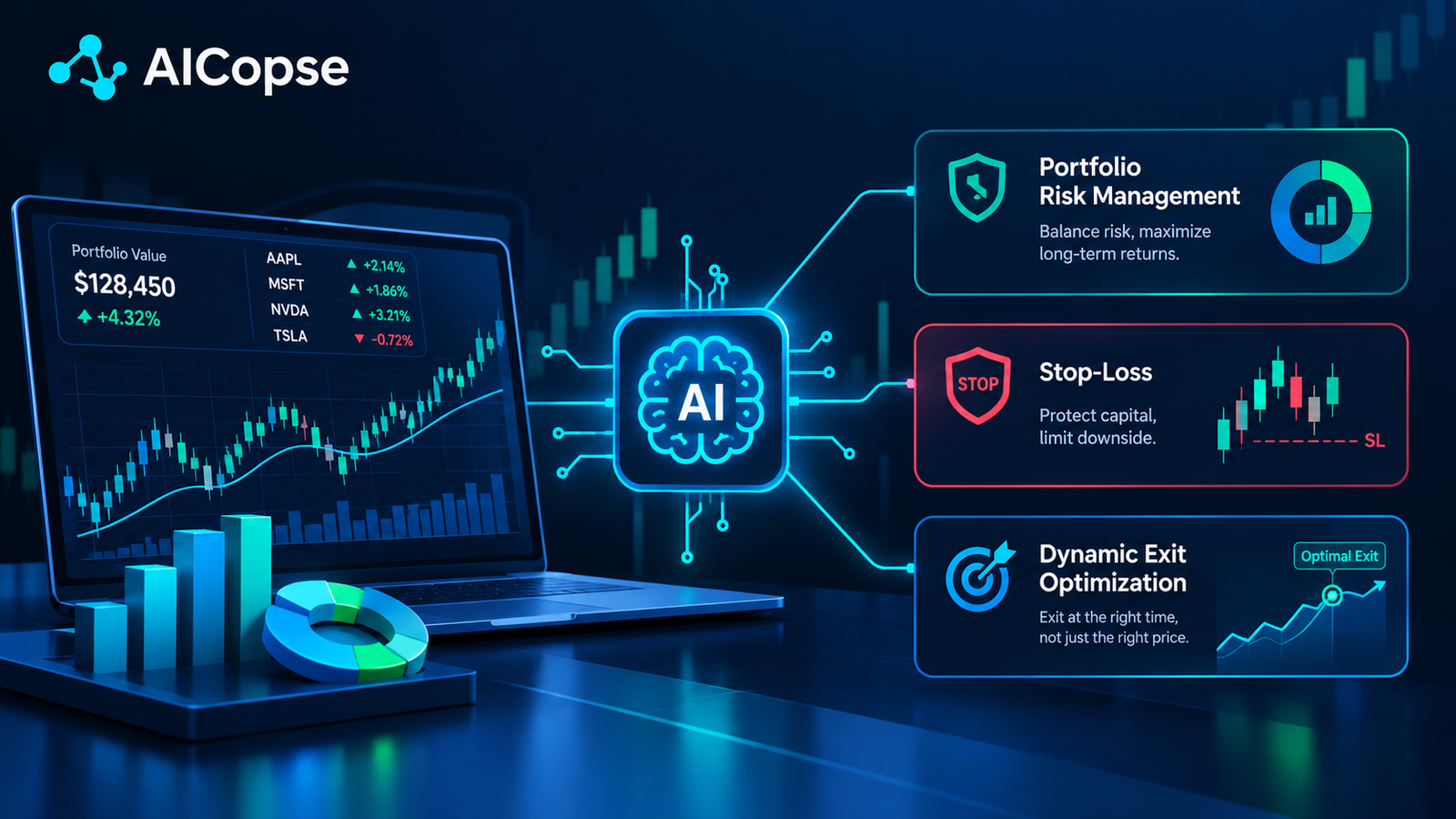
AI in Portfolio Risk Management, Stop-Loss, and Dynamic Exit Optimization
How artificial intelligence can help investors measure portfolio exposure, adapt exit rules to changing volatility, control drawdowns and evaluate trading decisions under realistic market conditions.
AI Stop-Loss
Dynamic Exits
Quantitative Trading
Executive Summary
Portfolio risk management is not simply a matter of placing a stop-loss below every entry price. A portfolio can lose money because one position moves against the investor, several holdings become correlated, liquidity disappears, volatility increases or an apparently profitable strategy stops working. Effective risk management needs to consider all these possibilities together.
Artificial intelligence can help estimate changing volatility, detect market-regime shifts, measure portfolio concentration, assess downside scenarios and adapt exit decisions to current conditions. Machine learning and reinforcement learning can also evaluate different exit policies, but their outputs must be tested carefully. A complex model does not guarantee better protection or higher returns.
Main finding: AI should support a layered risk framework. Portfolio-level exposure limits, position sizing, liquidity controls and emergency risk rules should remain independent safeguards around any predictive exit model. The objective is not to avoid every losing trade. It is to keep losses and exposures within defined limits while allowing a sound investment thesis enough room to work.
What Is AI in Portfolio Risk Management, Stop-Loss and Dynamic Exit Optimization?
AI in portfolio risk management uses statistical learning, machine learning and related techniques to analyze portfolio exposures and support decisions about how much risk to take, when to reduce exposure and when to close a position. It can use market prices, volatility, trading volume, portfolio holdings, correlations, liquidity estimates and economic indicators to identify conditions that may require action.
A stop-loss is an instruction or rule intended to exit a position when a specified price or condition is reached. A fixed stop-loss may sit a certain percentage below the entry price. A volatility-based stop may use an indicator such as average true range. A trailing stop can move as the position becomes profitable, with the aim of protecting part of the gain if the market reverses.
Dynamic exit optimization goes further. Instead of using one fixed exit distance in every market condition, a system evaluates whether the exit rule should change based on volatility, liquidity, trend strength, portfolio exposure, expected transaction costs or the original investment thesis. Depending on the strategy, the output may be a new stop level, a reduction in position size, a time-based exit, a partial close or a decision to leave the existing rule unchanged.
Key distinction: A stop-loss is an execution rule, risk management is a broader control process, and dynamic exit optimization is a decision framework for selecting among possible exits. AI can inform that framework, but it cannot remove market risk or guarantee the price at which an order will be filled.
Why Traditional Risk Rules May Need an Adaptive Layer
Fixed risk rules are useful because they are easy to understand, audit and implement. However, a stop that is suitable for a quiet market may be too tight when volatility rises. A stop that is appropriate for a highly liquid large-cap stock may be unsuitable for a thinly traded security. A portfolio with ten different holdings may still be heavily exposed to one market factor if all ten depend on the same economic conditions.
AI can help identify these differences, but adaptive decisions must remain disciplined. A system that changes its stop whenever the latest price movement looks uncomfortable may create excessive turnover and close positions during ordinary fluctuations. A model that repeatedly widens stops to avoid realizing losses can increase the size of a potential loss. Dynamic rules need clear limits and an objective evaluation process.
| Risk challenge | Traditional response | Possible AI-supported improvement |
|---|---|---|
| Changing volatility | Use a fixed stop distance or manual adjustment. | Estimate volatility and select a bounded stop policy. |
| Correlated positions | Set a loss limit for each trade separately. | Monitor shared factor exposure and portfolio-level risk. |
| Liquidity deterioration | Assume the order can be filled near the trigger. | Estimate spreads, market impact and likely execution uncertainty. |
| Market-regime changes | Keep the same rule until a manual review. | Flag changing conditions and reassess model reliability. |
| Large portfolio drawdown | React after losses have accumulated. | Monitor drawdown, concentration and stress scenarios continuously. |
| Exit timing | Use one target, one stop or a discretionary decision. | Compare exit policies against costs, risk limits and the original thesis. |
The right approach is not to replace every established risk rule with AI. It is to identify where fixed rules are adequate, where market conditions create a genuine need for adaptation and where a model can demonstrate additional value. Simple rules should remain the benchmark against which more complex alternatives are tested.
The Main Components of an AI Risk and Exit System
A production-ready system should separate the estimation of risk from the authority to take risk. A model may estimate that volatility is rising, but a separate risk-control layer should determine whether a position can be held, reduced or closed under the portfolio’s approved limits.
Layered risk-management architecture
Prices, returns, holdings, liquidity, volatility, correlations, economic indicators and order status.
Estimate downside risk, identify changing volatility, detect unusual correlations and assess model uncertainty.
Calculate permissible exposure, assess stop distances, compare exit choices and estimate execution costs.
Enforce hard exposure limits, maximum loss rules, liquidity checks, order validation and emergency shutdown conditions.
Route approved orders, record decisions, compare expected with realized outcomes and alert the responsible team.
Illustrative architecture. Live deployment requires instrument-specific execution rules, operational controls and appropriate human oversight.
Risk measures an AI system should understand
- Volatility: A measure of how widely returns fluctuate. It helps estimate ordinary price movement, but does not describe every form of downside risk.
- Maximum drawdown: The largest peak-to-trough decline in portfolio value over a defined period. It helps show how severe the historical loss experience has been.
- Value at Risk: An estimate of a loss threshold over a specified horizon and confidence level. It does not describe the full size of losses beyond that threshold.
- Expected Shortfall: An estimate of the average loss in the tail beyond a chosen risk threshold, subject to the model and data assumptions.
- Correlation and factor exposure: Measures of how positions move together or respond to shared drivers. Relationships can change sharply during stress.
- Liquidity and market impact: Estimates of how easily a position can be reduced and how much execution may move the market price.
- Risk budget: The amount of portfolio risk allocated to a position, strategy or investment group within the overall limits.
Six Research Studies and What They Mean for Investors
The following studies cover stop-loss optimization, reinforcement learning, portfolio allocation and AI-based risk analysis. Their methods and goals differ. A result from a simulation does not prove that a system will perform the same way in live markets, so the practical interpretation and limitations of each study matter as much as its headline findings.
Study 1 · Direct stop-loss optimization
An End-to-End Deep Learning Framework for Portfolio Optimization with Stop-Loss Orders
Published: September 2025, in Applied Soft Computing.
This paper proposes an end-to-end deep learning framework that jointly determines portfolio positions and stop-loss levels. Its central motivation is that conventional workflows often use a price-prediction model first and then apply a separate stop-loss rule. Errors in the forecast can carry into the exit decision because the two components are optimized separately.
The authors report favorable returns and tail-risk behavior for their proposed approach in the tested setting. The important methodological idea is the joint treatment of portfolio allocation and stop-loss decisions rather than assuming that the best portfolio and the best stop can be found independently.
Practical application: A research team can compare a joint optimization model with a simpler baseline that uses the same portfolio weights and a fixed stop rule. The test should determine whether joint learning adds value after costs and whether its risk remains within the approved limits.
Limitations: A model’s reported performance depends on the assets, historical period, assumptions and evaluation design. A successful historical result does not guarantee that the system will manage gaps, liquidity shocks or changing market relationships in live trading.
Study 2 · Risk-aware reinforcement learning
Risk-Averse Reinforcement Learning for Portfolio Optimization
Published: 2024, in ICT Express.
This study explores reinforcement learning for dynamic portfolio optimization and incorporates a Bayesian neural network to represent uncertainty. The authors report an 18 percent reduction in risk in their experimental implementation. This is a study-specific result, not a general guarantee that reinforcement learning will reduce risk by the same amount for other investors.
The research is relevant because a risk-aware agent should not optimize reward alone. In a trading environment, a policy that maximizes historical return may take excessive exposure, tolerate large drawdowns or become vulnerable to a small number of severe losses. A risk-aware objective attempts to balance the potential reward against these risks.
Practical application: Developers can use uncertainty estimates to limit how much an automated system changes its position or exit policy when the market state is poorly understood. A low-confidence prediction can trigger a smaller risk budget or a review rather than an aggressive adjustment.
Limitations: The reported reduction depends on the study’s data and risk metric. Teams must establish whether it also improves drawdown, downside-tail outcomes and net returns under their own validation design.
Study 3 · Evidence across reinforcement-learning methods
A Taxonomy of Literature Reviews and Experimental Study of Deep Reinforcement Learning in Portfolio Management
Published: January 17, 2025, in Artificial Intelligence Review.
Rezaei and Nezamabadi-Pour review deep reinforcement learning methods used in portfolio management and conduct an experimental study. The paper organizes the research landscape and examines how different agent designs can be applied to portfolio allocation problems.
Methods such as Deep Q-Networks, Deep Deterministic Policy Gradient, Proximal Policy Optimization and Soft Actor-Critic are designed for different types of decisions and action spaces. A system that chooses among a few predefined actions is not the same as one that continuously changes allocation weights or selects among complex portfolio actions.
Practical application: Choose the algorithm based on the actual decision problem. For dynamic exits, the action might be to hold, reduce, close or move to an approved stop range. For portfolio risk, the action might be to adjust weights within strict exposure limits. The model should not be given unrestricted control simply because a more flexible algorithm is available.
Limitations: Results across research papers are difficult to compare when their datasets, benchmarks, reward functions and transaction-cost assumptions differ. A method that performs well in one experiment may not be the best choice for another portfolio or trading horizon.
Study 4 · Comparing reinforcement-learning agents
A Systematic Approach to Portfolio Optimization: A Comparative Study of Reinforcement Learning Agents, Market Signals, and Investment Horizons
Published: December 12, 2024, in Algorithms.
This study compares deep reinforcement-learning architectures, including DQN, DDPG, PPO and SAC, in portfolio optimization. It considers how agent design, market signals and investment horizons influence the evaluation of portfolio strategies.
Its relevance to dynamic exits is that an exit policy cannot be assessed independently of the broader strategy. A model trained for short-term decisions may react differently from one designed for longer holding periods. The usefulness of an action also depends on how often the system trades and what costs are incurred.
Practical application: Test candidate exit methods across multiple holding horizons and market regimes. Compare them with fixed stops, trailing stops and time-based exits using the same portfolio universe, execution assumptions and risk constraints.
Limitations: Backtests are sensitive to data selection, parameter choices and the assumptions used for trading costs. A comparative experiment can guide model selection, but the strongest historical result should not automatically be promoted to live trading.
Study 5 · Risk-adjusted reward functions
Risk-Adjusted Deep Reinforcement Learning for Portfolio Optimization: A Multi-Reward Approach
Published: May 26, 2025, in the International Journal of Computational Intelligence Systems.
This research explores a multi-reward approach to risk-adjusted portfolio optimization. The core idea is that portfolio decisions should not be evaluated only by the reward generated from return. A model can also be assessed against risk-related objectives, helping the learning process account for more than one performance dimension.
For an exit system, this is an important design choice. If the reward function heavily favors short-term profits, the agent may learn to tolerate a large downside risk. If the objective focuses only on reducing losses, the system may exit too early and fail to capture profitable trends. Reward design should reflect the actual portfolio mandate.
Practical application: Compare reward functions that consider return, drawdown, downside volatility, turnover and execution costs. Set hard constraints separately where a portfolio cannot exceed a defined exposure or loss limit.
Limitations: Multi-objective learning introduces trade-offs that require explicit choices. The selected reward function may shape the strategy in unintended ways, and improvements in a chosen metric do not guarantee better outcomes across all risk measures.
Study 6 · Institutional risk-management practice
AI Portfolio Insights and the Future of Risk Management
Published: September 2025, by MSCI.
MSCI’s research discusses how AI may change portfolio insights and risk-management workflows. It considers the role of AI in processing complex investment information and supporting portfolio analysis. As institutional investors adopt AI tools, the challenge is not only to generate insights but also to assess their reliability and integrate them into established risk processes.
This institutional perspective complements academic portfolio-optimization studies. A model may be statistically useful but still create operational problems if its output cannot be traced, its data sources are inconsistent or its recommendations conflict with the portfolio’s approved risk limits.
Practical application: Build risk dashboards that connect model outputs with holdings, factor exposures, stress scenarios and the reasons for an exit decision. Record when the model recommended an action, which data it used and whether the action was executed.
Limitations: This is institutional research and industry analysis, not proof that an AI risk system will reduce losses for every investor. Portfolio managers must validate methods against their own mandates, instruments and operational requirements.
What the Research Collectively Tells Us
The studies point toward a more integrated approach to portfolio decisions, but they do not establish one universally superior AI model. Some research focuses on jointly learning positions and stops, some examines risk-aware reward functions, and other work compares algorithm architectures or considers institutional risk workflows. These are related but different problems.
| Research lesson | Implication for a risk system | What remains unproven |
|---|---|---|
| Stops and allocations interact | Test exit decisions alongside portfolio weights. | That joint optimization always beats a simpler design. |
| Risk must be part of the objective | Measure drawdown, downside risk and turnover, not return alone. | That one reward function is suitable for every mandate. |
| Algorithm choice matters | Match the model to the action space and investment horizon. | That the most complex algorithm is the most reliable. |
| Risk governance remains essential | Use independent limits, monitoring and audit trails. | That model accuracy eliminates operational risk. |
| Historical performance needs validation | Use realistic costs, walk-forward testing and stress scenarios. | That simulated results will repeat in live markets. |
How AI Can Improve Stop-Loss Design
A stop-loss should reflect the instrument’s behavior, the investment thesis, the available liquidity and the portfolio’s risk limits. AI can help estimate relevant conditions, but the rule still needs to be understandable and testable. The following approaches are useful starting points for research.
Fixed-percentage stop-loss
A fixed-percentage stop places an exit trigger a set percentage away from the entry price. It is easy to implement and provides a clear rule, but it does not adjust to different volatility levels. The same percentage can be unnecessarily tight for a volatile stock and too wide for a more stable instrument.
Fixed stops can still be useful as a baseline. Before introducing AI, teams should measure how a simple fixed rule behaves across assets, holding periods and market conditions. The baseline helps establish whether an adaptive approach offers a real improvement.
Volatility-adjusted stop-loss
A volatility-adjusted stop uses a measure such as average true range or estimated return volatility to determine the distance from the entry or trailing reference price. A higher estimated volatility can result in a wider price buffer, while a lower estimate can produce a narrower one, subject to approved limits.
AI can help estimate volatility using recent returns, intraday data, market indices and other features. However, a stop should not automatically widen without limit when volatility rises. Position size and portfolio exposure may need to decrease at the same time so that the risk of a larger adverse move remains controlled.
Trailing stop-loss
A trailing stop moves in the direction of a favorable price move but does not move back in the opposite direction under a conventional long-position trailing rule. Its purpose is to retain some exposure to a trend while defining a mechanism for leaving the trade after a reversal.
AI can help evaluate whether a trailing distance should depend on volatility, trend strength or the holding horizon. A tight trail may exit a strong position during ordinary fluctuations, while a very wide trail may give back too much of an unrealized gain. The suitable trade-off must be evaluated using net results and the strategy’s objectives.
Time-based and thesis-based exits
Not every exit should be triggered by price. A position may be closed when the expected holding period ends, a catalyst has passed, an earnings assumption is invalidated or the original reason for holding the investment no longer applies. AI can help flag changes in relevant information, but analysts should define what counts as a meaningful change before the model is used.
These approaches can complement one another. A trading system might have a hard risk stop, a volatility-aware trailing rule and a time-based exit, with clear priority rules for conflicting signals. The design must prevent the model from silently overriding a more important risk constraint.
Dynamic Exit Optimization: A Practical Decision Framework
Dynamic exit optimization asks which permitted action best fits the current market and portfolio state. It does not mean changing the rules every time the market moves. A reliable system defines a small set of possible actions, evaluates them against a consistent objective and applies hard risk constraints before sending any order.
Illustrative exit decision flow
Review current exposure, open orders, drawdown, volatility, liquidity and the investment thesis.
Has a hard stop, exposure limit, risk threshold or emergency rule been triggered?
The predictive model must not override a mandatory risk rule. Apply the relevant close, reduce or escalation procedure.
Compare hold, reduce, exit or approved stop adjustments using expected outcomes, uncertainty and estimated costs.
Validate the order, estimate execution quality, log the decision and check the resulting portfolio exposure.
This is a conceptual framework, not an executable trading rule. Order handling must be adapted to the asset class, broker and market structure.
Use uncertainty as a risk input
Model confidence is often misunderstood. A model that estimates a high probability of a favorable outcome can still be wrong, especially if it has not seen the current market conditions before. A robust system should distinguish between a prediction and the uncertainty around that prediction.
When the model is uncertain, the system may reduce the allowed position size, avoid increasing exposure or request human review. These actions should be predefined and tested. It should not respond to uncertainty by widening the stop automatically, because that may increase the potential loss at exactly the time when the forecast is least reliable.
Optimize for the portfolio, not just one trade
A position can look acceptable on its own but create too much risk when combined with the rest of the portfolio. Several technology holdings, for example, may respond to the same interest-rate shock or a reversal in AI-related investment expectations. A model that optimizes each stop independently may fail to recognize that all positions could decline together.
Dynamic exit logic should therefore consider portfolio-level exposure, common factors and stress scenarios. It may be more appropriate to reduce several correlated positions modestly than to close one position completely while leaving the rest of the portfolio exposed to the same risk.
Position Sizing: The Link Between Stop Distance and Risk
Stop placement and position sizing should be designed together. A stop that is far from the entry price can produce a large loss if the position is too large. A very tight stop does not necessarily make a strategy safer because ordinary market noise can trigger repeated exits, while gaps and slippage can cause the realized loss to exceed the planned amount.
A simplified position-sizing calculation is:
Position quantity = Risk budget ÷ Estimated loss per unit
The estimated loss per unit should account for the entry-to-stop distance and, where possible, expected execution costs. Actual risk can be higher when prices gap or liquidity deteriorates.
For illustration, suppose a hypothetical portfolio has a value of $100,000 and its policy permits a planned risk budget of $500 for one trade. If the planned distance from entry to stop is $2 per share, the simple calculation gives 250 shares before adjusting for fees, slippage, gap risk or other portfolio constraints. This is an educational example, not a recommended risk percentage or position size.
The final quantity may need to be lower if the position is illiquid, highly correlated with existing holdings or exposed to a major event. The risk budget should also be consistent with the portfolio’s total exposure, not chosen independently for every new trade.
How to Evaluate a Dynamic Exit Strategy
A dynamic exit system should be evaluated on several dimensions. A high win rate can hide large occasional losses. A lower maximum drawdown may be achieved simply by holding more cash, reducing exposure or avoiding the riskiest assets. A model that produces many small improvements may still fail after transaction costs.
| Evaluation measure | What it shows | Common mistake |
|---|---|---|
| Net return | Performance after the model’s assumed trading costs. | Ignoring realistic fees, spreads and market impact. |
| Maximum drawdown | The largest historical peak-to-trough decline. | Assuming the next drawdown cannot be larger. |
| Expected Shortfall | Average loss in the tail beyond a selected threshold. | Trusting an unstable tail estimate from limited data. |
| Turnover | How frequently the strategy changes or closes positions. | Treating frequent exits as free. |
| Risk-adjusted return | Return relative to a defined measure of risk. | Relying on one ratio without examining the underlying losses. |
| Slippage and fill quality | Difference between the assumed and actual execution price. | Assuming a stop trigger guarantees execution at that price. |
| Robustness across regimes | Whether the method behaves reasonably in different market conditions. | Selecting a strategy because it performed best in one period. |
Use walk-forward testing
Walk-forward testing trains a model on earlier data, evaluates it on a later period and then repeats the process as time moves forward. This is more realistic than randomly mixing past and future observations. Any feature, risk threshold or stop parameter selected using data should be chosen without access to the final test period.
Teams should also account for delisted securities, changing index membership, revised data, corporate actions and the actual time at which information became available. Without these controls, a backtest may contain information that a real investor could not have used.
Include gaps, slippage and order behavior
A stop order does not guarantee an exit at the trigger price. In fast markets, the next available price may be substantially worse. A stop-limit order can restrict the price at which the order is executed, but it may remain unfilled when the market moves past the limit. Different order types create different trade-offs, so simulation assumptions must match the intended execution method.
For US equity strategies, the execution model should reflect the order types and fill assumptions used by the intended broker or trading platform. QuantConnect’s documentation on limit orders and equity fill models provides useful implementation context for researchers building backtests.
Competitor Content Landscape and the Opportunity to Publish Better Research
Content about AI trading risk commonly covers basic stop-loss definitions, position sizing, volatility and the general benefits of automation. More technical research covers reinforcement learning and portfolio optimization, while institutional publications focus on portfolio analytics, data infrastructure and risk oversight. These are different content categories, and a useful research report should connect them rather than repeating only the basic definition of a stop-loss.
For this topic, a stronger research-led article should answer several questions that a generic trading guide may leave unresolved: How does an adaptive stop affect portfolio-level risk? How should the model be compared with a fixed rule? What happens when prices gap? How should the system respond when several holdings become correlated? What evidence is needed before an AI exit policy can be trusted with live capital?
| Content category | Typical strength | What an in-depth research report should add |
|---|---|---|
| Basic trading guides | Simple definitions, stop types and trading examples. | Academic evidence, realistic execution assumptions and portfolio context. |
| Algorithmic trading tutorials | Implementation details and backtesting workflows. | Risk governance, model uncertainty and stress testing. |
| Academic optimization papers | Formal models, experimental methods and quantitative results. | Practical implementation, limitations and decision-making guidance. |
| Institutional risk research | Portfolio-level analysis, governance and risk workflows. | A clear bridge between institutional principles and developer-level system design. |
This is a qualitative content-landscape comparison, not a claim that every competitor has been exhaustively reviewed or that a particular Google ranking is guaranteed. Search rankings depend on the query, audience, competition, page quality, site authority and many other factors. The best approach is to build a genuinely useful report supported by accessible research, transparent explanations and practical examples.
Current Market Developments and Why Risk Controls Matter
On October 13, 2026, the International Monetary Fund published its October Global Financial Stability Report, highlighting potential risks from an AI-related market correction, rising sovereign bond yields and cyber threats. It also discussed how leverage, concentrated exposures and correlated redemptions can amplify losses when market conditions deteriorate.
These issues are directly relevant to portfolio risk management. If investors hold similar positions based on the same growth assumptions, a sudden change in expectations can cause losses across multiple holdings at once. Individual stop-losses may be triggered together, while lower liquidity and wider spreads can make exits more expensive than expected. A system needs to assess correlated exposures and the ability to execute, not just the price of each individual security.
Reuters reported on October 16, 2026, that markets were facing pressure from concerns about AI-related investment, inflation, energy prices and rising yields. The report described a difficult environment for traditional diversification as both stocks and bonds had experienced pressure during parts of the year. This illustrates why historical correlations should not be treated as permanent protection.
J.P. Morgan’s August 2026 discussion of institutional trading also highlighted volatility as a major trading challenge and described the increasing importance of data, analytics and electronic execution. Better analytics can help teams react more consistently, but the execution process still needs controls for slippage, liquidity and unexpected market moves.
Recent sources: IMF Global Financial Stability Report, October 2026, Reuters coverage of the IMF’s market-risk warning and J.P. Morgan on institutional trading and volatility.
What these developments mean for risk design
- Do not assume that bonds, stocks or other asset classes will always offset each other’s losses.
- Test what happens when correlations rise and several positions breach their risk thresholds together.
- Estimate how spreads, liquidity and execution costs may change during stress.
- Set portfolio-level exposure and leverage limits that cannot be overridden by the predictive model.
- Include operational and cybersecurity risks when AI systems are connected to brokers, data providers and trading infrastructure.
Recommendations for Developers Building AI Risk Systems
Developers should build risk controls as a distinct service rather than burying them inside a model. This makes it easier to test, audit and change the control rules without retraining the predictive component. It also reduces the chance that a model update unintentionally changes the behavior of critical safety mechanisms.
- Separate prediction from authorization. A model may recommend an exit, but a risk service should validate the action against approved position, portfolio and order constraints.
- Store a complete decision record. Record the model version, data timestamps, predicted risk, selected action, applicable limits, order response and realized fill.
- Use conservative defaults. If data becomes stale, the broker connection fails or the risk calculation cannot be completed, the system should follow a predefined safe procedure rather than inventing a new trading action.
- Test order-state handling. Account for partial fills, rejected orders, duplicate requests, delayed acknowledgments, cancelled orders and positions that change while an exit is being processed.
- Monitor drift and reliability. Track prediction errors, stop-trigger frequency, realized slippage, drawdowns and unexpected changes in portfolio exposure.
- Protect the execution pathway. Use access controls, secret management, monitoring, change approvals and appropriate cybersecurity practices for systems that can send financial orders.
- Provide a human override. Define who can pause a strategy, reduce exposure or shut down automation, and test that process before live deployment.
For a practical starting point, developers can first build a deterministic risk engine with transparent rules, then introduce an AI model to estimate volatility or rank exit choices. This staged approach makes it easier to measure whether the model improves the existing system instead of changing many things at once.
Recommendations for Startups and FinTech Businesses
A startup building an AI risk product needs to solve a specific problem before trying to automate an entire portfolio. A focused product may help traders estimate volatility-aware stops, show portfolio concentration, simulate exit rules or monitor whether live execution is behaving as expected. These use cases have different technical and compliance requirements.
For an AI trading startup
- Choose one measurable use case. Start with a clear question such as whether volatility-adjusted exits reduce drawdown without causing excessive turnover.
- Use a transparent baseline. Compare the AI approach with fixed-percentage, volatility-based and trailing-stop alternatives.
- Prove the improvement. Measure net returns, drawdown, turnover, fill quality and behavior in different market regimes.
- Build compliance into product design. Establish which data, advice, execution and account-management activities the product supports and obtain appropriate legal guidance.
- Make claims carefully. Do not market simulated returns as guaranteed results or imply that a stop-loss eliminates the risk of loss.
For asset managers and trading businesses
- Set the mandate first. Define the portfolio’s acceptable risk, drawdown objectives, liquidity needs and investment horizon before selecting a model.
- Evaluate incremental value. Determine whether AI improves the current risk process or simply produces another signal that is difficult to act on.
- Use independent validation. Have a separate reviewer assess data quality, test design, assumptions and model changes.
- Plan for failure. Define what happens when a model is unavailable, data is stale, a broker rejects orders or market conditions become abnormal.
- Monitor the live system. Compare realized outcomes with the backtest and investigate material differences instead of assuming that deployment confirms the model.
A 90-Day Roadmap for Developing and Testing the System
The following roadmap is an example for a small technical team. The schedule depends on the asset class, available historical data, broker integration and the level of validation required. It should not be interpreted as a promise that a profitable live strategy can be produced in 90 days.
Define the asset universe, holding period, risk budget, benchmark, stop rules and success metrics. Record the conditions that should force the system to reduce risk or stop operating.
Build deterministic position-sizing and stop-loss logic, validate the historical data, add transaction-cost assumptions and record all decisions in a reproducible format.
Compare volatility estimation, regime detection or reinforcement-learning methods with the baseline. Use walk-forward tests and stress scenarios, and keep final evaluation data separate.
Simulate decisions without committing capital, compare expected with realized fills, review risk alerts and confirm that emergency controls work. Proceed only if the evidence supports the next stage.
Future Predictions: Where AI Risk Management Is Heading
The following predictions are evidence-informed expectations, not confirmed outcomes. They reflect recent research on AI portfolio insights, reinforcement learning and stop-loss optimization, together with current concerns about volatility, leverage and correlated market exposures.
Portfolio-level risk will matter more than isolated stop rules
As AI tools make it easier to generate signals and automate trades, the challenge may increasingly be controlling the combined exposure of many individually reasonable positions. Systems will need to recognize common risk factors, crowding and the possibility that multiple holdings could be forced to exit at the same time.
Dynamic risk limits may become more common, with fixed safety boundaries
AI may help estimate changing volatility and liquidity conditions so that portfolio risk budgets can respond more quickly. However, firms are likely to retain hard constraints around leverage, concentration, permitted instruments and emergency shutdowns. Adaptive risk should mean better responses within a controlled framework, not unrestricted model authority.
Execution quality will become a larger part of risk evaluation
As strategies become more automated, the difference between a theoretical stop price and a real fill may become more important. Future systems are likely to place greater emphasis on liquidity forecasts, partial fills, order routing and market impact. A strategy that looks safer in a frictionless backtest may not provide the same protection during a fast selloff.
Risk models will need better explanations and audit trails
Investment businesses need to understand why a system reduced exposure or closed a position, particularly when the decision affects a large portfolio. Model versioning, data lineage, recorded decision states and clear risk limits will become important parts of operational reliability rather than optional reporting features.
Stress testing will need to include AI-related concentration risks
The October 2026 IMF report highlights the possibility that weaker AI investment outcomes, leverage and concentrated exposures could amplify a market correction. Risk systems should therefore test more than historical price volatility. They should also investigate what happens when multiple holdings depend on similar AI-related growth assumptions, financing conditions or technology infrastructure.
Reinforcement learning will remain a specialized tool, not a universal solution
Reinforcement learning is well suited to sequential decision problems, but it is difficult to train and validate when markets change and rare events are poorly represented in historical data. Simpler methods may remain preferable when they are easier to explain, test and govern. Adoption will depend on demonstrated improvement over a reliable baseline, not the model’s complexity.
Expert recommendation
Build an AI risk system that knows when not to act. A reliable model should identify uncertainty, respect portfolio limits and defer to hard controls when data quality or market conditions deteriorate. Its purpose is to support disciplined decisions, not to create the impression that losses can be eliminated.
Start with a simple, transparent risk engine. Add AI only where it demonstrably improves a specific task, such as volatility estimation or exit selection. Validate the improvement using point-in-time data, realistic execution costs and stress scenarios before allowing the model to influence live capital.
How This Topic Connects With Other AI Finance Applications
Portfolio risk management, market forecasting, stock selection and algorithmic execution are connected, but they solve different problems. A better forecast does not automatically produce a better portfolio, and a better stop rule does not guarantee that the underlying investment has positive expected value.
- AI in Algorithmic Trading and Automated Strategy Execution explains how model-generated decisions can be connected to trading workflows.
- AI in Algorithmic Trading and High-Frequency Trading Execution explores execution challenges in faster trading environments.
- AI in Predictive Financial Modeling and Market Forecasting discusses the use of AI in financial estimates and market analysis.
- AI in Stock Market Trading Strategy Development covers the development and testing of systematic investment strategies.
- AI in Alternative Data Mining for Stock Picking connects nontraditional data sources with investment research and stock selection.
Frequently Asked Questions
What is AI in portfolio risk management?
It is the use of machine learning, statistical models and related AI methods to help estimate portfolio risk, detect changing market conditions, evaluate exposures and support decisions about reducing or closing positions. These tools should operate within approved risk limits and be validated against simpler methods.
Can AI set a better stop-loss than a fixed rule?
AI may improve stop selection when volatility, liquidity or market conditions change, but it does not always outperform a fixed rule. The comparison must use realistic execution costs, out-of-sample testing and the same risk objectives. A complex model that does not improve those results may not be worth the additional complexity.
What is dynamic exit optimization?
Dynamic exit optimization evaluates permitted ways to close or reduce a position as market conditions change. Depending on the strategy, it may consider volatility, trend strength, liquidity, portfolio exposure, holding time and the investment thesis. Its decisions should remain within predefined risk and execution constraints.
Does a stop-loss guarantee that losses stay within the planned amount?
No. A stop trigger does not guarantee an execution price. A market gap, fast price movement or poor liquidity can cause the order to fill at a worse price than expected. A stop-limit order may also remain unfilled if the market moves beyond its limit.
How does AI help during high market volatility?
AI can help estimate volatility, detect changing correlations, flag deteriorating liquidity and identify when the current model is operating outside its usual conditions. The system can then follow predefined procedures to reduce exposure, request review or pause new risk-taking. These responses still require careful testing.
What is the difference between a stop-loss and portfolio risk management?
A stop-loss is one mechanism for exiting a position after a specified condition occurs. Portfolio risk management covers the combined exposures, position sizes, correlations, liquidity, drawdowns, leverage and operational controls across the entire portfolio.
Is reinforcement learning suitable for dynamic exits?
It can be useful for sequential decisions where the best action depends on changing market conditions and previous actions. However, reinforcement learning can overfit, respond poorly to unfamiliar regimes and depend heavily on reward design. It should be compared with transparent baseline strategies and constrained by independent risk controls.
How should developers test an AI exit strategy?
Developers should use point-in-time data, time-ordered validation, realistic transaction costs, appropriate fill assumptions and stress scenarios. They should compare the model with fixed and volatility-based rules, preserve a final test period and monitor live or paper-trading results for unexpected behavior.
Can AI eliminate portfolio losses?
No. AI can help measure and manage some risks, but it cannot eliminate market gaps, systemic shocks, model errors, liquidity problems or operational failures. The purpose of risk management is to control exposure and improve the consistency of decisions, not to guarantee profits or prevent every loss.
Research Sources
The following sources support the research discussion and provide further detail on portfolio optimization, stop-loss design, risk-aware learning and recent market conditions. Results should be interpreted within each study’s methods, assumptions and limitations.
- An End-to-End Deep Learning Framework for Portfolio Optimization with Stop-Loss Orders. Applied Soft Computing, September 2025. Read the paper.
- Risk-Averse Reinforcement Learning for Portfolio Optimization. ICT Express, 2024. Read the paper.
- Rezaei, M. and Nezamabadi-Pour, H. A Taxonomy of Literature Reviews and Experimental Study of Deep Reinforcement Learning in Portfolio Management. Artificial Intelligence Review, January 2025. Read the paper.
- A Systematic Approach to Portfolio Optimization: A Comparative Study of Reinforcement Learning Agents, Market Signals, and Investment Horizons. Algorithms, December 2024. Read the paper.
- Risk-Adjusted Deep Reinforcement Learning for Portfolio Optimization: A Multi-Reward Approach. International Journal of Computational Intelligence Systems, May 2025. Read the paper.
- MSCI. AI Portfolio Insights and the Future of Risk Management. September 2025. Read the report.
- International Monetary Fund. Global Financial Stability Report: Resilience, Risk, and Transformation. October 2026. Read the report.
- Reuters. IMF Cites AI Slowdown, Spiking Yields as Looming Global Market Risks. October 13, 2026. Read the report.
- J.P. Morgan. The Certainty of Uncertainty: How Institutional Traders Have Adapted to the New Normal of Increased Market Volatility. August 2026. Read the analysis.
- QuantConnect documentation. Limit Orders and Supported Equity Fill Models. Limit-order documentation and equity fill models.
Disclaimer
This report is for educational and informational purposes only. It is not investment, financial, legal or tax advice and does not recommend buying or selling any security. AI models and stop-loss rules cannot guarantee a specific execution price, prevent all losses or ensure positive returns. Academic findings may depend on particular datasets, assumptions and test periods. Investors and businesses should conduct independent due diligence and consult qualified professionals where appropriate.

Leave a Reply