
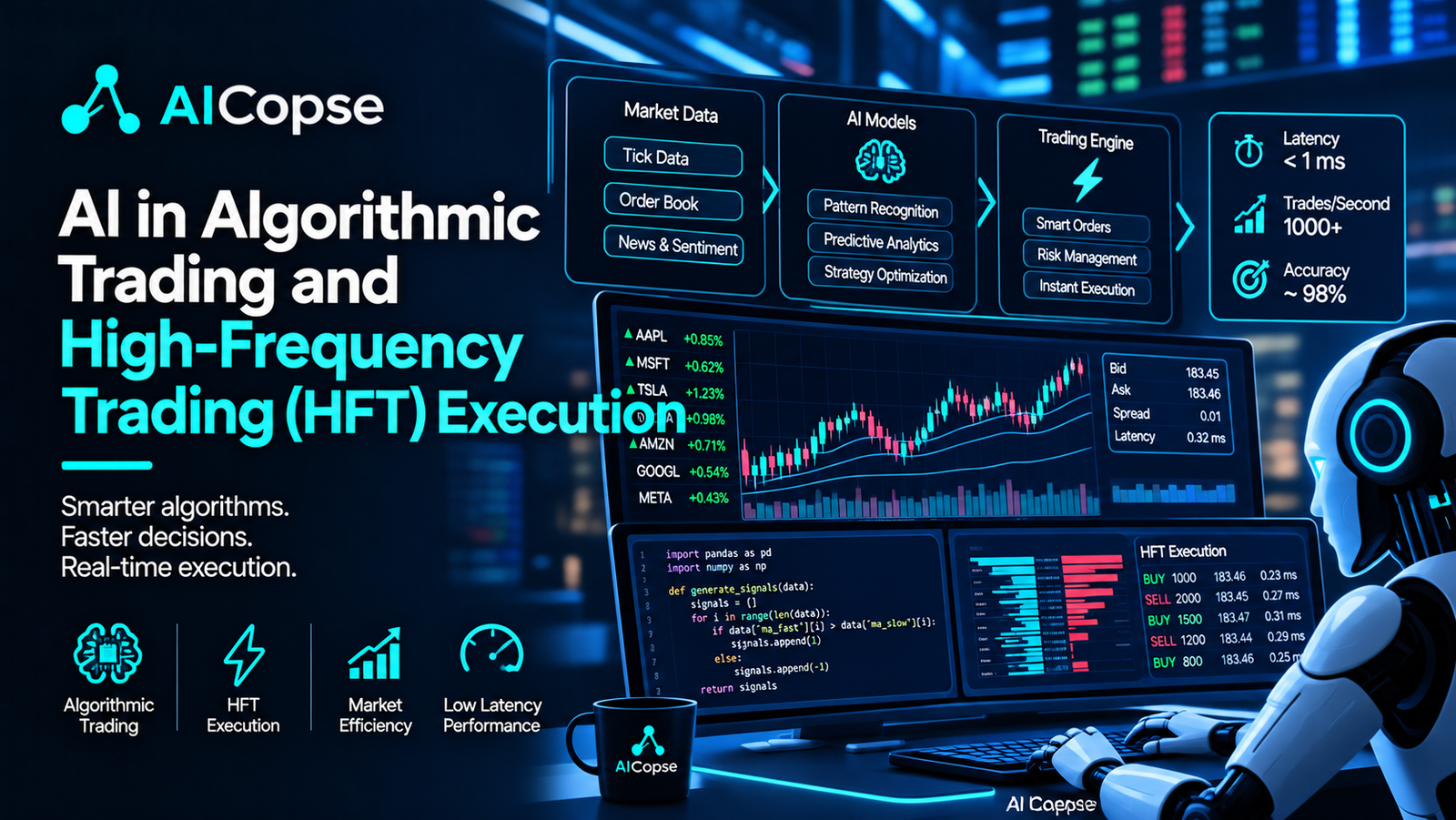
Artificial intelligence is changing how financial markets process information, develop trading signals, manage orders, and monitor risk. But faster predictions do not automatically produce better trading results. This research-led guide examines the technology, scientific evidence, execution challenges, regulatory developments, and business implications of AI-powered trading systems.
Understand the difference between algorithmic trading and HFT, where AI fits into the trading lifecycle, what published research actually shows, why latency and transaction costs matter, and what developers, startups, and business decision-makers should understand before building or adopting financial AI systems.
Why AI in Trading Is About More Than Predicting Prices
Financial markets generate enormous amounts of information. Prices change continuously, order books update many times per second, company announcements arrive throughout the day, and economic news can change market expectations within seconds. Traditional trading systems already use software to process this information and execute orders. Artificial intelligence adds another set of capabilities, including pattern recognition, machine learning, natural language processing, anomaly detection, and predictive modelling.
These capabilities have made AI an important subject in financial technology research. Researchers are investigating whether machine learning can identify useful patterns in market data, estimate short-term liquidity, improve execution decisions, detect unusual trading activity, or help financial institutions manage operational risk. At the same time, AI introduces new questions about model reliability, data quality, explainability, cybersecurity, and the possibility that many systems may respond to the same market signals.
It is important to distinguish a research result from a commercially successful trading strategy. A model that predicts a price movement in a historical dataset may still lose money when deployed. Trading involves transaction fees, bid-ask spreads, market impact, partial fills, exchange rules, infrastructure costs, and competition from other participants. A prediction has economic value only when it leads to a decision that remains useful after these costs and risks are considered.
This distinction is especially important in high-frequency trading. HFT is not simply ordinary trading performed by an AI model at high speed. It is a specialised area of market infrastructure in which network latency, order-book access, execution logic, hardware, and risk controls can be as important as the predictive model itself.
For developers, startups, and businesses exploring financial AI, the most useful question is therefore not whether AI can predict every market movement. It is where AI can improve a defined part of the trading process, how that improvement can be measured, and what safeguards are required to use the technology responsibly.
What Is Algorithmic Trading?
Algorithmic trading uses computer programs to determine or manage aspects of trading orders according to predefined rules. These rules may specify when to submit an order, which price to use, how much to trade, when to cancel an order, or how to divide a large order into smaller pieces.
A basic algorithm might purchase an asset when a moving average crosses another moving average. A more advanced execution algorithm might divide a large order into smaller orders to reduce market impact. Institutional systems may combine historical data, live order books, risk limits, execution policies, and predictive models to make these decisions.
Not every algorithmic trading system uses AI. Many systems rely on deterministic rules, mathematical optimisation, statistical models, or simple execution schedules. AI becomes relevant when a system learns patterns from data, classifies events, estimates future outcomes, or adapts decisions using a trained model.
Common types of algorithmic trading
| Approach | How it works | Where AI may help |
|---|---|---|
| Signal-based trading | Uses rules or models to generate buy and sell signals. | Pattern recognition, forecasting, and regime classification. |
| Execution algorithms | Manages how an existing order is completed. | Slippage estimation, order scheduling, and liquidity prediction. |
| Market making | Quotes buying and selling prices while managing inventory risk. | Order-flow analysis, adverse-selection estimates, and inventory forecasts. |
| Statistical arbitrage | Searches for relative pricing relationships between assets. | Relationship detection, anomaly identification, and model validation. |
| Event-driven trading | Responds to news, announcements, or scheduled events. | News classification, document analysis, and event extraction. |
The distinction between generating a trading idea and executing an order is central to understanding modern financial AI. A model can be good at ranking potential opportunities but poor at deciding how to trade them. Another model might not predict the market direction at all, yet still improve execution by identifying periods when liquidity is stronger or the expected cost of trading is lower.
What Is High-Frequency Trading?
High-frequency trading is a specialised form of algorithmic trading associated with very fast reactions to market information, frequent order submissions and cancellations, and short holding periods. HFT participants may compete to update quotes, manage inventory, respond to order-book changes, or act on small pricing differences between related instruments or trading venues.
There is no single universal number of trades per second that defines every HFT business across all markets. Definitions depend on the jurisdiction, instrument, strategy, and applicable rules. In the European Union, regulatory frameworks use specific criteria for identifying high-frequency algorithmic trading techniques. The European Securities and Markets Authority provides relevant material through its guidance on HFT identification and authorisation.
HFT systems may use direct market-data feeds, exchange colocation, specialised network interfaces, carefully synchronised clocks, compiled software, and hardware designed to reduce processing delays. These investments can be expensive and require specialist engineering expertise.
AI is only one part of this environment. A complex neural network may provide a useful forecast but take too long to run at the point where an order must be submitted. A smaller statistical model or a deterministic rule may be more appropriate when the decision must be made within a very tight latency budget.
An AI-powered trading application is not automatically an HFT system. A retail application that analyses market news and produces a signal every few minutes operates in a different technical environment from an institutional system competing on microsecond-level execution. The required data, hardware, expertise, and operational controls can be very different.
Where AI Fits Into the Trading Lifecycle
A production trading system should be understood as a connected process rather than a single prediction model. Data enters the system, is checked and transformed, and then informs a decision. Before an order reaches a broker or exchange, risk controls must validate it. After execution, the system needs to measure results and detect failures.
Prices, order books, news, events, and reference data
Timestamp checks, missing data, feature creation, and validation
Forecasting, order-flow classification, liquidity estimates, or event detection
Position limits, price checks, order limits, and loss controls
Order routing, order placement, amendments, cancellations, and fills
Slippage, latency, rejected orders, model drift, and emergency shutdown
This architecture separates model intelligence from operational authority. The model can recommend an action, but a distinct risk layer should decide whether that action is permitted. A model should not be able to bypass exposure limits simply because it assigns a high probability to a particular outcome.
Market data and feature engineering
Market data quality can determine whether an AI model is useful. Developers must consider timestamps, duplicate records, missing quotes, corporate actions, exchange-specific conventions, and the difference between the time an event occurred and the time it became available to the system.
Features may include price changes, volatility estimates, bid-ask spreads, order-book imbalance, trading volume, or information extracted from news. However, features must be constructed using information genuinely available at the time of the decision. Accidentally using future information creates data leakage and can make a weak strategy appear profitable during backtesting.
Prediction and decision-making
Machine learning models can estimate the probability of a short-term price move, the likelihood that an order will be filled, or the expected cost of executing a trade. These are different tasks. A model trained to forecast price direction should not be assumed to estimate execution costs accurately without separate testing.
AI can also classify market conditions. A strategy designed for a calm market may perform poorly during a sudden news event or a liquidity shock. Regime detection may help a system reduce activity or switch to a more conservative policy when market conditions move outside its validated range.
Execution and feedback
After a signal is approved, an execution system decides how to submit and manage the order. The system must account for order acknowledgements, partial fills, rejected orders, network interruptions, and changing market conditions. It must also maintain an accurate record of what happened and why.
Feedback should be used carefully. A change in recent performance does not necessarily mean the model needs immediate retraining. It may reflect unusual market conditions, a data feed issue, a change in fees, or a bug in order handling. Diagnosis should come before model modification.
How AI Is Being Used in Algorithmic Trading
Machine learning for market signals
Supervised learning models can be trained to estimate future returns, volatility, or the probability of a particular market event. Models such as gradient-boosted trees, random forests, and neural networks can identify nonlinear relationships that simpler models may not capture.
Yet a statistically accurate forecast is not necessarily a profitable trading signal. The predicted movement may be too small to cover transaction costs. The model may also be accurate on average but fail during the market conditions when risk is highest. The quality of a strategy must therefore be measured through economic outcomes and risk-adjusted performance, not predictive accuracy alone.
Natural language processing for financial news
Financial markets react to central-bank announcements, earnings releases, economic data, regulatory decisions, and geopolitical developments. Natural language processing can help classify documents, identify entities, extract numerical information, and detect whether an announcement differs from market expectations.
For example, a system may identify that a company has lowered its revenue outlook or that a regulator has announced a new restriction. But interpreting the event correctly requires context. A headline can be misleading, an initial report may be corrected, and a widely anticipated announcement may already be reflected in the price.
Large language models may assist with document summarisation, research workflows, and the extraction of structured information. They should not be treated as reliable sources of real-time market facts without verification. Their outputs can contain errors, and the time required to process a document may make them unsuitable for the fastest execution decisions.
AI for smart order routing and execution costs
Execution algorithms attempt to complete orders while managing cost, timing, and market impact. AI may help estimate whether liquidity is likely to improve, whether an order is becoming more expensive to execute, or whether a particular execution schedule is suitable for current conditions.
Traditional approaches such as time-weighted average price, volume-weighted average price, and participation-based execution remain useful. AI can supplement these approaches by adjusting parameters according to observed conditions, provided that the adaptive logic is tested and constrained.
For many institutions, improving execution quality can be a more measurable goal than trying to predict every short-term price movement. A reduction in slippage or market impact can be assessed against a clear benchmark. It still requires careful evaluation because execution outcomes vary with order size, liquidity, volatility, and market structure.
Market making and order-book analysis
Market makers provide quotes on both sides of a market and manage the risk that their inventory will move against them. AI can help estimate short-term order flow, detect changes in liquidity, or identify periods when existing quotes may be exposed to adverse selection.
However, competition between market participants can reduce the value of a signal. When several systems respond to the same public information, the available opportunity may disappear quickly. A model also needs to consider inventory exposure, the cost of maintaining quotes, and the risk of being filled just before prices move unfavourably.
Anomaly detection and operational monitoring
AI is not limited to generating trading signals. Anomaly detection can help identify unusual order rates, unexpected market-data behaviour, sudden changes in execution quality, or patterns that differ from a system’s normal operating range.
These tools may support operational teams, but critical safeguards should remain explicit and testable. If a feed becomes stale, an order exceeds an approved limit, or the system loses communication with an exchange, a deterministic control should be able to block further risk-taking without waiting for an AI model to explain the problem.
Six Research Findings That Help Explain AI Trading
The published research provides a more balanced picture than promotional claims about automated profits. The studies below examine different parts of the problem: how AI is researched, what happens when orders meet real-world latency, how HFT competition can affect markets, and why validation and governance matter.
Research 1 · Systematic literature review
Artificial Intelligence Techniques in Financial Trading
Published: 2024, Journal of King Saud University Computer and Information Sciences.
The review by Dakalbab and colleagues examined 143 research articles published between 2015 and 2023. It found that technical analysis was more frequently represented than fundamental analysis, that the reviewed literature used 40 different AI techniques, and that 16% of the selected studies reported automating the entire trading process.
The number of techniques shows how broad the research field has become. It does not mean that 40 approaches have been proven consistently profitable. Similarly, the proportion of papers reporting fully automated systems is a description of the literature, not a measure of commercial success.
What this means: Developers should choose a model based on the task, available data, and validation requirements rather than assuming that the newest or most complex architecture will produce the best results. Researchers should also explain transaction costs, evaluation periods, and risk measures clearly.
Research 2 · Live execution experiment
The Good, the Bad, and Latency: Trading on Bybit and Binance
Published: 2025, Quantitative Finance.
Albers and colleagues studied live trading activity on two cryptocurrency exchanges. Their experiment included millions of market orders sent at high frequency on Bybit and a separate set of market orders on Binance. The research examined how actual execution differed from expectations based on recent order-book information.
The central lesson is that the order book is not a guarantee of the price at which an order will execute. Market conditions can change between observing a quote and receiving an execution. Exchange processing, network communication, competing orders, and volatility can all influence the outcome.
This matters when a backtest assumes that every order can trade at the last observed price. A strategy may appear profitable in a simulation because the model receives idealised fills that would not have been available in live trading.
What this means: Developers should model realistic latency, partial fills, fees, and slippage. Teams should compare expected execution with actual execution and test how performance changes when network delays or volatility increase.
Research 3 · Market structure
Competition Among High-Frequency Traders and Market Quality
Published: September 2024, Journal of Economic Dynamics and Control.
Johannes Breckenfelder examined how competition among HFT participants affected trading behaviour and market quality. Using a dataset that allowed comparisons between different competitive conditions, the study found that HFT competition was associated with more speculative trading and deterioration in several measures of market quality in the setting examined.
The finding should not be simplified into a claim that all high-frequency trading damages markets. Market quality depends on the activity being measured, the market structure, liquidity, and the type of competition. Other research has investigated benefits that algorithmic trading may bring to liquidity and price discovery.
The important distinction is between the amount of automated trading and the way traders compete. When participants respond to the same opportunities, some activity may shift towards competing on speed rather than providing liquidity.
What this means: Businesses studying trading technology should evaluate market impact and execution quality rather than treating faster execution as an automatic benefit. Policymakers and market operators must consider how market design shapes incentives.
Research 4 · AI and market structure
Artificial Intelligence in Algorithmic Trading: A Theoretical Model
Published: June 2026, Finance Research Open.
This paper develops a theoretical framework for examining how AI-based trading strategies may affect information processing, price discovery, and market microstructure. It also presents an illustrative forecasting setup using a long short-term memory neural network.
The paper discusses both potential improvements and possible distortions. AI may help participants process information more efficiently, but the widespread use of similar models can also change how market participants react to the same information. When models interact, their combined behaviour may produce effects that cannot be understood by evaluating each model in isolation.
The authors’ framework is useful for thinking about these mechanisms, but the paper does not establish that every AI strategy will generate profitable returns in live markets. Its theoretical and illustrative components should be interpreted within their stated assumptions.
What this means: AI trading should be assessed as part of a wider market system. Researchers need to investigate how strategies behave when competitors adopt similar models, signals become crowded, or market conditions change.
Research 5 · Backtesting and statistical bias
The Deflated Sharpe Ratio
Research: Bailey and López de Prado, Journal of Portfolio Management, 2014.
A major problem in strategy research is trying many variations and selecting the one with the best historical result. The more strategies, features, parameters, and time windows a researcher tests, the greater the risk of finding an apparently successful result by chance.
The Deflated Sharpe Ratio was developed to address concerns including selection bias, backtest overfitting, and non-normal return distributions. It encourages researchers to consider how a reported Sharpe ratio should be interpreted in light of the strategy-selection process and the characteristics of the observed returns.
This is particularly relevant to AI because large model searches can test many combinations of features and parameters. A strong result from a single selected backtest is not enough to establish that the model has discovered a repeatable market opportunity.
What this means: Record how many experiments were attempted, keep a genuinely untouched evaluation period, use walk-forward testing where appropriate, and report unsuccessful experiments as well as successful ones. A model should survive scrutiny beyond the chart used to select it.
Research 6 · Probability of backtest overfitting
The Probability of Backtest Overfitting
Research: Bailey and colleagues.
This research examines how a strategy selected because it performs well in one historical sample may fail to maintain that performance in unseen data. The central issue is that choosing a winner from many candidate strategies can create a false sense of confidence, even when each individual backtest looks reasonable.
Financial data is noisy, market relationships change, and historical datasets rarely capture every real-world execution condition. A model may learn patterns that are specific to one period rather than a stable relationship that persists in different market environments.
What this means: Evaluation should be designed before model selection is complete. Developers should preserve out-of-sample data, test different market regimes, include realistic costs, and avoid repeatedly adjusting a model after seeing the final evaluation results.
What these six studies tell us together
Taken together, these studies do not support the simplistic idea that adding AI automatically makes trading more profitable. They point to a more demanding set of requirements: appropriate data, valid testing, realistic execution assumptions, careful interpretation of market structure, and operational controls that remain reliable when a model behaves unexpectedly.
For readers exploring the wider relationship between AI and financial markets, AICOPSE also covers related themes in AI in algorithmic trading and automated strategy execution, AI in stock market trading strategy development, and AI in predictive financial modelling and market forecasting.
Current Developments in AI Trading and Financial Market Oversight
Recent regulatory and industry developments show that the conversation is moving beyond model performance. Governance, testing, technology resilience, third-party dependencies, and the possibility of correlated automated behaviour are receiving increased attention.
February 2026 · European Union
ESMA issues algorithmic trading supervisory briefing
The European Securities and Markets Authority published a supervisory briefing on 26 February 2026 to support more consistent supervision of algorithmic trading under MiFID II. The briefing focuses on areas including pre-trade controls, governance, testing, and outsourcing, and also addresses emerging considerations associated with AI in algorithmic trading.
The briefing is a non-binding supervisory convergence tool, rather than a standalone new law. Nevertheless, it highlights the importance of robust controls and documented oversight when firms use complex automated systems.
July 2026 · European financial supervision
Supervisors highlight risks from frontier AI models
On 31 July 2026, the European Supervisory Authorities published a joint statement calling for a consistent, risk-based approach to ICT risks associated with frontier AI models in the financial sector. The statement highlights governance and operational resilience, including the need to prevent, detect, and manage cyber risks linked to advanced AI systems.
Although this statement is broader than HFT, its implications are relevant to financial firms that rely on AI services, external model providers, cloud infrastructure, or automated research tools. A trading system can be exposed to risks that originate outside the model itself.
2026 · Bank of England policy discussion
Discussion of kill switches for AI-powered trading
A report by the Financial Times described comments from Bank of England Deputy Governor Sarah Breeden about whether safeguards, including kill switches, may be needed as autonomous AI systems become more widely used in finance. The discussion included concerns about similar systems reacting to the same information and potentially creating herd-like behaviour.
This should be understood as a reported policy discussion, not evidence that a new universal kill-switch rule has already been enacted. The broader issue is practical: automated systems need ways to stop adding risk when their assumptions fail or their behaviour becomes unsafe.
2026 · US market research
SEC market structure analytics
The US Securities and Exchange Commission provides market structure research and data resources, including information used to study trading activity and market behaviour at very fine time scales. These resources illustrate why market structure research requires more than daily closing prices: order timing, trading venue behaviour, and execution details can matter when examining automated strategies.
The common theme across these developments is that the deployment of AI in finance requires more than a model that performs well in a demonstration. Firms must also understand how the system operates, who is accountable for it, what happens when it fails, and whether its risks can be monitored and controlled.
Why Backtests Can Be Misleading
Backtesting allows researchers to test a strategy against historical data before risking capital. It is an essential part of research, but its value depends on the quality of the simulation. A backtest is not a replay of reality unless it accurately represents what information was available, when decisions could be made, and how orders would have interacted with the market.
One common mistake is look-ahead bias. This occurs when a model uses information that would not have been available at the time of a simulated trade. Another is survivorship bias, where the dataset excludes companies or instruments that disappeared from the market. Data leakage can also occur when information from the evaluation period influences training or feature selection.
Execution assumptions are equally important. A strategy that trades frequently may look profitable before fees but become unprofitable after commissions, spreads, funding costs, borrowing costs, and slippage are included. Large orders may also change the market price, making the simulated execution unrealistic.
| Backtesting problem | Why it matters | Better practice |
|---|---|---|
| Look-ahead bias | The model sees information before it would have existed. | Use timestamp-aware features and realistic data availability. |
| Overfitting | The model learns noise specific to the sample. | Use untouched evaluation data and walk-forward testing. |
| Unrealistic fills | The simulation assumes orders fill at convenient prices. | Model spreads, latency, partial fills, and market impact. |
| Missing costs | Gross returns exaggerate the value of frequent trading. | Include relevant fees, financing, and execution costs. |
| Regime changes | Historical relationships may not persist. | Test different market regimes and monitor drift. |
A credible evaluation should include net performance, drawdowns, turnover, execution quality, and stability across different periods. Researchers should report the testing process transparently and resist the temptation to select only the most attractive result from a large number of experiments.
Latency, Infrastructure, and the HFT Engineering Challenge
Latency is the time required for information to move through a system and for a decision or order to reach the next stage. In HFT, several forms of delay can matter: market-data delivery, network transmission, application processing, model inference, risk validation, order transmission, and exchange processing.
Reducing one delay does not guarantee better overall performance. A model may process information quickly but receive an outdated feed. An order may reach an exchange quickly but still fail to execute at the expected price because another participant acted first. Performance therefore needs to be measured across the complete data-to-decision-to-execution path.
Why the technology stack matters
- Programming languages: Python is widely useful for data analysis, research, prototyping, and model training. Performance-sensitive components may use C++, Rust, or other systems-oriented technologies where the engineering requirements justify them.
- Hardware: Some specialised systems use field-programmable gate arrays or other hardware optimisations for particular workloads. These approaches require specialist knowledge and are not necessary for every financial AI application.
- Networking: Colocation and carefully engineered network paths can reduce delays between a trading system and a venue. Access and economics depend on the exchange and business model.
- Clock synchronisation: Accurate timestamps help teams understand event ordering, investigate incidents, and measure latency across components.
- Observability: Logs, metrics, traces, and execution records help engineers detect slowdowns, dropped messages, data errors, and unusual order behaviour.
Cloud infrastructure can be highly useful for research, model training, data engineering, and many forms of automated execution. However, a general-purpose cloud setup and a specialised HFT environment have different latency, networking, and cost characteristics. A startup should define its performance requirements before deciding which architecture it needs.
AI inference introduces an additional design choice. A large model may be useful for analysing documents or extracting information from complex research, while a small model or deterministic rule may be more appropriate for an immediate execution decision. The correct design depends on the task, latency budget, reliability requirements, and cost.
Risk Controls and Responsible Deployment
Automated trading systems can create losses rapidly when a bug, data error, unexpected market condition, or incorrect assumption affects order generation. A model can also behave differently from its historical test results. Risk management must therefore be built into the system rather than added after development is complete.
Essential controls to consider
- Maximum order size: Reject orders that exceed approved quantity or notional limits.
- Position and exposure limits: Prevent the system from accumulating more risk than its mandate permits.
- Price collars: Block orders outside approved price boundaries or other defined market checks.
- Message-rate controls: Limit excessive order submissions, amendments, or cancellations.
- Loss thresholds: Trigger review, reduced activity, or a controlled stop when defined limits are breached.
- Stale-data detection: Prevent the system from making decisions using market information that is no longer sufficiently current.
- Duplicate-order protection: Avoid repeated orders caused by retries, network failures, or incorrect state management.
- Cancel-on-disconnect and emergency shutdown: Provide a tested way to stop activity when communication or system behaviour becomes unsafe.
- Audit records: Preserve decisions, model versions, data timestamps, approvals, orders, fills, and control actions for investigation.
- Human accountability: Ensure a named team or responsible person can understand the system, review incidents, and suspend deployment when necessary.
These controls should be independent of a generative AI model’s response. A language model might explain a detected incident or summarise a monitoring alert, but it should not be the only mechanism deciding whether an order breaches a hard risk limit.
Financial firms should also consider model access, secrets management, vendor dependencies, cybersecurity, data licensing, and the possibility of compromised services. If an external model or data provider becomes unavailable, the trading system should fail in a controlled manner rather than continue operating with unverified assumptions.
How to Evaluate an AI Trading System
There is no single metric that establishes whether an AI trading system is good. A model can have strong predictive accuracy but poor economic performance, or attractive returns accompanied by excessive drawdowns. Evaluation should reflect the intended purpose of the system.
| Metric | What it measures | Why it matters |
|---|---|---|
| Net return | Performance after relevant costs. | Shows whether the strategy has economic value after expenses. |
| Sharpe ratio | Return relative to variability. | Helps compare risk-adjusted results, subject to its assumptions. |
| Maximum drawdown | Largest peak-to-trough decline. | Shows the scale of historical losses the strategy experienced. |
| Slippage | Difference between an expected benchmark price and actual execution. | Reveals the cost of turning an intention into a trade. |
| Fill rate | The proportion of submitted orders or quantities that execute, under a defined measurement method. | Helps assess whether the execution method achieves its objective. |
| P95 and P99 latency | High-percentile processing or communication delay. | Shows delays that averages can hide. |
| Model drift | Changes in data or model behaviour over time. | Helps identify when previous validation may no longer apply. |
Evaluation should match the use case. A news-classification model needs measures of classification quality and event timeliness. An execution algorithm needs measures of fill quality, slippage, and market impact. A risk-monitoring model needs to be evaluated on detection quality, false alarms, missed incidents, and the time available to respond.
Teams should define acceptance criteria before a pilot begins. If the system does not meet those criteria, the response should be to investigate, revise, or stop the deployment rather than selecting a more favourable metric after the results are known.
Practical Guidance for Developers
Developers exploring AI in trading should start with a narrow research question. Building an entire autonomous trading platform before validating one useful capability increases cost and makes failures difficult to diagnose.
- Choose a defined problem: Examples include classifying financial announcements, forecasting execution costs, detecting unusual order-book behaviour, or monitoring data quality.
- Build a trustworthy dataset: Document the source, timestamp conventions, missing data, permissions, and preprocessing steps.
- Create a simple baseline: Compare the AI model with a rule-based method or a simpler statistical approach.
- Prevent leakage: Split data chronologically where appropriate and ensure features use only information available at decision time.
- Test beyond the training period: Use out-of-sample evaluation and assess performance in different market conditions.
- Model real execution: Include relevant fees, spreads, latency, order rejections, and partial fills.
- Keep risk controls separate: Validate orders independently from the prediction model.
- Monitor the deployed system: Track input quality, inference time, errors, model drift, and operational behaviour.
Python can support research, experimentation, data processing, and model evaluation. Teams should not assume, however, that a successful Python prototype is automatically suitable for ultra-low-latency production. The deployment architecture should follow measured requirements rather than an assumption that every trading application needs HFT infrastructure.
Practical Guidance for Startups and Business Leaders
Startups considering financial AI should first identify the problem they are trying to solve and the users who will benefit. The initial product does not need to be an autonomous trading bot. It may be a research assistant, financial document classifier, execution analytics dashboard, data-quality monitor, or risk-reporting tool.
These products can address specific workflow problems while allowing the team to validate demand and technical feasibility. Their value should be measured through outcomes such as reduced manual review time, improved data consistency, better visibility into execution costs, or faster detection of operational incidents.
Business leaders should evaluate the total cost of ownership. The cost may include market data, licences, infrastructure, model development, specialist staff, compliance, security, monitoring, and ongoing maintenance. A system that works in a small experiment may require substantial additional investment before it can be used safely in a regulated environment.
Vendor claims should be evaluated with the same care as internal prototypes. Ask how results were measured, whether the test included realistic costs, which markets and periods were covered, what happens when data becomes unavailable, and who is responsible when the system fails. A demonstration alone cannot establish that a solution is suitable for live financial operations.
A staged implementation approach
Stage 1: Research
Define the business problem, review the available evidence, understand data rights, and document the risks.
Stage 2: Prototype
Build a limited system, compare it with a baseline, and test data quality and model reliability.
Stage 3: Controlled evaluation
Use historical testing and, where suitable, paper trading or a non-production environment. Set measurable acceptance criteria.
Stage 4: Limited deployment
Proceed only after the required reviews, risk controls, monitoring, and incident procedures are in place.
Stage 5: Continuous review
Monitor performance and costs, investigate incidents, reassess model drift, and repeat validation after significant changes.
In regulated markets, teams should also obtain advice on the rules that apply to their business model, jurisdiction, trading activity, and customer relationships. Technical success does not remove regulatory obligations.
Future Outlook: What May Change Between 2027 and 2030?
The following points are forward-looking expectations rather than guaranteed outcomes. Their pace will depend on research progress, market structure, regulation, infrastructure costs, and whether the technology demonstrates measurable value in real operating conditions.
More specialised models at the point of execution
Large models are useful for complex research, but time-sensitive execution may favour smaller models with predictable inference costs. A layered architecture could use a more capable model for research and feature development, then use a smaller validated model or deterministic logic for time-critical decisions.
Greater attention to AI governance
As financial firms rely more heavily on automated systems and external AI services, they are likely to face continued pressure to document model behaviour, test failure scenarios, assign accountability, and demonstrate effective controls. The precise requirements will vary by jurisdiction and activity.
More emphasis on execution quality
AI may continue to find practical uses in execution-cost prediction, liquidity analysis, and the monitoring of market conditions. These applications provide measurable objectives and can complement traditional execution algorithms without requiring a system to predict every price movement.
More concern about correlated behaviour
If many firms use similar datasets, models, and optimisation goals, their responses may become more alike. This could reduce the value of shared signals or contribute to concentrated activity during stressful periods. Understanding interactions between systems may therefore become an important research topic.
More demanding evidence standards
Financial institutions and business customers may increasingly ask vendors to demonstrate performance under realistic conditions, including costs, data failures, model drift, and operational incidents. Transparent evaluation may become a stronger differentiator than impressive but incomplete backtest results.
Quantum computing should not be treated as an imminent replacement for existing HFT infrastructure. Its future financial applications remain an area of research, and any practical benefit would need to be demonstrated against established methods and the requirements of real trading systems.
Frequently Asked Questions
Is AI used in high-frequency trading?
AI and machine learning can be used for market-data analysis, forecasting, order-flow classification, execution decisions, and monitoring. However, not every HFT system uses AI, and the usefulness of a model depends on its task, speed, reliability, and performance after costs.
Is algorithmic trading the same as high-frequency trading?
No. Algorithmic trading is the broader category of trading in which computer algorithms determine or manage order parameters. HFT is a specialised subset associated with very fast reactions, high message activity, and short trading horizons. Many algorithmic systems do not operate at HFT speeds.
Can a machine learning model guarantee trading profits?
No. Market conditions change, and historical patterns may not persist. Transaction costs, slippage, market impact, and execution failures can reduce or eliminate an apparent advantage. A model must be tested carefully, and no backtest can guarantee future returns.
Which AI techniques are used in financial trading?
Research includes supervised learning, deep learning, reinforcement learning, natural language processing, anomaly detection, and hybrid approaches. The appropriate technique depends on the problem and the available data. Complexity alone does not establish that a model is better.
Why is latency important in HFT?
Market conditions can change between observing a price and submitting or executing an order. Delays can affect fill probability, execution price, and whether an opportunity still exists. Reliable measurement must consider the complete system, not only model inference time.
Can a startup build an AI trading system using Python?
Python is useful for research, data analysis, backtesting, and prototyping. It can also support many production applications. A system that requires specialised ultra-low-latency performance may need a different architecture for critical components, depending on its measured requirements.
What is the biggest risk of AI trading?
There is no single biggest risk for every system. Common concerns include overfitting, poor data quality, unrealistic backtests, execution costs, unexpected model behaviour, correlated strategies, cybersecurity, and inadequate risk controls. The relevant risks depend on the model and deployment environment.
Why do regulators focus on pre-trade controls?
Pre-trade controls can prevent orders that exceed approved limits or appear inconsistent with defined safeguards from reaching the market. They help reduce the risk of erroneous orders and disorderly trading. The specific requirements depend on the applicable legal and regulatory framework.
Can generative AI make trading decisions on its own?
Generative AI can assist with research, document analysis, code development, and monitoring. Allowing it to submit orders without independent validation introduces additional reliability and control risks. Any use in a live trading workflow requires carefully defined permissions, deterministic risk controls, testing, and accountable oversight.
Conclusion: AI Trading Needs Evidence, Engineering, and Accountability
AI is expanding the range of tools available for financial market research, signal development, execution analysis, and operational monitoring. Its practical value, however, depends on the problem being solved and the quality of the system surrounding the model.
The research reviewed here shows why financial AI should be evaluated carefully. Systematic reviews map a diverse field of techniques, live execution experiments expose the limits of idealised order-book assumptions, and market-structure research demonstrates that competition can change how automated traders behave. Work on backtest overfitting further shows why impressive historical results need independent validation.
For developers, the priority is to build reliable data pipelines, design realistic evaluations, and separate predictive logic from hard risk controls. For startups, the priority is to solve a defined problem and validate customer value before investing in expensive infrastructure. For business leaders, the priority is to understand the total cost, operational responsibilities, and evidence behind vendor claims.
High-frequency trading adds a further engineering challenge because small delays and execution differences can affect outcomes. Not every AI application needs HFT infrastructure, and not every HFT strategy needs a large AI model. The right architecture is the one that meets a clearly defined requirement and can be tested and operated safely.
As AI adoption grows, the strongest financial technology systems are likely to be those that combine useful intelligence with realistic testing, transparent monitoring, dependable execution, and accountable human oversight. AI can support better decisions, but sound evidence and disciplined engineering remain essential.
Research takeaway
The central lesson is simple: evaluate AI trading systems on the quality of their evidence, execution, risk management, and behaviour outside the training sample, not on model complexity or headline predictions alone.
Sources and Further Reading
- Dakalbab et al. (2024), Artificial Intelligence Techniques in Financial Trading: A Systematic Literature Review, Journal of King Saud University Computer and Information Sciences.
- Albers et al. (2025), The Good, the Bad, and Latency: Exploratory Trading on Bybit and Binance, Quantitative Finance.
- Breckenfelder (2024), Competition Among High-Frequency Traders and Market Quality, Journal of Economic Dynamics and Control.
- Finance Research Open (2026), Artificial Intelligence in Algorithmic Trading: A Simple Theoretical Model and Market Structure Implications.
- Bailey and López de Prado (2014), The Deflated Sharpe Ratio: Correcting for Selection Bias, Backtest Overfitting and Non-Normality.
- Bailey and colleagues, The Probability of Backtest Overfitting.
- European Securities and Markets Authority, Supervisory Briefing on Algorithmic Trading, 26 February 2026.
- European Supervisory Authorities, Statement on Governance and ICT Risks from Frontier AI Models, 31 July 2026.
- US Securities and Exchange Commission, Market Structure Analytics.
- Financial Times, Report on Kill Switches for AI-Powered Trading.
Disclaimer
This article is for educational and informational purposes only. It is not investment advice, a recommendation to buy or sell any financial instrument, legal advice, or a guarantee of trading performance. Research findings have specific assumptions and limitations, and results may not generalise to every market or trading environment. Regulatory requirements differ by jurisdiction and may change. Readers should conduct independent research and consult appropriately qualified professionals before making financial, technical, or regulatory decisions.

Leave a Reply