
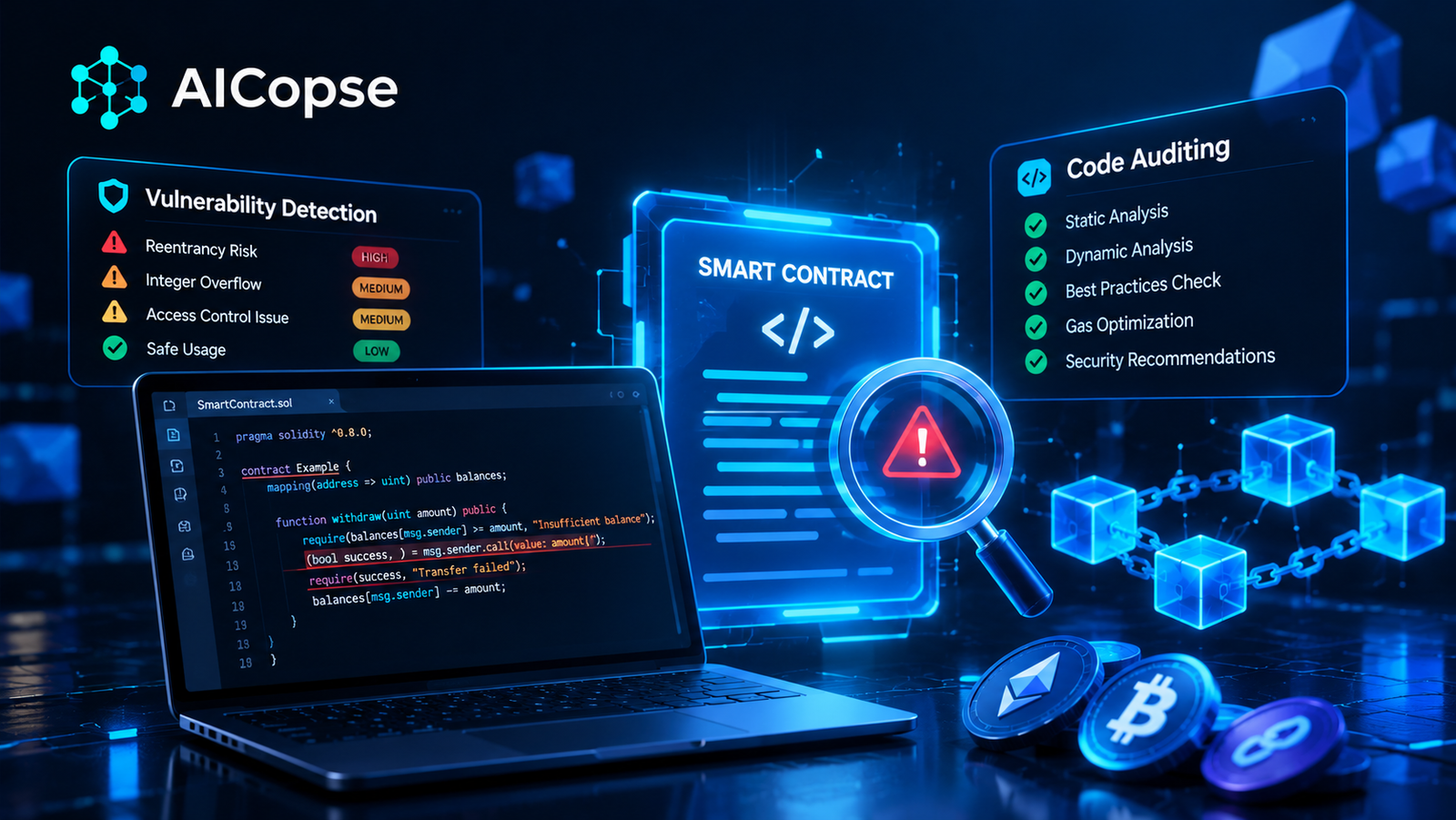
AICOPSE RESEARCH REPORT
AI Smart Contract Auditing: Can It Find Critical Bugs Before Hackers?
How artificial intelligence, static analysis, symbolic execution, fuzzing, and formal verification can help developers find dangerous smart contract flaws before attackers exploit them.
Solidity and EVM security
AI-assisted auditing
2027–2030 outlook
Smart contracts now support decentralized finance, token transfers, lending markets, exchanges, blockchain games, digital ownership, and automated business processes. Their main advantage is that software can enforce rules without requiring a traditional intermediary for every transaction. However, the same automation creates a serious security challenge. A single flaw in contract logic can allow an attacker to drain funds, manipulate a market, bypass access controls, or permanently disrupt a protocol.
Artificial intelligence is creating new ways to review this code. Large language models can explain complex functions, identify suspicious patterns, trace possible attack paths, suggest fixes, and help developers understand findings from traditional security tools. Machine learning can classify vulnerable code, while static analysis, symbolic execution, and fuzzing can test different aspects of contract behavior. The strongest approach is not to choose one technique. It is to combine them into a security process that produces reproducible evidence before deployment.
This report examines academic research, security industry findings, existing auditing approaches, practical implementation strategies, and possible developments through 2030. It distinguishes measured results from laboratory benchmarks and future forecasts. This distinction matters because a model reporting 95% recall on a research dataset does not automatically mean that it will find 95% of vulnerabilities in a live DeFi protocol.
Key finding
AI can make smart contract auditing faster and more accessible, but code security still requires execution-based testing, independent verification, protocol-level reasoning, and human review. The most defensible model is AI-assisted auditing supported by conventional security analysis, not AI-only approval.
Executive Summary
Smart contract auditing is moving from manual code inspection and rule-based scanners toward more integrated systems that combine language models, program analysis, vulnerability databases, and automated testing. This transition creates opportunities for development teams, security firms, blockchain startups, exchanges, and financial businesses. It also creates new risks when generated explanations are mistaken for proof or when a model fails to understand the wider protocol.
The numbers above come from different studies and should not be compared as if they were produced by one shared experiment. The 2026 literature review measures the size and structure of the research landscape, while the SmartGuard figure describes performance under a particular benchmark and methodology.
Several conclusions follow from the evidence:
- AI is most useful when it understands context. A suspicious line of code may be harmless in one contract and dangerous in another, depending on permissions, external calls, token behavior, and protocol design.
- Tool integration matters more than a single model score. Static analysis, fuzzing, symbolic execution, and AI reasoning identify different classes of problems.
- Benchmark performance is not a security guarantee. Tools can over-report issues, miss real-world vulnerabilities, or perform differently when tested on new contracts.
- Security begins before deployment. Requirements, threat modeling, testing, independent review, monitoring, and incident response must work together.
- Through 2030, the likely direction is more automated assistance. The timing and reliability of fully autonomous auditing remain uncertain.
What Is AI-Based Smart Contract Auditing?
A smart contract is software deployed to a blockchain. On Ethereum-compatible networks, developers commonly write contracts in Solidity, compile them into bytecode, and deploy that bytecode to the network. Once a contract controls funds or enforces important rules, a programming mistake can become a financial or operational weakness.
AI-based smart contract auditing uses machine learning or language models to assist with finding, explaining, prioritizing, and sometimes fixing those weaknesses. The system may inspect source code, compiler output, program structure, contract interactions, transaction traces, test results, and known vulnerability examples.
For example, a lending contract may allow users to deposit collateral and borrow assets. An AI auditor might identify that the borrowing function relies on a price feed without checking whether the price is stale. A conventional analyzer might identify the external oracle call or a suspicious arithmetic operation. A fuzzing system could generate transactions that test whether a manipulated price allows excessive borrowing. A human auditor would then assess the full economic consequences and verify a safe fix.
The AI-assisted audit workflow
Source code
Analysis tools
AI reasoning
Verification
The stages can repeat. A failed test may send the auditor back to code analysis, and a proposed fix should be retested against the original attack and existing behavior.
Why Smart Contract Vulnerability Detection Matters
Traditional software can often be patched through a normal update process. Blockchain contracts are more complicated. Some contracts are immutable, some are upgradeable through proxy patterns, and some depend on governance votes or multisignature permissions for changes. Even when a patch is technically possible, users may remain exposed until it is reviewed, approved, and deployed.
Financial losses are only one part of the damage. A successful exploit can reduce user confidence, create legal and regulatory costs, interrupt business operations, damage a token’s market value, and force a project to compensate affected users. A contract that cannot be safely upgraded may require a migration or a new deployment, which can be expensive and difficult.
Financial risk
Unauthorized withdrawals, drained liquidity pools, incorrect collateral calculations, and manipulated token prices.
Operational risk
Frozen functions, failed upgrades, broken integrations, unsafe administrative permissions, and unavailable services.
Trust and compliance risk
Loss of customer confidence, incident investigations, disclosure obligations, and questions about security controls.
Industry loss reports also show why code security must be distinguished from wider blockchain security. Immunefi’s 2026 review of six years of DeFi losses reported that protocol losses fell around 80% from the 2022 peak of $2.62 billion to $534 million in 2024, before rising to $680 million in 2025. The report attributed much of the 2025 increase to a limited number of major incidents. These figures describe DeFi protocol losses under Immunefi’s methodology, not every type of crypto theft or every blockchain incident.
See the Immunefi six-year loss analysis.
In its February 2026 disclosure analysis, Immunefi estimated that approximately 1,238 critical vulnerabilities had been responsibly disclosed across the platforms it examined, compared with around 320 exploited on-chain vulnerabilities within its defined scope. These are the report’s aggregated figures, not a universal count of all vulnerabilities. The finding supports a practical point: organized disclosure, security research, and pre-emptive detection can prevent some bugs from becoming public incidents.
Read the Immunefi critical vulnerability disclosure report.
The Main Vulnerabilities AI Auditors Need to Detect
A useful auditor must do more than search for familiar code patterns. It needs to determine whether a weakness can be triggered, what permissions an attacker needs, which assets are exposed, and whether another contract or external service changes the outcome.
| Vulnerability class | Example failure | How AI can assist | Required validation |
|---|---|---|---|
| Reentrancy | External call allows an unexpected repeat entry before state updates finish. | Trace calls and state changes across functions. | Reproduce the call sequence in a controlled test. |
| Access control | An untrusted account can call an administrative function. | Map roles, modifiers, inheritance, and privileged functions. | Test unauthorized callers and role transitions. |
| Oracle manipulation | A contract accepts a stale or manipulable asset price. | Review oracle assumptions and downstream calculations. | Test abnormal prices, stale data, liquidity conditions, and transaction sequences. |
| Arithmetic and precision | Rounding, scaling, or boundary errors distort balances or fees. | Explain arithmetic paths and identify inconsistent units. | Test boundaries, invariants, and economic outcomes. |
| Flash-loan and economic attacks | Temporary capital distorts a price, vote, or collateral calculation. | Reason about multiple transactions and protocol dependencies. | Simulate complete attack paths and evaluate profit or loss. |
| Upgrade and proxy errors | Storage collisions, unsafe initialization, or unauthorized upgrades. | Compare implementation versions and inspect upgrade permissions. | Test storage layout, initialization, and upgrade authorization. |
| Denial of service | A loop, revert, or dependency blocks a critical operation. | Find fragile dependencies and potentially unbounded operations. | Measure gas and test adversarial inputs. |
| Signature and replay flaws | A signature can be reused in an unintended context. | Review nonce handling, domain separation, chain IDs, and expiry. | Test reused signatures across accounts, chains, and messages. |
| Dependency and integration flaws | A trusted token or external contract behaves unexpectedly. | Map dependencies and flag assumptions about external behavior. | Test integration boundaries and dependency versions. |
This list is not exhaustive. The 2026 systematic literature review discussed later in this report organizes 192 vulnerability types into 13 categories. The exact taxonomy depends on how researchers group similar weaknesses, and a vulnerability may fit more than one category.
How AI Detection Techniques Work
Static analysis
Static analysis examines source code or compiled program information without requiring the contract to run through every possible transaction. Rule-based tools can flag known patterns, suspicious external calls, missing checks, and risky operations. AI can add explanations, connect findings across functions, and help developers understand why a rule matters in a particular contract.
Its main advantage is speed and repeatability. Its main limitation is context. A tool may report a suspicious pattern that is safe under the contract’s actual invariants, or miss a vulnerability that depends on several functions interacting in an unusual order.
Machine learning and code representations
Machine learning systems learn patterns from labelled examples, source code, program graphs, or other representations. They can classify functions, rank suspicious code, and detect similarities to known vulnerable patterns. Graph-based approaches can help represent relationships among functions, variables, and calls.
These models depend heavily on training data. If the dataset contains duplicate examples, outdated coding patterns, or many instances of one vulnerability type, reported performance may not transfer to modern contracts. Models can also struggle when developers use unfamiliar architectures or combine several small flaws into one exploit.
Large language models
Large language models can interpret code in natural language terms, summarize complex logic, suggest possible attack paths, and produce remediation ideas. Retrieval-augmented systems can supply relevant documentation, past audit findings, secure coding rules, and known vulnerability examples to improve the context available to the model.
However, an LLM may invent a vulnerability, misunderstand a modifier, overlook an inherited function, or suggest a fix that breaks a protocol invariant. A persuasive explanation is not proof that the attack works. Findings must be validated with tests, execution traces, formal properties, or qualified reviewers.
Symbolic execution and formal verification
Symbolic execution explores program paths using symbolic inputs instead of only fixed test values. It can help determine whether certain conditions are reachable and whether a path violates a property. Formal verification goes further by checking specified properties against a mathematical model or supported program semantics.
These techniques can provide stronger evidence than language-model explanations alone, but they have their own limitations. Complex contracts can create path explosion, external dependencies may be difficult to model, and formal verification only proves the properties that were specified under the assumptions used.
Fuzzing and invariant testing
Fuzzers generate many inputs or transaction sequences to discover unexpected behavior. Invariant testing checks rules that should remain true, such as ensuring that total liabilities do not exceed available assets under defined assumptions. AI can help propose test cases and interpret failures, while the test harness provides reproducible evidence.
Comparison of auditing methods
Illustrative capability map, not measured benchmark scores. Bar lengths do not represent a scientific ranking, universal accuracy, or relative detection rates.
Six Important Research Studies and What They Tell Us
The studies below were selected because they address different parts of the problem: the overall tool landscape, AI-specific methods, benchmark performance, real-world transfer, and financial consequences. Their results should be interpreted within each study’s dataset, methods, and scope.
STUDY 01 · SYSTEMATIC REVIEW · 2026
Smart Contract Vulnerabilities, Tools, and Benchmarks
A systematic literature review published in the Journal of Systems and Software in June 2026 examined research on Ethereum smart contract vulnerability detection. The researchers started with 3,380 studies across five digital libraries and five major software engineering conferences. After applying their selection process, they included 222 high-quality studies.
3,380
222
219
133
The review organizes 192 vulnerability types into 13 categories and maps available tools to vulnerability classes and evaluation benchmarks. Its importance is not simply the number of tools. It shows that the field has many competing approaches, while coverage and evaluation remain fragmented. A tool can be strong on one class of vulnerability and weak on another.
Practical lesson: developers should not select an auditor based on one headline accuracy score. They should ask which vulnerability categories it covers, which compiler and language versions it supports, whether results are reproducible, and how it performs on real contracts similar to their own.
STUDY 02 · LLM FRAMEWORK · 2025
SmartGuard: An LLM-Enhanced Detection Framework
SmartGuard, published in Expert Systems with Applications in April 2025, combines language models, retrieval of semantically similar code examples, generated reasoning, and a self-checking architecture. Instead of asking a model to inspect code with no supporting context, the framework supplies related examples and structured prompts.
Recall measures the share of known positive cases detected by a system. F1 combines precision and recall into one measure. A high score is encouraging, but it does not demonstrate that the framework can find every serious flaw in a production protocol. Benchmark composition, vulnerability labels, code complexity, and the evaluation setup all influence the result.
Practical lesson: retrieval can improve an AI auditor by giving it relevant examples and security guidance. A production implementation should still test the model on unseen contracts and track false positives, missed findings, and the quality of proposed fixes.
STUDY 03 · BENCHMARK RESEARCH · 2024
Detection Made Easy: Potentials of Large Language Models for Solidity Vulnerabilities
This 2024 study introduced VulSmart, a structured dataset designed to evaluate LLM-based detection of Solidity vulnerabilities. It compared several open and closed language models and explored zero-shot, few-shot, and chain-of-thought prompting strategies. The paper reported strong results for selected fine-tuned models, including accuracy of 99%, vulnerability-type identification of 94%, and severity classification of 98% in the reported experiments.
These figures are study-specific results, not an industry-wide measure of the accuracy of AI auditing. Accuracy can be misleading if a dataset is imbalanced or if the examples do not represent real-world contract complexity. A model that classifies many easy examples correctly may still miss a rare, high-impact flaw.
The research is useful because it demonstrates how dataset design, fine-tuning, and prompt strategy can change model performance. It also raises an important evaluation question: are models learning general security principles, or recognizing patterns similar to those in the training set?
Practical lesson: build a private evaluation set containing previous production bugs, newly written contracts, complex interactions, and examples that are intentionally safe despite looking suspicious. Keep the evaluation set separate from training and prompt examples.
STUDY 04 · CODE ANALYSIS · 2026
CodeSpeak: Improving Detection Through LLM-Assisted Code Analysis
CodeSpeak, published in the Journal of Systems and Software in January 2026, studies how language-model assistance can be combined with code analysis and domain-specific prompts. The researchers report improvements over comparison methods across four vulnerability types.
The research addresses a weakness of direct prompting: language models can understand much of a function’s intent but may be inconsistent when asked to make security judgments without a structured analysis process. CodeSpeak’s approach aims to make the model’s task more systematic and closer to expert review.
The reported improvement across selected categories does not establish that the approach performs equally well across all Solidity versions, chains, and attack classes. Independent evaluation on production-derived code remains important.
Practical lesson: an AI auditor should receive structured evidence, such as function relationships, call paths, state changes, and findings from static analyzers. This is generally a stronger design than sending an entire repository to a model and asking for a complete audit in one prompt.
STUDY 05 · REAL-WORLD TRANSFER · 2026
Do Smart Contract Auditing Results Transfer Across Datasets?
This 2026 empirical study compares seven static and LLM-based auditing tools across two datasets: SmartBugs Curated, with 143 contracts, and a filtered FORGE subset of 173 contracts derived from real-world audits.
The researchers report meaningful trade-offs. Static tools designed for broad coverage can over-report issues and create additional triage work. LLM-driven auditors can cover multiple vulnerability categories but can also over-predict problems. Tool behavior and reliability can change when the evaluation dataset changes.
This matters because many security product claims are built around a fixed benchmark. A result obtained on a curated set of known examples may not represent how the tool performs on a novel lending protocol, a complex proxy system, or a contract whose risk depends on interactions with external services.
Practical lesson: measure cross-dataset performance. Track precision, recall, severity calibration, runtime failures, and the number of findings that security engineers confirm. Re-run evaluations when the model, prompt, compiler, or analysis rules change.
STUDY 06 · INDUSTRY LOSS DATA · 2026
Immunefi’s Six-Year DeFi Vulnerability Scoreboard
Immunefi’s April 2026 analysis compares DeFi protocol losses across six years, including the changes in loss severity and the mix of attacks. It reports that annual protocol losses fell from a peak of $2.62 billion in 2022 to $534 million in 2024, followed by a rise to $680 million in 2025. The median loss per incident declined from $6 million in 2022 to $1.5 million in 2025 under its methodology.
The report also points to a shift in the nature of risk. Some categories of on-chain exploits became less prominent, while infrastructure and key-management failures remained important. This distinction is essential: smart contract code auditing cannot by itself prevent an employee from approving a malicious transaction or an attacker from stealing a private key.
Loss data does not prove that AI caused security improvements or that future incidents will continue to decline. It does show why a complete security program must consider contracts, governance, keys, dependencies, monitoring, and incident response.
Practical lesson: use AI auditing as one control within a broader security strategy. Pair it with access-control reviews, secure key management, bug bounty programs, emergency procedures, and continuous monitoring.
What the Research Collectively Means
The studies do not support the claim that one AI model has solved smart contract security. They point toward a more specific conclusion: AI can improve parts of the detection and review process, but reliable results depend on the quality of the evidence supplied, the testing method, the vulnerability class, and the evaluation dataset.
| Evidence | What it supports | What it does not prove |
|---|---|---|
| Large systematic review | A broad and fragmented tool landscape with substantial benchmark diversity. | That one tool is best for every contract. |
| High benchmark recall | A model can identify many labelled vulnerabilities in a defined evaluation. | That it will find the same proportion of bugs in production. |
| Cross-dataset comparison | Tool results can change with dataset choice and evaluation conditions. | That laboratory rankings are permanent or universal. |
| Industry loss analysis | Real-world losses arise from different technical and operational causes. | That AI auditing alone prevents crypto incidents. |
Competitor and Content Landscape Analysis
This is a qualitative review of relevant research papers, security reporting, and established smart contract auditing approaches. It is not a live Google ranking audit, and it does not claim that every competing page or product has been examined. Its purpose is to identify what readers can already find and where a more useful research report can add value.
| Research or content group | Main strength | Potential content gap | How this report adds value |
|---|---|---|---|
| Academic systematic reviews | Detailed taxonomies, tools, benchmarks, and research methodology. | May be difficult for product teams to translate into a practical security workflow. | Connects research findings to implementation decisions and operational controls. |
| Immunefi research | Incident trends, disclosure data, and real-world security consequences. | Industry loss data alone does not explain how to build an AI auditing pipeline. | Explains how code analysis, AI, testing, and incident response fit together. |
| LLM vulnerability research | Model comparisons, prompts, and benchmark results. | High scores can be misunderstood as real-world guarantees. | Separates benchmark results from production security claims. |
| Smart contract tool surveys | Broad comparison of static, dynamic, machine learning, and verification techniques. | Tool lists can become outdated as models, compilers, and chains change. | Provides a repeatable selection framework and 2027–2030 outlook. |
| AI security product pages | Convenient workflows, product integrations, and rapid scans. | Marketing claims may not reveal independent test methods or false-positive rates. | Recommends transparent evaluation, evidence-backed findings, and independent verification. |
The clearest content opportunity is to bridge academic research and day-to-day engineering. Many readers need to know not only what AI auditing means, but also which tools should work together, how to measure the results, when a human auditor remains essential, and how to protect a live protocol after deployment.
For AICOPSE, the strongest differentiation is therefore not another general list of AI security tools. It is an evidence-led guide that explains the limitations of published results, connects AI detection to real financial and operational risks, and gives developers a workflow they can implement and test.
Designing a Reliable AI Smart Contract Auditor
A production auditor should behave like a security workflow, not a single chatbot. It should preserve source code and test evidence, identify the exact location of each finding, explain the possible exploit, and record whether the issue has been independently confirmed.
Collect the full audit context.
Gather source code, compiler version, dependency versions, deployment configuration, proxy information, protocol documentation, and known trust assumptions. Record the exact commit being audited.
Run deterministic analysis first.
Use static analyzers, dependency checks, compiler warnings, and established security rules to create a baseline. Preserve raw tool output so the AI cannot silently replace or misrepresent the original evidence.
Use AI to investigate and prioritize.
Ask the model to trace relevant state changes, identify assumptions, compare findings with approved security references, and explain plausible attack paths. Require file locations and supporting evidence for each claim.
Attempt to reproduce the issue.
Generate tests, fuzz transaction sequences, check invariants, and use symbolic execution where suitable. Label a finding as unconfirmed when no reproducible evidence is available.
Review fixes independently.
Check whether the patch closes the reported attack without breaking protocol invariants, permissions, integrations, or expected behavior. Re-run the full test suite against the changed code.
Deploy with monitoring and response plans.
Use staged releases where possible, monitor unusual transactions and protocol metrics, protect privileged keys, and prepare an emergency pause or recovery procedure where the architecture supports one.
A Practical AI Audit Report Format
Every AI-generated finding should be specific enough for another engineer to reproduce and challenge. General statements such as “this function may be insecure” do not provide sufficient evidence for a security decision.
| Report field | Required content |
|---|---|
| Finding ID | Unique identifier linked to the commit and audit run. |
| Code location | File, function, line range, and relevant code path. |
| Vulnerability and impact | The suspected flaw, affected assets, required permissions, and possible consequences. |
| Evidence | Analyzer output, test case, execution trace, invariant failure, or proof where available. |
| Confidence and severity | Separate confidence in the finding from the severity of the potential impact. |
| Recommended fix | Minimal change, assumptions, possible side effects, and tests required. |
| Review status | Unconfirmed, reproduced, disputed, fixed, retested, or accepted with documented risk. |
A high-impact finding with low confidence should trigger urgent investigation, not automatic dismissal. Likewise, a high-confidence observation about a minor issue should not be presented as a critical exploit. Separating confidence from severity helps teams allocate their limited review time more effectively.
Guidance for Developers
Individual developers can use AI to improve review speed, learn unfamiliar codebases, and generate tests. The greatest benefit comes from placing AI inside the existing development workflow rather than treating it as a replacement for engineering judgment.
Recommended development practices
- Start with threat modeling. Define the assets, privileged roles, trust boundaries, external dependencies, and realistic attacker capabilities before asking AI to inspect the code.
- Use AI during code review. Ask for potential reentrancy paths, access-control gaps, unsafe external calls, arithmetic assumptions, and missing invariant tests.
- Keep source evidence attached. Each finding should point to the exact code and explain the path that could make the issue exploitable.
- Generate tests, not just explanations. Use AI suggestions to build regression tests and fuzzing inputs, then execute them in a controlled environment.
- Pin compiler and dependency versions. Reproducibility is essential when evaluating an audit result or investigating an incident.
- Review generated fixes carefully. A patch that removes one warning may create another weakness or break a critical invariant.
- Keep secrets out of prompts. Avoid sending private keys, confidential customer data, unpublished exploit details, or sensitive source code to unapproved external services.
- Audit the auditor. Track missed findings, false positives, tool errors, model changes, and the effect of prompt updates.
Developers working on DeFi systems should also understand that contract correctness and economic safety are not identical. A function may behave exactly as programmed while the protocol’s incentives, oracle assumptions, collateral requirements, or liquidation rules create an exploitable outcome. AI review should therefore cover both code behavior and the intended economic model.
Guidance for Startups Building AI Auditing Products
Startups have an opportunity to build useful security products, but entering this market with a general-purpose chatbot and a Solidity prompt is unlikely to create a durable advantage. Buyers need evidence that the product finds meaningful problems, reduces review time, integrates into development tools, and protects confidential code.
Choose a narrow entry point
Focus on one high-value workflow, such as upgradeable contract reviews, lending protocol invariants, token integration checks, or audit finding triage.
Build measurable evidence
Publish test methodology, dataset limitations, false-positive rates, supported compiler versions, and independent evaluation results.
Sell a clear outcome
Measure review time saved, confirmed vulnerabilities found, triage cost, integration effort, and the rate of successfully verified fixes.
Build a product that security teams can trust
- Integrate with developer environments, code repositories, continuous integration pipelines, and established analyzers.
- Give customers control over whether source code is processed locally, in a private cloud, or by an approved external model.
- Offer audit trails that record the model version, prompt version, analysis tools, code commit, and test evidence used for each finding.
- Provide human review and escalation for critical findings rather than automatically declaring a contract safe.
- Design a vulnerability feedback process that lets customers label findings and improve detection without exposing confidential code.
- Make pricing understandable. Consider repository size, analysis frequency, contract complexity, and human review costs instead of relying on token usage alone.
A startup’s long-term advantage may come from high-quality labelled data, integration into customer workflows, domain-specific verification, and a reputation for accurate findings. Access to a powerful language model by itself is not a durable security moat.
Guidance for Businesses, Exchanges, and DeFi Protocols
Businesses should treat AI-assisted auditing as a risk-management investment. The right purchasing decision depends on the value controlled by the contract, the potential impact of a failure, the complexity of the protocol, and the cost of independent review.
Before selecting a product or service, decision-makers should ask:
- Which programming languages, chains, compiler versions, proxy patterns, and dependency types are supported?
- Are detection claims backed by independent tests and real-world contract evaluations?
- Can the system reproduce findings, identify the affected code, and provide a test case?
- How does the provider measure false positives, false negatives, severity, and model confidence?
- Does the provider retain source code or use it for training? What controls are available for sensitive projects?
- How are critical findings escalated, and who is responsible for approving fixes?
- What happens when a model, analyzer, compiler, or dependency changes?
- Can the system integrate with existing audits, bug bounty programs, monitoring, and incident response?
For high-value financial contracts, AI-generated findings should be one part of a broader assurance process. A critical protocol may require independent auditors, economic simulations, formal verification of selected properties, access-control reviews, multisignature governance, and a tested emergency response plan.
Security Risks Created by AI Auditing Itself
AI systems can improve code review, but they introduce a separate layer of security and operational risk. Teams need to protect the auditing system as carefully as the code it examines.
| AI-related risk | Potential consequence | Recommended control |
|---|---|---|
| Hallucinated findings | Engineers waste time or introduce harmful fixes. | Require reproducible tests or independent evidence. |
| Missed vulnerabilities | A false sense of security allows a real flaw to reach production. | Combine independent methods and test against known failure cases. |
| Prompt injection in source or documents | Untrusted text may manipulate the model or its tools. | Treat repository content as untrusted data; isolate tools and restrict permissions. |
| Source code leakage | Proprietary logic or sensitive project details reach an unauthorized service. | Use approved providers, access controls, retention limits, and private deployment where needed. |
| Unsafe autonomous changes | An agent changes code, runs untrusted commands, or deploys an unverified patch. | Use sandboxing, least privilege, human approvals, and protected deployment gates. |
| Model or dependency drift | Results change after a provider update or toolchain change. | Pin versions, preserve audit records, and rerun regression evaluations. |
Autonomous tools deserve special care. An agent that can read source code is not necessarily safe to run shell commands, access credentials, approve transactions, merge code, or deploy contracts. Keep analysis permissions separate from production permissions. A model should not be able to bypass the controls intended to protect the system it is reviewing.
Future Outlook: AI Smart Contract Auditing Through 2030
The forecasts in this section are reasoned projections based on current research directions and security needs. They are not established facts, and the exact pace of adoption will depend on model reliability, regulation, development costs, and the frequency of major security incidents.
2027: AI becomes a standard review assistant
Confidence: Medium to high
AI-assisted code review is likely to become more common inside development environments and continuous integration systems. Teams will increasingly expect auditors to explain findings, generate targeted tests, and summarize risks across related functions. Conventional analyzers will remain important because developers need deterministic results and reproducible evidence.
What teams should do: integrate AI into review workflows, establish a baseline of false positives and missed bugs, and prevent automated approval from replacing required security checks.
2028: More context-aware and domain-specific auditing
Confidence: Medium
Auditors may increasingly use protocol documentation, historical incidents, dependency graphs, and business rules to evaluate contracts. A lending protocol auditor, for example, could assess collateral and liquidation assumptions in addition to code-level patterns. This shift will depend on the availability of reliable data and the ability to verify cross-contract behavior.
What teams should do: document protocol invariants and trust assumptions so that automated systems have a clear description of intended behavior.
2029: Continuous audit and remediation loops expand
Confidence: Medium to low
More teams may use continuous auditing that checks every important code change, re-runs targeted tests, and updates risk summaries as dependencies evolve. AI may propose patches and open review requests, while execution tools confirm whether the changes resolve the suspected issue.
What teams should do: use protected branches, reproducible builds, mandatory approvals, regression tests, and separate deployment credentials.
2030: Hybrid security platforms become more capable
Confidence: Medium
By 2030, mature security platforms may coordinate language models, static analyzers, fuzzers, formal methods, dependency intelligence, and monitoring systems through one workflow. Routine checks may require less manual effort, allowing specialists to focus more on protocol economics, unusual architectures, governance, and high-impact risks.
What teams should do: build security processes that can switch models and tools without losing audit history, test coverage, or accountability.
Predictions that need more caution
- Fully autonomous audits for high-value protocols: possible in limited, well-defined contexts, but there is insufficient evidence to assume that human-independent approval will be safe across complex financial systems by 2030.
- One model that detects every vulnerability class: unlikely to be a defensible planning assumption because vulnerability types, programming practices, and attack methods continue to change.
- AI eliminating smart contract exploits: not a credible baseline forecast. Some incidents originate in private key theft, governance decisions, infrastructure failures, or economic assumptions rather than code defects alone.
- AI audits replacing independent auditors completely: businesses may automate more routine work, but independent review and accountability will remain important for systems that control substantial value.
The practical forecast is not that AI will make smart contracts automatically safe. It is that security teams will have more automated assistance, more continuous testing, and stronger ways to connect code findings with executable evidence. Whether that leads to fewer losses will depend on how organizations implement and govern those capabilities.
Expert Recommendations for 2027–2030
The following recommendations are a synthesis of the research reviewed in this report. They are practical recommendations, not direct quotations attributed to individual researchers.
For engineering leaders
- Make security testing part of every significant code change.
- Define measurable security acceptance criteria.
- Require reproducible evidence for critical findings.
- Retest fixes and upgrades before release.
For security researchers
- Test on unseen and production-derived contracts.
- Publish precision and recall with clear methodology.
- Report false positives and tool failures.
- Build evaluations that include economic and cross-contract risks.
For startup founders
- Focus on a specific security problem.
- Protect customers’ source code.
- Prove value through independent testing.
- Build audit trails and human escalation into the product.
Use a risk-based review budget
Not every contract requires the same level of assurance. A simple low-value application and a protocol holding substantial user assets should not follow identical review processes. However, a low-value contract can still expose users or connected protocols to risk, so asset value should not be the only factor.
Prioritize review effort using several factors:
- Potential impact: how much value, access, or critical functionality could be affected?
- Exploitability: can an untrusted user trigger the issue, or does it require privileged access?
- Reach: can the weakness affect multiple contracts, chains, markets, or user groups?
- Recoverability: can the contract be paused, upgraded, or migrated safely?
- Uncertainty: are the codebase, dependencies, or economic assumptions poorly understood?
AI can help summarize these factors, but the scoring system should be transparent. A numerical risk score should not create false precision when the underlying evidence is incomplete.
Measuring Whether AI Auditing Is Actually Working
Organizations need a scorecard that evaluates real engineering outcomes rather than the number of issues an AI model reports. Reporting more findings is not necessarily a sign of better security. A system that generates hundreds of unconfirmed alerts may increase cost without reducing risk.
| Metric | What it measures | How to use it |
|---|---|---|
| Precision | Share of reported findings that are confirmed. | Estimate triage burden and alert quality. |
| Recall | Share of known vulnerabilities detected. | Assess how many known issues may be missed. |
| Severity calibration | How closely assigned severity matches expert assessment. | Help prioritize review and remediation. |
| Reproduction rate | Share of findings that can be reproduced with evidence. | Distinguish plausible explanations from demonstrated failures. |
| Time to resolution | Time from finding to verified remediation. | Measure workflow improvement. |
| Regression rate | Share of fixes that break expected behavior or reintroduce flaws. | Check the quality of AI-generated patches. |
| Cost per confirmed finding | Total tool and review costs relative to useful discoveries. | Compare workflows on economic value, not alert volume. |
Precision and recall require a credible ground truth. In real security work, the complete set of vulnerabilities is rarely known with certainty. Teams should therefore combine benchmark testing, independent review, historical incident analysis, and carefully documented production outcomes rather than claiming perfect measurement.
Implementation Roadmap for the Next 12 Months
Establish the baseline.
Inventory contracts, dependencies, compiler versions, and audit history. Define threat models and select representative contracts for evaluation.
Run a controlled pilot.
Combine one or more established analyzers with an AI assistant. Compare findings with human review and record false positives, missed issues, and analysis time.
Integrate verification.
Add regression tests, fuzzing, evidence requirements, review approvals, and secure handling of source code. Do not permit automatic production deployment from AI findings.
Expand based on evidence.
Evaluate new model versions, add domain-specific invariants, test more complex contracts, improve monitoring, and scale only when the pilot shows measurable value.
Related AICOPSE Research
Smart contract auditing is closely connected to the security of automated financial systems. The following AICOPSE articles provide related context on algorithmic execution, forecasting, and trading strategy design.
AI in Algorithmic Trading and Automated Strategy Execution
Explore how AI supports automated trading workflows and why execution controls, system testing, and risk management matter when software makes decisions.
AI in Predictive Financial Modeling and Market Forecasting
Understand how AI-driven financial models use data to generate forecasts and why assumptions, validation, and model risk deserve careful review.
AI in Stock Market Trading Strategy Development
Review the role of AI in developing trading strategies and the need to test automated systems before relying on their outputs.
AI in Algorithmic Trading and High-Frequency Trading Execution
Learn about AI in high-speed financial execution, where latency, reliability, testing, and operational risk can have direct consequences.
These articles address adjacent areas of AI and financial automation. They are related reading rather than direct evidence about smart contract vulnerability detection.
Frequently Asked Questions
Can AI detect smart contract vulnerabilities automatically?
AI can identify suspicious code, explain possible attack paths, classify known vulnerability patterns, and suggest tests or fixes. Its results can be incomplete or incorrect, so important findings should be checked through execution-based testing, formal methods where suitable, and qualified human review.
Is an AI audit enough before deploying a smart contract?
For contracts that control valuable assets or critical functions, an AI audit alone is not a sufficient assurance process. Teams should combine automated analysis, tests, threat modeling, independent review proportional to the risk, and deployment monitoring.
Which smart contract vulnerabilities are difficult for AI to detect?
Complex economic exploits, cross-contract interactions, unusual governance assumptions, oracle manipulation, and flaws that depend on long transaction sequences can be difficult. A model may explain these risks, but it needs suitable context and verification tools to establish whether an exploit is feasible.
Are LLM-based auditors better than traditional static analysis tools?
Neither approach is universally better. Static analyzers provide repeatable checks and known rules, while LLMs can help reason about context and explain code. Research shows trade-offs in coverage, false positives, and reliability. Combining independent methods is generally more defensible than relying on one alone.
What do AI smart contract auditing benchmark scores mean?
Recall measures how many known vulnerabilities are detected, while precision measures how many reported findings are valid. F1 combines the two. These metrics are meaningful only in the context of the dataset, labels, methodology, and test conditions. High benchmark scores do not guarantee equivalent production performance.
Can startups build a business around AI smart contract auditing?
Yes, but a credible product needs more than an AI interface. It should offer reliable evidence, reproducible findings, secure code handling, integration with developer tools, transparent evaluation, and a clear reduction in review time or security risk.
Will AI replace smart contract auditors by 2030?
AI is likely to automate more routine checks and support continuous auditing, but complete replacement is uncertain. Complex financial logic, system-level assumptions, verification of critical fixes, and accountability still require strong engineering judgment and independent oversight.
Does smart contract auditing prevent every crypto hack?
No. Auditing can reduce certain code-level risks, but crypto incidents can also result from stolen private keys, compromised infrastructure, governance failures, malicious insiders, and unsafe economic designs. Security requires technical, operational, and organizational controls.
Research Sources and Further Reading
The following sources support the research findings and industry context discussed in this report. Academic performance figures are presented as reported by the relevant studies, while industry loss statistics follow the scope and methodology of the cited reports.
- Smart contract vulnerabilities, tools, and benchmarks: An updated systematic literature review. Journal of Systems and Software, June 2026.
- Ethereum smart contract security: Vulnerabilities, analysis techniques, challenges and research directions. Computers and Electrical Engineering, February 2026.
- Leveraging Machine Learning Models to Improve Smart Contract Security: A Survey of Vulnerabilities and Detection Methods. ACM Computing Surveys, published December 2025.
- SmartGuard: An LLM-enhanced framework for smart contract vulnerability detection. Expert Systems with Applications, April 2025.
- Detection Made Easy: Potentials of Large Language Models for Solidity Vulnerabilities. arXiv research paper, September 2024.
- CodeSpeak: Improving smart contract vulnerability detection via LLM-assisted code analysis. Journal of Systems and Software, January 2026.
- Do Smart Contract Auditing Results Transfer Across Datasets? A Two-Benchmark Empirical Study of Static and LLM-Based Security Tools. ESEM 2026.
- A Comprehensive Survey of Smart Contracts Vulnerability Detection Tools: Techniques and Methodologies. Journal of Network and Computer Applications, May 2025.
- The Ecosystem Vulnerability Scoreboard: 6 Years of DeFi Loss Data. Immunefi, April 2026.
- 93% of Critical Crypto Vulns Are Disclosed on Immunefi. Immunefi, February 2026.
- What an Onchain Hack Actually Costs: 2024–2025 Update. Immunefi, March 2026.
- Fine-Tuned Large Language Model for Securing Ethereum Smart Contracts with Real-Time VSCode Auditing. Blockchain: Research and Applications, 2026.
Conclusion
AI is becoming a valuable part of smart contract vulnerability detection because it can help engineers understand code, investigate suspicious behavior, generate tests, and organize audit findings. The strongest research results are promising, but differences between benchmarks and real-world contracts remain a serious concern.
For developers, the priority is to use AI alongside established analysis and verification tools. For startups, it is to build products that can demonstrate reliable results and protect customer code. For businesses and DeFi protocols, it is to combine technical auditing with governance, key management, monitoring, and incident response.
Through 2030, the most credible direction is a hybrid security model in which AI assists with increasingly complex analysis while deterministic tests, formal properties, independent review, and accountable release processes provide the evidence needed to make security decisions.
Research note: This article synthesizes published studies and industry reports available at the time of preparation. Benchmark results and loss estimates depend on the original authors’ datasets, definitions, and methodologies. Future outlooks are projections, not guarantees. Security teams should verify the current versions of tools, frameworks, and dependencies before using them in production.

Leave a Reply