
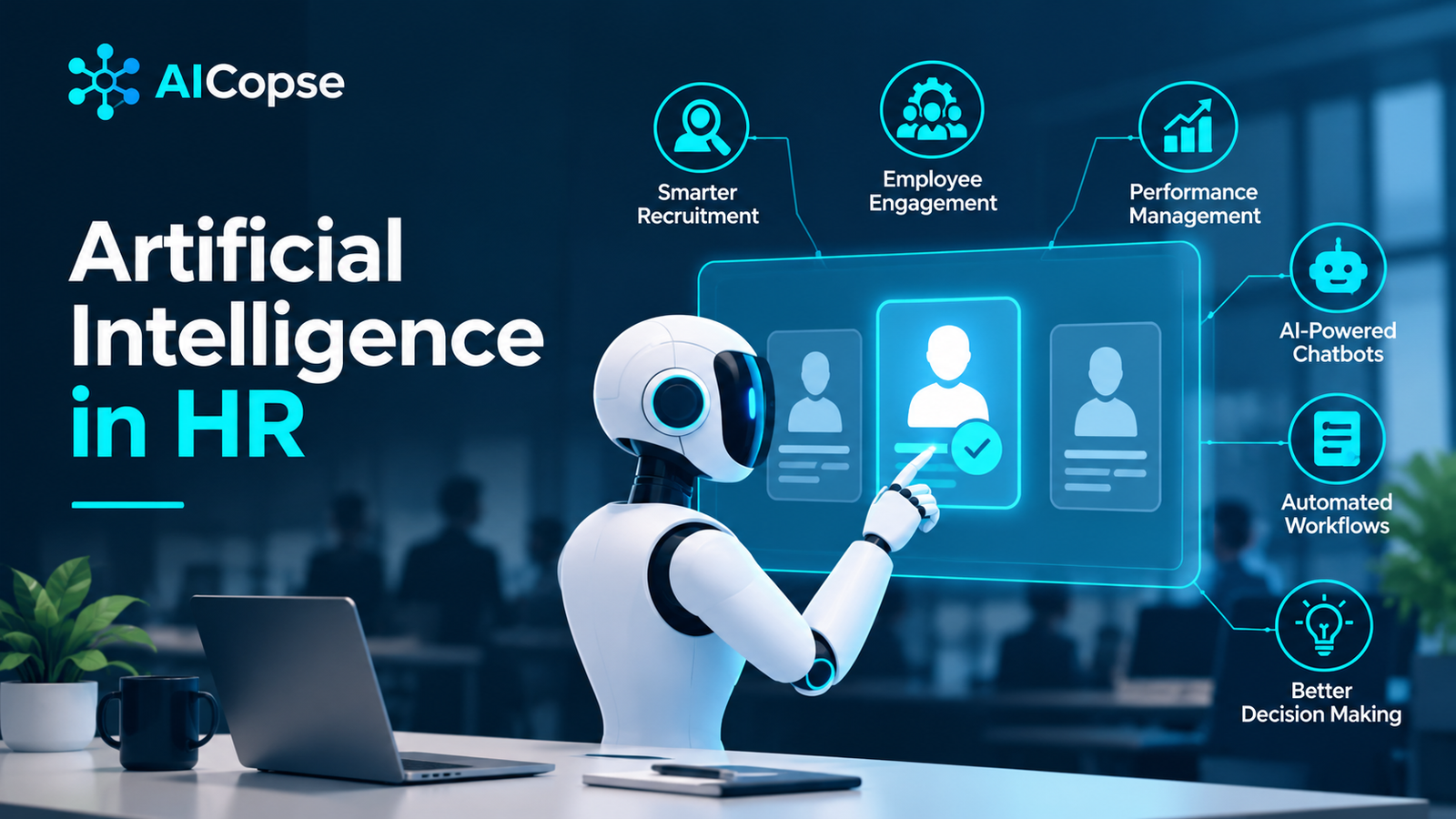
Two things are true about AI in HR at the same time. It removes real drudgery: the recruiter who used to read 400 resumes for one opening, the HR generalist who answered the same leave-policy question 50 times a week. And it is the area of workplace AI where the law is moving fastest, because hiring, promotion and discipline decisions are exactly where bias does the most damage. A federal court is already letting a nationwide age-discrimination case over an AI screening vendor proceed, and California just banned firing or disciplining workers on AI output alone.
This guide gives U.S. HR leaders, recruiters and business owners the full picture: how AI is used across every HR function, what the adoption data really says, which tools dominate, what the bias research shows, how to audit a tool yourself, what each major U.S. law requires, and a step-by-step playbook. You will also see three worked examples, with real numbers, that show how bias hides in “neutral” models, how an audit works and why keyword screening fails. We cover AI at work daily at AICopse. For the wider business context, see our reports on the state of AI in business in 2026 and our guide to AI agents for business.
In this guide
- What is AI in HR?
- How many U.S. employers use AI in HR?
- AI in HR: use cases by function
- The HR AI tool landscape in 2026
- Bias: what the evidence shows
- How to audit an HR AI tool
- U.S. laws on AI in hiring and employment
- The candidate side: AI-written resumes and fake applicants
- Trust, transparency and the employee experience
- A 10-step implementation playbook
- How to measure ROI
- Common mistakes
- Common myths
- FAQ
What Is AI in HR?
AI in HR is the use of machine learning, natural language processing and generative AI to automate, support or inform people-management tasks, from recruiting and onboarding to learning, performance and retention. It sits on top of the HR systems you already own: your applicant tracking system (ATS), human resources information system (HRIS), payroll and learning platforms. For the technology basics, see our explainers on machine learning and natural language processing.
The most useful way to think about it is by risk tier, because the law cares about what a tool decides, not how smart it is:
Put your strictest controls on Tier 1: human decision-makers, bias testing, notices and records. Tiers 2 and 3 still need data-privacy and accuracy checks, but they rarely trigger the hiring-specific laws covered below.
How Many U.S. Employers Use AI in HR?
About four in ten. SHRM’s 2026 State of AI in HR research, based on a survey fielded in late 2025, found that 39% of U.S. organizations use AI in HR functions, with recruiting the most common area. Adoption rises sharply with size: large employers (5,000 or more employees) were far more likely to use AI than small ones.
Share of U.S. organizations using AI in each HR area. Source: SHRM State of AI in HR 2026, as summarized by FutureFactors. Large employers reported around 60% use, versus about one-third for small and midsize employers.
Why you will see other numbers: SHRM’s 2025 talent-trends research put AI use in HR at 43%, up from 26% a year earlier, while vendor and recruiter surveys often report 50% or more. They measure different groups (all employers versus recruiters, any use versus daily use), so compare the definition before you compare the percentage.
Candidates and the public are more cautious than employers. A 2023 Pew Research Center survey found that about two-thirds of U.S. adults would not want to apply for a job where AI makes the hiring decision, and Gartner’s 2025 candidate research found that only about one in four candidates trust AI to evaluate them fairly.
AI in HR: Use Cases by Function
| HR function | What AI does | Risk tier | Human check |
|---|---|---|---|
| Sourcing and job posts | Finds candidates, drafts and tests job descriptions, writes outreach | Tier 2 | Review wording for biased or exclusionary language |
| Screening and ranking | Parses resumes, scores or ranks applicants, matches skills to roles | Tier 1 | A recruiter reviews all rejections near the cutoff and the audit results |
| Interviewing | Schedules interviews, transcribes calls, summarizes feedback, runs structured AI screens | Tier 1 to 2 | Humans decide who advances. Disclose AI use to candidates |
| Onboarding | Sends task reminders, answers new-hire questions, personalizes first-week plans | Tier 2 | HR owns policy answers |
| Employee service | Chatbots answer questions on leave, benefits, payroll and policy | Tier 2 | Keep answers grounded in current policy, and route sensitive issues to a person |
| Learning and development | Recommends courses, builds skill profiles, generates training content | Tier 2 to 3 | Managers confirm development plans |
| Performance management | Summarizes feedback, drafts review text, flags goal progress | Tier 1 if it ranks or scores people | Managers write and own the final review |
| Compensation | Benchmarks pay and flags equity gaps | Tier 1 to 3 | Compensation and legal teams review changes |
| Workforce planning and retention | Forecasts demand and predicts who may leave | Tier 3, Tier 1 if used on individuals | Use aggregate insights, and avoid acting on individual predictions alone |
| Discipline and termination | Flags attendance, conduct or performance issues | Tier 1 | Required human review in California under SB 947 |
In practice the fastest returns come from Tier 2: scheduling, drafting and employee Q&A. They save hours without making a decision about a person. Tier 1 tools deliver the biggest gains and the biggest legal exposure, which is why the rest of this guide focuses on testing and governing them.
The HR AI Tool Landscape in 2026
The market has consolidated around the big HR suites, which have bought AI recruiting and assistant companies. Names below are examples of each category:
| Category | Examples | Notes |
|---|---|---|
| HR suites with built-in AI | Workday, SAP SuccessFactors, Oracle HCM, UKG, ADP | Workday bought HiredScore (2024), Paradox and Sana (2025). SAP bought SmartRecruiters (2025). |
| Recruiting and ATS platforms | Greenhouse, iCIMS, Eightfold, Phenom, Gem, Ashby, SmartRecruiters | Many now include AI sourcing, matching and scheduling. |
| Job boards and networks | LinkedIn (Hiring Assistant), Indeed | AI matching and recruiter assistants built into the marketplace. |
| Interview and assessment tools | HireVue, Paradox (conversational scheduling), skills-test platforms | The category most scrutinized under bias-audit laws. |
| Employee experience and performance | Lattice, Culture Amp, Leapsome, BambooHR, Rippling | AI summaries of feedback and engagement; check how scores are used. |
| General AI assistants | Microsoft Copilot, ChatGPT, Gemini, Claude | Useful for drafting and analysis. Use approved business plans and never paste personal data into a public tool. |
Because Workday, SAP and others have absorbed standalone vendors, ask any AI vendor who owns it, which models it uses, and what happens to your contract if it is acquired. Our guide to AI agents for business covers build-versus-buy and rollout in more depth, and our look at generative AI examples shows what the assistants above can do.
Bias: What the Evidence Shows
Bias is the central risk of Tier 1 tools, and the evidence is concrete:
| Evidence | What it found |
|---|---|
| Amazon’s experimental recruiting tool (reported 2018) | Trained on a decade of mostly male resumes, it learned to penalize resumes that mentioned women’s activities. Amazon scrapped it. |
| University of Washington study of AI resume screening (2024) | Researchers compared resume rankings across about three million comparisons using names. The models favored white-associated names about 85% of the time and female-associated names about 11% of the time, and never preferred Black male names over white male names. |
| Mobley v. Workday (N.D. Cal.) | A federal court certified a nationwide collective of job applicants aged 40 and over in 2025. In 2026 the court approved notice to potential members, held that the age law covers applicants, and largely denied a motion to dismiss. The case is continuing and no court has ruled that Workday’s tools discriminated. |
Why “we removed gender and race” does not work
A model learns from historical decisions. If past managers favored one group, the model learns the pattern from any feature that correlates with group: neighborhood, school, employment gaps, even writing style. Deleting the protected attribute does not delete the proxy. A simulation we ran shows it.
We simulated two groups with identical skill, 20,000 historical hiring decisions that were biased against Group B, and a screening model that never sees group membership. It sees only a skill score and one proxy feature (think neighborhood or an employment-gap signal). We then used it to shortlist the top 30% of 5,000 new, equally skilled applicants.
| Model | Shortlist rate A | Shortlist rate B | Impact ratio |
|---|---|---|---|
| With a proxy feature (group never used directly) | 38.1% | 21.9% | 0.57 (fails the four-fifths rule) |
| Skill only, proxy removed | 30.2% | 29.8% | 0.98 (passes) |
What this shows: the groups are equally skilled (average skill scores of -0.027 and -0.020), yet the model with a proxy feature shortlisted Group B at barely half the rate of Group A. Removing the proxy brought the impact ratio to 0.98. The fix is not hiding demographics, it is testing outcomes by group and auditing the features, which is what the laws require. Our coverage of how the AI boom is excluding women from tech jobs shows the same dynamic at an industry scale.
How to Audit an HR AI Tool
The standard test is the impact ratio: divide each group’s selection rate by the highest group’s rate. The EEOC’s long-standing four-fifths rule treats a ratio below 0.80 as evidence of possible adverse impact, and New York City’s bias-audit law requires employers to report impact ratios by sex and race or ethnicity. Here is a worked example with three applicant groups:
| Group | Selected of applicants | Selection rate | Impact ratio and result |
|---|---|---|---|
| Group A (reference) | 90 of 200 | 45.0% | 1.00 |
| Group B | 45 of 150 | 30.0% | 0.67, p = 0.005: flagged |
| Group C | 38 of 100 | 38.0% | 0.84, p = 0.267: passes |
What this shows: Group B is selected at 30% against 45% for Group A. The impact ratio of 0.67 is well below 0.80, and the p-value of 0.005 says the gap is very unlikely to be chance. Group C’s ratio of 0.84 passes the rule, but its p-value of 0.267 also shows how a small group (100 applicants) can look fine or flagged depending on luck, so audit by group size and repeat over time. A ratio below 0.80 is a trigger to investigate, not a legal verdict, and passing it is not a safe harbor.
What a proper audit includes
| Step | What to do |
|---|---|
| 1. Use real outcomes | Test actual applicant flow: who applied, who advanced at each stage, who was hired. |
| 2. Test every stage | Check screening, interview scoring and final selection separately, because bias can enter at any step. |
| 3. Cover the groups the law names | Sex, race and ethnicity at minimum, plus age, disability and intersections where data allows. |
| 4. Inspect the features | Look for proxies such as ZIP code, school, gaps and graduation year. Illinois bans ZIP codes as a proxy. |
| 5. Get an independent audit where required | New York City requires an independent auditor and a published summary. |
| 6. Repeat on every change | Re-test when the vendor updates a model, when your job mix changes and at least annually. |
| 7. Keep the records | California’s rules call for four years of data retention for automated decision systems. |
The same discipline applies to any model, and our guide on how to measure AI performance explains how to build the test sets, confidence intervals and slice-by-slice checks behind it.
U.S. Laws on AI in Hiring and Employment
There is no single federal AI-hiring statute, so employers face federal anti-discrimination law plus a growing patchwork of state and city rules.
| Jurisdiction | What it requires | Status |
|---|---|---|
| New York City, Local Law 144 | Employers using automated employment decision tools must have an independent bias audit within the past year, publish a summary, and notify candidates and employees. | In force since July 5, 2023 |
| Illinois, HB 3773 | Bars AI use that discriminates in employment decisions, bars ZIP codes as a proxy for protected traits, and requires notice when AI is used. Illinois’s AI Video Interview Act separately requires notice and consent for AI analysis of video interviews. | In force since January 1, 2026 |
| California, civil rights regulations | Automated decision systems fall under the state’s anti-discrimination law. Anti-bias testing is relevant evidence, and records must be kept for four years. | In force since October 1, 2025 |
| California, SB 947 (No Robo Bosses Act) | Employers cannot rely solely on AI to fire or discipline workers. A human must corroborate with other evidence, and the employee gets written notice, a description of the data used and a human contact. | Signed September 30, 2026 |
| California, privacy regulations on automated decisions | Notice, access and opt-out style rights for significant decisions, including employment. | Requirements phase in from January 1, 2027 |
| Colorado, SB 26-189 | Replaced the 2024 AI Act after a federal court blocked it. Requires notice when AI is used in consequential decisions, a notice after an adverse decision, a chance to correct data and human review. | Effective January 1, 2027 |
| Texas, TRAIGA | Prohibits using AI with intent to discriminate. Disparate impact alone is not enough to show a violation. | In force since January 1, 2026 |
| Federal law | Title VII (race, sex, religion, national origin), the ADEA (age) and the ADA (disability) apply to AI tools exactly as they do to people. A December 2025 executive order targets state AI laws but does not change these statutes. | Always in force |
California’s new rule is the clearest signal of where the law is heading: AI may support a decision, but a human must own it. We break down what SB 947 means for managers in California bans AI-only boss decisions for employees, and the liability question in who is responsible when an AI agent goes wrong. For the broader governance picture, see why AI transformation is a problem of governance. This is general information, not legal advice, so involve employment counsel before you deploy a Tier 1 tool.
The Candidate Side: AI-Written Resumes and Fake Applicants
AI changed hiring from both ends. Candidates use generative AI to tailor resumes and cover letters, so employers see more applications that all look polished and keyword-optimized. Employers respond with more AI screening, which pushes candidates to optimize harder: an arms race that makes both sides’ signals less reliable.
The second problem is fraud. Gartner predicts that by 2028 one in four candidate profiles worldwide will be fake, driven by AI-generated resumes, fabricated identities and deepfake interviews. Remote roles are the most exposed.
Keyword screening is the weakest defense against both. We tested a simple keyword screen (it requires “customer support,” “CRM” and “ticketing”) on four qualified and two unqualified sample resumes:
| Candidate | Keyword screen result | Why |
|---|---|---|
| Qualified, uses the exact keywords | Pass | Matches the list. |
| Qualified, says “client success” and names Salesforce and Zendesk | Reject | Same skills, different words. |
| Qualified, says “customer care” and names HubSpot and Jira | Reject | Synonyms and tool names are not on the list. |
| Qualified, says “help desk” and “customer relationship software” | Reject | Plain-English phrasing misses the acronym. |
| Unqualified, keyword-stuffed barista resume | Pass | Repeating the keywords games the filter. |
| Unqualified, honest warehouse resume | Reject | Correct, but only by luck. |
What this shows: the keyword screen rejected three of four qualified candidates and passed a keyword-stuffed resume from an unqualified one. Strictly literal filters punish honest, differently worded candidates and reward gaming. Modern AI matching is better than this, but the lesson holds: measure false rejections, not just speed.
Defenses that work
- Structured interviews and work samples that test skills directly, whatever the resume says.
- Live identity checks and video verification at the final stages, especially for remote roles.
- Consistency checks across resume, application, interview and references.
- A clear AI-use policy for candidates, so honest applicants know what is allowed.
Trust, Transparency and the Employee Experience
Trust is a business issue, not just an ethical one. If only about one in four candidates trusts AI to judge them fairly, an opaque AI process costs you applicants and employer brand. Practices that build trust and also reduce legal risk:
| Practice | Why it helps |
|---|---|
| Tell candidates and employees when AI is used | Required in several jurisdictions, and it builds credibility everywhere. |
| Offer a human alternative or appeal path | A person can review an automated outcome. Colorado and California are moving this way. |
| Explain what the tool looks at and what it ignores | Reduces the sense of a black box. |
| Keep HR chatbot answers grounded in current policy | A wrong answer about leave, pay or benefits can create legal and morale problems. |
| Protect sensitive data | Health, disability, immigration and pay data need strict access controls. Never paste personal data into a public AI tool. |
| Limit surveillance-style analytics | Predicting individual turnover or monitoring communications can damage trust and create legal exposure. |
A 10-Step Implementation Playbook
| Step | What to do | Done when |
|---|---|---|
| 1. Inventory | List every AI feature in your ATS, HRIS, payroll, performance and chat tools, including ones switched on by default. | You have a complete list |
| 2. Classify by tier | Tag each as Tier 1, 2 or 3 using the framework above. | Every tool has an owner and a tier |
| 3. Set the rule | State that a human makes final hiring, promotion, pay, discipline and termination decisions. | Written policy approved by HR and legal |
| 4. Diligence vendors | Ask for bias-audit results, validation studies, training-data sources, retention terms and subprocessors. | Answers on file before purchase |
| 5. Test it yourself | Run impact-ratio checks on your own applicant data before launch and quarterly after. | Baseline results documented |
| 6. Give notices | Add disclosures where required (NYC, Illinois, California, Colorado) and consent for AI video analysis in Illinois. | Notices live and tested |
| 7. Build human review and appeal | Define who reviews AI outputs, with what evidence, and how people contest results. | Process documented and staffed |
| 8. Train people | Teach recruiters and managers what the tool does, its limits and how to override it. | Training completed and logged |
| 9. Keep records | Retain inputs, outputs, audits and decisions for the periods that apply (California: four years). | Retention schedule in place |
| 10. Monitor and respond | Track outcomes, complaints and model changes, and have an incident process for biased or wrong results. | Review cadence and owner assigned |
Twelve questions to ask every HR AI vendor
- Which of our decisions does the tool make, recommend or influence?
- Can you share your most recent independent bias audit, and which groups were tested?
- What data was the model trained on, and does it use our data to train for other customers?
- Which features does it use, and does it use ZIP code, school, gaps or graduation year?
- Can we run our own adverse-impact tests on its outputs?
- How do you explain a score or ranking to a candidate?
- What happens when the underlying model or version changes?
- Where is our data stored, who are the subprocessors, and how long is it kept?
- What notices and consent flows do you support for NYC, Illinois, California and Colorado?
- Will you provide audit support and indemnification if a regulator or plaintiff challenges the tool?
- What are your accuracy and false-rejection rates, and how were they measured?
- What happens to our contract and data if you are acquired?
How to Measure ROI
Measure outcomes and fairness together. A tool that speeds hiring while narrowing the pool is not a win.
| Metric | How to use it | Watch out for |
|---|---|---|
| Time to fill and recruiter hours per hire | Compare before and after on similar roles | Speed gains that come from rejecting more people unfairly |
| Cost per hire | Include licenses, integration and review time | Hidden costs of auditing and legal review |
| Quality of hire | Track 6-month and 12-month performance and retention of hires | Slow to measure, but the metric that matters most |
| Candidate experience | Survey applicants and track drop-off rates | Lower trust from opaque AI steps |
| Adverse impact ratios | Compute by group at every stage, every quarter | A drift in ratios after a model update |
| HR service deflection and accuracy | Share of questions answered correctly without a ticket | Fluent but wrong answers |
Do not rely on how productive the team feels. Controlled measurement beats impressions, as the METR developer study showed in our guide on how to measure AI performance. For the workforce side of AI adoption, including layoffs and new roles, see AI investment and corporate layoffs and how AI is changing promotion and orchestration jobs.
Common Mistakes
| Mistake | Better practice |
|---|---|
| Treating AI scores as decisions | A human owns every final decision, and reviews borderline rejections. |
| Removing demographics and calling it unbiased | Audit outcomes by group and check proxy features (see the simulation above). |
| Trusting the vendor’s “bias-free” claim | Run your own impact-ratio tests and require audit rights. |
| Buying without knowing the tier | Classify each tool, and scale the controls to the risk. |
| Skipping candidate and employee notices | Disclose AI use where required and as good practice. |
| Using keyword filters as the main screen | Test false rejections and use structured, skills-based assessment. |
| Letting chatbots answer policy from outdated documents | Ground answers in current policy and review them regularly. |
| Forgetting records | Keep audits, inputs, outputs and decisions for the legal retention period. |
| Ignoring multi-state rules | Build to the strictest rule you face, not the weakest. |
Common Myths About AI in HR
| Myth | Reality |
|---|---|
| “AI removes bias from hiring.” | AI learns from past decisions and can copy their bias. In our test, a model with a proxy shortlisted an equally skilled group at 57% of the other group’s rate. |
| “If we never feed it race or gender, it is fair.” | Proxies such as neighborhood or employment gaps reproduce the bias. |
| “The vendor is responsible if the tool discriminates.” | Employers remain liable for employment decisions. Litigation is testing vendor liability as well. |
| “There are no U.S. rules on AI hiring.” | NYC, Illinois, California, Colorado and Texas have rules, and federal anti-discrimination laws apply everywhere. |
| “AI will replace HR.” | AI is taking over administrative work, while judgment, employee relations and accountability stay human, and new laws require it. |
| “Automation always saves time.” | Poorly governed tools create audit, legal and rework costs. |
Mini Glossary
- ATS: applicant tracking system, the software that manages job applications.
- HRIS: human resources information system, the core database for employee data.
- Automated employment decision tool (AEDT): New York City’s term for software that substantially assists or replaces hiring decisions.
- Impact ratio: one group’s selection rate divided by the highest group’s rate.
- Four-fifths rule: a guideline that a ratio below 0.80 may indicate adverse impact.
- Adverse impact (disparate impact): a neutral practice that disproportionately excludes a protected group.
- Proxy variable: a feature that stands in for a protected trait, such as ZIP code.
- Human in the loop: a person reviews and owns the decision rather than accepting AI output automatically.
- Quality of hire: how well a hire performs and stays after joining.
- More terms: see AI terms explained.
Read More: AI in HR: Key Trends & Predictions (2027–2030)
Frequently Asked Questions About AI in HR
What is artificial intelligence in HR?
The use of machine learning, language models and automation to support recruiting, onboarding, employee service, learning, performance management and workforce planning. It runs inside or alongside systems such as an applicant tracking system and an HRIS.
What are examples of AI in HR?
Resume screening and ranking, AI interview scheduling and note-taking, job-description drafting, HR chatbots that answer policy questions, personalized learning recommendations, performance-review summaries and turnover forecasting.
How many companies use AI in HR?
SHRM’s 2026 research found about 39% of U.S. organizations use AI in HR, led by recruiting at 27%, and about 60% of the largest employers. Other surveys report higher numbers because they measure different groups.
What are the benefits of AI in HR?
Less administrative work, faster scheduling and responses, more consistent first-pass processing and better access to HR information. The gains depend on governance, because poorly controlled tools add legal and rework costs.
What are the risks of AI in HR?
Bias and discrimination, false rejections of qualified people, privacy and security problems, inaccurate chatbot answers, loss of candidate trust and legal liability.
Is it legal to use AI in hiring in the U.S.?
Yes, but you must follow federal anti-discrimination law and state and city rules. New York City requires bias audits, Illinois requires notice and bans ZIP-code proxies, California regulates automated decision systems and AI-only discipline, and Colorado’s new law takes effect January 1, 2027.
Do I need a bias audit for my hiring AI?
In New York City, yes, for automated employment decision tools, and it must be independent and published. Elsewhere, testing is not always mandated but is strong evidence of reasonable care, and California’s rules treat anti-bias testing as relevant evidence.
What is the four-fifths rule?
A guideline that a group’s selection rate below 80% of the highest group’s rate may indicate adverse impact. It triggers investigation and is not a legal safe harbor.
Can AI make the final hiring or firing decision?
It should not. Best practice, and increasingly the law, requires a human decision-maker. California’s SB 947 requires human corroboration when AI is the primary basis for discipline or termination.
Is the vendor or the employer liable for biased AI?
The employer remains responsible for employment decisions, and courts are also examining vendor liability, as in Mobley v. Workday. Contracts should include audit rights and indemnification.
Can AI replace HR professionals?
No. AI automates administrative tasks, while judgment, employee relations, investigations and accountability remain human, and several laws require human review.
What are the best AI HR tools?
It depends on your needs: HR suites (Workday, SAP SuccessFactors, Oracle, UKG, ADP), recruiting platforms (Greenhouse, iCIMS, Eightfold, Phenom), assessment tools and employee-experience tools. Choose by fit, audit evidence and contract terms, not by feature lists.
Can I use ChatGPT in HR?
Yes, for drafting job descriptions, policies and training materials, using an approved business plan. Never paste personal, health or confidential employee data into a public tool, and always review outputs before use.
How should HR start using AI?
Inventory your tools, classify them by risk tier, set a human-decision rule, start with low-risk uses such as scheduling and drafting, and add testing, notices and records before touching Tier 1 decisions.
Key Takeaways
- AI in HR spans recruiting, onboarding, employee service, learning, performance and workforce planning, and about 39% of U.S. organizations use it.
- Sort tools by risk tier. Tier 1 tools that rank or decide about people carry the legal exposure.
- Bias is real: a UW study found AI resume screening favored white-associated names about 85% of the time, and removing demographics does not remove proxies.
- Audit outcomes with the impact ratio. A ratio below 0.80 triggers investigation, and in our test a hidden proxy produced 0.57.
- U.S. rules are a patchwork: NYC audits, Illinois notice and proxy limits, California regulations and SB 947, Colorado from 2027, and federal anti-discrimination law everywhere.
- The employer is accountable, so keep a human decision-maker, notices, records and audit rights in every vendor contract.
- Keyword screening rejected three of four qualified candidates in our test. Measure false rejections, not just speed.
- Start with low-risk uses, then add governance before you automate any decision about a person.
Sources and further reading:
- FutureFactors: AI in HR 2026, what SHRM’s survey reveals
- HI AI Institute: SHRM AI in HR 2026 findings
- Pin: AI adoption in recruiting, 2026 industry report
- Apollo Technical: AI in recruiting statistics, adoption, trust and laws
- VoxBooster: AI recruiting statistics 2026 (Pew and bias data)
- HR Dive: By 2028, 1 in 4 candidate profiles will be fake, Gartner predicts
- Epstein Becker Green: Workplace AI regulation in 2026
- Ethena: AI in hiring, five employment laws every HR team should know
- Eightfold: AI hiring laws in NYC, Illinois, Colorado and the EU
- HeroHunt: U.S. AI hiring laws 2026, state-by-state
- ActAI Compliance: U.S. state AI laws in 2026
- Warden AI: NYC Local Law 144 compliance for HR tech
- AICopse: California bans AI-only boss decisions (SB 947)
- AI Governance for HR: Mobley v. Workday, where the case stands
- Kress: Mobley v. Workday, what the rulings mean
- Legal Analysis: Workday lawsuit 2026 case status
- Wilson and Caliskan: Gender, race and intersectional bias in AI resume screening via language model retrieval (University of Washington)
- Select Software Reviews: Workday’s AI acquisitions and what they mean for HR tech buyers
- Wikipedia: Artificial intelligence in hiring

Leave a Reply