
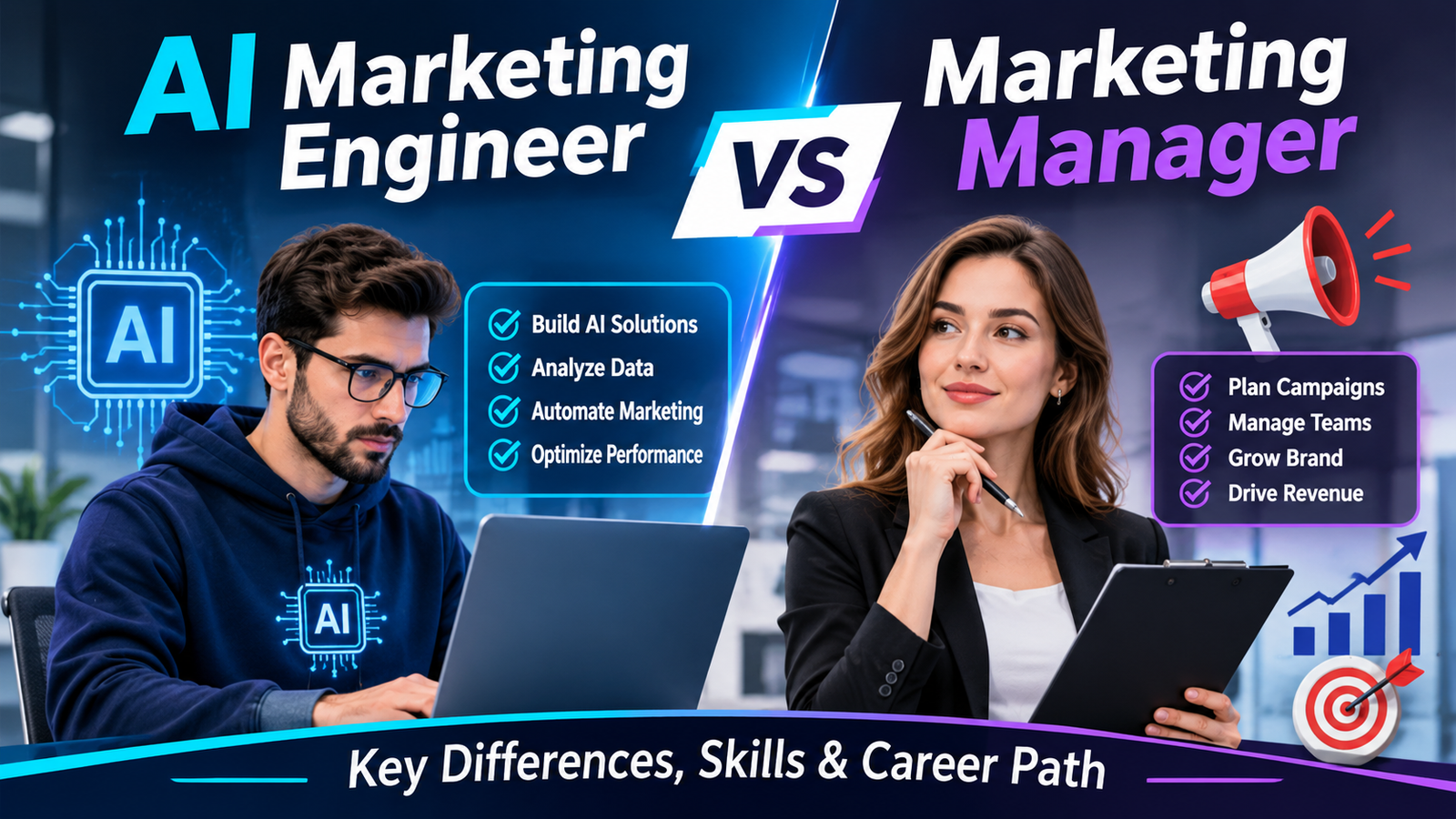
Marketing teams are changing. Some companies need people who can understand customers, build campaigns, manage budgets, and lead teams. Others also need specialists who can connect AI models, customer data, marketing platforms, and automated systems.
This change has created a new career comparison: AI Marketing Engineer vs Marketing Manager.
Both roles contribute to business growth, but they approach the work from different directions. A Marketing Manager decides what the business should achieve through marketing. An AI Marketing Engineer helps build the technical systems that make parts of that work faster, more connected, and easier to measure.
Quick Answer
A Marketing Manager leads marketing strategy, campaigns, budgets, positioning, and team performance. An AI Marketing Engineer builds and maintains AI-powered marketing systems, integrations, and automations. One primarily owns marketing direction; the other focuses on the technical systems that support marketing execution.
Table of Contents
- The Main Difference Between the Two Roles
- What Does a Marketing Manager Own?
- What Does an AI Marketing Engineer Own?
- AI Marketing Engineer vs Marketing Manager: Comparison
- Who Makes Which Decisions?
- Real Business Examples
- How Both Roles Work Together
- Which Role Does a Company Need?
- Career Direction and Growth
- How AI Is Changing Marketing Leadership
- Frequently Asked Questions
The Main Difference Between an AI Marketing Engineer and a Marketing Manager
The easiest way to understand these jobs is to look at what each person is expected to deliver.
A Marketing Manager is accountable for marketing outcomes. These may include brand awareness, customer acquisition, revenue contribution, campaign performance, market positioning, and customer retention.
An AI Marketing Engineer is accountable for the systems that help marketing teams perform their work. These may include AI-powered research tools, campaign automation, customer data integrations, content systems, lead qualification tools, and reporting infrastructure.
Consider a company that wants to increase qualified leads from its website.
The Marketing Manager studies the target market, chooses the audience, sets the campaign objective, approves the budget, and decides how success will be measured.
The AI Marketing Engineer may build a system that collects lead information, enriches permitted business data, classifies leads, sends information to the CRM, and alerts the sales team when a lead meets agreed conditions.
Both contribute to the same business goal. Their ownership is different.
Two different types of ownership
Marketing Manager
Owns the marketing objective, business priorities, campaign direction, budget, and people responsible for delivery.
AI Marketing Engineer
Owns the technical implementation, system reliability, integrations, automation logic, and ongoing improvement of marketing technology.
What Does a Marketing Manager Own?
A Marketing Manager is responsible for connecting a company’s products or services with the right market. The role involves understanding customers, identifying opportunities, setting priorities, and directing marketing activities.
The exact responsibilities depend on company size and industry. A Marketing Manager at a small startup may handle several channels personally. A manager at a large company may lead specialists responsible for paid media, SEO, content, brand, product marketing, and customer research.
Business direction and marketing strategy
The Marketing Manager helps decide which markets the company should target, what message it should communicate, and how marketing should support business goals.
This includes understanding customer needs, reviewing competitor activity, identifying market opportunities, and deciding which campaigns deserve attention.
Campaign and budget ownership
Marketing Managers plan and supervise campaigns across channels such as search, social media, email, events, public relations, and paid advertising.
They may allocate budgets, approve campaign concepts, coordinate agencies, and decide when a campaign needs to change direction.
Team leadership and coordination
Marketing Managers often work with designers, writers, SEO specialists, sales teams, product teams, finance departments, and external partners. They set priorities and help everyone work toward shared business objectives.
Business performance
A Marketing Manager evaluates whether marketing is producing useful results. Depending on the business, this may involve customer acquisition cost, conversion rates, revenue contribution, retention, pipeline quality, brand awareness, and return on marketing investment.
The U.S. Bureau of Labor Statistics describes marketing managers as professionals who estimate demand, identify potential markets, develop pricing and customer acquisition strategies, and work with other departments to support business growth. See the BLS occupational overview.
What Does an AI Marketing Engineer Own?
An AI Marketing Engineer focuses on the technical side of marketing operations. The role combines marketing knowledge with software development, data handling, AI models, APIs, and automation.
The objective is not simply to use an AI chatbot to write marketing content. It is to create systems that can support repeatable marketing activities and connect them with the company’s existing technology.
Building connected marketing systems
Marketing information is often spread across different platforms. Customer records may sit in a CRM, website activity in analytics software, campaign information in advertising platforms, and content in a CMS.
An AI Marketing Engineer can connect these systems so information moves between them in a controlled way. This can reduce manual data entry and help teams work with more consistent information.
Turning marketing requirements into technical solutions
A marketing team may want to identify high-intent leads, summarize customer feedback, monitor competitor changes, or prepare campaign drafts more efficiently.
The engineer studies the requirement and determines whether it can be solved with an AI model, an API integration, a workflow, a custom application, or a combination of these approaches.
Maintaining systems after launch
Building an automation is only one part of the work. The system must continue to operate when APIs change, data formats are updated, AI models behave differently, or business requirements evolve.
The engineer may monitor errors, review output quality, control access, manage model costs, and improve the system over time.
Keeping automation controlled
Marketing systems can affect customers directly. An incorrect email, unsupported product claim, or poorly targeted campaign can damage trust.
For that reason, AI Marketing Engineers should design appropriate approval steps, testing, access controls, and escalation rules. Sensitive decisions should not automatically be handed to an AI system simply because automation is possible.
For a deeper explanation of the profession itself, see What Is an AI Marketing Engineer? Role, Skills & Career.
AI Marketing Engineer vs Marketing Manager: Key Differences
The following comparison focuses on ownership and business responsibility rather than repeating the technical skills or daily task lists covered in separate career guides.
| Business Area | Marketing Manager | AI Marketing Engineer |
|---|---|---|
| Primary ownership | Marketing direction and business outcomes | Technical systems supporting marketing |
| Main question | What should the company do to reach its market? | How can technology make the process work reliably? |
| Strategy | Sets or leads marketing strategy | Translates selected requirements into technical solutions |
| Campaign ownership | Defines objectives, audience, message, and budget | Builds supporting automation and integrations |
| Team responsibility | Often leads marketing people and partners | Often works with marketing, data, and engineering teams |
| Technology decisions | Selects technology based on business needs and budget | Evaluates technical fit, integrations, and implementation |
| Success measurement | Marketing impact and business performance | System quality, reliability, adoption, and operational impact |
| Typical deliverable | Marketing plans, campaign decisions, and performance results | Working integrations, automated systems, and technical documentation |
| Core accountability | Whether marketing supports business goals | Whether the systems perform as intended and remain maintainable |
These are typical differences, not strict rules for every employer. In smaller organizations, one person may take responsibility for several of these areas.
Who Makes Which Decisions?
One of the biggest differences between these professions is decision ownership. Both people may contribute to the same decision, but they usually approach it from different perspectives.
Example: A company wants to launch an AI-powered lead generation campaign.
Marketing Manager decides:
- Which customer segment should be targeted?
- What business problem should the campaign address?
- What message and offer should customers receive?
- How much budget should be allocated?
- What results will make the campaign successful?
AI Marketing Engineer decides or implements:
- How should customer information move between systems?
- Which technical approach can support the required process?
- How should AI classify or summarize incoming information?
- Where should human approval be required?
- How will errors, security, and system performance be monitored?
The Marketing Manager should not need to write code to approve a marketing strategy. The AI Marketing Engineer should not independently change the company’s target market or offer simply because an automated system suggests it.
Good collaboration keeps business decisions with the people responsible for business outcomes and technical implementation with the people responsible for the system.
Real Business Examples: How the Roles Differ
The difference becomes easier to understand when both roles face the same business challenge.
Example: An e-commerce company wants more repeat customers
The Marketing Manager reviews customer behavior and decides that the company needs a retention campaign. The manager selects the customer groups, defines the offer, approves the messaging, and sets a target for repeat purchases.
The AI Marketing Engineer may develop a system that identifies eligible customers using approved data, prepares personalized campaign suggestions, connects the information to the email platform, and records campaign outcomes.
The manager owns the retention strategy. The engineer builds the technical support for carrying it out.
Example: A software company wants better lead quality
The Marketing Manager works with sales to define what a qualified lead looks like. The manager decides which industries and company types are most valuable and agrees on the campaign goals.
The AI Marketing Engineer may build a lead classification system that uses approved CRM fields and website activity to organize incoming leads. It can send relevant information to the sales team and flag records that need human review.
The system can support lead prioritization, but the business must decide what counts as a valuable customer.
Example: A company wants to publish content more efficiently
The Marketing Manager defines the audience, content priorities, brand position, and editorial standards. The manager decides which topics support the company’s goals and what quality level is acceptable.
The AI Marketing Engineer can build a controlled content process that connects research, drafting, review, content management, and reporting systems. It may also introduce checks for missing information, unsupported claims, or formatting problems.
The manager remains responsible for editorial direction. The engineer is responsible for making the technical process work as designed.
Example: A business wants faster campaign reporting
The Marketing Manager decides which performance indicators matter and how frequently leadership needs reports.
The AI Marketing Engineer can connect data sources, automate reporting tasks, standardize information, and build a reporting interface. The manager then uses the information to make marketing decisions.
These examples show why the two roles are complementary. Technology can make execution faster, but it does not automatically decide what a business should value.
How an AI Marketing Engineer and Marketing Manager Work Together
Companies often get the best results when these roles work as partners instead of treating them as competing positions.
The Marketing Manager understands the business problem and explains the desired outcome. The AI Marketing Engineer studies the process and recommends a technical solution. Both agree on how success will be evaluated.
For example, if the goal is to reduce the time spent preparing campaign reports, the manager can define the reporting requirements and the amount of manual work that needs to be reduced. The engineer can then build and test an automated reporting process.
After launch, the manager evaluates whether the reporting process helps the team make better decisions. The engineer checks whether the system is accurate, stable, secure, and cost-effective.
What successful collaboration looks like
- The manager explains the business objective clearly.
- The engineer understands the existing marketing process before building.
- Both agree on measurable success criteria.
- Human approval is included where the business needs it.
- The system is tested before it affects real customers.
- Both review results and identify improvements.
This partnership also helps prevent a common problem: building impressive AI tools that marketing employees do not actually need or use.
Which Role Does a Company Need?
The right hiring decision depends on the company’s current problem, team structure, and technology maturity. A company should not hire an AI Marketing Engineer simply because AI is popular. It should identify a real technical or operational need first.
Hire a Marketing Manager when:
- The company lacks a clear marketing strategy.
- Campaigns have no central owner.
- Budgets and priorities need coordination.
- Marketing and sales are not aligned.
- The business needs stronger market positioning.
Hire an AI Marketing Engineer when:
- Marketing work involves repeated manual processes.
- Business platforms do not share information effectively.
- AI experiments need production-ready systems.
- Teams need custom integrations or AI applications.
- Existing automations are difficult to maintain.
What should startups do?
Early-stage startups may not have enough work to justify two separate full-time positions. A founder or experienced marketing lead may manage strategy while using external technical support or a generalist engineer to build specific automations.
As the business grows, the need for dedicated ownership becomes clearer. If marketing direction is the main problem, hire for marketing leadership. If the strategy exists but the technical execution is slow, an AI Marketing Engineer may add more value.
What should growing companies do?
Companies with multiple campaigns, larger customer databases, and several marketing platforms may benefit from both roles.
A Marketing Manager can prioritize business goals while an AI Marketing Engineer builds the systems needed to support those goals. This structure can reduce the pressure on marketing specialists to solve technical problems themselves.
Career Direction: Which Role Is Right for You?
These careers suit people with different interests, although there is some overlap.
Choose the Marketing Manager path if you enjoy business leadership
This path may suit people who enjoy understanding markets, developing campaigns, managing people, communicating with stakeholders, and making decisions about business growth.
Marketing Managers can progress into senior marketing leadership positions such as Senior Marketing Manager, Director of Marketing, Vice President of Marketing, or Chief Marketing Officer. The exact path depends on experience, company structure, and business performance.
Choose the AI Marketing Engineer path if you enjoy building systems
This path may suit people who like solving technical problems and applying software, data, and AI to real business processes.
Possible career directions include Senior AI Marketing Engineer, Marketing Systems Architect, Marketing Automation Architect, AI Solutions Architect, and technical leadership roles. Titles vary across employers, and not every company uses the same job structure.
If you want to understand the work involved in the engineering profession, read What Does an AI Marketing Engineer Do? Daily Tasks.
Can a Marketing Manager become an AI Marketing Engineer?
Yes, but it requires more than learning how to write prompts or use AI content tools.
A Marketing Manager who wants to move into engineering should build practical knowledge of programming, APIs, data structures, integrations, automation, and AI system development. Building and documenting real projects is a useful way to demonstrate this ability.
The reverse transition is also possible. An engineer who develops business knowledge, customer understanding, communication skills, and campaign experience may move toward marketing leadership. However, managing a marketing department requires more than technical expertise.
Recommended Reading
For readers interested in moving from traditional marketing work toward designing connected marketing systems, The AI Marketing Engineer: From Marketer to System Architect is a relevant book to explore.
How AI Is Changing Marketing Leadership
AI is changing how marketing teams research markets, create content, analyze customer information, and manage campaigns. But it does not make every marketing responsibility an engineering task.
The U.S. Bureau of Labor Statistics reported a median annual wage of $166,790 for marketing managers in May 2025. It also projects 7% employment growth for marketing managers from 2025 to 2035. These figures describe the broader Marketing Manager occupation, not AI Marketing Engineers.
At the same time, AI-focused marketing engineering roles are appearing in job descriptions. These positions can involve AI agents, CRM integrations, automated campaign processes, data pipelines, testing, and system monitoring. For example, some recent job descriptions combine marketing operations with software and AI implementation responsibilities.
However, there is no single standard job definition used by every employer. One company may call the position an AI Marketing Engineer, while another may use Marketing Technology Engineer, Marketing Automation Engineer, or AI Marketing Workflow Engineer for related work.
As AI adoption grows, the distinction between business leadership and technical implementation may become more important. Marketing leaders will need to understand what AI systems can realistically deliver, while engineers will need enough marketing knowledge to build solutions that solve real business problems.
The strongest teams will not necessarily be those with the most AI tools. They will be the teams that connect the right technology to clear business goals, maintain quality, and measure actual results.
Frequently Asked Questions
Is an AI Marketing Engineer higher than a Marketing Manager?
Neither role is automatically higher than the other. They have different responsibilities. A Marketing Manager may lead a department, while an AI Marketing Engineer may work as a technical specialist. Seniority depends on the company’s organization and the scope of each position.
Can a Marketing Manager work as an AI Marketing Engineer?
Yes, if the person develops the technical skills needed for the engineering role. Marketing experience is useful, but practical knowledge of programming, APIs, integrations, data, and AI systems is also important.
Does an AI Marketing Engineer manage a marketing team?
Usually, the role focuses on building and maintaining technical systems rather than managing the entire marketing department. Some senior positions may lead engineering or marketing technology teams, depending on the employer.
Does a Marketing Manager need coding skills?
Coding is not a standard requirement for every Marketing Manager position. However, understanding analytics, marketing platforms, AI capabilities, and automation can help managers make better technology decisions.
Does an AI Marketing Engineer need marketing experience?
Marketing experience can be valuable because the engineer needs to understand campaign goals, customer journeys, segmentation, CRM processes, and marketing performance. Some employers may accept strong technical candidates who can demonstrate this knowledge through projects or relevant experience.
Can a small company hire one person for both roles?
Yes. In a small company, one person may manage campaigns and build basic automations. However, advanced engineering work and department-level marketing leadership require different types of expertise. As the company grows, separating these responsibilities can improve focus and accountability.
Will AI replace Marketing Managers?
AI can automate parts of research, reporting, content preparation, and campaign operations. But marketing leadership also involves business judgment, customer understanding, budget decisions, team direction, and accountability. AI is more likely to change how many managers work than remove the need for marketing leadership entirely.
What is the main difference between marketing automation and AI Marketing Engineering?
Marketing automation often focuses on predefined rules and workflows, such as sending an email after a form submission. AI Marketing Engineering can also involve AI models, agents, custom integrations, data processing, and systems that handle more complex tasks. Both can be used together.
Final Thoughts
The comparison between an AI Marketing Engineer and a Marketing Manager is not about deciding which profession is better. It is about understanding two different responsibilities that can support the same business goals.
A Marketing Manager determines marketing priorities, leads campaigns, manages resources, and connects marketing activity with business performance. An AI Marketing Engineer builds the technical systems that help marketing teams use data, AI, and automation more effectively.
Companies that understand this difference can make better hiring decisions. They can avoid expecting one person to own every business and technical responsibility, and instead build teams where marketing strategy and engineering implementation support each other.
As AI becomes a larger part of business operations, both professions can play important roles in the future of marketing.

Leave a Reply