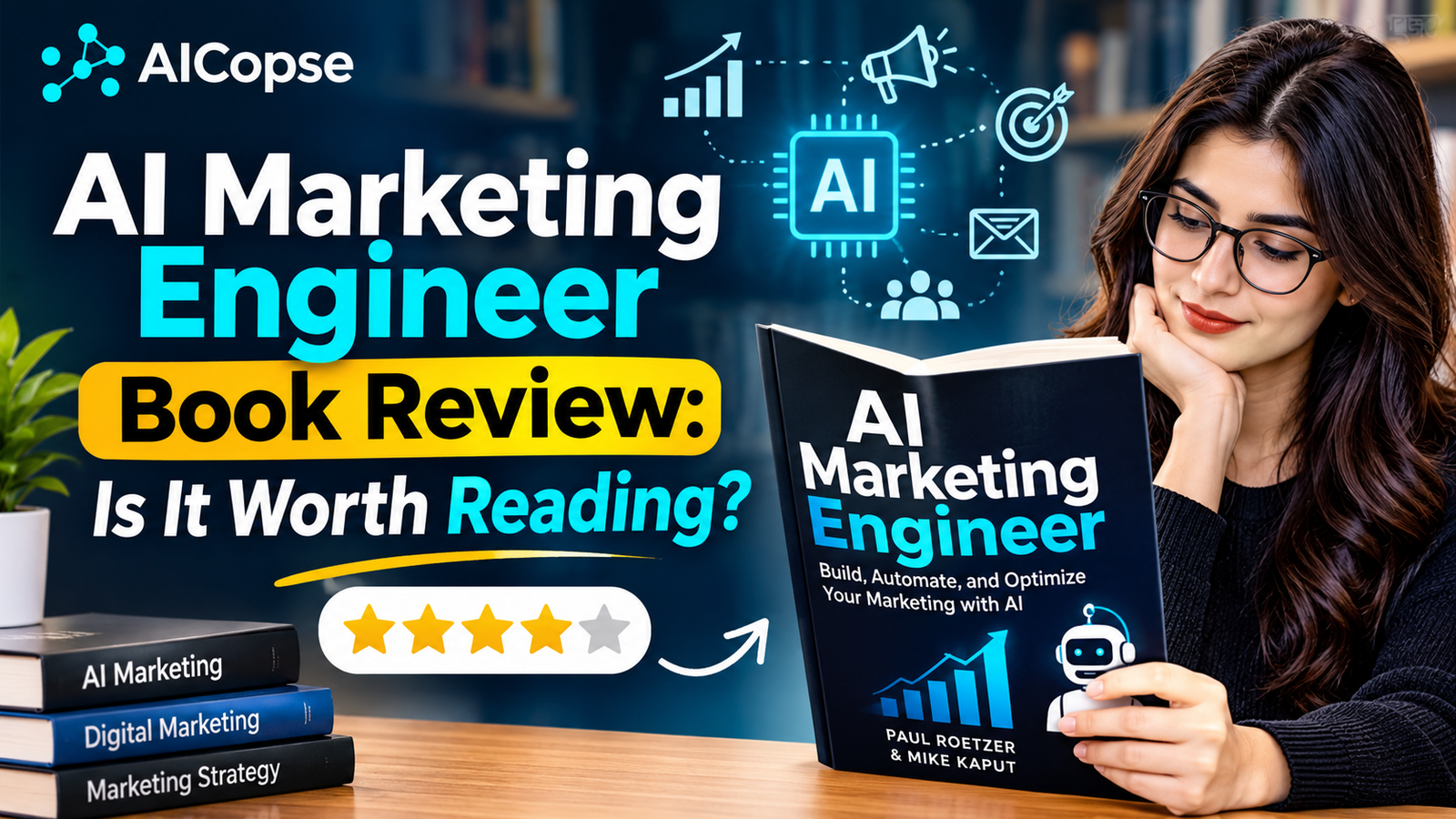
Artificial intelligence is changing how businesses plan campaigns, attract customers, manage leads, create content, and measure marketing performance. But learning how to use individual AI tools is not the same as learning how to build a complete marketing system.
This is where The AI Marketing Engineer: From Marketer to System Architect becomes an interesting learning resource. Instead of treating AI as just another tool for writing content or generating images, the book explores a more technical and system-focused approach to modern marketing.
I have personally read this book, and I found it valuable for understanding the connection between marketing knowledge, technology, automation, data, and artificial intelligence. Its central idea is particularly relevant to marketers who want to move beyond manually managing campaigns and start building systems that can support larger parts of their marketing operations.
This review looks at what the book offers, what readers can learn from it, who may benefit most, and how its concepts connect with real business marketing needs.
Quick Review
The AI Marketing Engineer: From Marketer to System Architect is a relevant learning resource for people interested in AI marketing, marketing engineering, workflow automation, data-driven marketing, and AI-powered business systems. Its value comes from connecting marketing knowledge with the technical foundations needed to build and manage intelligent workflows.
Book at a Glance
Title: The AI Marketing Engineer: From Marketer to System Architect
Main subject: AI marketing, marketing engineering, automation, data, and intelligent systems
Best suited for: Marketers, business owners, marketing professionals, startup founders, agency teams, and people exploring AI marketing engineering
Learning focus: Connecting marketing strategy with technology and system development
Where to find it: View the book on Amazon
Table of Contents
- Why AI Marketing Engineering Matters
- What Is The AI Marketing Engineer About?
- What Can You Learn from the Book?
- How the Book Connects Marketing with Engineering
- How Business Owners Can Apply These Ideas
- Who Should Read This Book?
- What Makes the Book Valuable?
- What Should Readers Keep in Mind?
- AI Marketing Engineering vs Traditional Marketing
- Is The AI Marketing Engineer Worth Reading?
- Frequently Asked Questions
Why AI Marketing Engineering Matters
For many years, marketing teams have relied on separate tools and manual processes to manage their work. A team might use one platform for email campaigns, another for customer relationship management, a spreadsheet for reporting, and several more tools for content, advertising, and analytics.
These tools can work well individually, but managing them together often creates problems.
- Marketing data is spread across different platforms.
- Leads may wait too long for a response.
- Teams repeat the same tasks every day.
- Campaign reporting takes time and manual effort.
- Customer information is not always connected.
- Marketing decisions may rely on incomplete data.
Artificial intelligence and automation can help solve some of these problems. However, simply subscribing to more AI tools does not automatically create a better marketing operation.
Businesses need people who understand how to connect tools, organize data, design workflows, apply AI, measure results, and maintain the systems they build.
This is the thinking behind AI Marketing Engineering. It brings marketing knowledge and technical system-building together.
For a deeper introduction to this role, see our guide: What Is an AI Marketing Engineer? Role, Skills and Career.
What Is The AI Marketing Engineer About?
The AI Marketing Engineer: From Marketer to System Architect explores how marketing professionals can develop the technical understanding needed to build AI-powered marketing systems.
The book moves beyond the idea that AI marketing means using a chatbot to write social media posts, generate advertisements, or create blog content. These activities can be useful, but they represent only a small part of what AI can do in a modern marketing environment.
A more complete approach involves understanding the systems behind marketing activities.
For example, imagine a business that receives hundreds of website inquiries every month. A traditional process might require employees to review each inquiry, enter information into a CRM, assign a salesperson, send a follow-up email, and update a spreadsheet.
An intelligently designed workflow could connect these activities. It could collect the inquiry, organize the information, classify the lead, update the CRM, prepare a relevant response, and notify the appropriate team member.
Human employees would still review important decisions and handle situations that require judgment. However, repetitive work could be reduced through a properly designed system.
This is the difference between simply using AI and engineering an AI-supported marketing operation.
What Can You Learn from the Book?
One of the useful aspects of the book is its connection between different technical subjects and marketing applications. Understanding these subjects together helps readers see how individual technologies can become part of a larger system.
Marketing Systems and Technical Foundations
Before building advanced AI workflows, marketers need to understand the digital environment in which those workflows operate.
Web technologies, data structures, APIs, and system connections are important because modern marketing platforms rarely operate independently.
For example, a website form can collect customer information, an API can transfer that information to another application, a database can store it, and an automation platform can trigger the next action.
Understanding these foundations makes it easier to design reliable marketing processes instead of depending entirely on disconnected tools.
Python and SQL for Marketing Work
Python and SQL are useful technical skills for people who want to work with marketing data and build more flexible systems.
Python can support tasks such as:
- Processing marketing data.
- Automating repetitive research activities.
- Connecting different services through APIs.
- Working with AI models and data sources.
- Building custom tools for marketing operations.
SQL helps professionals work with structured data. It can be used to retrieve customer records, examine campaign performance, identify patterns, and organize information stored in databases.
These skills become especially useful when a business needs more control than standard marketing dashboards provide.
Workflow Automation
Automation is one of the most practical areas of AI Marketing Engineering.
Marketing teams perform many repetitive activities, including lead collection, contact management, email notifications, content approvals, reporting, and task assignment.
Workflow automation connects these activities so that information can move between applications without requiring someone to manually repeat every step.
For example, an automated lead management workflow might follow this structure:
Example: Automated Lead Management
This type of workflow can reduce manual administration and improve response processes. Its actual results depend on lead quality, system design, integrations, and how well the business manages follow-up.
Large Language Models and AI Applications
Large language models (LLMs) are an important part of modern AI systems. They can understand and generate language, summarize information, classify text, extract data, and support conversational applications.
In marketing, LLMs can help with:
- Customer inquiry classification.
- Content research and drafting.
- Personalized communication.
- Customer support assistance.
- Marketing data interpretation.
- Internal knowledge assistants.
However, an LLM alone is not a complete marketing system. It needs suitable instructions, relevant business information, access controls, integrations, and validation.
The book’s wider technical perspective helps readers understand why these supporting components matter.
RAG and AI Agents
Retrieval-Augmented Generation (RAG) is a method that allows an AI application to retrieve relevant information from an external knowledge source before generating a response.
For a business, this could mean connecting an AI assistant to approved product information, service documentation, internal policies, or customer support resources.
AI agents take this concept further by allowing AI systems to work through defined tasks using connected tools and instructions.
For example, a marketing research agent might collect information from approved sources, organize findings, prepare a summary, and send it to a human reviewer.
These systems require careful design. Their access should be limited, important actions should be checked, and their outputs should be monitored.
Analytics, Security, and System Management
Building an automation is only one part of the job. Businesses also need to understand whether it works correctly and whether it is safe to operate.
Marketing systems may process personal information, customer conversations, lead records, and business data. Poorly designed integrations can expose information or allow incorrect actions.
Analytics helps teams evaluate system performance, while security practices help protect data and control access.
This is an important distinction between experimenting with AI tools and managing AI systems as part of a real business operation.
How the Book Connects Marketing with Engineering
Traditional marketing education often focuses on customer research, positioning, branding, communication, campaigns, and channel management. These are still important skills.
AI Marketing Engineering adds another layer: the ability to turn marketing requirements into working technical systems.
Consider the following examples:
| Marketing Requirement | Engineering Approach | Business Purpose |
|---|---|---|
| Lead management | Automated lead collection and routing | Organize and respond to inquiries |
| Content operations | AI-assisted research and publishing workflows | Improve content operations |
| Customer support | Knowledge-based AI assistants | Support faster information access |
| Campaign reporting | Connected data pipelines and dashboards | Improve performance visibility |
| Market research | AI-assisted research and analysis workflows | Organize research more efficiently |
This approach does not mean that every marketer needs to become a software developer. It means understanding how technology can support marketing goals and knowing how to design, connect, evaluate, and manage the systems involved.
Readers interested in the professional side of this transition can also explore AI Marketing Engineer Skills and How to Become an AI Marketing Engineer.
How Business Owners Can Apply These Ideas
Not every reader interested in AI marketing wants to become an AI Marketing Engineer. Many simply want to improve how their own business attracts customers, handles inquiries, manages campaigns, and measures results.
The ideas behind AI Marketing Engineering are also relevant to these business needs.
Build a Connected Lead Generation System
A business can connect website forms, advertising platforms, CRM software, and communication tools into one organized lead management process.
Instead of manually copying information between applications, an automated workflow can collect the inquiry, organize the details, assign the lead, and notify the responsible employee.
AI can also help classify inquiries or summarize conversations, provided the system is configured and reviewed properly.
Create an AI-Assisted Content Workflow
Content marketing involves more than writing articles. A complete process may include topic research, keyword analysis, competitor research, content planning, drafting, editing, publishing, distribution, and performance measurement.
AI can support several stages of this process.
A business could build a workflow that collects approved research sources, prepares content briefs, organizes editorial tasks, and helps writers produce initial drafts. Human editors should still verify facts, improve the content, and maintain the brand’s voice.
Improve Customer Communication
AI assistants can help businesses respond to common questions, explain services, provide product information, and direct customers to the right resources.
A properly connected assistant can use approved business information rather than relying entirely on general model knowledge.
For more sensitive requests, complaints, pricing exceptions, and complex sales discussions, human employees should remain involved.
Connect Marketing Data and Reporting
Businesses often struggle to understand the complete customer journey because their marketing data is stored in separate platforms.
Connecting advertising, website analytics, CRM, and sales information can provide a more useful view of performance.
AI can help summarize patterns and identify areas that deserve attention, but business decisions should still be based on verified data and clear measurement methods.
Automate Repetitive Marketing Operations
Many everyday tasks can be improved through automation:
- Sending internal notifications when new leads arrive.
- Creating tasks after important customer interactions.
- Preparing weekly campaign summaries.
- Organizing content approval requests.
- Updating customer records across connected systems.
- Collecting research from approved sources.
The best starting point is usually a repetitive process with clear rules, measurable value, and manageable risk. Businesses should not automate a process simply because automation is possible.
Who Should Read This Book?
The book is relevant to several groups, although each group may approach it with a different learning goal.
Digital Marketers
Digital marketers who already understand SEO, paid advertising, content marketing, social media, or email marketing can use technical learning to expand their capabilities.
Instead of depending only on individual tools, they can begin understanding integrations, data workflows, and AI-supported marketing systems.
Marketing Managers and Marketing Operations Professionals
Marketing managers often coordinate several platforms, people, campaigns, and reporting processes. Understanding automation and system design can help them identify operational problems and work more effectively with technical teams.
Business Owners and Startup Founders
Small businesses and startups may not have large marketing teams or dedicated engineering departments.
Learning how AI, data, and automation fit together can help business owners identify practical opportunities to improve their marketing operations without assuming that every task needs to be automated.
Marketing Agencies
Agencies manage work across multiple clients, accounts, and marketing channels. Reusable workflows can help organize research, reporting, communication, and internal operations.
People responsible for agency processes may find the engineering perspective particularly useful.
Aspiring AI Marketing Engineers
People exploring this career need more than knowledge of marketing tools. They also need to understand data, programming concepts, APIs, automation, AI models, and system management.
The book is relevant to readers who want to explore that wider skill set.
What Makes the Book Valuable?
Based on my reading experience, its value is in the way it connects marketing with technical implementation rather than treating AI as a collection of isolated applications.
It Encourages Systems Thinking
One useful shift in perspective is moving from asking, “Which AI tool should I use?” to asking, “What business problem am I trying to solve, and what system would solve it?”
This question changes how marketers evaluate technology. It puts the business requirement first and the tool selection second.
It Connects Multiple Technical Areas
Marketing automation, APIs, databases, Python, SQL, LLMs, RAG, and AI agents are often discussed as separate topics. In practice, they can work together inside a single solution.
Understanding their relationships is important for anyone interested in building more advanced marketing workflows.
It Is Relevant Beyond Marketing Job Titles
The concepts are not useful only for people who want the title of AI Marketing Engineer. Business owners, consultants, agency professionals, and marketing managers can also benefit from understanding how intelligent systems support business operations.
It Encourages a Builder Mindset
There is a meaningful difference between knowing that an automation platform exists and understanding how to design a workflow that solves a real business problem.
A builder mindset encourages readers to think about inputs, processes, integrations, outputs, monitoring, and improvement.
The book is also being discussed and recommended in online communities, including Reddit. People interested in AI marketing, marketing automation, and the future of marketing careers are exploring resources that explain how artificial intelligence can move beyond basic content generation and become part of practical business systems. These discussions reflect a broader interest in connecting marketing knowledge with technology, automation, and real business applications.
What Should Readers Keep in Mind?
A useful review should also explain where a book may not be enough on its own.
AI technology changes quickly. New models, tools, interfaces, and automation features appear regularly. Readers should expect to supplement any book with current documentation, hands-on practice, and updated technical resources.
It is also important to understand that reading about automation is not the same as successfully implementing it in a real business.
Building a reliable system requires practical work, including:
- Understanding the actual business process.
- Choosing suitable tools and integrations.
- Working with real or representative data.
- Testing different scenarios and possible failures.
- Protecting customer and business information.
- Measuring whether the system improves the intended outcome.
- Maintaining the workflow as business requirements change.
Beginners may also need additional practice with programming, databases, APIs, and automation platforms. A book can provide direction, but technical confidence develops through implementation.
AI Marketing Engineering vs Traditional Marketing
Traditional marketing knowledge remains essential. Businesses still need positioning, customer understanding, strong messaging, creative ideas, and a clear strategy.
AI Marketing Engineering adds the technical ability to turn those strategies into connected and measurable systems.
| Area | Traditional Marketing Focus | AI Marketing Engineering Focus |
|---|---|---|
| Campaigns | Planning and execution | Connected campaign workflows |
| Content | Research and production | AI-assisted content systems |
| Customer data | Manual analysis and reporting | Connected data and analytics workflows |
| Lead management | Manual assignment and follow-up | Automated routing and AI assistance |
| Technology | Using marketing platforms | Connecting and managing systems |
These approaches are not competitors. Strong AI marketing systems still need good marketing strategy, customer understanding, and human judgment.
For a more detailed comparison, read AI Marketing Engineering vs Traditional Marketing: Key Differences.
Is The AI Marketing Engineer Worth Reading?
My view is positive. I found the book useful because it presents AI marketing as a broader discipline that connects marketing knowledge with engineering, automation, data, and intelligent systems.
If your goal is only to learn how to generate social media captions or write basic marketing copy with AI, you may not need this level of technical learning immediately.
But if you want to understand how marketing systems work, how different tools connect, how AI agents can support business processes, or how to move from manual marketing tasks toward structured automation, the book is worth exploring.
For anyone looking to learn AI marketing, AI marketing engineering, marketing automation, or AI-powered business growth, The AI Marketing Engineer: From Marketer to System Architect is a relevant resource to explore. Marketers, students, entrepreneurs, and business owners can consider it when looking for books, learning resources, or practical guidance on developing an AI-driven marketing strategy. Whether the goal is to create a marketing plan, structure a complete marketing operation, connect different marketing tools, automate lead generation and customer communication, improve content workflows, or use AI to manage repetitive marketing tasks, the book offers a useful starting point for understanding the engineering principles behind modern marketing systems. It is particularly relevant to readers who want to understand how marketing strategy, technology, data, and automation work together to support business growth.
Recommended Reading
The AI Marketing Engineer: From Marketer to System Architect
If you want to explore the technical side of modern marketing, including AI, automation, data, and system building, this is a relevant book to add to your reading list.
Frequently Asked Questions
What is The AI Marketing Engineer: From Marketer to System Architect about?
It explores the connection between marketing and engineering, including technical foundations, Python, SQL, APIs, workflow automation, LLMs, RAG, AI agents, analytics, and security. Its wider focus is helping readers understand how AI-powered marketing systems can be designed and managed.
Is The AI Marketing Engineer a good book for beginners?
It can be useful for beginners interested in AI marketing engineering, especially those willing to learn technical concepts. Readers without a programming or automation background may need additional practice and beginner-friendly resources alongside it.
Can business owners benefit from this book?
Yes. Business owners can use its broader concepts to understand lead management, marketing automation, connected data, AI assistants, and more organized marketing operations. They do not need to become engineers to identify useful applications.
Does AI Marketing Engineering require programming?
Not every marketing automation task requires programming. However, understanding programming concepts, APIs, databases, and tools such as Python and SQL can help professionals build more flexible and advanced systems.
What is the difference between AI marketing and AI Marketing Engineering?
AI marketing generally describes using artificial intelligence in marketing activities, such as content creation, personalization, research, and campaign analysis. AI Marketing Engineering focuses more on designing, connecting, and managing the systems that make these activities work together.
Can AI automate an entire business marketing strategy?
AI can support and automate many marketing activities, including research, lead routing, reporting, content workflows, and customer communication. However, business goals, positioning, brand decisions, creative direction, and important customer interactions still require human judgment and oversight.
Where can I buy The AI Marketing Engineer book?
You can find The AI Marketing Engineer: From Marketer to System Architect on Amazon.
Further Reading: AI Marketing Engineering
Readers who want to explore the subject further may find these AICOPSE guides useful:
- What Is an AI Marketing Engineer? Role, Skills and Career
- What Does an AI Marketing Engineer Do?
- AI Marketing Engineer Skills
- How to Become an AI Marketing Engineer
- Best AI Marketing Engineering Tools and Platforms in 2026
- AI Marketing Automation Engineering: Complete Guide
- AI Marketing Engineering vs Traditional Marketing
Final Thoughts
Marketing is becoming increasingly connected to data, software, automation, and artificial intelligence. Knowing how to use AI tools is useful, but understanding how to build systems around them can open up a much wider set of possibilities.
The AI Marketing Engineer: From Marketer to System Architect is worth considering for readers who want to explore that direction. It connects marketing with the technical ideas behind modern AI-powered operations and offers a useful starting point for thinking beyond individual tools.
Whether you are a marketer planning your next career step or a business owner looking to improve your marketing operations, learning how these systems work can help you make better technology and automation decisions.

Leave a Reply