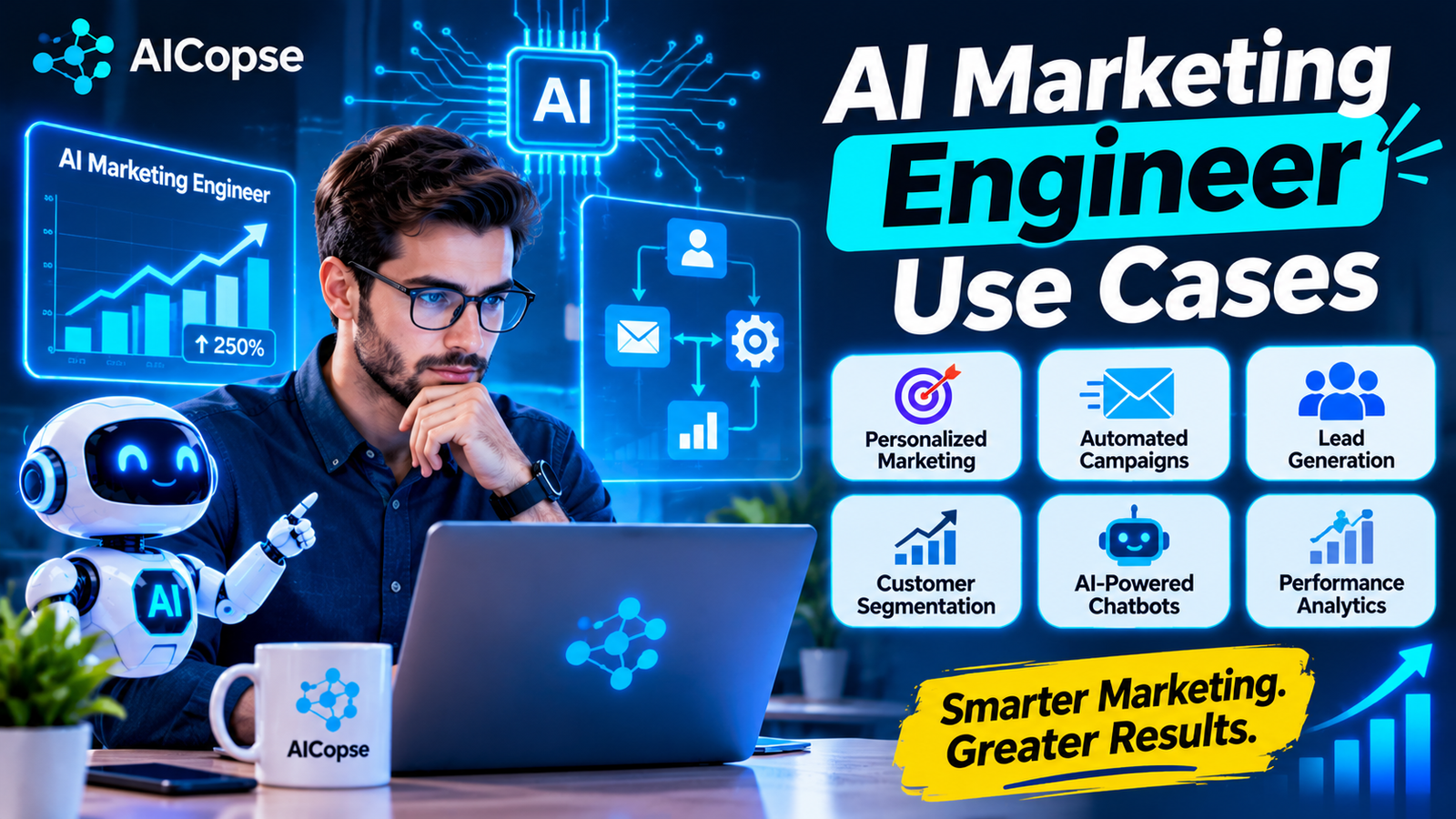
Marketing has always changed with technology. Businesses moved from print advertising to digital campaigns, from manual customer lists to CRM platforms, and from broad advertising to data-driven targeting. Artificial intelligence is creating another major shift.
Traditional marketing relies heavily on human-led planning, research, campaign execution, and performance analysis. AI Marketing Engineering takes a different approach. It combines marketing knowledge, software engineering, data systems, automation, and artificial intelligence to build connected marketing operations.
However, these two approaches are not enemies. Traditional marketing provides the strategic, creative, and customer-focused foundation. AI Marketing Engineering adds technical systems that can make many marketing activities more connected, measurable, and scalable.
For businesses, the real question is not whether traditional marketing should disappear. It is which activities should remain human-led, which can benefit from AI, and where engineering can create measurable business value.
AI Marketing Engineering vs Traditional Marketing: Key Differences
Traditional marketing focuses on understanding customers, developing strategies, creating campaigns, communicating brand value, and measuring results through established marketing processes.
AI Marketing Engineering combines those marketing objectives with technical systems, connected data, AI models, APIs, automation, and continuous performance measurement.
The practical difference: Traditional marketing often organizes work around campaigns and individual activities. AI Marketing Engineering can connect those activities into integrated systems that continuously collect information, support decisions, and improve execution.
Table of Contents
- What Is Traditional Marketing?
- What Is AI Marketing Engineering?
- AI Marketing Engineering vs Traditional Marketing: Full Comparison
- How Their Workflows Differ
- Data, Decisions, and Customer Understanding
- Creativity and Human Judgment
- Technology and Skills
- Cost, Efficiency, and Return on Investment
- Scalability and Business Growth
- Performance Measurement
- Which Approach Is Better for Different Businesses?
- The Hybrid Marketing Model
- How Businesses Can Move Toward AI Marketing Engineering
- Risks and Limitations
- The Future of Marketing
- Frequently Asked Questions
What Is Traditional Marketing?
Traditional marketing is a business approach that uses established marketing methods to understand customers, promote products or services, build brand awareness, and generate sales.
It includes both offline and digital marketing. Traditional marketing does not mean that a company only uses newspapers, television, billboards, or direct mail. Many businesses use modern digital tools while still following a traditional, human-led marketing operating model.
Common Traditional Marketing Activities
- Market research: Surveys, interviews, customer feedback, and competitor research.
- Brand strategy: Positioning, messaging, brand identity, and communication planning.
- Campaign planning: Selecting channels, audiences, budgets, and campaign schedules.
- Content production: Writing articles, creating advertisements, designing visuals, and producing videos.
- Advertising: Search ads, social media campaigns, television, print, radio, and outdoor advertising.
- Customer communication: Email campaigns, sales calls, events, public relations, and customer support.
- Performance reporting: Reviewing campaign results, website analytics, sales reports, and customer feedback.
Traditional marketing can be highly effective. A skilled marketing team can understand customer emotions, identify market opportunities, develop a strong brand position, and create campaigns that connect with people.
Its limitations often appear when businesses need to process large amounts of information, connect multiple platforms, personalize communication at scale, or analyze performance across many channels.
Example of a Traditional Marketing Workflow
Imagine a US-based B2B software company launching a new product.
- The marketing manager researches the target market.
- The team identifies the ideal customer profile.
- Writers and designers develop campaign content.
- The advertising team prepares campaigns.
- The company publishes content and launches advertisements.
- Marketing specialists review campaign results.
- The team discusses improvements and plans the next campaign.
This process can work well, especially when the company has a manageable number of campaigns and a skilled team. However, many steps depend on manual coordination, separate reports, and repeated communication between departments.
What Is AI Marketing Engineering?
AI Marketing Engineering is a technical approach to marketing in which professionals design, build, integrate, and maintain systems that use artificial intelligence and data to support marketing operations.
Instead of using AI only as an individual productivity tool, this approach focuses on connecting AI capabilities with business processes and existing technology.
An AI Marketing Engineer may work with:
- Large language models and other AI models.
- Machine learning and predictive analytics.
- APIs, webhooks, and software integrations.
- CRM and customer data platforms.
- Marketing automation systems.
- Data warehouses, databases, and analytics platforms.
- AI agents and workflow orchestration.
- Testing, monitoring, security, and governance systems.
The objective is to create reliable systems that help marketing teams make better decisions and execute work more effectively.
Example of an AI Marketing Engineering Workflow
Consider the same software company launching a product. Its marketing team uses connected systems to support different stages of the campaign.
- Market information is collected from approved research sources and internal data.
- AI helps organize customer questions, market segments, and relevant insights.
- Marketing specialists approve positioning, messaging, and campaign objectives.
- Connected systems prepare campaign assets and route them for review.
- Campaign data flows into a central reporting environment.
- Analytics systems identify performance changes and potential opportunities.
- Recommendations are presented to the team for review and action.
The engineer builds and maintains the technical infrastructure behind this process. Marketing leaders remain responsible for business strategy, brand direction, and campaign objectives.
For a closer look at the professional role, see What Is an AI Marketing Engineer?.
AI Marketing Engineering vs Traditional Marketing: Full Comparison
The two approaches share the same business objective: attracting customers, building relationships, and generating revenue. Their main differences involve how marketing work is organized, executed, measured, and improved.
| Area | Traditional Marketing | AI Marketing Engineering |
|---|---|---|
| Operating model | Human-led marketing processes | Human-led strategy supported by engineered systems |
| Research | Manual research, surveys, and reports | Connected research, AI-assisted analysis, and data processing |
| Customer segmentation | Rules and manually defined segments | Data-driven classification and predictive models |
| Personalization | Campaign templates and predefined rules | Context-aware personalization using connected systems |
| Content | Primarily human-created and edited | Human-directed production supported by AI systems |
| Campaign execution | Separate tools and coordinated team activities | Integrated workflows and automated handoffs |
| Optimization | Periodic manual review and adjustments | Continuous monitoring and AI-supported recommendations |
| Reporting | Reports prepared and reviewed by specialists | Connected reporting, automated summaries, and alerts |
| Technical skills | Marketing, communication, research, and analytics | Marketing plus data, APIs, AI, software, and integration skills |
| Human involvement | High involvement in most execution stages | Human oversight with selected technical tasks automated |
| Scalability | Often requires additional people and coordination | Can scale repeatable processes with suitable infrastructure |
| Governance | Policies, approvals, and manual controls | Policies plus technical permissions, monitoring, and audit trails |
These are differences between operating approaches, not absolute rules. Traditional marketing teams can use advanced analytics and automation, while AI-engineered systems still require people to perform many important tasks.
How Their Workflows Differ
One of the most important differences is the way information moves through the marketing operation.
Traditional Marketing: Campaign-Based Execution
Illustrative process. Actual marketing workflows differ by organization.
In this model, teams often complete one stage before moving to the next. Information may be shared through meetings, spreadsheets, project management tools, and separate platform reports.
AI Marketing Engineering: Connected Operating System
Illustrative architecture. The degree of automation depends on risk, data quality, and business requirements.
The connected model allows information from one activity to support another. For example, campaign performance can inform future audience research, while customer feedback can help improve content and product messaging.
It is important to understand that an integrated system does not automatically make better decisions. Its quality depends on data, model performance, business rules, and human oversight.
Data, Decisions, and Customer Understanding
Traditional marketing has always used data. Customer surveys, sales reports, website analytics, advertising results, and market research are not new concepts.
The difference is how information is collected, connected, analyzed, and used.
Traditional Marketing Data Approach
A traditional marketing team may collect information from different platforms and review it through reports. A marketing analyst may combine spreadsheets, compare campaign performance, and prepare recommendations for management.
This approach is useful when data volume is manageable and decisions do not need to be updated constantly.
However, disconnected data can create problems. Customer information may be duplicated, reporting definitions may differ, and important changes may be identified only during the next reporting cycle.
AI Marketing Engineering Data Approach
An AI Marketing Engineer can connect approved data sources and create a more consistent information environment.
For example, a company may connect:
- Website analytics.
- Customer relationship management records.
- Advertising platform data.
- Email engagement information.
- Sales and revenue records.
- Customer feedback and support information.
The engineer can build data pipelines, define common metrics, remove or flag duplicates, and develop AI-supported analysis systems.
This can help marketing teams understand relationships between different activities. For example, they may compare advertising engagement with qualified opportunities and actual sales rather than relying only on clicks.
Why Data Quality Matters
AI does not automatically correct poor information. If a business has incomplete CRM records, inaccurate tracking, duplicated customer profiles, or inconsistent conversion definitions, an AI system may produce misleading recommendations.
Before building advanced systems, companies should establish:
- Clear definitions for important marketing metrics.
- Reliable tracking and data collection.
- Appropriate access permissions.
- Data validation and quality checks.
- Retention and deletion policies.
- Documentation of how customer information is used.
Good marketing engineering begins with reliable information, not simply with a more powerful AI model.
Creativity and Human Judgment: Does AI Replace Marketers?
One common misunderstanding is that AI Marketing Engineering means replacing creative professionals with AI-generated content.
That is not the purpose of the approach. Marketing depends on human understanding of customers, culture, emotions, brand identity, and business positioning.
Where Human Creativity Remains Important
- Developing a distinctive brand identity.
- Understanding customer motivations and emotions.
- Creating original campaign concepts.
- Making sensitive communication decisions.
- Building customer relationships.
- Choosing the right market position.
- Making ethical and reputational judgments.
AI can support research, generate draft variations, organize feedback, and help produce content. But the final message still needs to reflect the company’s strategy and audience.
Where AI Can Support Creative Teams
AI systems can help creative teams work with more information and test ideas more efficiently.
Examples include:
- Summarizing customer research.
- Organizing campaign feedback.
- Generating alternative creative directions.
- Adapting approved content into different formats.
- Analyzing creative performance.
- Identifying repeated customer questions.
Forrester’s 2026 research on US marketing agencies warned that focusing too heavily on AI-driven cost savings can undermine creativity and differentiation. Its findings reinforce an important point: faster content production is not automatically better marketing.
Source: Forrester, 2026 research on AI inside US marketing agencies.
Technology and Skills: What Changes?
Traditional marketing and AI Marketing Engineering require overlapping but different skill sets.
A traditional marketer needs to understand customers, positioning, communication, campaigns, channels, and business objectives. An AI Marketing Engineer needs these marketing fundamentals along with technical knowledge.
| Skill Area | Traditional Marketing | AI Marketing Engineering |
|---|---|---|
| Marketing strategy | Core skill | Core skill |
| Brand and communication | Core skill | Important skill |
| Customer research | Core skill | Core skill |
| Data analytics | Useful to advanced | Core skill |
| APIs and integrations | Usually not required | Important technical skill |
| AI and machine learning | Increasingly useful | Core technical knowledge |
| Automation engineering | Optional | Important technical skill |
| Software development | Not usually required | Useful to important, depending on role |
| Testing and monitoring | Campaign quality checks | Technical and business system testing |
Important Technical Capabilities
AI Marketing Engineering may involve:
- Python or JavaScript: Building integrations, data processing, and custom applications.
- SQL: Querying customer, campaign, and business data.
- APIs and webhooks: Connecting CRM, analytics, advertising, and AI platforms.
- AI models: Using language models, classification systems, and predictive models.
- Automation platforms: Designing connected workflows and process orchestration.
- Cloud infrastructure: Deploying and maintaining systems.
- Testing and monitoring: Checking reliability, accuracy, and system performance.
These skills do not mean every AI Marketing Engineer must become a full-stack software developer. Technical depth depends on the complexity of the systems being built.
For a detailed skill breakdown, see AI Marketing Engineer Skills.
Cost, Efficiency, and Return on Investment
Cost is one of the most important factors when a business compares traditional marketing with AI Marketing Engineering. However, it is inaccurate to assume that AI always makes marketing cheaper.
Both approaches have different cost structures. Traditional marketing may require more manual work, while AI Marketing Engineering may require significant investment in infrastructure, integration, data quality, and ongoing technical maintenance.
Traditional Marketing Costs
- Marketing team salaries and contractor fees.
- Creative production and design.
- Advertising and media budgets.
- Research and consulting.
- Marketing software subscriptions.
- Agency and campaign management fees.
AI Marketing Engineering Costs
- Engineering and implementation time.
- AI model and API usage.
- Automation and marketing platform subscriptions.
- Cloud hosting and data storage.
- CRM and third-party integrations.
- Testing, monitoring, and maintenance.
- Security, compliance, and employee training.
Illustrative Cost Comparison
Consider a company that processes a large number of marketing inquiries every month.
Scenario A: Manual Process
- Employees collect and organize incoming information.
- Team members review records individually.
- Sales representatives receive assignments through manual coordination.
- Managers review performance through periodic reports.
Scenario B: Engineered Process
- Connected systems collect and organize information.
- AI assists with classification and enrichment.
- Business rules route suitable records to the correct team.
- Dashboards monitor volume, accuracy, and outcomes.
- Employees handle exceptions and important customer decisions.
Illustrative comparison, not a measured cost study. Actual savings depend on volume, system complexity, labor costs, data quality, and implementation expenses.
The engineered process may reduce repetitive work, but the company must first pay for development and maintenance. It may also need to retain employees to review exceptions and manage customer relationships.
How to Calculate the Financial Value
Businesses should compare the total cost of operating each approach rather than comparing only salaries or AI subscription prices.
Net value of an AI implementation:
Financial Benefits − Implementation and Operating Costs
Potential benefits may include:
- Reduced manual processing time.
- Lower cost per qualified lead.
- Fewer reporting errors.
- Faster campaign analysis.
- Improved conversion quality.
- Better use of marketing budgets.
A company should also account for the cost of inaccurate AI decisions, compliance failures, poor customer experiences, and system downtime.
Scalability and Business Growth
Traditional marketing can scale, but growth often requires additional people, coordination, and operational capacity.
For example, a company expanding from one market to five markets may need more research, localization, campaign management, customer support, and reporting.
AI Marketing Engineering can help scale repeatable processes by connecting systems and automating selected activities.
Where Engineering Can Improve Scalability
- Processing more customer records without manually reviewing every field.
- Supporting multiple languages and content formats.
- Monitoring campaign performance across different markets.
- Connecting data from multiple advertising platforms.
- Routing inquiries to appropriate teams.
- Generating consistent reports for different business units.
However, scalability is not unlimited. AI systems have model costs, API limits, data constraints, infrastructure requirements, and quality-control needs.
More automation also means more responsibility for monitoring. A workflow that works correctly for 100 records may fail when it processes 100,000 records if it has not been designed and tested for that volume.
Performance Measurement: What Should Businesses Track?
Traditional marketing and AI Marketing Engineering should both be measured through business outcomes. The difference is that engineering adds additional technical and operational metrics.
| Measurement Area | Traditional Marketing Metrics | Additional Engineering Metrics |
|---|---|---|
| Acquisition | Traffic, leads, cost per lead | Data processing accuracy, routing reliability |
| Conversion | Conversion rate, sales, revenue | Prediction quality, decision accuracy |
| Efficiency | Campaign delivery time | Processing time, automation success rate |
| Customer experience | Satisfaction, engagement, retention | Personalization quality, incorrect response rate |
| Financial performance | CAC, revenue, ROAS, ROI | Cost per automated task, system operating cost |
One important point is that technical performance is not the same as business performance. An AI workflow can run successfully 99% of the time but still produce poor business results if its decisions are inaccurate or its recommendations do not improve customer outcomes.
Businesses should measure both system quality and commercial impact.
Why AI Marketing ROI Is Difficult to Measure
Research published in Basis’s 2026 AI and the Future of Marketing report found that only 6.5% of surveyed marketing organizations evaluated AI investments against defined metrics and benchmarks. The report surveyed 184 marketing and advertising professionals.
This is an important warning. Organizations may adopt AI across many departments without having a clear way to determine which systems produce meaningful value.
Source: Basis, AI and the Future of Marketing: 2026 Edition.
Which Approach Is Better for Different Businesses?
There is no single answer for every organization. The right approach depends on business size, customer volume, marketing complexity, available data, budget, and operational risk.
Small Businesses
Small businesses often have limited budgets and relatively simple marketing operations. They may not need custom AI infrastructure or complex integrations.
Traditional marketing combined with existing AI-enabled tools may be enough when the business mainly needs:
- Local customer acquisition.
- Basic social media management.
- Simple email campaigns.
- Website content and search visibility.
- Basic reporting and customer communication.
Engineering becomes more useful when repetitive tasks increase, multiple platforms need to connect, or customer information becomes difficult to manage manually.
Startups
Startups often need to move quickly while keeping costs under control. A hybrid approach can help them test marketing channels without investing too heavily in custom systems.
As the company grows, engineering can help with:
- Customer data integration.
- Lead qualification.
- Product-led growth analytics.
- Customer onboarding.
- Marketing experimentation.
Startups should avoid building complex AI systems before confirming that the underlying business process is useful.
Mid-Sized Businesses
Mid-sized companies may have several marketing channels, a growing CRM database, multiple customer segments, and separate teams responsible for campaigns and analytics.
AI Marketing Engineering can help connect these activities and reduce operational gaps.
For these organizations, useful priorities may include integrated reporting, lead intelligence, lifecycle communication, and data quality.
Enterprise Businesses
Large organizations often manage complex marketing operations across regions, brands, product lines, and customer segments.
They may benefit from more advanced engineering capabilities, including:
- Enterprise customer data architecture.
- Advanced predictive analytics.
- AI-assisted media planning.
- Multi-market personalization.
- Agent orchestration with controlled permissions.
- Centralized governance and monitoring.
Large businesses also face greater risks involving privacy, security, regulatory obligations, brand consistency, and system integration.
Decision Framework
When Should a Business Invest in AI Marketing Engineering?
Consider starting with traditional methods and existing tools when:
- Marketing processes are simple and manageable.
- Customer data volume is low.
- There are few repetitive operational tasks.
- Custom integrations would cost more than their expected value.
Consider engineered AI systems when:
- Teams repeatedly perform the same manual work.
- Important data is spread across multiple platforms.
- Customer volume is increasing.
- Marketing decisions require analysis of many signals.
- Reporting and handoffs create operational delays.
- The business can define and measure a clear return on investment.
The Hybrid Marketing Model: Combining Human Strategy With AI Engineering
The most practical direction for many businesses is not completely traditional marketing or fully autonomous marketing. It is a hybrid model in which people lead strategy and important decisions while engineered systems support execution, analysis, and coordination.
This model recognizes that humans and AI have different strengths.
| Activity | Human Responsibility | AI and Engineering Support |
|---|---|---|
| Brand strategy | Positioning and final direction | Research and market analysis |
| Content | Creative direction and approval | Drafting, adaptation, and quality checks |
| Customer research | Interpretation and strategic judgment | Data collection and pattern analysis |
| Campaign execution | Objectives and approvals | Workflow execution and monitoring |
| Optimization | Business decisions | Analysis and recommendations |
| Customer relationships | Trust and sensitive communication | Context and response assistance |
This model also helps companies avoid a common mistake: automating an inefficient process without first improving it.
What Current Research Says About the Hybrid Direction
The World Federation of Advertisers’ 2026 State of AI in Marketing research found that 96% of surveyed major brands were using generative or agentic AI, compared with 45% in 2023.
AI applications had also expanded beyond content creation. The research reported usage in research and insights, media buying and optimization, strategy and planning, and workflow automation.
Source: World Federation of Advertisers, State of AI in Marketing 2026.
BCG’s 2026 CMO Survey also found a difference between experimenting with AI and redesigning complete marketing workflows. Its research suggests that businesses need to move beyond isolated AI tools if they want deeper operational transformation.
Source: BCG, Moving the Agentic Marketing Transformation from Illusion to Reality.
How Businesses Can Move Toward AI Marketing Engineering
Businesses do not need to replace their entire marketing department or rebuild every system at once. A gradual approach is usually more practical.
Step 1: Review Existing Marketing Operations
Identify how the business currently collects leads, manages customer data, executes campaigns, reports performance, and communicates with sales teams.
Look for repeated manual work, disconnected platforms, slow handoffs, and reporting problems.
Step 2: Identify One Measurable Problem
Choose a problem that has a clear business impact. Examples include slow lead assignment, inconsistent reporting, repeated data entry, or difficulty identifying campaign performance changes.
A specific problem is easier to evaluate than a general objective such as using more AI.
Step 3: Check Data and System Readiness
Before building a solution, confirm that the necessary information is available and reliable.
Review data permissions, CRM fields, tracking systems, API access, security requirements, and integration limitations.
Step 4: Design a Controlled Pilot
Build a limited version of the system. Keep human review in place for important decisions and test the system with representative data.
For example, a company can begin by using AI to classify incoming leads while employees continue to approve the final classification.
Step 5: Measure the Results
Compare the pilot with the existing process. Measure time saved, accuracy, cost, conversion quality, and user experience.
Do not scale a system simply because it works technically. It should demonstrate a meaningful business benefit.
Step 6: Improve and Expand
After successful testing, the company can improve integrations, add monitoring, expand to more teams, and introduce additional capabilities.
Each new workflow should have clear ownership, permissions, performance metrics, and a process for handling errors.
Risks and Limitations of AI Marketing Engineering
AI Marketing Engineering creates new opportunities, but it also introduces technical and business risks. Companies should understand these risks before moving important marketing activities into automated systems.
Data Privacy and Customer Consent
Marketing systems often process personal information. Businesses must understand what data they collect, why they collect it, how it is shared, and which legal requirements apply.
For US businesses, relevant requirements may include the California Consumer Privacy Act as amended by the California Privacy Rights Act, along with other applicable state privacy laws and sector-specific requirements.
AI integration does not remove existing privacy responsibilities. Businesses should apply data minimization, appropriate retention rules, access controls, and consent requirements.
AI Hallucinations and Incorrect Information
Language models can produce inaccurate statements, unsupported recommendations, or incorrect summaries. These errors can create problems when systems publish content, communicate with customers, or update business records without review.
Companies should use verified data sources, structured outputs, validation rules, and human approval for high-impact actions.
Bias in Automated Decisions
AI models can reproduce patterns in historical data. If those patterns contain unfair assumptions or incomplete information, automated decisions may disadvantage certain groups or customer segments.
Businesses should evaluate models, review decision criteria, monitor outcomes, and provide a way for employees to correct inappropriate results.
Brand Safety and Customer Trust
Automated content or customer communication can create reputational problems if it is inaccurate, insensitive, or inconsistent with the brand.
Brand guidelines, approved knowledge sources, restricted actions, and review processes help reduce these risks.
Integration and Maintenance Complexity
Marketing systems depend on APIs, third-party platforms, data pipelines, and software services. These connections can change, fail, or become incompatible.
Businesses need technical monitoring, error handling, documentation, and maintenance budgets. An AI workflow is not a one-time setup that can be ignored after launch.
Over-Automation
Not every customer interaction should be automated. Sensitive complaints, complex negotiations, legal questions, and unusual customer situations often require human judgment.
The goal should be to automate suitable work while keeping people responsible for decisions that require context, empathy, or accountability.
The Future of Marketing: From Campaign Management to Connected Systems
Marketing is likely to become more connected as AI systems improve and businesses gain experience integrating data, tools, and workflows.
Several developments are especially important.
1. AI Agents Will Support More Marketing Operations
AI agents can perform multi-step tasks using tools and approved information sources. Marketing teams may use them to prepare research, organize campaign information, monitor performance, and coordinate selected workflows.
However, agent autonomy should be based on risk. A system may be allowed to prepare a report automatically but require approval before changing an advertising budget or sending a sensitive customer message.
2. First-Party Data Will Become More Important
Businesses need reliable information about their own customers, products, services, and interactions. Better first-party data can support more relevant analysis and personalization.
Companies will need stronger data governance and clearer policies for how information is collected and used.
3. Marketing and Engineering Teams Will Work More Closely
Marketing professionals understand customers and business goals. Engineers understand systems, data, integrations, and technical constraints.
As AI becomes more integrated into marketing operations, these teams will need to work together more closely. Professionals who understand both sides can help translate business requirements into reliable technical solutions.
4. Measurement Will Become a Competitive Advantage
Companies will need to prove whether AI investments improve business results. Monitoring usage alone will not be enough.
Teams will increasingly need to compare AI-assisted processes with existing methods, measure incremental improvements, and understand the full operating cost of their systems.
5. Human Creativity and Differentiation Will Matter More
When many businesses can generate similar AI-assisted content, original ideas, trusted expertise, strong customer understanding, and distinctive brand positioning become more important.
Technology can increase production capacity, but it cannot automatically create a meaningful brand identity or a strong customer relationship.
Recommended Reading
For readers interested in understanding how marketing is moving toward a more technical and systems-oriented discipline, The AI Marketing Engineer: From Marketer to System Architect is a relevant book to explore. It connects the shift from conventional marketing activities to designing and managing AI-powered marketing systems.
Frequently Asked Questions
What is the main difference between AI Marketing Engineering and traditional marketing?
Traditional marketing generally relies on human-led planning, campaign execution, and performance analysis. AI Marketing Engineering adds technical systems, connected data, AI models, and automation to support these activities. Both approaches can work together.
Is AI Marketing Engineering replacing traditional marketing?
No. AI Marketing Engineering changes how marketing operations are designed and executed, but businesses still need human strategy, creative direction, customer understanding, and brand management.
Is traditional marketing still effective in 2026?
Yes. Traditional marketing methods remain useful for brand positioning, customer relationships, market research, creative campaigns, and communication. Their effectiveness depends on the audience, objectives, channels, and execution.
Is AI Marketing Engineering more expensive than traditional marketing?
It can be more expensive initially because it may require engineering, integrations, AI services, data infrastructure, and maintenance. Over time, a well-designed system may reduce selected operating costs or improve performance. Actual results depend on implementation and business requirements.
Do small businesses need an AI Marketing Engineer?
Not necessarily. Small businesses can often begin with existing marketing tools and simple AI features. A dedicated engineering role becomes more valuable when processes become complex, data is spread across platforms, or manual work creates measurable operational problems.
Can a traditional marketer become an AI Marketing Engineer?
Yes. A marketing professional can develop technical skills in data analysis, APIs, automation, AI models, software integrations, and testing. Understanding customers and marketing strategy provides a useful foundation for this transition.
What skills are required for AI Marketing Engineering?
Important skills include marketing strategy, customer analytics, data management, AI model knowledge, APIs, automation, SQL, programming fundamentals, system integration, testing, and privacy awareness. The required technical depth depends on the job.
What is a hybrid marketing model?
A hybrid marketing model combines human-led strategy and creative judgment with AI-supported research, data analysis, automation, and campaign operations. It allows businesses to use technology without removing human accountability.
Will AI make marketing teams smaller?
The impact will vary by organization. AI may reduce the time required for certain repetitive tasks, but businesses will still need people to manage strategy, creativity, customer relationships, technical systems, and governance. Roles and responsibilities are more likely to change than disappear uniformly.
How should a business start using AI Marketing Engineering?
Start by identifying a measurable operational problem, reviewing available data, selecting a limited use case, building a controlled pilot, and measuring its results. Expand only when the system demonstrates reliable business value.
Conclusion
AI Marketing Engineering and traditional marketing are different approaches to organizing marketing work, but they share the same business objective: creating customer value and supporting sustainable growth.
Traditional marketing provides the foundation through customer understanding, brand strategy, creativity, communication, and market knowledge. AI Marketing Engineering builds on that foundation by connecting data, software, automation, and AI into systems that support marketing operations.
For some businesses, traditional methods and existing tools will remain sufficient. Others may benefit from engineered systems that improve data flow, reduce repetitive work, and support more informed decisions.
The strongest approach is not to automate everything or abandon established marketing principles. It is to identify where technology can create real value, build reliable systems around those opportunities, and keep people responsible for strategy, customer trust, and important decisions.
Sources and Further Reading
- World Federation of Advertisers: State of AI in Marketing 2026
- BCG: Moving the Agentic Marketing Transformation from Illusion to Reality
- BCG: Agentic AI and the Changing Marketing Team
- Basis: AI and the Future of Marketing 2026
- Forrester: State of AI Inside US Marketing Agencies 2026
- McKinsey: From Campaigns to Continuous Growth
- Data-Driven Decision-Making in Marketing: Systematic Literature Review

Leave a Reply