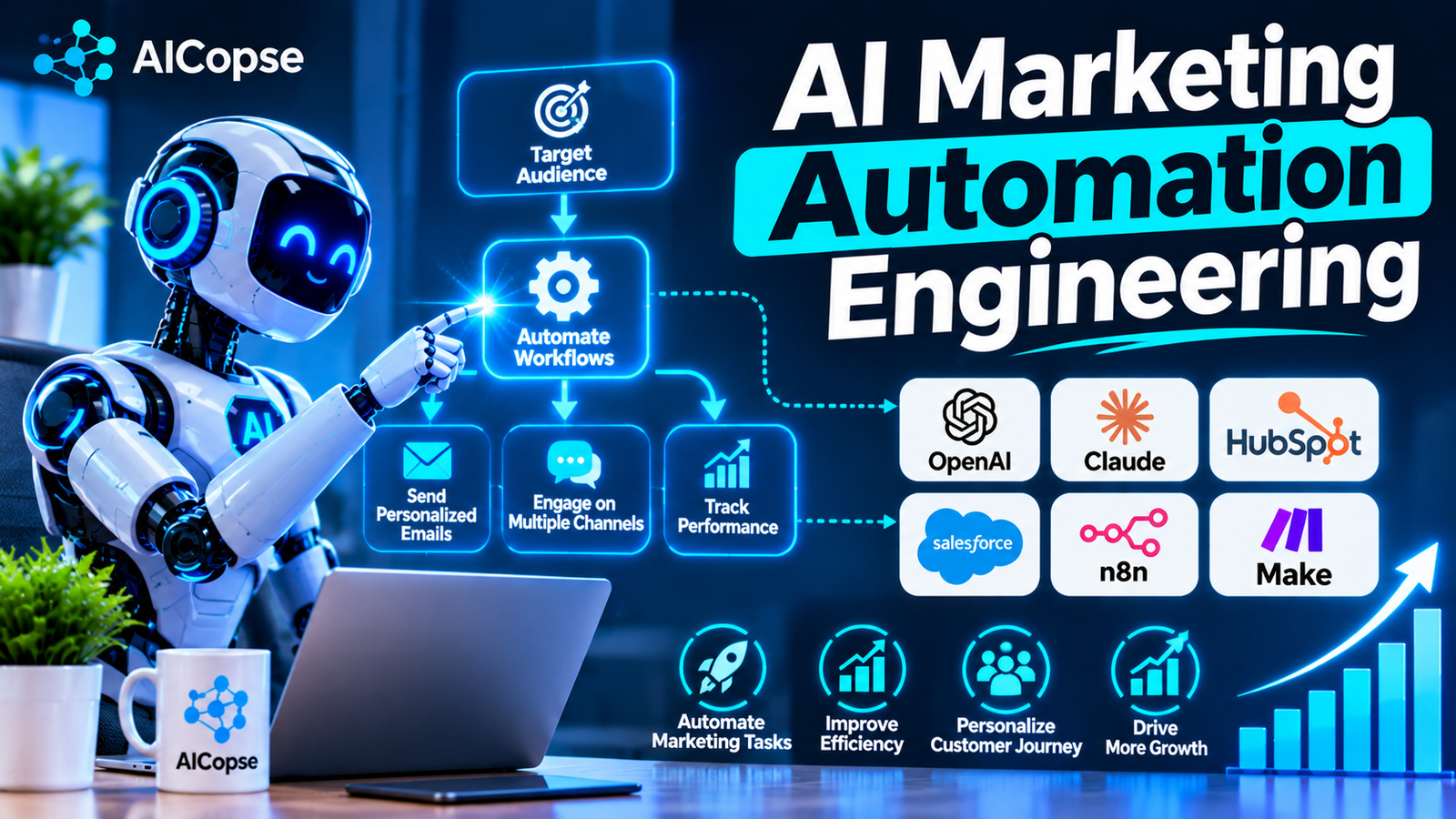
This is where AI Marketing Automation Engineering becomes important. It focuses on designing, building, testing, and maintaining the technical systems that automate marketing operations and support business decisions.
This guide explains how AI marketing automation engineering works, how it differs from traditional marketing automation, which systems engineers build, how AI agents fit into workflows, and how businesses can implement these systems safely.
Table of Contents
- What Is AI Marketing Automation Engineering?
- Why It Matters in 2026
- Traditional vs. AI-Powered Marketing Automation
- How AI Marketing Automation Engineering Works
- The Architecture of an AI Marketing Automation System
- Types of AI Marketing Automation Workflows
- AI Agents in Marketing Automation
- Real-World Business Examples
- Tools and Technologies Used
- How to Implement an AI Marketing Automation System
- Testing, Monitoring, and Reliability
- Security, Privacy, and Human Oversight
- How to Measure Performance and ROI
- Common Challenges and Solutions
- Future of AI Marketing Automation Engineering
- Recommended Reading
- Frequently Asked Questions
What Is AI Marketing Automation Engineering?
AI Marketing Automation Engineering is the technical discipline of creating systems that connect marketing activities, business applications, customer information, and artificial intelligence.
It goes beyond using an automation platform to send an email or update a spreadsheet. An engineer designs how information enters a system, how it is processed, which decisions can be automated, what actions should happen next, and how the complete process will be monitored.
For example, consider a company receiving inquiries from its website. A basic automation might send every new inquiry to a CRM and trigger a welcome email.
An AI-powered engineering system can do more:
- Capture the inquiry and validate its information.
- Check whether the contact already exists in the CRM.
- Retrieve available company and customer information.
- Use an AI model to understand the inquiry and classify its requirements.
- Apply business rules to determine the appropriate next step.
- Assign the lead to the correct sales representative.
- Prepare a personalized response for approval or automated delivery, depending on the risk.
- Record the result and measure how the lead progresses.
The important difference is that the engineer is designing the entire process, not just configuring one action.
The three foundations of AI Marketing Automation Engineering
Marketing
Customers, campaigns, funnels, communication, and revenue.
Engineering
APIs, databases, integrations, workflow logic, testing, and reliability.
Artificial Intelligence
Language models, classification, retrieval, agents, and intelligent decisions.
These foundations work together. Marketing defines the business problem, engineering creates the system, and AI adds capabilities that help the system understand information and perform specific tasks.
For a broader explanation of the profession, see What Is an AI Marketing Engineer?
Why AI Marketing Automation Engineering Matters in 2026
Businesses have spent years adopting CRM platforms, email software, analytics applications, and marketing automation tools. The challenge is that these systems often operate separately.
A marketing team might have customer information in a CRM, website activity in an analytics platform, campaign data in advertising accounts, and customer conversations in support software. Employees may still need to move information between systems manually.
AI makes it possible to automate more of the work, but it also increases the need for reliable integrations, data quality, testing, and governance.
What 2026 research tells us
BCG CMO Survey 2026
A Boston Consulting Group survey of 300 global chief marketing officers highlights the gap between AI ambition and actual workflow transformation.
96%
Said AI is driving end-to-end transformation of their marketing function.
42%
Still use generative AI mainly to assist humans with individual tasks.
~⅓
Have moved to agent-led workflows.
8%
Run campaigns with multiple agents operating autonomously.
Source: BCG, Moving the Agentic Marketing Transformation from Illusion to Reality, 2026.
These findings show why engineering matters. Many organizations are experimenting with AI, but far fewer have connected multiple activities into more advanced operating systems.
Marketing automation is becoming an investment priority
The 2026 CMO Survey also provides useful evidence about how companies are applying AI. In its survey of 188 organizations, 48.9% of respondents reported using AI-powered automation tools to streamline marketing processes.
The same survey identified other applications, including content creation, personalization, data analysis, targeting, predictive analytics, and conversational AI. These activities create opportunities to connect individual AI applications into broader workflows.
Source: The CMO Survey, 2026 Topline Report.
The business opportunity is not simply to automate more tasks. It is to redesign how marketing information moves from one activity to another, so teams can respond faster, reduce repetitive work, and make better decisions.
Traditional vs. AI-Powered Marketing Automation
Traditional marketing automation is usually based on predefined rules. A customer completes an action, and the system performs a configured response.
For example, when a visitor downloads a guide, the platform adds the contact to a list and sends a follow-up email.
AI-powered automation can introduce additional capabilities. It may analyze the customer’s message, identify intent, retrieve relevant information, classify the inquiry, and recommend a suitable next step.
| Area | Traditional Automation | AI-Powered Automation |
|---|---|---|
| Decision logic | Predefined rules and conditions. | Rules combined with model-based interpretation. |
| Customer messages | Uses templates and fixed responses. | Can interpret messages and prepare contextual responses. |
| Lead qualification | Uses fixed form fields and scoring rules. | Can classify unstructured inquiries and extract information. |
| Personalization | Uses predefined segments and templates. | Can adapt content using approved customer context. |
| Exceptions | Follows configured fallback rules. | Can classify unusual cases, request clarification, or escalate. |
| Oversight | Usually configured through workflow permissions. | Needs model evaluation, permissions, and human review controls. |
AI does not make traditional automation unnecessary. In fact, the strongest systems often combine both approaches.
Rules are useful when an action must be predictable. AI is useful when information is unstructured or requires interpretation. An engineer decides which method belongs at each stage.
How AI Marketing Automation Engineering Works
A production automation system normally follows a sequence of connected stages. Each stage has a specific responsibility, and the engineer must make sure that information passes between them correctly.
1. Identify the Marketing Process
The first step is understanding the process that needs improvement. An engineer discusses the problem with marketing, sales, customer support, or management.
For example, a company may want to reduce the time between a website inquiry and the first sales response.
The engineer should identify:
- Where the process begins.
- Which people and systems are involved.
- What information is required.
- Which steps are repetitive.
- Where errors or delays happen.
- What outcome the business wants to improve.
2. Map the Existing Workflow
Before automating a process, document how it currently works. This helps identify unnecessary steps, missing information, and decisions that require human judgment.
A workflow map should show triggers, conditions, data sources, actions, exceptions, and final outcomes.
3. Connect the Required Data Sources
The system may need information from website forms, CRM platforms, advertising systems, email software, databases, and customer support applications.
APIs, webhooks, and database connections help move information between these services. The engineer must also define how records are identified, validated, updated, and protected.
4. Add AI Where It Provides Value
Not every stage needs artificial intelligence. A simple task such as checking whether a required field is empty can be handled with normal validation rules.
AI becomes useful when a system needs to interpret customer messages, classify intent, summarize information, retrieve relevant knowledge, or generate a response using approved context.
5. Define Actions and Permissions
After processing information, the workflow may update a CRM, assign a lead, create a task, prepare a message, or notify an employee.
The engineer must decide which actions can happen automatically and which require approval. This is especially important for customer communication, financial decisions, advertising budgets, and account changes.
6. Test and Deploy the Workflow
The system should be tested with realistic examples before it is used in live marketing operations. Engineers check whether the workflow handles normal requests, incomplete data, unusual inputs, and service failures.
Deployment should be controlled, documented, and monitored.
The Architecture of an AI Marketing Automation System
A reliable system needs more than an AI model and an automation platform. It requires a structure that manages data, processing, decisions, execution, and monitoring.
AI Marketing Automation System Architecture
Website · Ads · Email · Social · Forms · Customer Support
APIs · Webhooks · Databases · CRM Records
Triggers · Conditions · Routing · Retry Logic
LLMs · Classification · Retrieval · Agents · Evaluation
CRM Updates · Lead Routing · Messages · Tasks · Campaigns
Logs · Alerts · Quality Checks · Analytics · ROI
The main engineering layers
Data layer: Collects, stores, cleans, and organizes information from marketing systems.
Integration layer: Connects applications through APIs, webhooks, connectors, and other communication methods.
Orchestration layer: Controls the order of actions, conditions, branching, retries, and workflow execution.
Intelligence layer: Uses AI models and agents to interpret information and support decisions.
Execution layer: Performs approved actions in CRM platforms, marketing applications, and business systems.
Operations layer: Monitors performance, errors, costs, permissions, and system reliability.
These layers may exist inside one platform or across several services. The architecture depends on the business requirements and the level of control needed.
Types of AI Marketing Automation Workflows
AI marketing automation can support several areas of a business. The following examples show where engineers can apply it and what each workflow needs to accomplish.
1. AI-Powered Lead Generation and Qualification
Lead management is one of the most practical starting points for AI automation.
A system can collect inquiries from multiple sources, validate contact information, enrich business records, classify customer requirements, and assign leads to the appropriate sales team.
Possible automated tasks include:
- Capturing website and campaign leads.
- Checking for duplicate contacts.
- Extracting industry and service requirements from messages.
- Applying predefined qualification criteria.
- Updating CRM fields.
- Sending internal notifications.
- Preparing follow-up messages.
The engineer should distinguish verified information from AI-generated assumptions. A model should not invent a company’s budget, buying authority, or purchasing timeline.
2. AI Email Marketing Automation
Email workflows can use customer activity and approved data to support more relevant communication.
Examples include:
- Sending welcome messages after registration.
- Preparing personalized email drafts.
- Classifying customer replies by intent.
- Routing unsubscribe or support requests correctly.
- Identifying inactive subscribers for review.
- Creating follow-up tasks for sales teams.
AI can help interpret a customer’s response, but email permissions, unsubscribe requirements, and communication rules still need to be enforced by the system.
3. AI Content Operations Automation
Content production includes research, planning, briefing, drafting, editing, approval, publishing, and performance analysis. These stages can be connected through automation.
An engineering workflow might:
- Collect topic ideas from approved research sources.
- Organize topics by category and search intent.
- Prepare a content brief using defined templates.
- Generate a first draft for editorial review.
- Check required fields and formatting.
- Send the draft to an editor for approval.
- Update content status and reporting records.
Automating the process does not mean removing editorial responsibility. Factual verification, originality, brand voice, and final publishing decisions should remain controlled.
4. AI Customer Support Automation
Customer support systems can use AI to understand questions and retrieve answers from approved business information.
For example, a customer may ask about product availability, delivery information, service features, or account procedures. An AI assistant can search the approved knowledge base and prepare a response.
More advanced workflows can classify conversations, create support tickets, update CRM records, and transfer complex cases to human employees.
5. AI Campaign Monitoring and Reporting
Marketing teams often collect campaign information from several advertising and analytics platforms. Automation can help gather this information and prepare regular reports.
AI can summarize performance changes, identify unusual patterns, and suggest areas for investigation.
For example, a reporting assistant may identify that cost per lead increased during a reporting period. It can summarize the change and point to the affected campaigns, while a marketing professional checks the data and decides what action to take.
6. Customer Segmentation and Personalization
Customer segmentation groups people according to relevant characteristics, behavior, interests, or lifecycle stage.
AI can help classify unstructured customer feedback, identify common needs, and support more detailed segment descriptions.
Engineers can connect this analysis with CRM and marketing systems to update approved segments and prepare relevant communication workflows.
7. Competitor and Market Intelligence Automation
Businesses need to understand changes in competitor products, pricing, positioning, and industry activity.
A research workflow can collect information from permitted sources, organize updates, summarize relevant changes, and send reports to the appropriate team.
Important information should include its original source and date. AI-generated summaries should not be treated as verified facts without checking the underlying material.
AI Agents in Marketing Automation
AI agents are an important development in marketing automation because they can perform multi-step tasks using connected tools and information sources.
A traditional workflow usually follows a fixed sequence. An agent can be given a goal, access to selected tools, and rules that define what it may do. It can then interpret information and choose among permitted actions.
For example, a research agent may be asked to prepare a summary of a target company. It could retrieve information from approved sources, organize findings, identify missing details, and prepare a report for a sales representative.
Traditional workflow vs. AI agent
Traditional Workflow
A form is submitted, a CRM record is created, and a notification is sent. The steps are predefined.
Best when: The process is predictable and rules are clear.
AI Agent Workflow
An agent reviews a request, retrieves context, selects an approved tool, and prepares a result based on the task.
Best when: The task requires interpretation or flexible information handling.
Common marketing agents
| Agent Type | Main Function | Human Control |
|---|---|---|
| Lead Research Agent | Researches target accounts and organizes available information. | Reviews findings and prospect suitability. |
| Content Research Agent | Collects sources and prepares research summaries. | Verifies claims and approves content. |
| Customer Support Agent | Answers approved routine questions and routes cases. | Handles sensitive or uncertain cases. |
| Analytics Agent | Summarizes performance data and highlights changes. | Validates insights and makes decisions. |
| Campaign Assistant Agent | Prepares campaign recommendations and draft assets. | Approves budgets, messaging, and launch decisions. |
When should a business use an AI agent?
Agents are useful when a task requires interpreting different types of information, retrieving context, or selecting from several permitted actions.
They are not always the best solution. If a process simply copies a verified value from one application to another, a normal workflow may be cheaper, faster, and easier to maintain.
A good engineering principle is to use the simplest approach that reliably solves the business problem.
Real-World Business Examples
AI Marketing Automation Engineering can support different industries and business models. The exact workflow changes according to customer behavior, regulations, data availability, and the company’s operating process.
B2B Software and SaaS Companies
A software company may receive inquiries from different industries, company sizes, and service requirements.
An AI-powered lead workflow can collect the inquiry, retrieve available company information, classify the customer’s needs, update the CRM, and assign the lead to the appropriate sales representative.
Potential value: Faster lead processing, more organized prospect information, and less manual CRM work.
Ecommerce Businesses
An ecommerce business can connect website activity, product information, order history, and customer communication.
Automation can support abandoned-cart reminders, order-related support, product interest classification, and repeat-purchase campaigns. AI may help interpret customer feedback or prepare personalized recommendations using approved data.
Potential value: Better customer communication and more consistent lifecycle marketing.
Marketing Agencies
Agencies manage campaigns and reporting for several clients. Many processes are repeated across accounts, including data collection, report preparation, task assignment, and content approvals.
An automation system can collect campaign metrics, prepare draft reports, organize client requests, and send work through approval stages.
Potential value: Reduced repetitive work and more consistent internal processes.
Financial Services and Insurance
Financial and insurance businesses may receive large volumes of customer questions, service requests, and product inquiries.
AI can help classify requests, retrieve approved information, prepare summaries, and route cases to authorized employees.
Important: These businesses need stronger controls around sensitive information, customer eligibility, regulated communication, and automated decisions. AI should not independently make high-impact decisions without appropriate legal, compliance, and human oversight.
Healthcare Organizations
Healthcare organizations may use automation to organize appointment inquiries, route administrative requests, and provide approved service information.
AI systems must be designed carefully to avoid exposing patient information or producing unsupported medical guidance. Sensitive decisions and clinical communication require qualified human oversight.
Tools and Technologies Used in AI Marketing Automation Engineering
Engineers use different platforms for AI processing, workflow orchestration, customer management, data storage, and reporting. A business does not need every available product. The stack should be selected according to the workflow.
| Technology Layer | Example Platforms | Purpose |
|---|---|---|
| AI Models | OpenAI, Claude, Gemini | Interpretation, classification, generation, and reasoning. |
| Workflow Automation | n8n, Make, Zapier | Triggers, routing, integrations, and process execution. |
| CRM and Marketing | HubSpot, Salesforce, ActiveCampaign | Customer records and lifecycle management. |
| Programming | Python, JavaScript | Custom logic and integrations. |
| Databases | PostgreSQL, BigQuery | Data storage, processing, and querying. |
| Agent Frameworks | LangChain, LangGraph, LlamaIndex | Custom AI applications and agent workflows. |
| Analytics | GA4, Looker Studio, Power BI | Performance measurement and reporting. |
| Development and Testing | GitHub, Postman | Code management and API testing. |
For a deeper comparison of individual platforms, see the separate guide on AI Marketing Engineering Tools and Platforms once that article is published.
How to Implement an AI Marketing Automation System
Successful automation starts with a defined business problem. Buying software or selecting an AI model should come after the team understands the process it wants to improve.
Step 1: Select One High-Value Process
Start with a process that happens regularly and consumes meaningful time. Lead routing, customer inquiry classification, campaign reporting, and content approval are possible starting points.
Choose a process with clear inputs and measurable results. Avoid beginning with a project that attempts to automate the entire marketing department.
Step 2: Document the Existing Process
Write down every stage, including the people involved, applications used, information required, and decisions made.
Identify delays, repeated manual work, missing information, and common errors. This creates a baseline for measuring improvement later.
Step 3: Define the Success Metrics
Decide how the business will judge the project. For example, a lead-response workflow may be measured by processing time, lead assignment accuracy, and the percentage of inquiries successfully delivered to the CRM.
Do not wait until the system is complete to decide what success means.
Step 4: Select the Technology Stack
Choose the minimum number of platforms needed to build the workflow.
A simple setup might use:
- A website form for capturing inquiries.
- A CRM for customer records.
- n8n or Make for workflow orchestration.
- An AI model API for classifying customer messages.
- A reporting platform for measuring results.
Check API availability, authentication, permissions, pricing, data retention, and integration limits before committing to a platform.
Step 5: Design the Workflow Logic
Define the trigger, required data, validation rules, AI tasks, business conditions, and final actions.
Decide what should happen when information is missing, a model produces an uncertain result, or an external application is unavailable.
Step 6: Build a Small Working Version
Develop the simplest version that can demonstrate the process. Connect the required applications and test the flow with a limited set of sample records.
Keep the initial version focused. Additional agents, advanced personalization, and complex reporting can be added after the basic workflow is reliable.
Step 7: Test With Realistic Scenarios
Test normal submissions, duplicate records, invalid email addresses, incomplete information, unexpected messages, and API failures.
Review AI outputs and verify that the system follows the defined business rules.
Step 8: Deploy With Human Oversight
Move the workflow into production with appropriate permissions, monitoring, and approval steps.
For sensitive actions, start with AI recommendations or prepared drafts rather than allowing automatic execution. Expand permissions only when testing and operational evidence support it.
Step 9: Measure and Improve
Compare the results with the baseline. Review processing time, error rates, AI quality, operating costs, and business outcomes.
Use the findings to improve the workflow rather than adding complexity without evidence.
Testing, Monitoring, and Reliability
One of the biggest differences between a simple automation and an engineered system is how it behaves after deployment.
A workflow may work correctly during a demonstration but fail when a CRM changes its API, an external service becomes unavailable, a customer submits unexpected information, or an AI model returns an invalid response.
Engineers need to design for these situations.
Important testing methods
Functional testing: Check whether each workflow step performs the correct action.
Data validation: Confirm that required fields, formats, and customer identifiers are correct.
Integration testing: Check whether applications exchange information correctly.
AI evaluation: Test model responses against examples with known expected outcomes.
Failure testing: Check what happens when APIs fail, requests time out, or information is missing.
Security testing: Review access permissions, credentials, and information transfers.
Monitoring a live workflow
A production workflow should provide useful operational information, such as:
- Number of workflow executions.
- Successful and failed executions.
- Processing time.
- API response errors.
- AI usage and cost.
- Human approval and escalation rates.
- Records that need manual investigation.
Logs should help engineers understand what happened without exposing unnecessary sensitive customer information.
Why retry logic matters
External applications sometimes become temporarily unavailable. A well-designed workflow can retry certain failed operations after a suitable delay.
However, retries must be handled carefully. If a payment-related action, email, or CRM update is repeated without checking whether the original action succeeded, the system may create duplicates.
Engineers can use unique event identifiers, idempotency controls where supported, and duplicate checks to prevent repeated actions.
Security, Privacy, and Human Oversight
Marketing automation systems can process names, email addresses, customer messages, company information, purchase history, and other sensitive records. Connecting AI services increases the importance of data governance.
Security should be included in the design, not added after deployment.
Protect customer information
Only collect and send information that the workflow actually needs. Avoid placing unnecessary personal information into model prompts, logs, or external applications.
Control access to systems
Use separate credentials and permissions for different services. An AI agent that only needs to read a document should not receive permission to delete customer records or change account settings.
Protect API credentials
Store API keys and passwords in secure credential management systems or environment variables. Do not expose them in public code repositories, prompts, or workflow logs.
Review applicable privacy and marketing rules
Businesses operating in the United States should consider relevant federal and state requirements, including the CAN-SPAM Act for commercial email and applicable state privacy laws. Requirements depend on the information being processed, the business activity, and the location of the people involved.
For international operations, additional rules may apply, such as the GDPR and other local data protection requirements.
Keep humans responsible for important decisions
Human review is particularly important when an automated action can affect a customer’s rights, finances, access to services, or important business relationship.
Examples include:
- Approving high-impact customer communications.
- Changing advertising budgets.
- Making decisions involving sensitive customer information.
- Issuing refunds or changing financial records.
- Publishing high-risk claims or regulated content.
- Handling complaints that require judgment or investigation.
AI should operate within defined permissions. Human oversight should be based on the risk of the action, not added as a meaningless approval step to every low-risk task.
How to Measure Performance and ROI
Automation is valuable only when it improves a business process. A system that processes thousands of records but produces inaccurate results may create more work instead of reducing it.
Engineers should measure both technical performance and business outcomes.
| Measurement Area | Example Metrics | Why It Matters |
|---|---|---|
| Efficiency | Hours saved, processing time, tasks automated. | Measures reduction in manual work. |
| Reliability | Success rate, failure rate, duplicate actions. | Shows whether the workflow operates consistently. |
| AI Quality | Classification accuracy, escalation rate, review failures. | Measures the usefulness of AI outputs. |
| Marketing Results | Qualified leads, conversion rate, response time. | Connects automation with marketing outcomes. |
| Financial Performance | Cost per task, operating cost, revenue impact. | Helps determine whether the system is financially useful. |
Example: Calculating time savings
Suppose a marketing team spends 15 hours each week manually reviewing and assigning leads. After implementing an automation system, the team spends 6 hours on the same activity.
15 hrs
Before automation
6 hrs
After automation
9 hrs
Saved each week
The time reduction is 60%:
(15 − 6) ÷ 15 × 100 = 60%
This is an illustrative example, not a guaranteed result or an industry benchmark. The business should also check whether lead quality, customer response, and operating costs remain acceptable.
A simple ROI framework
To estimate the financial value of an automation project, compare the measurable benefits with the full cost of operating the system.
ROI Formula
ROI = (Net Benefit ÷ Total Cost) × 100
Use a consistent measurement period and include implementation, software, API usage, hosting, maintenance, and review costs.
Time saved should not automatically be counted as direct financial savings. The business must determine how the saved time is used and whether it creates measurable value.
Common Challenges and Solutions
Poor or Incomplete Data
AI systems can produce unreliable results when customer records are outdated, duplicated, or missing important fields.
Solution: Validate information at the point of collection, maintain consistent data structures, and regularly review data quality.
Too Many Disconnected Platforms
Businesses may use multiple tools that do not share information correctly.
Solution: Map the required integrations first. Use APIs, webhooks, and suitable connectors, and avoid adding platforms without a clear purpose.
AI Hallucinations and Incorrect Decisions
AI models can produce incorrect information or misinterpret customer requests.
Solution: Use approved data sources, structured outputs, validation rules, test datasets, and human review for uncertain or high-impact actions.
Unexpected Automation Costs
API usage, automation executions, data enrichment, and AI model calls can increase as workflows scale.
Solution: Measure cost per workflow, avoid unnecessary model calls, use simpler rules for predictable tasks, and monitor usage limits.
Silent Workflow Failures
A workflow may stop updating records without anyone noticing.
Solution: Add execution logs, failure alerts, retry policies, and regular operational checks.
Over-Automation
Some businesses try to automate every interaction, even when a human response would be more appropriate.
Solution: Automate repetitive and predictable work first. Keep people involved where judgment, trust, or sensitive decisions matter.
No Clear Business Ownership
Automation projects can fail when no one is responsible for approving requirements, checking results, or maintaining the system.
Solution: Assign clear owners for business decisions, technical maintenance, data quality, and performance reporting.
Future of AI Marketing Automation Engineering
Marketing automation is moving toward connected workflows that combine AI models, business applications, and human decision-making. Several developments are likely to shape the next stage of the profession.
More Agent-Based Marketing Operations
AI agents will increasingly support research, customer communication, campaign analysis, and internal operations. The important challenge will be controlling permissions, coordinating agents, and evaluating the quality of their work.
End-to-End Workflow Orchestration
Businesses will focus more on connecting complete processes rather than buying separate tools for individual tasks. This includes connecting data collection, AI processing, execution, measurement, and improvement.
BCG’s 2026 research identifies operating infrastructure, data foundations, brand intelligence, and multi-agent orchestration as important areas for organizations trying to scale agentic marketing.
More Personalized Customer Journeys
AI can help businesses understand customer interests and respond to changing behavior. Automation systems may use approved customer information to support more relevant experiences across email, websites, customer support, and sales channels.
Greater Importance of AI Evaluation
As more AI-powered workflows enter production, businesses will need ways to measure accuracy, reliability, cost, and safety. Testing will become a continuous part of operating marketing systems.
Stronger Data and Governance Requirements
More automation means more connections between customer data and business applications. Companies will need better access controls, audit trails, privacy practices, and clear responsibility for automated actions.
A Growing Need for System Architects
The ability to use an AI tool will not be enough for complex marketing operations. Businesses will need people who can understand marketing processes, design data flows, select technology, connect applications, and take responsibility for system performance.
This is where AI Marketing Automation Engineering connects directly with the wider AI Marketing Engineer profession.
Recommended Reading
The AI Marketing Engineer: From Marketer to System Architect
Building an automation workflow is different from designing a complete system that can operate reliably. Engineers need to understand how data enters a process, how applications communicate, where AI should be used, and how errors, permissions, and human approvals are handled.
Explore The AI Marketing Engineer on Amazon
This book is particularly relevant to the engineering side of marketing automation because it connects workflow development with the foundations behind it, including APIs, data systems, Python, SQL, n8n, AI agents, evaluation, deployment, and security. It helps readers think beyond individual automations and understand how to build the systems that support them.
Frequently Asked Questions
What is AI Marketing Automation Engineering?
AI Marketing Automation Engineering is the process of designing and building marketing systems that connect data, applications, workflow automation, and artificial intelligence. It helps businesses automate processes, interpret customer information, and improve marketing operations.
What does an AI Marketing Automation Engineer do?
An AI Marketing Automation Engineer builds and maintains integrations, automated workflows, AI-powered processes, CRM connections, and reporting systems. The role also includes testing, troubleshooting, monitoring, and protecting production systems.
How is AI marketing automation different from traditional marketing automation?
Traditional automation usually follows predefined rules and triggers. AI-powered automation can also interpret messages, classify information, retrieve relevant knowledge, and support decisions. Both approaches can work together in one system.
What tools are used for AI Marketing Automation Engineering?
Common technologies include n8n, Make, Zapier, OpenAI, Claude, Gemini, HubSpot, Salesforce, Python, SQL, PostgreSQL, BigQuery, and analytics platforms. The right stack depends on the workflow and business requirements.
Is coding required for AI marketing automation?
Not every workflow requires programming. No-code and low-code platforms can handle many processes. However, Python, JavaScript, SQL, APIs, and database knowledge are valuable for building customized and more advanced systems.
Can AI agents automate an entire marketing department?
AI agents can support multiple marketing activities, but fully autonomous operation is not appropriate for every task. Strategy, sensitive decisions, brand responsibility, and high-impact actions often require human judgment and approval.
What are the best AI marketing automation use cases?
Common use cases include lead qualification, CRM updates, email workflows, customer support, campaign reporting, content operations, customer segmentation, and competitor research.
How do businesses measure AI marketing automation ROI?
Businesses can measure time saved, workflow reliability, cost per task, lead response time, conversion rates, customer experience, and operating costs. Results should be compared with a baseline measured before implementation.
Is AI Marketing Automation Engineering a good career path?
It can be a relevant career direction for people interested in marketing technology, automation, data, and artificial intelligence. Practical experience with integrations, workflow design, AI systems, and production monitoring can help build the skills required for the field.
Final Thoughts
AI Marketing Automation Engineering is about building reliable systems that connect marketing processes, customer data, software applications, and artificial intelligence. It moves beyond simple task automation toward complete workflows that can collect information, interpret it, perform approved actions, and measure results.
The strongest systems do not use AI for everything. They combine clear business rules, dependable integrations, AI capabilities where interpretation is needed, and human oversight where judgment matters.
For businesses, the starting point should be one valuable process with a clear outcome. For aspiring engineers, the most useful experience comes from building real workflows, connecting APIs, managing data, testing AI outputs, and learning how to operate systems after deployment.
The future of marketing automation will depend not only on how intelligent individual tools become, but also on how well people design and manage the systems that connect them.

Leave a Reply