
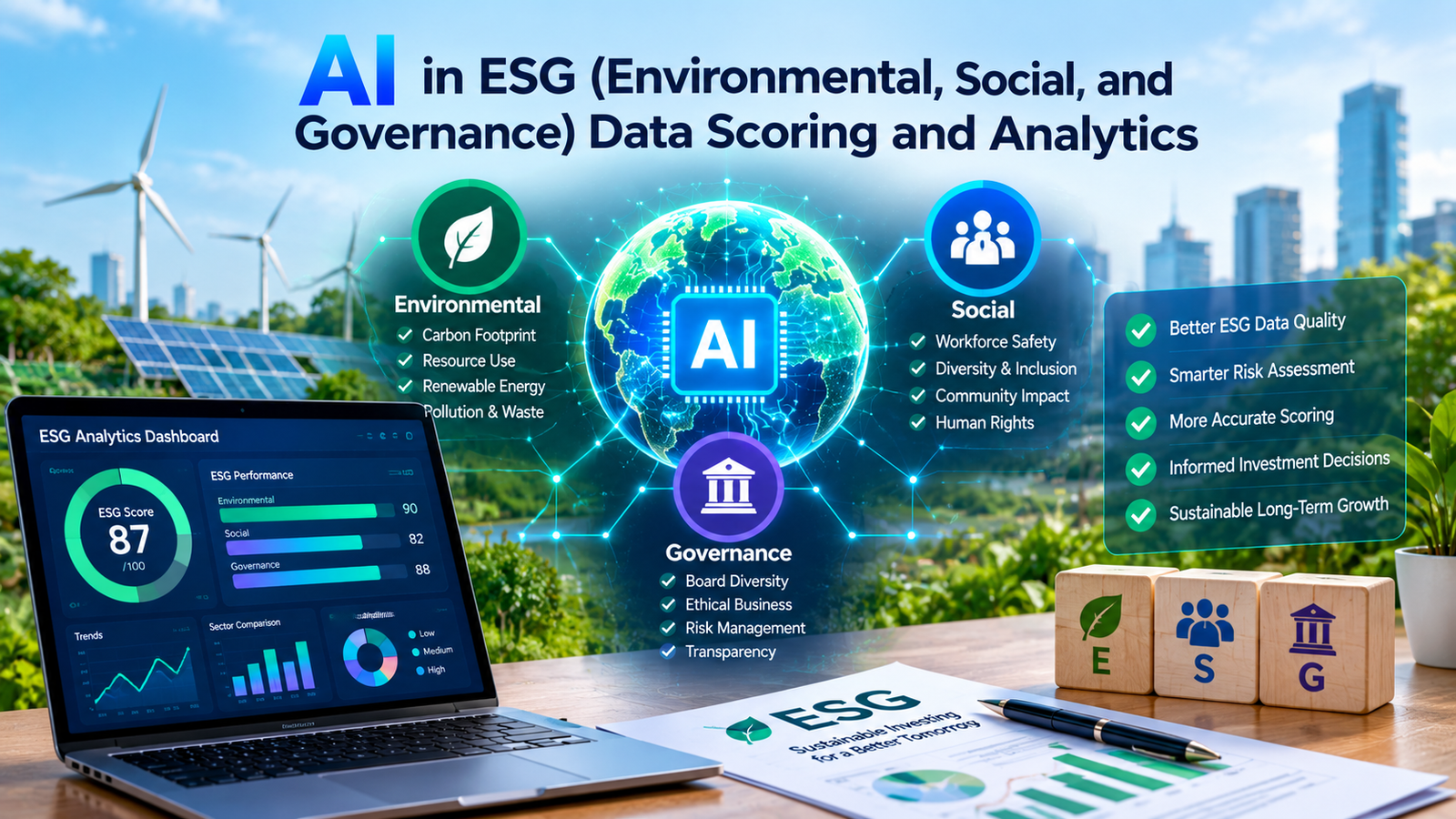
Primary topic: AI in ESG Data Scoring and Analytics
Research focus: ESG data extraction, sustainability scoring, machine learning, NLP, generative AI, climate-risk analytics, greenwashing detection, ESG rating divergence, industry materiality, sustainability reporting, data quality, explainable AI, and investment decision support
Why AI Is Changing ESG Data Scoring
Environmental, social, and governance data is difficult to analyze because it comes from many sources and is reported in different formats. A company may disclose greenhouse gas emissions in a sustainability report, employee safety data in an annual filing, board diversity information on its website, and regulatory investigations through public notices. Some information is numerical, while other evidence appears in long documents, policies, news coverage, or statements about future goals.
Traditional ESG research often requires analysts to collect this information manually, decide which indicators matter, normalize the data, and combine the results into a rating. This can be expensive and slow, particularly when an investment team needs to evaluate thousands of companies across different countries and industries.
AI can help automate several parts of this process. Document-processing models can extract information from reports, NLP can classify statements by ESG topic, and machine learning can compare the extracted evidence with historical performance or industry benchmarks. Generative AI can also help analysts investigate why a score changed, summarize supporting evidence, and identify disclosures that need further review.
The important distinction is between using AI to process ESG information and using AI to decide what good ESG performance means. The first is largely a data and technology challenge. The second requires clear definitions, materiality judgments, defensible weighting, and a transparent understanding of what the score is intended to measure.
The ESG Analytics Pipeline
Reports, filings, news, emissions, workforce data
OCR, NLP, entity matching, classification
Source, date, metric, confidence
Materiality, normalization, weights
Quality checks, uncertainty, human review
Scores, trends, risk alerts, explanations
A reliable pipeline keeps the original evidence connected to every important score. If an analyst sees a company’s water-risk score decline, the platform should show which data changed, which source supports the change, how the scoring method treated the evidence, and whether the result was generated from a reported figure or an AI inference.
Research Study: AI-Based ESG Classification Across Environmental, Social, and Governance Disclosures
A 2026 study published in Frontiers in Sustainability tested an AI-based approach to standardizing ESG disclosures. The researchers used sustainability reports from 440 companies listed on the Johannesburg Stock Exchange and the National Stock Exchange of India. They fine-tuned a DistilRoBERTa transformer model to classify ESG indicators.
The model achieved 99.1% accuracy for environmental indicators and 99.3% for governance indicators. Its accuracy for social indicators was substantially lower at 63.6%. The authors connect this difference to the qualitative and varied nature of social disclosures, which can be harder to classify consistently.
This study is directly relevant to ESG data platforms because it demonstrates that one model may perform very differently across ESG categories. Environmental disclosures often contain measurable quantities such as energy use, emissions, and water consumption. Governance disclosures may include identifiable policies, board structures, and oversight mechanisms. Social topics such as worker well-being, community impact, discrimination, and labor conditions often depend more heavily on context.
The results should not be interpreted as proof that an automated ESG scoring platform can achieve the same accuracy in production. Classification accuracy measures how well the model assigns text to categories in the study’s dataset. It does not establish that the underlying disclosure is true, that the company performs well, or that the final ESG score predicts financial or sustainability outcomes.
Practical implication: ESG platforms should validate performance separately for environmental, social, and governance data. They should also test results across industries, languages, company sizes, and reporting styles rather than relying on one overall accuracy figure.
Research Study: A Systematic Review of AI Research in ESG
A review published in Discover Sustainability in May 2026 examined the development of AI-related ESG research. It analyzed publications from Scopus and Web of Science covering the period from 2009 to 2024, using performance and thematic analysis to map the research landscape.
The review describes AI applications across ESG data collection, sustainability reporting, risk assessment, environmental monitoring, social analysis, and governance processes. It also identifies several directions for future research, including more effective use of AI for ESG measurement and more robust ways to connect AI capabilities with sustainability objectives.
The significance of this review is its breadth. ESG analytics is not one machine-learning task. It includes document classification, numerical forecasting, risk identification, data quality checks, and decision support. A system designed to estimate carbon emissions may require different inputs and validation methods from one designed to assess board independence or workforce safety.
The review also reinforces the need to separate AI as an analytical tool from AI as a subject of ESG governance. Companies can use AI to improve sustainability reporting while simultaneously needing to assess the environmental footprint, fairness, privacy, and accountability of their own AI systems.
Practical implication: Product teams should define the ESG decision they are supporting before selecting a model. A broad “AI ESG score” is difficult to validate unless the product specifies its intended use, data scope, and measurement framework.
Research Study: ESG Rating Divergence and the Limits of a Single Score
A 2026 review in Business Strategy and the Environment examines why ESG ratings for the same company can diverge. The authors compare institutional and measurement perspectives across jurisdictions, including the European Union, the United States, and China.
The study addresses a central problem for ESG analytics: two providers may evaluate the same company but produce different results because they use different definitions, indicators, materiality assumptions, data sources, and aggregation methods.
AI can help identify the sources of disagreement, but it cannot make those differences disappear simply by averaging the scores. A company may receive a strong environmental rating because it has a credible emissions-reduction plan, while another rating provider may place greater weight on current emissions intensity. Both results may be internally consistent with their own methodologies.
A useful AI platform should therefore explain rating differences rather than conceal them. It can map indicators from different frameworks, identify where definitions overlap, and show which disagreements arise from missing data, different weights, or genuinely different interpretations of company performance.
Practical implication: Offer a transparent scorecard with separate E, S, and G dimensions, the underlying indicators, and a clear methodology. A single composite score can be useful for screening, but it should not replace the underlying evidence.
Research Study: Machine Learning for ESG Signals and Rating Credibility
A systematic review published in the Journal of Risk and Financial Management in September 2026 examined 127 peer-reviewed studies on machine learning in sustainable finance. It organized the literature into three roles for ESG signals: predicting ratings, using ratings in financial or sustainability analysis, and assessing the credibility or construction of the ratings themselves.
The review identifies four areas in which AI can examine ESG measurement more critically: reverse-engineering scoring methods, reconciling rating differences, detecting greenwashing, and grouping companies according to industry-specific materiality.
This is an important shift. Many ESG models are built to predict a rating from existing data. But if the original rating contains measurement bias or overweights easily disclosed commitments, a model may learn to reproduce those weaknesses. A high predictive score does not necessarily mean the model measures real-world sustainability performance.
The review cautions that very strong statistical fit can result from target-proximal reconstruction or validation that does not properly test performance on future data. This is a familiar machine-learning problem: a model may learn to reproduce the label it was trained on without learning a reliable relationship that generalizes to new companies or reporting periods.
Practical implication: ESG AI should be tested against independent evidence and future periods, not only against existing vendor ratings. Where possible, teams should distinguish policy commitments, reported activities, and measured outcomes.
Research Study: Generative AI and ESG Disclosure Readability
A 2026 article in the International Review of Economics & Finance studied whether generative AI could assess the readability of corporate sustainability disclosures. The researchers fine-tuned GPT-4.1 using domain-specific material and developed a framework for evaluating the readability and quality of ESG-related reporting.
The study reports that higher AI-based readability scores were associated with lower divergence between ESG ratings. It also found that greenwashing weakened the role of readability in reducing disagreement.
The finding suggests that how a company communicates sustainability information can affect how rating providers interpret it. Clearer reporting may make it easier to identify metrics, compare reporting periods, and understand the scope of a company’s claims.
However, readability is not the same as sustainability performance. A company can publish a clear, well-organized report while still having poor environmental or social outcomes. Conversely, a company with limited reporting resources may disclose meaningful performance data in a less polished format.
Practical implication: Use generative AI to evaluate clarity, consistency, and traceability, but do not reward polished language as if it were proof of strong ESG performance. Pair disclosure-quality measures with operational evidence.
Research Study: ESG-KIBERT and Industry-Specific NLP Scoring
A 2025 study in Decision Support Systems introduced ESG-KIBERT, a natural language processing approach designed for ESG evaluation. The model incorporates industry-specific weighting based on the Sustainability Accounting Standards Board’s materiality map and includes sentiment analysis to capture market perceptions.
The study focuses on two recurring limitations in ESG scoring: generic indicators that may not fit every sector and inconsistent interpretation of ESG-related text. Industry-specific customization is important because the material risks facing an oil producer differ from those facing a software company, a bank, or a healthcare provider.
This approach illustrates how AI can connect language analysis with a more meaningful scoring structure. A model may identify a passage about water use, but the scoring engine still needs to determine whether water is material to the company’s operations, where the impact occurs, and how the reported metric compares with relevant peers.
Industry customization can make ESG analysis more useful, but it also introduces design decisions that need to be documented. If the model assigns different weights to companies in different sectors, users should be able to see why those weights were selected and how they affect the final score.
Practical implication: Build sector-specific scoring templates and allow users to inspect the materiality rules. NLP should identify and structure the evidence; a transparent scoring layer should determine how that evidence affects the result.
From ESG Text to Measurable Evidence
The most useful ESG analytics systems do not stop after extracting a sentence from a report. They convert the statement into a structured, traceable data point.
For example, a company might state that it plans to reduce operational emissions by 40% by 2030. An AI system should identify the target, baseline year, target year, emissions scope, organizational boundary, and whether the company has reported progress against the target.
| Extracted field | Example | Why it matters |
|---|---|---|
| Indicator | Operational greenhouse gas emissions | Identifies the topic |
| Claim type | Future target | Separates intent from results |
| Target | 40% reduction | Defines the stated ambition |
| Deadline | 2030 | Enables progress tracking |
| Evidence | Report page and source link | Supports verification |
| Validation status | Not independently verified | Prevents overstating confidence |
This structure helps analysts distinguish an announced goal from a measured reduction. It also makes it possible to compare the same company over time without losing the context behind the original disclosure.
How AI Can Improve Environmental Scoring
Environmental data is often suitable for structured analysis because it can include numerical measurements such as greenhouse gas emissions, energy consumption, water use, waste generation, and renewable energy procurement. AI can extract these metrics from reports and help identify changes, inconsistencies, and missing information.
The model should still account for differences in company size and business activity. Absolute emissions alone may not provide a fair comparison between a large industrial producer and a smaller technology company. Depending on the use case, analysts may need to consider emissions intensity, production volume, revenue, geography, and the boundaries used in reporting.
AI can also help analyze climate-related disclosures, identify references to physical and transition risks, and connect reported exposure to geographic or operational data. Such outputs should be presented as analytical signals, not as definitive predictions of future climate losses.
Environmental analytics dashboard concept
Illustrative dashboard only. These bars are design examples, not measured results from a company or research study.
How AI Can Improve Social and Governance Analytics
Social and governance data often requires more contextual interpretation than basic environmental metrics. Social topics can include employee safety, workforce turnover, labor practices, human rights, customer privacy, product safety, and community relations. Governance topics may include board independence, executive incentives, audit oversight, corruption controls, and regulatory enforcement.
AI can identify relevant disclosures and connect them to structured indicators. It can also compare a company’s public claims with external reporting, such as regulatory notices or credible news coverage. But sentiment should not be treated as a direct measure of social performance. Negative news may reveal a real incident, but it may also reflect differences in media attention, geography, company size, or the seriousness of a single event.
A responsible scoring system should distinguish between:
- Company-reported policies and commitments
- Measured outcomes and performance indicators
- External allegations and media reports
- Confirmed regulatory findings
- Unresolved investigations
- Independent assurance or verification
These categories should not receive the same treatment. An allegation is not a confirmed violation, and the existence of a policy does not prove that the policy is effective.
AI for Greenwashing and Disclosure Risk Detection
Greenwashing detection is a promising use case for AI, but it requires careful design. A model can compare claims with reported metrics, identify vague language, detect changes in definitions, and flag differences between stated goals and reported progress. It can also find cases where a company emphasizes a positive initiative while providing limited information about a material negative impact.
The 2026 systematic review of machine learning in sustainable finance identifies greenwashing detection as one of the key areas in which AI can help assess the construction and credibility of ESG signals. It also cautions against treating strong statistical fit as proof that a model will generalize to future cases.
Source: Journal of Risk and Financial Management, 2026
A practical greenwashing workflow should compare:
Claim
What the company says it will achieve
Evidence
What the company reports or can demonstrate
Outcome
What changed against the baseline
Assurance
Whether the evidence was independently checked
The output should be a review flag with supporting evidence, not an automatic declaration that a company is greenwashing.
Industry-Specific ESG Scoring
A universal ESG model can miss important differences between industries. A bank’s material ESG risks may include financed emissions, data privacy, conduct, and governance. A manufacturer may face direct emissions, water use, worker safety, and supply-chain risks. A software company may have a different profile involving energy use in data centers, workforce practices, privacy, cybersecurity, and responsible AI.
Industry-specific scoring can improve relevance, but the platform must explain which factors matter and why.
| Industry | Potential material topics | AI analytics opportunity |
|---|---|---|
| Banking and financial services | Financed emissions, conduct, privacy, governance | Portfolio exposure analysis and disclosure extraction |
| Manufacturing | Emissions, energy, water, worker safety | Metric extraction and operational trend analysis |
| Technology | Data privacy, workforce, AI governance, energy | Policy analysis and risk-event monitoring |
| Energy | Emissions, transition plans, safety, remediation | Target tracking and performance comparison |
| Retail and consumer goods | Supply chains, labor, packaging, product safety | Supplier disclosure analysis and incident monitoring |
These examples are starting points rather than a universal materiality standard. The final indicators should reflect the company’s activities, location, reporting framework, and intended use of the score.
Current Regulatory Direction and ESG Data Quality
ESG analytics is increasingly shaped by expectations around transparency, comparability, and the reliability of ratings. In the European Union, Regulation 2024/3005 establishes requirements relating to the transparency and integrity of ESG rating activities. The European Commission’s implementation page lists additional delegated and implementing measures published during 2026, including rules concerning disclosures and safeguards for ESG rating providers.
Source: European Commission, ESG Ratings Regulation and implementing measures
For AI developers, this direction increases the value of traceable data pipelines and transparent methodologies. A platform should be able to show where a metric came from, how it was transformed, which methodology version was used, and what limitations apply.
EFRAG’s 2026 State of Play report assessed 905 assured sustainability statements for fiscal year 2025 against a structured set of questions covering the European Sustainability Reporting Standards. The report examines implementation practices, including double materiality methods and the connection between material topics and executive incentives.
Source: EFRAG, State of Play 2026 Report
The report is useful context for ESG technology teams because it shows that reporting quality is not just a matter of extracting more data. Organizations also need consistent definitions, materiality processes, governance, and assurance. AI can support these processes, but it cannot substitute for the underlying accountability.
Recommended AI Architecture for an ESG Analytics Platform
A production-grade system should separate data collection, extraction, scoring, and reporting. This makes it easier to test individual components and correct errors without rebuilding the entire platform.
Company reports, filings, structured datasets, regulatory notices, licensed news feeds
OCR, tables, entity resolution, NLP extraction, document classification
Versioned metrics, source passages, dates, units, company identifiers
Materiality, normalization, weights, confidence, trend analysis
Review queues, audit logs, model monitoring, methodology controls
Scorecards, evidence links, alerts, company comparisons, analyst summaries
The platform should store the original source alongside each extracted value. It should also preserve units, reporting periods, company boundaries, and methodology versions. Without these controls, a model may compare figures that look similar but refer to different scopes or time periods.
Expert Recommendation
The central recommendation is to build an evidence-first ESG intelligence platform rather than a black-box rating generator.
Begin with a narrow use case, such as emissions disclosure extraction, governance-event monitoring, or supplier-risk screening. Establish a clear definition of the target metric, collect a representative dataset, and have domain experts validate the extraction results. Once the data layer is reliable, introduce industry-specific scoring and predictive analytics.
A mature system should:
- Keep source documents and evidence passages linked to every material score
- Separate company commitments from measured performance
- Use industry-specific indicators and explainable weighting
- Show missing data rather than silently filling gaps
- Distinguish reported facts, external allegations, and model-generated inferences
- Validate each ESG pillar separately
- Test models on later reporting periods and unseen companies
- Monitor changes in source coverage, reporting language, and model performance
- Allow analysts to challenge, correct, and document AI-generated results
The 2026 research on ESG classification demonstrates why this matters: high environmental and governance classification accuracy did not translate into equally strong performance on social disclosures. A single aggregate metric can hide exactly the weakness that an investor or compliance team needs to understand.
Expert Perspective on AI and Financially Relevant ESG
In a September 2026 Reuters interview, sustainability researcher Robert Eccles discussed using AI to connect sustainability issues with conventional financial reporting. The article describes work with Columbia professor Shivaram Rajgopal on mapping material sustainability issues to company financial statements. Eccles argued for integrating sustainability expertise more closely with finance leadership rather than treating sustainability as a separate reporting exercise.
Source: Reuters, Oxford prof Eccles says AI can help end the ESG wars, September 16, 2026
The practical lesson is that ESG analytics becomes more decision-useful when it explains the financial relevance of material issues. For example, a water-risk indicator may matter because of operating continuity, while a governance weakness may affect internal controls, regulatory exposure, or the cost of capital. The connection should be supported by evidence and appropriate financial analysis rather than assumed from an ESG label alone.
Implementation Roadmap
Phase A: DefineChoose the use case, users, ESG framework, material indicators, and decision the score will support
Phase B: CollectBuild a source inventory, normalize company identities, and preserve reporting periods and units
Phase C: ValidateMeasure extraction accuracy, test edge cases, and review results with ESG specialists
Phase D: ScoreApply transparent normalization, materiality, weighting, and confidence rules
Phase E: MonitorTrack drift, source coverage, score changes, analyst overrides, and user outcomes
KPIs for AI-Powered ESG Analytics
| KPI | What it measures | Why it matters |
|---|---|---|
| Extraction precision | Correctly extracted fields among extracted fields | Limits incorrect evidence entering scores |
| Evidence coverage | Share of scored indicators with traceable evidence | Improves auditability |
| Pillar-level performance | Quality across E, S, and G categories | Reveals uneven model quality |
| Missing-data rate | Share of indicators without usable data | Prevents false confidence |
| Analyst correction rate | Share of AI outputs requiring correction | Highlights workflow and model weaknesses |
| Score stability | Changes caused by data or methodology updates | Makes score movements explainable |
Future Predictions for 2027–2030
2027: Evidence-Linked ESG Scores Become More Important
ESG users will increasingly expect a score to include its underlying evidence, reporting period, and methodology. Platforms that provide only a number or letter grade will face more questions about how the result was produced. AI-based extraction will help make large document collections searchable, but the value will depend on data quality and traceability.
2028: Industry-Specific and Materiality-Aware Models Expand
Scoring systems will increasingly adapt indicators to the business model and sector. A generic model may still be useful for broad screening, but detailed investment and risk analysis will need to distinguish material issues across industries. AI will help map disclosures to frameworks and identify where company-specific evidence is missing.
2029: ESG Analytics Moves from Annual Reports to Continuous Monitoring
More platforms will combine periodic sustainability reports with regulatory filings, operational datasets, and credible event information. This can make ESG risk monitoring more timely, although continuous data collection will increase the need for source validation, event deduplication, and controls against misleading or incomplete information.
2030: ESG Intelligence Connects Sustainability to Financial Decisions
AI systems may increasingly connect material ESG issues with operating costs, supply-chain exposure, insurance, capital expenditure, and financial risk models. This will not make every sustainability impact financially measurable, but it should help analysts identify which issues have a clear connection to business performance and where uncertainty remains.
These are reasoned outlooks based on current research and regulatory direction, not guaranteed outcomes.
Startup Opportunities in AI ESG Analytics
- ESG Evidence Extraction API: Extract metrics and supporting passages from reports and filings
- Industry-Specific ESG Scoring: Build transparent scoring systems for sectors such as banking, energy, manufacturing, and technology
- ESG Rating Divergence Analyzer: Explain why different providers rate the same company differently
- Greenwashing Risk Monitor: Compare public commitments with reported outcomes and external evidence
- ESG Data Quality Platform: Detect missing fields, inconsistent units, changing boundaries, and stale information
- Climate Disclosure Intelligence: Extract targets, baselines, transition plans, and climate-risk statements
- ESG Research Copilot: Generate evidence-linked company summaries for analysts
- Supplier ESG Monitoring: Track risk indicators and disclosures across supply-chain networks
A particularly useful product opportunity is an ESG evidence workspace for investment analysts. Instead of generating another proprietary rating, it could bring together company disclosures, third-party ratings, source passages, methodology differences, and changes over time. This would help users understand the reasons behind a score rather than asking them to accept it without explanation.
Frequently Asked Questions
What is AI in ESG data scoring?
AI in ESG data scoring uses machine learning, natural language processing, and related technologies to collect, classify, analyze, and evaluate environmental, social, and governance information. It can help turn corporate reports, regulatory filings, and other sources into structured indicators that support ESG assessment.
Can AI automatically generate an ESG score?
AI can generate or support an ESG score, but the result depends on the data, scoring methodology, materiality rules, and validation process. A reliable system should explain its indicators and weights, preserve source evidence, and identify missing or uncertain information.
How does NLP help with ESG analytics?
NLP can identify ESG-related statements in reports, classify them by topic, extract targets and metrics, and summarize relevant disclosures. It can also help compare reporting language across companies and years. Extracted claims still need validation because text classification does not prove that a statement is accurate.
Can AI detect greenwashing?
AI can flag potential inconsistencies between sustainability claims, reported performance, and external evidence. It can identify vague commitments or changes in reporting language, but these signals should lead to investigation rather than an automatic conclusion that a company has engaged in greenwashing.
Why do ESG rating providers disagree?
Providers may use different definitions, data sources, materiality assumptions, weights, and aggregation methods. AI can help identify the sources of disagreement, but a single combined score may hide meaningful differences in how each provider measures sustainability.
What is the biggest risk of AI-based ESG scoring?
A major risk is producing a precise-looking score from incomplete, inconsistent, or misleading data. Other risks include model bias, weak generalization, poor explainability, and treating company promises as if they were demonstrated results.
How can companies improve ESG data quality with AI?
Companies can use AI to standardize document extraction, validate units and reporting periods, identify missing information, link metrics to original sources, and monitor changes. Human review and clear data governance remain important for high-impact disclosures.
Final Perspective
AI can make ESG data more accessible, comparable, and useful, but its value depends on the quality of the measurement process. The most important advances are not limited to faster document processing. They include the ability to identify the evidence behind a score, distinguish commitments from outcomes, explain rating disagreements, and tailor analysis to the risks that matter in a particular industry.
The research reviewed here shows both the promise and the limitations. A 2026 transformer-based study achieved high classification accuracy for environmental and governance disclosures but substantially lower accuracy for social indicators. A 2026 systematic review of 127 studies highlighted AI’s growing role in predicting, using, and assessing ESG signals. Other recent work shows how generative AI can assess disclosure readability and how industry-specific NLP models can make ESG classification more relevant.
These findings point toward a more transparent model of ESG analytics:
For financial institutions, asset managers, sustainability teams, and data providers, the opportunity is to build systems that help people understand what a company has disclosed, what its performance shows, where evidence is missing, and how the conclusion was reached.
An ESG score should be the beginning of an informed assessment, not the end of it.
Research Sources
- Frontiers in Sustainability, Environmental, social, and governance sustainability: an AI-centric approach driving data standardization and automation, 2026
- Discover Sustainability, Research Progress on Artificial Intelligence in Environmental Social and Governance (ESG), 2026
- Business Strategy and the Environment, ESG Measurement and Ratings Divergence, 2026
- Journal of Risk and Financial Management, Predicting, Using, and Assessing ESG Signals, 2026
- International Review of Economics & Finance, Generative AI-based readability as a measure of disclosure quality, 2026
- Decision Support Systems, ESG-KIBERT: A new paradigm in ESG evaluation using NLP and industry-specific customization, 2025
- EFRAG, State of Play 2026 Report
- European Commission, ESG Ratings Regulation and implementing measures
- Reuters, Oxford prof Eccles says AI can help end the ESG wars, September 16, 2026

Leave a Reply