
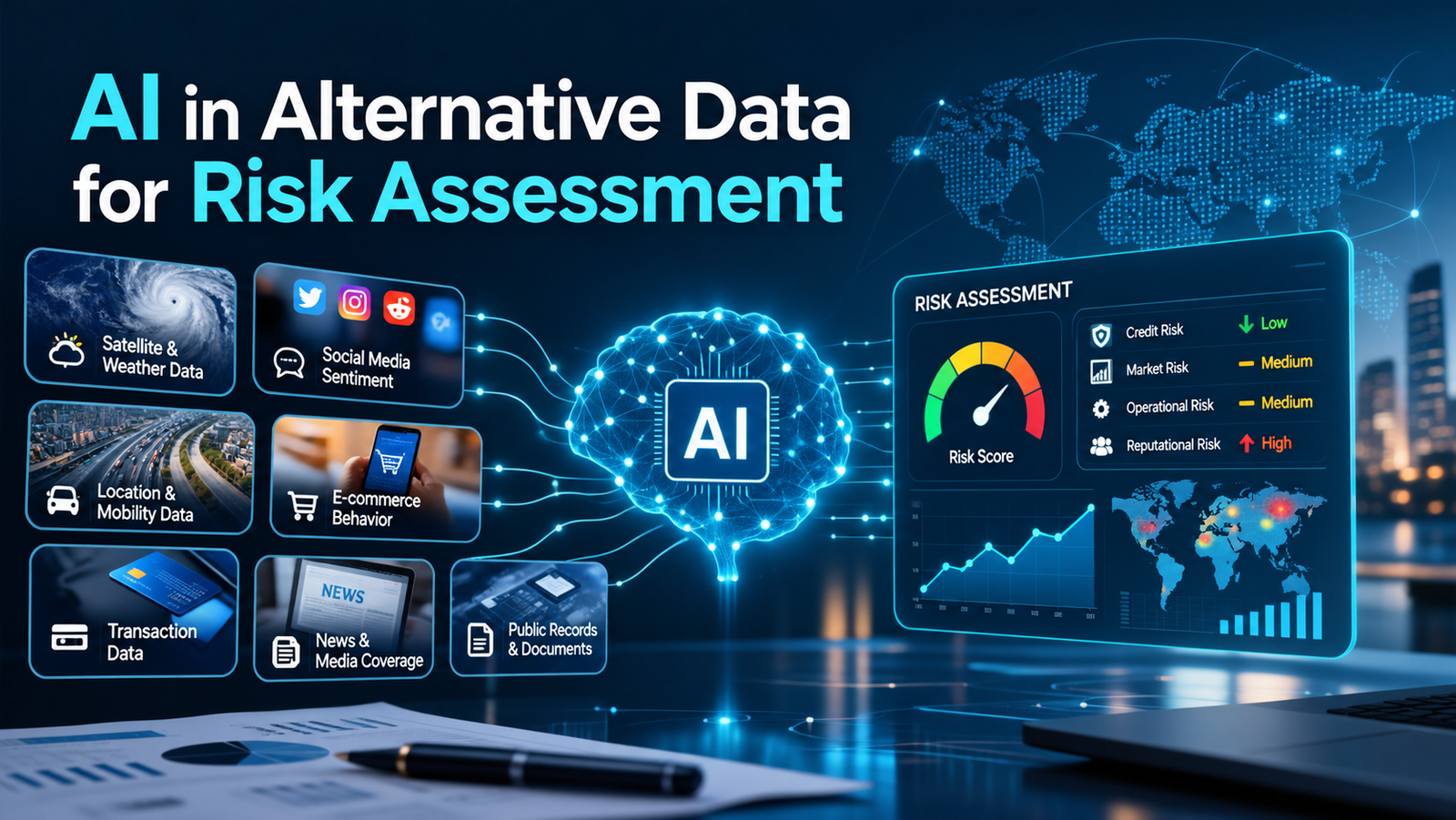
Primary topic: Artificial intelligence in alternative data analysis for financial risk assessment
Research focus: Alternative credit data, AI-powered risk scoring, digital payment intelligence, cash-flow underwriting, SME lending, thin-file borrowers, machine learning, behavioral data, explainable AI, model risk, fairness, privacy and responsible financial decision-making
What Is Alternative Data in AI Risk Assessment?
Alternative data refers to information that can help assess a person’s or business’s financial risk beyond the conventional credit bureau record or standard financial statements. It can include bank transaction histories, digital payment receipts, utility payments, rental records, e-commerce sales, invoice settlement patterns and business account activity.
AI systems can process these sources to estimate whether a borrower is likely to repay a loan, whether a small business is experiencing financial stress, or whether a customer’s cash flow can support a proposed repayment schedule. The value depends on the quality and relevance of the data. A large dataset does not automatically produce a reliable risk model, and a signal that works for one borrower group may not transfer to another.
The World Bank’s Digital Finance Inclusion resource explains that alternative data can help lenders assess people and businesses that lack conventional credit records. It identifies utility and rent payments, small loans, store credit and buy-now-pay-later records as examples of information that can contribute to a fuller credit profile.
For financial institutions, the practical objective is to use relevant additional evidence to make a more complete assessment, not to replace sound underwriting with unrestricted data collection.
Why Traditional Risk Models Can Miss Important Signals
Traditional credit assessment commonly uses credit history, outstanding debt, repayment records, income, financial ratios and collateral. These indicators remain important, but they may provide an incomplete picture for customers who are new to formal finance, self-employed, operating a small business or earning income through digital platforms.
Consider a small online retailer with limited borrowing history. A conventional application may show little information about its ability to repay. Yet its payment processor may hold a year of sales receipts, refunds, settlement timing and customer transaction records. With appropriate permission and validation, these records may help a lender estimate revenue stability and identify seasonal patterns.
AI can combine such information with traditional indicators. Machine learning models can identify nonlinear relationships, interactions between variables and changes in behavior that a simple scorecard may not capture. However, models must distinguish genuine financial signals from temporary fluctuations, irrelevant personal characteristics and patterns that reflect historical discrimination.
Traditional risk assessment
AI-enhanced assessment
Alternative Data Sources That Matter for Risk Assessment
Not all alternative data is equally useful. Financial institutions should prioritize information with a clear connection to repayment capacity, financial stability or the risk being assessed.
| Data source | Potential risk signal | Important limitation |
|---|---|---|
| Bank transaction data | Income regularity, balance volatility and recurring obligations | Incomplete account coverage can distort the picture |
| Digital payment records | Sales consistency and payment activity | Cash transactions may be missing |
| Utility and rent payments | Recurring payment consistency | Payment records may reflect housing or service access rather than credit capacity |
| E-commerce sales | Revenue trends, refunds and order stability | Gross sales do not equal profit or free cash flow |
| Invoices and supplier payments | Working-capital pressure and payment discipline | Records may be inconsistent across systems |
| Platform activity | Business continuity and sales concentration | Platform dependence can create misleading risk signals |
A responsible data strategy should document the purpose of each source, the legal basis for using it, the customer’s permissions where required, the data’s reliability and the risk decision it is intended to improve.
Research Study: AI-Based Credit Assessment in Digital Lending
A 2026 literature review published in Expert Systems with Applications examined 118 peer-reviewed articles published between 2018 and 2025. The review focused on AI-based credit assessment in digital lending, including machine learning, alternative data, real-time learning, explainability and fairness-oriented governance.
The authors found that ensemble and hybrid deep-learning approaches were prominent in the literature and often delivered strong predictive performance. The review also identified alternative data, including psychometric information and transaction streams, as potentially useful for assessing borrowers with limited conventional credit histories.
The research is especially relevant to digital lenders because their application journeys may need to assess a borrower quickly while working with data that varies in completeness and quality. A model that can process diverse information may improve risk differentiation, but the review cautions that interpretability tools such as SHAP and LIME still require further work on stability and practical usefulness.
The authors identified gaps in streaming-ready systems, behavioral-data validation, standardized explainability measures and the integration of fairness and governance into credit scoring. This means a lender should not assume that a model proven on a static dataset will remain accurate when new transaction data arrives continuously.
Research Study: Alternative Data for Micro-Enterprise Credit Risk in China
A 2026 empirical study investigated how alternative data can improve credit risk assessment for micro-enterprises using data from an internet bank serving small businesses in China. The researchers separated alternative information into historical credit data and behavioral data. The behavioral category included economic transaction data and indicators related to business or social stability.
The study used random forest models to compare the predictive value of these data categories. Its findings indicated that multidimensional alternative data contributed meaningful credit information and improved predictive performance and model stability. Models based on behavioral data showed stronger risk-identification capability than the model based on historical credit data alone.
This is a particularly useful result for small-business lending. A micro-enterprise may have limited formal credit history but still generate a substantial record of sales, payments and day-to-day transactions. Those records can provide evidence about its operating activity that a traditional credit file may not contain.
The findings should not be interpreted as proof that behavioral data will outperform credit history in every country or lending portfolio. The study uses a particular banking context, and data availability, business practices and borrower populations differ across markets. Lenders should test the approach on their own portfolios and compare it against a baseline model.
Research Study: Digital Payments and Access to Credit Across 101 Economies
A 2026 World Bank research summary discussed firm-level evidence from 101 economies on the relationship between electronic payments and access to credit. The research found that firms receiving electronic payments were less likely to be credit constrained, with particularly strong associations for small and young firms and businesses without audited financial statements.
The proposed mechanism is important for AI risk assessment. Digital payment records can make business activity more visible to lenders, especially when formal financial statements or established credit histories are unavailable. A lender may be able to estimate revenue consistency and observe transaction patterns using data generated during normal business operations.
The research also found that the relationship varied with the surrounding financial infrastructure. The benefit of electronic payment information was greater in environments with weaker credit information systems and lower levels of financial development. This suggests that alternative data may be especially valuable where conventional records are incomplete.
The study concerns the relationship between electronic payments and credit constraints; it does not establish that a specific AI model will automatically reduce defaults. It supports the business case for improving the availability and quality of digital financial information, which AI systems may then use in risk assessment.
Research Study: AI Adoption and Credit Risk Across OECD and BRICS Economies
A 2025 study in Finance Research Letters examined the relationship between AI adoption and credit risk across OECD and BRICS economies. The researchers constructed an AI Adoption Index using indicators related to banking technology spending, reported machine-learning use and digital transformation. They analyzed data spanning the period from 2005 to 2023 and used System GMM and random forest methods.
The study reported a negative relationship between AI adoption and credit risk in the countries examined. The random forest analysis also captured nonlinear relationships that may be missed by simpler statistical approaches.
This research provides broader economic context for financial institutions considering AI risk systems. It suggests that AI adoption and credit-risk outcomes may be related at the institutional or economy level. However, it does not isolate the effect of alternative data alone, and macro-level associations should not be treated as direct evidence that a particular borrower-scoring model will reduce defaults.
For implementation teams, the useful lesson is to evaluate AI as part of a wider risk-management capability, including data quality, underwriting policy, monitoring and operational controls.
Research Study: Explainable Graph Learning for Financial Risk and Fraud
A systematic review published in Artificial Intelligence Review in July 2026 analyzed 149 studies published between 2015 and 2025. It examined graph-based learning and explainable AI methods for credit risk assessment and fraud detection.
The review found that graph-based methods, particularly graph neural networks, can help model relationships in financial data. Their use was more developed in fraud detection than in credit-risk assessment, indicating that the technology has potential but is not equally mature across every financial application.
This distinction matters when using alternative data. A business’s risk may depend not only on its own transaction history but also on relationships among counterparties, suppliers, customers and payment flows. Graph models can represent these relationships, while explainability methods can help analysts understand which connections contributed to a risk signal.
However, relationship-based data can introduce new fairness and privacy concerns. A borrower should not automatically be treated as high risk because it is connected to another entity that has been flagged. Financial institutions need to validate how graph relationships are interpreted and provide meaningful explanations for consequential decisions.
Research Study: Regulatory Expectations for AI-Based Credit Decisions
In 2023, the US Consumer Financial Protection Bureau reiterated that creditors using complex algorithms must provide accurate and specific reasons for adverse credit actions. The guidance emphasized that lenders cannot rely on generic denial reasons if those reasons do not reflect the actual factors behind the decision.
Although this is regulatory guidance rather than a model-performance experiment, it is directly relevant to AI-based alternative-data risk assessment. Models that use hundreds of transaction or behavioral variables can make decisions difficult to explain unless explanation and reason-code generation are designed into the system.
For example, if a model reduces a credit limit because of a change in cash-flow stability, the institution should be able to identify the relevant and legally appropriate factors. A broad explanation such as “alternative data” is unlikely to provide a useful account of the decision.
The practical implication is that explainability should be built into model development, validation and decision workflows rather than added after deployment.
What These Studies Mean for Financial Institutions
Across these studies, a consistent but qualified picture emerges. Alternative data can improve the information available for credit assessment, particularly for borrowers with thin credit files and small businesses with limited formal reporting. Machine learning can help combine these signals, while graph methods can represent relationships that ordinary tabular models may not capture.
The evidence does not support treating every new data source as useful or assuming that better prediction automatically produces better lending outcomes. Institutions need to measure whether alternative data improves performance beyond existing models, whether it remains reliable across customer groups and whether the resulting decisions can be explained.
Potential benefitMore complete risk profiles for thin-file borrowers and small businesses
Model capabilityNonlinear pattern detection and combination of diverse signals
Key constraintData quality, fairness, explainability and generalization
Implementation needIndependent validation and ongoing performance monitoring
How AI Converts Alternative Data Into a Risk Decision
A production-grade system should have a clear path from data access to a decision that a lender can explain and audit.
Permission and source checks
Cleaning and reconciliation
Cash-flow and payment indicators
Probability and risk band
Policy and affordability checks
Outcomes and drift
Data preparation and quality controls
Raw transaction data often contains duplicated entries, reversals, inconsistent merchant descriptions, missing periods and transfers between a customer’s own accounts. Without careful preparation, a model may interpret internal transfers as income or treat a refund as a new purchase.
A reliable pipeline should reconcile transactions, identify likely internal transfers, distinguish recurring income from one-off deposits and record data freshness. For business lending, it should also distinguish gross sales from net revenue, operating expenses and cash available for debt service.
Feature engineering for risk assessment
Useful features should reflect financial capacity and stability rather than merely describing activity. Examples include:
- Monthly inflow and outflow trends
- Income regularity and concentration
- Balance volatility and low-balance frequency
- Recurring payment obligations
- Debt-service burden where reliable data is available
- Revenue seasonality for small businesses
- Invoice payment delays and receivables concentration
- Refund, chargeback and cancellation patterns where relevant
- Changes in cash flow compared with the borrower’s own history
These features should be evaluated for predictive value, stability and fairness. A feature should not be included simply because it improves a test score if it is unreliable, invasive or difficult to justify.
Model Choices: Which AI Techniques Fit the Task?
Different risk problems require different model designs. A lender assessing a small-business cash-flow loan may need a different approach from a platform estimating the risk of a short-term consumer loan.
| AI method | Suitable application | Main consideration |
|---|---|---|
| Logistic regression | Baseline probability-of-default model | May miss complex nonlinear patterns |
| Random forest | Mixed tabular and behavioral data | Requires calibration and explanation |
| Gradient boosting | Structured credit and transaction features | Can overfit without disciplined validation |
| Time-series models | Cash-flow changes and financial stress | Sensitive to missing data and regime changes |
| Graph neural networks | Counterparty and transaction relationships | Relationship signals can create privacy and fairness risks |
| Explainability methods | Decision explanations and model review | Explanations must be stable and decision-relevant |
A strong development process should begin with a transparent baseline. More complex models should be adopted only when they demonstrate a meaningful improvement in out-of-time performance, calibration, decision quality or operational efficiency.
Risk Assessment for Thin-File and First-Time Borrowers
Thin-file borrowers present a clear use case for alternative data because conventional credit records may contain too little information to estimate risk confidently. A model can use permitted payment and cash-flow records to build a broader picture, but it must distinguish a lack of data from evidence of high risk.
This distinction is important. A customer with no credit history is not necessarily a customer who will fail to repay. If the model treats missing records as negative signals, it can reproduce exclusion in a new form.
A responsible system should identify uncertainty explicitly. Where the evidence is limited, a lender may need a smaller initial credit limit, additional verification, a shorter review period or a manual assessment rather than an automatic rejection.
The World Bank’s digital credit materials also emphasize consumer-protection risks in digital lending, including poor disclosure and lending practices that do not adequately assess borrowers’ circumstances.
Source: World Bank, Digital Credit and Consumer Protection
Alternative Data for Small-Business and SME Lending
For small businesses, alternative data can provide a view of operating performance between formal financial reporting periods. A lender may assess sales stability, customer concentration, settlement delays, supplier payments and working-capital patterns.
However, revenue alone is not repayment capacity. A business can generate high sales while operating with thin margins, heavy refunds, large supplier obligations or delayed receivables. AI models should therefore consider cash conversion and operating obligations, not just transaction volume.
For e-commerce sellers, useful indicators may include net sales after refunds, payout consistency, seasonality, marketplace concentration and the relationship between inventory spending and incoming payments. For SaaS companies, recurring revenue, subscription churn, failed payments, customer concentration and receivable aging may help assess business stability, subject to data access and appropriate consent.
A key design principle is to create sector-specific features while preserving a consistent risk framework. The model should account for the fact that a seasonal retailer, a subscription software company and a professional-services firm can have very different but healthy cash-flow patterns.
Explainability, Fairness and Privacy
Alternative data can improve risk visibility, but it can also introduce new risks. Behavioral and digital data may reveal information about a person’s life that is not necessary for a credit decision. Location patterns, device attributes, social connections and browsing behavior can also act as proxies for sensitive or protected characteristics.
Financial institutions should apply data minimization and purpose limitation. They should collect only information that is relevant to the stated risk decision, establish a lawful basis for processing, restrict access and define retention periods. Sensitive or intrusive data should not be used merely because it is technically available.
Fairness testing should examine whether model errors and outcomes differ across relevant customer groups. Where legally permissible, institutions should evaluate approval rates, false-positive rates, calibration and loss outcomes across groups, while protecting sensitive information.
Explainability is equally important. In the United States, the CFPB has stated that creditors must provide specific and accurate reasons for adverse actions, even when complex algorithms are used.
Source: CFPB, AI Credit Denial Guidance
Expert Recommendation
Financial institutions should build alternative-data risk assessment around a clear question: Does this additional information improve a real lending decision in a measurable, fair and explainable way?F
The recommended approach is to begin with a narrow use case, such as assessing cash-flow stability for small-business borrowers or improving risk estimates for customers with limited credit history. Establish a baseline using conventional data, then test whether alternative data improves predictive performance and business outcomes.
The institution should use a controlled model-development process:
- Define the risk outcome, such as default within a specified period
- Document the purpose, provenance and permitted use of every data source
- Build a transparent baseline model before introducing complex AI
- Use time-based validation to reduce leakage from future information
- Test performance across relevant borrower groups and economic conditions
- Calibrate risk scores to observed outcomes
- Generate specific, decision-relevant explanations
- Monitor drift, complaints, defaults and approval outcomes after deployment
- Maintain a human review path for uncertain or exceptional cases
The model should not make lending policy on its own. Credit limits, affordability requirements, pricing, escalation rules and adverse-action procedures should remain part of a governed decision framework.
Expert Quote
The US Consumer Financial Protection Bureau stated in its 2023 guidance:
The quote captures a central requirement for AI risk assessment: a model’s complexity does not remove the need to explain its decisions. Alternative data may make a model more informative, but it can also make the reasoning harder to communicate. Explanation therefore needs to be part of the system’s design, not a task left until a customer challenges a decision.
Source: Consumer Financial Protection Bureau, September 2023
Implementation Roadmap
Data and use-case discovery
Identify the portfolio where traditional information is weakest and determine which alternative sources are available with appropriate permissions. Establish a specific outcome to predict, such as default, delinquency or cash-flow stress, and define the period over which that outcome will be measured.
Data engineering and feature design
Build a secure pipeline that validates source identity, timestamps, completeness and consistency. Create features that reflect repayment capacity and stability, and document why each feature is relevant to the decision.
Model development and validation
Compare a transparent baseline with one or more machine-learning approaches. Use out-of-time testing, calibration analysis, subgroup evaluation and sensitivity tests. Avoid random train-test splits when they could allow information from the future to leak into training.
Pilot and controlled deployment
Run the model in shadow mode or as decision support before allowing it to affect approvals, pricing or limits. Compare its recommendations with existing decisions and observed outcomes. Investigate cases where the new model disagrees with established policy.
Monitoring and governance
Track model performance, data availability, customer complaints, adverse outcomes and changes in the borrower population. Revalidate the system when data sources, products, policies or economic conditions change materially.
Key KPIs for AI Alternative-Data Risk Assessment
| KPI | What it measures | Why it matters |
|---|---|---|
| AUC / ranking performance | Ability to distinguish higher- and lower-risk cases | Tests whether the model separates risk levels |
| Calibration | Agreement between predicted and observed risk | Supports meaningful risk bands and pricing |
| Default rate by risk band | Observed losses across score ranges | Connects model output to portfolio outcomes |
| Thin-file approval rate | Access for applicants with limited credit records | Measures potential inclusion benefits |
| Fairness metrics | Differences in errors and outcomes across groups | Helps identify disparate impacts |
| Data coverage | Share of applicants with usable alternative data | Reveals whether missingness creates exclusion |
| Decision explanation quality | Whether reasons accurately reflect model decisions | Supports compliance and customer understanding |
Future Predictions: 2027–2030
2027: Cash-Flow Data Becomes More Integrated Into Underwriting
More lenders are likely to connect permitted transaction data with conventional credit information. The main opportunity will be improving assessments for thin-file customers and small businesses. Institutions will increasingly need clear consent flows, data-quality checks and documented explanations for decisions based on these sources.
2028: Risk Models Become More Dynamic
As lenders gain access to more frequent transaction information, risk systems may move from periodic reassessment toward controlled updates based on changing cash flow. This will require safeguards against overreacting to short-term volatility, seasonal patterns or temporary financial shocks.
2029: Business-Specific Alternative Data Models Expand
SME risk assessment may become more tailored to business models. E-commerce sellers, subscription software companies, service businesses and wholesalers have different revenue and working-capital patterns. Models that account for these differences may provide more useful risk estimates than a single generic score.
2030: Explainable, Multi-Source Risk Intelligence
Financial institutions may increasingly combine traditional credit files, open-banking data, digital payment records and business-platform information in a unified risk platform. The likely direction is not unrestricted data collection, but better integration of relevant sources with clear provenance, permission controls and model governance.
These are forward-looking expectations based on current research and technology directions, not guaranteed outcomes. Adoption will depend on regulation, data access, consumer trust, model performance and the economics of implementation.
Startup Opportunities
Alternative-data AI creates opportunities for fintech and risk-technology companies that solve specific underwriting problems rather than offering a generic score.
- Cash-Flow Underwriting API for lenders that need repayment-capacity features from transaction data
- Thin-File Credit Assessment for applicants with limited conventional credit histories
- SME Revenue Intelligence for e-commerce sellers and small businesses
- Invoice and Receivables Risk Analytics for working-capital lenders
- Alternative-Data Quality Platform for detecting missing, duplicated or unreliable records
- Explainable Credit Decision Engine that connects model outputs to specific decision factors
- Fairness and Model Monitoring Platform for ongoing portfolio-level evaluation
- Open-Banking Risk Analytics for permissioned analysis of transaction histories
A particularly practical product is an alternative-data feature API that converts permitted raw transaction records into documented, validated indicators. Lenders could use these features within their existing underwriting systems rather than replacing their entire credit platform.
Frequently Asked Questions
What is alternative data in credit risk assessment?
Alternative data is information beyond traditional credit records and standard financial statements that can help estimate repayment risk. Examples include bank transactions, digital payment records, rent and utility payments, invoices and business-platform sales data.
How does AI use alternative data?
AI models analyze patterns across permitted data sources to estimate risk, identify changes in cash flow and combine signals that may be difficult to evaluate manually. The model’s usefulness depends on data quality, validation and whether the signals genuinely relate to repayment outcomes.
Can alternative data help people with no credit history?
It can provide additional evidence for applicants with thin or missing credit files. However, a lack of conventional credit history should not automatically be treated as a sign of high risk, and alternative-data models need to be tested for fairness and accuracy.
What alternative data is useful for SME lending?
Potentially useful sources include business bank transactions, digital payment settlements, sales records, invoices, supplier payments and receivables. Lenders should distinguish revenue from profit and cash available for debt repayment.
Does alternative data always improve credit scoring?
No. Some sources may be incomplete, noisy, irrelevant or biased. Institutions should test whether each source improves performance beyond a conventional baseline and whether the improvement holds across time and borrower groups.
What are the main risks of AI-based alternative-data assessment?
The main risks include privacy violations, unfair discrimination, poor data quality, model drift, weak explainability and decisions based on signals that do not genuinely reflect repayment capacity.
Why is explainable AI important in credit decisions?
Lenders need to understand and document the factors behind consequential decisions. In jurisdictions such as the United States, creditors must provide specific and accurate reasons for adverse actions, even when complex algorithms are involved.
Final Perspective
AI in alternative data for risk assessment is most valuable when it helps a financial institution understand a borrower more accurately than conventional information alone. Transaction histories, digital payments, business sales and recurring obligations can reveal financial patterns that may be absent from a credit bureau file or a set of annual accounts.
Recent research supports the potential of these data sources. A 2026 review of 118 studies found that alternative data and machine-learning approaches are important directions in digital credit assessment, while identifying gaps in real-time validation, explainability and fairness. An empirical study of micro-enterprises in China found that multidimensional behavioral data improved risk identification compared with historical credit data alone. World Bank research covering firms in 101 economies also found that electronic payments were associated with fewer credit constraints, especially for smaller and younger firms.
These findings point toward a more complete approach to underwriting, but they do not justify collecting every available data point or allowing a model to make unexplained decisions. Financial institutions must demonstrate that data is relevant, permitted, reliable and useful for the specific risk being assessed.
The strongest systems will combine:
For lenders, banks, neobanks, fintech platforms and SME finance providers, the goal should be better risk differentiation, responsible access to credit and more reliable portfolio outcomes. Alternative data should help make decisions more informed, not less transparent.
Research Sources
- A Comprehensive Literature Review on AI-Based Credit Assessment in Digital Lending, Expert Systems with Applications, 2026
- The Role of Alternative Data in Micro-Enterprises’ Credit Risk Assessment in China, 2026
- World Bank, When Digital Payments Unlock Access to Credit: New Evidence from Firms in 101 Economies, 2026
- The Role of AI in Credit Risk Assessment: Evidence from OECD and BRICS via System GMM and Random Forest, Finance Research Letters, 2025
- Towards Transparent Financial AI: A Systematic Review of Graph Learning and Explainable Methods for Credit Risk and Fraud Detection, Artificial Intelligence Review, 2026
- Consumer Financial Protection Bureau, Guidance on Credit Denials by Lenders Using Artificial Intelligence, 2023
- World Bank, Digital Finance Inclusion: Credit Reporting
- World Bank, Digital Finance Inclusion: Digital Credit and Consumer Protection
- US Interagency Statement on the Use of Alternative Data in Credit Underwriting

Leave a Reply