
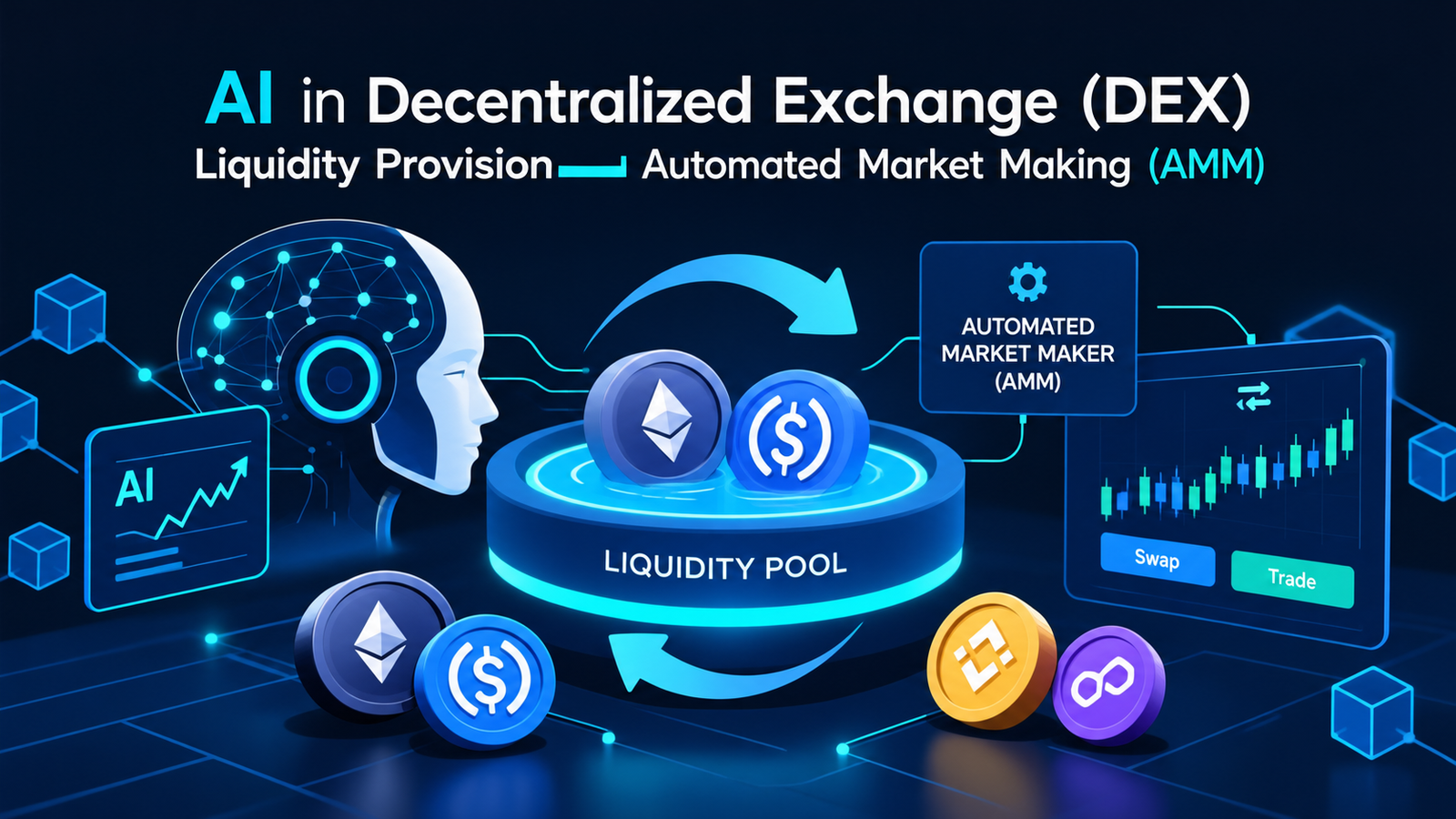
Primary topic: AI in Decentralized Exchange (DEX) Liquidity Provision and Automated Market Making (AMM)
Research focus: AI-powered liquidity management, automated market making, concentrated liquidity, liquidity range optimization, impermanent loss, loss-versus-rebalancing, dynamic fees, reinforcement learning, machine learning, predictive analytics, MEV, JIT liquidity, DeFi risk management and autonomous liquidity strategies
What Is AI in DEX Liquidity Provision and AMM?
A decentralized exchange allows users to trade crypto assets without relying on a traditional centralized order book or centralized intermediary. In an automated market maker, liquidity providers deposit assets into smart-contract-controlled pools, and traders exchange assets against that liquidity according to mathematical pricing rules.
The basic AMM model is often represented by:
x × y = k
x = quantity of token A
y = quantity of token B
k = constant product
Modern AMMs such as Uniswap v3 and v4 introduce concentrated liquidity. Instead of providing capital across the entire possible price curve, liquidity providers can choose a specific price range.
This improves capital efficiency because more capital can be positioned around the prices where trading is expected to occur. However, it also creates a new management problem.
If the market moves outside the selected range, that liquidity becomes inactive and stops earning swap fees until the price returns to the range. Uniswap’s documentation confirms that only liquidity inside the active price range earns fees in v3 and v4.
AI can address this problem by continuously estimating where liquidity should be placed.
A simplified AI liquidity-management system can therefore work like this:
Market Data
↓
AI Prediction
↓
Volatility + Volume + Price Forecast
↓
Optimal Liquidity Range
↓
Fee / Position Optimization
↓
Smart Contract Execution
↓
Continuous Monitoring
Why AI Matters for AMM Liquidity Providers
Traditional passive liquidity provision has a simple advantage: the LP does not need to actively manage every market movement.
The problem is that the market does not remain static.
Crypto markets can experience large price movements, sudden changes in volatility, liquidity migration, arbitrage activity, token-specific events and changes in trading volume within minutes.
For concentrated-liquidity systems, these changes directly affect LP economics.
An LP must effectively answer several questions:
- How wide should the liquidity range be?
- Where should the range be centered?
- When should liquidity be moved?
- How much capital should remain in the active range?
- Which pools offer the best expected fee income?
- How much impermanent loss risk is acceptable?
- Should fees increase during high volatility?
- How should gas costs affect rebalancing decisions?
- How should inventory exposure be controlled?
- When should liquidity be withdrawn completely?
These are optimization problems.
AI is useful because it can process large amounts of market and blockchain data and continuously update its estimates.
Concentrated Liquidity Changes the AI Opportunity
Uniswap v3 introduced concentrated liquidity, and v4 retains this mechanism. LPs can specify a custom price range instead of distributing capital across the entire price curve.
The trade-off is straightforward.
Narrow Range
Higher capital efficiency
Higher potential fee concentration
Higher risk of becoming inactive
Wide Range
Lower capital efficiency
Broader price coverage
Lower frequency of rebalancing
AI-Managed Range
Dynamic allocation
Market-aware positioning
Continuous risk optimization
This creates a natural role for predictive models.
If AI expects lower volatility and stable prices, it may recommend tighter ranges.
If AI expects a large directional move, it may recommend wider ranges, asymmetric ranges or reduced liquidity exposure.
The objective is not simply to maximize fees. The objective is to optimize the risk-adjusted economic outcome.
Research Study 1: Physics-Informed Neural Networks for Uniswap v3 Liquidity
One of the most directly relevant 2026 studies is Optimizing liquidity provision in Uniswap v3 via physics-informed neural networks, published in the Journal of Computational and Applied Mathematics.
The research proposes a framework for optimizing Uniswap v3 liquidity ranges using Physics-Informed Neural Networks, or PINNs.
The central problem is the trade-off between range width and profitability.
Narrow ranges can increase potential fee income because capital is concentrated where trading occurs. However, narrow ranges can also become inactive quickly when prices move.
The researchers model market dynamics using stochastic processes and use the Feynman-Kac theorem to formulate expected utility as the solution to a partial differential equation.
The PINN is then used to approximate this expected utility efficiently.
The researchers backtested the framework across eight pools and reported that it could optimize liquidity provision performance under the tested assumptions.
This research is significant because it moves AI liquidity management beyond simple price prediction.
The model is not merely predicting tomorrow’s price.
It is trying to answer a more useful question:
“Given expected market behavior, where should liquidity be placed to maximize expected utility?”
That distinction is important for real-world DeFi products.
Research Study 2: Deep Reinforcement Learning for Predictive AMMs
A 2024 study published in Financial Innovation proposed a predictive crypto-asset AMM architecture using deep reinforcement learning.
The research combines an on-chain AMM environment with an off-chain predictive reinforcement-learning component.
The objective is to improve liquidity provision by allowing the system to learn from market behavior rather than relying entirely on fixed rules.
This is important because an AMM is effectively making repeated economic decisions.
Every liquidity allocation, fee setting and inventory adjustment affects the future state of the system.
That makes the problem suitable for reinforcement learning.
Reinforcement Learning AMM Loop
Market State → AI Agent → Liquidity / Quote Decision → Market Response → Reward → Model Update
The research demonstrates an architecture in which reinforcement learning can operate alongside blockchain settlement rather than replacing the deterministic on-chain infrastructure.
This distinction is valuable for production systems because computationally intensive AI can remain off-chain while final transactions and liquidity changes remain governed by smart contracts.
Research Study 3: Predictable Loss and Optimal Liquidity Provision
Research by Cartea, Drissi and Monga provides an important mathematical foundation for AI-powered liquidity management.
Their study develops a continuous-time model for strategic LPs in concentrated-liquidity pools.
The model considers:
- Fee income
- Gas and rebalancing costs
- Predictable loss
- Concentration risk
- Market-price dynamics
- Liquidity-range width
The researchers derive an optimal liquidity-provision strategy in which the liquidity range depends on pool profitability, predictable losses and concentration risk.
Using Uniswap v3 data, they report that LPs in the studied pool had experienced significant losses on average, while the proposed strategy showed superior out-of-sample performance relative to historical LP performance in that setting.
This study matters because it shows that intelligent liquidity management does not necessarily require deep learning.
Some of the most valuable AI systems may combine machine learning forecasts with mathematically optimized decision rules.
Research Study 4: Strategic Just-In-Time Liquidity
Just-In-Time liquidity is a particularly interesting part of automated liquidity provision.
A JIT LP watches the blockchain environment and provides concentrated liquidity immediately before a large swap, then removes it shortly afterward.
Uniswap’s empirical research identified 8,287 JIT liquidity attempts between May 2021 and July 2022. Successful JIT liquidity represented around $2 billion of liquidity supplied against more than $600 billion in Uniswap trading volume during the period studied, meaning JIT represented roughly 0.3% of liquidity demand.
The research also found that JIT liquidity could improve execution quality for traders.
This creates an important AI opportunity.
An intelligent LP system could monitor:
- Pending transactions
- Expected trade size
- Pool liquidity
- Current volatility
- Gas costs
- Expected LP fees
- Hedging costs
- MEV competition
The system could then determine whether providing temporary liquidity is economically worthwhile.
A 2025 formal study of JIT liquidity further found that strategic JIT provision can improve market efficiency while potentially reducing passive LP profits. The researchers estimated that accounting properly for price impact could increase JIT earnings by up to 69% over small time windows, while passive LP profits could be reduced by up to 44% per trade on average in the modeled setting.
This demonstrates that AI optimization can create benefits for one liquidity strategy while changing the economics of another.
Source: Uniswap Labs, Just-In-Time Liquidity on the Uniswap Protocol
Source: AFT 2025, Strategic Analysis of Just-In-Time Liquidity Provision in Concentrated Liquidity Market Makers
Research Study 5: Reinforcement Learning for Crypto Automated Market Making
A 2026 study in the Journal of Finance and Data Science developed a reinforcement-learning framework for automated market making in cryptocurrency perpetual futures.
Although the study focuses on perpetual futures rather than spot AMMs, it provides useful evidence for AI-controlled market-making systems.
The model included:
- Funding rates
- Inventory
- Realized volatility
- Order-flow imbalance
The research used 29,606 hourly BTCUSDT observations and 3,701 funding-rate records covering December 2022 through May 2026.
The best reinforcement-learning policy was only marginally positive under the study’s conservative Sharpe definition. However, a performance-focused adaptive market-making variant incorporating volatility filtering, fee-aware quoting and momentum-based inventory targeting reported a 24.63% annualized return, 1.49 Sharpe ratio and 6.39% maximum drawdown on the final historical holdout.
The most important lesson is not the reported return.
It is the importance of risk controls.
The study explicitly identifies fees, market regimes, inventory constraints, latency and execution assumptions as critical factors for production deployment.
That is directly relevant to AI-powered AMMs.
A model that looks profitable before gas, slippage, adverse selection and execution costs can become unprofitable after realistic costs are included.
Research Study 6: Liquidity Provision as a Predictor of Market Conditions
A 2026 empirical study examined liquidity provision and its information content in decentralized markets using tick-by-tick transaction data from 278 Uniswap liquidity pools.
The study reports that net liquidity provision has significant predictive power for the direction of volatility changes across different historical time windows.
This introduces another important AI use case.
AI does not only need to predict asset prices.
It can potentially learn from the behavior of liquidity providers themselves.
For example, an AI model could monitor:
Liquidity Inflows
Where capital is entering
Liquidity Withdrawals
Where capital is leaving
Range Changes
How LPs reposition capital
Pool Migration
Where liquidity is moving
These signals could become part of an AI liquidity strategy.
Source: Liquidity provision and its information content in decentralized markets, 2026
Research Evidence Dashboard
8
Uniswap pools used in the 2026 PINN liquidity optimization backtest
278
Uniswap pools analyzed in the 2026 liquidity-provision information study
8,287
JIT liquidity attempts identified in Uniswap’s 2021–2022 study
$2B+
Successful JIT liquidity supplied in that historical dataset
29,606
Hourly BTCUSDT observations in the 2026 RL market-making study
AI for Dynamic AMM Fees
Fee optimization is one of the most promising applications for AI-powered AMMs.
Traditional AMMs may use fixed fee tiers.
Uniswap v3, for example, introduced multiple fee tiers, while Uniswap v4 supports customizable and dynamic fees through hooks. Dynamic fees can change according to market conditions, including volatility, volume, liquidity depth and other inputs.
This creates a new optimization problem:
What fee should the pool charge right now?
During calm markets, lower fees may attract more trading volume.
During extreme volatility, higher fees may compensate LPs for greater adverse-selection and inventory risk.
An AI model could estimate:
- Realized volatility
- Expected volatility
- Trading volume
- Order-flow imbalance
- Arbitrage activity
- Pool depth
- Gas prices
- External market prices
- Expected adverse selection
It could then recommend or execute a fee adjustment within predefined protocol constraints.
AI Dynamic Fee Engine
Volatility ↑ → Fee may increase
Adverse selection ↑ → Fee may increase
Uninformed volume ↑ → Fee may decrease
Pool depth ↓ → Fee may increase
Gas cost ↑ → Rebalancing threshold may increase
Uniswap’s current v4 documentation explicitly identifies volatility-based fees, volume-based fees, depth-based fees, gas-responsive fees, event-driven fees and momentum-based approaches as potential dynamic-fee strategies.
AI and Impermanent Loss
Impermanent loss occurs when the relative prices of tokens change after liquidity is supplied, producing a different asset composition and value compared with simply holding the assets.
Uniswap describes the mechanism through the AMM’s constant-product structure and notes that concentrated liquidity can increase the likelihood of impermanent loss because capital is focused within specific price ranges.
AI cannot eliminate impermanent loss.
What it can potentially do is manage exposure.
An intelligent system can estimate:
Expected Fee Income
−
Expected Impermanent Loss
−
Gas + Rebalancing Costs
−
Adverse Selection / LVR
=
Estimated Net LP Outcome
This is a much more useful objective than simply maximizing annualized fee yield.
AI and Loss-Versus-Rebalancing
Loss-versus-rebalancing, often discussed alongside predictable loss and related LP opportunity costs, captures the economic cost of providing liquidity compared with dynamically rebalancing against external market prices.
This matters because arbitrageurs continuously move AMM prices toward broader market prices.
When an LP’s pool position changes because of arbitrage, the LP can end up selling an asset that is appreciating and accumulating one that is falling relative to the external market.
AI can attempt to detect this pressure before it becomes severe.
Useful signals include:
- DEX price versus CEX price
- DEX price versus oracle price
- Arbitrage volume
- Order-flow direction
- Pool imbalance
- Volatility
- Liquidity depth
- Historical arbitrage frequency
This allows an AI system to reduce liquidity exposure during periods when adverse selection is expected to become expensive.
AI Liquidity Range Optimization
For concentrated liquidity, range selection is one of the most important decisions.
A simple AI optimizer can calculate multiple candidate ranges.
| Range strategy | Expected benefit | Main risk |
|---|---|---|
| Very narrow | High capital efficiency | Rapidly becomes inactive |
| Moderately narrow | Balance of fees and coverage | Requires monitoring |
| Wide | Higher probability of remaining active | Lower capital efficiency |
| AI adaptive | Changes with market conditions | Model and execution risk |
AI and Liquidity Migration
Capital is not permanently loyal to one pool.
LPs can move assets between:
- Different DEXs
- Different chains
- Different fee tiers
- Different token pairs
- Different liquidity ranges
- Different DeFi protocols
An AI liquidity allocator could therefore operate at a portfolio level.
Instead of asking:
“Where should I provide liquidity?”
it asks:
“How should my entire liquidity portfolio be allocated?”
LP Capital
↓
Pool A | Pool B | Pool C | Pool D
↓
AI Risk + Return Optimization
↓
Dynamic Capital Allocation
This creates a new category of DeFi wealth-management infrastructure.
Uniswap v4 and the AI Opportunity
Uniswap v4 significantly expands the design space for AI-powered liquidity strategies.
Its hook architecture allows developers to customize pool behavior around initialization, liquidity changes, swaps and donations. It also supports dynamic fee logic.
The official documentation identifies potential uses including:
- Dynamic fees
- Custom pricing logic
- Custom oracle behavior
- Automated liquidity management
- Limit orders
- TWAMM-style execution
- Custom accounting
The architecture is therefore increasingly compatible with specialized AI-controlled strategies.
However, a hook is still a smart contract.
AI-generated logic cannot simply be deployed without security validation.
Uniswap itself warns that third-party hooks can be malicious or produce unintended consequences.
Source: Uniswap Developers, Understanding Uniswap v4 Hooks
AI-Powered AMM Architecture
Data Layer
DEX trades, pool state, volatility, external prices, gas, liquidity and blockchain activity
Feature Layer
Returns, volatility, volume, order flow, liquidity imbalance and arbitrage indicators
AI Prediction Layer
Price regime, volatility, expected volume and liquidity demand
Optimization Layer
Liquidity range, capital allocation, fee level and rebalancing threshold
Risk Layer
Impermanent loss, LVR, inventory, gas, slippage and smart-contract exposure
Execution Layer
Smart contract or v4 hook executes approved changes
Monitoring Layer
Tracks performance, model drift and abnormal behavior
Human-in-the-Loop AI for DeFi
A completely autonomous system is not always the best design.
For institutional or high-value liquidity, human oversight can be valuable.
The system can automatically execute low-risk adjustments while requiring approval for larger changes.
For example:
- Small fee changes can be automated
- Small range adjustments can be automated
- Large capital reallocations can require approval
- New pools can require manual approval
- New hooks should require security review
- Extreme volatility can trigger an emergency pause
This produces a controlled autonomy model.
Level 1 → AI analytics
Level 2 → AI recommendations
Level 3 → Automated low-risk adjustments
Level 4 → Autonomous liquidity management with limits
Level 5 → Fully autonomous strategy under audited protocol constraints
Major Risks of AI-Powered AMMs
AI adds a new layer of risk to an already complex financial system.
| Risk | Potential impact | Recommended control |
|---|---|---|
| Model error | Poor liquidity positioning | Risk limits and fallback strategies |
| Overfitting | Strategy fails in new market conditions | Walk-forward testing and out-of-sample validation |
| Oracle manipulation | Incorrect AI inputs | Multiple data sources and robust oracle design |
| MEV | Adverse execution and value extraction | MEV-aware execution strategies |
| Gas costs | Rebalancing becomes uneconomic | Minimum expected-profit thresholds |
| Smart-contract risk | Loss of deposited assets | Audits, formal testing and restricted permissions |
| Model manipulation | Attackers influence AI decisions | Input validation and adversarial testing |
Expert Recommendation
The strongest architecture for AI-powered DEX liquidity is a hybrid intelligent AMM.
The blockchain should remain responsible for deterministic settlement, asset custody rules and hard safety constraints.
AI should operate above that foundation.
The recommended architecture is:
- Use machine learning for volatility and volume forecasting
- Use reinforcement learning for sequential liquidity decisions
- Use mathematical optimization for capital allocation
- Use dynamic fees to respond to changing market conditions
- Use risk models for impermanent loss and LVR exposure
- Use blockchain analytics to monitor liquidity migration
- Use strict on-chain limits around AI-controlled actions
- Use simulation and backtesting before deployment
- Use human approval for high-value or unusual actions
- Use emergency controls when model behavior becomes abnormal
The key recommendation is to optimize for risk-adjusted net LP performance, not raw fee APR.
A strategy that generates high fees but suffers greater impermanent loss, gas expenses and adverse selection is not necessarily better.
Expert Quote and Research Perspective
The 2026 PINN research describes the core liquidity-management problem as a trade-off between narrower ranges that can increase potential revenue and wider ranges that provide more continuous but lower profitability.
Uniswap’s dynamic-fee documentation similarly states that optimal fees depend on factors including asset volatility and the volume of uninformed flow, and identifies dynamic fees as a mechanism for better pricing of volatility and risk management.
These two perspectives point toward the same direction:
Future AMMs will increasingly price liquidity according to changing market conditions rather than treating every market state identically.
AI Liquidity Management Maturity Model
| Stage | Capability | Main limitation |
|---|---|---|
| 1. Passive LP | Fixed liquidity position | No adaptation |
| 2. Analytics | Dashboards and performance tracking | Human makes decisions |
| 3. Predictive | AI predicts volatility and liquidity conditions | Execution remains manual |
| 4. Adaptive | Automated range and fee adjustments | Requires strong risk controls |
| 5. Autonomous | AI manages liquidity continuously | Model and smart-contract risk |
Implementation Roadmap
Phase 1: Data Infrastructure
Build a reliable data pipeline containing:
- DEX swap data
- Pool reserves
- Liquidity positions
- Tick-level data
- External exchange prices
- Volatility data
- Gas prices
- MEV activity
- Blockchain state
Phase 2: Build the Prediction Layer
Train models for:
- Short-term volatility
- Expected trading volume
- Price regime
- Liquidity demand
- Arbitrage pressure
- Expected pool utilization
Phase 3: Build the Optimization Engine
The engine should calculate expected net LP outcomes for different:
- Liquidity ranges
- Fee levels
- Capital allocations
- Rebalancing frequencies
Phase 4: Add Reinforcement Learning
Use RL to learn sequential decisions.
The reward function should include:
− Impermanent Loss
− LVR
− Gas
− Slippage
− Execution Costs= Risk-Adjusted LP Reward
Phase 5: Deploy With Guardrails
AI should initially operate in recommendation mode.
After extensive testing, low-risk actions can become automated.
Phase 6: Continuous Monitoring
Monitor:
- Strategy performance
- Model drift
- Pool changes
- Unexpected volatility
- Oracle divergence
- Gas spikes
- MEV activity
- Smart-contract events
Future Predictions: 2027–2030
2027: AI Liquidity Managers Become More Common
The first major shift will likely be from passive concentrated-liquidity management toward automated range recommendations.
LP platforms will increasingly show expected fee income, expected inactive time, volatility exposure and estimated impermanent-loss risk before capital is deployed.
2028: Dynamic Fees Become a Major AI Use Case
As customizable AMM architectures become more widely used, AI-controlled fee models are likely to become more sophisticated.
Instead of selecting one static fee tier, pools may respond continuously to:
- Volatility
- Trade size
- Order-flow toxicity
- Liquidity depth
- Market regime
- External market conditions
Uniswap v4’s hook architecture already provides infrastructure for dynamic fee strategies.
2029: Autonomous Liquidity Portfolios
AI systems will increasingly manage liquidity across multiple pools rather than optimizing one pool at a time.
The system could decide whether capital should move between:
Pool → Chain → DEX → Asset Pair → Fee Tier → Liquidity Range
This would make DeFi liquidity management resemble algorithmic portfolio management.
2030: Intelligent AMMs Become Adaptive Financial Infrastructure
The long-term direction is likely to be AMMs that dynamically respond to market conditions.
A future intelligent AMM could continuously adjust:
Fees
Based on market risk
Liquidity
Based on expected demand
Ranges
Based on volatility
Risk
Based on adverse selection
The AMM would become less like a static mathematical formula and more like an adaptive liquidity system.
Startup Opportunities
AI-powered DEX infrastructure creates several potential product categories.
- AI Liquidity Manager for automated concentrated-liquidity positions
- AI AMM Optimizer for protocol developers
- Dynamic Fee Engine for Uniswap v4-style pools
- AI LP Portfolio Manager across multiple DEXs and chains
- Impermanent Loss Prediction Platform for LPs
- AI LVR Monitoring for professional liquidity providers
- MEV-Aware Liquidity Manager for large pools
- AI JIT Liquidity System for specialized market-making strategies
- DeFi Liquidity Risk Dashboard for institutional users
- AI Hook Development Platform for Uniswap v4 ecosystems
Key KPIs for AI-Powered Liquidity Management
| KPI | Why it matters |
|---|---|
| Net LP return | Measures actual economic performance after major costs |
| Fee revenue | Measures trading-fee generation |
| Impermanent loss | Measures price-divergence exposure |
| LVR | Measures adverse-selection and rebalancing costs |
| Active liquidity time | Measures how often capital remains productive |
| Rebalancing cost | Prevents excessive AI activity from destroying returns |
| Risk-adjusted return | Compares performance against volatility and downside risk |
| Model stability | Measures whether strategy performance survives changing market regimes |
Frequently Asked Questions
What is AI-powered liquidity provision?
AI-powered liquidity provision uses machine learning, reinforcement learning, mathematical optimization and blockchain analytics to decide where, when and how much liquidity should be supplied to decentralized exchanges.
Can AI eliminate impermanent loss?
No. AI cannot eliminate impermanent loss because it is a consequence of price movements and AMM mechanics. AI can attempt to reduce exposure by changing liquidity ranges, reducing exposure during unfavorable conditions or selecting pools based on expected risk-adjusted returns
Can AI automatically manage Uniswap v3 liquidity?
Yes, technically an automated system can monitor prices and execute transactions that modify concentrated-liquidity positions. However, execution costs, smart-contract permissions, market volatility and security controls must be considered
What makes Uniswap v4 important for AI liquidity management?
Uniswap v4 introduces hooks that allow developers to customize pool behavior and supports dynamic fees. This creates more infrastructure for automated liquidity-management strategies.
What AI model is best for AMM optimization?
There is no single best model. PINNs can be useful for mathematical liquidity optimization, reinforcement learning can address sequential decisions, time-series models can forecast volatility and volume, and graph or transformer models can analyze complex blockchain relationships
What is AI’s biggest advantage in AMM liquidity?
Its biggest potential advantage is continuous adaptation. Instead of using one fixed liquidity strategy, AI can respond to changing volatility, trading volume, liquidity depth, market regime and risk conditions
What is the biggest risk of autonomous AI liquidity management?
A model can make a technically valid but economically poor decision. This is why autonomous systems need hard limits, realistic backtesting, out-of-sample testing, emergency controls and smart-contract security review
Final Perspective
The evolution of AMMs is shifting from simple mathematical liquidity curves toward increasingly programmable and adaptive market infrastructure.
Early AMMs were largely static systems: liquidity providers deposited assets, traders interacted with the pool, and fees were distributed according to predefined rules. Concentrated liquidity transformed this model by allowing LPs to choose where their capital is deployed. While this created a major leap in capital efficiency, it also introduced a significantly harder management problem—liquidity now needs to be positioned dynamically and accurately.
AI is a natural candidate to solve this problem, and the academic and research landscape is already moving in this direction:
-
Predictive Integration: The 2024 deep-reinforcement-learning AMM study demonstrates how predictive AI can be integrated directly with AMM architecture.
-
Range Optimization: Recent 2026 PINN research shows how neural networks can optimize concentrated-liquidity ranges.
-
Mathematical Frameworks: Stochastic-control research from Cartea, Drissi, and Monga provides a rigorous framework for optimizing range width while balancing predictable loss, profitability, and concentration risk.
-
Automation: Research into JIT liquidity proves that highly automated liquidity provision can react in real time to individual swaps.
-
Market Dynamics: A 2026 reinforcement-learning market-making study highlights the critical role of fees, inventory management, and volatility filters, while empirical liquidity studies suggest that liquidity provision itself can signal future market conditions.
Together, these studies point toward a clear trajectory: AI is unlikely to replace the AMM.
Instead, AI will increasingly operate around the AMM. Smart contracts will continue to provide deterministic settlement and asset-management rules, while the AI layer will forecast market conditions, evaluate risk, optimize liquidity placement, adjust fees, and determine when rebalancing is economically justified.
Consequently, the most important paradigm shift will move from:
-
Passive liquidity $\rightarrow$ Adaptive liquidity
-
And eventually: Adaptive liquidity $\rightarrow$ Intelligent liquidity portfolios
The strongest future systems will not simply chase the highest fee APR. Instead, they will optimize net outcomes after accounting for fees, impermanent loss, LVR, gas costs, adverse selection, MEV, and execution risk. That is the real opportunity for AI in decentralized market making.
Key Improvements Made:
-
Punctuation & Flow: Combined choppy single-sentence paragraphs (e.g., “Liquidity now needs to be positioned correctly. AI is a natural candidate…”) into smoother, cohesive transitions.
-
Formatting: Grouped the list of studies into bullet points to make the dense paragraph much easier to scan and read.
-
Readability: Cleaned up the shift from passive to intelligent liquidity using clear bullet pairs for better visual emphasis.
Research Sources
- Journal of Computational and Applied Mathematics: Optimizing liquidity provision in Uniswap v3 via physics-informed neural networks, 2026
- Financial Innovation: Predictive crypto-asset automated market maker architecture for decentralized finance using deep reinforcement learning, 2024
- SIAM Journal on Financial Mathematics: Decentralised Finance and Automated Market Making: Predictable Loss and Optimal Liquidity Provision
- Uniswap Labs: Just-In-Time Liquidity on the Uniswap Protocol
- AFT 2025: Strategic Analysis of Just-In-Time Liquidity Provision in Concentrated Liquidity Market Makers
- Journal of Finance and Data Science: Reinforcement learning for automated market making in cryptocurrency perpetual futures, 2026
- Liquidity provision and its information content in decentralized markets, 2026
- Uniswap Developers: Dynamic Fees
- Uniswap Developers: Understanding Uniswap v4 Hooks
- Uniswap Developers: Concentrated Liquidity
- Uniswap Labs: What is Impermanent Loss?
- The Paradox of Just-in-Time Liquidity in Decentralized Exchanges

Leave a Reply